New contributor Mahri Smith reviews ‘The Peacock Room’ by Merryn Corcoran
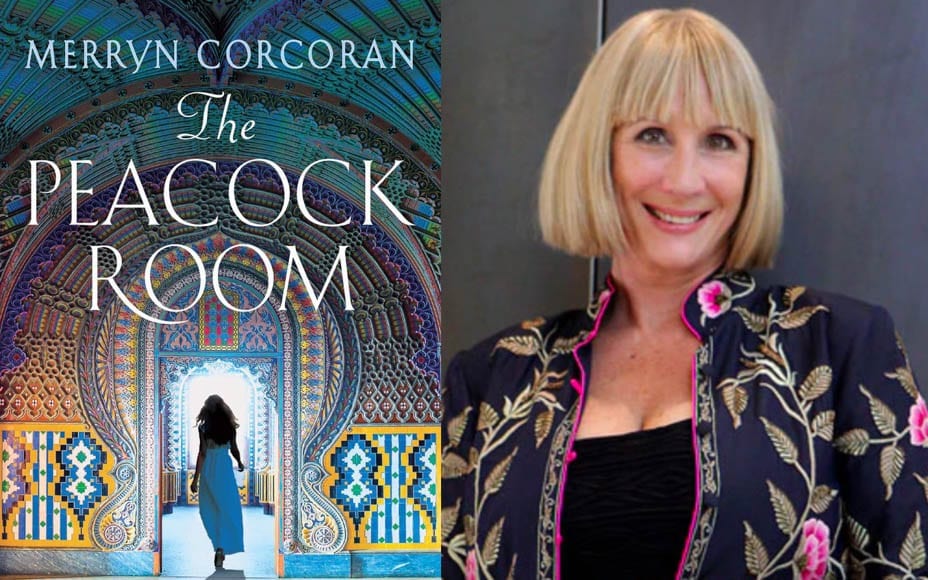
Set in Tuscany, Merryn Corcoran’sThe Peacock Room is set in the Sammezzano Castle that radiates eccentric colours and has a curious history linked to the main character, Allegra’s grandfather. After suffering heartbreak upon discovering the infidelity of her husband Hugo, we follow Allegra from Fulham, London to a dramatic landscape of Chianti wines and hilltop villages of central Italy.
With a setting so beautiful and an Italian romance that all girls have dreamt about – surely more than we would admit to – Corcoran’s The Peacock Room is like sugar in water, you simply dissolve into it.
Allegra O’Brien’s life is nothing short of sumptuous. Living in her beautiful London home with her two children and charming husband Hugo the idea of her life turning upside down was the last thing on her mind. After discovering the two lives her husband had been living, one being the prince in her fairy-tale and the other being the boyfriend of a girl closer in age with her daughter, the infidelity drives her to re-write her own story.
With Allegra’s new found spontaneity and blood still boiling, she finds herself on a plane with her best friend to Tuscany. The setting in this novel is simply enchanting and finding out that the Sammezzano Castle is a true historical landmark makes the fairy-tale even more lifelike; leading to indulgence in each page. Throughout Allegra’s life her mind had been flooded by her beloved grandfathers stories of the whimsical ‘Peacock Room’ in said castle.
Throughout a series of misadventure Allegra finds herself in the exact room her grandfather reminisced upon as well as to a slightly cheesy, but fanciful romance with her newfound Italian lover Massimo. With each sentence sounding like a love poem, and the voice behind it being an Italian accent that could melt your gelato, the spark inside of her heart is relit.
Merryn Corcoran incorporated heartbreak, mystery, loss and love early on in the book making it hard to put down after you’ve picked it up. Throughout the book there are family complications as well as personal growth that will surely pull at your heart strings and might even make you call up a relative you’ve grown distant with. The motherly traits towards our characters two teenage children, as they too deal with the growing pains that life has to throw at them are nothing but admirable. Watching the relationship between mother and daughter blossom even through the toughest of times might even have you shed a tear.
The romantic element of this novel was dreamy, although it left a lingering feeling of ‘this is too good to be true’ in my head. From the over the top charming dialogue to the instant emersion in love and lust between our character and her newfound lover, I couldn’t depict whether it was cheesy or cynical. But Massimo’s unwavering good intentions and pure heart towards Allegra and all of the weight she carried, allowed me to go to sleep believing that true love exists.
All of the elements that this novel held made it very enjoyable to read and very difficult to put down. From the details in colour and structure that will make you day dream, to decades of mystery and the true meaning of family, the fast paced and immersive writing makes for a quick read that will carry you away.
Chelsea apartment for sale for just £140,000; there is, of course, a catch
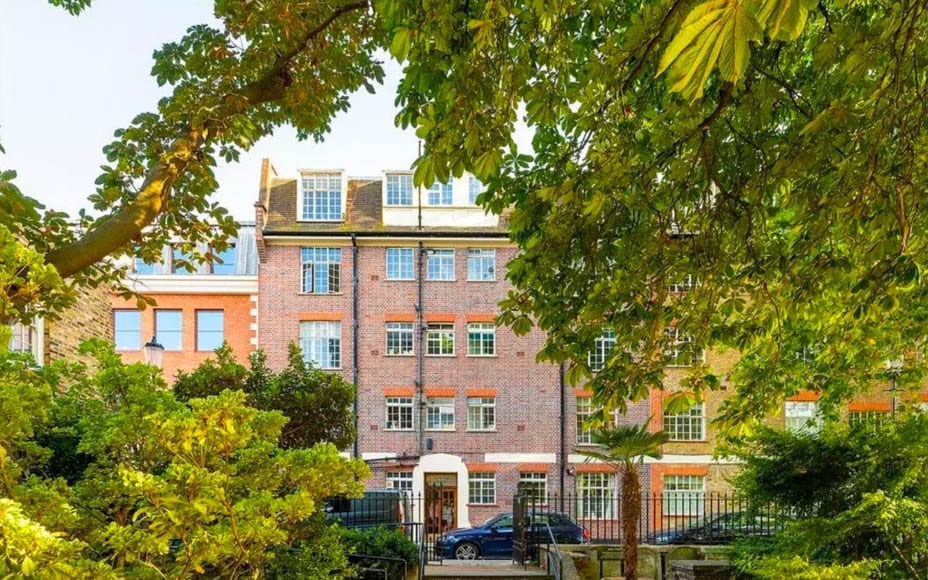
A studio flat has gone on sale in Britten Street, Chelsea, SW3 for just £140,000 ($170,000, €153,000 or درهم625,000).
Offered by agents Douglas & Gordon, the 302 square foot, second floor apartment comprises of a studio room, kitchen and bathroom. It is described as “bright” and “situated in a desirable location.”
The catch? It just has nine years left on the lease, so will cost you the equivalent of £15,555 ($18,900, €17,020 or درهم69,414) per year.
Rare (and noisy) 1990 cabriolet created by a man named Mr Bitter for sale
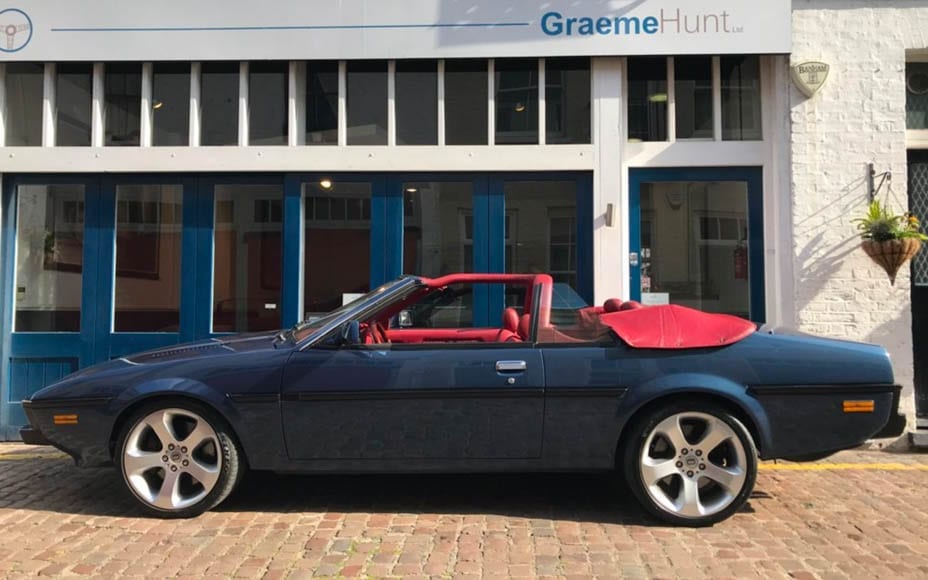
Natty Kensington dealer Graeme Hunt is known for selling the finest cars, but currently he has something extremely rare, a convertible created by the little known firm Bitter.
Founded by a former racing driver named Erich Bitter in Schwelm, Germany in 1971 after he ended his “short, sour and expensive” time importing what his biography describes as “poorly built” Italian cars named Intermeccanica, Bitter’s desire was to create “beautiful fast cars” which “[one could also] get in and drive away.”
In the ensuing years Bitter built over 880 cars, of which just 22 were cabriolets. Now Graeme Hunt is offering the final one built, a 1990 Bitter SC for £77,500 ($94,000, €84,000 or درهم344,000).
Owned from new until 2005 by a “very successful baker” named Mr Pawlak, the original 3.0-litre Opel Monza engine of the car “gave up the ghost” in 2008. It was replaced with a LS2 V8 of 6.0-litre capacity from a Holden Mareno and mated to a 6-speed manual Tremec gearbox.
Having covered 3,500 miles in the time since, Hunt describes the car as “starting on the button, never grumbles in traffic, looks terrific and sounds even better.” He adds: “Everyone loves the look and noise and so many people, even though they don’t what it is, are blown away by how pretty she is.”
Erich Bitter’s company ceased trading in 1997, but continues to collaborate with Opel. His official website reports that a showroom and museum is due to open this year in Rüsselsheim and that a “dedicated restoration company for Bitters and old Opels is under investigation.”
1966 Mercedes-Benz 600 sedan complete with ‘Jimmy Savile-esque’ fold-down bed to be auctioned; it was created for the eccentric Armenian oil magnate Nubar Gulbenkian
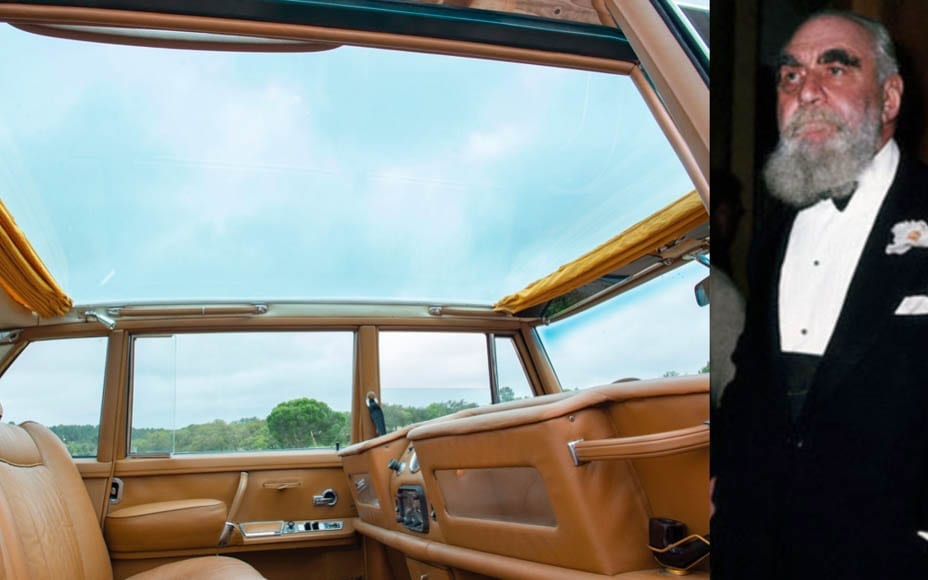
Santa Claus lookalike and all-round extravagant Nubar Gulbenkian (1896 – 1972) – his father sued him over him charging a single sandwich to petty cash and ended up with a legal bill equivalent to £4.7 million in costs in 1938 – was a man who liked, in fact, loved his cars.
London and South of France based Gulbenkian didn’t opt for just any kind of automobile; this thrice married son of “the then world’s richest man” Calouste Gulbenkian (1869 – 1955) – nicknamed ‘Mr Five Per Cent’ due to his policy of retaining 5% of the shares of the oil companies that he developed – insisted on cars that were made to reflect his truly whacky character.
Nubar Gulbenkian was most definitely a bon viveur.He was known for his eccentricity and living the life to the full.The Mercedes-Benz 600 sedan by Henri Chapron that is to be sold in September.
Aside from bizarrely merging Austin taxi cabs with the bodies of horse-drawn Hackney cabs, Ottoman Empire born Gulbenkian personalised his many Rolls-Royces – one of which subsequently used as Uncle Monty’s car in the iconic film Withnail & I – with such things as speedometers in the rear compartment (so he could keep an eye on what speed his driver was motoring at) and snakeskin trimmings.
Bought at a cost of around £75,000 ($91,000, €82,000 or درهم335,000) and with a further £91,000 ($111,000, €100,000 or درهم408,000) supposedly spent on customisation, a 1966 Mercedes-Benz 600 sedan originally delivered new to Nubar Gulbenkian is to be sold at auction in September.
Gulbenkian supposedly initially approached Mercedes-Benz to build him a vehicle with a full glass roof and seats that would convert to a double bed so that he could lay down and look up at the sky. They allegedly refused this request – perhaps sensibly not wanting to have association with a concept that later was used by the paedophile Jimmy Savile in a “live-in” Range Rover in which he abused some of his many victims – so instead the Armenian purchased a standard 600 sedan under a fake name through a French dealer.
With a budget plainly of “no expenses spared,” the Mercedes was sent to the Parisian coachbuilder Henri Chapron for modifications. They included the aforementioned bed and roof and also hand held mirrors (to reflect the owner’s plain vanity), deflector frames of glass to regulate the flow of fresh air and to create minimal turbulence, a minibar and special tobacco pipe holders.
Gulbenkian monitored his driver’s performance from the rear with a speedometer and fuel guage he had fitted to the rear and as a “man obsessed with detail” had the typical wood lining replaced entirely with “sumptuous leather throughout.”
On the magnate’s death in 1972, the 600 was left to the gardener of his house in Cannes. It was shipped to his home in Portugal and left in storage for the next thirty years. Surprisingly, on being moved thereafter, it supposedly needed “only minimal servicing and a cleaning to bring it back to a usable condition.”
Owned subsequently by a Portuguese collector named José Mira since circa 2002 and part of the Sáragga Collection more recently, the 6.3-litre V8 sedan has “never been rolled into a restorer’s workshop” according to a January 2019 Petrolicious article by Robb Pritchard.
RM Sotheby’s will sell the former Nubar Gulbenkian 1966 Mercedes-Benz 600 sedan by Henri Chapron of Paris as part of the Sáragga Collection sale near the beach resort of Comporta in Portugal on the 21st September. They offer the car without reserve, but with an estimate of £274,000 to £365,000 ($333,000 to $444,000, €300,000 to €400,000 or درهم1.2 million to درهم1.6 million).
Of this historic vehicle, the auctioneers conclude: “Every Mercedes-Benz 600 is a special car, but this example is undoubtedly more special than most and warrants serious consideration from any Mercedes-Benz aficionado.”
The legacy of the Gulbenkian family lives on today through the Calouste Gulbenkian Foundation – which was started with a donation of £58 million in 1902 or the equivalent of £7 billion today – and in January this year a fascinating analysis of the life of Calouste Gulbenkian was published also.
“I’ve been retired all my life, but I’ve also been working hard all my life. A fortune does not look after itself, after all.”
Of his schooling:
“At Harrow, I played no games and had an unpronounceable name and quite soon I was recognised as something of an oddity, but I was accepted on my own terms.”
Of his religious beliefs (and his somewhat whacky eyebrows):
“During Lent I brush my eyebrows down. It’s an oriental religious custom that you must show outward signs of your sorrow.”
Of taking England as his home:
“I get along very well with all honest people. England’s a very fine country, but it takes a long time to learn to take the English. I tell all my foreign friends the first forty years are the hardest.”
When asked to state his “position in life” on a market research form, his answer was:
“Enviable.”
Of his view of his own lifestyle:
“I believe in comfort. I enjoy myself. I enjoy life. I enjoy everything I do.”
“If something is too much of a bore to do thoroughly and with zest, then don’t bother to do it at all.”
When asked whether he preferred old brandy or young women, horses or Rolls‐Royces and city life over country life, he answered:
“I prefer everything.”
On money:
“I have all of it I could possibly desire.”
On business:
“My father always said oilmen are like cats. You can never tell whether they are fighting or making love.”
Asked about his hobbies, he invented a word (coined from Greek):
“Pan taraxia… Keeping people on their toes.”
The well-known gourmet on dinner parties:
“The best number for a dinner party is two – myself and a damn good head waiter.”
On food in general:
“Gastronomy is an art as difficult to master as music or painting, and, for me, much more rewarding. I certainly get more pleasure from working out a menu, discussing the pros and cons of each dish with a chef who knows his business than I do from listening to the best of Beethoven’s symphonies.”
“I never eat bad food. If you wander into any restaurant and want something quick, quick in ten minutes, you’ll get a bad meal and bloody well deserve it.”
Of his sartorial style:
“In England a man cannot be seen around horses without his gloves and hat. One never wears a gray bowler unless he is with horses. It wouldn’t do. It would shock people’s feelings.”
Of the only occasions he would not wear the trademark dark blue orchid that he sported daily:
“When I am in France, on board a French ship or airplane, or at a French Embassy. It is the French custom, in France, for those who have been granted the Legion of Honor to wear the insignia of the order in their buttonhole. I feel it only courteous, to show the respect for the country which granted me the honor, to wear mine instead of an orchid.”
Of how he made his orchid dark blue:
“I dip a white orchid into a mixture of Stephen’s Ink and water – I have got the mixture virtually right by now – let it dry, then shake it out gently – and I achieve a very adequate dark blue orchid.”
On suing his father in 1938 after the elder Gulbenkian upbraided him for having charged a meal of chicken in tarragon jelly with asparagus tips costing £1.80 to petty cash:
“That was surely the most expensive chicken in history.”
(The case was subsequently settled out of court, but the father had to pay £70,700 or the equivalent of £4.7 million today in court costs and lawyers’ fees).
Of his friendship with John Paul Getty:
“Have I got only one Rolls-Royce? Oh come now. I’m not so rich as Mr. Getty, but I not so poor as all that! Mr. Getty asks my wife and me down for a meal at his house, Sutton Place, from time to time. There is always plenty to eat and drink, it is all of good quality, but he does not take such an interest in gastronomy as I do. But then, few people do.”
On taking up hunting shortly after turning 65:
“I’m a huntin’ man,” he said. “Say ‘huntin’ man,’ not ‘hunter.’ A hunter is a horse, not a gentleman. ‘Fancy Nubar Gulbenkian dressing that way,’ they’d say. ‘He should know better.”
On golf:
“It is more satisfying to be a bad player at golf. The worse you play, the better you remember the occasional good shot.”
On owning two remodeled Austin FX4 taxi cabs merged with the rear parts of horse-drawn Hackney carriages:
“I like to travel in a gold‐plated taxi that can turn on a sixpence – whatever that is!”
“I wanted my taxi dolled-up, more comfortable inside and more distinguished outside, without losing its mobility. People recognise it. After a party or an opening they come and tell me where it is and I don’t have to wait.”
On marriage in general:
“I’ve had good wives, as wives go, and as wives go, two of them went.”
Of his second wife, Dora Freeland (married 1928), he stated:
“I certainly cannot blame Doré for our marriage breaking down. It was entirely my fault that it failed. Being younger and more virile than I am now, I succumbed to other charms.”
His third wife, Marie Berthe Edmée de Ayala (married 1948), on their union:
“Of course, he’s a very difficult man to live with, but it’s worthwhile. Don’t you think that all the most amusing, intelligent men would be difficult to live with? Heaven forbid that I should have married a mollusk.”
When a friend from his Cambridge University days, George Ansley, was asked about Gulbenkian, he answered:
“Nubar is so tough that every day he tires out three stockbrokers, three horses and three women.”
The roof of the car is truly unique (right image from Petrolicious.com) and features two blinds also.Another view of the glass roof.The driver’s compartment.The passenger seats (that turn into a double bed).Gulbenkian was able to monitor his driver’s performance on these instruments.He also had special storage fittings for his pipes.Further details include artwork and vanity mirrors within the doors (Images from Petrolicious.com).The engine.The car was customised by Henri Chapron of Paris.Gulbenkian possessed many other personalised vehicles.Two further examples from his collection.The car to be sold pictured in Portugual earlier this year (Image from Petrolicious.com).
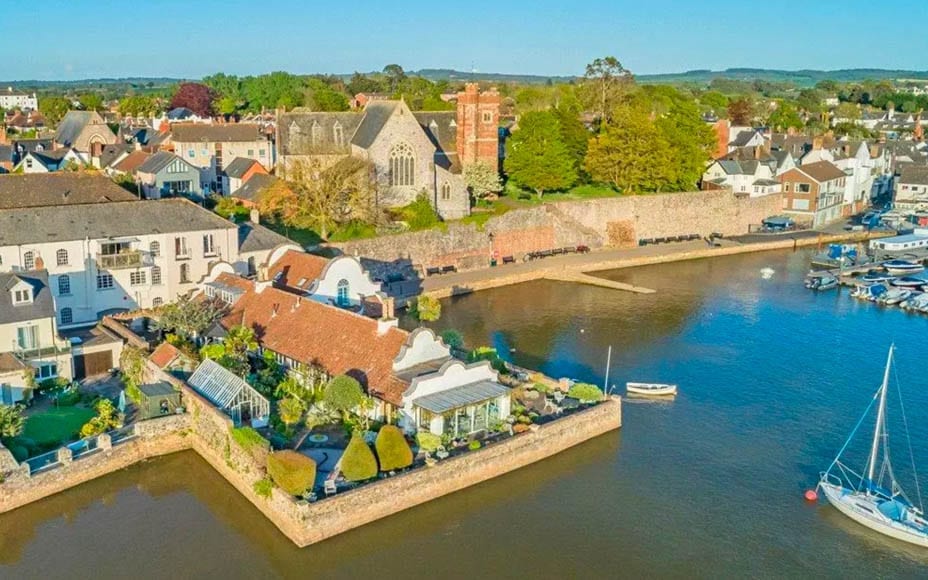
Stunning converted sail loft and “local landmark” in “the best position” in Topsham, Devon for sale for £3.5 million
A Grade II listed 18th century sail loft and nail factory in Topsham, Devon converted to a 4,231 square foot house in 1920 has recently been put up for sale.
Wixels, situated on the banks of the River Exe and surrounded on three sides by water, is situated in a town that was a major ship building centre between 1750 and 1780 and is now a popular holiday destination.
Featuring Dutch gabling and wrought ironwork, this 5 bedroom, 4 bathroom detached marine residence includes a room known as ‘The Cabin’ complete with a clinker built boat supported in the ceiling. It also has off-street parking for two vehicles, an integral garage, an artist’s studio, a conservatory and a garden packed to the rafters with “exotic specimens.”
Owned previously by the publisher Richard Webb, Wixels, was bought by architect Triff Lambert and his wife Mary in 1993 as their retirement home. Following Mr Lambert’s death, the house is now being offered by Knight Frank at a price of £3.5 million ($4.3 million, €3.9 million or درهم15.9 million).
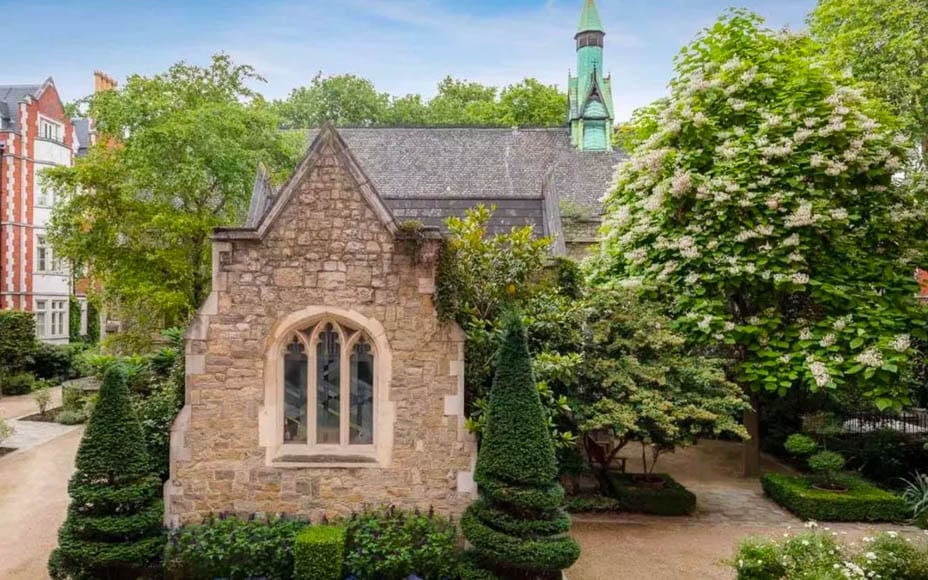
Derelict Grade II* listed Gothic revival chapel in South Kensington for sale for the extraordinary sum of £7.5 million; it cost just £1,613 to build
The purchaser of a home that will be created from a derelict chapel hidden in South Kensington will not only have to find some £7.5 million to buy it, but also will have to fork out £500,000 to relocate the existing pews and organ to a church in Hammersmith.
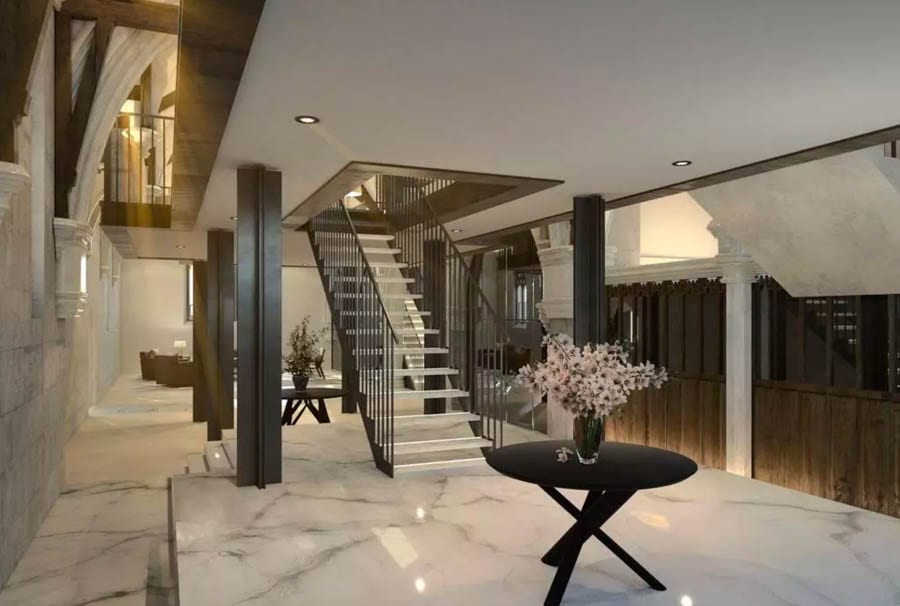
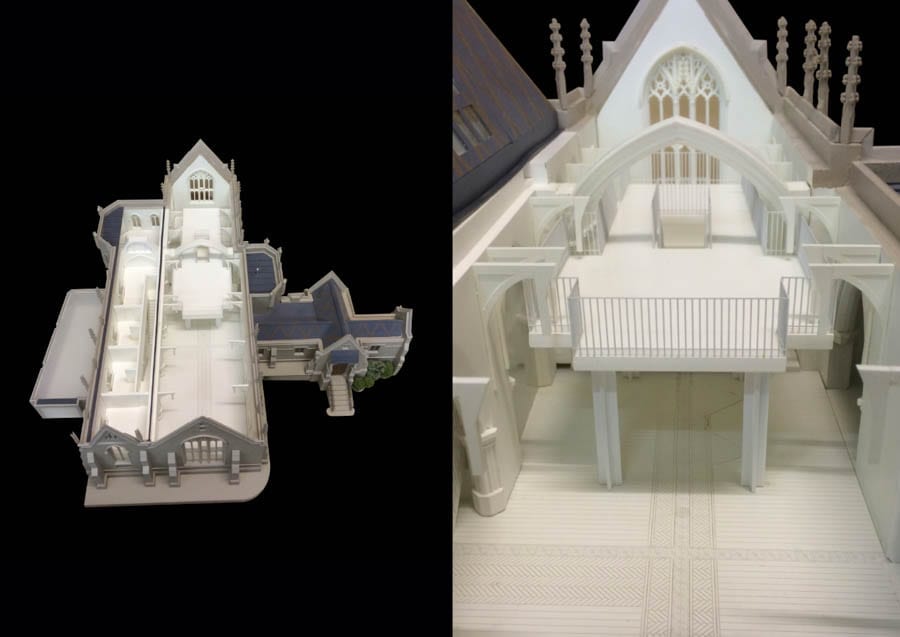
With plans in place to increase the former St Luke’s Chapel in the grounds of The Bromptons development off Fulham Road in size from 4,257 square foot to 7,330 square foot and a development team selected, agents Russell Simpson describe what could be created as “an opportunity to build a home with unique character and a bright and spacious interior.” The detached house that will result will have 82 new roof lights and as well as a vaulted living room with a library above, snug, conservatory, kitchen and 4 bedroom suites, “consideration has been given to this property as an exceptional space for an art lover with an incredible backdrop for pieces.”
The resulting residence will be subject to an annual service charge of £70,500 and will come with two secure underground car parking spaces and access to all the facilities of The Bromptons. They include 24-hour concierge service, an indoor swimming pool complex and manicured gardens. Access to Onslow Gardens to the rear may also be available but is not guaranteed.
Justifying their expected value of “in excess of £25 million when complete,” the sellers – back in 2017 – cited how house prices in the Royal Borough had “risen 90% in the past 10 years” and claimed “growth in the London market [is] expected to return in 2019… despite recent Brexit uncertainty.” Given prices in the Royal Borough have declined 10% in the last year, how wrong they plainly were. No doubt they’ll now be praying to God for a miracle.
St Luke’s Chapel, Rose Square, The Bromptons, South Kensington, London, SW3 6RS – The Numbers
Estimated value on completion (in 2017) – “In excess of £25 million” ($31.3 million, €27.9 million or درهم114.8 million) according to the selling agent. Equivalent to £3,411 per square foot ($4,265, €3,801 or درهم15,662 per square foot).
July 2019 – ‘All in’ guide for development costs estimated at £5.195 million ($6.495 million, €5.788 million or درهم23.854 million).
July 2019 – Relaunched at £7.5 million ($9.4 million, €8.4 million or درهم34.4 million) by Russell Simpson and Strutt & Parker on a 999 year lease with the freehold being available on completion of the project.
2017 – Initially offered for £9.5 million ($11.9 million, €10.6 million or درهم43.6 million).
1849 – 1850 – Built by Hopkins and Roberts of Islington at a cost of £1,613 or the equivalent of £201,000 ($251,000, €223,000 or درهم921,000).
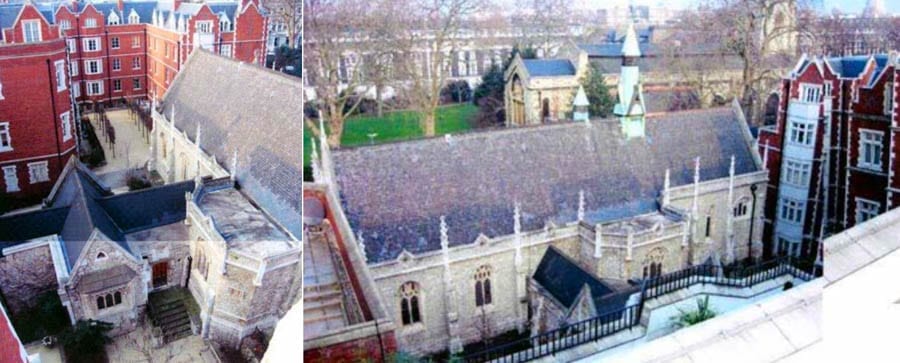
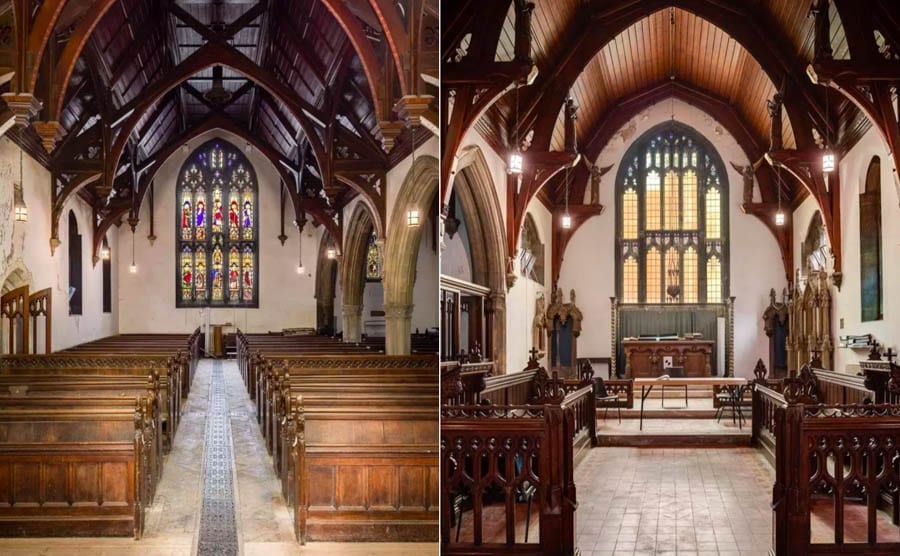
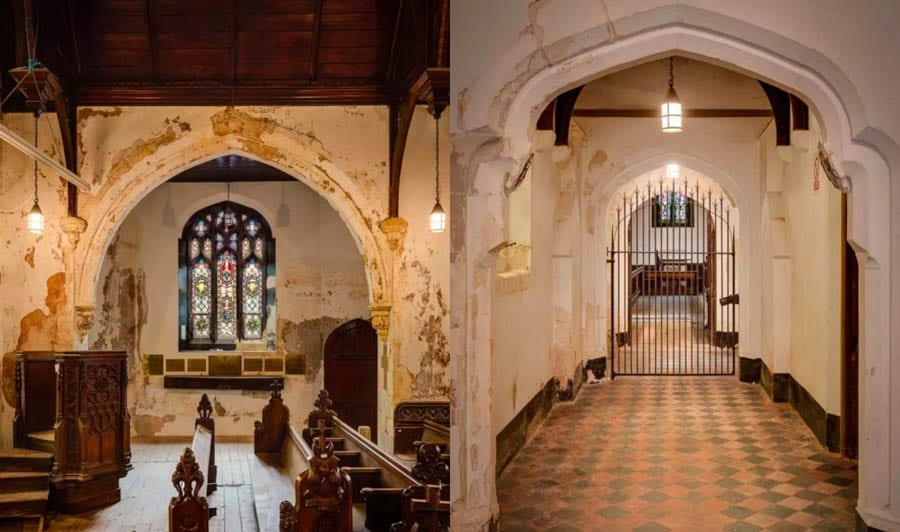
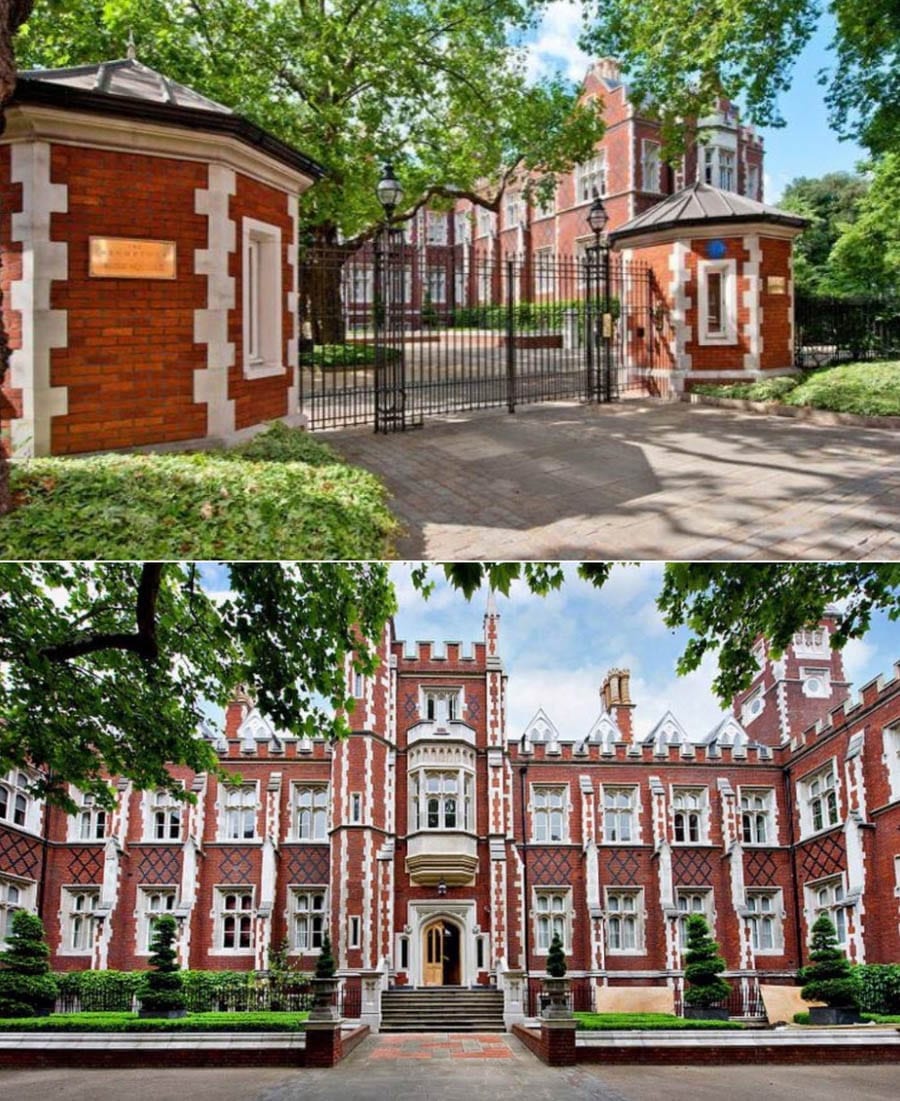
Architect Edward Buxton Lamb (1806 – 1869) was labelled a ‘Rogue Gothic Revivalist’ during his lifetime and was later described by Nikolaus Pevsner as: “The most original though certainly not the most accomplished architect of his day.” He designed St Luke’s Chapel (pictured above in 2005) at the Royal Brompton Hospital and it was built between 1849 and 1850 at a cost of £1,613. The building was subsequently extended and altered in 1891 by another architect, William White (1825 – 1900) . St Luke’s Chapel has been empty since 1991 and has been described as having “experienced a great deal of deterioration” in the time since.The interior of the chapel (as is)Other views show the deterioration of the buildingThe chapel is situated within The Bromptons development (also known as Rose Square)A rendering of the proposed redvelopment into a single family residence The proposed design for a staircase in the buildingThe proposed floor plan at ground levelThe proposed floor plan at first floor levelA 3D model of the proposed redevelopment
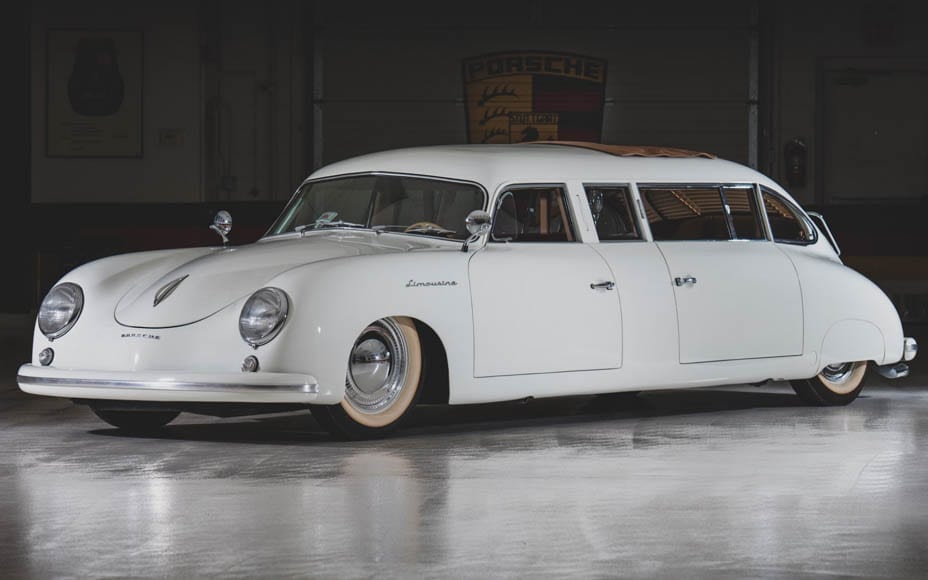
Presented in white with a camel brown leather interior, the “quirky” car – described as displaying its rather plainly named late owner John Dixon’s “sense of humour” by the Robb Report – has no reserve but does come with a guide of £120,000 to £200,000 ($150,000 to $250,000, €134,000 to €223,000 or درهم551,000 to درهم918,000). Amazingly, it has just 112 miles on its clock.
Built from a 356 Pre-A coupé by Don Boeke of Egyptian Custom Body in Dayton, Ohio at the behest of Dixon himself for his daughter’s wedding, the limousine features an air-suspension system and an engine from a Porsche 912. The passenger compartment has space for two occupants and a large rear section for luggage and there is even a thermometer that displays both indoor and outdoor temperature readings on the divider.
RM Sotheby’s will sell the Porsche limousine alongside 30 other motor cars and 350 lots of Porsche related memorabilia and collectibles on the 27th September in Dayton, Ohio in the Taj Ma Garaj building. Limousine lovers will no doubt be queuing round the block.
The Steeple Times selects the highlights of Masterpiece 2019
Eighty-one of the finest items of James Bond memorabilia
£2.5 million ($3.2 million, €2.8 million or درهم11.6 million)
Fulham Road based Peter Harrington offer the ultimate collection for a wealthy James Bond fan. To be sold only as a single lot, it includes every lifetime edition of the books signed by Ian Fleming along with manuscripts, pre-publication proofs, advance copies and related correspondence and ephemera. Amongst them is one dedicated to Sir Winston Churchill. In it, he makes reference to the victorious wartime Prime Minister’s Thoughts and Adventures and states: “To Sir Winston Churchill, From whom I stole some words.”
Climb Out (1964)
£330,000 ($416,000, €368,000 or درهم1.5 million)
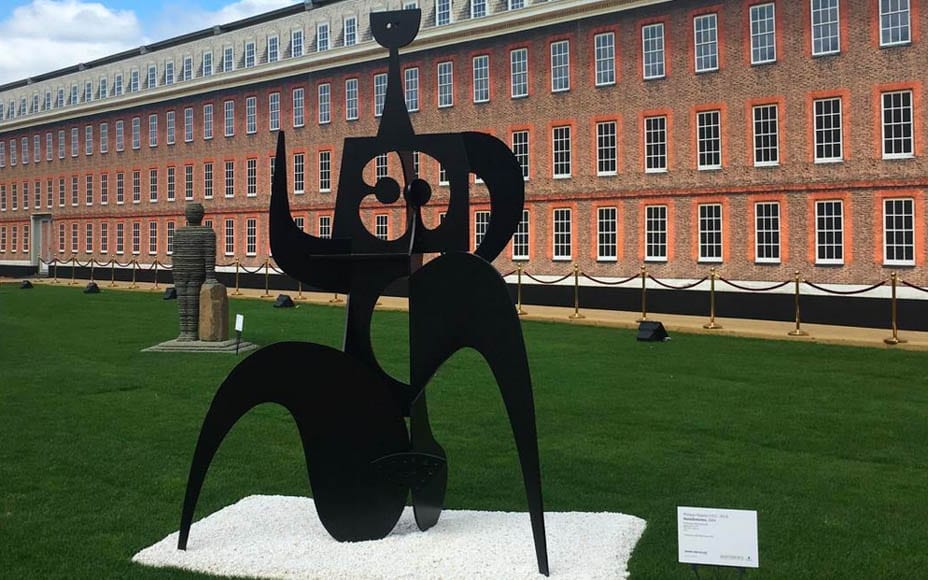
Steven Beale, Simon Mills and their colleagues at Trinity House are undoubtedly amongst the most welcoming of dealers at Masterpiece. With galleries in London, the Cotswolds and America, they offer an array of artworks and this year’s delights include an oil, polystyrene and wood on canvas work painted as part of his ‘Glider Series’ by Peter Lanyon (1918 – 1964) just before he died in a gliding accident. Of the work, Mills comments: “This Cornish artist’s prices have been increasing for some time with one work making over £1m last year.” Of why he took to the sky, Lanyon once remarked: “To get a more complete knowledge of the landscape.”
An interlocking, overlapping limestone circle sculpture
Offered for £30,000 ($38,000, €33,000 or درهم139,000) and now sold
Crane Kalman – best known for being the leading dealer of Lowry – sold this stunning sculpture by greengrocer turned artist Tom Stogdon on the first day of the fair. With this naturalistic work destined for a Gloucestershire garden, the artist remarks: “I often wonder how life would have been if I had gone to art school instead of the market but always arrive at the same conclusion… Who really knows? … I am striving to create my own individual language with the way I use material and in particular stone.”
Road on the Moors – Gloucester (1919)
Price on application
Each year New York based Collisart, LLC’s stand is filled with fascinating examples of 19th and 20th century American art and this year is no exception. Continuing with another work connected to the Cotswolds, this bold oil on canvas is titled ‘Road on the Moors – Gloucester’ by Stuart Davis (1892 – 1964). It certainly reflects this American modernist painter’s positivity and optimism and has been exhibited at the Metropolitan Museum of Art and the Koriyama City Museum of Art.
Models in Windows (1960)
£44,000 ($55,000, €48,000 or درهم202,000)
Santa Monica photography dealer Peter Fetterman Gallery brings vibrancy to the fair with an image of 43 women standing in the windows and on the sidewalk of an about to be demolished (the next day) New York brownstone. Shot only after photographer Ormond Gigli agreed for the demolition supervisor’s wife to be included (she is on the third floor, third from left), it is described as representing a “rhythmic composition of colour and form” and a “slice in time.”
Masterpiece is held in the South Grounds of The Royal Hospital Chelsea, London. The fair closes today, Wednesday 3rd July, at 9pm.
Five highly unusual items for sale currently including one that might be suitable as a gift for wannabe PM and one-time cocaine experimenter Michael Gove
William IV Sterling Silver Novelty Cocaine Powder Tower and Scoop
Price: £2,735 ($3,470, €3,070 or درهم12,750)
Given his admission about what he’s previously put up his nose, this sterling silver novelty cocaine powder tower and scoop could be the perfect thing for Michael Gove’s desk. Hallmarked by royal silversmith Benjamin Smith, London, 1833, the pyramidal obelisk with brickwork decoration is 10.8cm tall and is offered by Daniel Cotton. He can be contacted at [email protected] or on +44 (0) 776 887 6825.
The Gold Open-Face Pocket Watch Of Edgar Allen Poe
Estimate: £63,000 to £95,000 ($80,000 to $120,000, €71,000 to €106,000 or درهم294,000 to درهم441,000)
Described as a “poignant symbol his fleeting commercial success in the face of nearly lifelong debt” by auctionners Christie’s, this French 18k gold pocket watch features an engraved inscription Edgar A. Poe. Given clocks, watches and time in general were recurring themes in his work and that he had to give it towards settling his debts in 1842, this literary artifact will no doubt appeal to collectors. It will be sold on the 12th June in New York.
1948 Healey Woodie Estate by Dibbins of Southampton
Price: £125,000 ($159,000, €140,000 or درهم583,000)
One of just two surviving examples of only seventeen ever built, this British racing green and wood clad shooting brake has just 5,000 miles on the clock. The 2-litre manual, petrol car is described as having been subjected to a full restoration after being found in a “very poor state” in Scotland and now “drives like a dream.” It is being sold by Classic Mobilia of Milton Keynes.
1973 Land Rover Range Rover Suffix B Convertible by Special Vehicle Conversions
Price: £29,550 ($37,500, €33,200 or درهم138,000)
Also for sale through Classic Mobilia currently is a Range Rover that was converted to a convertible in the 1980s. Won by its current owner in a game of cards in the 1990s, the 3.5-litre vehicle was then put into storage and forgotten about until 2014. Subsequently reconditioned, the rioja red manual vehicle has covered 62,200 miles and is described as being something that would be “at home on a grouse moor.”
Chinese Quing Dynasty Rock-Crystal Deer Formerly Owned By Coco Chanel
Estimate: £1,800 to £2,700 ($2,300 to $3,400, €2,000 to €3,000 or درهم8,300 to درهم12,500)
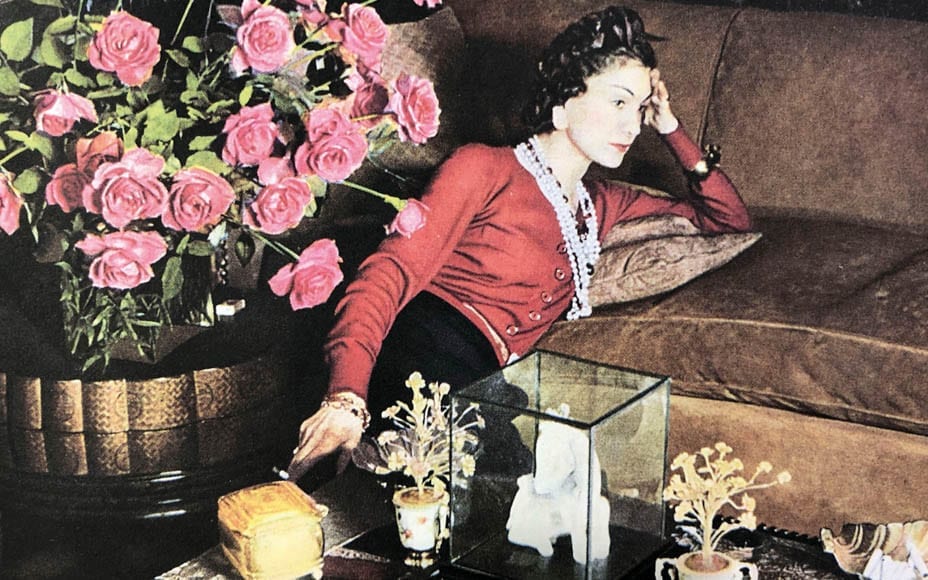
This rock-crystal deer, sculpted in China during the Quing dynasty (1644 – 1911), adorned Coco Chanel’s coffee table and her mantlepiece during her time living at the Ritz in Paris (our main image shows her pictured with it). It is described by Christie’s Chinese ceramics and works of art specialist Camille de Foresta as having “tremendous appeal to lovers of Asian art as well as devoted admirers of Coco Chanel.” It will be sold in Paris on 12th June.