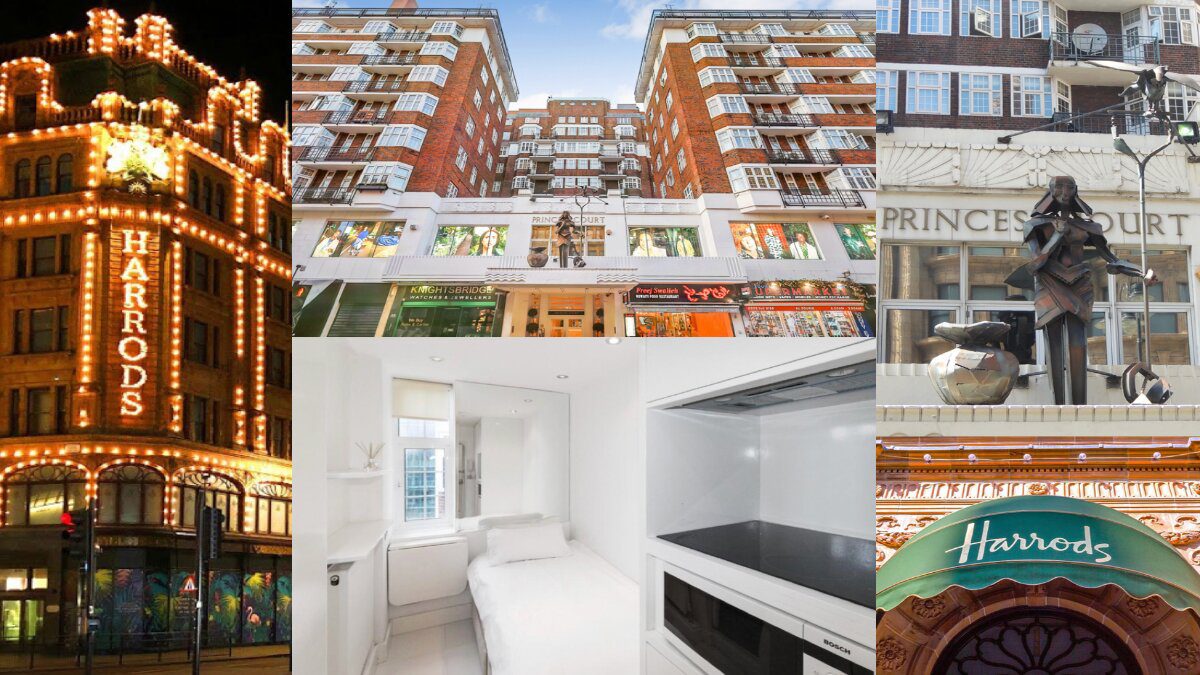
Tiny, overpriced studio ‘flatlet’ lacking room to even swing a cat in somewhat ‘shady’ building opposite Harrods in Knightsbridge unsurprisingly remains on sale for the not so tiny sum of £250,000 after 3 years on the market reports Matthew Steeples
Prison cell-like 109 square foot ‘flatlet’ in Brompton Road, Knightsbridge for sale for staggering £250,000; national minimum allowable size for a flat since 2011 is 398 square foot.
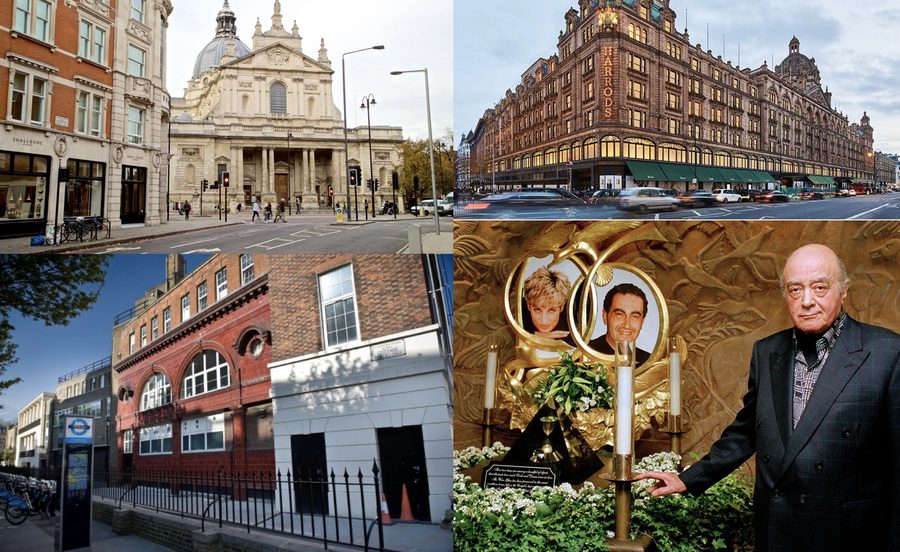
Brompton Road is one of London’s most polluted roads; the Brompton Oratory, one of the highway’s main landmarks, was used as a ‘dead letter drop box’ by Soviet spies during the Cold War.
Nearby now defunct Brompton Road London Underground station became the control centre for the 26th(London) Anti-Aircraft Brigade during the Second World War.
Ritzy department store Harrods, directly opposite, stands on a 5 acre site and was sold to the Qatar Investment Authority for £1.5 billion by alleged abuser of 200 women Mohamed Al-Fayed in 2010.
Listed initially at £275,000 in December 2022 but now slashed to a still stupendous £250,000 after failing to get flogged, Grow Portfolio estate agents are hawking a minute and clearly overpriced 109 square foot studio flat in Brompton Road, Knightsbridge as a “fantastic base” and “excellent opportunity”. If the ask price were to be achieved, the vendor would earn themselves a very punchy return of £2,294 per square foot; the median average price for this part of London, SW3 has been a significantly lower £1,610 per square foot during 2025.
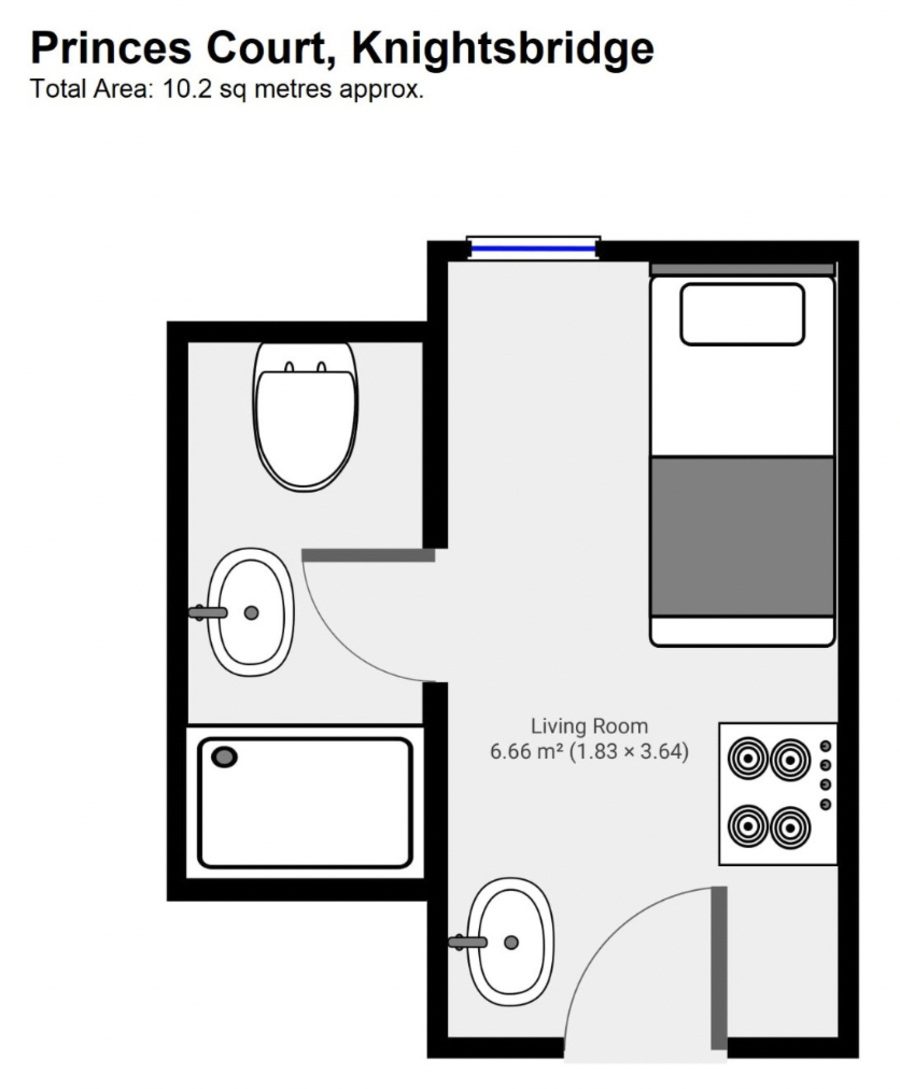
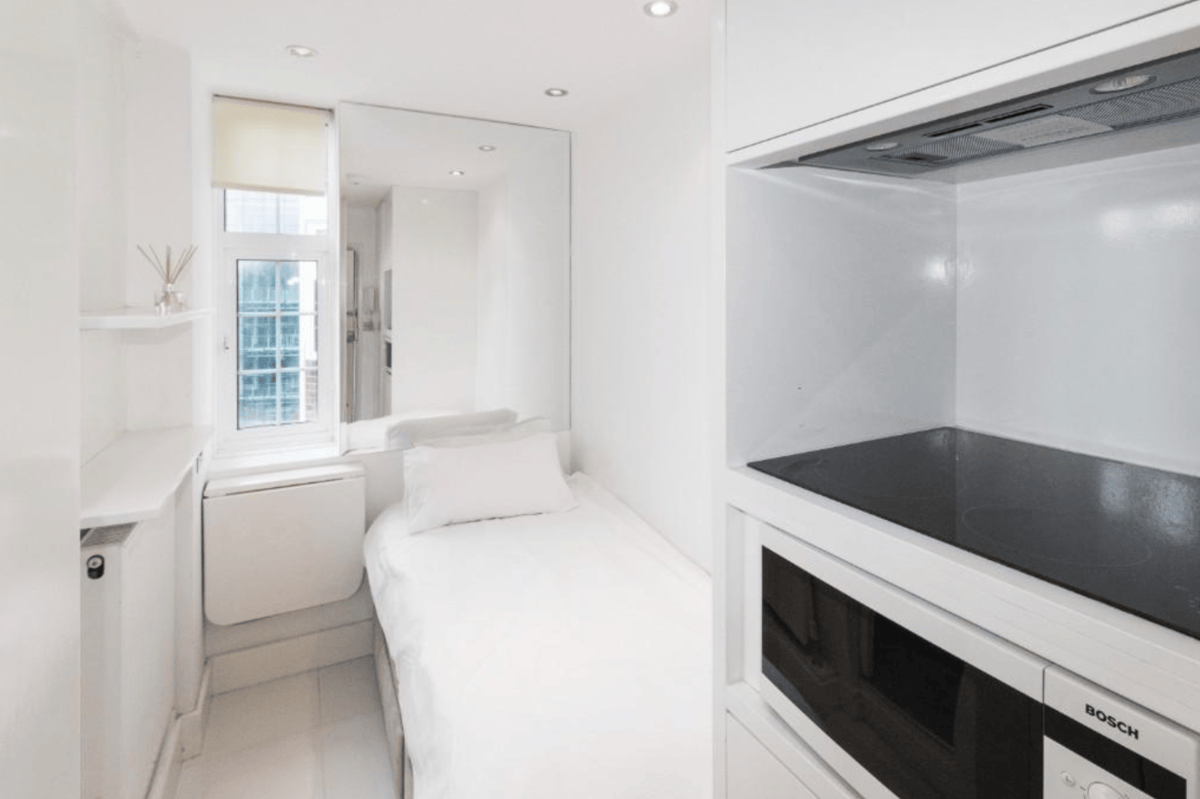
Offered on a lease of approximately 169 years and having a service charge of “approximately’ £1,000 per annum to include the assistance of a 24-hour concierge, a buyer will garner themselves a single room measuring 6 feet by 11’9” feet with a small adjoining shower room also. The 70 square foot room itself has tiled flooring, a window, a cupboard housing a microwave and cooking hob and a minute fold-down table also. There’s frankly nowt much else to say about it further than in November, the Evening Standard lauded its décor for being a “clinical white” achromatic scheme.
A floor plan shows the very limited scope of the accommodation offered. Tax dodging tennis legend Boris Becker produced a son after a ‘bonk’ in a broom cupboard at the Metropolitan Hotel; given his size now, he might struggle with such activity in this space today.It’s rare that a property can be entirely shown with just a single photo; in this case, it most definitely can.In this watercolour by Cyril Farey (1888 – 1954), which Manning Fine Art describe as “capturing Princes Court at its prime”, the golden era of a building is shown. The art dealers observe: “[This] is not merely an architectural drawing it is expressing a lifestyle that only an apartment in Princes Court can provide. As such the fashionable and modern apartment block is surrounded by a Mediterranean blue sky and Hyde Park peaks out from the sides as an Eden of lush green. The smart street is punctuated by smart, friendly, yellow awnings whilst classic, stylish cars and iconic London buses pass by.” The same cannot sadly be said of the setting today given this part of Brompton Road has become better known for housing hookers, Rolex robberies and chronic pollution.
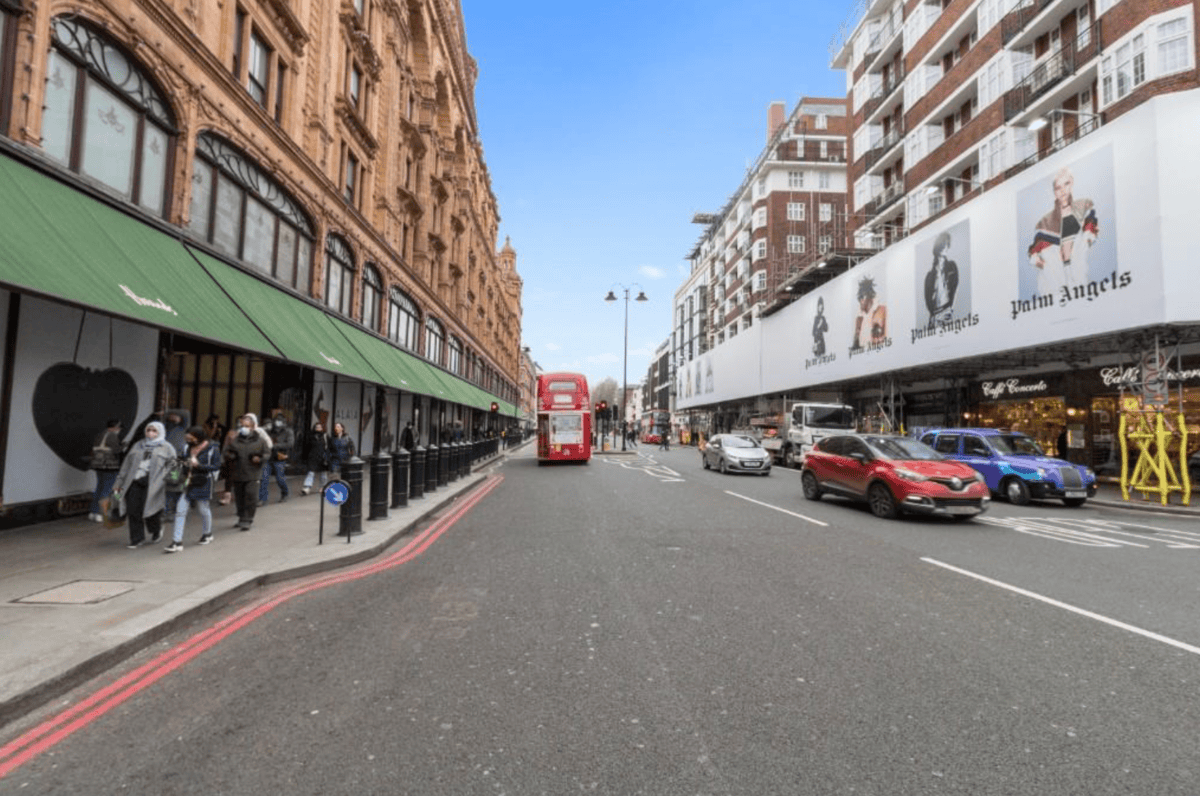
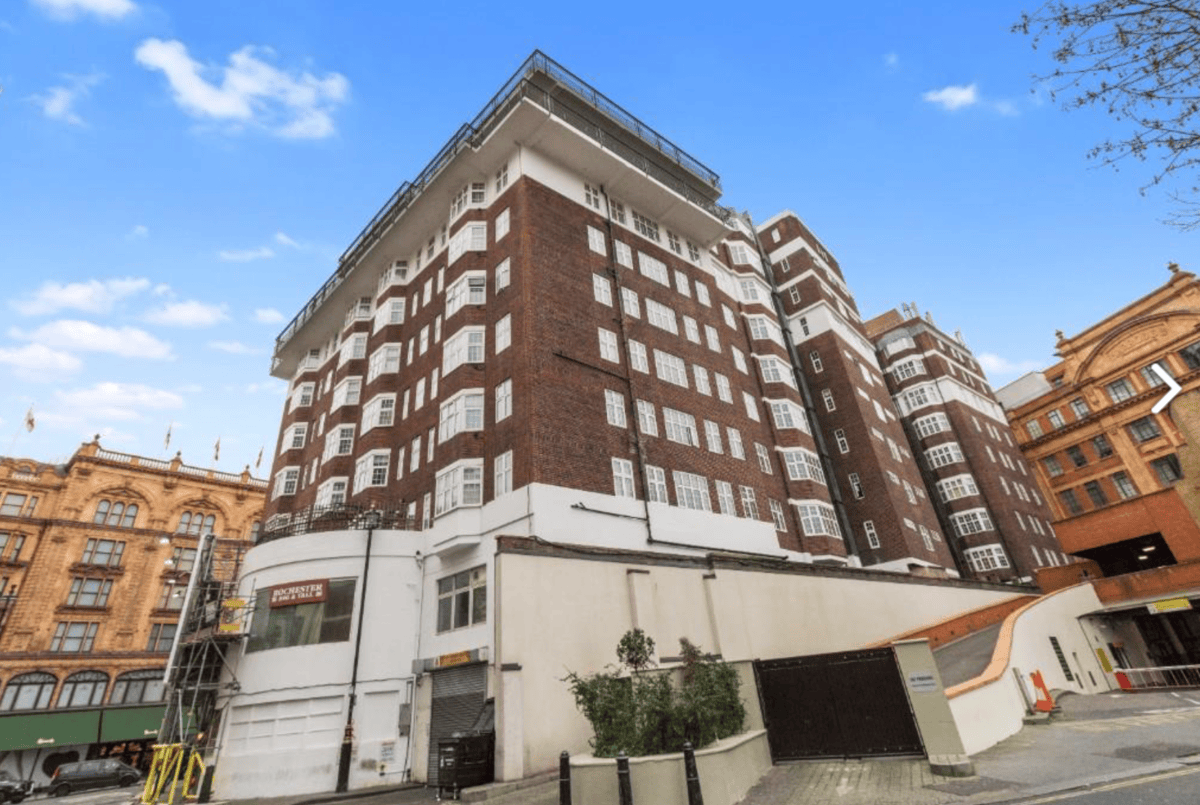
Designed to “resemble an ocean liner” by architect George Valentine Myer (1883 – 1959) between 1934 and 1935, the building in which the studio flat is to be found, Princes Court at 88 Brompton Road, SW3 1ES, was originally named Knight’s Court. This large steel-framed block of 94 flats with 9 retail premises on the ground and first floors directly opposite Harrods began life as “a popular and exclusive place to live”, but in recent years has become more commonly used for Airbnbs and by ‘ladies (and gents) of a certain profession of the night’.
Of the apartment complex, a past resident complained to The Steeple Times: “I did not live there long as I could not even open the windows in the summer due to the pollution and traffic noise from supercars revving in the summer on the Brompton Road. The ‘bedroom banging activity’ from my clearly-a-hooker neighbour did not help me sleep at night either.”
No-longer-so-ritzy Princes Court previously hit the headlines in 2012 when an 84 square foot studio flat went on sale for £89,950, in 2021 when a 128 square foot offering sold for £325,000 and in 2022 when an 88 square foot studio – in spite of lacking even a lavatory and without any kind kitchen – was auctioned with a guide price of £175,000. A two bedroomed flat extending to 877 square feet on the ninth floor of the building is currently being touted by Harrods Estates at a guide price of £1.3 million.
Given the spoof website supporting the homeless charity Shelter that is the National Institute of Feline Orbital Studies (NIFOS) calculates that 78.54 square foot is required to swing an ‘average’ cat and that it would cost £158,180 to “buy enough space to swing a cat in SW3”, the 109 square foot flat offered by Grow Portfolio has not only not enough room to swing a cat, but would not even adhere to the government’s technical housing standards if it were a new build property. The minimum today required to meet regulations is 398 square foot, meaning that this poxy pad falls 72% short of that sum; these regulations do not apply to buildings constructed prior to 2011.
Fair warning to whoever purchases this ‘flatlet’ suitable only for someone seriously slim: In February 1988, an actual broom cupboard measuring 5’6” feet by 11 feet “with not even a cooker” in Princes Court sold for £36,500 (the equivalent of £102,500 today) during what Pete May termed an “obscene property boom” in his 2012 book Rent Boy. The self-professed “punk-turned-journalist who spent 20 years falling off the property ladder’ added: “Even I wouldn’t live in that. Yet it was recommended as a purchase for ‘those who like eating out’.”
Within months of the cupboard sale, the economy tanked and studio flats, given their limited appeal, were the very first properties to see their values plummet. In 2025, with Rachel Reeves ‘Queen of Thieves’ having her grubby mitts on the nation’s tiller, this is probably not the time to be shelling out £250,000 for what the “honest estate agent” and Brothel in Pimlico author Roy Brooks would have likely marketed as a ‘broom cupboard in a brothel building in Knightsbridge’. At this time, perhaps, ‘buyer best beware’ would better be borrowed.
Curious facts about Brompton Road
The area of ‘Brompton’ dates to the 15th century and originates from the name ‘Brokendon’ – meaning “a place near a brook”.
The road itself starts at Knightsbridge Underground station and ends at the crossroad intersection known as ‘Brompton Cross’ where Fulham Road begins. It is thought to have ‘officially’ first been designated as ‘Brompton Road’ in 1863 on land originally owned by the Moreaus, a wealthy French Huguenot family.
Brompton Road is one of London’s most polluted highways due to heavy traffic, especially from diesel vehicles. In 2013, the London Assembly claimed pedestrians were being “showered in dangerous airborne particles” on this road identified as having NO2 levels massively exceeding World Health Organization guidelines.
Between 1906 and 1934, passengers on the Piccadilly London Underground line were able to alight at Brompton Road tube station. It was closed due to being surprisingly little used, but served as the command centre of the 26th (London) Anti-Aircraft Brigade during the Second World War. During this period, the tunnels, subways and lift-shafts were adapted to provide bomb-proof accommodation and in 2014, the site was sold to Dmytro Firtash, a billionaire Ukrainian businessman for £53 million. His plans to convert the 28,000 square foot site into residential accommodation have still not come to fruition.
The best-known retail landmark on Brompton Road is Harrods department store. It stands on a site that covers an astounding 5 acres in total and includes 1.1 million square feet of retailing space.
Famous customers of the store, which first opened in its present form in 1894, have included Agatha Christie, Beatrix Potter, Oscar Wilde and Asma al-Assad, the wife of the former President of Syria. She used an alias to shop there in order to get around European Union sanctions that froze the assets of her and her husband.
In 1898, Harrods debuted Britain’s first ‘moving staircase’ (or what we now term an ‘escalator’). At the top, “nervous” customers were offered brandy to revive them from the “ordeal” of their ride, The Drapers’ Record reported at the time.
Harrods was bombed by the IRA in 1983 and 1993. The first attack killed 6 people and the second injured 4.
The store was bought by the now late alleged serial sex offender Mohamed Al-Fayed in 1985. The ‘Phony Pharaoh’, as the Egyptian was nicknamed, is said to have abused at least 200 women on the premises during his ownership. He sold the business to the Qatar Investment Authority for an astounding £1.5 billion in 2010 and died in 2023 without ever having been brought to justice.
In 2022, Apple opened a store on the road in what was once the Brompton Arcade. It is staffed by over 200 employees, or as the tech giant prefers to call them – team members.
Another major landmark, and a building like Harrods complete with a dome, is the Church of the Immaculate Heart of Mary. This Catholic parish church is better known as the Brompton Oratory and also referenced as the London Oratory.
Consecrated in 1884, the church was where ‘Master of Suspense’ Sir Alfred Hitchcock married Alma Reville in 1933 and it is said to have inspired Nick Cave to write the song Brompton Oratory in 1997.
During the Cold War, this ornately decorated church was used as a ‘dead letter drop’ (or ‘DLD’ to those in the know) by Soviet agents in Britain. Spies would visit the church and place documents and microfilm behind one of the pillars for later collection by their compatriots; the location suited given the building’s proximity to the Russian embassy and as Harrods was a suitable rabbit warren for losing a tail if they thought they were being followed.
Standing behind the Brompton Oratory and accessed from Brompton Road is Holy Trinity Church, Brompton. ‘HTB Brompton’, as it is now generally referenced, stands on a site of 3.5 acres and is now one of the primary sites for the teaching of the Alpha course programme that focuses on “the evangelization of the nations, the revitalization of the church and the transformation of society.’
Further photographs of the £250,000 Princes Court flatlet
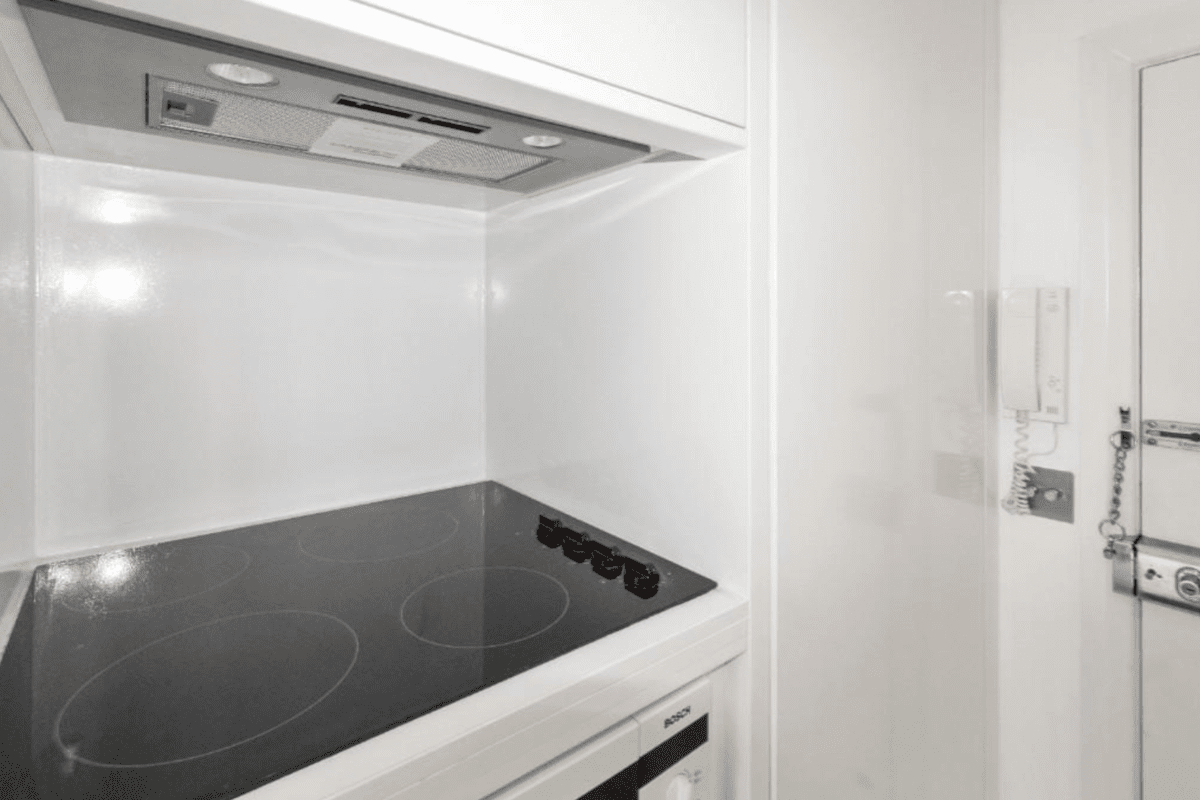
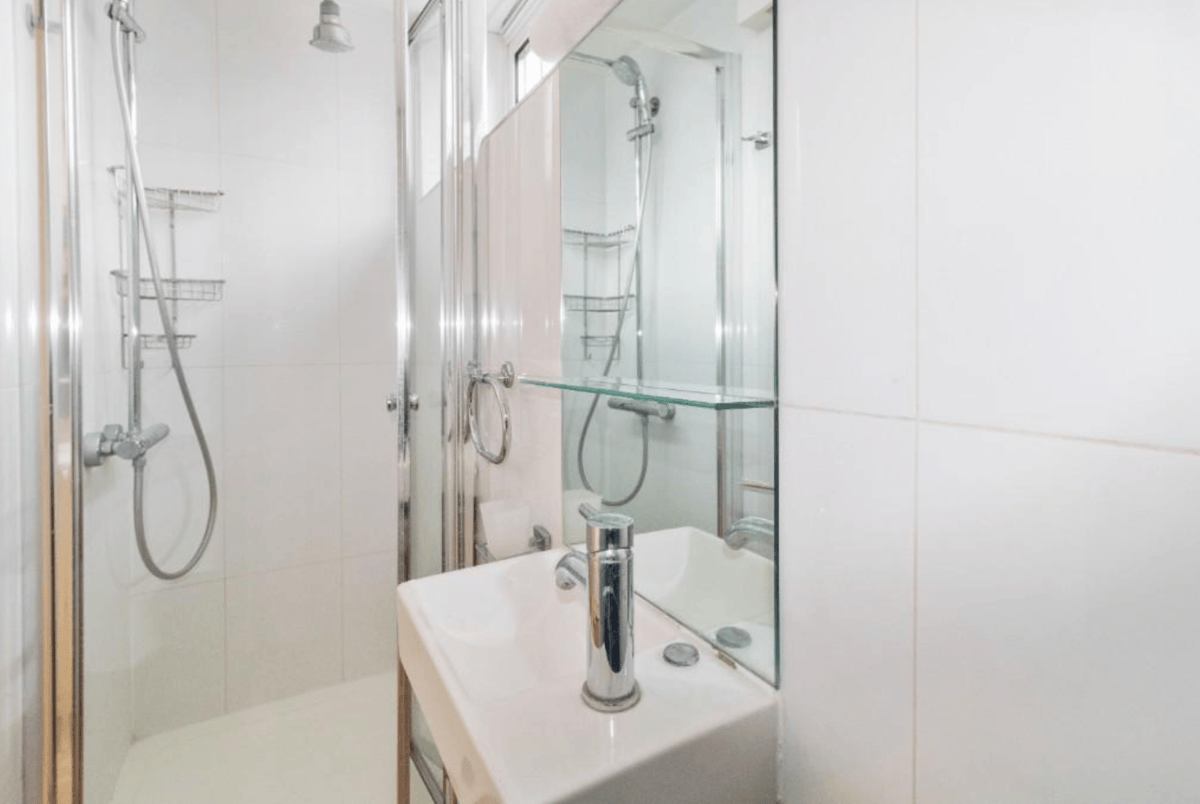
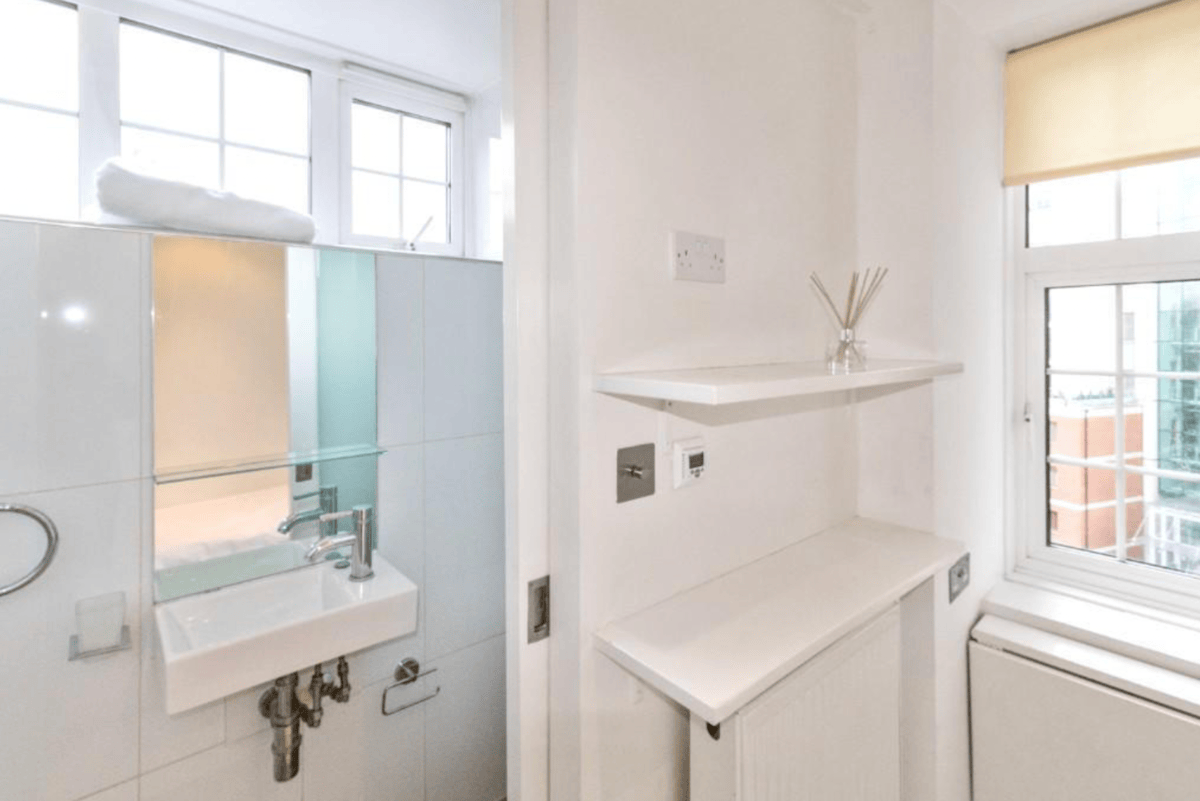
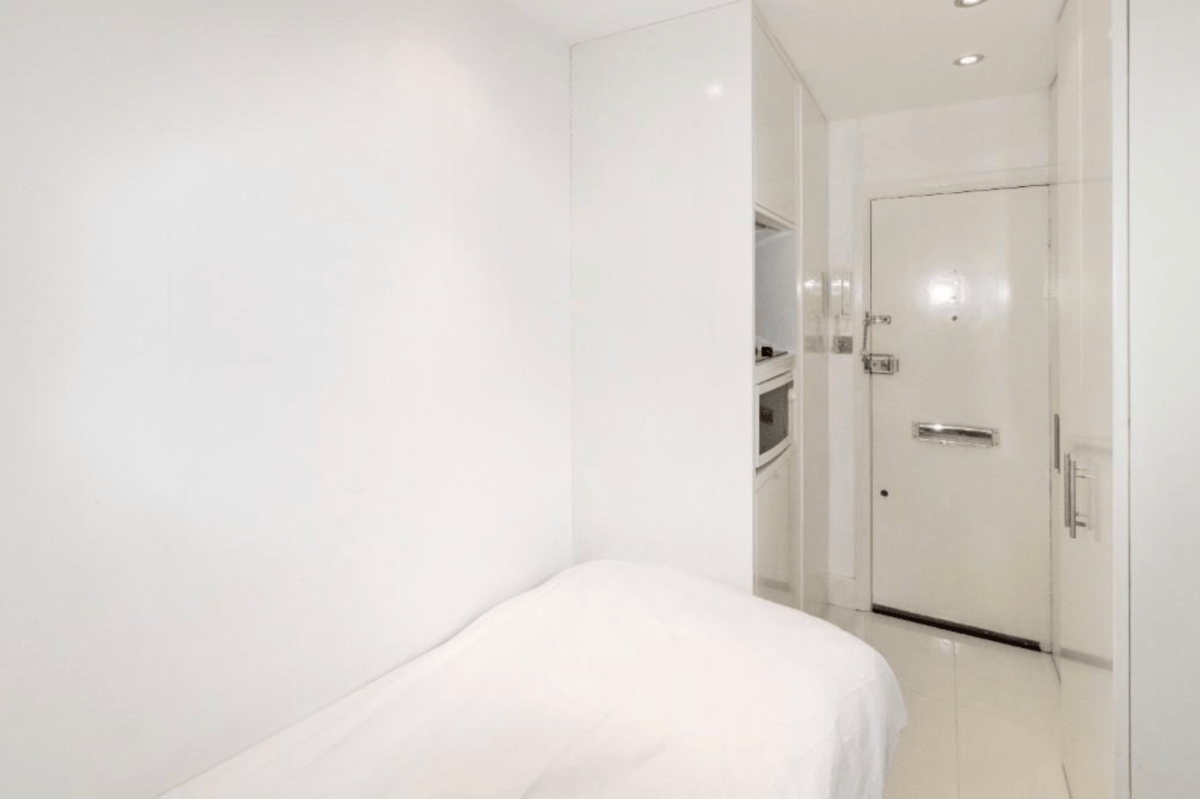
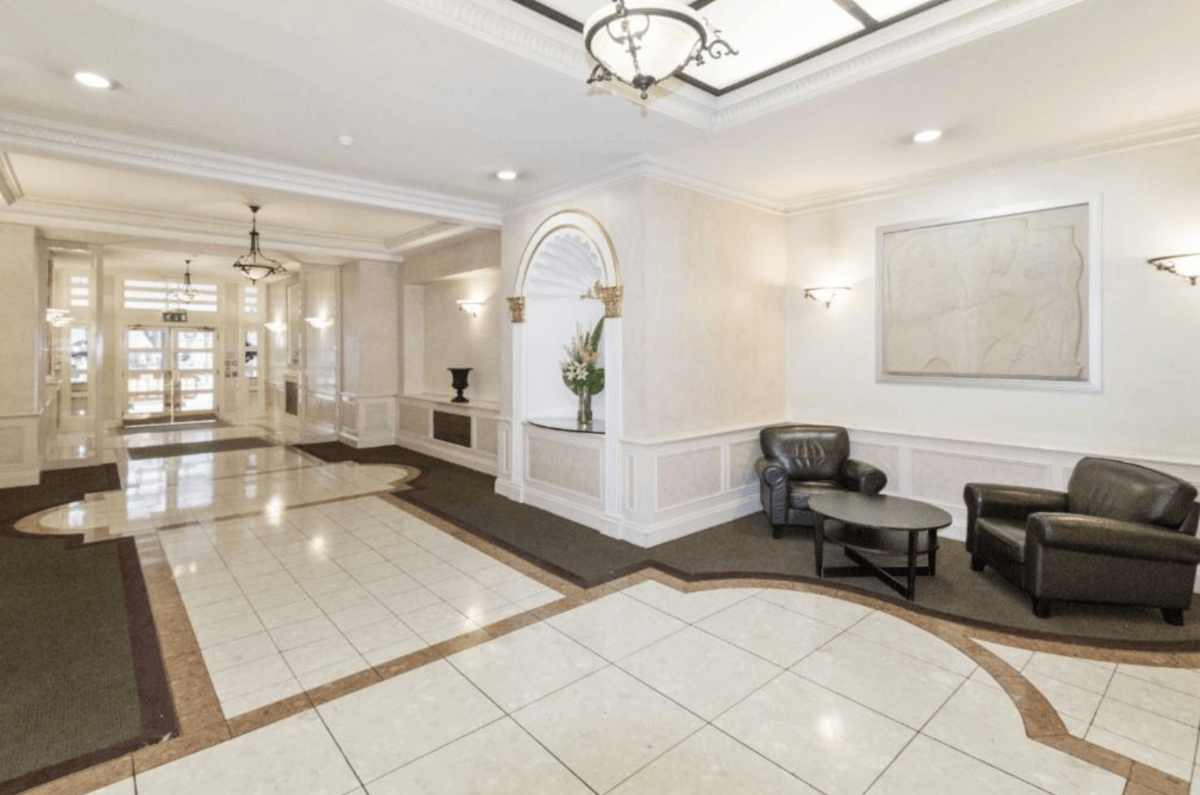
The kitchen facilities would not exactly excite Gordon Ramsay.The shower room is modern and clean; there’s not much further to say further than that.Both the shower room and ‘studio’ room have windows; a ‘Brucie bonus’ for sure.A view of the ‘studio’ towards the door; most prison cells are bigger than the space offered here.If you bought the studio offered and needed to host a visitor, you could do so in the lobby of Princes Court. It’s got seating and space aplenty in comparison to the ‘flatlet’ itself.Princes Court (here partly shrouded in scaffolding) is literally opposite Harrods, undoubtedly one of the most famous department stores in the world.The rear of Princes Court with Harrods department store behind and the store’s former depository, now apartments also, to the right.
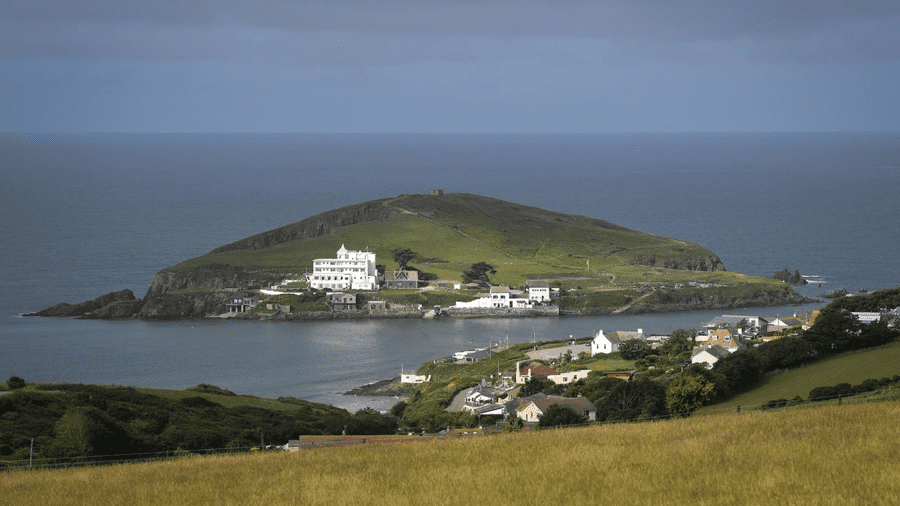
Burgh Island in South Devon, where Agatha Christie wrote several novels and The Beatles stayed also, goes on sale for the staggering sum of £15 million
Described as “the best hotel west of The Ritz” by its current owner Giles Fuchs, a favourite South Devon bolthole of Agatha Christie has just come up for sale for £15 million. It was here that the ‘Queen of Crime’ had her own writer’s retreat and where also that she was inspired to pen both And Then There Were None and Evil Under The Sun.
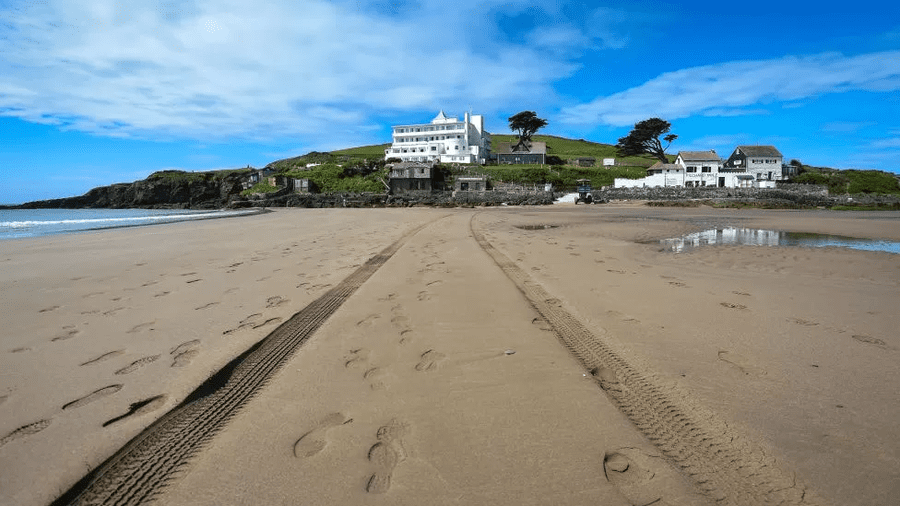
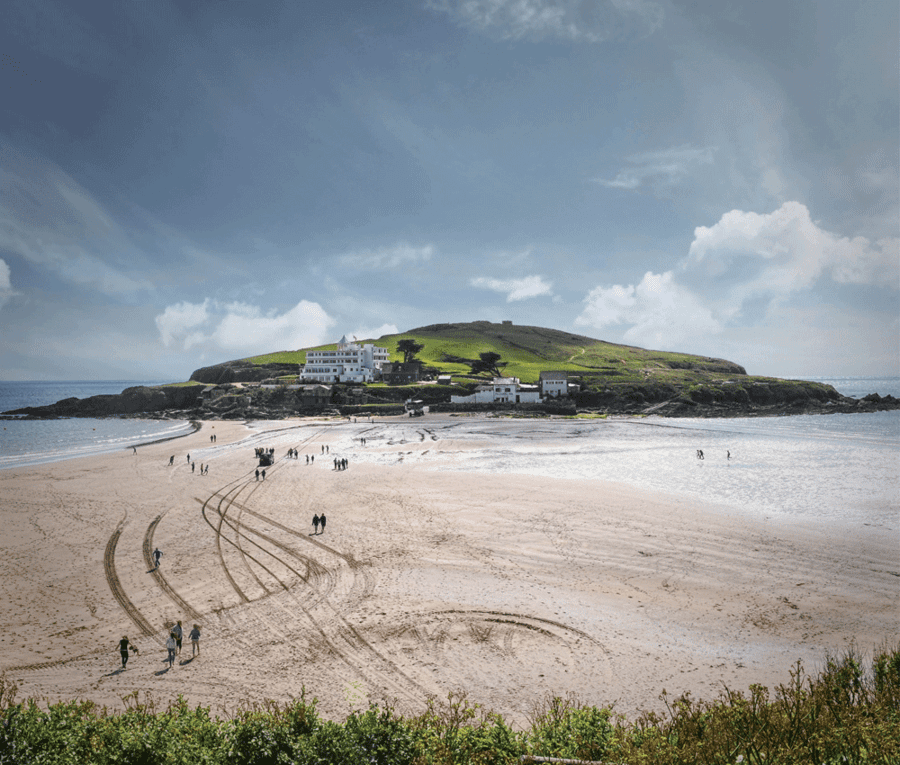
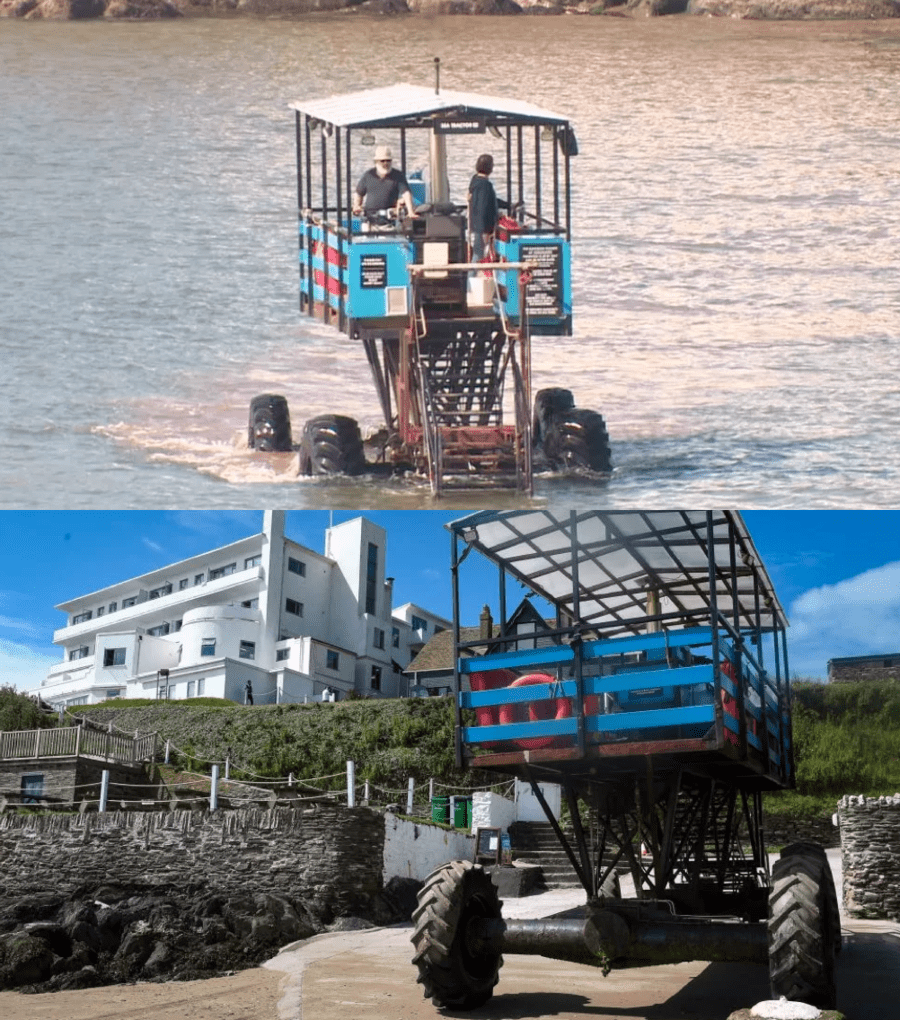
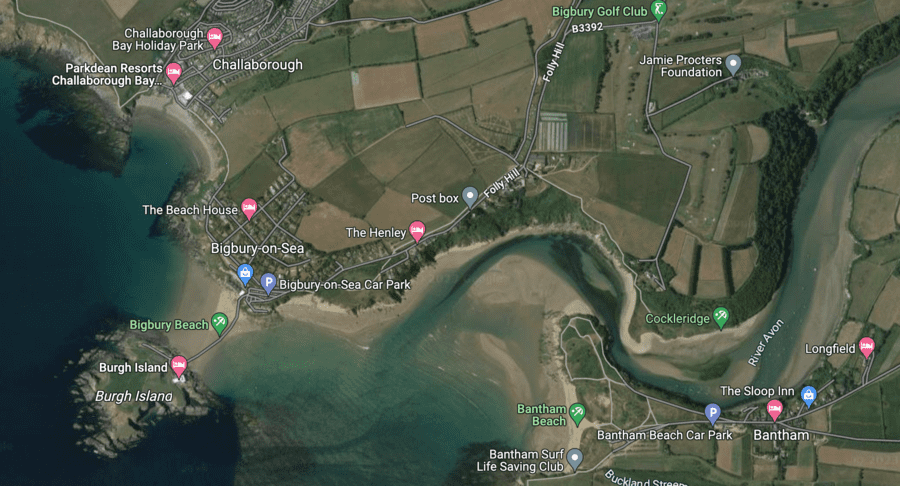
Burgh Island is situated just 820-feet from the mainland and is approachable by foot at low tide and accessible by a sea tractor at high tide; it also has a helipad for those wishing to make a grand entrance. Though 3 hours from London Paddington by train, those that have visited in the past – amongst them the Duke and Duchess of Windsor, Sir Winston Churchill and J. M. W. Turner even – supposedly returned again and again captivated, like Christie, by its seclusion and beauty.
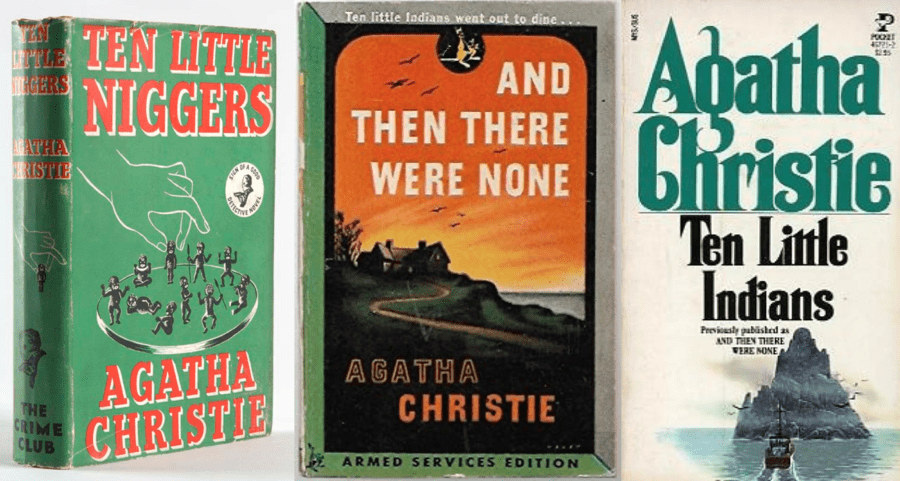
The 21-acre island – which has gone through several name changes itself and was once known as St Michael’s Island – was the inspiration for Christie’s fictional ‘Soldier Island’ in a novel titled Ten Little Niggers when it was first published in 1939. The 272-page book was subsequently retitled Ten Little Indians and then And Then There Were None because of concerns about offending – even prior to the arrival of ‘wokery’ and ‘cancel culture’ – the American market.
The strategy worked as to this day, the novel became both the best-selling crime and the best-selling mystery novel of all-time. Critics enthuse of what is a brilliantly warped yet rationally believable psychological thriller that follows the story of eight people invited to an isolated private island to meet their ultimate demise alongside their two caretaker hosts at a house party from hell. Unsurprisingly, since Christie produced a version for the stage in 1943, there have been more adaptations for that medium as well as for film, radio and television adaptations than of any of her other works.
A clear work of genius in both plot and the financial returns it generated for its author, And Then There Were None was actually structured around an 1869 minstrel song titled Ten Little Niggers by the British songwriter Frank Green. The rhyme – as published for these politically correct times where even future editions of Roald Dahl’s book will no longer feature the adjective ‘fat’ – reads:
Ten little Soldier Boys went out to dine; One choked his little self and then there were nine.
Nine little Soldier Boys sat up very late; One overslept himself and then there were eight.
Eight little Soldier Boys travelling in Devon; One said he’d stay there and then there were seven.
Seven little Soldier Boys chopping up sticks; One chopped himself in halves and then there were six.
Six little Soldier Boys playing with a hive; A bumblebee stung one and then there were five.
Five little Soldier Boys going in for law; One got in Chancery and then there were four.
Four little Soldier Boys going out to sea; A red herring swallowed one and then there were three.
Three little Soldier Boys walking in the zoo; A big bear hugged one and then there were two.
Two little Soldier Boys sitting in the sun; One got frizzled up and then there was one.
One little Soldier Boy left all alone; He went out and hanged himself and then there were none.
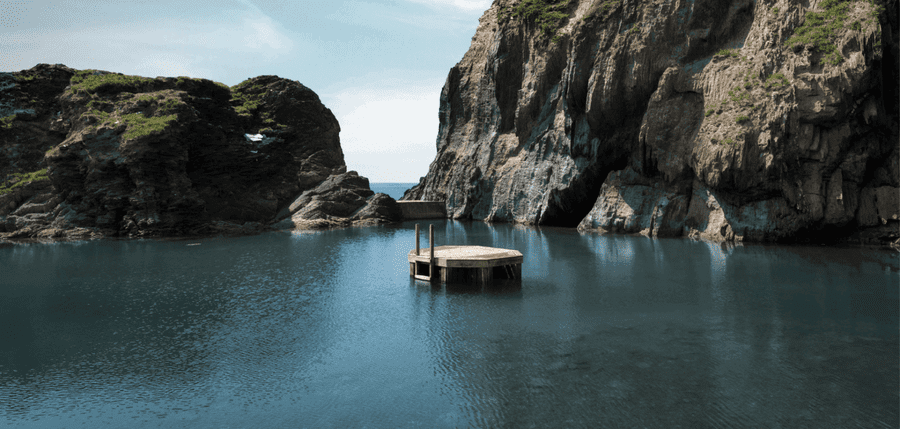
Whilst today’s visitors to the “comprehensively refurbished,” Grade II listed, 25-bedroom Burgh Island Hotel certainly are unlikely to face the unhappy endings of Christie’s ten unfortunates, they are able to enjoy “fine dining” at its two restaurants, and cocktails in its Palm Court bar. One can quite easily imagine Hercule Poirot sleuthing in or at the island’s 14th century pub, The Pilchard Inn. In addition, there is what is called the ‘Mermaid Pool’ – a naturally enclosed body of seawater where guests can swim or if, in the unlikely event they’d take a break from Dubai, perhaps ‘Wagatha Christie’ Coleen Rooney could witness Rebekah Vardy ‘Davy Jones-ing’ her mobile telephone for a second time even.
Of this “iconic landmark” – which a company ultimately controlled by Mr Fuchs paid around £5 million for in 2018 – selling agents Knight Frank enthused in their marketing material:
“The private island setting is virtually unique in the UK and the hotel, which has been fully restored, is one of the finest examples of working Art Deco architecture in Europe.”
“Burgh Island is a natural micro-environment, with wildlife to observe and cliff walks around the circumference. The sandy tidal beach on the eastern (mainland-facing) side is washed by the tide twice daily and so is always clean.”
Whilst the realty firm lauds total sales of in excess of £6 million for the year ending 2022, Agatha Christie actually best surmises why Mr Fuchs is seek to sell: “The best of an island is once you get there – you can’t go any farther… You’ve come to the end of things.” This week PlymouthLive revealed his company, Office Space in Town Limited (OSiT), “has debts of £130 million and is paying nearly £7 million in interests on its loans each year… [It] has borrowed huge sums and is relying on London property prices to remain stable in order to avoid breaching covenant terms which would mean loans having to be immediately repaid and potentially leading to the business going bust.”
Editor’s Note – Unlike as is the case in many publications, this article was NOT sponsored or supported by a third-party. Follow Matthew Steeples on Twitter at @M_Steeples.
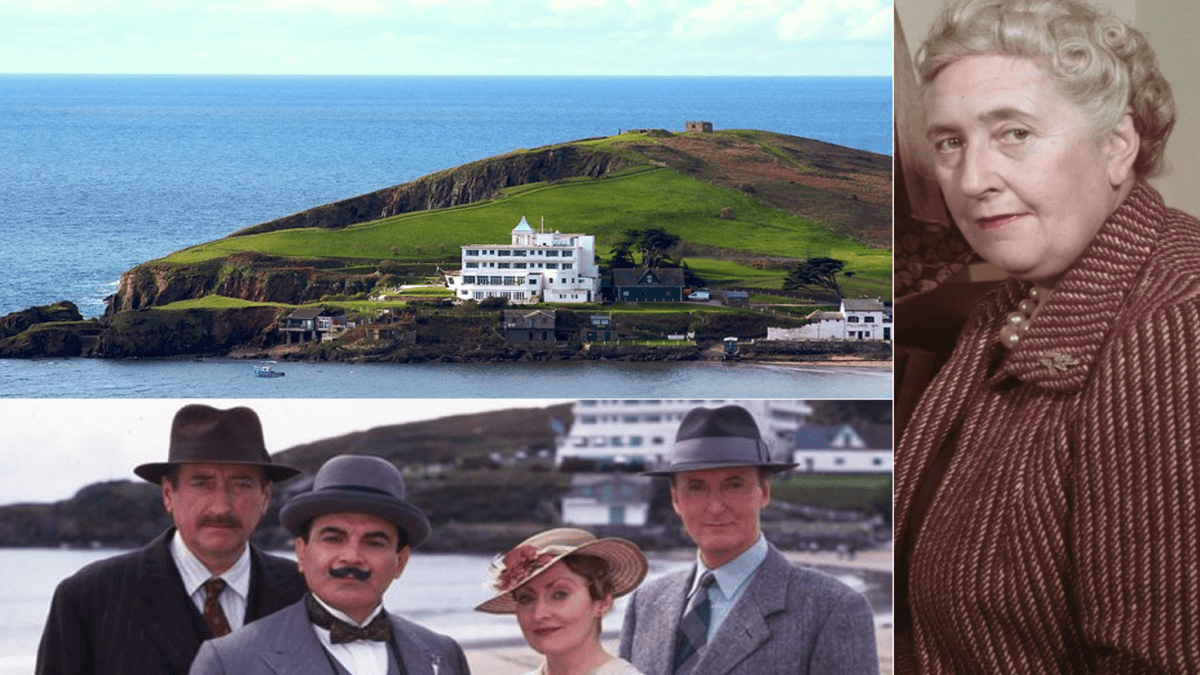
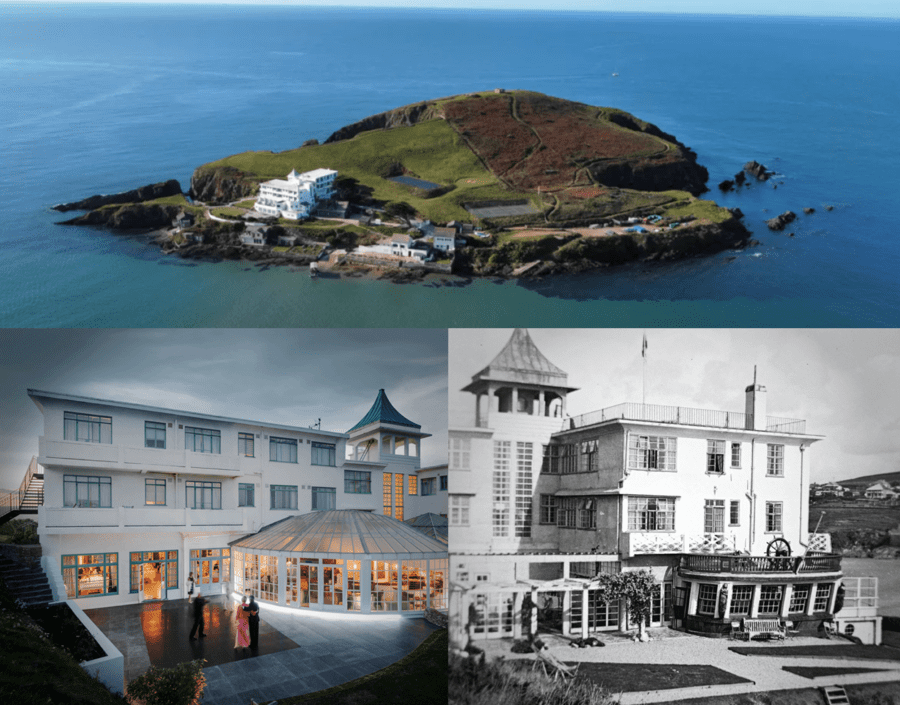
Pictured Top – The island, hotel and The Pilchard Inn (top left); David Suchet as Poirot filmed ‘Evil Under The Sun’ there in 2001 (bottom left) and the island’s most famous visitor, Dame Agatha Christie DBE (right).
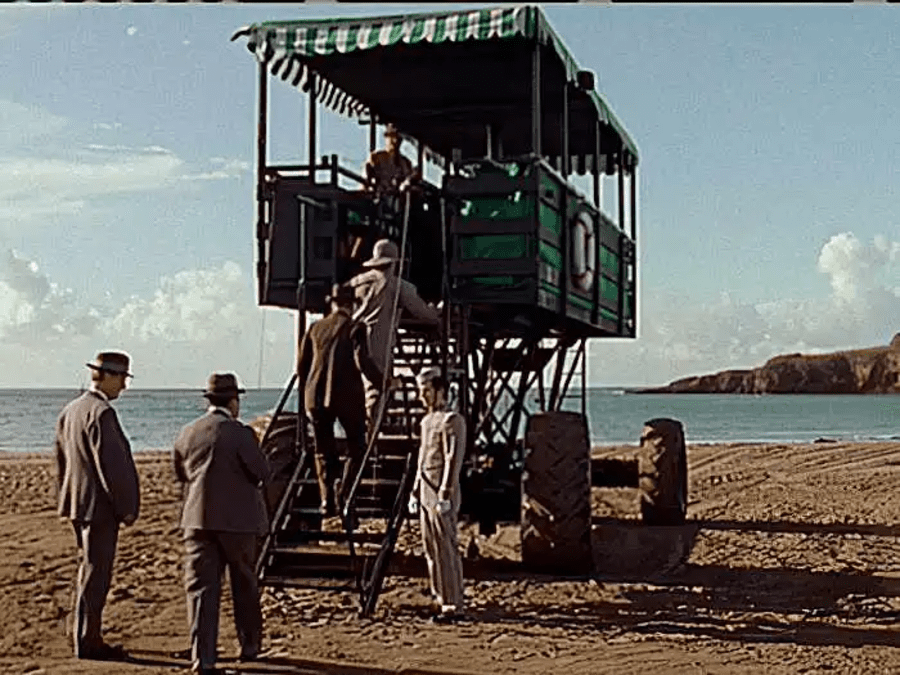
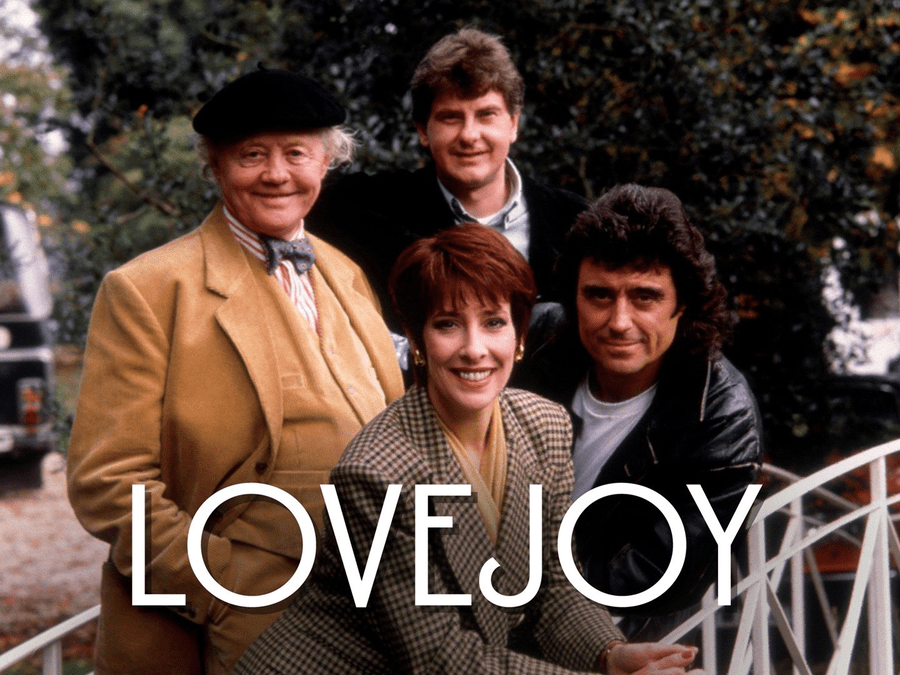
The island is being marketed by Knight Frank at a staggering price of £15 million after being sold last in 2018 for £5 million and prior for £2 million in 2001. The hotel includes 25 en-suite guest bedrooms and suites as well as the Ballroom Restaurant (64 covers), the Nettlefold Restaurant (72 covers), the Palm Court bar and lounge (42 covers) and The Pilchard Inn (35 internal and 114 external covers). There is also a billiards room, sauna and treatment room, a staff house with 9 bedrooms, a car park on the mainland with 18 spaces and a helipad. The property is offered on a freehold basis.Dame Agatha Christie DBE (1890 – 1976) remains to this day the world’s best-selling crime author. She penned 66 detective novels and 14 short story collections, as well as the world’s longest-running play, ‘The Mousetrap.’ Over a billion copies of her works in the English language and a billion in translation have been sold; most notable are ‘Murder on the Orient Express,’ ‘Death on the Nile,’ ‘The Murder at the Vicarage’ and ‘The A. B. C. Murders.’‘And Then There Were None’ began life as ‘Ten Little Niggers’ and via being ‘Ten Little Indians’ gained its present title to suit the American market. Christie claimed it was the most difficult of her books to write, but it is also one of her most popular – over 100 million copies have been sold and the work stands as the sixth best-selling title (any language, including reference works) of all-time.‘Evil Under The Sun’ (1931) – which features an investigation into the murder of a flirtatious but not liked woman who is murdered whilst on holiday in Devon –remains one of Christie’s most popular works. It has been adapted multiple times and became a feature film in 1982 with Peter Ustinov as Poirot. In 2001, David Suchet played the detective in a version with alterations including the addition of the characters of Hastings, Japp and Miss Lemon – none of whom appear in the original novel. A PC game version of the story has even been made and in 1999, John Moffat played Poirot for a BBC Radio 4 adaptation. Here, the cast are seen getting into Burgh Island’s famous sea-tractor during filming.Roguish antiques dealer Lovejoy (Ian McShane) and his eccentric sidekick Tinker (Dudley Sutton) brought a new era of drama to Burgh Island when they filmed an episode there titled ‘Somewhere – Over the Rainbow?’ It was first shown in October 1994 and featured them going there to save Tinker’s financially strapped sister and her wheelchair-bound husband (presented as owners of the hotel) from losing it to a greedy property developer. The key to the story is finding a treasure trove hidden there by a notorious smuggler centuries earlier.Self-made multi-millionaire Giles Fuchs is the current owner of Burgh Island. He began his career as an estate agent, claims to have invested more than £1 million renovating the hotel to turn into something that looks “pretty spectacular.” He doubled the number of staff on site, brought in Mark Mosimann, son of King Charles III’s favourite chef, Anton Mosimann, and also bought accommodation on the mainland for some of the hotel’s workers to live in. In July 2020, he described the hotel as “like a house party” and the island as “beautiful” in comments to ‘Great British Life’ magazine.
The ‘Famous Face’ Guest List – Burgh Island, Bigbury-on-Sea, South Devon, TQ7 4BG, United Kingdom (Formerly Known As St Michael’s Island, Borough Island And Bur Island)
Dancer and singer Josephine Baker.
Musicians The Beatles – The band stayed there before playing a concert in nearby Plymouth.
World speed record holder Malcolm Campbell.
Agatha Christie – The prolific author is described as having made the island “her second home” and wrote And Then There Were None (1939) and Evil Under The Sun (1941) there. A beach hut was built for her to use as a “writer’s retreat.”
Prime Minister Sir Winston Churchill – The politician supposedly met with President Dwight Eisenhower there prior to D-Day.
Flamboyant actor, playwright and singer Noël Coward – He supposedly booked in for three days, but stayed for three weeks and clearly very much enjoyed A Room With A View.
Shipping heiress, socialite and muse Nancy Cunard.
Odeon cinema chain founder Oscar Deutsche – The businessman travelled to the island with his wife and companion, World War One fighter ace Sol Joseph, in the latter’s Ford V8 Pilot just before the outbreak of the Second World War.
Actor and singer-songwriter George Formby – He is said to have been viewed as “the cheeky northern chappie who proudly picknicked on Bigbury Beach” during his visit who “guests didn’t know what to make of.”
Aviator Amy Johnson.
Actress Gertrude Lawrence.
Designer of the Spitfire R. J. Mitchell.
Last Viceroy of India Lord Mountbatten of Burma.
Artist J. M. W. Turner – The painter was “cast ashore during rough weather and ‘with a pencil, clambered nearly to the summit of the island’ to sketch its wilderness.”
Renegade royals The Duke and Duchess of Windsor – Said to have travelled to the islands on “frequent occasions” with their aide-de-camp Major Edward ‘Fruity’ Metcalfe.
In 1926, Christie disappeared from her home in Berkshire for 11 days. Mayhem and a manhunt worthy of her murder mystery books followed. Surprisingly, she didn’t choose to head to Burgh Island, but maybe that would have made her too easy to find given her love of the place. The reason for her decision to ‘vanish’ remains hotly contested today and this indeed will likely forever remain in the realms of the debate over who Jack the Ripper was – a case forever unsolved.
The Dates, Developments & Numbers – Burgh Island’s History
May 2023 – Placed for sale for £15 million ($18.8 million, €17.2 million or درهم69 million) through agents Matthew Smith and Henry Jackson of Knight Frank.
Commenting of the sale, Giles Fuchs told Plymouth Live: “Ownership of the Burgh Island Hotel has provided me with a wonderful journey and given me the true privilege of restoring and enhancing one of the most treasured tourist assets in the UK over the past few years. What we have achieved is an immense source of pride for all of us who have been involved and, in our work, we have always tried to ensure that the hotel’s 1920s spirit remains just as vibrant in the 2020s.”
Speaking to The Caterer, Matthew Smith of Knight Frank added: “It is rare for a hotel of such character and heritage to come to the open market.
“In recent years the buildings have received considerable investment and operates as a thriving business which generated in excess of £6 million ($7.5 million, €6.9 million or درهم27.6 million) turnover in its most recent financial year.”
“This is a unique opportunity to acquire a truly iconic hotel that benefits from a number of value-add opportunities to further develop the trading performance, and will no doubt appeal to a global investor audience.”
February 2023 – Plymouth Live reported on rumours about the hotel being for sale for £9 million ($11.3 million, €10.3 million or درهم41.4 million) after an advertisement appeared on Knight Frank’s website for a “mystery property” matching the description of it. Responding at the time, Henry Jackson of Knight Frank stated: “Burgh Island is not on the market. I don’t know where these rumours come from. At the time, the PR firm representing the hotel, Sapience Communications, added: “We have nothing additional to add.”
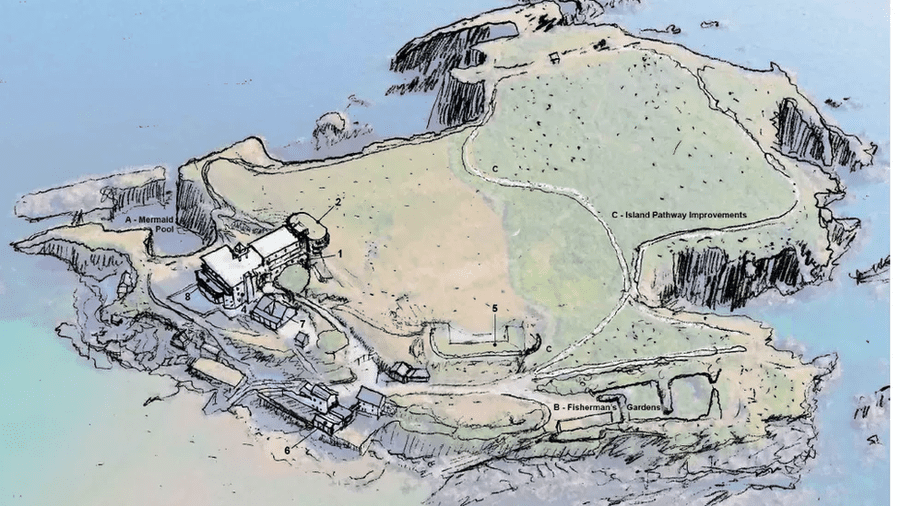
December 2022 – Planning permission granted for 12 additional guest bedrooms and suites and 13 staff bedrooms by South Hams District Council. Approval was also granted for extension of two of the restaurants and a spa facility.
This redevelopment, BBC News recently reported, will cost £7 million to £10 million ($8.8 million to $12.5 million, €8 million to €11.5 million or درهم32.2 million to درهم45.9 million) and of it, Mr Fuchs observed:
“I’m not the man for that job because once you start that, you need to do the whole thing. It’s also a substantial amount of cash and I don’t want to find [it], thanks very much.”
“We’ve got a big business in London and I could divert funds but the hotel was always about a love story; it was saving something that had been around for years that our family fell in love with.
“To divert more funds doesn’t make any sense to us. We want to buy more buildings in London.”
“She’s a demanding mistress and I ended up getting more and more involved at the expense of my life and other businesses, [but] I’m really pleased we’ve turned it around.”
Autumn 2021 – Burgh Island Limited accounts valued the business at £9.5 million ($11.9 million, €10.9 million or درهم43.7 million). At the time, profits of £296,000 ($370,000, €339,000 or درهم1.4 million) were listed down from £336,000 ($420,000, €385,000 or درهم1.5 million) in 2020.
The company was reported as employing 63 people with a wage bill of £1.6 million ($2 million, €1.8 million or درهم7.4 million). It paid dividends of £2 million ($2.5 million, €2.3 million or درهم9.2 million).
Mid 2018 – Sold by then owners Deborah Clark and Tony Orchard to Office Space in Town Ltd (OSiT), a company ultimately controlled by a London based businessman named Giles Fuchs and his sister Nichola, for a sum of £5 million ($6.3 million, €X million or درهم23 million).
January 2018 – Valued by estate agents Savills at £8.64 million ($10.81 million, €9.90 million or درهم39.69 million).
2012 – Singer-songwriter Ben Howard named his EP after the island.
2003 – The then owners closed the public footpaths on the island; this move was reversed in 2006 other than the routes closest to the hotel.
2002 – Used as a location for the television adaptation of Agatha Christie’s Evil Under The Sun.
2001 – Sold for £2 million ($2.5 million, €2.3 million or درهم9.2 million).
2001 – Used as the location of a television adaptation of Evil Under The Sun starring David Suchet as Hercule Poirot.
2001 and 2008 – Used as the location for ITV’s GMTV show Inch-loss Island.
1994 – Used as the location for an episode of the BBC series Lovejoy titled ‘Somewhere – Over the Rainbow?’
1987 – Used as a location in the BBC adaptation of Agatha Christie’s Miss Marple: Nemesis.
1986 – Sold to a couple named Tony and Beatrice Porter, who “faithfully restored it to its former Art Deco glory.”
1965 – Used as a location for the film Catch Me If You Can.
1950s – Renovated, but instead of being used as a hotel became self-catering accommodation.
1939 – 1945 – Used by the RAF as a recovery centre for wounded RAF personnel. During this period, the top two floors of the main building suffered damaged after a direct hit by a bomb.
1927 – Sold to the filmmaker Archibald Nettlefold. He constructed a more substantial 25-room hotel in the Art Deco style in 1929 and after it became popular in the 1930s, added improvements and extensions in 1932 including ‘The Captain’s Cabin’ – it had been taken from HMS Ganges, a warship built in 1821.
1890s – Purchased by the music hall star George H. Chirgwin. He built a prefabricated wooden house to use for weekend parties.
14th century – The Pilchard Inn, the ‘local’ hostelry, is constructed circa 1336. It is believed to have begun life as guest lodgings for a monastery that possibly stood on the site of the current hotel.
Iron Age to Sub-Roman period – First settlers, tin traders, believed to have arrived.
More Images Of Burgh Island…
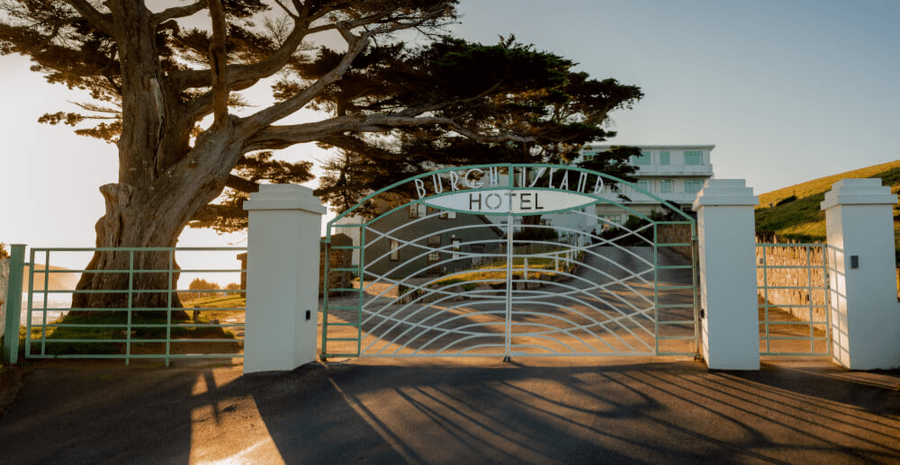
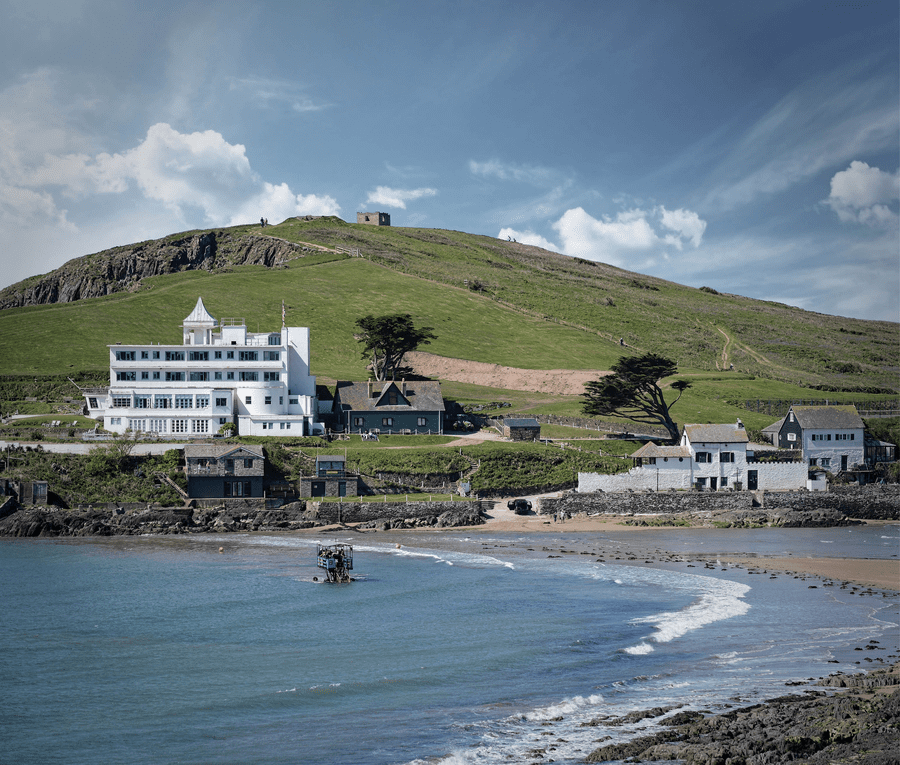
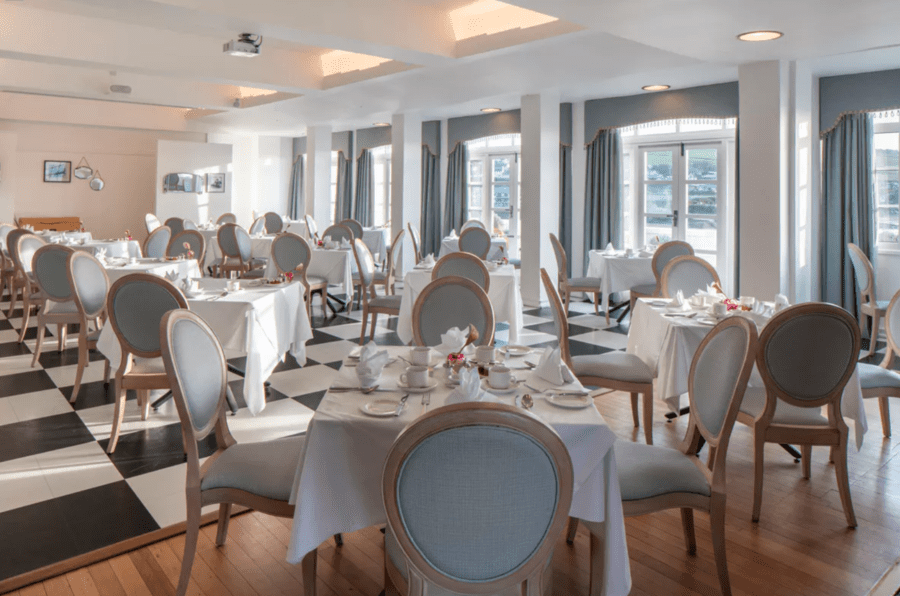
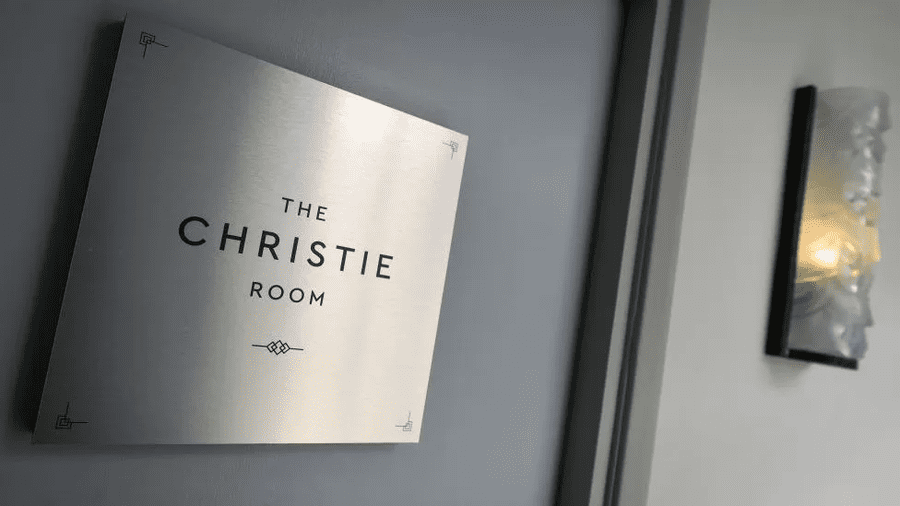
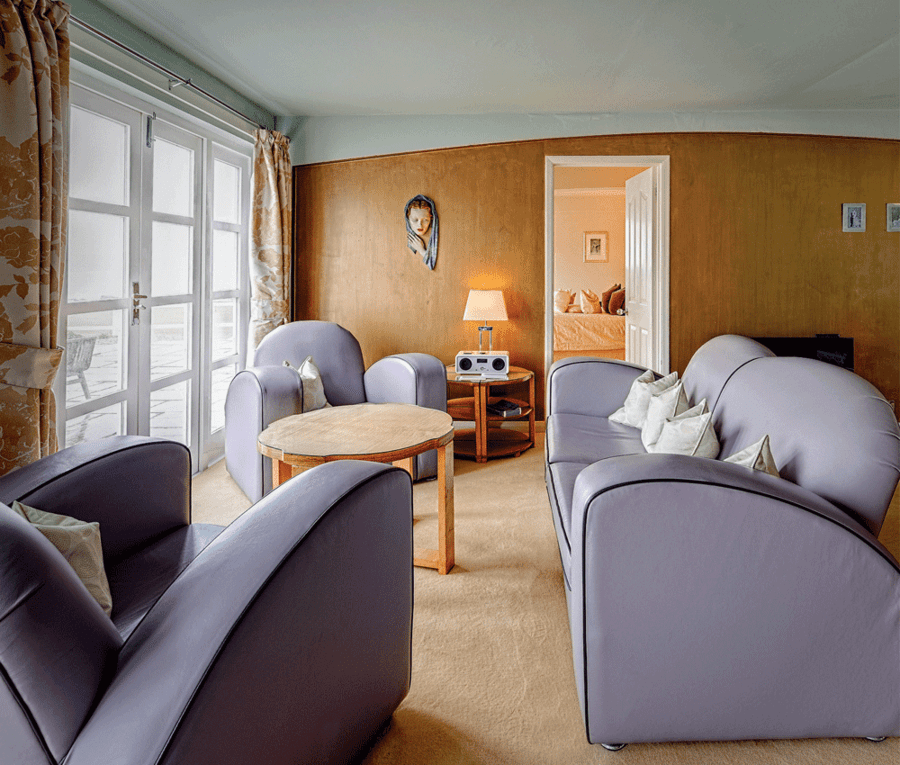
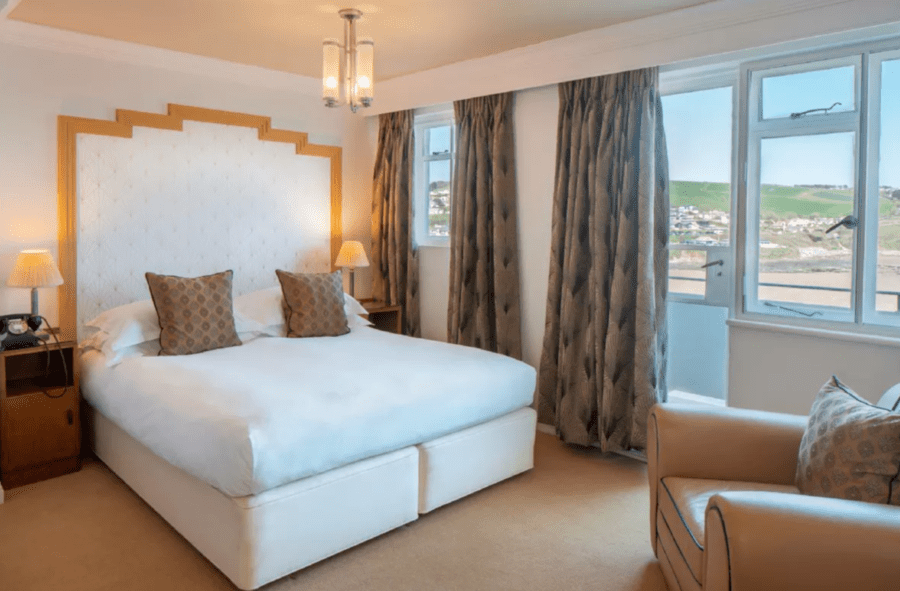
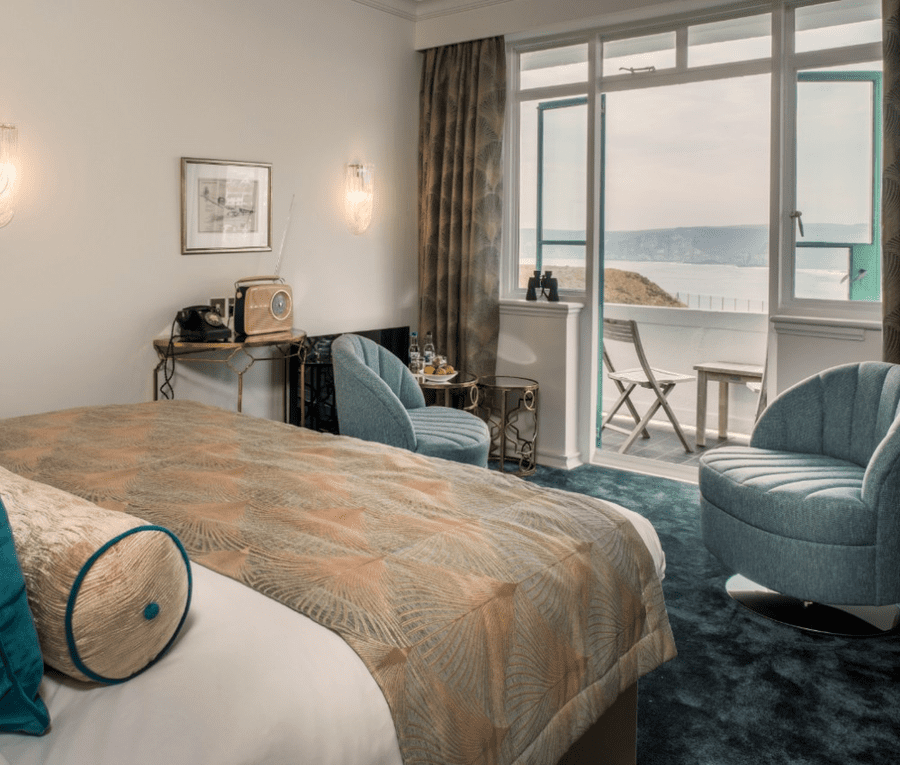
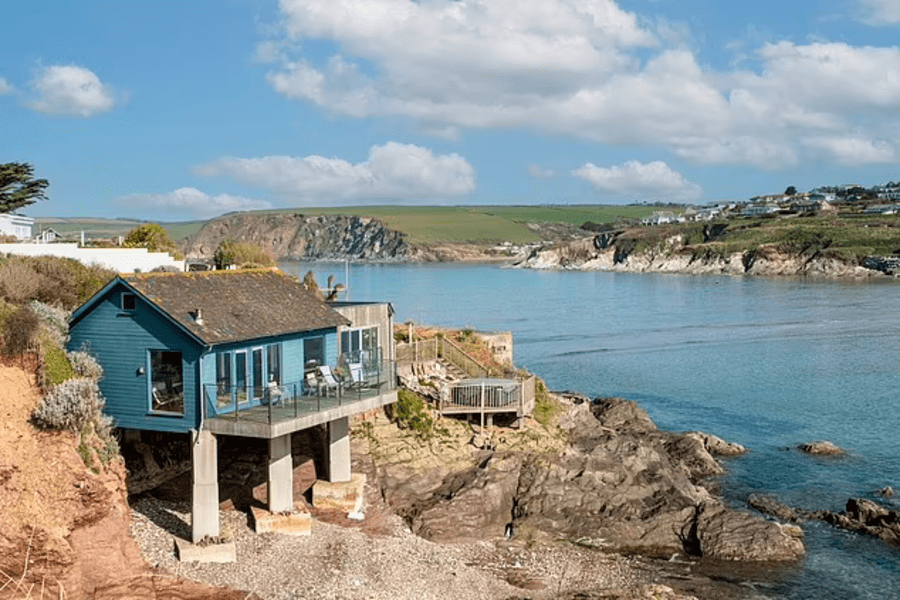
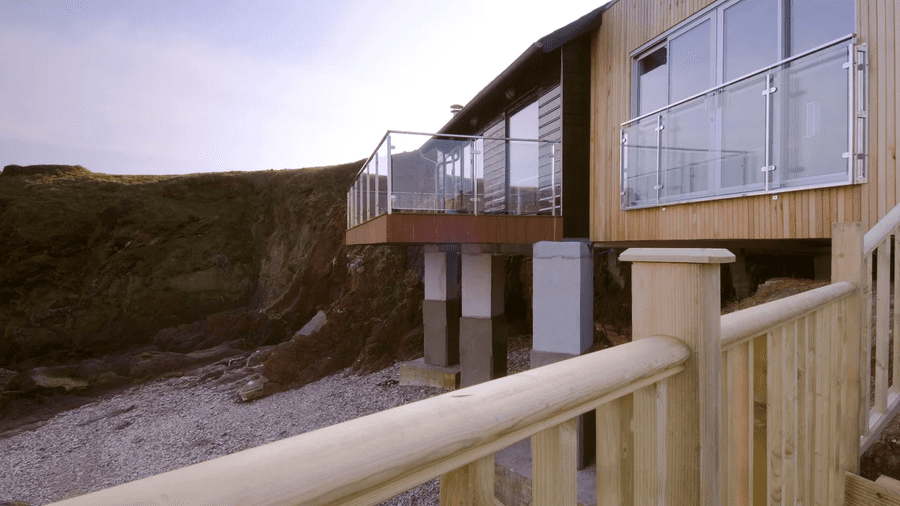
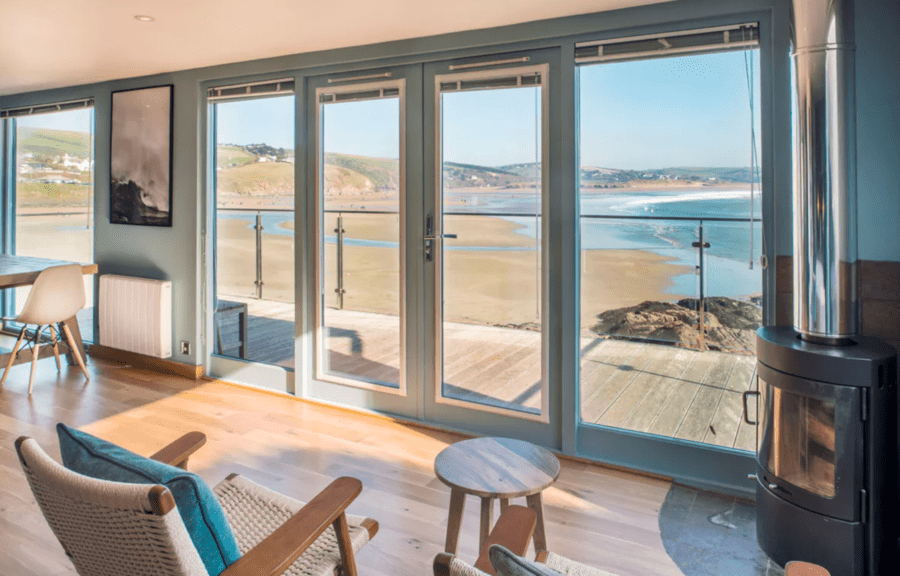
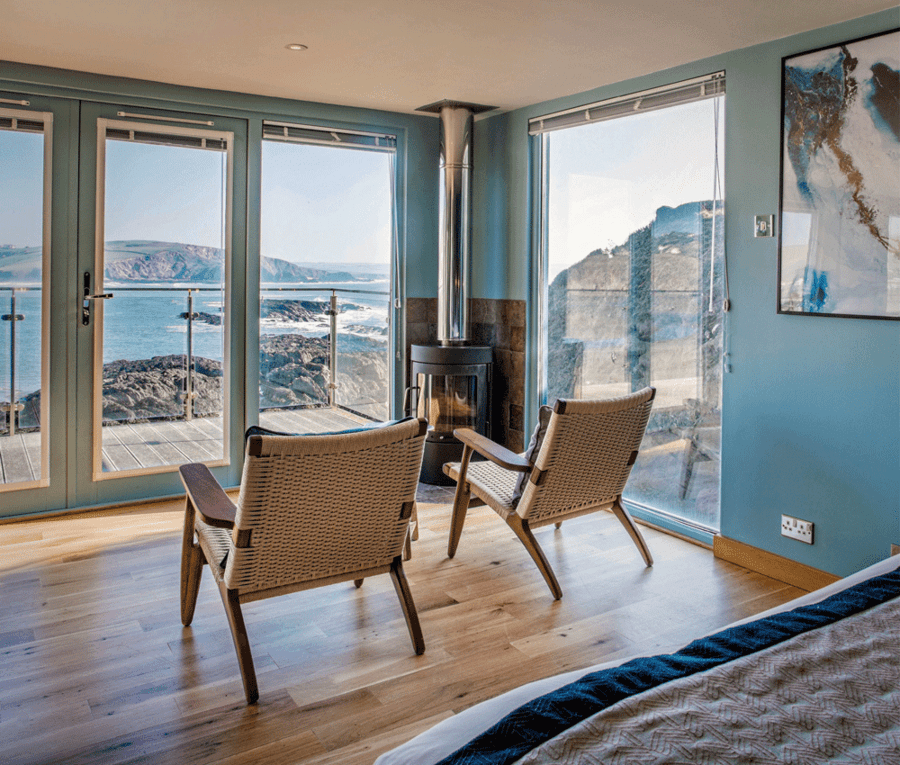
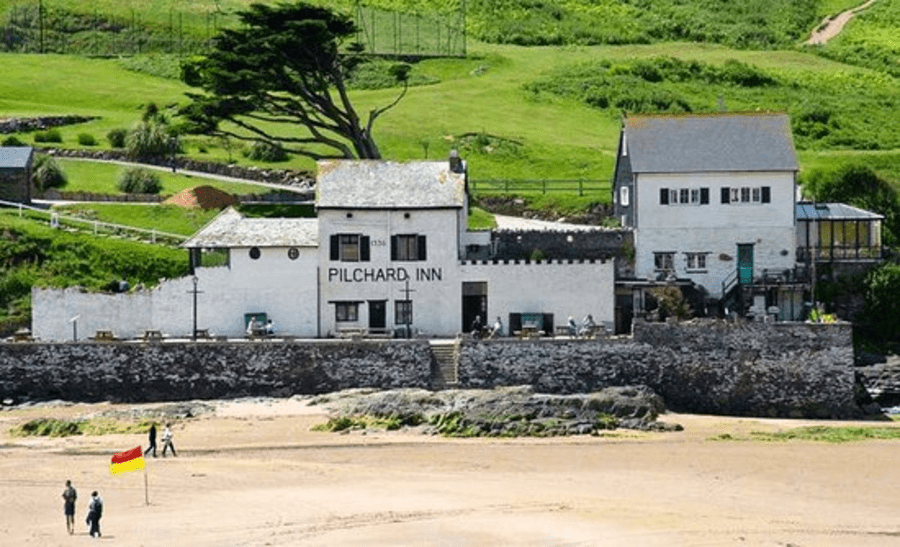
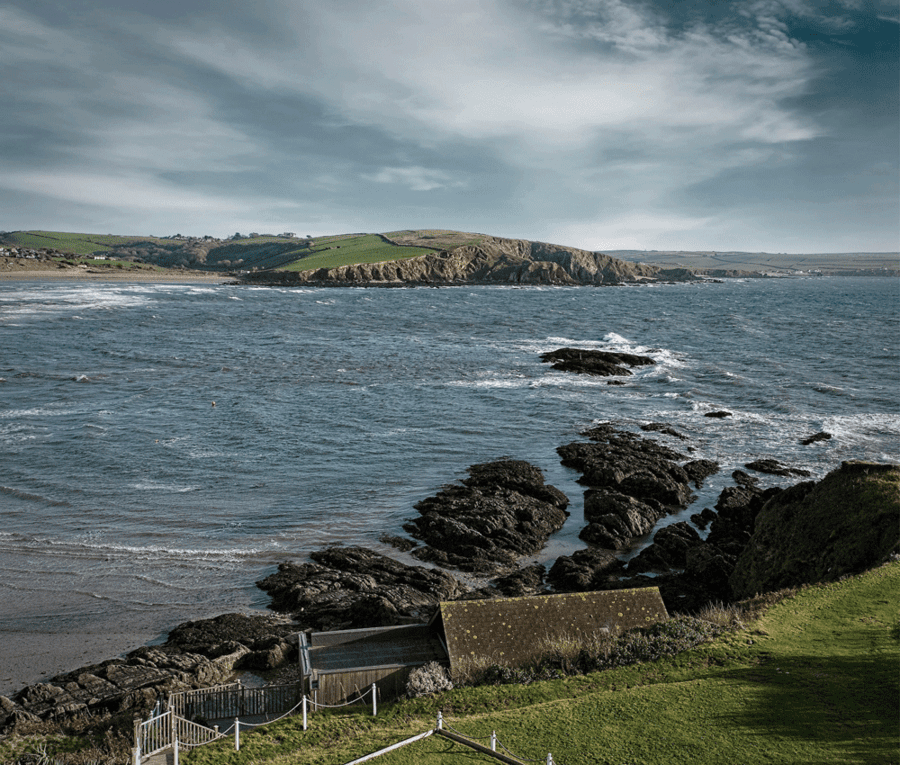
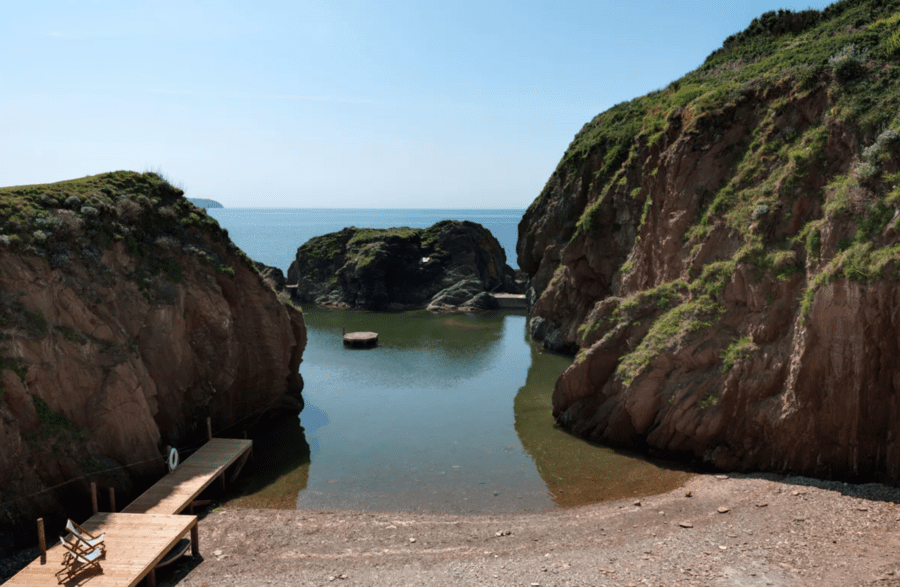
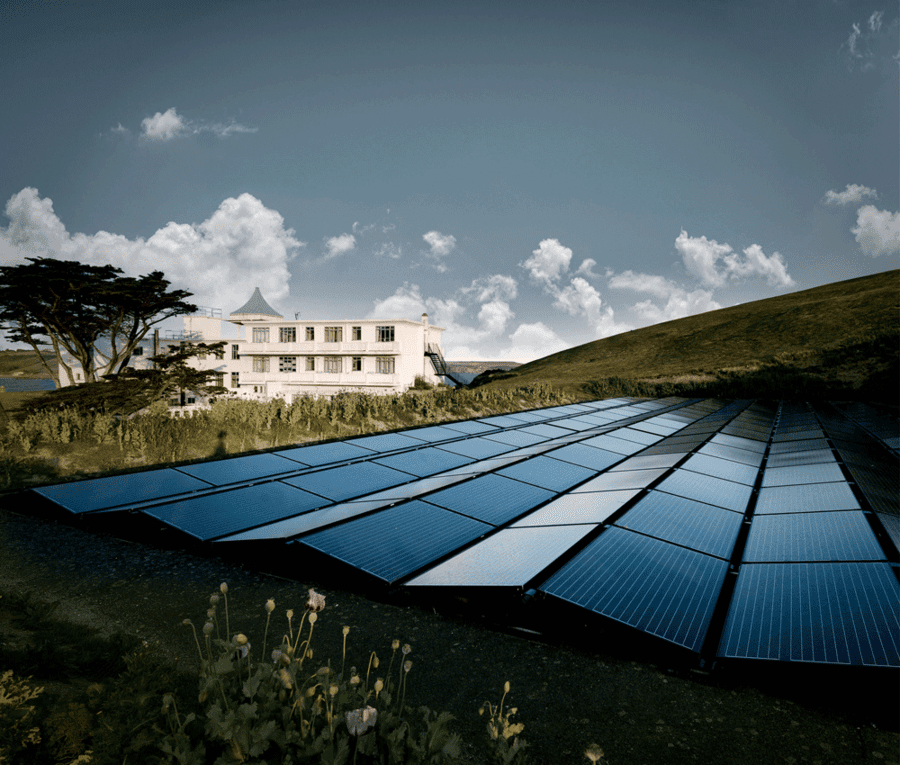
The approach to Burgh Island at low tide.Many people approach on foot; there are also a number of footpaths for visitors to enjoy once they get to the island.For guests of the hotel, there is a sea tractor they can travel on. Those that have experienced this wonderful contraption have commented on how much they have enjoyed the journey back and forth to and from the mainland.The gates to the hotel are suitably reflective of the Art Deco style of the property.The building is striking and one can certainly see what attracted the likes of Agatha Christie to it and the island.The Palm Court features a restored circular skylight. It is stunning and this is certainly a place where one can imagine such people as the Duke and Duchess of Windsor and Nancy Cunard sipping martinis there of an evening whilst looking out to sea.One of two restaurants in the main hotel. The Nettlefold offers menus that are said to reflect the “uniquely wild island location.”The second, The Grand Ballroom, is a fine dining restaurant that is lauded as serving “award-winning food” in a setting that is styled around the “grandeur of a bygone era.”The guest rooms, such as ‘The Christie Room,’ have primarily been named after the famous faces who’ve stayed at the hotel in times past.The current owner has fully refurbished the property and furnished it with in-fitting Art Deco items.One of 25 bedrooms and suites at The Burgh Island Hotel; the majority enjoy superb views out to sea and to the South Devon countryside also.Another bedroom, this one with a private balcony.The Artist’s Studio is situated above The Pilchard Inn. It is a dog friendly room and just a few yards walk from the main Burgh Island Hotel building.Agatha’s Beach House has been described as “one of the sexiest hotel rooms in the UK” and is undoubtedly the ultimate place to stay on Burgh Island. It was built specifically for Agatha Christie in the 1930s and was where she penned both of her Burgh Island novels. It has a sitting room, outdoor hot tub, sun decks right onto the sea and includes a king sized bed, a double sofa bed and two single beds.The building from another angle.The sitting room of Agatha’s Beach House has the benefit of the most wonderful of aspects.It also has a woodburning stove.The Pilchard Inn was supposedly built in the 14th century as a lodging house for visitors to the monastery that is believed to have been on the island at that time. It is one of the oldest pubs in Devon.The bar.A traditional space perfect for drinks by the fire.Many of the rooms and suites at the Burgh Island Hotel, such as the Noël Coward suite, allow guests to experience the drama of the sea beyond.The ‘Mermaid Pool’ is a natural seawater pool in a “rugged” setting.Another view of this extremely unusual place to swim. Burgh Island is partly powered by solar panels.South Hams Council approved plans for additional rooms and additional staff accommodation at the Burgh Island Hotel in December 2022.The 21-acre island is just across the water from Bigbury-on-Sea.From a distance, one can genuinely see what attracted the great and the good to Burgh Island.
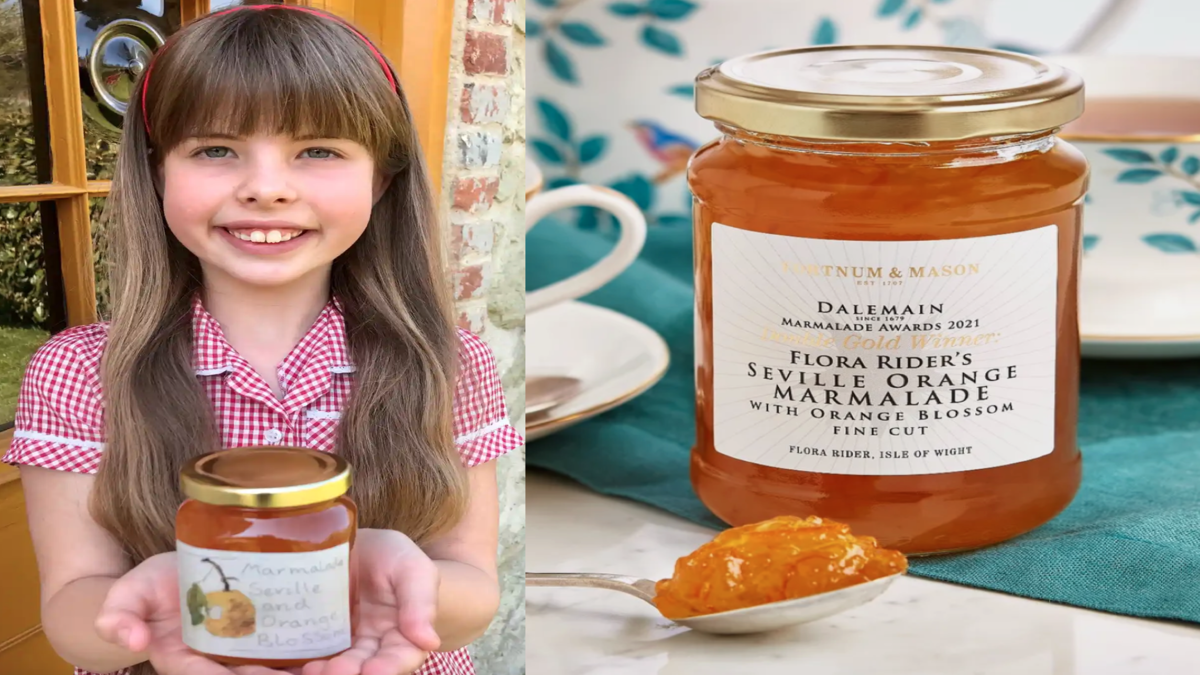
9-year-old girl’s prize-winning “little pot of sunshine” conserve goes on sale in Fortnum & Mason after beating 3,000 others in the world marmalade awards; 99-year-old’s grandson meanwhile claims marmalade helped her beat coronavirus
Now, going to the other end of the age spectrum, the paper shared news late last week that a 9-year-old child, Flora Rider from the Isle of Wight, has become the youngest ever winner of the world marmalade awards.
Having “impressed the judges with her marmalade made from Seville oranges and orange blossom from her local supermarket… which was made on only her second attempt” and beaten off other amateur and professional makers also, Rider’s conserve has now gone on sale in Fortnum & Mason.
Commenting of the winning entry, the ritzy store’s website now is offering the creation and shares of it:
“Selected from over 3,000 entries from all over the world, Flora Rider’s Seville Orange & Orange Blossom Marmalade has been crowned the winner of the 2021 Dalemain Marmalade Double Gold Awards.”
“Described by 9-year-old Flora as a ‘little pot of sunshine,’ this joyous jar is bursting with fresh citrus notes and a bright and honey-like flavour. Seville oranges harmonise with subtle hints of orange blossom water to create a delicately floral spread. Finely cut and light in colour, this marmalade pairs perfectly with breakfast pastries or dolloped atop fresh yoghurt.”
“Flora’s homemade marmalade has been commercially produced and will be exclusively sold at Fortnum & Mason and Dalemain throughout the year – with 50p from each jar going to Hospice at Home Carlisle & North Lakeland.”
“[I was] very excited, over the moon and really amazed to have won the prize.”
“I enjoyed shredding the peel and filling the jars, but best of all I enjoyed eating the finished marmalade. I liked the thought of adding flowers to my marmalade, so using orange blossom seemed like a good idea. The taste was very nice, with a lovely floral and honey flavour.”
To order Flora Rider’s marmalade – priced at £5.95 for a 340g jar – click here. Also available from the store is last year’s winning entry, Jonathan Hamel Cooke’s Dark & Chunky Marmalade – also priced at £5.95.
In April 2020, nonagenarian Rita Reynolds of Bramhall, Stockport’s grandson told the ‘Guardian’: “I don’t know how she got through [and recovered from coronavirus]. I don’t think she has ever eaten a vegetable or fruit. She lives on marmalade sandwiches and biscuits. But she’s never smoked or really drank.” Mrs Reynolds is plainly like a cat with nine lives. In the Second World War, aged 21, she supposedly refused to go into an air raid shelter “because she wanted to read her book.” She instead hid under a table at her home in Liverpool and amazingly survived when a bomb landed right outside.
Flora Rider beat off over 3,000 entries from 30 countries around the world – including Canada, the Czech Republic, Australia, Japan, Kuwait and Brazil – to win the 2021 Homemade Marmalade Awards. Of her entry, the judges declared: “A first time marmalade maker, Flora and her family, like so many in the UK, decided to get creative in the kitchen during the winter lockdown – with phenomenal results! Her entry absolutely bowled over the judges and was unanimously declared the winner, not just of the Children’s category, but of the whole competition.”
Going further of the winning entry, Dalemain declared: “Flora’s winning marmalade was ideal for the ‘floral’ feel of the day, and organisers hope it will be the perfect accompaniment to a gorgeous summer ahead.”
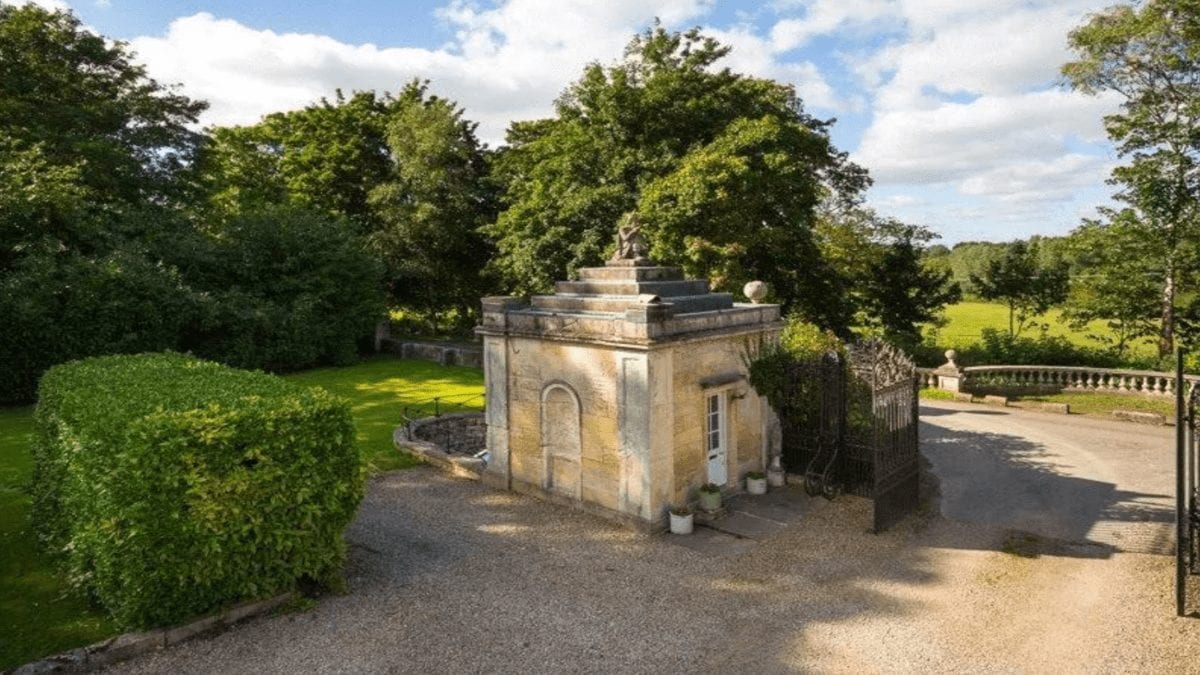
Tardis-like Grade II listed lodge house currently for sale could be Britain’s smallest detached house; it measures 10-foot by 8-foot and today also we feature some other examples of the nation’s smallest character packed homes
Whilst the Mirror wrote of what they called “Britain’s smallest detached house” in April – measuring 12-foot by 26-foot and priced at £140,000 – we can go one better and today feature a Grade II listed detached house in North Yorkshire measuring just 10-foot by 8-foot.
More practical than the £810,000 2.5-foot by 65-foot Knightsbridge “corridor” mews houseThe Steeple Times included in March 2017, 481 square foot Sunset Lodge forms one of a pair of symmetrical lodges standing either side of decorative wrought iron gates to Grimston Park, near Tadcaster – a Grade II* listed Georgian mansion of the Italianate style that has now been converted into thirteen individual residences.
Sunset Lodge forms one of a pair of symmetrical gate lodges at the entrance to Grimston Park in North Yorkshire.Grimston Park has been occupied as a grand country residence, was used by the RAF in the Second World War and subsequently became an events venue. It was converted into 13 residences more recently.
Tardis-like internally in that it actually extends over 2 floors with a mezzanine sleeping platform also, the majority of the living space is actually underground. Featuring a kitchen with an “orangery style roof” with a sunken patio beyond, there is also a living area, a “barrel ceilinged” shower room and a dressing room also.
Parking is provided outside for two vehicles and lawned gardens extend beyond. The estate beyond includes a stud-livery, parkland and buildings occupied on both a residential and a commercial basis.
Agents Carter Jonas initially marketed the property at £299,950 in March 2020, but have since reduced that sum to £250,000. The present owners, Tom and Rebecca Hallisey, paid just £85,000 for the building 15 years ago and thus stand to return an increase of +194% if they sell at asking price.
Speaking of the property to the Yorkshire Post in March 2020, Rebecca Hallisey remarked: “It was in a poor state of repair but [when we first saw it, but] we fell in love with it and we could see it had potential.”
She continued: “We moved a lot before we came here but we have stayed because we love the building and it is such a beautiful, peaceful place to live. We wish we could stay forever and we are only moving for health reasons as we need a single-storey home.”
The Numbers – Sunset Lodge, Grimston Park, Grimston, Tadcaster, North Yorkshire, LS24 9DB, United Kingdom
May 2021 – Reduced in price to £250,000 ($355,000, €291,000 or درهم1.3 million) or £520 per square foot ($738, €605 or درهم2,700 per square foot) with Carter Jonas.
March 2020 – Placed for sale for £299,950 ($425,700, €349,100 or درهم1.6 million) with Carter Jonas.
June 2006 – Sold for £85,000 ($121,000, €99,000 or درهم443,000).
Some Other Examples of Britain’s Smallest Homes
Starborough Castle, Dormsland, Lingfield, Surrey
Featured in The Steeple Times in April 2017, this Grade II* listed scheduled ancient monument stands in 10 acres and has a 44 million gallon moat. It features a mini great hall and was offered for sale for £1.75 million.
20 Britten Street, London, SW3
Also featured in The Steeple Times when for sale in 2017 for £600,000, this 290 square foot detached house measured 8.5-foot by 14-foot. Estate agents estimated it could be worth £1 million when renovated, but as of May 2021, it remains in unloved condition.
The Round House, Stanton Drew, Somerset
In December 2016, we wrote about this Grade II listed former toll house that extends to just 146 square foot. The 18th century, detached, thatched property was priced at just £110,000 at the time.
24a The Boltons, London, SW10
At the other end of the price scale, but still the cheapest, smallest house on one of London’s smartest streets, The Boltons in London, this £6.5 million terraced residence was home to novelist Jeffrey Archer from 1972 to 1976. Surprisingly due to it widening as it goes back, it actually provides 3,123 square foot of accommodation over 4 floors – so is not as quite as small as it initially seems.
Vast Scots Baronial mansion Carbisdale Castle – nicknamed ‘The Castle of Spite’ – goes on sale for sum 97% lower than it cost to build in the 1900s and 25% less than the sum spent on its 2010 renovation
A mega-mansion termed “the last grand castle built in Scotland” that cost £62 million to build between 1905 and 1917 has gone on sale for just £1.5 million in spite of developers having spent a small fortune on its renovation to date.
Extending to 41,433 square foot, category B-listed Carbisdale Castle in Sutherland is gargantuan in size compared to an average 818 square foot British home. Its construction began after the resolution of the then Dowager Duchess of Sutherland, Mary Caroline’s dispute with her late husband’s children from his first marriage, but ultimately the palatial pad was not completed until five years after her own demise.
Cash Consuming Carbisdale Castle – Mary Caroline, Dowager Duchess of Sutherland (1848 – 1912) and George Sutherland-Leveson-Gower, His Grace The 3rd Duke of Sutherland (1828 – 1892). According to one source, the “deviant duchess” enjoyed an astonishing income of £100,000 per year until her death and married her third husband, a politician and businessman, Sir Albert Rollit (1842 – 1922) in 1896.Cash Consuming Carbisdale Castle – The castle was used as a youth hostel for 66 years from 1945 until 2011.Cash Consuming Carbisdale Castle – Its vast size made it ideal for institutional usage.
Featured on these pages in August 2014 and April 2016 after it was placed for sale after being used for 70 years as a youth hostel, the allegedly haunted building was sold to a London based investment firm now known as Faro Capital after being reduced in price from £1.2 million to £900,000. At this stage, £2 million had already been spent on renovations due to extensive water damage in 2010.
In the years since, Faro Capital have cleared Carbisdale Castle of its institutional contents and put in place plans to return the structure to use as what they term a “world class single family residence.” Now, of its current condition, a surveyor recently remarked: “The building offers a superb blank canvas,” according to current selling agents Strutt & Parker.
Speaking to The Scotsman late last week, Robert McCulloch for Strutt & Parker remarked of the sale of Carbisdale Castle:
“Already there has been interest. The property is in a state of partial renovation so it lends itself to being either a private residence or a commercial venture.”
“There has been interest in it as a hotel and also those who are interested in its charitable use. With its proximity to the North Coast 500 driving route and the rise in domestic tourism, I am sure people will see a lot of opportunity in this property.”
Carbisdale Castle, however, is still not without problems. Aside from its vast size and the associated costs of maintaining such a white elephant, it comes with a mere 20 acres of land and that is split into various spread-apart parcels. Thus, for a likely oligarch or business titan buyer – who will have to be someone with very, very deep pockets – privacy and security will remain an obvious issue.
The Names & Numbers – Carbisdale Castle, Culrain, Ardgay, Sutherland, IV24 3DP, Scotland, United Kingdom
May 2021 – Placed for sale with Strutt & Parker for £1.5 million ($2.1 million, €1.7 million or درهم7.6 million) or the equivalent of just £36.20 per square foot.
2017 onwards – Of progress since purchase by Faro Capital, Strutt & Parker remarked in 2021: “The current position is that, since 2017, significant works have been carried out to the castle pursuant with the approved consent but the works required to complete the project have been put on hold.”
“This provides the flexibility to purchasers to either complete the development of the castle as a private home, or seek to vary the Listed Building Consent to include the development of the building for commercial use or the subdivision of the building as residential apartments.”
“The intention of the project was to combine all of the decorative features and grandeur of the Dowager Duchess of Sutherland’s original creation with services, systems, fixtures, fittings and layout of the highest contemporary quality together with reorganisation of the existing accommodation to suit 21st Century living and the development of a spa and swimming pool as complementary features.”
Works to Carbisdale Castle have included the stripping down of the building, the removal of redundant items, the excavation of a proposed swimming pool and the replacement of heating systems and lighting circuits.
September 2016 – Sold to Sloane Street, London based Faro Capital Limited (formerly known as the FCFM Group), who planned to turn the building into a “world class residence.”
April 2016 – Reduced in price to just £900,000 ($1.2 million, €1 million or درهم4.6 million) or the equivalent of just £21.70 per square foot.
August 2014 – Offered for sale by Savills for £1.2 million ($1.7 million, €1.4 million or درهم6.1 million).
2010 onwards – After extensive water damage caused by frost, £2 million ($2.8 million, €2.3 million or درهم10.1 million) is spent on renovations.
1945 – 2011 – Used as a youth hostel.
1944 – Gifted to the Scottish Youth Hostel Association (SYHA) by Colonel Salvesen’s son, Captain Harold Salvesen.
22nd June 1941 – Used as the location to host the Carbisdale Conference at which it was “agreed that that the Russian forces, should they enter Norwegian territory, would not stay there after the war.”
1933 – Sold to Norwegian shipping and whaling tycoon Colonel Theodore Salvesen and used during the Second World War as a “safe refuge” for King Haakon VII of Norway and Crown Prince Olav, later King Olav V, during the Nazi occupation of Norway.
The Dowager Duchess (better known as ‘Duchess Blair’) had been jailed for 6 weeks after being found guilty of stealing documents during her divorce and when that was eventually finalised, it was agreed that a castle would be built for her just outside the Sutherland lands.
She intentionally chose – supposedly to spite them – a prominent hillside site visible from the very railway line the Sutherlands used to travel south and insisted that the clock tower of the house only had three clock faces. On the side facing Sutherland, the face is blank as “the Duchess did not wish to give the time of day to her former relatives.” As a result, Carbisdale Castle gained the nickname ‘The Castle of Spite.’
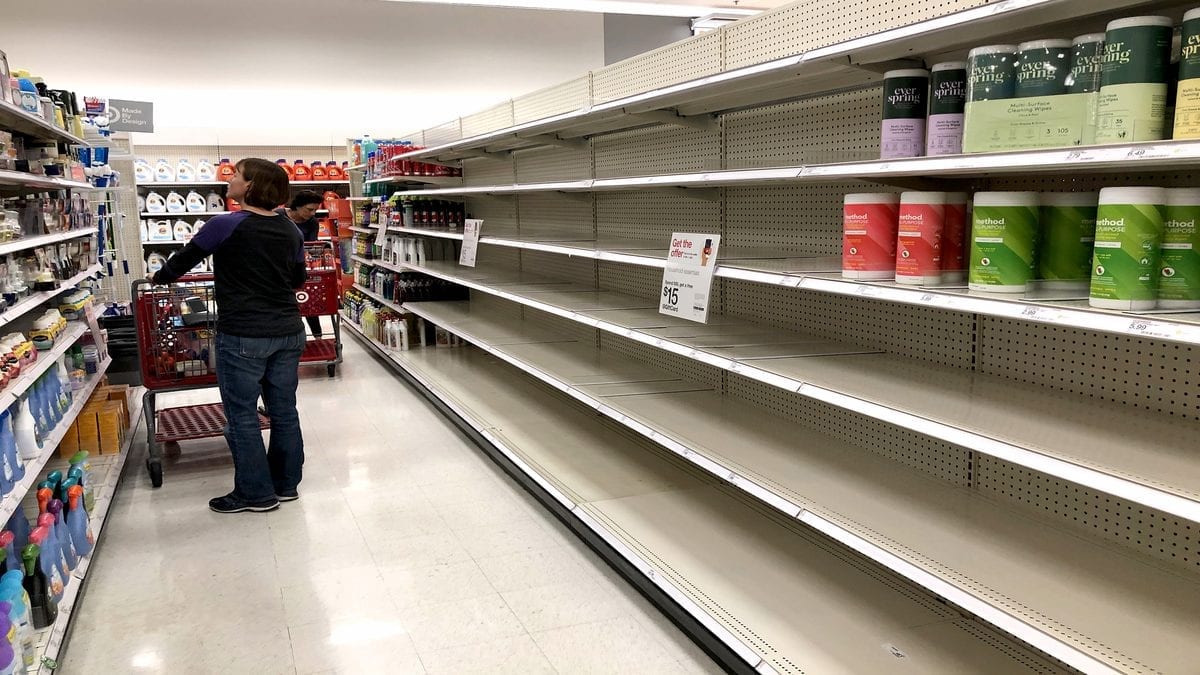
Featuring an unnamed person “so angry with [Tesco] rearranging its shelves during the coronavirus lockdown that they have vowed never to shop there again,” the story focused on the vitally important fact that said individual had to “back-track and walk around unnecessarily looking for products.”
The customer concerned – who unsurprisingly “wished to remain anonymous” given the amount of stick they subsequently got on the Facebook group Angry People in Local Newspapers – managed to find everything they’d set out to buy in spite of the alterations, yet ranted:
“This practice of reorganising shelves is highly annoying in peace time, but is it really sensible and safe to do this during a highly contagious, killer pandemic?”
“We, along with the majority of other people, are adhering to the rules. We don’t want to catch this awful virus or, worse still, be in any way responsible for the suffering or death of others.”
“I felt very strongly that the midst of this awful pandemic is not the time to re-organise the shelves!”
Amongst the 215 comments on APILN, one ‘top fan’ named Whitby Vlad remarked: “Anyone who invokes WW2 imagery for any reason, apart from either objective academic analysis or to highlight the cost of human suffering caused by global conflict, is the sort of person that would have been right on the phone to the Gestapo to say Mrs Smith at number 4 must have black market butter, had the Germans invaded.”
Of the “plonker” complainer, another, Mike Lewis, added: “Since I don’t know where anything is, in Tesco, apart from the booze, I would not notice them doing such a wicked thing” whilst another ‘top fan,’ Steve Larrad, quite correctly concluded: “Christ, that was a harrowing read.”
A Sorry Shelf Saga – The unnamed angry shopper had visited the Weston Favell Tesco Extra store at 6am “to avoid other shoppers” and had found “walking around stressful.” They furiously told the ‘Northampton Chronicle & Echo’s’ Jack Duggan: “I have tried to get a satisfactory response from Tesco but to no avail. I will never shop there again.”A Sorry Shelf Saga – Said shopper plainly wouldn’t approve of the late Dale Winton’s ‘Supermarket Sweep’ style of shopping and would also have got very angry about Tesco’s March 2020 ‘fish finger f**kup’ as well.
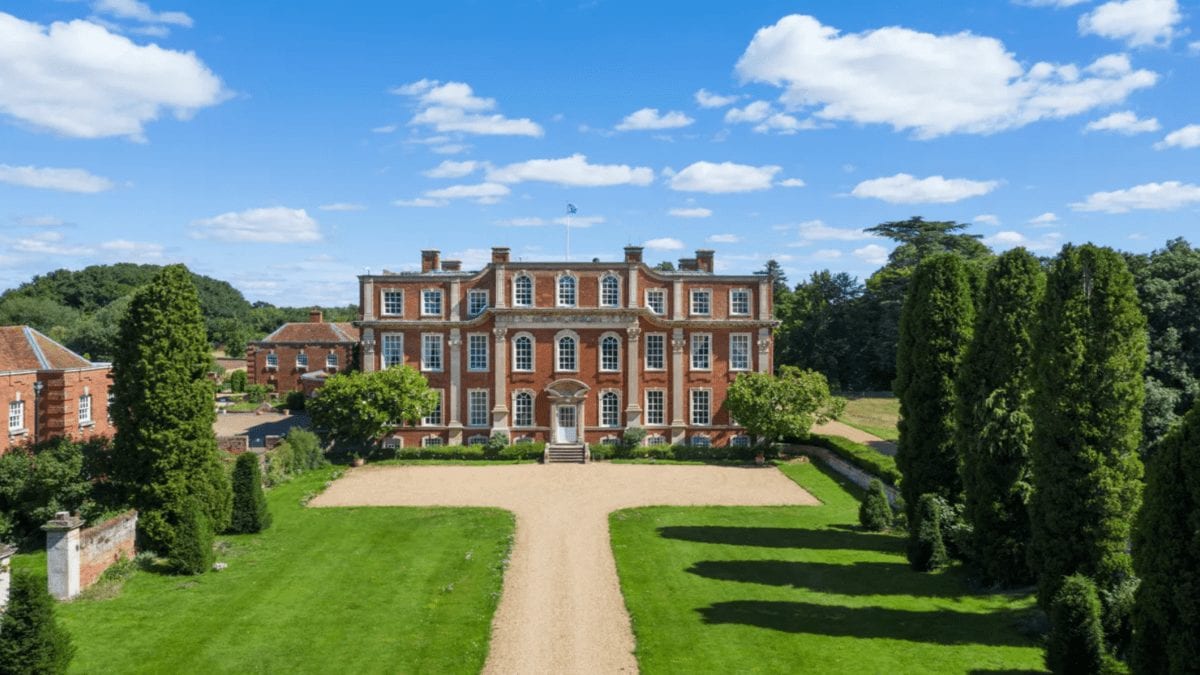
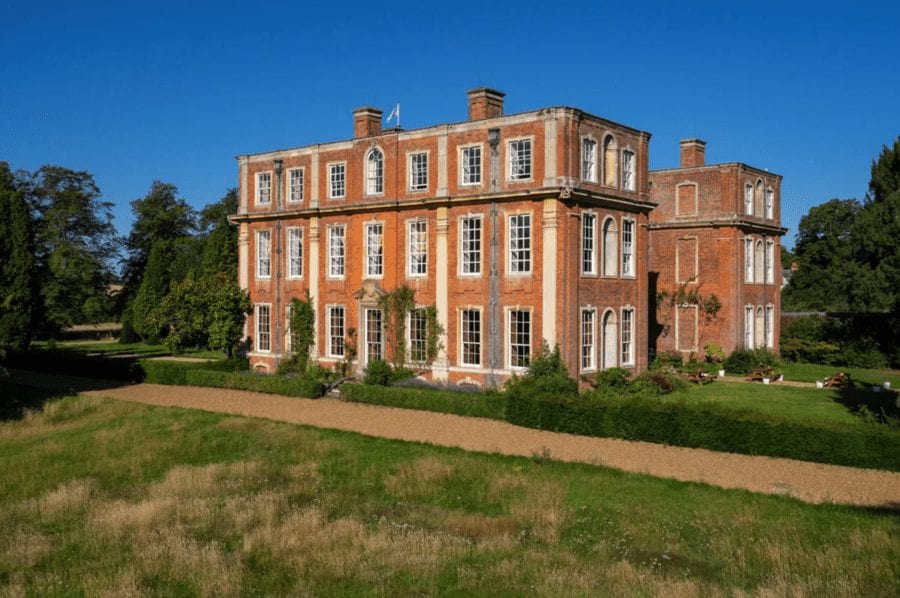
Grade I listed Baroque mansion Chicheley Hall in Buckinghamshire for sale for £7 million or 62% less than the current owners have spent on it
Just as historically significant as the £10 million Lilford Hall in nearby Northamptonshire we featured in June, but in far better condition, a Grade I listed mansion in Buckinghamshire has just come to the market for £3 million less.
Chicheley Hall, near Olney is being sold due to the activities there – a combination of a conference venue, hotel and a centre used by the Royal Society – being curtailed due to the impact of the coronavirus pandemic. It is offered for the sum of £7 million – which seems a relative bargain given its current owners paid £6.5 million for it in 2007 and spent a further £12 million on its renovation subsequently.
Constructed on the site of an earlier house destroyed in the Civil War in the 1720s to the designs of master builder Francis Smith, Chicheley Hall became the seat of Sir John Chester, the 4th baronet. It is of nine bays on three floors upon a raised basement and is described as an “exceedingly rare example” of English Baroque architecture.
“For more than 100 years, architectural historians have waxed lyrical in the pages of Country Life of Chicheley Hall” remarked Penny Churchill when it was placed for sale in June 2007 and since 2009 it has been owned by the Royal Society.
Knight Frank market the 34,928 square foot freehold property as a whole or in three lots complete with 75 acres. They describe the mini-estate as including “beautiful formal gardens, a ‘3 sided’ lake, a walled garden, woodland walks, a Grade II* dovecote and farmland.”
Chicheley Hall is situated 7 miles north east of Milton Keynes and is 50 miles from both central London and Oxford.
The Names & Numbers – Chicheley Hall, Hall Lane, Chicheley, near Olney, Newport Pagnell, Buckinghamshire, MK16 9JJ, United Kingdom
September 2020 – For sale for £7 million ($9.1 million, €7.7 million or درهم12.6 million) through Knight Frank.
June 2020 – De Vere Venues permanently closed Chicheley Hall as a conference venue and hotel due to the impact of coronavirus. In a statement to MKFM, the firm remarked: “Sadly the resulting devastating economic impact [of the pandemic] on the hospitality industry, together with heightened operational restrictions, has meant we have taken the difficult decision to close our doors permanently.”
2007 – Sold to the Royal Society for £6.5 million ($8.5 million, €7.2 million or درهم31.1 million). They supposedly subsequently spent £12 million ($15.6 million, €13.3 million or درهم57.5 million) on renovations. These were in part funded by the Norwegian-American business and philanthropist Fred Kavli (1927 – 2013).
June 2007 – Placed for sale for £9 million ($11.7 million, €10 million or درهم43.1 million) through Savills on behalf of Nicholas Beatty, the 3rd Earl (born 1946).
2001 – Used as a stand-in for Bletchley Park in the feature film Enigma. The building has also been used in other productions including Pride and Prejudice, The Meaning of Life, The Red Violin and Black Beauty.
1952 – Ownership by the Chester family ends when David Beatty, 2nd Earl Beatty (1905 – 1972), son of First World War naval hero Admiral David Beatty, bought the hall. Of his “major restoration programme,” Penny Churchill remarked: “Interior designer Felix Harbord, perhaps best known for his work at Luttrellstown Castle near Dublin, set out to recreate classic 18th-century interiors, using mainly light colours to accentuate the beauty of the mouldings and panelling. Very sensibly, the earl also added a bathroom to almost every bedroom.”
1939 to 1945 – Chicheley Hall was used by the Special Operations Executive as its Special Training School No. 46, by Czechoslovaks for SOE parachute missions and as a FANY wireless telegraphy school. After the war, the hall was converted for use as a school.
1720 to 1724 – Built by Sir John Chester, 4th baronet on the site of an earlier mansion to the designs of master-builder Francis Smith of Warwick. According to Country Life’s Penny Churchill, “a total of 955,550 bricks was used in the construction of the house, wings and garden, of which a staggering 85,000 were used for the garden walls.” She added: “For the next four years, Sir John himself paid the various master-craftsmen who worked on the interiors. The result was some of the finest woodcarving, joinery and plaster-work to be found in any English country house of that period. The elegant formal gardens were laid out by George London and Henry Wise, of Hampton Court and Melbourne Hall fame.”
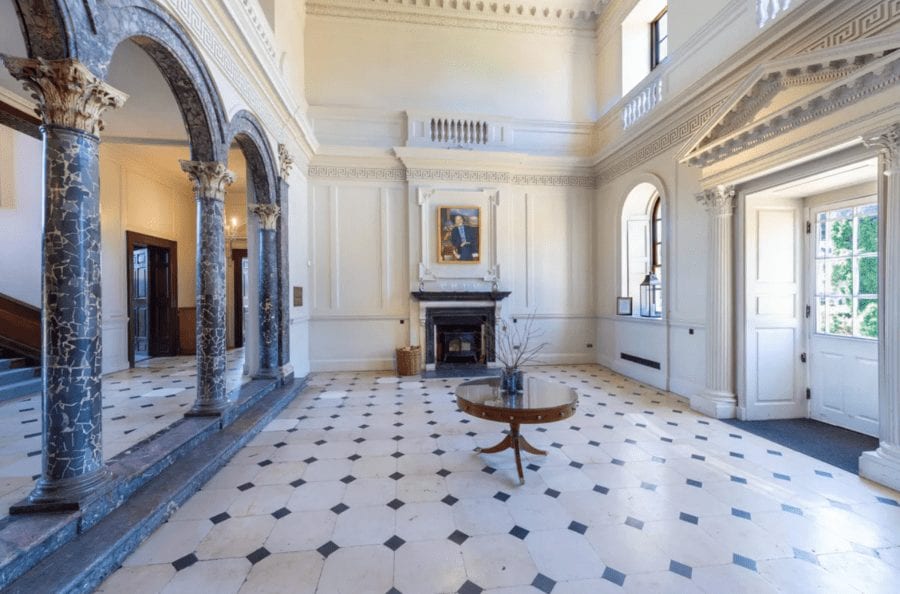
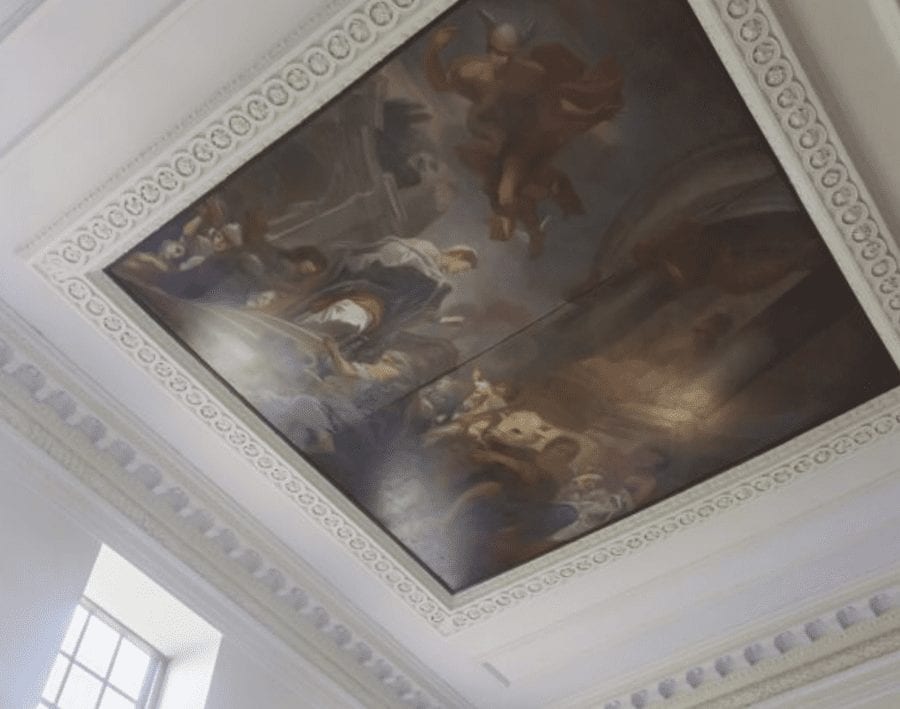
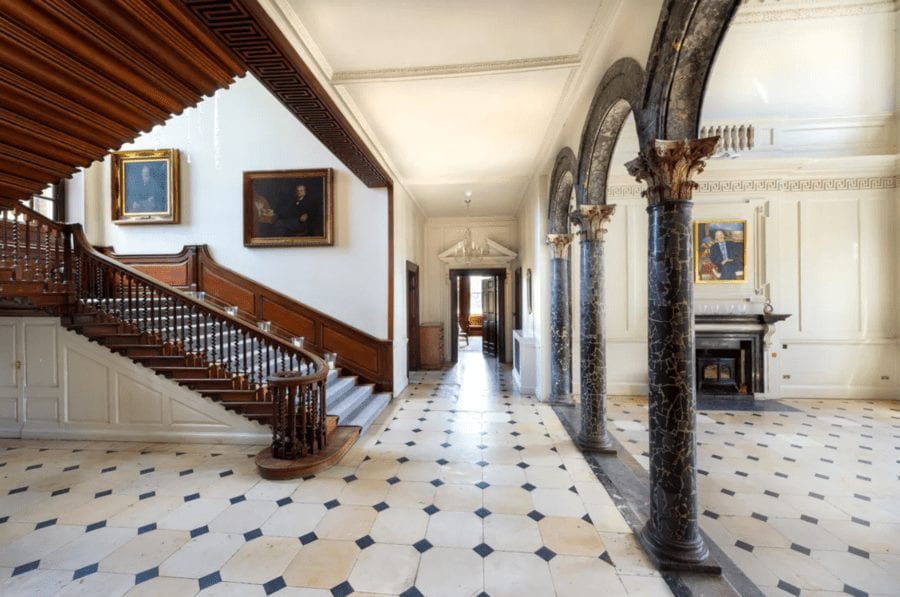
The entrance hall of the house is impressive. English Heritage remark of it: “Entrance hall with Corinthian surround to front door and triple arched screen with marble columns leading to staircase, said to be designed by Flitcroft when working for Kent. Ceiling painting attributed to Kent.”The ceiling painting is attributed to William Kent and depicts Herse and her sisters sacrificing to Flora.Continuing, there is an especially wide staircase beyond.One of many reception rooms.The dining room is dominated by wooden panelling.Another entertaining space.In its last use as a hotel and conference centre, a total of 48 bedroom suites were created within the property.This former coach house is currently configured as two large conference suites and a meeting room.One of two lecture theatres currently on-site.A conference room.Another view of the exterior of Chicheley Hall.Viewed from across the ‘three sided lake.’An aerial shot of part of the 75-acre mini estate.And from another angle.Formal gardens.A plan of part of the Chicheley Hall site.
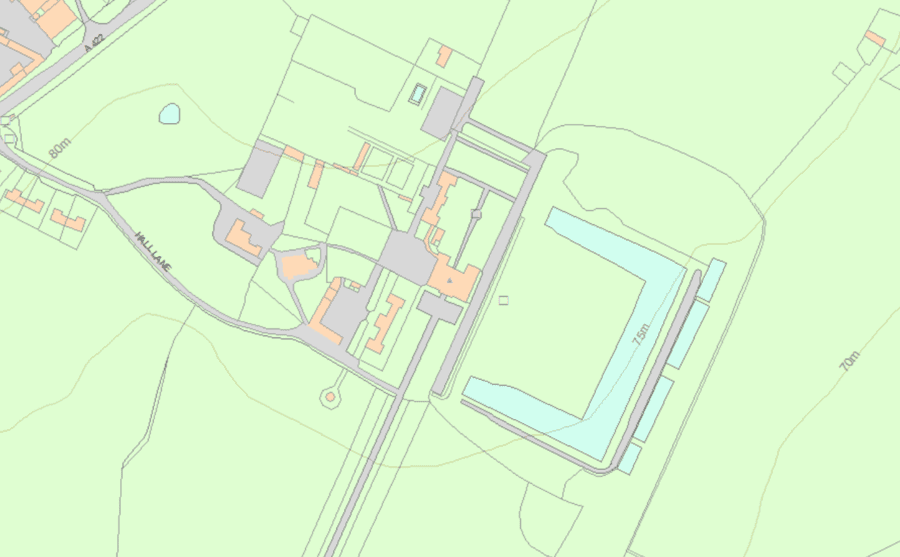
Cambridgeshire mansion used by Special Operations Executives in the Second World War and as a borstal subsequently for sale; Gaynes Hall is next to the prison that housed Max Clifford and was briefly a cannabis farm in 2019
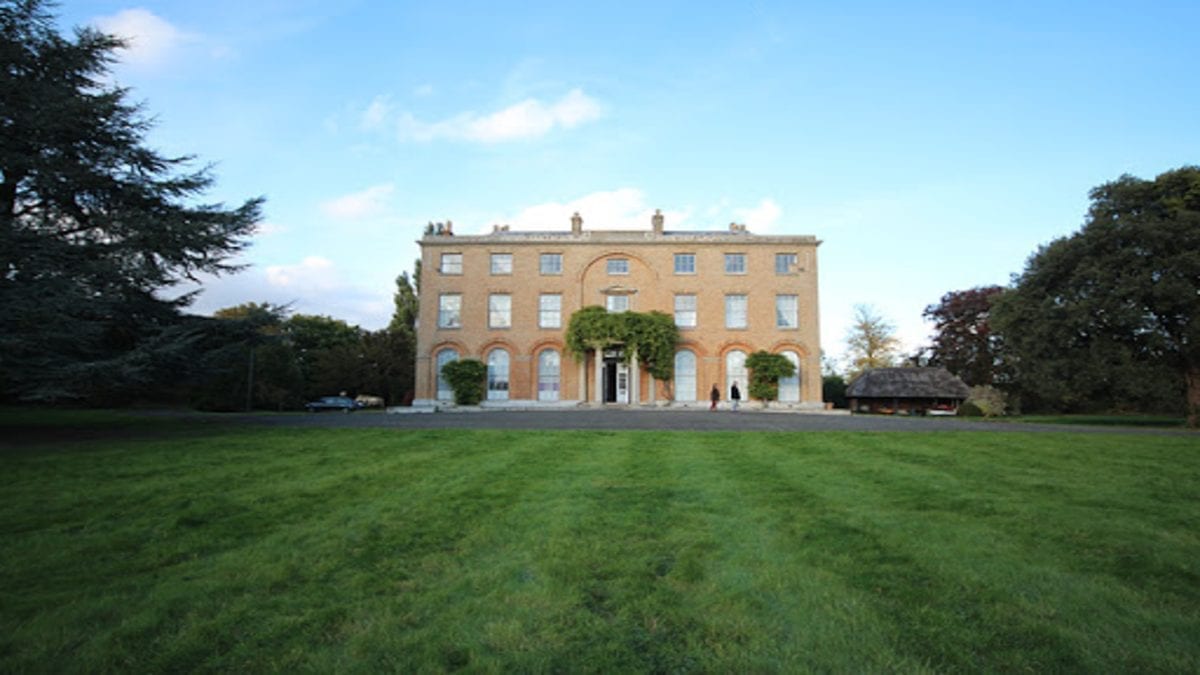
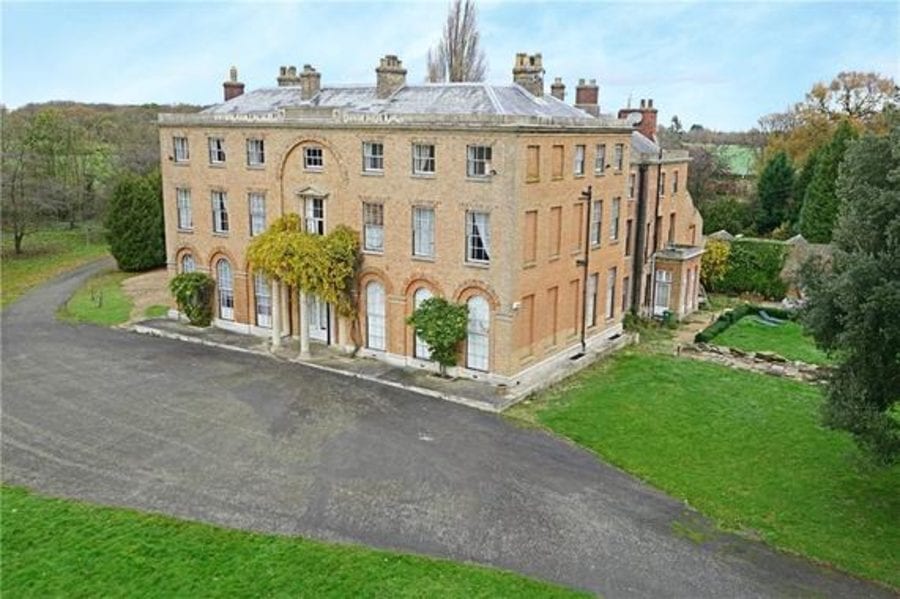
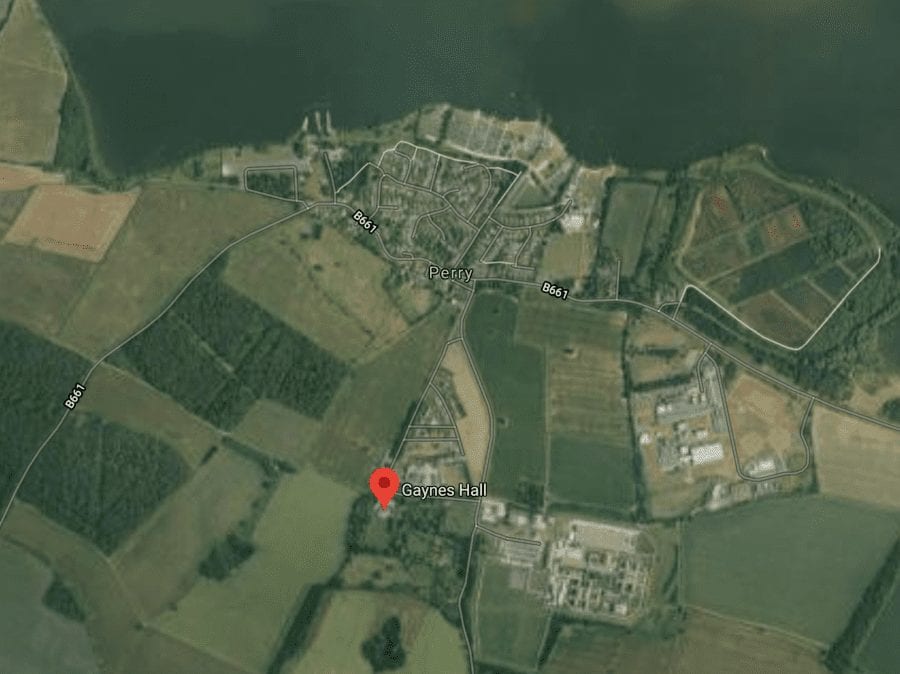
Grade II* listed Georgian mansion in Cambridgeshire for sale for £2.65 million in spite of being in far from perfect condition and next door to a prison housing 1,220 convicted sex offenders.
The estate was owned by the aristocratic Duberly family from 1798 until 1940. An earlier house on the house had been home to Oliver Cromwell’s namesake and uncle.
It was requisitioned in the Second World War by the Special Operations Executive. Hitler was so annoyed by the operations at Gaynes Hall that he supposedly nicknamed the place “the hornet’s nest.”
After the war, the hall became a borstal and after that closed, part of the estate became HM Prison Littlehey – famous for housing PR ‘guru’ Max Clifford, victim of a miscarriage of justiceStephen Downing and Australian cricketer Alex Hepburn.
More recently, the estate came to public attention after being discovered to be the centre of operations for drug lords. £250,000 of cannabis were seized there in 2019.
In June 2019, once ritzy Gaynes Hall at Perry, near Huntingdon in Cambridgeshire came to public attention when a drugs baron who’d turned part of the building into a cannabis farm was jailed. For his troubles, Nebir Tahiraj was relieved of £250,000 of drugs and ‘gained’ a sentence of 13 months.
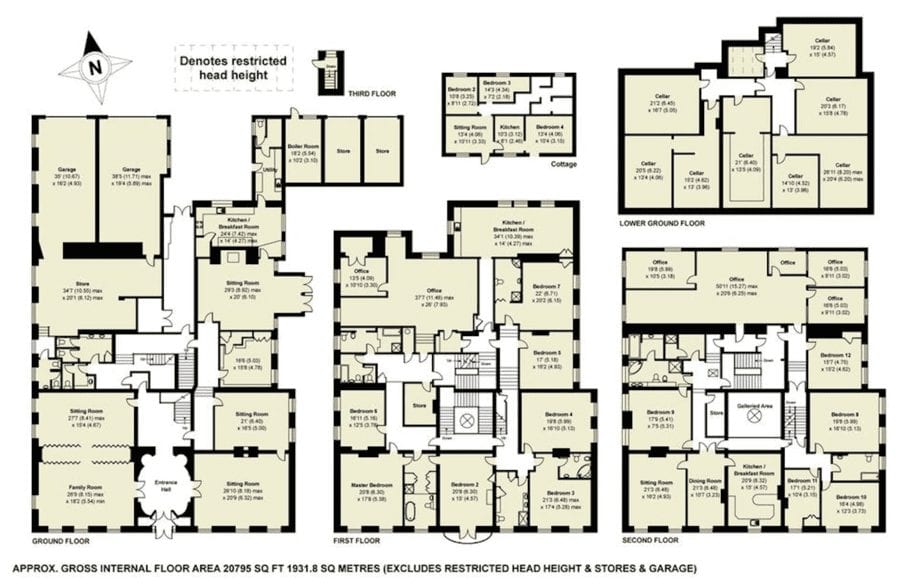
Grade II* listed and built circa 1800 for Sir James Duberly (1758 – 1832), the gault brick house was originally plaster rendered. Of three storeys plus cellars and seven bays, the 20,795 square foot building is currently being marketed by agents Wilson Peacock for £2.65 million – up from £2.2 million back in 2019.
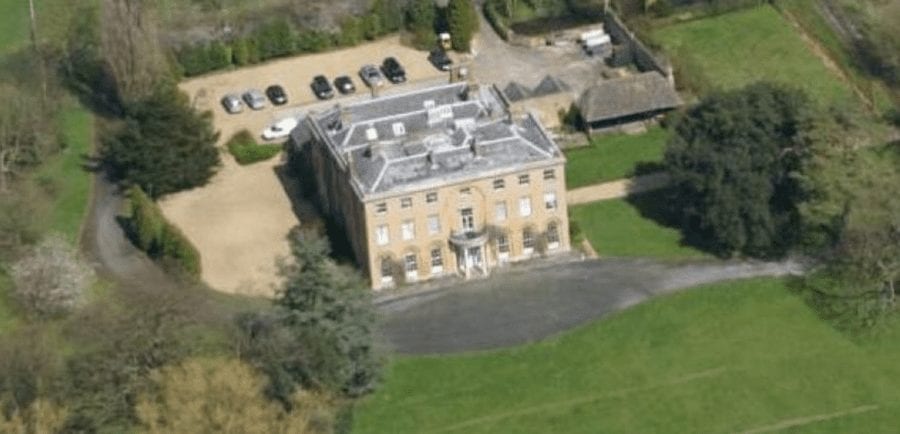
Gaynes Hall (also known as ‘Gaines Hall’ occasionally) stands in 16 acres of grounds including lakes and a moat and comes with a three bedroom cottage “requiring full modernisation and refurbishment.” It was home to the Duberly family until 1940 when it was requisitioned by Special Operations Executives (SOE) on the instructions of Winston Churchill.
Supposedly, according to the local Parish Council’s website, Hitler was so exasperated by the activities at Gaynes Park that he referenced the house “the hornet’s nest.” It was known locally during this period as a “spy school” and its master, Wing Commander Thomas Odett, was nicknamed ‘The White Rabbit’ on the basis that “he was always popping up in unexpected places.”
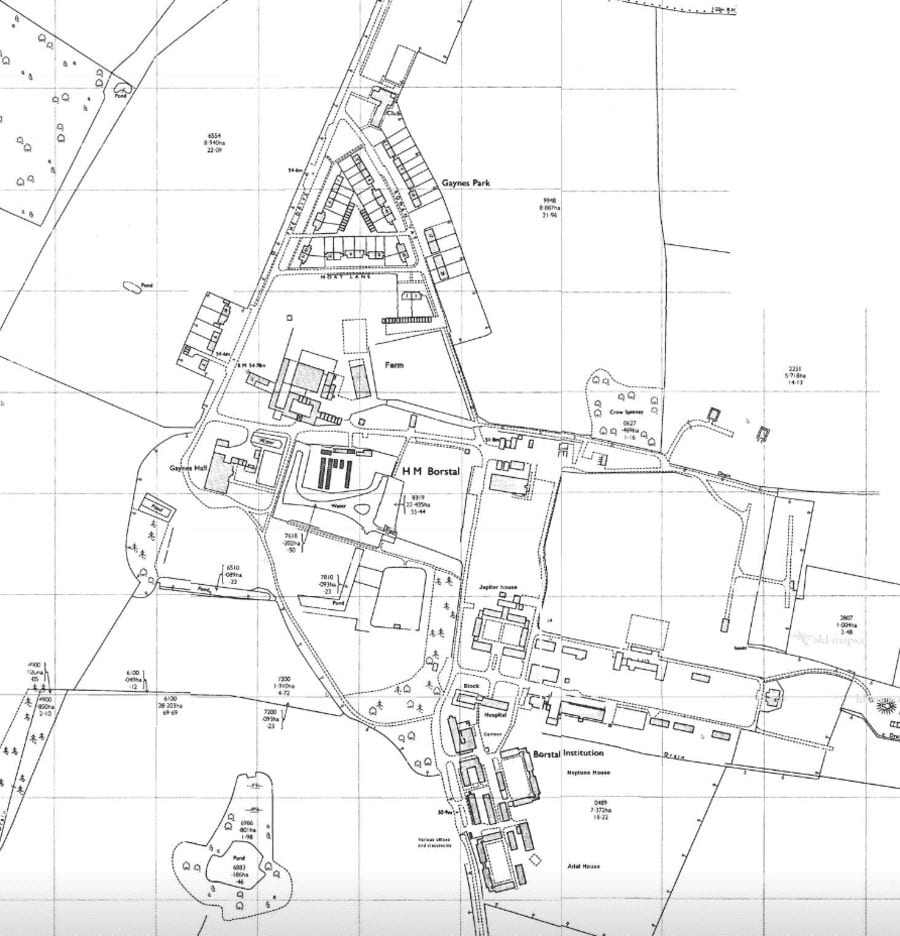
After the war, the mansion became the governor’s residence and administrative offices of the newly created Her Majesty’s Borstal Gaynes Hall and remained in that use until 1983 when the borstal closed. Her Majesty’s Prison Littlehey, which is best known as the place of death of the public relations ‘guru’ paedophile Max Clifford, was subsequently opened next door and residents of Perry get to hear its sirens periodically if a prisoner escapes or there is a disturbance.
In 1985, AIM Cambridge (later AIM Technology) leased the hall and from the Ministry of Defence and converted it into offices. When their business failed, the building became empty and in 1990, Gaynes Hall was sold again. In the years since, it has been in mixed use.
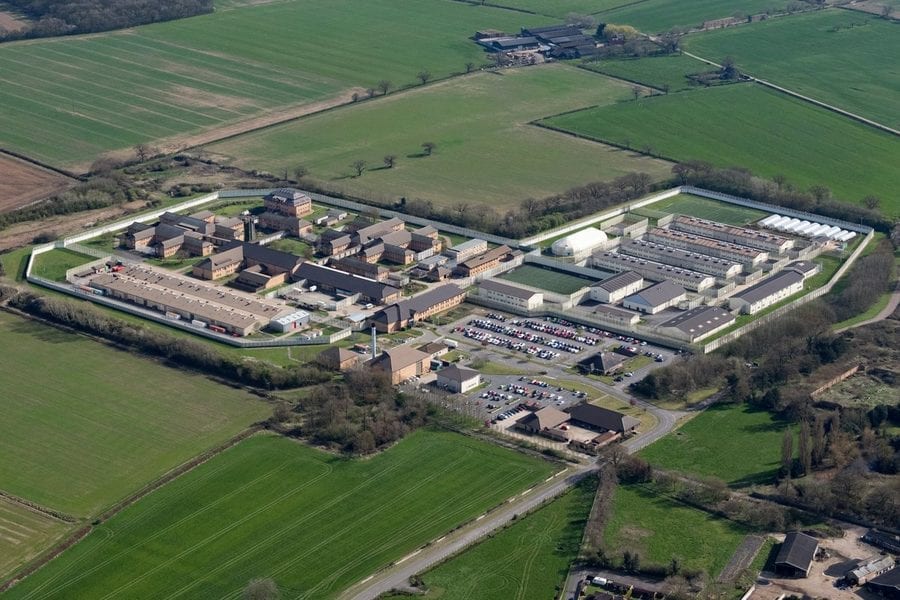
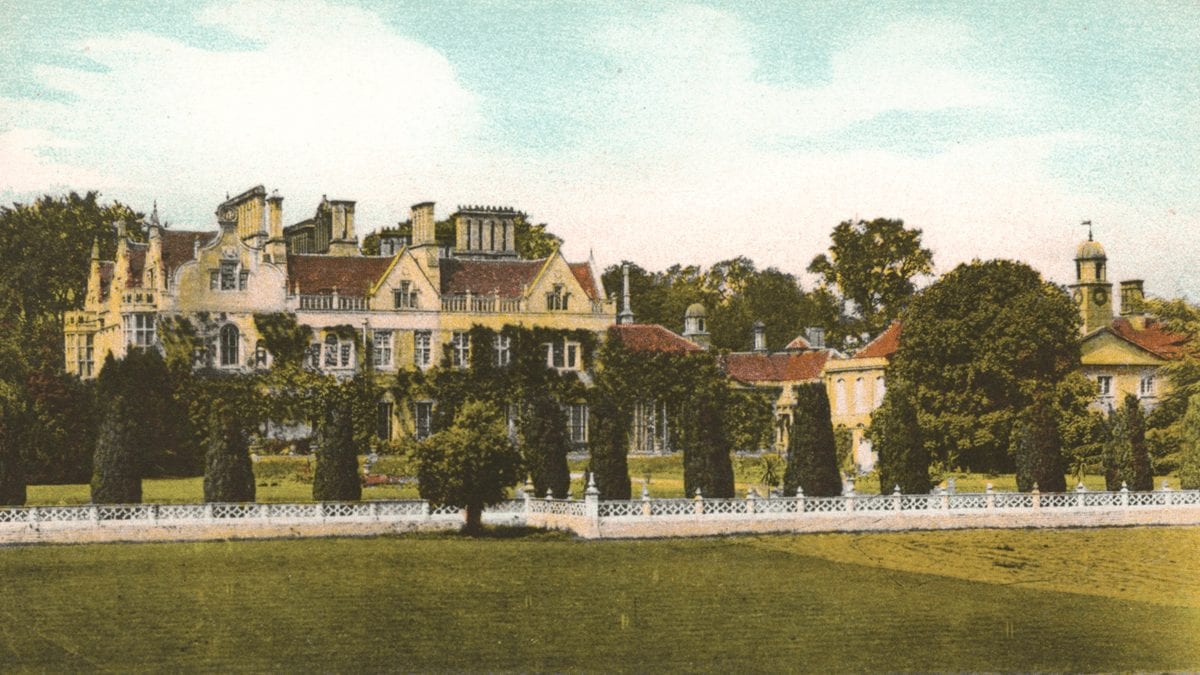
In need of some attention – Gaynes Hall has variously been used as a grand residence by aristocracy, requisitioned for use by Special Services Executives (SOE), served as an administrative office and governor’s house for a borstal and been converted to offices. It is currently configured in ‘mixed-use’ format and includes 20,975 square foot of accommodation.An aristocratic drug farm – Nebir Tahiraj was imprisoned in 2019 after having turned part of Gaynes Hall into a cannabis farm. He was caught with over £250,000 of drugs on the premises after neighbours complained about the noxious smell.Proximity to a prison – An aerial view of Her Majesty’s Prison Littlehey. Gaynes Hall is situated just to the west.Rapists next door – Convicted rapist and ex-cricketer cricketer Alex Hepburn, Stephen Downing (whose conviction for murder was overturned in 2002 after he had served 27 years in prison) and paedophile Max Clifford (who died in the prison) are connected by having been imprisoned at the Category C male prison HM Prison Littlehey. It has a capacity for 1,200 male prisoners – who all have been convicted of sexual offences.A once grand gentleman’s residence – Gaynes Hall in an image taken circa 1913. An earlier house on the site was leased for 21 years by Sir Oliver Cromwell (1566 – 1655), the uncle and namesake of the lord protector, from 1599.
The Names & Numbers – Gaynes Hall, Perry, Great Staughton, Huntingdon, Cambridgeshire, PE28 0ST, United Kingdom
December 2019 – Listed for sale by Wilson Peacock Country Homes at the increased price of £2.65 million ($3.35 million, €2.96 million or درهم12.32 million).
14th June 2019 – 35-yeard old Nebir Tahiraj found guilty at Cambridge Crown Court of “being concerned in the production of cannabis” in his flat at Gaynes Hall and jailed for 13 months. When police raided the property, they “found more than 200 plants at varying stages of growth, growing equipment and two large bags of cannabis ready to be sold” worth circa £250,000 ($316,000, €279,000 or درهم1.2 million). He attempted to claim “he was being exploited and kept at the flat against his will,” but the National Crime Agency (NCA) discovered he had been willingly involved.
Mid 2019 – For Sale for £2.2 million ($2.8 million, €2.5 million or درهم10.2 million) through Michael Graham.
March 2019 – Fleet Assist announce they will be moving their business from Gaynes Hall to Ermine Business Park in Huntingdon.
2002 – Purchased by the Malik family (according to Wikipedia).
1994 – 2002 – Owned by the McCallion family (according to Wikipedia).
1985 – Converted to offices and used by firms including AIM Cambridge (AIM Technology) and Fleet Assist in the years subsequently. Part-let as apartments and by the room also for residential use.
1945 – 1983 – Used as the governor’s residence and administrative officers of the Her Majesty’s Borstal Gaynes Hall. ‘Boys’ who were detained there have recounted their experiences on this fascinating Facebook page; it plainly was not an especially pleasant place.
1940 – Requisitioned for use by Special Operations Executive (SOE). Gaynes Hall – under the codename ‘Station 61’ – became the headquarters for Air Liason Officers and used as a ‘hotel’ for them prior to their being dropped into occupied Europe.
1798 – 1940 – Owned by the Duberly family. The present house was constructed for them circa 1800 to the designs of architect George Byfield (circa 1756 – 1813).
Crumbling Northamptonshire estate Lilford Hall – where the little owl was introduced to Britain – for sale for £10 million, a sum £35 million lower than in 2014
Grade I listed Jacobean mansion with 13 chimney stacks for sale for £10 million; it was for sale last for £44.9 million in 2014 in spite of being listed on English Heritage’s ‘At Risk Register.’
Lilford Hall – parts of which have not been occupied since 1947 –is currently owned by a businessman who tried to sell burial plots in the grounds for £1,250 a pop and shares in a yacht loosely associated with Frank Sinatra for £23 each.
The 321-acre estate includes not only overgrown parkland, but also a zoo with cages that formerly housed bears and a lake for flamingos.
From 1711 until 1990, Lilford House was the seat of the Powys family – the 4th baron is credited with introducing the little owl to the UK.
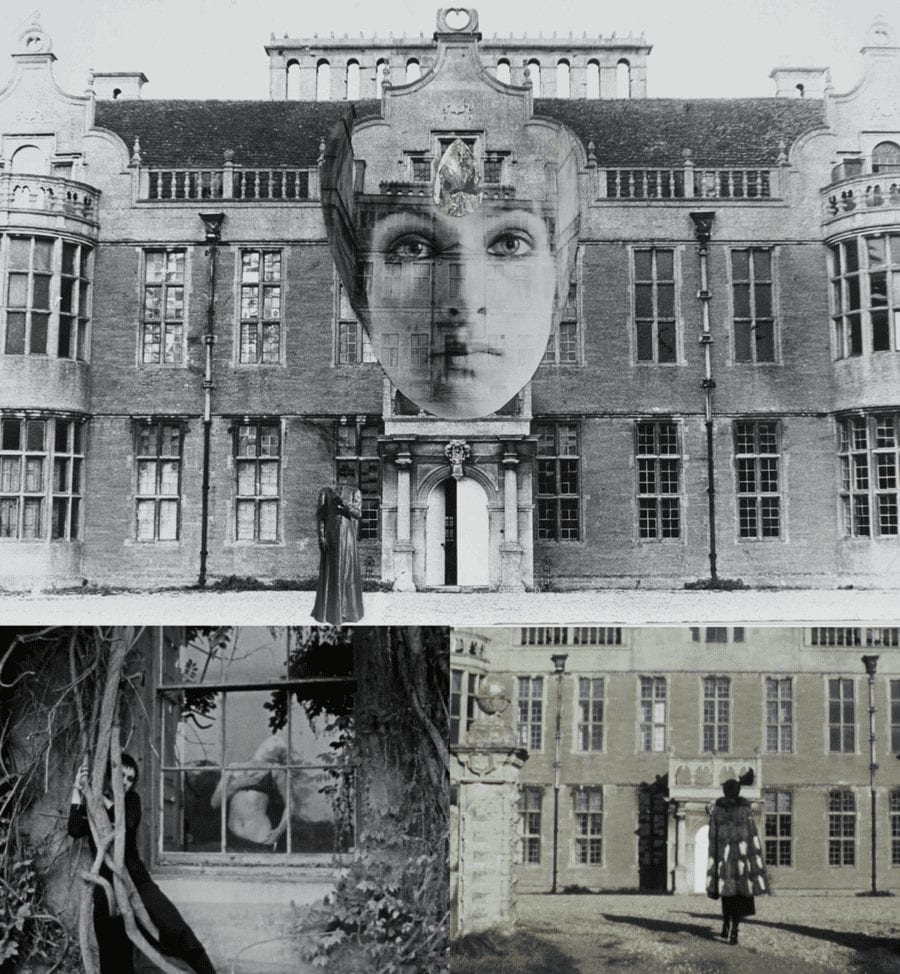
More recently, in 1969, the “sexual mystic” artist Penny Slinger used the at-the-time derelict mansion in one of her best-known works.
A 32,406 square foot Grade I listed Jacobean mansion 82 miles from Central London has gone on sale for £10 million – or the equivalent of just £308 per square foot.
On this basis, Lilford Hall – set in 321 acres near Oundle – seems a comparative bargain when considered against the £4,786 per square foot sought for a Lennox Gardens, Knightsbridge triplex flatThe Steeple Times featured in May, but buyers need to remember this – parts of this crumbling building, most notably the major state rooms, have not been used since 1947.
Marketed last in 2014 for the even more punchy sum of £45 million, the “exceptional residential and amenity estate located on the River Nene,” is now offered by agents Savills. The “wonderfully proportioned” U-shaped mansion itself is constructed of grey limestone and includes over 100 rooms and amongst them are 7 “impressive” reception rooms, a ballroom, a ‘great chamber’ and 9 bedrooms. In addition, there are two Georgian pavilions that were formerly coach houses and stabling, three cottages, a former zoo, the oldest private softball court in the world, a former flamingo enclosure and a deer park.
“Impressiveness in the chief attribute of Lilford Hall as a specimen of architecture” claimed County Life in 1990 and as the seat of the Powys family from 1711 until 1990, it became not only a Downton Abbey-esque entertaining pad, but also housed nurses in the Second World War. Here, indeed, is an English country house that has seen lavishness and decline and thankfully here is an example that thankfully escaped the wrecking ball wrought so disgracefully on such houses in the 1950s and 1960s.
Fascinatingly in the 1880s, Thomas Powys, 4th Baron Lilford filled his aviaries on the estate with rheas, kiwis, pink-headed ducks, free-flying lammergeiers and it was from here that he also introduced the little owl into the UK. There are said to be around 5,700 breeding pairs today, but sadly, according to the RSPB, their numbers are now in decline.
More recently, in 1969, “sexually erotic” performance artist Penny Slinger took over the by then “derelict” mansion in conjunction with the filmmaker Peter Whitehead. Their resulting work, titled An Exorcism, was exhibited internationally and in 2004, after the current owners, Charles and Aziza Micklewright, acquired the house, they did something equally avant-garde; they attempted to sell burial plots in the grounds to Americans by citing the estate’s connections to the founder of the Brownists, Robert Browne – a man better known as ‘The Father of the Pilgrims’ and ‘The Grandfather of the Nation’ (of the United States of America).
Whilst Mr and Mrs Micklewright were lauded for their considerable efforts towards the “huge task” of restoring Lilford Hall, they came to the attention of Historic England in May 2019 when the building was listed on the At Risk Register. At that time, the Oundle Chronicle reported: “The roof covering is in poor condition leading to water ingress and distress to the upper storeys. The front bays require structural attention. A schedule of urgent repairs has been identified but not implemented, and no long-term solution has been agreed.”
Now, someone with very, very deep pockets is required to restore this gem. It would be helpful if they liked erotic art, bears, squash and owls also.
The Names & Numbers – The Lilford Hall Estate, Lilford, Oundle, Peterborough, Northamptonshire, PE8 5SG, United Kingdom
June 2020 – The estate is listed sale for £10 million ($12.5 million, €11.1 million or درهم46 million) through Savills. It includes 321.31 acres, of which 148.17 acres are pasture land whilst 157.48 acres are woodland. The majority of the estate is held on a freehold title, whilst the remaining 127.6 acres – known as ‘The Linches’ and ‘Lilford Woods’ – are held on a lease with 91 years remaining.
2015 – Promoted as ‘The National Memorial Gardens,’ burial plots in the gardens of the hall were offered “available to any UK resident or national for an outstanding price of only £1,250 ($1,568, €1,393 or درهم5,758)” by Mark Bailey of Harley Investments. Around the same time, a website dedicated to Lilford Hall marketed “a piece of the formal gardens” for sale for £299 ($375, €333 or درهم1,377) to include “an officially certified ‘Squire of Lilford’ [title] … with this little piece of history.”
March 2014 – The Irish Times reported that the asking price for the estate had been increased to £44.9 million ($56.3 million, €50 million or 206.8درهم million). They claimed the agents Coldwell Banker blamed “confusion over currency conversion rates and new instructions from the owner.”
April 2014 – The Lilford Hall Estate is listed for sale through Coldwell Banker on MyHome.ie for £33.7 million ($44.2 million, €37.5 million or درهم155 million) on behalf of “an English gentleman.”
2004 – The estate is acquired by the Micklewright family. Little information is available online about the Old Framlingham Charles Micklewright (born July 1958), but he is described as a “patent attorney” on Companies Houses pages. The businessman is mentioned also as a publisher and trustee of the Marsh Christian Trust elsewhere, whilst his Singaporean born wife, Aziza (born 1964), was a director of Lilford Properties Limited from 2013 to 2018.
A website operated by Sign of the Times Limited, a Hong Kong company of Lilford Hall, Lilford, Oundle, Northamptonshire, PE8 5SG, currently offers shares in a yacht named ‘Sinatra the Voice’ for £23.91 ($29.99, €26.64 or درهم110.14) per share. The boat was built in 1956 and is tenuously linked to Frank Sinatra by the fact that a one-time owner, Beale Poste, loaned it occasionally to the crooner between 1968 and 1974 in West Palm Beach, Florida.
1990 – The estate is closed to the public.
1980s – The house is used as a location in the BBC English Civil War inspired historical drama series By the Sword Divided.
1970s – Aviaries on the estate restocked by George Powys, 7th Baron Lilford (1931 – 2005). He “opened [the estate] to the public as a leisure park” and housed more than 350 birds of 110 species there. It remained thus for around 20 years and included a restaurant and shop. The aviaries and the 1,896 square foot restaurant building remain present still today.
1969 – 1970 – American British “sexual mystic” artist Penny Slinger (born 1947) and Liverpudlian filmmaker Peter Whitehead used the “derelict mansion” as the setting for their works An Exorcism and Lilford Hall. They are lauded as a “photo romance” and exhibited at the Blum and Poe Gallery in Los Angeles in 2014, at the Haywood Gallery in London in 2015 and at the Fortnight Institute in New York in 2019.
1949 – Stephen Powys, 6th Baron Lilford (1869 – 1949) died without having married or having had children. His properties aside from Lilford – a house in Mayfair, Bank Hall in Lancashire and the Bewsey Estate in Cheshire – passed to his second cousin twice removed.
1947 – The estate is sold to a company named Merchant Ventures by the Powys family (though they remain present on the estate until 1990).
1939 – 1945 – During the Second World War, the parkland of the estate was used as a military hospital for nearby airfields. From 1949 to 1954, some of the buildings constructed during this period were then used as a Polish school.
1923 – First-class Northamptonshire cricketer Major John Powys, 5th Baron Lilford (1863 – 1945) built the first private softball court in the world in the grounds of the hall. It is now in disrepair and the roof has fallen into the inner court.
1909 – 1910 – The hall was extended in the Edwardian manner including the provision of a new master bedroom with dressing room and bathroom by William Dunn and Robert Watson of Dunn & Watson.
1901 – The estate surrounding the hall reaches its largest size and totals a vast 8,000 acres of land. Around this time, Queen Mary, wife of King George V, is said to have visited the gardens.
1880s – Ornithologist and expert on the fauna of the Balearics Thomas Littleton Powys, 4th Baron Lilford (1833 – 1896) introduces the little owl into England on the estate. His aviaries were said to “feature exotic birds from all around the world” and a species of European lizard, the Lilford’s wall lizard (Podarcis lilfordi), is named in his honour. The 4th baron is repeatedly mentioned in the works of Charles Darwin for his contribution to the study of the science of evolution.
1840s – Further changes to the building are orchestrated by the architect William Gilbee Habershon (circa 1818 – 1891). The Campaign to Protect Rural England described these Victorian extensions as “sensitive” in 2006 – a rare accolade given most additions to English country houses during this period were simply brash and vulgar.
1740s – The Palladian architect Henry Flitcroft (1697 – 1769) adds “outstanding” Georgian interiors whilst “respecting the hall’s Jacobean exterior.” He “softened and brightened” the building as a result and also “constructed the Georgian pavilions and additional storeys to the east end of the two wings.” Other works by Flitcroft can be seen at Bower House in Essex, Wentworth Woodhouse in Yorkshire and Woburn Abbey in Bedfordshire.
1711 – Lilford Hall is sold to the judge and Tory politician Sir Thomas Powys (1649 – 1719), Attorney General to King James II. Powys is best remembered for conducting the prosecution of the Seven Bishops in 1699. He is buried at Lilford.
1630s – Construction of the main exterior of what to this day remains Lilford Hall as a “Jacobean-style gentry house” by William Elmes (the younger).
1473 – The land that forms the estate is acquired by William Browne (1410 – 1489), a wealthy wool merchant and landowner from Stamford, from the estate of Baron Welles (who was beheaded by King Edward IV for treason). In 1495, “in a Tudor style,” he built a hall on the site and it passed to Robert Browne (1550 – 1633), the founder of the Brownists, ‘The Father of the Pilgrims’ and ‘The Grandfather of the Nation’ (of the United States of America).
Coastal ‘estate’ with its own lighthouse perched on The Front above the White Cliffs of Dover for sale; it was used in scenes featuring Oliver Reed in ‘The Shuttered Room’
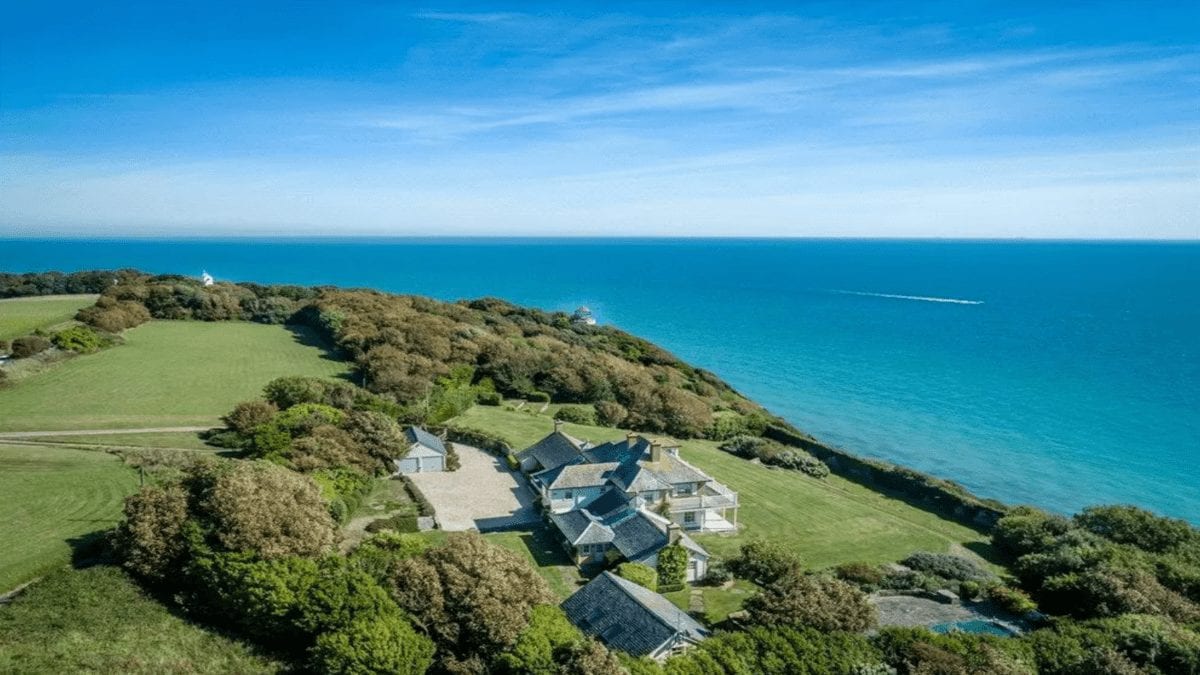
In November 2013, The Steeple Times featured the sale of ‘The South Foreland Estate’ for £4 million. Its price bizarrely had been increased by £500,000 from when it was on the market earlier that year and now it is again being promoted – this time for an even more punchy sum of £5 million.
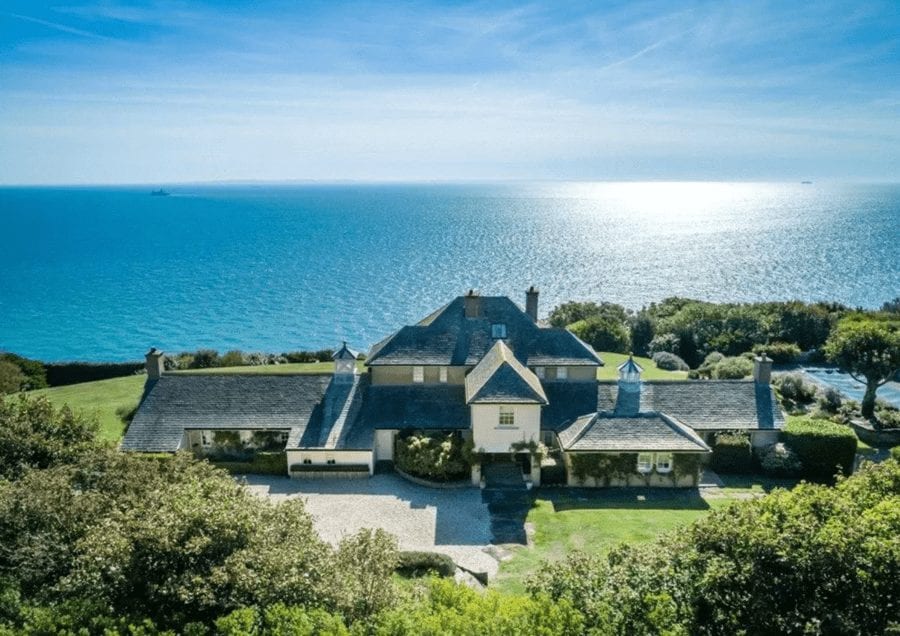
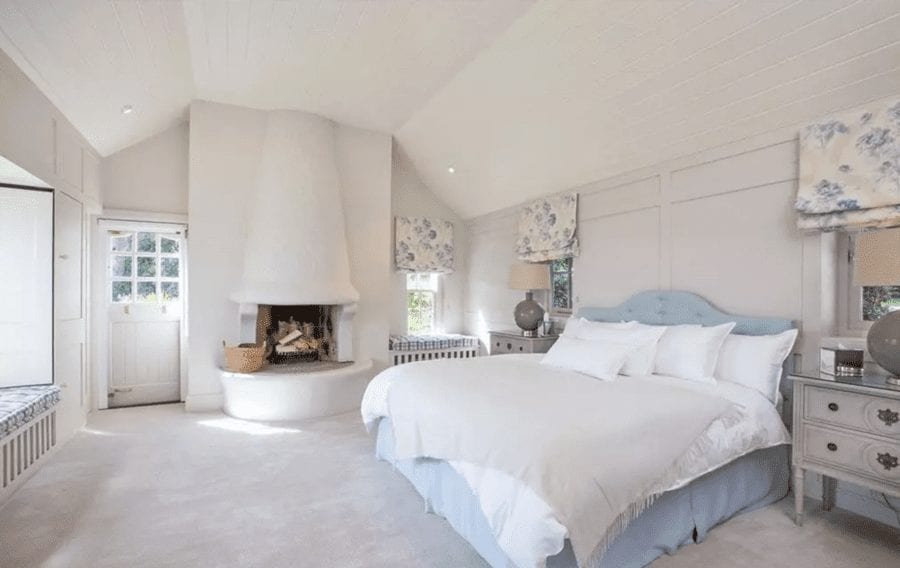
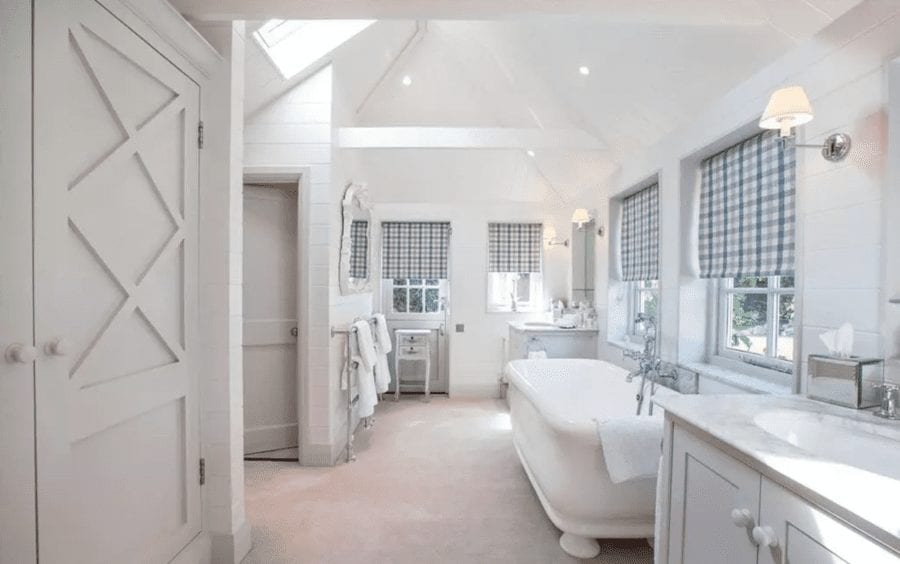
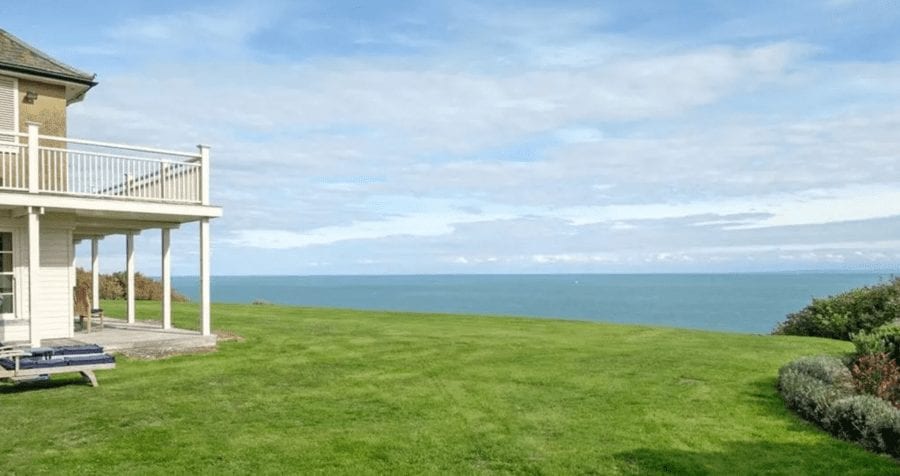
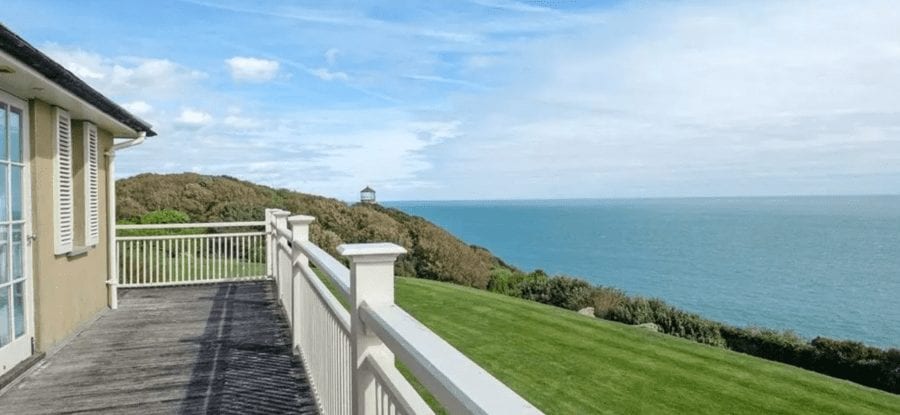
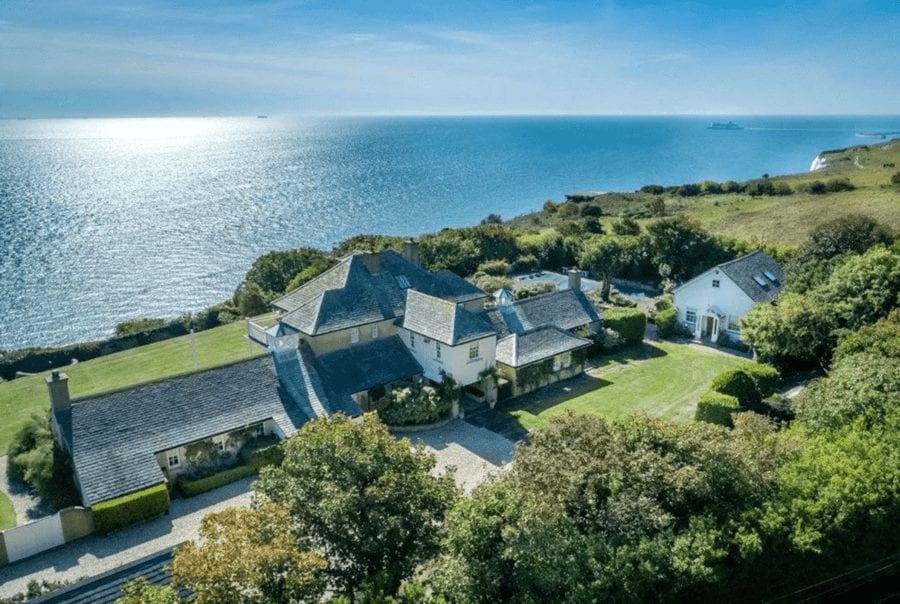
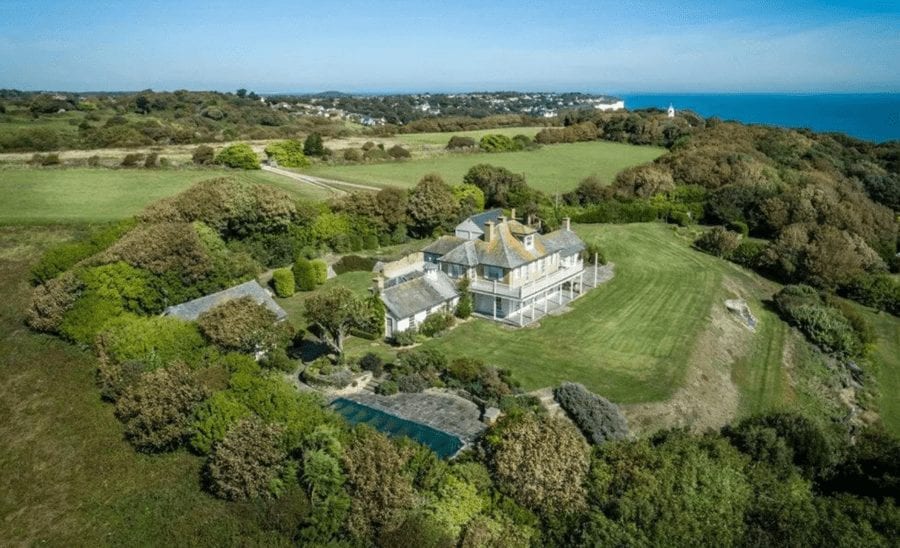
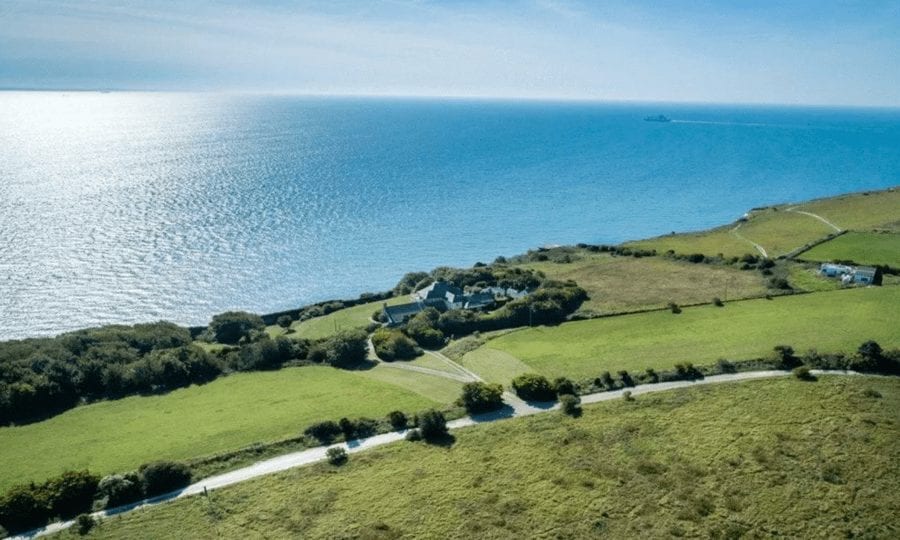
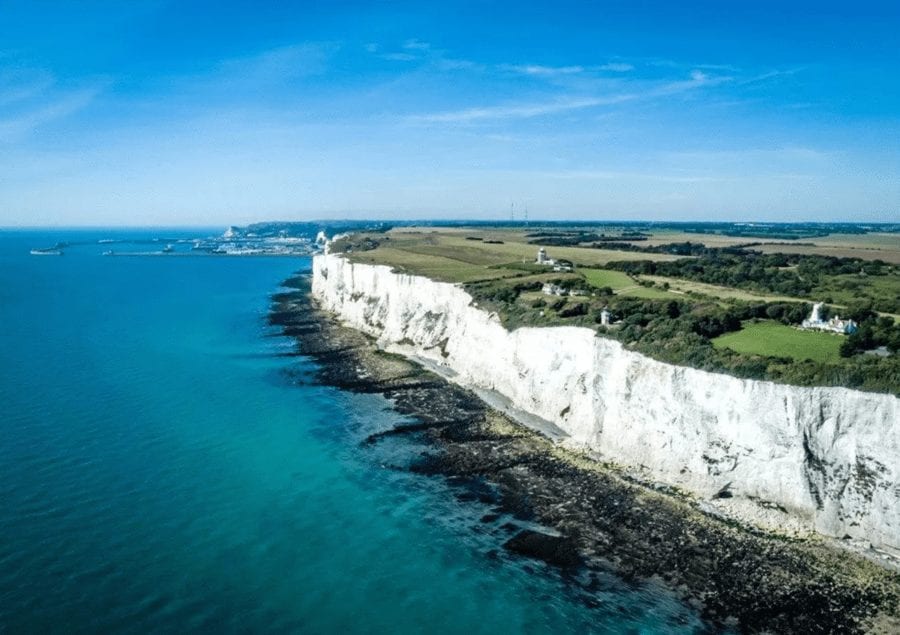
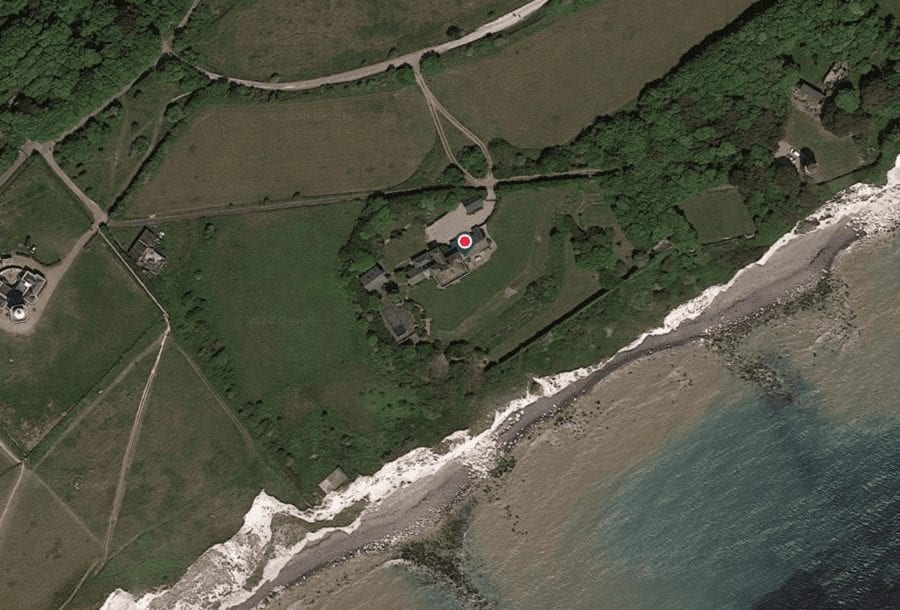
Standing in 11.5 acres of land on the edge of the White Cliffs of Dover in “the most remarkable location on the Kent coast” according to Knight Frank, the freehold property is now known more simply as ‘The Cliff House.’ It is described as having “been renovated by the past two proprietors” and of it, they add: “The current owners have carried out extensive redecoration during their occupation.”
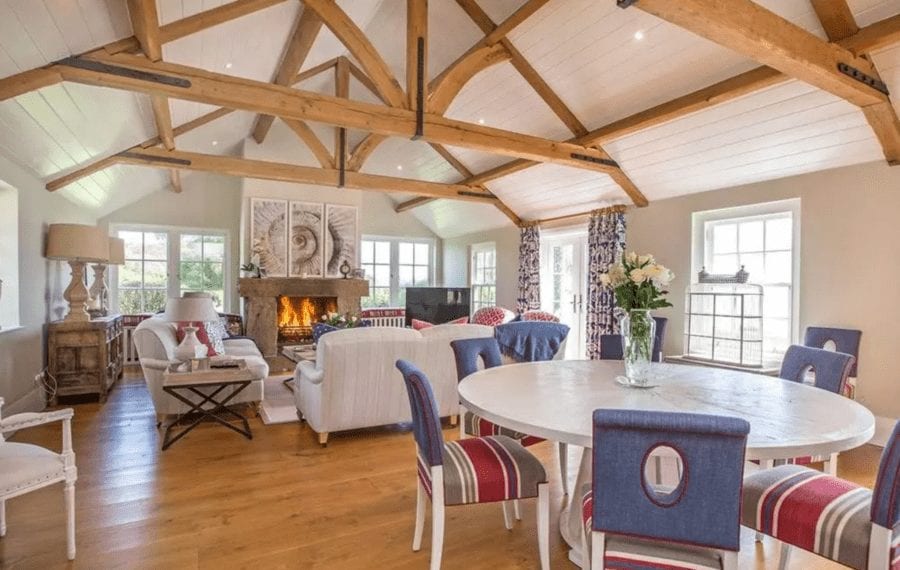
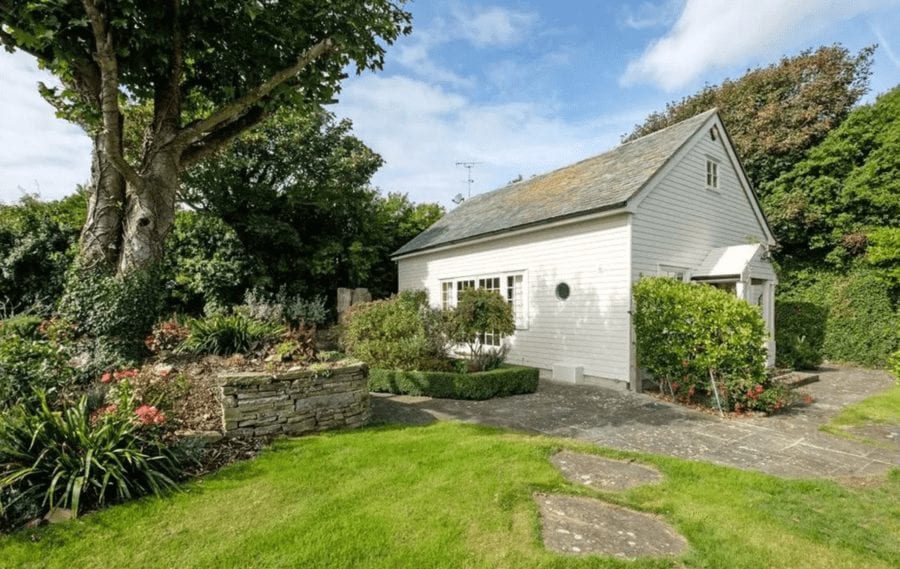
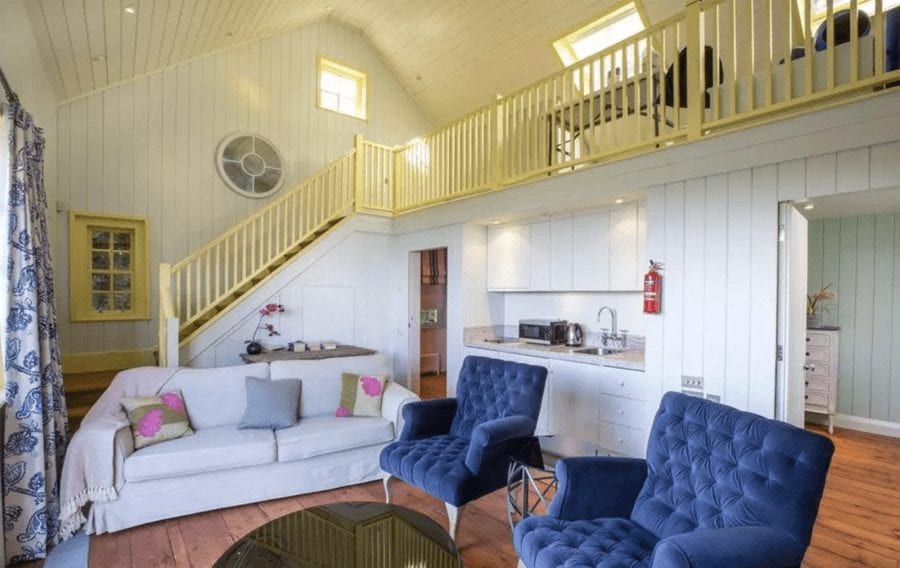
Aside from the main house with 3 reception rooms and 5 bedroom suites, there is a 2 bedroom annexe, a 3 bedroom cottage and a 2 bedroom cottage. Also included is an unused lighthouse, a large garage, a swimming pool, lawned gardens and some “light woodland.”
The agents don’t, however, mention if the owners will be making Dame Vera Lynn available to sing about bluebirds at post lockdown viewings.
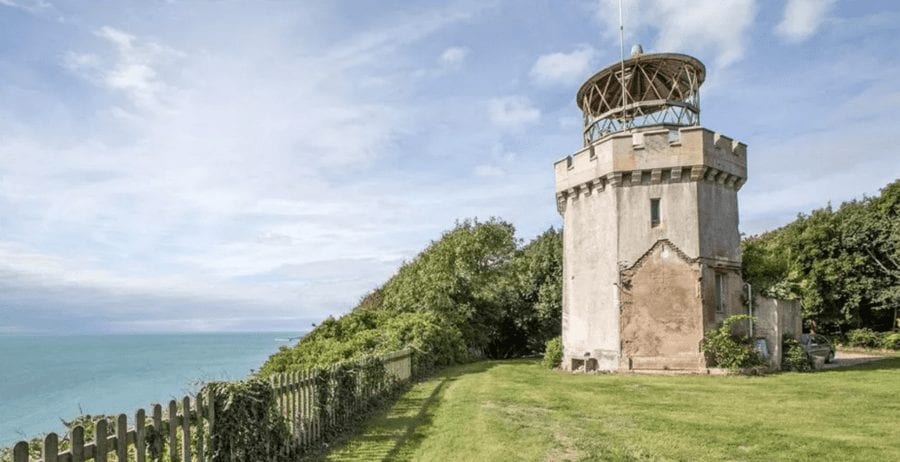
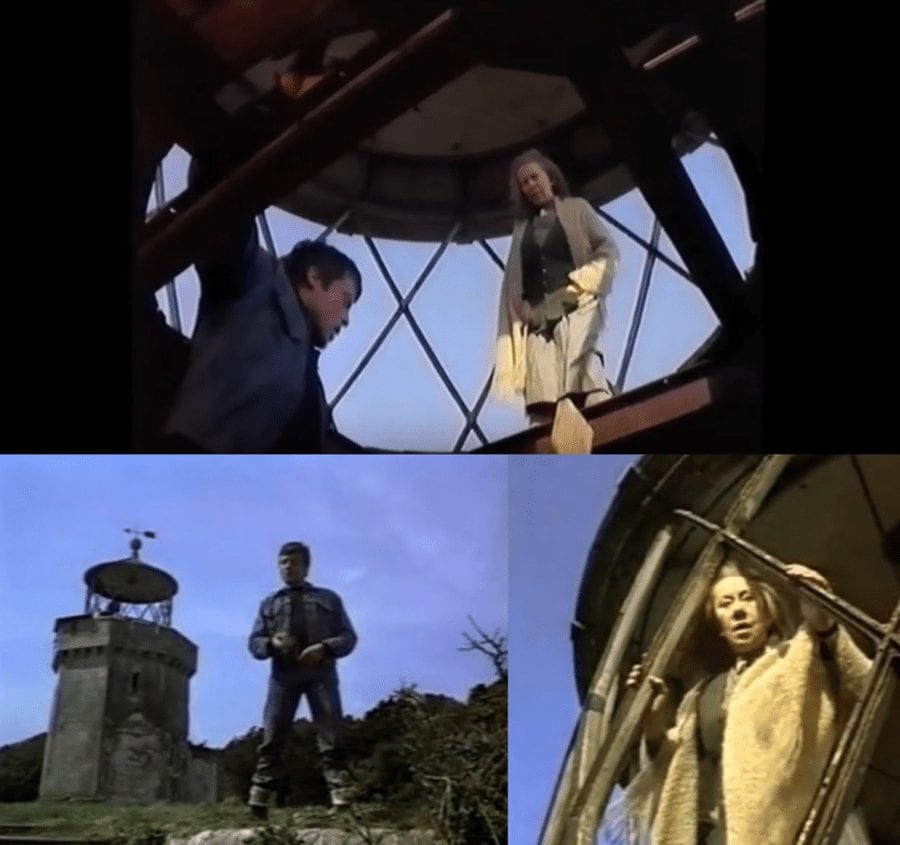
The lighthouse, originally known as the Lower South Foreland Lighthouse, itself was built in 1843 on the site of an earlier building. It was decommissioned in 1904 after the sands shifted and is Grade II listed. Agents Knight Frank simply remark of it: “Not use.”Oliver Reed as ‘Ethan’ at South Foreland Lighthouse in ‘The Shuttered Room’ with Flora Robson as ‘Aunt Agatha’ looking down. The 1967 British horror film was directed by David Greene and starred Gig Young and Carol Lynley.
The Numbers – The Cliff House, The South Foreland Estate, The Front, St Margaret’s Bay, Dover, Kent, CT15 6HP, United Kingdom
June 2020 – For sale for £5 million ($6.3 million, €5.6 million or درهم22.3 million) through Knight Frank.
November 2018 – For sale for £5 million ($6.3 million, €5.6 million or درهم22.3 million) through Knight Frank.
November 2013 – For sale for £4 million ($5.1 million, €4.5 million or درهم18.6 million) through Strutt & Parker.
July 2013 – For sale for £3.5 million ($4.4 million, €3.9 million or درهم16.3 million) through Strutt & Parker.
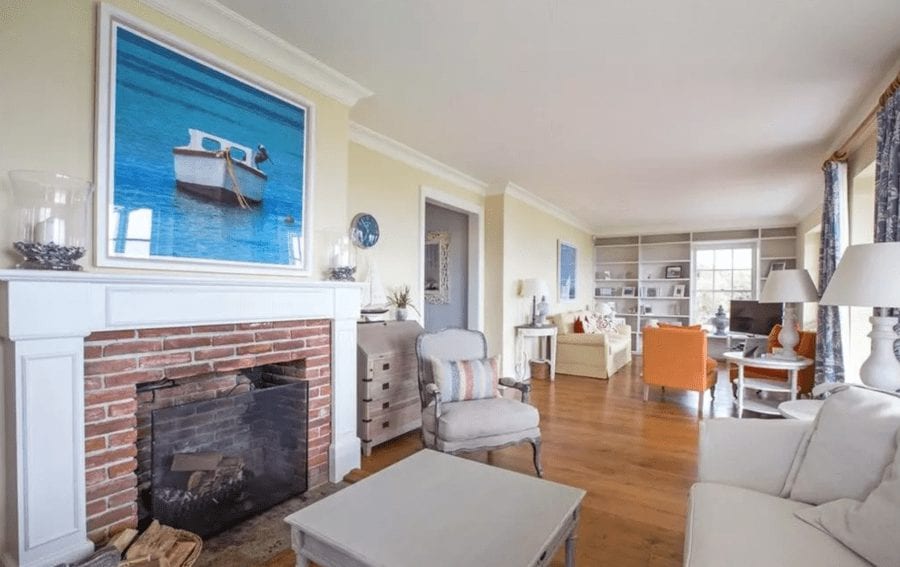
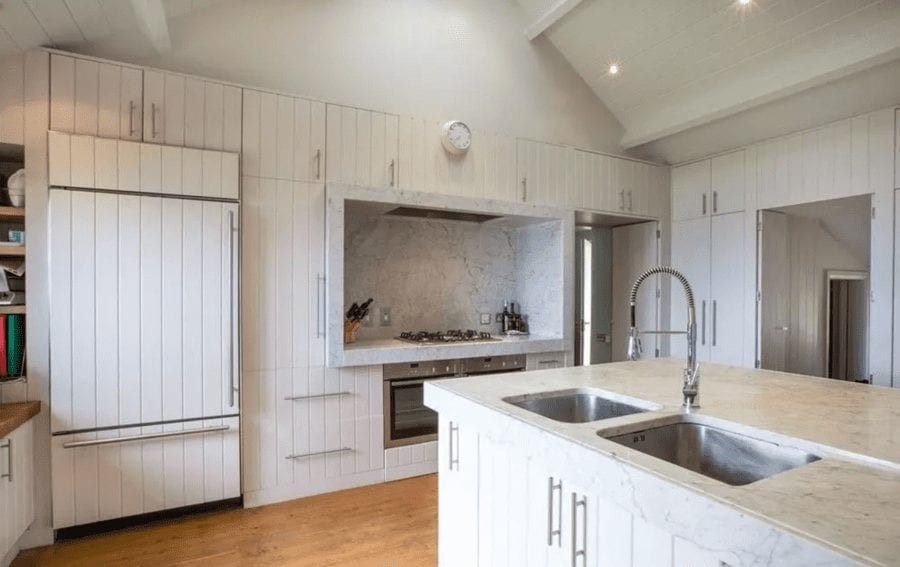
Out on The Front – The main entrance to The Cliff House.The main entertaining space is a large 27-foot by 17-foot drawing room. There is also a sitting room.The kitchen has been redecorated by the current owners.One of five bedroom suites.The largest of the bathrooms in the house.Out on The Front – Views out to sea.A balcony overlooking the Strait of Dover.Thrree ancillary properties are included in the sale price.The interior of one of these spaces.Looking out to sea.Looking inland.The property is surrounded by land owned by the National Trust.The White Cliffs.Out on The Front – An aerial shot of the property.