Contents of The Hempel Hotel to be sold at auction
The contents of Bayswater’s iconic The Hempel Hotel, originally designed by Anouska Hempel, are to be sold following the building’s sale to British Land for £33 million in March. (more…)

Contents of The Hempel Hotel to be sold at auction
The contents of Bayswater’s iconic The Hempel Hotel, originally designed by Anouska Hempel, are to be sold following the building’s sale to British Land for £33 million in March. (more…)
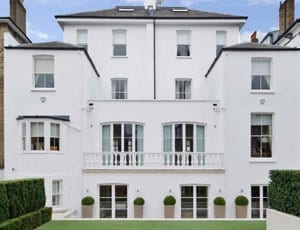
As David and Victoria Beckham continue their search for a new home in London, The Steeple Times suggests five of the best options
This morning, yet more “sources close to David and Victoria Beckham” were telling the press that they’re on the search for a London home. This unnamed individual stated that they need a “minimum of 10 bedrooms” (more…)
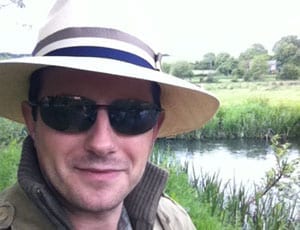
The Steeple Times asks estate agent Edward Thomson: “What’s on your mantelpiece?”
The Steeple Times shares “wit and wisdom”. What’s your guiding force?
Honesty and integrity.
“Don’t get even, get medieval” is, in our humble opinion, a great motto. What’s yours?
My favourite is: “What doesn’t kill me makes me stronger” but “Try everything once, except incest and Morris dancing” is more amusing.
Kerry Katona was considered unacceptable in 2007. Who or what is unacceptable in 2013?
Mexicans using live dogs and kittens as shark bait.
Tony Blair misses being Prime Minister. What do you miss most in your life?
Living in the countryside and most of the time, a river and a dog.
What might you swap all your wealth for?
The love of my life.
Donald Trump was once a case of: “If you owe the bank a thousand, they close you down; but if you owe the bank a billion, you own the bank”. What’s your view on the banking crisis?
My integrity and reputation is all that I am; all that I can absolutely determine. When you give that up what have you become? The banks no longer have a code. A few prison sentences ought to remind them to gamble their money, not ours.
What phrase or word do you most loathe?
“It’s not my problem”: I absolutely hate the mentality of people who say this.
In the UK, some people consider charity to “begin at home”. What’s your view and what causes do you personally support?
Family and friends first and then animal welfare. In particular, beasts of burden across the world.
The judge in Law Abiding Citizen states: “I can pretty much do whatever I want” before being blown up whilst answering her mobile phone. What’s your view on the appropriate use of such devices?
Mobile phones are anti-social, but absolutely necessary in today’s world.
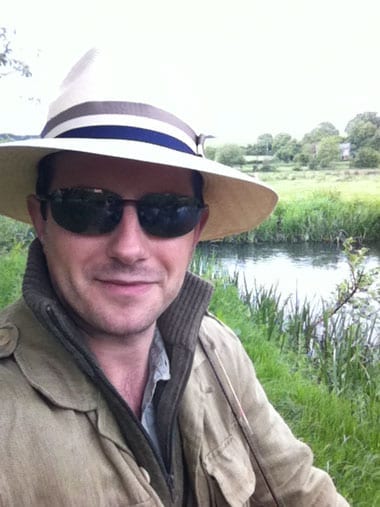
If you could fill a carriage on The Orient Express, who would be your fellow passengers?
Bill Murray, Ranulph Fiennes, that chap who just survived 40 minutes at depth in the North Sea with 20 minutes of mix (seriously interesting chat to be had there I think), Johnny Cash and oh yes, a seriously amazing and beautiful Australian I know.
If you were unfortunate enough to end up on death row, what would be your last meal and where would you eat it?
Potted shrimp on toast, lamb cutlets and some very good Stilton. I would have it on the banks of the River Nadder near Salisbury.
What time is it acceptable to consume the first drink of the day?
12 noon. Sherry.
A Negroni, a martini or a cup of tea?
Definitely a cocktail. A Porn Star martini is my current favourite.
Whose parties do you enjoy the most and why?
Any that end up in Annabel’s. Call me old hat, but I just love the dance floor in there.
Who is the most positive person you know?
My stepfather, Richard. An extraordinary chap.
What’s your most guilty pleasure?
Smoking. I have to stop again soon.
If a tattoo were to sum you up, what would it be of?
A rod and a rifle.
If you were a car, what marque would you be?
My Triumph TR6. My dream car is a 1949 Ferrari 166MM Barchetta.
Cilla Black presented Surprise, Surprise. Tell us the most surprising thing about you.
I like crooning to old Fred Astaire songs in the shower.
What’s currently sitting on your mantelpiece?
A carriage clock, two candlesticks, a picture of me releasing a salmon, a wedding invitation and a Herend porcelain rabbit.
Edward Thomson works for Strutt & Parker LLP in their Cadogan Street sales office. Website: http://www.StruttAndParker.com
The Steeple Times asks journalist and author Jessica Fellowes: “What’s on your mantelpiece?”
The Steeple Times shares “wit and wisdom”. What’s your guiding force?
To learn from history – in all senses of the word – but listen to the needs of the present.
“Don’t get even, get medieval” is, in our humble opinion, a great motto. What’s yours?
“No man lives by bread alone – he needs his bit of crumpet”.
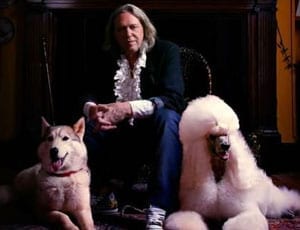
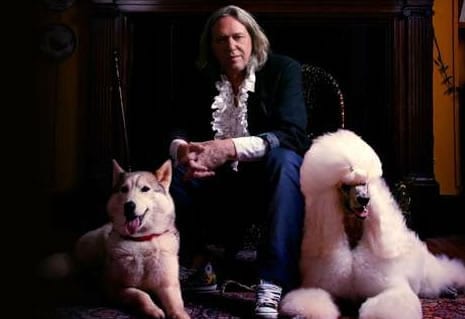 The undisputed king of gin. Martin Miller didn’t like the gins he tried and so created his own, Martin Miller’s Gin. It is wonderful. This father of five and husband of Ioana Beju was also the genius behind Miller’s Antiques Guides and a brilliant hotelier. He enjoyed life to the full in true Dickensian style and truly knew how to put on a party.
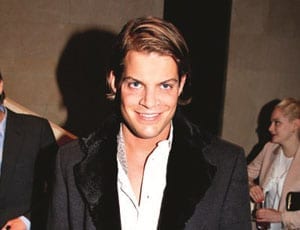
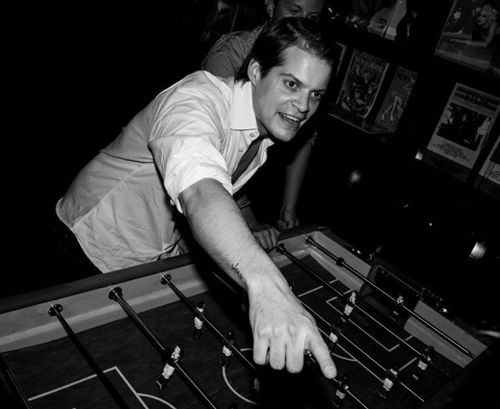 This affable German’s address book spans continents and cultures. A graduate of the Cass Business School and the University of Madrid, Weber’s projects have variously included The Cuckoo Club, Salon Club and Wanted Gallery. Here’s a gent who knows how to combining partying and business and one whose invites are most definitely like gold dust.
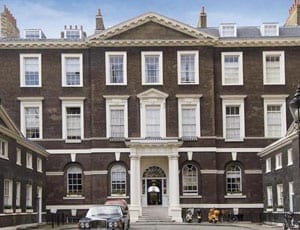
Matthew Steeples delves into the history of Albany, Piccadilly and discovers an affordable way of living there
Albany, off Piccadilly in Mayfair, was most probably London’s first apartment block and it’s certainly the city’s most exclusive. It may be next to the Royal Academy and opposite Fortnum & Mason but surprisingly few have even heard of it.
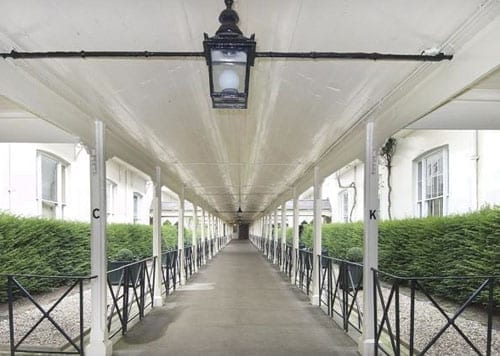
Considering its location, Albany, which some make the mistake of referring to as “The Albany,” is an amazingly quiet oasis of peace and tranquility but, equally, it is a place of intrigue and drama. Residents, or “proprietors,” as they prefer to be known, of the 69 “sets” are particular about the “the” part of the name as they’d rather their residence not be confused with a public house and they are even more protective of their privacy. A porters’ lodge guards the entrance to the building and it is staffed mostly by ex-servicemen, who, until the early 2000s, had to wear top hats and tailcoats. Those allowed to pass enter a rarefied world frequented by what the Irish novelist Marmion Savage (1803 – 1872) identified as “incurable oddities” and “superannuated fops” in The Bachelor of Albany.
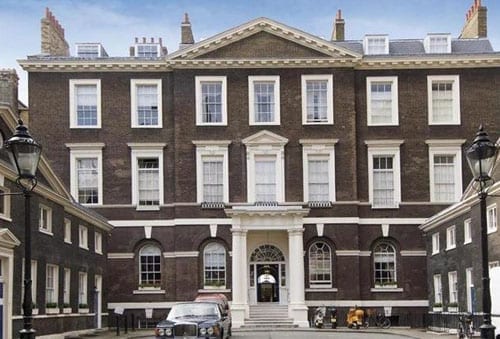
Built by Sir William Chambers (1723 – 1796), who also designed Somerset House and the pagoda at Kew, between 1770 and 1774 for 1st Viscount Melbourne (1745 – 1828), Albany was originally known as Melbourne House and conceived as a three-storey mansion, seven bays wide with a pair of service wings flanking a front courtyard. From 1791 to 1802, the property was occupied by George III’s son, Prince Frederick, Duke of York and Albany (1763 – 1827), but after he left, the renowned architect Henry Holland (1745 – 1806) sub-divided the existing house and added two parallel sets of buildings running the length of the garden to create 69 “bachelor apartments” which he named “sets.”
The “roll call” of residents since could easily fill our very own pages thrice over. They number royalty, politicians, artists, playwrights, academics and philosophers and here is a brief selection:
– Anthony Armstong-Jones, later 1st Earl of Snowdon
– Sir Thomas Beecham
– Sir Isaiah Berlin
– Lord Byron
– George Canning
– Sir Kenneth Clark
– Baroness Pauline de Rothschild
– William Ewart Gladstone
– Sir Edward Heath
– David Hicks
– Aldous Huxley
– Sir Simon Jenkins
– Rupert Lycett Green
– Malcolm Muggeridge
– Sir Harold Nicholson
– J. B. Priestley
– Sir Terence Rattigan
– Roger Scruton
– Baroness Sharples
– W. Somerset Maugham
– Terence Stamp
– Sir Denis and Lady Thatcher
– Sir Herbert Beerbohm Tree
Each had to pass the vetting of a committee of trustees of this Grade I listed building. That committee forbids children under 14, pets, musical instruments and commercial activities and each approved resident has undoubtedly added to the history of this den dominated by a central walkway named the “rope-walk.” Incidentally, an example of a curious quirk at Albany is that no resident is allowed to speak to another on this walkway. If they do, a fine is incurred. Albany, indeed, is rather like a college in its systems of rules, regulations, order and hierarchy.
For several centuries, women were not even allowed to cross the threshold and one legendary tale tells of Lady Caroline Lamb (1785 – 1828), disguised as a page boy, stealing into Lord Byron’s (1788 – 1824) set in 1815 to leave a note: “Remember me, Byron.” He replied with a simple verse:
Remember thee, aye, doubt it not:
Thy husband too shall think of thee.
By neither shalt thou be forgot —
Thou false to him, thou fiend to me.
The strict and formal structure that controls Albany and ensured its maintenance has succeeded in the main because 34 of the 69 sets are owned by Peterhouse College, Cambridge. They and the other owners are highly particular in whom they lease to and on one occasion on hearing of an “unsuitable tenant,” the secretary of the trustees is reported to have shouted:
“He’s a foreigner. Don’t like him. Don’t trust him.”
Needless to say, that application didn’t progress and nor did one from a physiotherapist who planned to operate from the building. Bone bashing in Albany just wouldn’t do.
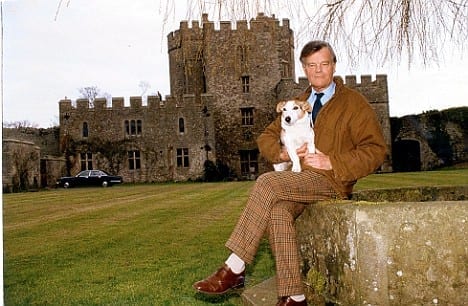
A horsewhip, however, nearly crossed the threshold of set B5 in 1994, as it was here that the late Alan Clark MP (1928 – 1999) lived. The affable philanderer seduced the wife and both daughters of a certain South African named Judge Harkess and the wronged man stated he would “have horse-whipped Clark if he had known how comprehensively he had violated his honour.” B5, itself, was described as having the feel of “the straitened quarter of an Edwardian bachelor on his uppers” and the dotty, English attitude of the residents is best summed up by the reaction of Clark’s neighbour when he accidentally flooded their basement. When asked what he could do to make amends, their answer was quite simple: “Go and lie down in Piccadilly and wait for a double-decker bus.”
The dandy and journalist John Morgan (1959 – 2000) typified social change at Albany in the 20th century just as much as he himself redefined etiquette and manners at Debrett’s and The Times. Of “humble origins,” Morgan was brought up in a “modest” bungalow in St Madoes, Perth, Scotland but is credited with persuading William Hague to remove his baseball cap whilst Conservative leader and offering advice ranging from “how to eat a banana” to “how best to tell friends that the partner you would like to bring to their wedding will be of the same sex as you.”

For the bachelor and GQ style director, living in Albany was symbolic of his own personal social elevation but he did not disown his past. This modern day Beau Brummell was a man of social contradictions who cashed his cheques at Claridge’s but was a member of the National Union of Journalists. He was a Tory but still regularly attended chapel meetings as he had done in his youth. Here was a man of paradoxes who seemed unable to come to terms with the fact that he was a homosexual.
Morgan, an asthma sufferer, fell to his death from a fourth floor window on 9th July 2000. He was found in just a white shirt in a basement below a window whose sill was strangely undisturbed. The coroner left an open verdict with a suspicion of suicide and it was widely reported that police found 60 made-to-measure Savile row suits, 300 monogrammed shirts and 90 pairs of shoes in the etiquette expert’s small set. Mystery shrouds the story of his tragic demise to this day but Johnny Morgan will forever be remembered as an arbiter of both good taste and behaviour.
Whilst Morgan represented continuation of the trend of bachelors living in Albany, change also came in the 20th century when the building’s committee removed the restriction that allowed only bachelors to be resident. With that females were allowed in and amongst them Fleur Fenton Cowles (1908 – 2009) was one of the most fascinating.
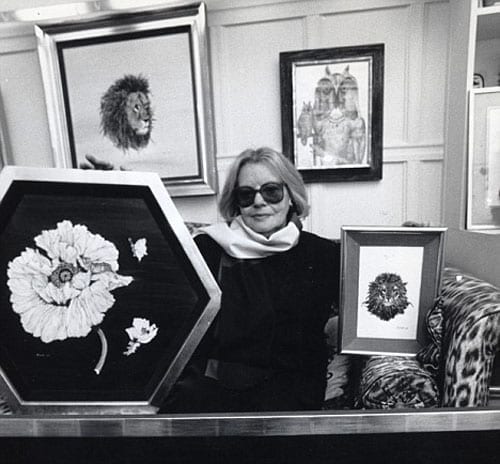
This writer and artist occupied five sets knocked into one with her fourth husband, timber merchant Tom Montague Meyer, and according to the Daily Mail’s Geoffrey Levy, hosted “elite soirees of the powerful and famous.” Levy recounts them at length but here is a flavour:
“On a Wednesday evening, a typical dinner party… would include Foreign Secretary Selwyn Lloyd, Labour leader Hugh Gaitskell, entertainer Danny Kaye and film star Douglas Fairbanks Jr. The Queen Mother regularly came to tea and was once joined by Pavarotti who sang Happy Birthday for the royal guest. ‘I don’t want her to die,’ said Fleur. ‘I couldn’t bear to think she doesn’t live just down the street.’ ”
Fenton Cowles, founder of the ill-fated Flair magazine and a “woman who knew everyone,” loved Albany and an exact replica of her “windowless, milk-yellow” study there has even been recreated at the University of Texas.
Another known for hosting extravagant bashes in Albany was my late friend, the Russian icon dealer John Gaze (1947 – 2011). Gaze had, as a boy, asked his father about the building when he passed it as a child and immediately declared he would live there one day. He took F2, the former set of Edward Heath that overlooked Savile Row to the rear, in the mid 1990s as he craved the safety that the building offered after having been kidnapped at gunpoint by an Oxford graduate conman named Sacheverell de Houghton in April 1991 from his then home in Fournier Street, E1. He made the most of his tenancy.
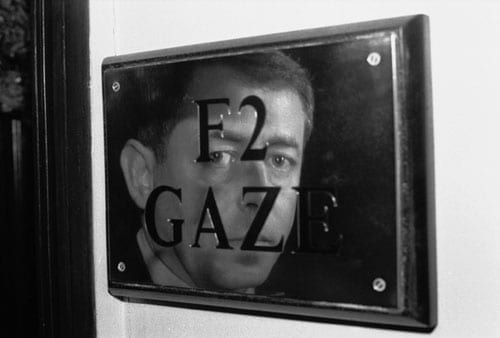
Gaze’s parties included a fundraiser for people with AIDS hosted by a drag queen. This sparked fury with certain other residents and coverage in the Daily Telegraph and another incident there involved him encountering Alan Clark on the ropewalk carrying a portrait of Lenin. “Where the fuck are you taking that?” Clark supposedly bellowed but was “reassured” when he was told it was “destined for a less salubrious address in Whitechapel.” John Gaze remained at Albany for several years but, like a number of others I know, was forced out by ever rising rents and moved first to Chelsea and then Ennismore Gardens, Knightsbridge. He always remembered his time at Albany fondly and as a bon vivant, he truly belonged there.
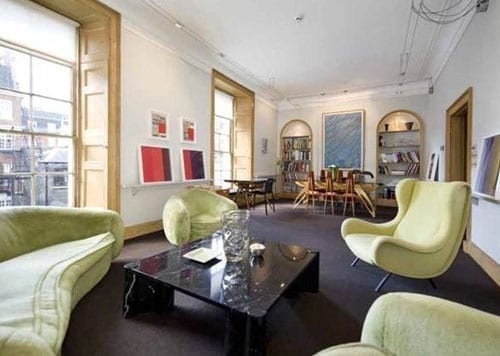
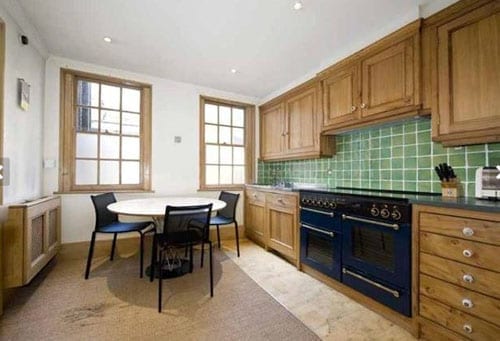
Contrary to what you’d expect, living in Albany is not quite as expensive as one might think. A 2-bedroomed 1,970 square foot set is currently available through Knight Frank for £1,400 a week: a figure that seems quite reasonable given the location, history and size of this property. Available on a minimum 8-year rental term, it includes a formal reception room, a dining kitchen, 2 bedrooms and 2 bathrooms.
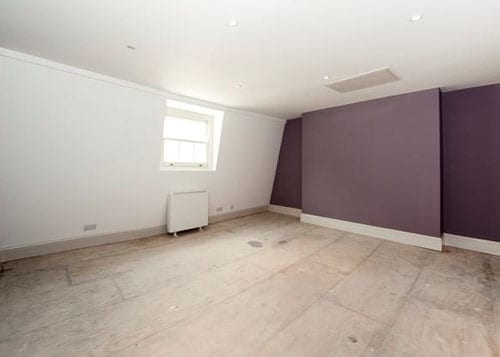
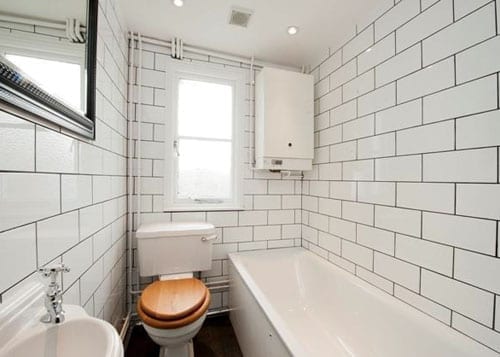
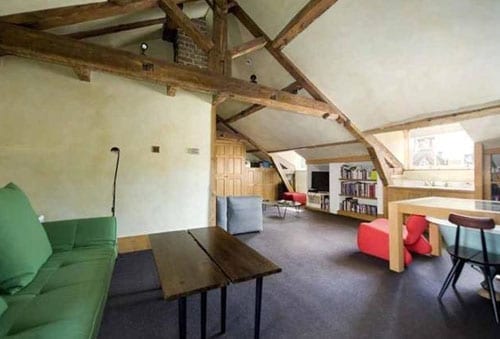
For those looking for something cheaper, Savills offer D2 Albany at £300 per week. This set consists of a 221 square foot third floor attic room with access to a communal bathroom and the agents suggest that it: “would make an ideal reading or writing room or an occasional bedroom for a pied-a-terre.” It’s effectively a posh form of tenement but what a way to impress your peers and subordinates.

Those renting either of these sets would find the likes of the industrialist Damon de László, a descendant of the Hungarian painter Philip Alexius de László (1869 – 1937), as their neighbour. The couple occupy Lord Byron’s former set, A2, and have, on occasions, opened it for a charity dinner with Matthew Parris at £1,000 a ticket as well and for members of The Portrait Institute to view their collection of de László’s works.
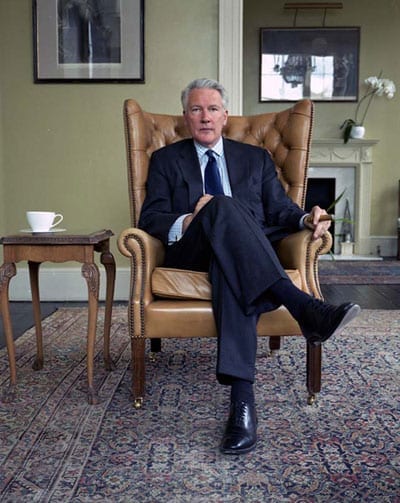
Another present day resident is a man Henry Kissinger calls “the outstanding philosopher of our times,” Professor Philip C. Bobbitt. This Texan lawyer is a nephew of Lyndon B. Johnson and the author of Terror and Consent, which Tony Blair describes as “required reading for political leaders.” Bobbitt owns an impressive flying freehold set that is described as having a masculine style of décor and a “kitchen he has designed to look like a bar.” In an interview for The Independent he states that he finds Albany: “a propitious place to work.”
Though governments and bankers come and go, behind this quintessentially English façade, order and disorder have always been maintained. The wildcards of this hidden haven have a knack for living by the doctrine “to live at Albany is to live in history” and indeed they make the most of that. Those who are lucky enough to be let in, do, indeed, truly find themselves in the “Paradise of Piccadilly.”
For more information about the £1,400 per week 2-bedroomed set in Albany, contact Knight Frank on +44 (0) 20 3641 2489 or go to: http://www.primelocation.com/to-rent/details/21089526?search_identifier=561863685a1a55b5da85141e12cfeec7
For more information about the £300 per week attic room in Albany, contact Savills on +44 (0) 20 3641 2584 or go to: http://www.primelocation.com/to-rent/details/26791351?search_identifier=561863685a1a55b5da85141e12cfeec7
A home suitable for James Bond
The latest James Bond film Skyfall is the talk of the town and it’s received many a rave review. The fictional James Bond allegedly lived in Royal Avenue, off the Kings Road in SW3, but if he were looking for a house today, we think 9 Hillgate Street would be the perfect pad.

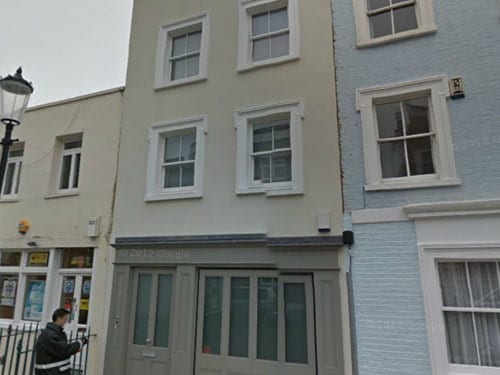
Utterly unassuming from the street, what lies behind the exterior of this four-storey building is deceptively a new build house constructed in 2010. Designed by Seth Stein Architects, the property is only 18ft wide but an amazing 85ft in length.

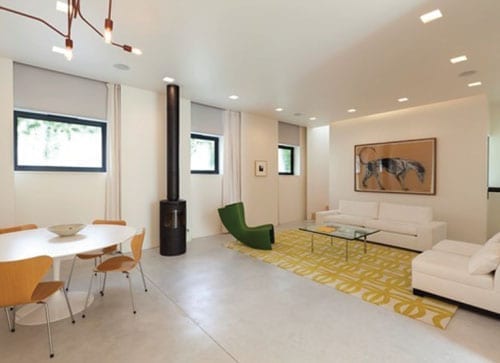

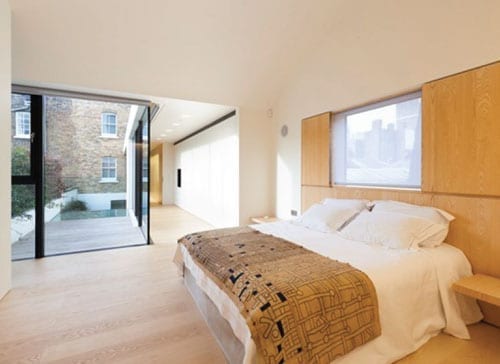
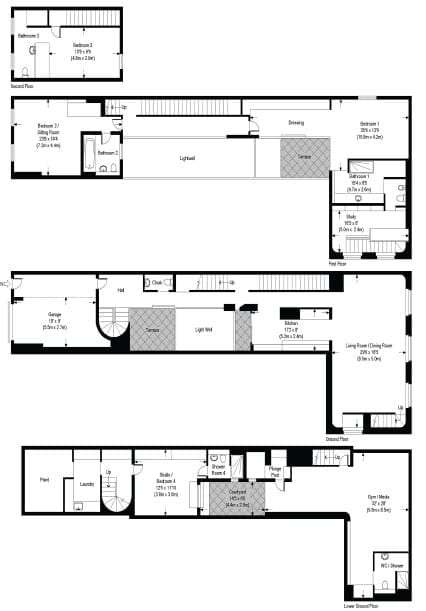
Bond would greatly appreciate the lower ground media room and gym with plunge pool and with a staff suite, there’s room to house someone to mix his martinis. A vast 29ft by 16ft living room is open plan to the kitchen and perfect for entertaining but it is most certainly the master bedroom suite that would make the perfect spot for his extra curricular activities. Four terraces arranged around a courtyard provide ample outdoor space and with all manner of techonological gadgets, 9 Hillgate Street most certainly would make an ideal bachelor pad.
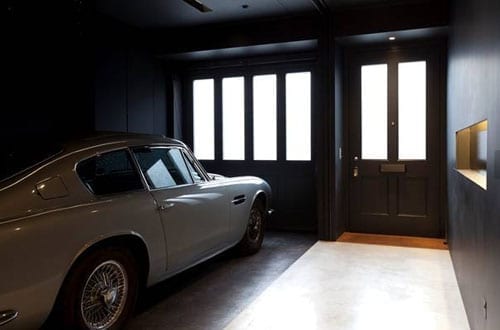
What truly would suit Bond perfectly, though, in this 4,286 square foot £7,950,000 house is the garage. Cleverly disguised and decorated as a normal room, there’s even an Aston sat waiting parked there. Daniel Craig should put in a bid.
9 Hillgate Street, London, W8 7SP is on the market with Domus Nova. Telephone: +44 (0) 20 7727 1717. For more details, go to: http://www.primelocation.com/for-sale/details/16234784?search_identifier=1dc68e7f093f381788be3dda54be33ed
For more information about Seth Stein Architects, go to: http://www.sethstein.com
Matthew Steeples explores the story of an empty Kensington mansion
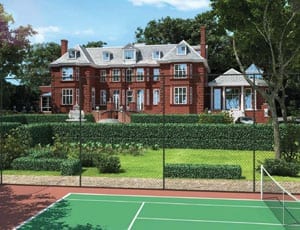
A multi-million pound 8-bedroomed house in Kensington isn’t anything unusual. In fact, rather, they’re ten a penny. In this, one of the wealthiest boroughs in the land, large, expensive homes are just the norm.


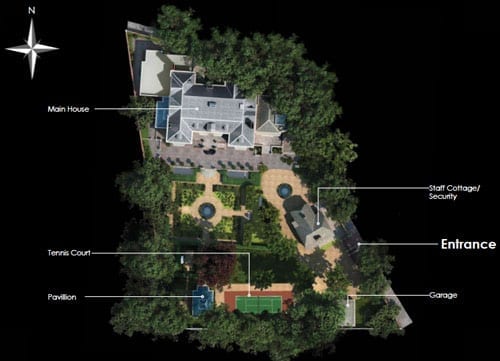
No. 1 Campden Hill, which is being marketed for an undisclosed eight-figure sum, is in a quite different league. Here is a detached Edwardian house in an acre of grounds just to the north of Kensington High Street. It’s an unrenovated property but it attracted much press attention in October 2011 because it was place on the market in October 2011 at a price of £75,000,000. Yes, you heard it right: £75 million for a fixer-upper. Last week, Radio 4 made a hell of a fuss about a derelict semi-detached house in Newcastle selling for just £14,000 so this truly must be something special.

The architect of the house Edward Prioleau Warren (1856 – 1937), a Bristol born architect and archaeologist, was best known for “Oxford colleges and minor country houses” but also designed the War Cemetery at Basra. He was a friend and adviser to the American novelist Henry James and in addition to building No. 1 Campden Hill in 1915, he also designed a house at 5 Palace Green in 1906 and another, Estcort House in Kensington Palace Gardens, in 1904. Warren’s guiding style is described as having been to recreate an “understated revival of English late 17th century” architecture and at No. 1 Campden Hill he created just that.
Colonel Edmond Grove-Hills (1864 – 1922), born Edmond Hills, and his wife, Juliet Spencer-Bell, were the architect’s clients. A plaque on the building bares their names and the following dedication:
This House I built for Me & Mine
May it be of Peace A Shrine
And no Enmity or Sin
Ever find its way therein
AD 1915
Sadly for the Grove-Hills, the following year, their son, Second Lieutenant Charles Herbert-Hills (1895 – 1916) was killed on the Somme aged just 21. His father, meanwhile, was awarded a CBE in 1918 after having served as the Assistant Chief Engineer of Eastern Command during the war.
Aside from his military exploits, Edmond Grove-Hills is best known for his role as president of the Royal Astronomical Society. He took part in observations of eclipse of the sun in Japan in 1896, India in 1898 and Russia in 1914 and contributed papers analysing both this and the causes of the irregular movements of the earth’s axis of rotation.
In 1951, No. 1 Campden Hill was purchased by the government of Uruguay and it became the residence of their ambassador to the United Kingdom. For the next fifty years the building was barely altered but when the lease from the Phillimore Kensington Estate came to an end, there were legal problems as the 1951 transfer had never been stamped. Of this, Sharon Mulroney of Forsters, the legal representatives of Phillimore, commented:
“It is highly unusual to be faced with complications of this kind when dealing with a registered London title, but this made the transaction all the more fascinating. Even the decision to allow ambassadorial staff to return to the property for security purposes after completion was fraught with potential problems about security of tenure, employment and tax.”
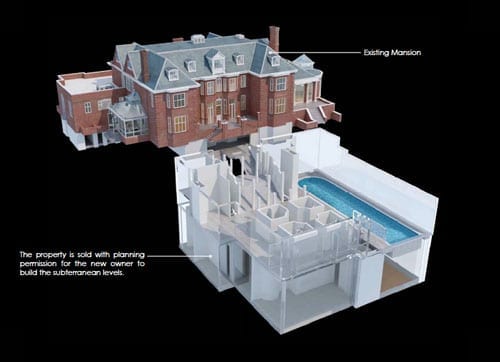
Eventually, without issue, the Phillimore Estate sold on the house in 2001 for a price of approximately £17,000,000. In the years since, the property was effectively mothballed as all the purchasers have done is to have obtained planning permission to redevelop the building into a mammoth mansion of epic proportions.
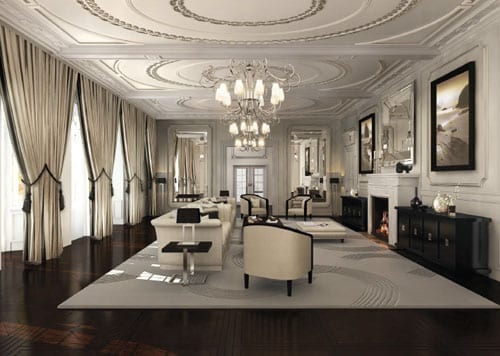
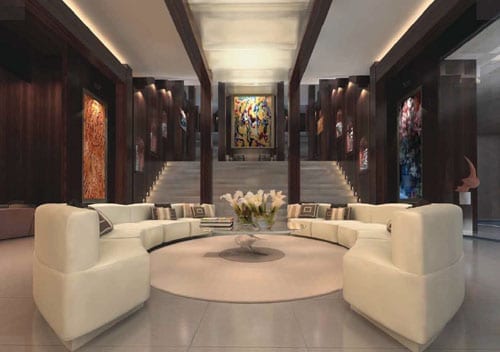
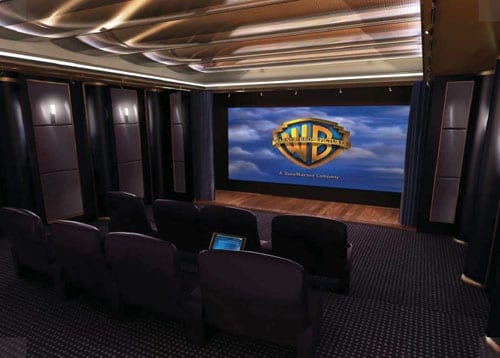
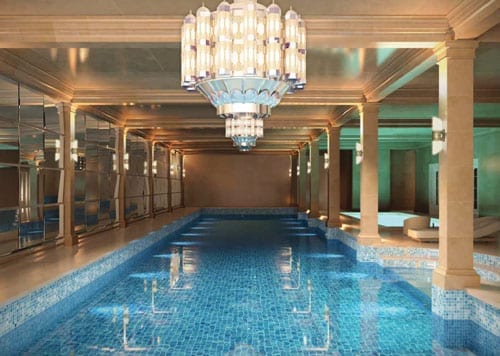


The approved plans show designs for something quite remarkable. Warren’s “understated” residence will be replaced with 8 vast bedroom suites, grand entertaining spaces, a lift and even bedrooms for 5 staff. In addition to a full-scale renovation of the original freehold house, there is scope to provide a total of 30,000 square feet of accommodation by adding a huge subterranean complex that will include a 25-metre swimming pool, court, squash court, gym, sauna, steam room, function room, entertainment room, home cinema, wine tasting room and even a nightclub to rival any of Kensington’s trendiest haunts.
On that basis alone, No. 1 Campden Hill is surely the ideal residence for Prince Harry: “Who needs Boujis?” we hear him cry.
No. 1 Campden Hill, London, W8 7AD is for sale through Knight Frank. For more details contact Roddy Craggs on +44 (0) 20 7938 4311 or go to: http://search.knightfrank.com/ken100161 to download a brochure.
For more information about The Phillimore Estate, go to: http://www.phillimore-kensington-estate.co.uk
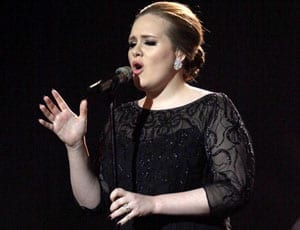
 “I don’t know what’s going to happen if my music career goes wrong,” states this Tottenham born singer. Having been named “one of the most influential people in the world” by TIME Magazine and broken the record for the longest number-1 album by a woman in Billboard history, she really need not worry. Adele’s still “Someone Like You,” except she’s now worth in excess of £23 million and is guaranteed a place amongst the music greats. Gordon Brown wrote to this Labour supporter to tell her that she’s a “light end of the tunnel” but we prefer the view of former Guns N’ Roses guitarist Slash. Of her, he proclaims: “She’s great. She’s a shot in the arm for this industry.”