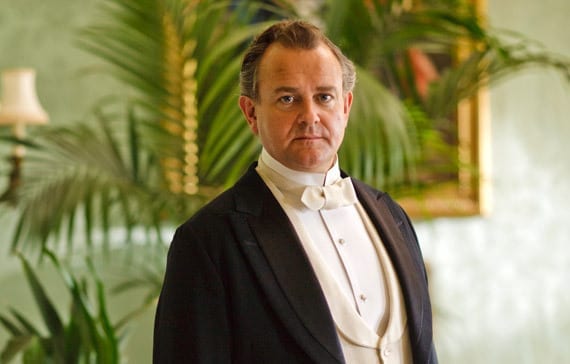
 In his role as Downton Abbey’s Lord Grantham, this actor warned that “scandals” always have a habit of coming out. He graduated in Theology at Cambridge but, according to Adam Helliker of the Daily Express, Bonneville wasn’t especially keen to show Christian compassion towards Lord Archer at a party at The Cadogan Hotel when it was requested that the pair be photographed together.
Tag: Notting Hill
-
Hugh Bonneville
-
Redefining Rachman
A different side to Peter Rachman is revealed
Whenever the name Rachman is mentioned, the first things that come to mind are greed, extortion and intimidation. The word is so engrained in such that “Rachmanism” now features in the dictionary, defined as:
“The exploitation of tenants of slum properties by unscrupulous landlords.”
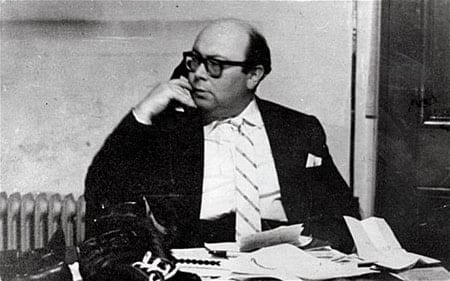
“Notorious slum landlord” Peter Rachman (1920 – 1962) Perec “Peter” Rachman (1920 – 1962) was born in Poland and the son of a Jewish dentist. He is best known for having built up a property empire of over 100 mansion blocks in London’s Westbourne Grove and Notting Hill areas in the 1950s where he evicted longstanding sitting tenants and replaced them with prostitutes and immigrants from the West Indies. Due to the relaxation of rent controls by the Conservative government in 1957 and as no other landlord was prepared to take them, he was able to charge these unfortunates whatever he wished.
Rachman came to public attention after the Labour MP for Paddington North, Ben Parkin (1906 – 1969), became vocal about the poor housing conditions of his tenants. Parkin coined the phrase “Rachnamism” in his quest to put a stop to the activities of “rent racketeers” and highlighted him as someone who used violence to maintain control of “his manor.” The MP even went as far as to suggest that Peter Rachman’s death was merely a ploy to distract from his activities and the result was to leave the public engrained with a belief that this landlord was a “manipulative, grasping Jew” who symbolised the moral decay of Great Britain.
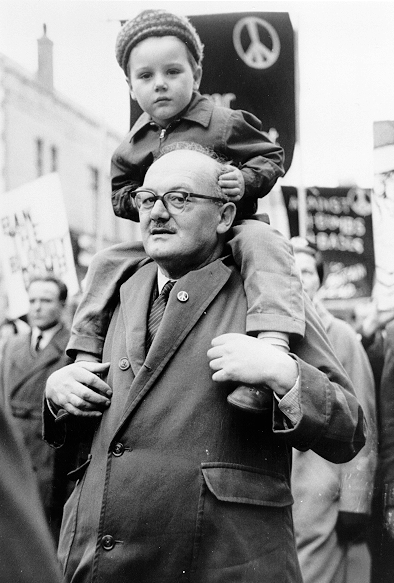
Ben Parkin MP (1906 – 1969) on a CND march A Radio 4 programme this week, however, highlighted an entirely different side to Rachman. In The Real Rachman – Lord of the Slums, a “barrister turned investigative reporter” named Joshua Levine suggested that those who believe Peter Rachman just to be a sordid intimidator fail to see the true persona of the man.
Levine’s witnesses, who number former tenants and Rachman’s biographer Shirley Green, do describe him as a “chancer” who was prepared to use the system to make money, but they also portray another side of this supposed “figure of evil’s” character.
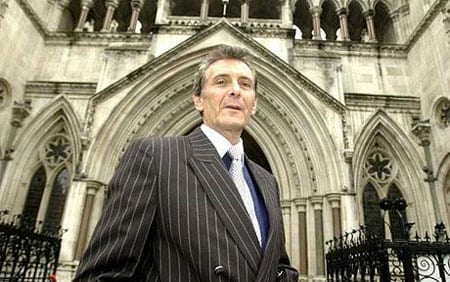
Nicholas van Hoogstraten (born 1945) One immigrant tenant stated: “He was the only one who ever did anything for us” whilst others added that Rachman was “well-liked” and “too soft to be a landlord.” He was a “benefactor” and “jolly” commented others who’d rented from him and a truly notorious modern-day landlord, Nicholas van Hoogstraten, failed to see the opportunist in Rachman at all: “It’s laughable. He had no wealth. It’s an invented moral [mission].” Rachman, equally, was defined as a man “affected” by his imprisonment in a Soviet labour camp in the Second World War by his former lover Mandy Rice-Davis and as someone who suffered true sorrow over the deaths of his family there.
Levine’s examination recounts how Rachman, who drove a navy blue Rolls-Royce with a white interior, was built into a symbol of corruption and moral decay. Rachman, like so many other mythical scapegoats, it turns out only died with only one conviction: parking without lights. The truth, indeed, is often stranger than fiction.
Listen to BBC Radio 4’s The Real Rachman – Lord of the Slums at: http://www.bbc.co.uk/programmes/b01ng4h3
Follow Joshua Levine on Twitter at: http://www.twitter.com/Joshua_Levine
-
Picture of the Week: A map with a difference
Matthew Steeples discovers a map of London with a difference
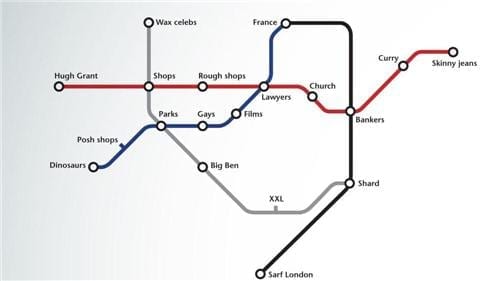
On the 16th October, an actor named Adam Lilley Tweeted an image based on a simplified version of a map of the London Underground. The creator had adapted it so that the names of the stations supposedly are indicative of what they believe the area around each station is best summed up by. Plainly it amused as over 4,000 Retweeted it.
A revised version of the London Underground map 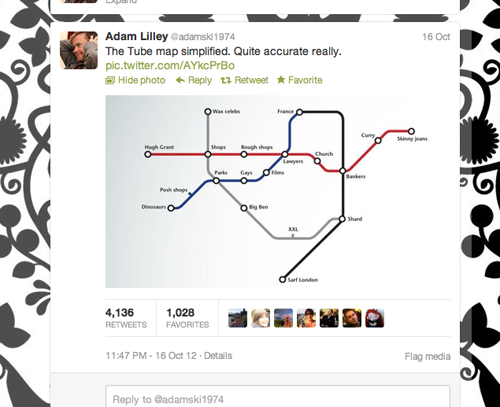
Adam Lilley’s revised London Underground Map has been Retweeted 4,136 times Knightsbridge is replaced by “posh shops” and South Kensington is all about “dinosaurs.” Westminster becomes “Big Ben” and Notting Hill Gate is simply “Hugh Grant.” Bethnal Green is replaced with “curry” and Leicester Square, “films.” Somewhere south of the river is simply “XXL” and out in Essex, another station is renamed “skinny jeans.” Irony is the order of the day.
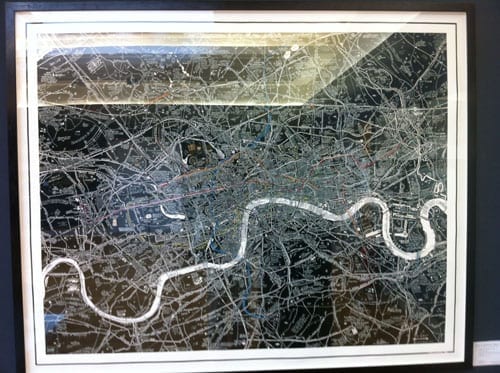
Stephen Walter’s “London Subterranea” 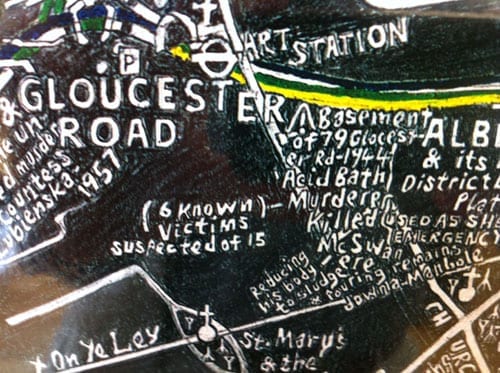
The section of the map detailing the exploits of “the acid bath murderer” 
And the section all Sloane Rangers should examine more closely Altering maps in this manner is nothing new and an especially brilliant one I saw at Christie’s in Old Brompton Road in their 3rd September sale depicted the location of events and discoveries I’d never heard of. In Stephen Walter’s London Subterranea, for example:
– The basement of 79 Gloucester Road was the location of the discovery of an “acid bath murderer” who killed at least 6 and is suspected of 15 murders. According to the depiction, he killed someone named “McSwan ‘ere and poured the remains down a manhole, reducing his body to sludge.”
– Harvey Nichols is shown as a plague pit.
– Brompton Oratory is described as aa “MI6 agent meeting place and dead letter office.”
Such maps provide a little light relief and for that reason we make Lilley’s image The Steeple Times picture of the week. We invite readers to submit their very own versions. We shall publish the best.
View Adam Lilley’s website at: http://www.adamlilley.com Follow him on Twitter at: http://www.twitter.com/adamski1974
Please send your versions to: [email protected]
-
The rise of the rucksack
The accessory of choice for fashion agnostics or a healthy two fingers to style? By Claire Rubinstein
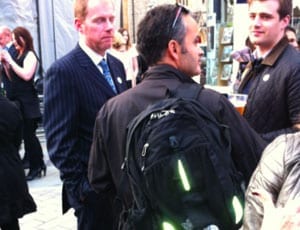
London is in the midst of an epidemic. So widespread is the affliction that it seems no area has escaped its advances. From St James’s to the Square Mile, from Notting Hill to Belgravia, the normally stylish urban gent is gripped by rucksack ruin. Precise tailoring – check, bespoke shoes – check, luxury timepiece – check, get a little closer and inhale the Creed Aventus. So far, so stylish until the aesthetic is shattered – Ninja Turtle style it’s a hero in a half shell, namely on his back is a Millets rucksack.
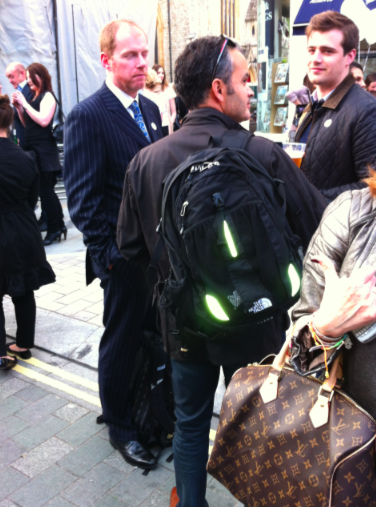
The archetypal rucksack look Once the domain of terrorists, one glimpse was enough to induce fear on such a scale that instant vacation of a tube carriage or any public place was guaranteed. Now rucksacks are commonplace. Want proof? Look no further than the cluttered window space at Cecconi’s or under the tables at The Wolseley. Rucksacks are everywhere.
Once upon a time the only bulge a man was politely allowed to have in his suit was his wallet, and so the classic briefcase or attaché case reigned supreme. But now a man is required to carry more than just his wallet and a few documents, likewise the resistance to carrying bags has become a thing of the past. Attitudes are changing and so are the bags. There is a huge variety of personal styles and even influential designers are embracing the trend with satchels, messenger bags, organiser bags and of course the controversial rucksack all in a range of materials from classic leather, fabric, canvas and even vegan-friendly hemp for the fashion conscious with a moral conscience.
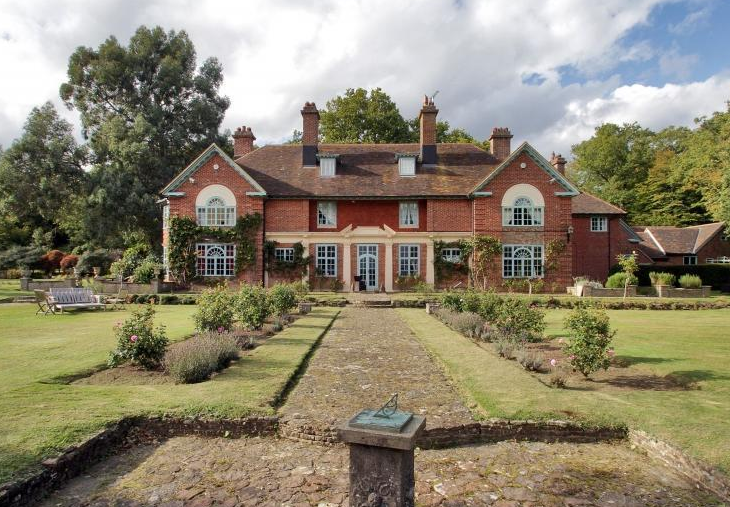
Matching jackets deserve matching bags and even a matching dog 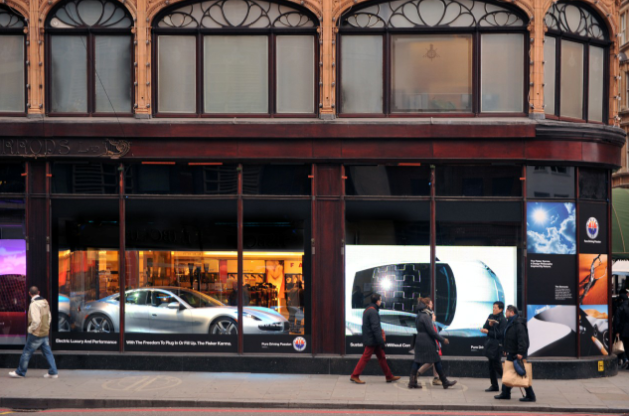
A casually discarded satchel But our obsession with bags is nothing new. Men once carried coin purses, with the oldest known purse dating back more than 5000 years, it was worn by a man known as Ötzi the Iceman. It can only be a matter of time before ‘The Ötzi’ becomes a coveted waiting-list only piece of male arm candy.
So what lies behind this devil-may-care attitude to accessorising? Chatting to the culprits, I found that it is nothing more than simple practicality. One Mayfair “hedgie” told me he eschewed his very stylish new Mulberry briefcase in favour of the rucksack as the offending item was much more practical when riding a scooter. A health-conscious West End property tycoon used a similar excuse reasoning that a briefcase made cycling impossible and was also not spacious enough for the extra grooming essentials needed for his daily sessions at The Royal Automobile Club’s pool.
But out of everyone I asked, there was one over-riding factor – the weather. So it seems that just as the iconic British Mackintosh has evolved for our rainy climate so too has the rucksack. And perhaps there is something rather charming about this stealth wealth with the cherished rucksack off-setting the traditional trappings of elegance.
As all that glitters is not gold, indeed the only man I knew who ticked every style box possible and never to be seen with a rucksack would proudly dress up in 3-piece suit and briefcase for ‘meetings’. This big-talking small-fry’s important appointments turned out to be meetings for one with the nearest bottle of house red and his briefcase contained nothing more than an Oyster Card and a clutch of court summonses for non-payment of bills.
I rest my case.
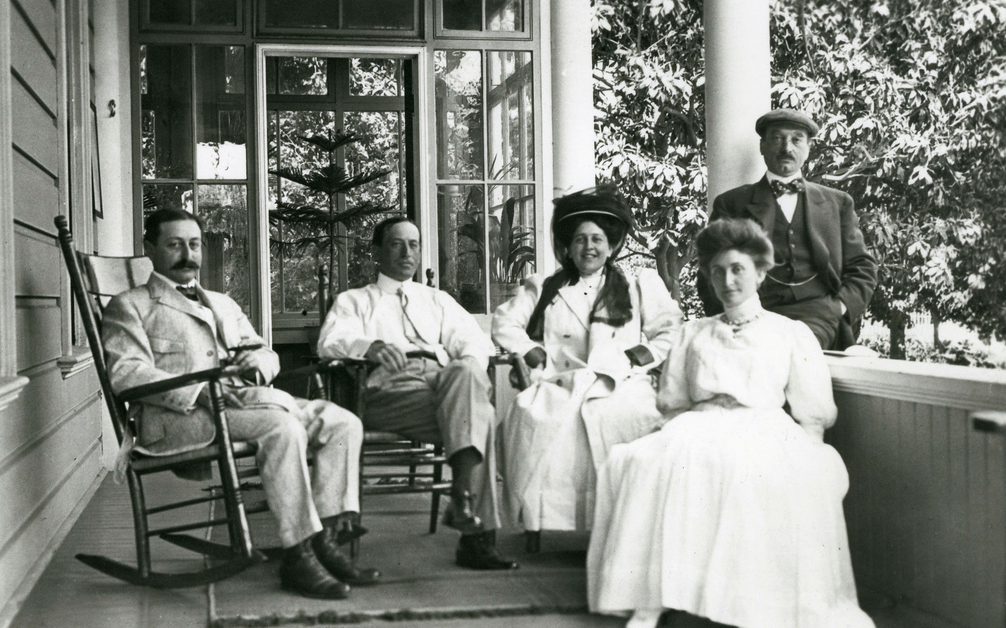
The author, Claire Rubinstein, with a gentleman who prefers a Harrods bag in jute 
A manbag in miniature -
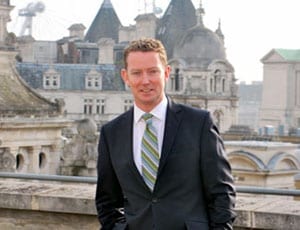
The Rt. Hon. Gregory Barker (AKA “Greg Barker”)
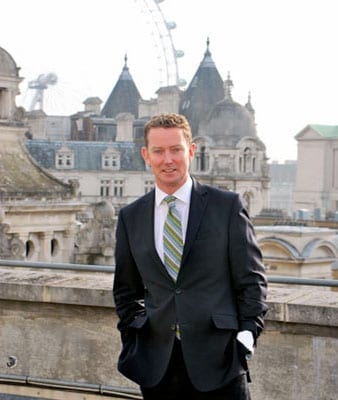 Gregory Barker worked for Roman Abramovich at the Sibneft Oil Group and as Energy Minister, took his daschund, Otto, to work at the Houses of Parliament. A Conservative Member of Parliament between 2001 and 2015, Barker lives between Notting Hill and Sussex and is widely cited as the architect of David Cameron’s “green conservatism”.
 -
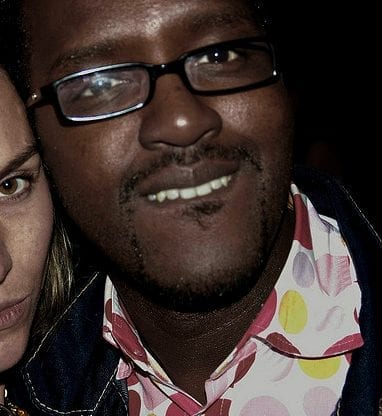
Orlando Hamilton
 Florist to the stars. “McFlower,” as he is affectionately known, sources the finest flowers from across the globe and transforms rooms with his imaginative style. His clients have included Sylvester Stalone, Madonna and Kylie Minogue. This “floral evangelist” must be second only to Nicky Haslam in the number of parties he attends.
 -
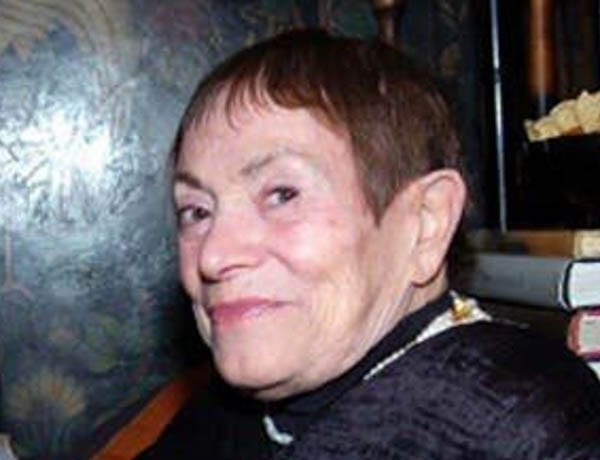
Marisa Masters (1925 – 2016)
This pint-sized nonagenarian hailed from Barri, Italy and was married to Lindsay Masters, one of the founders of Haymarket Publishing. (more…)
-
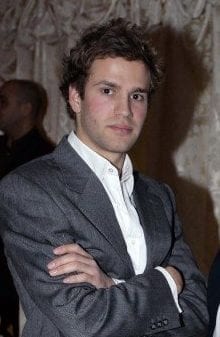
Edward Rigg
 This former filmmaker came up with his own cloudy apple juice. Cheltenham College educated, Edward Rigg has since expanded into a whole range of juices under the brand name Eager and once even also tried to revitalise bingo.