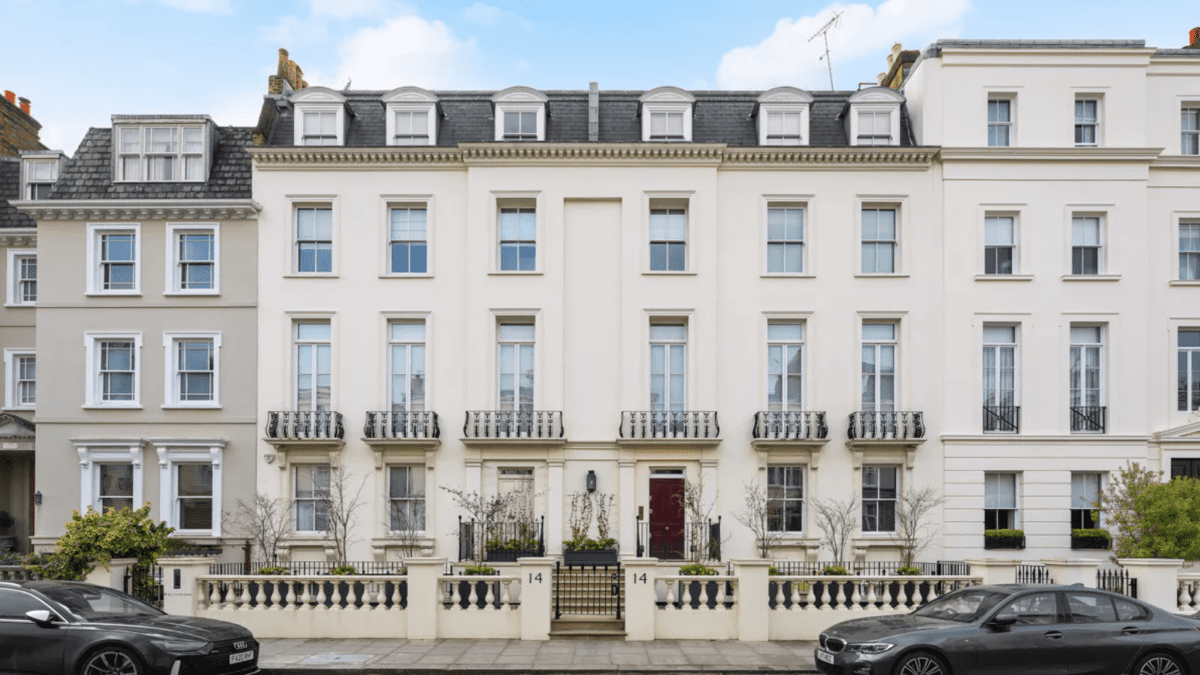
Matthew Steeples takes a look at a £36 million Kensington mansion formerly owned by disgraced business tycoons Alan Bond and Lord Black; its former chatelaine was known for stating “I have an extravagance that know no bounds”
Sir Winston Churchill’s daughter Mary Soames once described the buccaneering businessman and media tycoon Lord Black of Crossharbour as “London’s biggest bore unhung” whilst his wife, Lady Black – better known as the author and journalist Barbara Amiel – was suggested to be just a “rich bitch” by Sarah Sands in a “case for the defence” article in the Independent in October 2006.
“Poster boy for the 80s” turned fraudster and jailbird Alan Bond (1938 – 2015) was an English-Australian businessman equally Marmite-like in being liked or loathed and now a Kensington mansion owned for a time by both subsequently disgraced businessmen is once again for sale.
14 Cottesmore Gardens, formerly known as 12 – 14 Cottesmore Gardens, was purchased by Alan Bond’s Satellite Group for £7 million in the 1980s and sold by administrators of that business to Conrad Black and his wife for the knockdown sum of just £3.5 million in 1992.
Plain old Mr and Mrs Black (as they then were) lavished further millions – some of which came from the company Hollinger International, Inc., which ultimately resulted in their downfall – on the double fronted 19th century mansion and used it for entertaining on a lavish scale. Guests, including the likes of Prince and Princess Michael of Kent, Joan Collins, Margaret Thatcher, Henry Kissinger, Jimmy Goldsmith, James Hanson, Arnold Weinstock, Jacob Rothschild, Peter Mandelson and Tony Blair, were said to flock to the parties they gave there, but in 2005 these gatherings of upto 400 people at a time came to an almighty end.
Forced to sell at a bargain basement price of just £13.1 million on an ask of £17.5 million as the Canadian born billionaire faced jail time in America, Lord and Lady Black’s tenure was over and the residence saw its “arriviste torch” passed to Juan and Adriana Villalonga, a couple described as “a Mexican telecom czar and his beauty-queen wife.” Of what came next, The Globe And Mail’s Paul Waldie pointedly penned in February 2007: “[They] quickly erased many of the features that the Blacks prized.”
Once again for sale as of April 2023, the value of 14 Cottesmore Gardens has again been deemed to have substantially risen. Knight Frank offer the 12,310 square foot, five-storey residence at a punchy price of £36 million and laud it as “imposing” and “presented in good order throughout.” They add that a “pre-planning consultation” has found that further accommodation could be added that would take the internal space to more than 15,000 square feet; business barons with deep pockets only need apply.
Editor’s Note – Unlike as is the case in many publications, this article was NOT sponsored or supported by a third-party. Follow Matthew Steeples on Twitter at @M_Steeples.
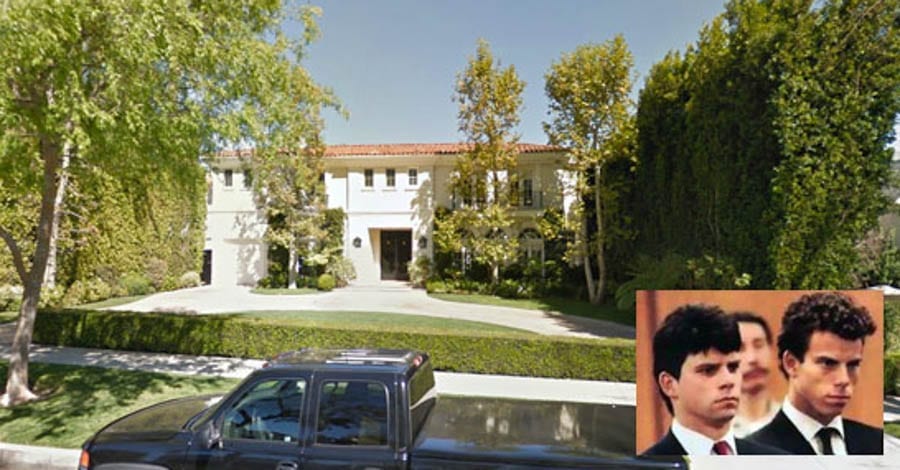
Pictured Top – 54-foot wide 14 Cottesmore Gardens is described by selling agents Knight Frank as “offering lateral living so often requested but so hard to find in central London.” They neglect to mention that with its hedges cut back to the minimum, the place actually looks extremely forlorn.
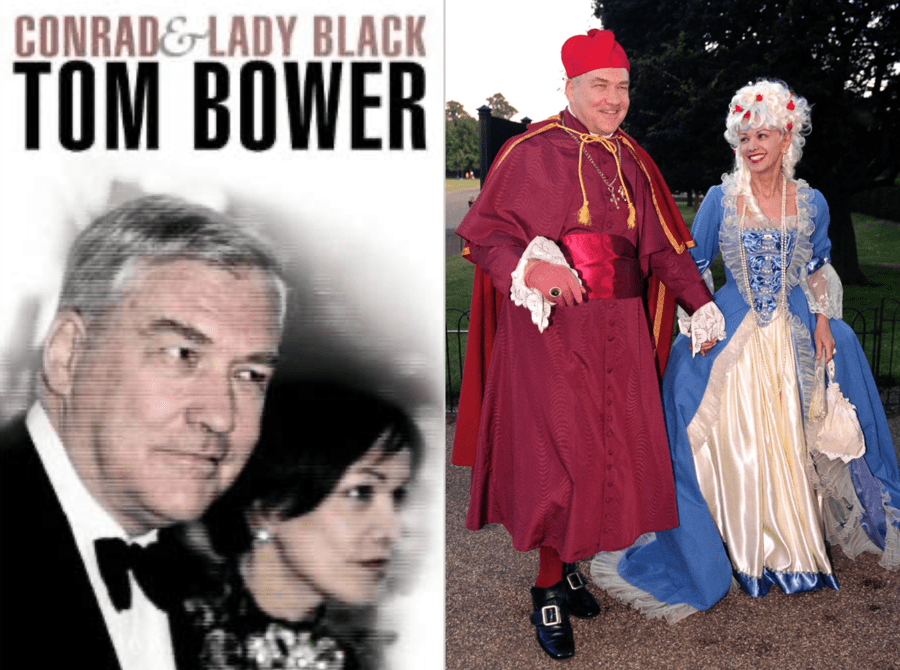
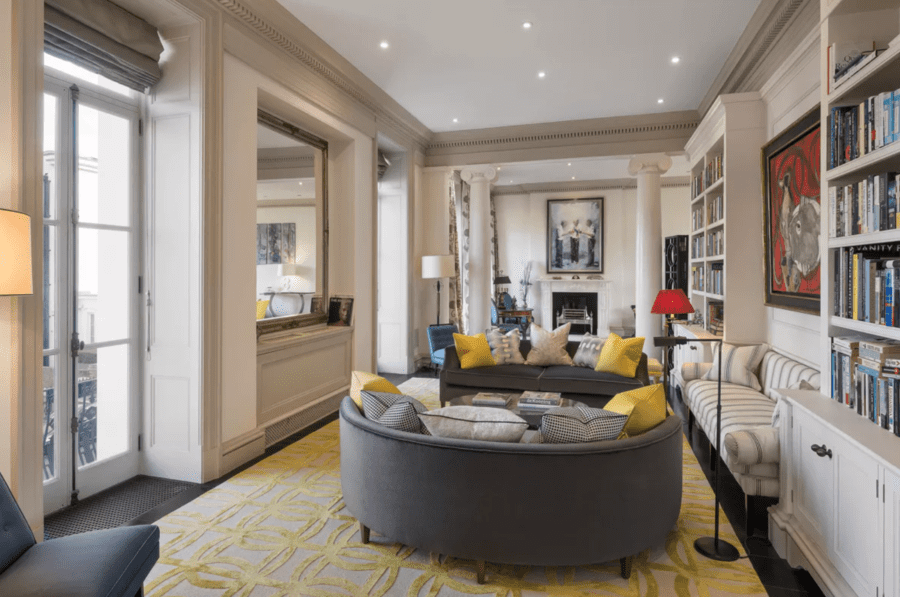
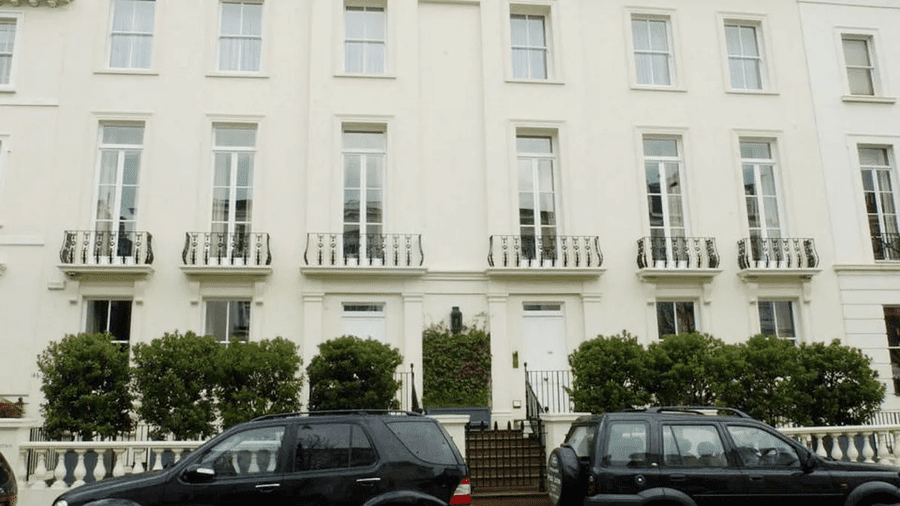
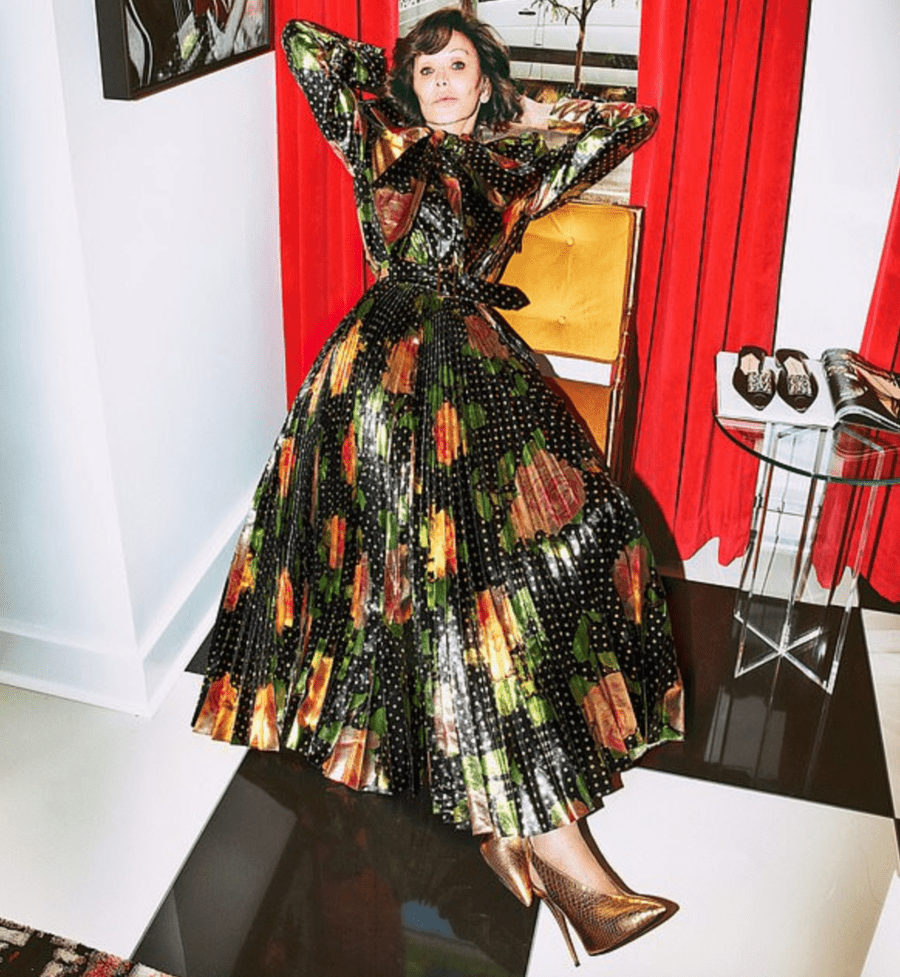
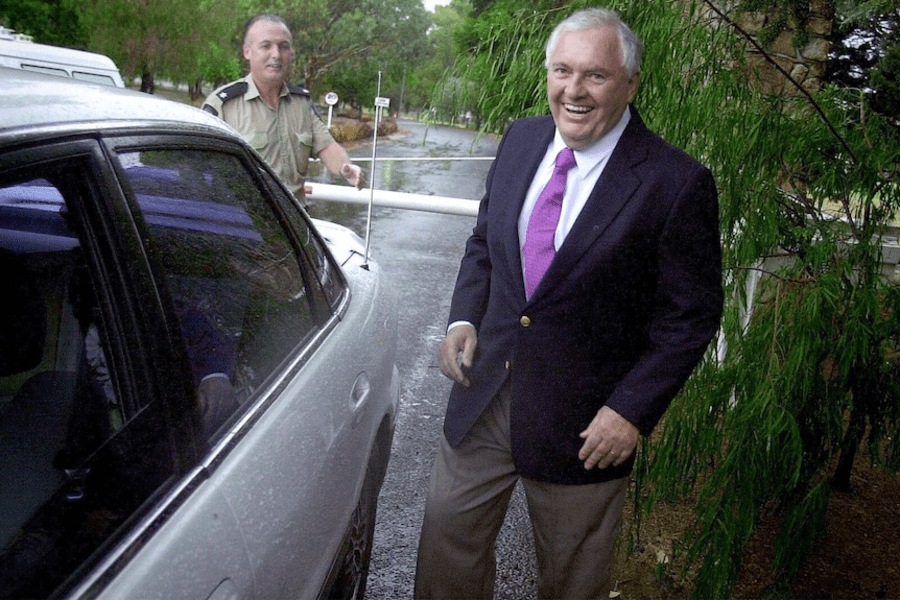
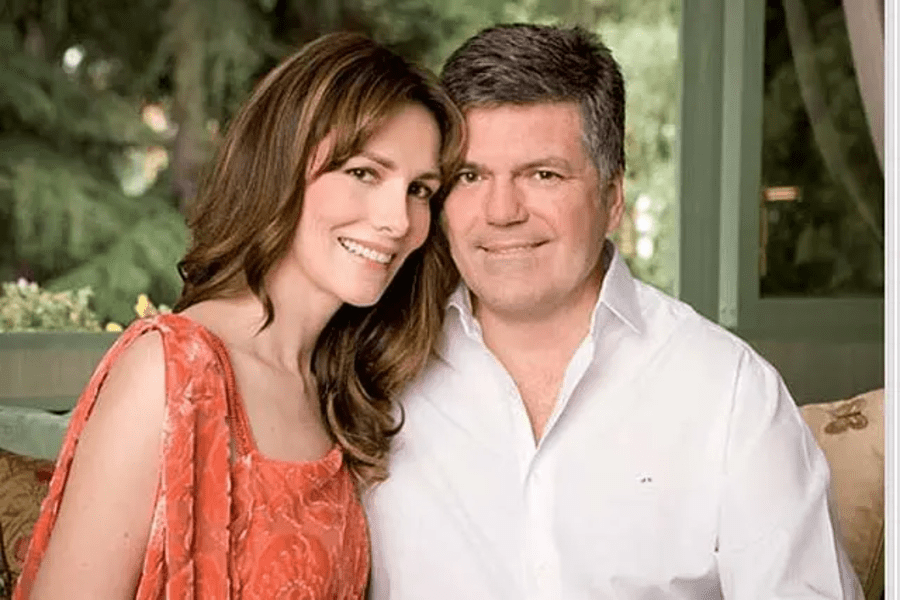
Flamboyant Lord and Lady Black dressed as Cardinal Richelieu and Marie Antoinette for a party at Kensington Palace in 2000. For a time, the couple employed 17 butlers (if Tom Bower is to be believed) and had two private jets and homes – aside from the 19th Cottesmore Gardens mansion – in New York, Palm Beach and Toronto. “Guests packed into their parties at Cottesmore Gardens,” Bower remarked in his 2006 book the couple, adding: “Amiel was a big spender… Under the control of senior butler Andrew Lightwood, second butler Peter Wilson and a succession of third butlers, Amiel’s life in Kensington had become what her constantly changing staff called ‘bizarre.’ Each recruit was taken by Lightwood on an introductory tour of the house, ending on the roof. ‘Make sure the landing lights are on at all times,’ instructed Lightwood solemnly, ‘because Madame takes off from here on her broomstick looking for cats. She needs the lights to guide her return.’ His face would crack into a smile. ‘Most important, take care that she never sees you. She hates seeing any of us.’ Amiel’s eccentricity demanded that her staff hid whenever she approached, diving into cupboards if necessary, and never entered her quarters when she was present. Every day, all the bed linen was changed and subjected to ‘the penny test.’ A coin was dropped onto the sheets. If it failed to bounce they were not drawn sufficiently tight. Every cushion was arranged to a precise pre-ordained position, and each towel placed exactly as Amiel had predetermined. ‘Andrew!’ she screamed down the telephone on one memorable occasion, ‘the towels are in the wrong place!’ Lightwood, as Amiel knew, was in New York, but he was expected to telephone the staff in the house in London to rectify the error. ‘You f**king pillock!’ she yelled at another member of staff for reading her ‘Daily Mail’ before it was delivered to her.”Barbara Amiel Black (or ‘Lady Black’ as she prefers to be known) in her drawing room at Cottesmore Gardens (pictured). Of her, Sarah Sands on Lord and Lady Black in the ‘Independent’ in October 2006 opined: “Conrad and Barbara in their monstrous, glamorous way, knew how to throw parties. The talk was of geo-politics and hemlines. Nowadays, we scorn their extravagance and doubt the source of their wealth with prune-faced hindsight. Meanwhile, everyone is sucking up to Russians…. Barbara would disingenuously begin her midnight calls to me by saying in her low, breathy voice: ‘I hope I am not disturbing you.’ She would then offer little glimpses of her own home life. I remember her mentioning that Conrad Black was upstairs playing with his fleet of toy gun ships in the bath… I remember her examining an exhibition of doll’s houses at the Chelsea Flower Show and sighing how restful it would be to live in this cosy little home. How she envied people in small houses. The burden of wealth was one of her more dangerous fantasies. At one of her Gatsby-style parties in Kensington, she flinched at the elaborate canapés on offer: ‘Really, all I want is a sausage,’ she said, piteously. Then, she ran a hand down her inconceivably expensive dress and whispered: ‘I hate these parties, I am so shy.’ Later, I was invited to her boudoir, where she lay on cushion surrounded by her women friends. She was Kensington’s Cleopatra, surrounded by maidens such as the designer and Forte daughter Olga Polizzi, the political thinker Tessa Keswick and the writer Miriam Gross.”The very same drawing room at 14 Cottesmore Gardens today. The décor is now somewhat more modern and less ‘classical country house-ified.’ It’s certainly more Soho Farmhouse than Alberto Pinto in style; it is currently a space that the former Meghan Markle would feel more at home than say, perhaps, the likes of Lord and Lady Black’s chum Ghislaine Maxwell and her fellow noxious nonce Ponzi scheming paedophile boyfriend Jeffrey Epstein. Mr Pinto was responsible, it should be noted, for the designs of most of Epstein’s residences.The front elevation of 12 – 14 Cottesmore Gardens during the era it was owned by Lord and Lady Black.Multiple entries for Lord and Lady Black during the time they owned 14 Cottesmore Gardens appeared in the ‘Little Black Book’ address book often attributed as being that of the friends and associates of Jeffrey Epstein, but that featured more of the contacts of Ghislaine Maxwell in fact. In October 2020, Barbara Amiel took revenge on the pension pot plunderer’s padeophile sex trafficker daughter by featuring her in her “score-settling” memoir ‘Friends & Enemies: A Life in Vogue, Prison, & Park Avenue.” Maxwell had “dumped” Lady Black when Lord Black was being investigated for fraud. She wrote of their last meeting: “We were friends – so putting on my ‘So good to see you’ face, I headed for her. She bolted. Turned that sharp tight little turn when you really want to get away. And that was it.” Of the clear lover of plastic surgery Lady Black, in October 2020, Sarah Sands remarked in ‘The Mail on Sunday’: “She had a bohemian, almost masculine, view of opportunistic sex. She describes, for instance, accompanying an early love in his white Triumph sports car ‘in which once or twice I had performed fellatio to the fascination of passing truck drivers, all for fun.’”After getting out of the clink in 2012, Lord and Lady Black decided to go back on the ‘razzle-dazzle’ and posed for photographers before heading back to London to party with friends. In May 2019, the rambunctious peer arrogantly announced he’d be returning to the House of Lords after President Donald Trump pardoned and praised him. Commenting, of this pardon, Lord Black declared: “I’m not bitter… Officially in the United States, I’ve never been charged and I won in the end. It was a war and there are casualties in wars. I lost the time, I lost a lot of money, but as you can see my standards of living isn’t bad… The truth is, these, last 15 years, I haven’t been as interested in British politics as I was before – in the Thatcher years. It could be quite interesting again, in fact it is as of right now – it’s very interesting… It’s my good fortune that at a time when it is feasible, it happens – by happy coincidence – that it is a time of great fermentation in British public affairs.” Surprisingly, he doesn’t seem to have turned up on occasions since.The previous owner of 14 Cottesmore Gardens, Alan Bond (1938 – 2015), will forever be remembered as “Australia’s most notorious corporate criminal.” Born in Hammersmith, London, Bond’s first crime occurred when he was charged with theft aged 14 in Fremantle in Australia and whilst he is remembered for bankrolling the successful challenge for the 1983 America’s Cup, it is for causing the then biggest corporate collapse in Australian history that he will be go down in history. Former Miss Mexico Adriana Abascal López-Cisneros (at the time Adriana Villalonga) bought the house in 2005. She divorced the Spanish businessman Juan Villalonga in 2009 and married the French businessman Emmanuel Schreder in Ibiza in June 2013. In August 2014, the magazine ‘Quién’ featured the model and television presenter on its cover and at that time she described her new husband as “the love of my life.”Madrid born Juan Villalonga became the joint owner of 14 Cottesmore Gardens with his then wife Adriana Abascal – the couple were married between 2000 and 2009 – in 2005. He is listed on Companies House as being a director of the now dissolved Medikidz Foundation at the address between August 2009 and November 2013. Married since 2011 to a photographer named Vanessa Von Zitewitz, Mr Villalonga was a partner at McKinsey & Company in the 1980s, CEO for Credit Suisse First Boston and Bankers Trust in Spain in the early 1990s and CEO of Telefónica from 1996 to 2000. He was named as one of the best performing chief executive officers in the world by ‘Harvard Business Review’ in 2010 and is also linked to addresses in Monaco.
The Names & Numbers – 14 Cottesmore Gardens (formerly known as ’12 – 14 Cottesmore Gardens’), Kensington, London, W8 5PR, United Kingdom
April 2023 – Offered for sale for £36 million ($44.4 million, €40.9 million or درهم163.2 million) through Knight Frank. Valued on Homipi at an upper sum of £28.558 million ($35.250 million, €32.440 million or درهم129.456 million).
2009 – Mr and Mrs Villalonga divorce and subsequently Adriana Abascal married Emmanuel Schreder, a French businessman, in Ibiza in June 2013.
2005 – Sold by Lord and Lady Black for £13.1 million ($16.2 million, €14.9 million or درهم59.4 million) to Spanish businessman Juan Villalonga Navarro and Mexican model, Miss Mexico winner and television presenter Adriana Abascal López-Cisneros Villalonga.
October 2004 – Placed for sale for £17.5 million ($21.6 million, €19.9 million or درهم79.3 million) according to NZ Herald.
January 2004 – Valued at £14 million ($17.3 million, €15.9 million or درهم63.5 million) according to The Globe And Mail. At the time, the “mansion” in “the upscale Kensington neighbourhood” was described as having “10 bedrooms, 6 bathrooms and a swimming pool.”
Featured also in The Guardian in an article by Chris Tryhorn. Quoting Lord Black, he shared: “At a certain price, anything is for sale. [It has] been shown to people in the not-too-distant-past.”
Going further, Tryhorn added: “Artwork from the 18th and 19th centuries lines the walls, and there is plenty of storage space for the extensive wardrobe and shoe collection of Lord Black’s wife, Barbara Amiel, who famously declared once that her ‘extravagence knows no bounds.’ … It was originally two homes and one of the two original front doors is now a ‘deliveries’ entrance. He has used it in the past to host dinners with butler and maid service that was part-paid by Hollinger.”
Also in 2004, in a profile in The Spectator, Peter Oborne wrote:
“Every year the Blacks threw two parties, one at Christmas and one summer event, at their double-fronted 11-bedroom mansion in Cottesmore Gardens. Everybody who mattered at the time went: Margaret Thatcher, Henry Kissinger, Jimmy Goldsmith, James Hanson, Arnold Weinstock, Jacob Rothschild, royalty, the playwright Tom Stoppard.”
“Some of these, injudiciously as it turned out, agreed to join the main Hollinger board. The luckier ones – Peter Carrington, Robert Salisbury – got away with being made directors of TheTelegraph. As the Tories faded out, Labour ministers started to arrive, the indefatigable Peter Mandelson, David Blunkett and other ministers eager to ingratiate themselves with the Tory press. Prince and Princess Michael of Kent were assiduous in attendance. In London, the Nineties belonged to the Blacks. They were London’s most glamorous power couple.”
“There had been a time when both Blacks had kept their feet on the ground. This ceased to be the case. One evening Barbara Black rang Charles Moore panic-stricken from her Kensington home. There had been a last-minute drop-out from one of the famous Black dinner parties. ‘I’m short of a woman,’ she told Moore. Moore surveyed the newsroom. His gaze alighted on the journalist Eleanor Mills, by chance the stepdaughter of the Cabinet minister Tessa Jowell.”
“An hour later, hastily groomed, made-up and brushed, Mills was sipping pre-dinner drinks in Cottesmore Gardens. Then disaster struck. A male guest, Max Fisher, dropped out. Mills was approached by Conrad Black. ‘Finish your drink and skedaddle,’ he told her. Barbara Black then told her to go to the kitchen and out through the servants’ door, where the driver would pick her up and take her home.”
2001 – Conrad Black is elevated to a life peerage in the United Kingdom at the suggestion of Tony Blair. He sat on the Conservative benches in the House of Lords until 2007 as The Right Honourable The Lord Black of Crossharbour KCSG, but took a “leave of absence” between 2012 and 2019.
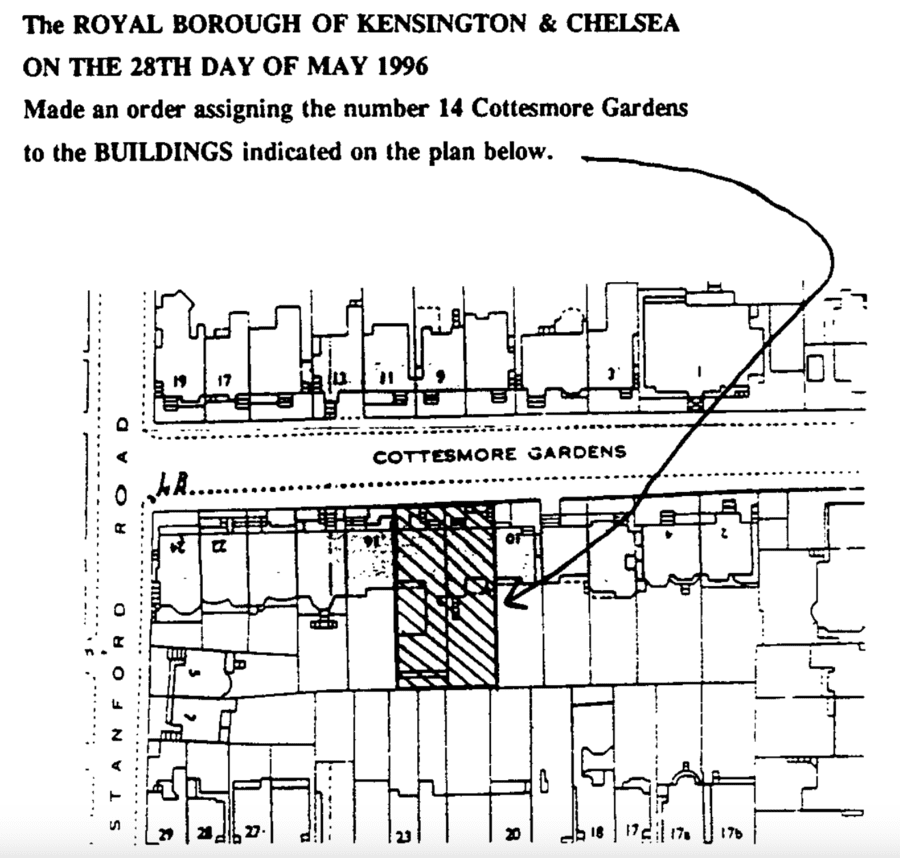
28th May 1996 – The Royal Borough of Kensington And Chelsea ordered that 12 – 14 Cottesmore Gardens “shall be known and described” simply instead as 14 Cottesmore Gardens.
Mid 1990s – The Blacks set about renovating 12 and 14 Cottesmore Gardens with the help of J. E. Evans Associates. Of the work in October 2006, The Sunday Times shared a segment of Tom Bower’s 2006 hatchet job Conrad and Lady Black that read: “Amiel vowed to create a palace that would attract celebrity worshipers of a power couple. Part of the first floor was to be removed to create a huge ground floor reception area.”
1992 – 12 and 14 Cottesmore Gardens sold by the administrators of the affairs of Alan Bond through estate agents Savills to media tycoon Conrad Black and his Watford born journalist wife Barbara Amiel Black for “well under the asking price” for a sum of £3.5 million ($4.3 million, €4 million or درهم15.9 million).
Mr Bond had been granted mortgages valued at £16.2 million ($20 million, €18.4 million or درهم73.5 million) on the property by Bell Satellite Services on the property along with two others at 4 and 16 Belgrave Mews in London, SW1 previously according to a report published by Financial Review in March 1990.
1991 – Rented to an American businessman for £6,000 per week ($7,400, €6,800 or درهم27,200 per week).
1990 – Placed in the hands of administrators of Mr Bond’s and placed for sale through Savills for a bargain basement sum of £3.8 million ($4.7 million, €4.3 million or درهم17.2 million) according to Financial Review.
1980s – Sold to Alan Bond’s Bell Satellite Group for £7 million ($8.6 million, €8 million or درهم31.7 million).
Circa 1905 – Walter Tapper is said to have “designed a library with handsome Arts and Crafts plasterwork (now removed) at the rear of the building.”
1869 – In their current marketing blurb, Knight Frank suggest: “There has been a house on the site of 12 – 14 Cottesmore Gardens since at least 1869. The current house has been altered, extended and most notably joined over the subsequent century and a half. With the local planning department strongly opposed to further amalgamation of homes, opportunities to acquire a house of this width will be rarer still in the future.”
1850s to 1860s – Built “under the direction of David Howell, of Serjeants Inn, Fleet Street.” Mr Howell was described in 1853 as an “articled clerk to a solicitor, lately carrying on business as a solicitor.” The architecture was lauded as: “Designed in a bold classical manner, with rather fleshy consoles and modillions… and bands of Vitruvian scroll between the bases of the ground-floor windows.”
More photographs of the £36 million mansion…
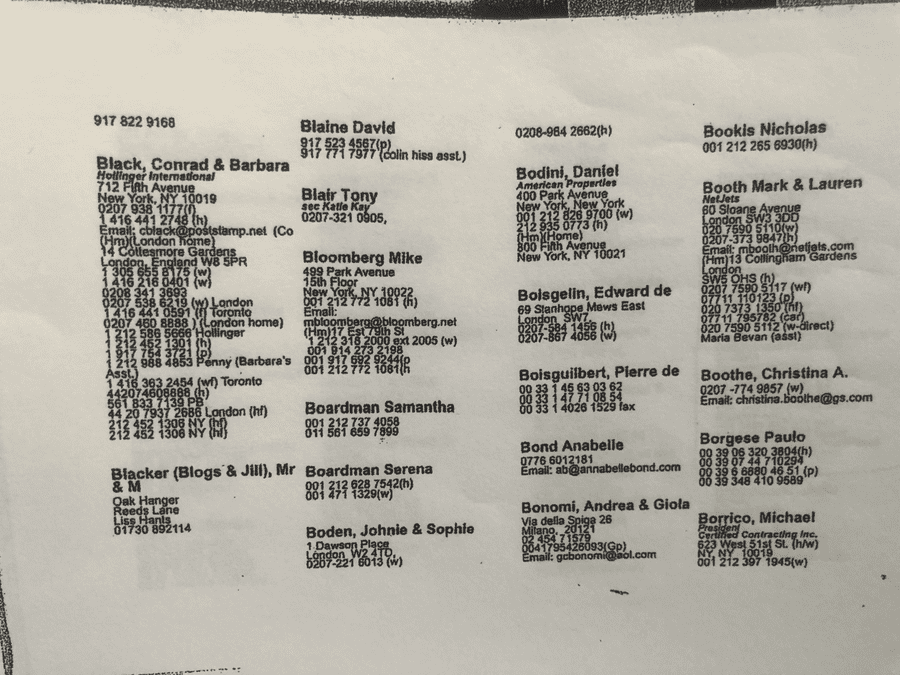
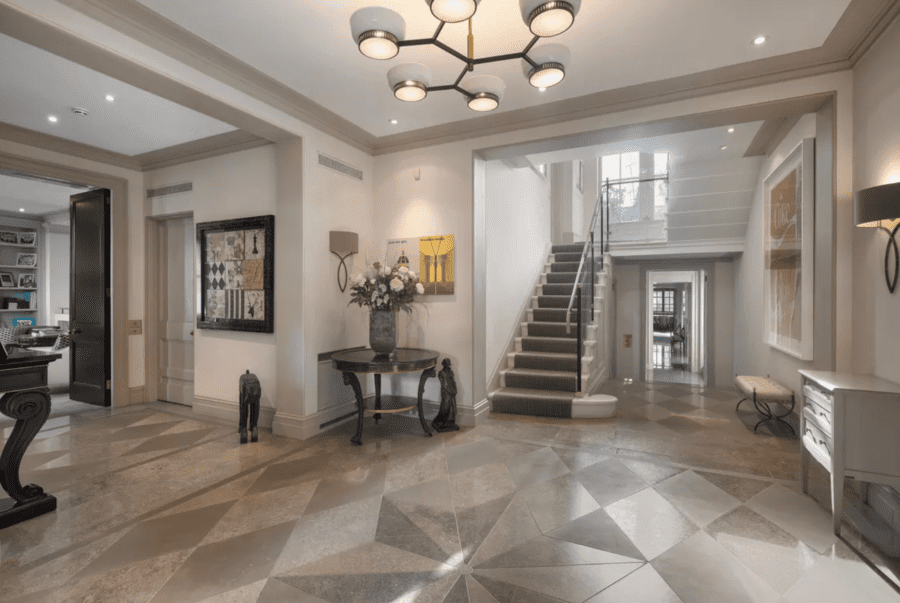
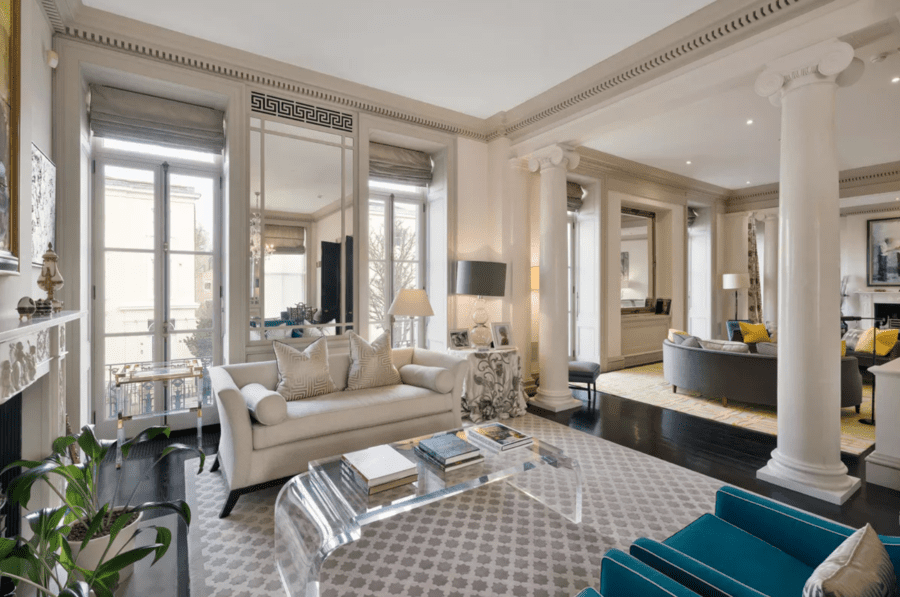
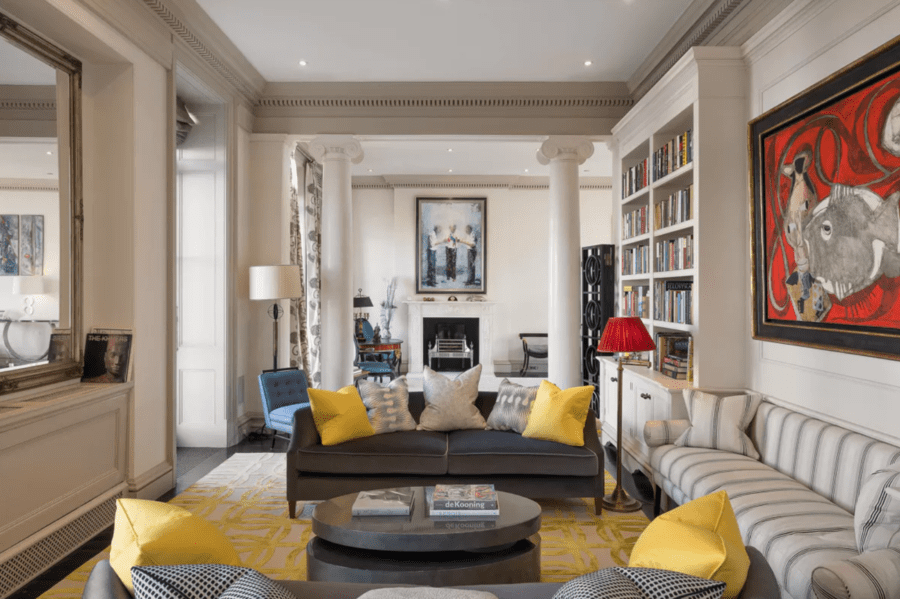
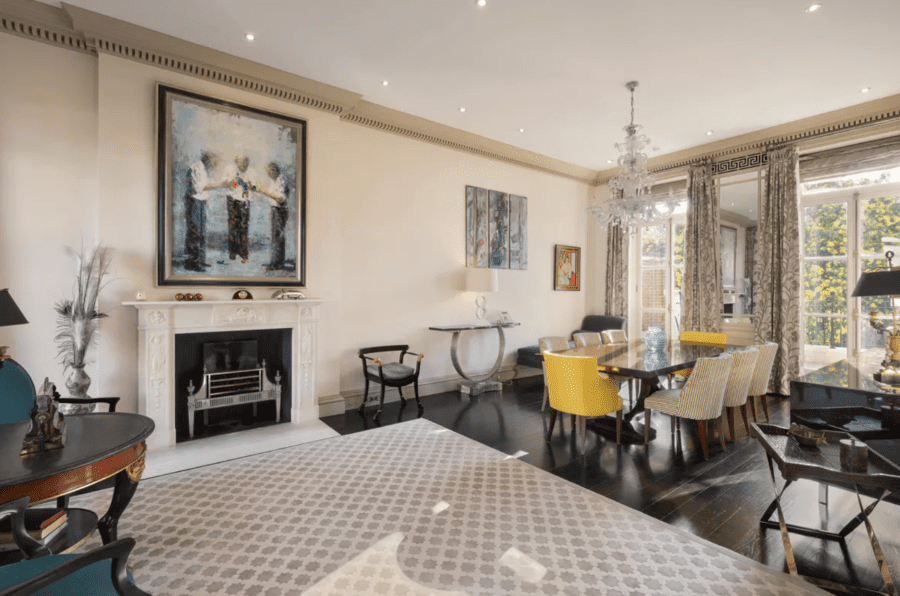
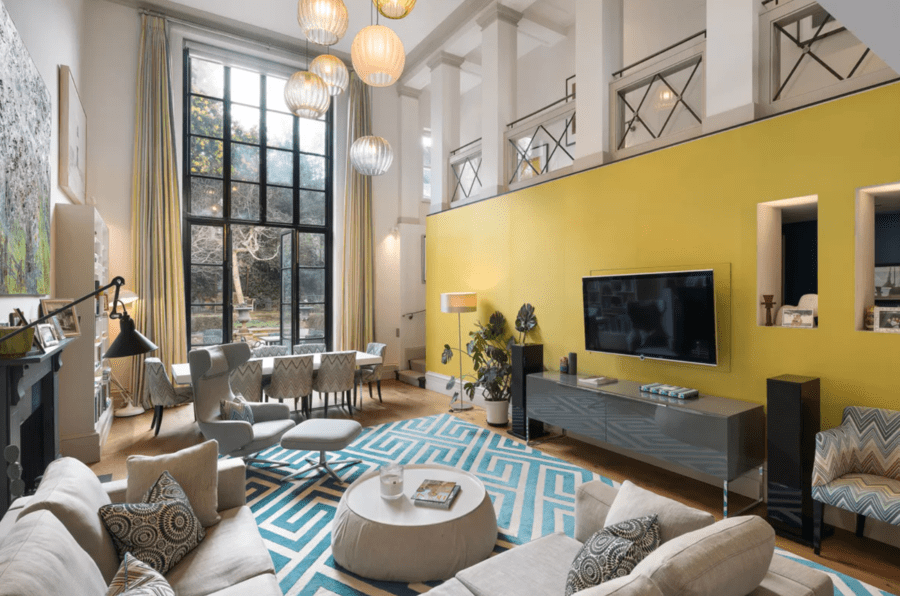
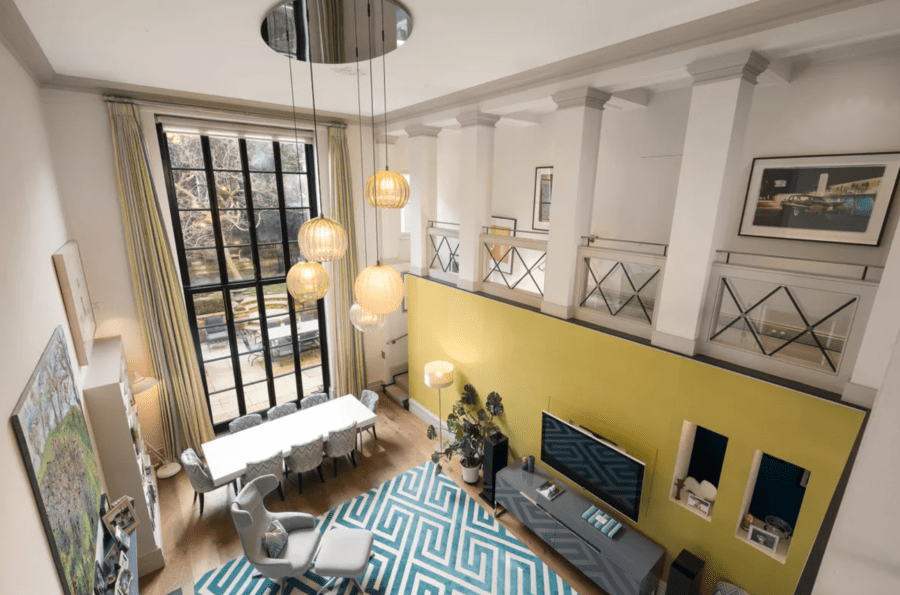
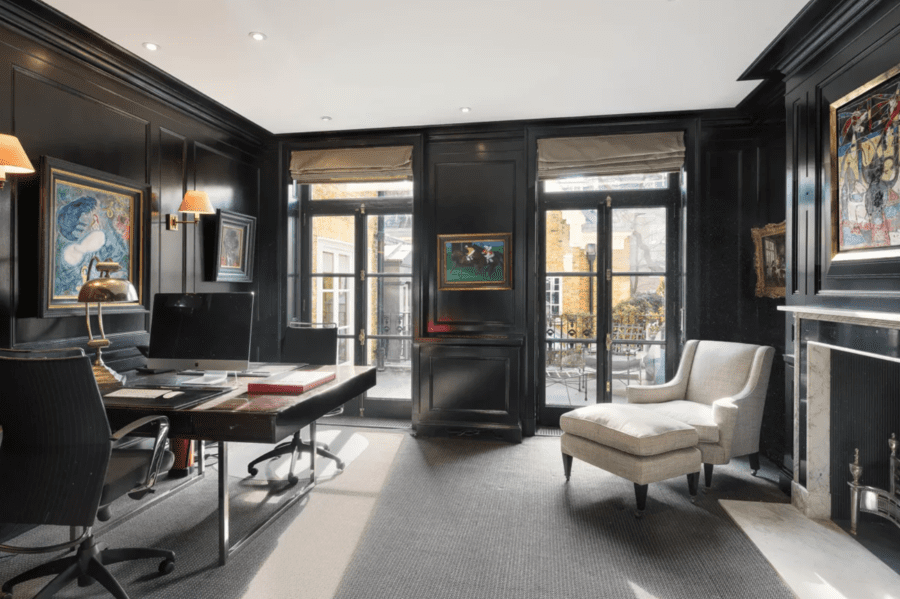
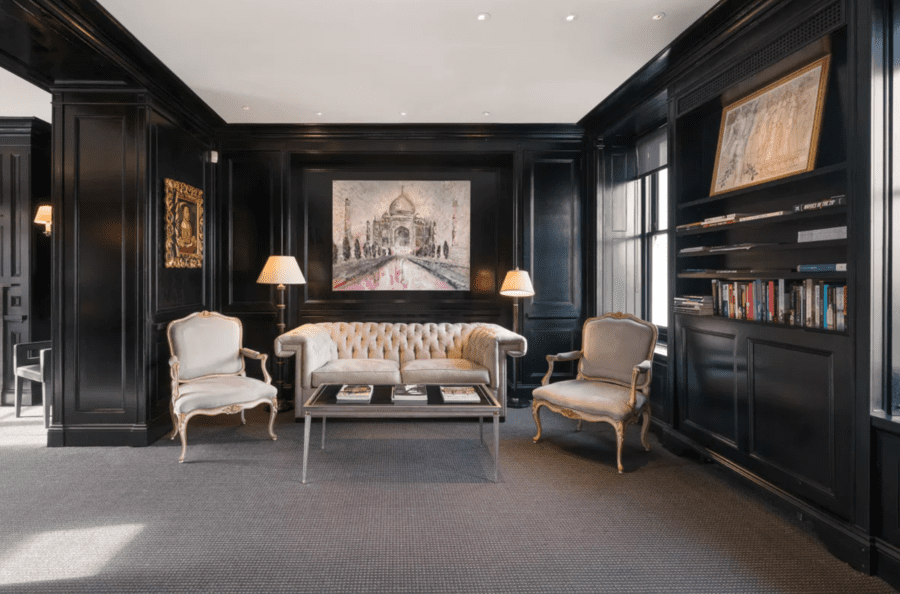
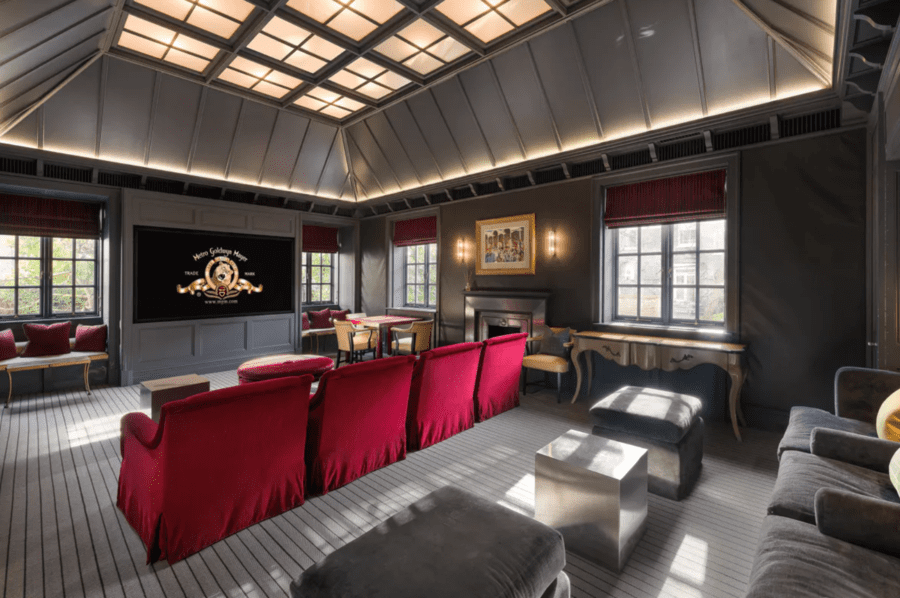
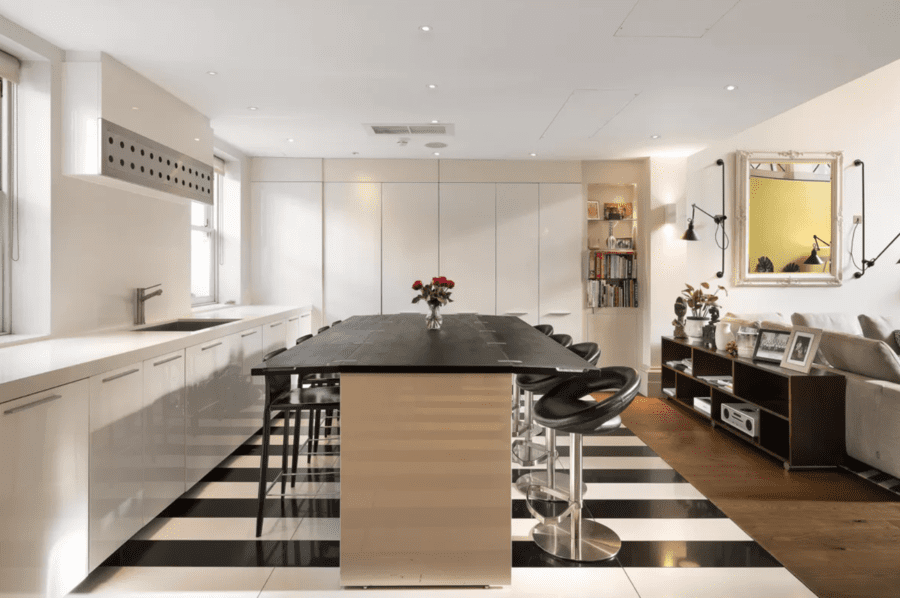
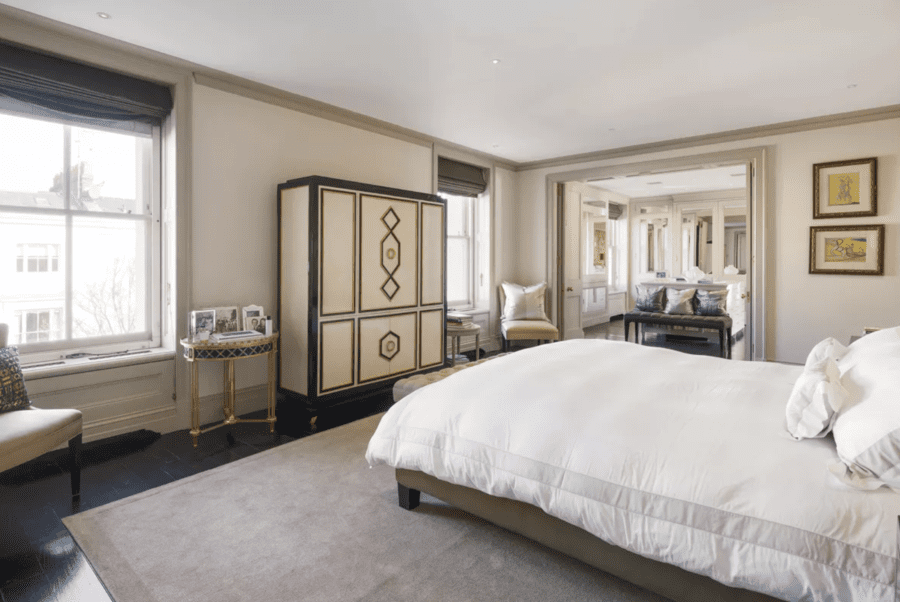
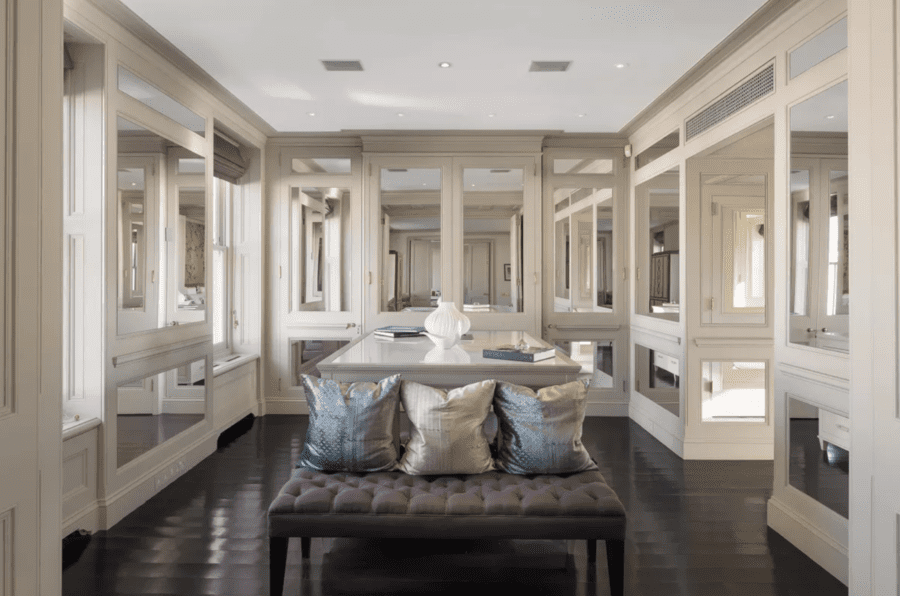
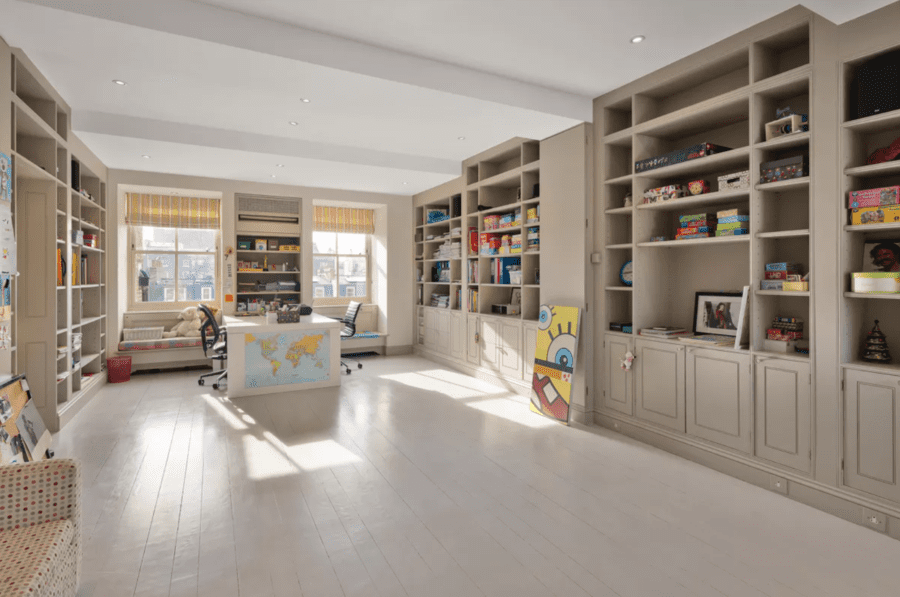
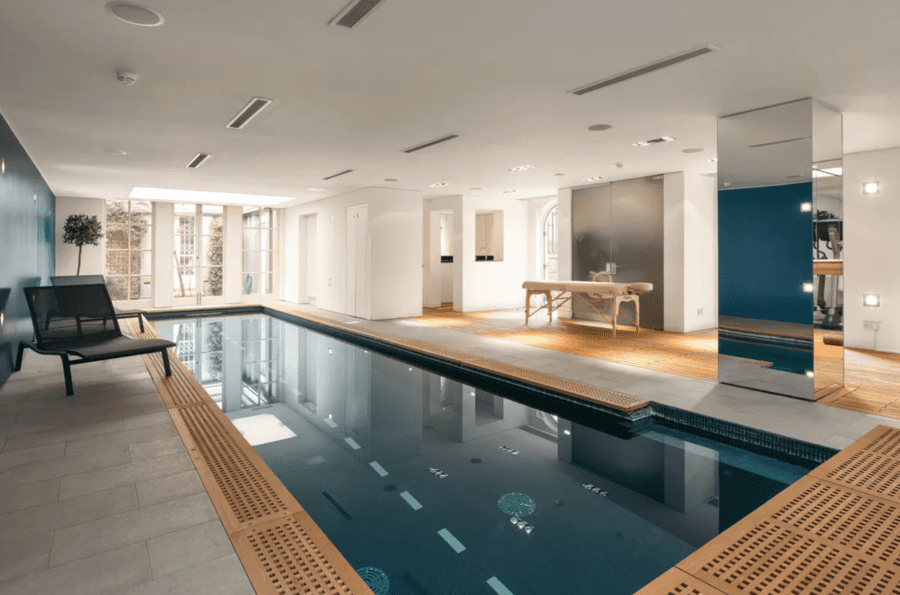
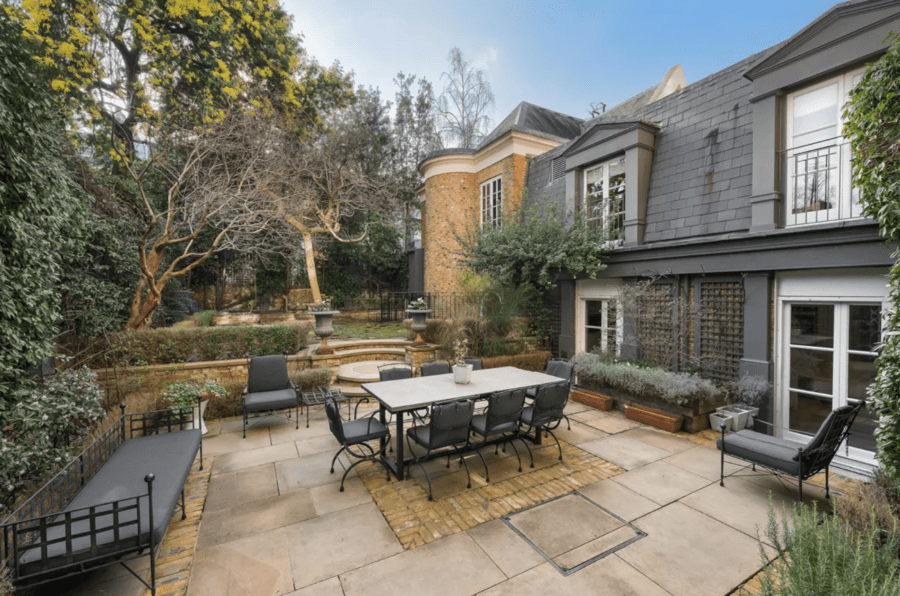
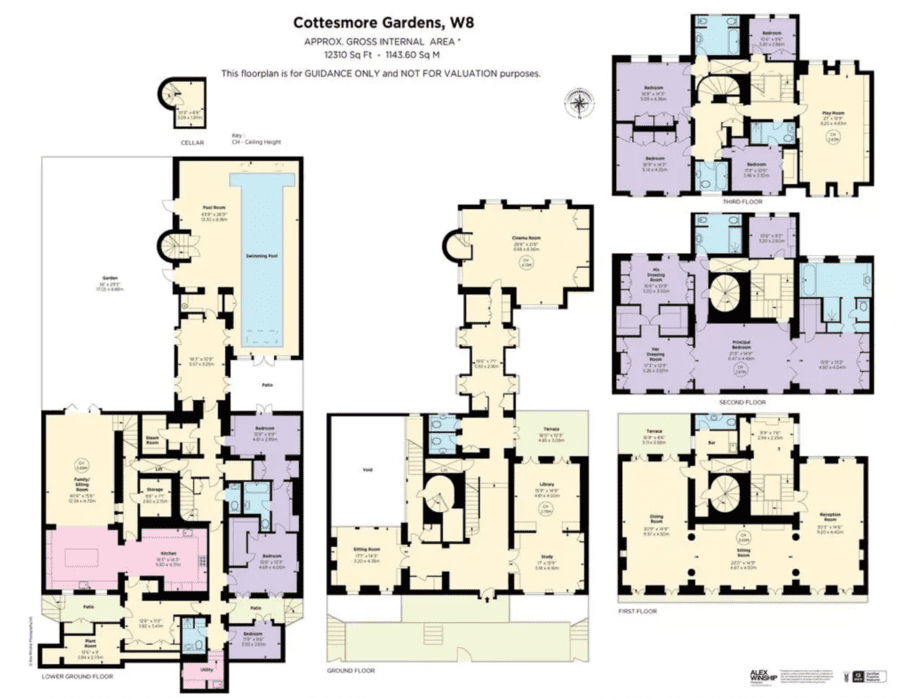
An entrance hall where power and privilege have most certainly mingled previously.The 54-foot wide drawing is lauded by selling realtors Knight Frank as “arguably the best room in the house” and “double aspect.” They add: “[It has] six windows overlooking the street and additional views over the private garden to the rear.”The columns where Barbara Amiel Black once posed for photographs remain, but the subsequent owners eliminated much of the 1990s ‘brash’ that had been installed by a Watford born woman whose excess clearly offended so many.This dining room, where Conrad Black hosted presidents and prime ministers, is now somewhat diminished. The table for eight looks completely out of place and a future owner would do well to install something a little grander.A double height entertaining space was installed at the insistence of the loftier-than-lofty Lady Black in the 1990s and it remains today. However, it is now currently being used for more casual affairs such as Netflix viewing rather than being the scene of something that you’d more likely find in the ‘House of Cards’ in fact.A new owner might reinstate the grandeur of the past; sadly, however, this seems unlikely and the purchaser is more likely to be a footballer or Internet tycoon than a super-connected business tycoon.This currently very dark and very depressing study would most certainly not appeal to the very clearly very, very bright yet very, very pompous The Right Honourable The Lord Black of Crossharbour KCSG – a man who is said to count Julius Caesar and Napoleon Bonaparte as “his military heroes.” Of him in July 1997, Mark Honigsbaum in the ‘Independent’ remarked: “Although Black’s grandfather had briefly been a business partner of Harold Harmsworth, the original Viscount Rothermere, it was from his father, George Montegu Black Jr, that Black learned the art of corporate warfare, the importance of historical perspective and that gambling provides a disappointing rate of return compared to the Dow Jones index… The young Conrad was precocious. At the age of eight he sank his life savings of $60 into a single share of General Motors. He also became obsessed with Napoleon, and would astound his father’s friends by reeling off details of campaigns. Another story has him washing dollar bills and hanging them out to dry on a line outside his father’s home in Toronto. The last is apocryphal – Black says he slipped in the mud and was cleaning his change – but the image of the young capitalist, wise beyond his years, is accurate. His childhood tutor, the historian Laurier LaPierre, once asked Black why he always seemed to have the air of someone waiting for something to happen… A few years ago, for instance, the rumour went round Fleet Street that Black had bought Napoleon’s preserved penis at an auction. Black denied it, but many remain convinced that Bonaparte’s body part sits in Black’s collection of military curios… Black is no philanderer and is devoted to his second wife, the former ‘Sunday Times’ columnist Barbara Amiel. They are said to be intellectual soul mates and the parties at their four-storey mansion in Kensington are famous for bringing together a cross-section of the great and good.”One could not imagine the likes of the late great Baroness Thatcher, for example, liking the idea of sitting in this extremely depressing and dark waiting area. A new owner would do well to obliterate a décor scheme that could have only been favoured by a completely colour blind banker.A room currently described as a ‘cinema room’ measures 28’6” by 21’6” and is situated at the rear of the house. One can imagine Conrad Black having sat here for hour upon hour watching historical dramas about Napoleon with the likes of chums such as the acclaimed historian Andrew Roberts, the gambling tycoon John Aspinall and the politician and diarist Alan Clark, but a new owner will be more likely next showing episodes of ‘Succession’ – based on ‘The Telegraph’ tycoon’s rival Rupert Murdoch – than viewing historical works one most definitely suspects.Dining whilst the staff cook would NEVER have been on the agenda in the era that pomposity reigned whilst Lady Black was chatelaine of 14 Cottesmore Gardens.A 2,000 square foot entire floor fit for a tycoon… The master bedroom suite of the house takes up the entirety of the second floor of the building. It incorporates not only the principal bedroom, but also a “his” dressing room and a “her” dressing room as well as a sitting area, a bathroom, a shower room and storage rooms. It has direct lift access and is bigger than the average Brit’s entire house.A dressing room in the house where Barbara Black opened up to ‘Vogue’ and displayed “closets overflowing with dazzling evening gowns, designer handbags and 100 pairs of Manolo Blahnik shoes. ‘I have an extravagance that knows no bounds,’ she famously declared. Unfortunately for Lady Black, the article was closely perused at investment company Tweedy, Browne, a Hollinger International shareholder.”This playroom certainly did not exist in the era that Lord and Lady Black owned the property. It would be more likely crammed with books or stuffed with Manolo Blahnik shoes than toys from Toys ‘R Us. A new owner may likely reinstate it as an additional bedroom or office or games room perhaps.The pool room measures 43’9” by 26’9” and is no doubt where Lady Black spent many an hour relaxing.The garden to the rear was where Lord and Lady Black hosted their annual summer party (with guests “spilling” into their drawing room also). In surprisingly Tardis-like fashion, the duo were able to supposedly squeeze in upto 400 guests at such occasions. Amongst those said to have enjoyed hospitality there were Joan Collins and of such, magazine publisher Nicholas Coleridge wrote: “If you get a kick out of milling about with present and former prime ministers, cabinet ministers, minor royals, dukes, editors, vastly rich Americans, distinguished historians, gossip columnists, playboys and lots of pretty ‘it’ girls, then this was the place to be.”The existing floor plan of the property illustrates the vast scale of the building offered. A buyer, Knight Frank observe, has additional options and “a pre-planning consultation has been carried out with RBKC by leading architects Studio Indigo.” They add: “[It] would completely reconfigure the house adding an additional basement floor and taking the internal space to more than 15,000 square foot. The resulting house would have a 40-foot by 41-foot south-facing rear garden.”A plan of the site as presented in 1996 when 12 and 14 became known just as 14 Cottesmore Gardens.
Elizabeth Bond highlights the case of the mysterious disappearance of Andrew Gosden; last seen in London in 2007 aged just 14
Yesterday marked the 28th birthday of Andrew Gosden. He did not, however, celebrate the day with his immediate family as he vanished in September 2007.
It’s a case that has received relatively little media coverage – at least in comparison to that of Madeleine McCann, who went missing the same year – but now it’s an appropriate time to rectify this and appeal for anyone with information to come forward.
What makes this story so baffling is that there has been no explanation for what happened. At the time of his disappearance, Andrew Gosden was a promising 14-year-old student from a happy, loving home in Doncaster. He had a 100% attendance record at school and was expected to score straight A grades in his exams. There is no evidence that he was being bullied or suffering from depression of any kind.
Yet on the morning of 14th September 2007, Andrew did not catch the bus to school as usual. Instead, he waited in a nearby park until his parents had gone to work. He then returned home, changed out of his school uniform, and put on a black Slipknot T-shirt and a pair of jeans. He left the house, taking only a black canvas bag and a portable games console with him, and went to a local cashpoint where he withdrew £200.
At around 9:30 am, Andrew made his way to Doncaster Station and bought a one-way ticket to London. He refused the offer of a return ticket, despite it costing less than a pound more. He then boarded a train, and two hours later was pictured on CCTV leaving King’s Cross Station and heading out onto the streets of London. This was the last confirmed sighting of him, and there has been no trace of him since. His bank account has also remained untouched since that day.
Unfortunately, due to errors on the part of the school, the Gosden family did not realise that Andrew had gone missing until later that evening. In addition, it took a few days for the lady who sold Andrew the ticket for London to come forward, and several weeks before police identified Andrew on camera at King’s Cross. All these delays meant that other potential CCTV street footage of Andrew was wiped.
The Gosden family has searched tirelessly for Andrew and tried to ascertain the reasons for his disappearance. It has been suggested that Andrew may have met someone online who persuaded him to come to London. However, there is nothing to support this theory. Andrew did not have a mobile phone or an e-mail address, and his family has said that he did not even seem particularly interested in the Internet.
To date, nothing has come from appeals or supposed sightings of Andrew. Nevertheless, the Gosden family has not given up hope of ever hearing from him one day. An age-progressed image of Andrew was released in 2019. The family has also set up a website which includes a personal message for Andrew, as well as contact details. If Andrew should read this, they say that they do not care about the past or any decisions he may have made. They simply love and miss him, and hope to hear from him, so they can support him in any way.
If anyone else believes they have information about Andrew, they can contact South Yorkshire Police on 0114-220 2020 or Missing People on 116 000.
Follow the efforts to find Andrew Gosden on Twitter by clicking here.
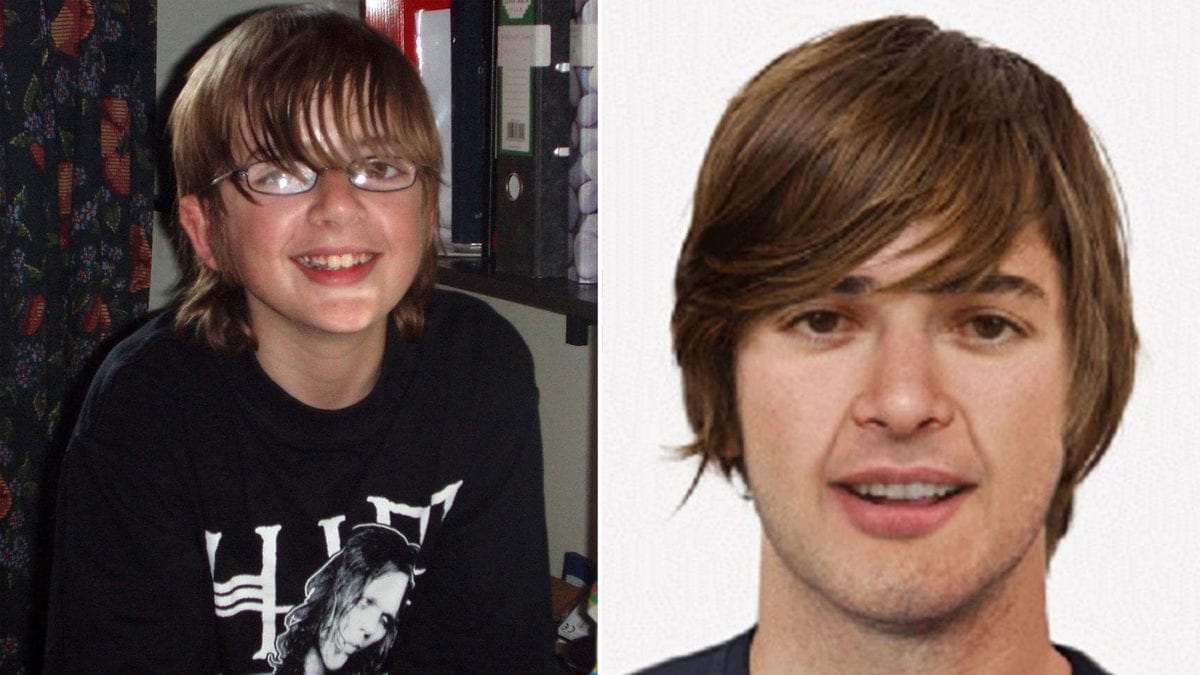
Pictured top: Andrew Gosden (left) and an age-progressed image of how he might now look that was released in 2019.
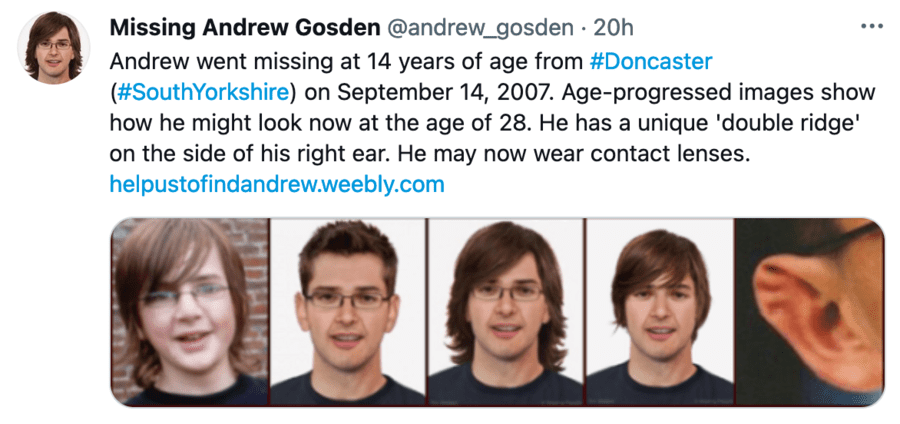
The last sighting of Andrew Gosden was at King’s Cross railway sation on the 14th September 2007.A tweet shared about this missing person case yesterday.
Reaction of “pooterish residents” of Hurstbourne Tarrant, Hampshire to community library becoming a “book sexchange” is laughable and condemned as “righteous indignation”
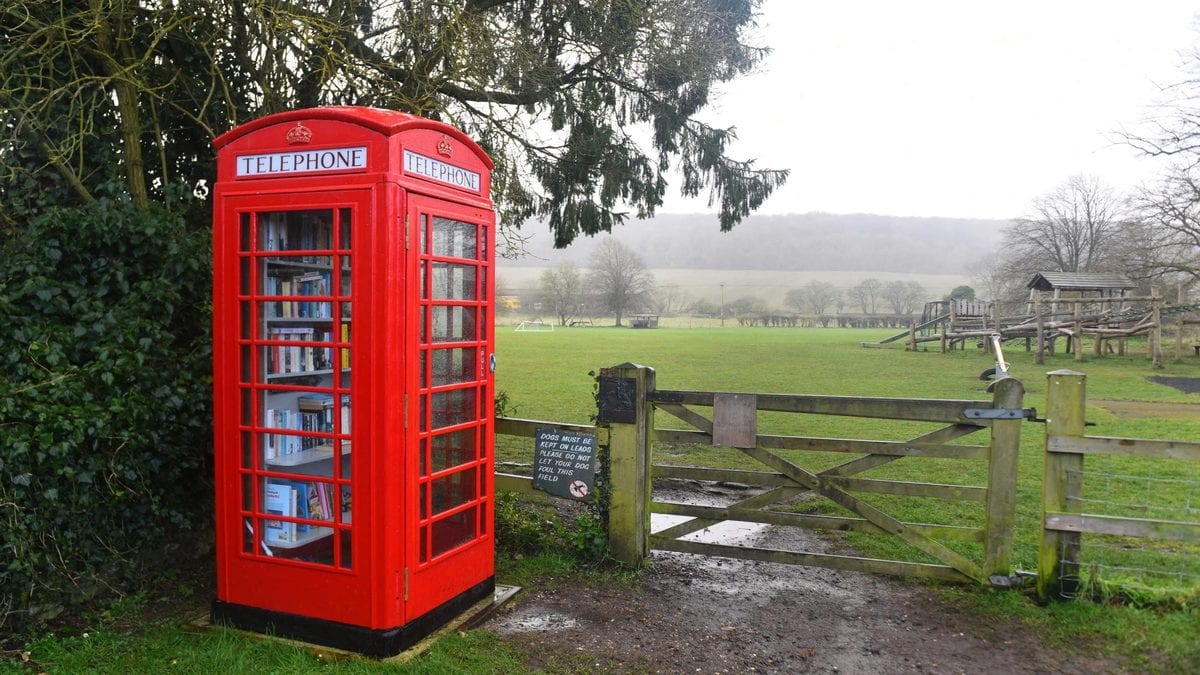
‘Book Sexchange’ scandal hits Hants – You’d have thought any populous would be grateful, especially in times of lockup boredom, for a book exchange, but the raucous residents of Hurstbourne Tarrant in Hampshire (population 851) most certainly are not after erotic fiction was discovered in their phone box library.
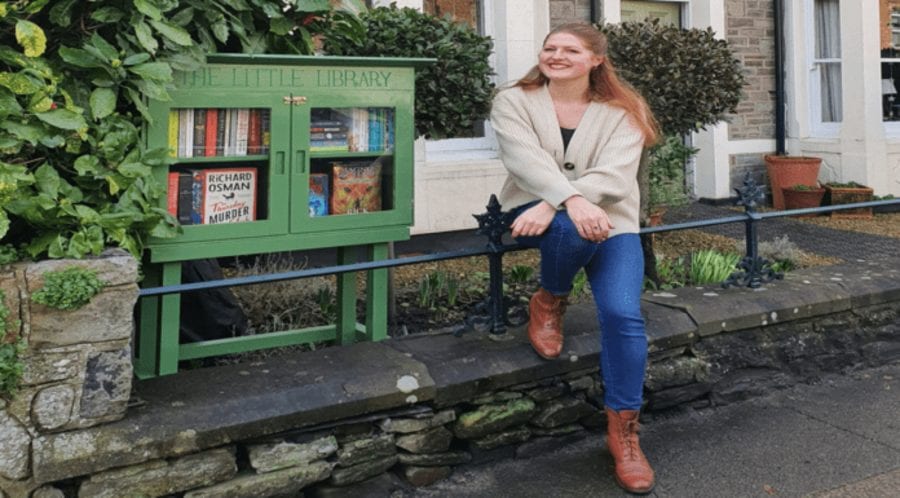
Echoing the uproar that followed our having made bookseller Olivia Clements a ‘Heroine of the Hour’ in February after she installed a free community library box in her garden in Exeter, a spokesman for the local council complained: “We love our phone box library but we don’t love salacious adult literature being left in there… Please find another outlet for your collection.”
Speaking to The Sun, a local councillor, Kirsty North, furiously exclaimed: “This certainly wasn’t what I had in mind when the village bought the kiosk,” whilst an angry parish council clerk named Miriam Edwards added:
“A lot of people don’t find this funny. We don’t want this made into some sort of laughing stock and a sideshow when the underlying issue is actually very important. We don’t want somebody acting like it’s OK to put porn in a public phone box.”
Analysed further by Daniel Johnson in The Article yesterday also in an article titled: “The great British telephone box library scandal,” the “righteous indignation” and of the “pooterish” South Downs National Park residents about “smutty paperbacks in a phone box” was deservedly condemned. He quite rightly observed:
“Is it possible that the good people of Hurstbourne Tarrant are stuck in a 1950s time warp, perhaps connected with their telephone kiosk library? (Where is Doctor Who when you need her?) Has news of the Lady Chatterley trial and the abolition of censorship yet to reach this corner of the South Downs National Park, an area of outstanding natural beauty and seemingly of unnatural prudishness?”
“The point about libraries – even very, very small ones – is that they almost always contain books that are ‘inappropriate’ for somebody. But the moral jeopardy of letting children roam fancy-free among the bookcases is far outweighed by the value of serendipity – the magical moment when a child discovers the joy of reading for him or herself.”
“To treat adult literature as dangerous is to infantilise young readers – and counter-productive, too. Do parents and teachers worry about child protection every time boys and girls set foot in the local public library, lest they stray into the ‘grown-up’ sections? In reality, most are more likely to be glad that the kids are reading books at all, rather than spending their leisure looking at who-knows-what online. Their innocence is at incomparably greater risk from the smartphones they all have.”
In March 2013, we reported that the number of BT telephone boxes in the UK had declined from 92,000 to just 51,500 in 2012. Since then many more have been removed and in their place a book exchange would surely be a good thing for any community – unless, of course, you are a doddering denizen of Hurstbourne Tarrant, of course.
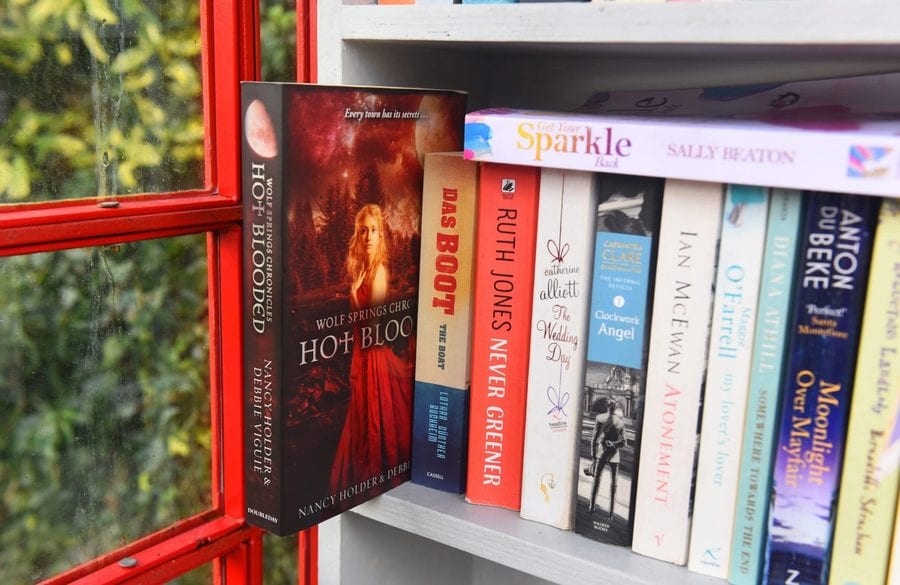
Bonkers Book Sexchange Saga 2021 – A unnamed less prudish resident of Hurstbourne Tarrant told ‘The Sun’: “I have heard that there are some salacious books – I’m number 20 in the queue.” The paper added: “One title is ‘Hot Blooded’ by Nancy Holder and Debbie Viguié. The blurb reveals that one character is ‘struggling to resist her own animal urges’.”Bonkers Book Sexchange Saga 2021 – When we featured the generous act of Olivia Clements in setting up a community library in her garden in Exeter in February, a tedious twerp named Mark Wicks took to Twitter and complained that it was “a really middle class thing to do with no real understanding of collection management or the role of libraries as a place maker in the local community.” We’d like to know what good Mr Wicks has ever done for anybody and what he has to say about Hurstbourne Tarrant’s ‘book sexchange’ scandal also.
Former hostage Terry Waite wisely tells the nation to keep their dignity, structure their day, become creative and be grateful during the coronavirus lockdown
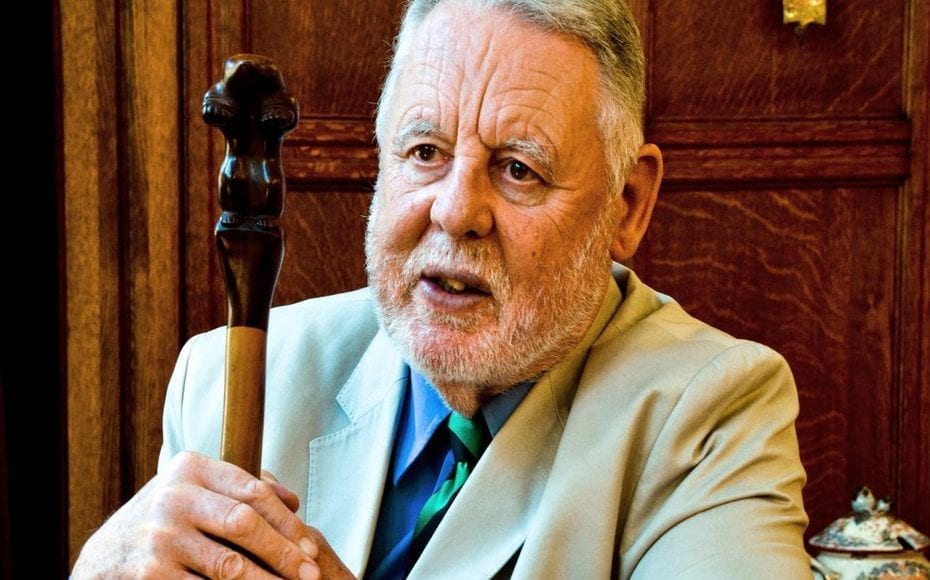
Speaking to Sarah-Jane Mee of Sky News on Tuesday from his home in Hartest, Suffolk, Terry Waite CBE provided insightful and wise tips to the nation about how to cope with the current coronavirus lockdown.
Waite, who spent 1,736 days or almost five years in captivity in Beirut from 1987 until 1991, told of how he is himself self-isolating and of how the current strange conditions have “levelled” us all. He urged people to be positive about the future and remarked:
“The way to do that, in part, is to try and live for the moment; try and live for now. Erm, try and make the moment as full as possible. Now, how do you do that in captivity where you’ve no books, you’ve no paper, you’ve nothing? Well, I had to do that by mentally adjusting to the situation. Saying there’s little or nothing I can do to change this, but I can hold on to the fact that I have life now, not tomorrow, I have it now. And I’m going to live it as fully as possible.”
Speaking of finding something useful to do, he continued:
“I began to write in my head, I began to use my mental capacity in a way that extends that. And that was a way of just surviving. And, as I say, there will be many people who are deeply afraid and worried at the moment; well, somehow, remember that this virus will be defeated, there will be a life after that and, you know, things do have a habit of turning out well if we want to work for them.”
“For the majority of us, it will be fine. But we just somehow have to develop that capacity within ourselves to take the situation at the moment as it is.”
“What I had to do, also, was to keep myself, keep myself, erm, alive in the following way. I mean, I’ll tell you a silly story, but it is perfectly true. In the first week of captivity, I had my own clothes. And at night, I managed to get my trousers off even though I was chained. And I put them under the mattress to press them. Now, that might sound really stupid, but it was something that I learned in the army during National Service.”
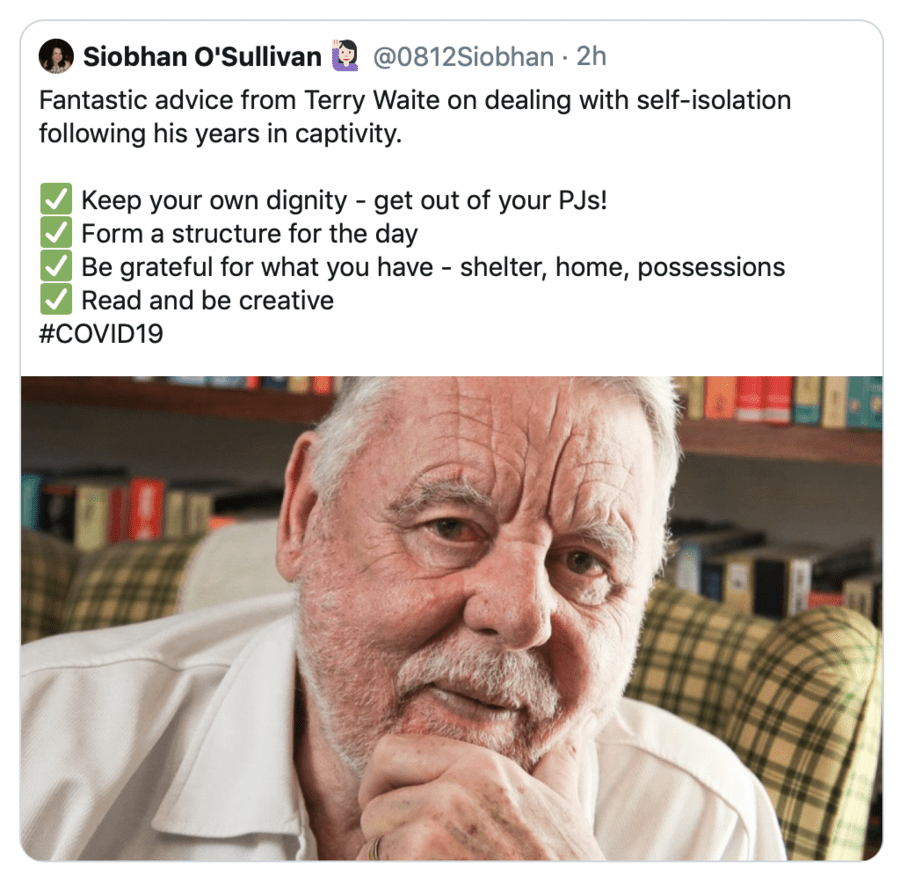
“In all these situations, keep your own dignity, keep yourself smart and the same applies today when those people are at home in lockdown. You know, don’t just get up and hang around all day in a dressing gown or pajamas. Take a pride in your appearance still, keep yourself smart. Retain your own dignity. That’s really pretty important.”
“The other thing to say is form a structure for the day. Now, I’m sitting here at home alone. I’ve been in lockdown for the last week, maybe longer, but I’m so fortunate. I mean, I’m surrounded by my books, I’m surrounded by papers, I’ve got access to the Internet, a whole range of things. I can use this time creatively, which I’m trying to do. I’m actually beginning to start writing a new book at the moment. We can use this time creatively… rather than emphasising the negative.”
Moving on, more generally, the humanitarian added:
“I remember a few years ago, a politician saying: ‘There’s no such thing as society.’ Well, I think that’s been proved to be absolutely wrong. I’m here in Suffolk in a small village and we are very, very fortunate because there is a good sense of community.”
Waite finally spoke of the positives he sees for the future. He concluded:
“On Saturday, I needed some shopping doing and on Sunday morning someone left a bag of shopping at my front door. I heard yesterday, that the local church, through a charity, has organised a system of distributing meals for those that need it. And in all sorts of ways, people are responding… The British people, the time like this, it often brings out the best in people. It brings out the worst in some people and we’ve had examples of that. But, overall, it brings out the best.”
“And what I hope will happen is that we’ll have a new sense of community and society when we’ve been through this and, in fact, even going much further than that perhaps we’ll have a new understanding that be in tune and in touch with our environment in a way that perhaps we haven’t been in the past.”
Terry Waite is entirely right: It’s time we were more grateful for what we actually have and it’s time we put to good use this lockdown. Let his words be a lesson to us all.
Julian Assange achieves a new low by hanging out with a whack job Trump supporter who previously supported Black Lives Matters and Bernie Sanders
Julian Assange’s pathetically small ragbag of supporters are once again bleating and this time that bleating comes from the mouth of a most confused young lady.
In an article for The Gateway Pundit – a little known hotchpotch rant sheet that cites itself as being “Where Hope Finally Made a Comeback” and a publication that claims: “We report the truth – and leave the Russia-Collusion fairy tale to the Conspiracy media” – a Donald Trump supporting “political activist” named Cassandra Fairbanks claimed Assange’s living conditions are “more akin to [a] Stasi-era dissident than an award-winning publisher with asylum.”
“Social media star” Fairbanks – whose favourite quote is said to be “Build the Wall” in spite of her previously being a backer of Bernie Sanders – is, in fact, just like Assange in several regards: This queen of contradictions is a bit of self-promoting, self-obsessed sort and she plainly craves constant attention.
On Twitter, this Silver Springs, Maryland based former liberal tells her 156,000 followers that the “Federal court says ‘I trolled the web through Twitter’” and that she is “an information terrorist according to Wired.” She previously was said to be “distinguished for her liberal campaigns” but has now wholeheartedly U-turned and become a fully-fledged Trumpette.
In spite of helping to organise the ‘DeploraBall’ to celebrate the inauguration of Donald Trump in 2017, Fairbanks has also been involved with the “hacktivist” group Anonymous and once came out in support of immigrants by saying: “Why should an invisible line created by some [politicians] dictate where we can and cannot go? If I want to go to the beach at 11pm I should be able to. If I feel like rowing a boat to Australia, why can’t I just go?”
Cassandra Fairbanks at the White House
Previously a reporter for the Russian state funded news agency Sputnik News and also at one-time a supporter of the Black Lives Matter movement, Fairbanks lost a defamation suit in June 2018 against a former Fusion journalist, Emma Roller. Fairbanks had claimed Roller “maliciously” retweeted an image of her allegedly giving a white power hand gesture.
In her article for The Gateway Pundit, published Thursday after Fairbanks having visited Assange at the Embassy of Ecuador in Knightsbridge the previous Monday, the self-proclaimed “grassroots journalist” claimed his hosts were imposing “draconian” conditions on the bail dodger and keeping him in something “like a scene from the Stasi spy drama The Lives of Others.”
Refusing to acknowledge that Julian Assange chose his very own path is one thing, but that Fairbanks moaned about his hosts being “spies… even noting his general mood” is another. She refers to the Ecuadorians as “menacing” and “shadowy state actor[s]” and their embassy as like a “federal penitentiary.” In doing so, this plainly delusional woman ignores the most important fact: Nobody is forcing Julian Assange to remain holed up with people she views to be baddies. He could end this farce and he could finally do the decent thing: It is time for Julian Assange to surrender himself to the British police.
Lucy Smith takes a look at developments in point of sale systems
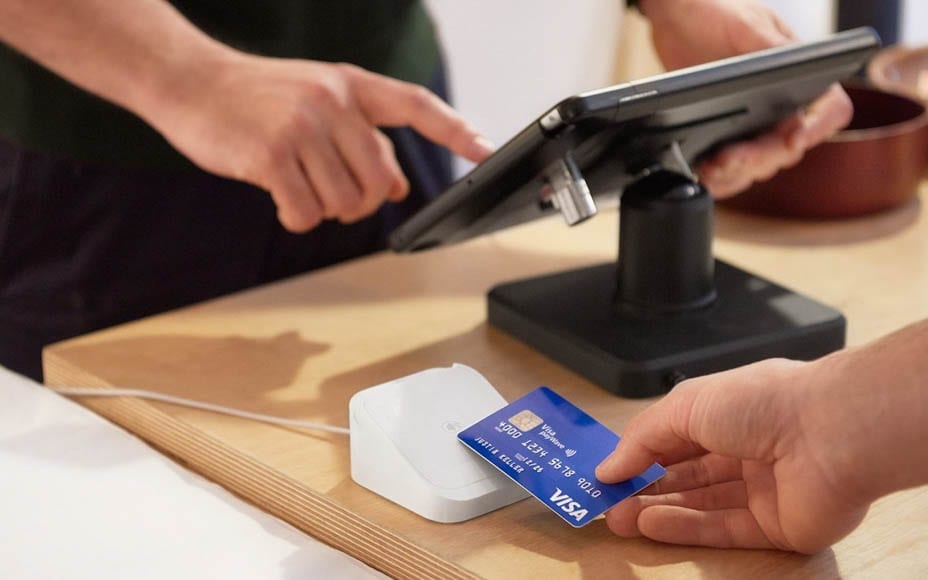
It is human nature to take for granted that which we interact with on an daily basis. After all, when was the last time that we contemplated the technology behind an online transaction? We simply point, click and wait to receive confirmation that the payment was accepted.
It is interesting to note that there is more than, what I call, the “wizard behind the curtain” when speaking of modern point-of-sale (POS) architecture. Not only are these applications intended to keep your transactions secure at all times, but they are now associated with some very real sci-fi gadgetry.
You may recall the heady digital days of the Internet associated with the late 1990s: Dial-up tones, incredibly long loading times and bare-bones checkout platforms were commonplace. If we fast-forward twenty years later, times have indeed change: Modern point-of-sale systems have taken on what can only be called a slightly human touch. They are incredibly flexible and even friendly at times. Some of their most interesting features include:
The ability to remember your previous purchases.
The acceptance of dozens of different payment methods.
Live chatbot help in the event of an issue or a problem.
Advanced forms of security such as 256-bit AES encryption.
There are two intentions behind the advancements mentioned directly above. First, they are meant to instil a sense of confidence; encouraging the customer to make additional purchases in the future. They are also intended to exhibit the branding of businesses and offer a notion of seamless uniformity.
We are now beginning to witness the emergence of point-of-sale templates that can be fully moulded around the needs of the business in question. Cloud-based providers such as Shopify have embedded a host of unique and user-friendly tools into these platforms. Multi-channel marketing, malleable templates, plug-and-play hardware, precise inventory management, and support for advanced checkout procedures are only a handful of examples.
The real advancements are now involving the incorporation of artificial intelligence (AI) into this very same hardware. What does this signify for the end user? First and foremost, you can expect an even faster and more intuitive checkout process than in the past. The chances are also high that you will be interacting with a “bot” as opposed to human if the problem arises. This does not signal that real-life representatives will be taken out of the loop. On the contrary, your query can be directed towards the appropriate source within seconds.
The next time you make an online purchase or provide your credit card details to a virtual retailer, keep in mind the complexities of the technology mentioned above. It is amazing to witness just how far it has come in only two decades.
Lucy Smith is based in Spain and is widely considered an expert in online marketing.
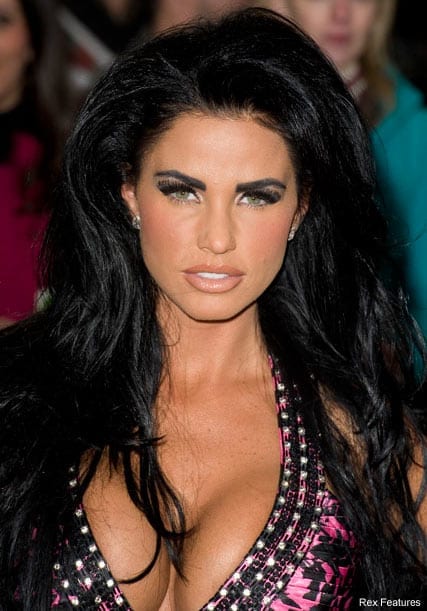
Having myself been part of the case that ultimately resulted in the racist bigot Viscount St Davids being sent to prison for using Facebook to offer rewards to kill others, I know first-hand the trauma online trolling can cause. It can be as offensive and scary as a heavy breathing phone call or poison pen letter and, as this publication has repeatedly stated before, given the profits made by social media operations, it is time that they accepted that it is their responsibility to regulate their users.
On the programme, Miss Price remarked:
“I’ve had two people arrested. They took it as far they could… But I need to do something… There is nothing in place so I am going to fight to get online abuse made a criminal offence.”
“Anyone is allowed freedom of speech but people know when they’ve crossed the line… People shouldn’t get away… Just because it’s online people don’t seem to take it serious [SIC]… Of course you can say things people won’t agree with.”
“I’ve got five children but they are aware they only pick on Harvey… Basically I’m counting on them [Members of Parliament] to put a good case and take it to the next level. If no one believes in this, they’ve got no heart and no soul.”
In response, on the programme, the former Cabinet Minister Justine Greening told the BBC’s Jo Coburn:
“I really admire Katie Price… The Internet revolution is challenging every aspect of our lives.”
“It’s not a question of limiting what people can say but we should have the same laws for online as well as offline… I hope to see some sensible proposals that will tackle the kind of things that Katie Price and her family have had to suffer…. MPs have had to suffer too. It’s not acceptable.”
Whilst it is easy to agree with Price’s sentiments, it now transpires she might not exactly be innocent herself. Allegations of her partaking in ‘revenge porn’ against her ex-husband Alex Reid have since surfaced and, equally, given that she’s known as a brilliant self-publicist, one is simply left questioning this glamour model’s true motivations.
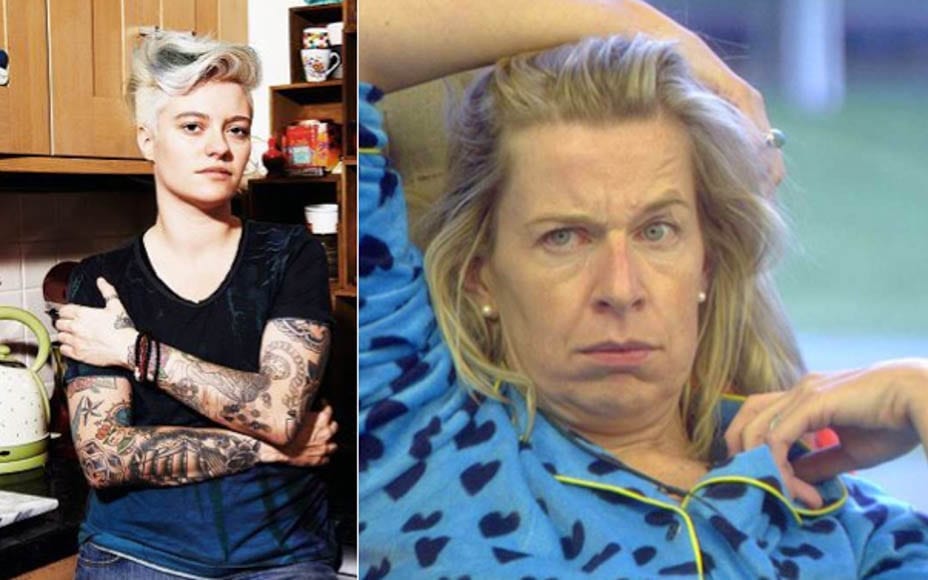
Jack Monroe’s analysis of Katie Hopkins’s supposed “sacking” by the ‘Mail Online’ illustrates just one thing: The pair are actually virtually the same and simply ‘Sisters in Shock’
Yesterday, in a column for The Guardian, the self-opinionated, self-serving know-all Jack Monroe (sometimes a woman, sometimes ‘Gender X’ and sometimes no gender at all) shared her views about her equally bombastic adversary, Katie Hopkins, leaving the Mail Online in the wake of the paper having to pay libel damages to a school teacher named Jackie Teale.
In her words, Monroe, in spite of claiming “[Hopkins’s] sacking is nothing to celebrate” and admitting “I have been nasty on the Internet,” provides illustration yet again of her true character. Here, in suggesting Hopkins is “deemed too much” for even Mail Online readers and claiming she, herself, “take[s] responsibility for [her] words, and try to be better,” Monroe just illustrates that there two women are exactly the same and motivated by one thing only – the next pay cheque for their outrageous words.
#GetARoomGirls
Follow The Steeple Times on Twitter at @SteepleTimes.
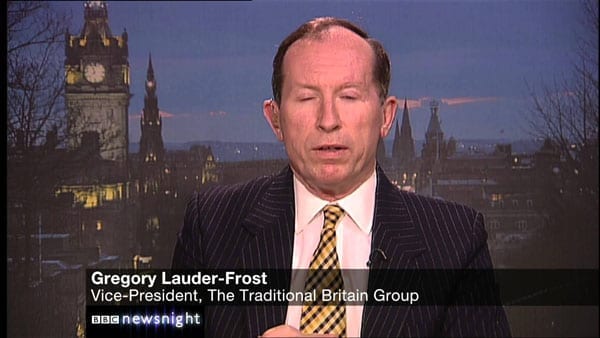
After far-right Traditional Britain Group is exposed in an ITV documentary, oddball founder and ex-jailbird Gregory Lauder-Frost responds
Last night ITV screened an hour long documentary that “examined the resurgence of the far right in Britain; its expansion on and use of the Internet and social media; the internationalization of the far right with cooperation and contact between groups and individuals on a scale not seen before; the recruiting of more women and young people to different groups, and the impact that this is having on British society.”
In Exposure’s Undercover – Inside Britain’s New Far Right, produced by David Henshaw, not only did several courageous journalists go undercover within far right organisations but one also managed to infiltrate a meeting of the crackpot Traditional Britain Group in Mayfair, London. At that gathering, the compere was heard to suggest that there are “10 million aliens in this country who are ‘producing children all the time’” and referenced the group’s policy of seeking “voluntary repatriation of aliens to their natural homelands.”
In response, Gregory MacLennan Scholey Lauder-Frost (or ‘GLF’ to his mates) – a previous The Steeple Times ‘Moron of the Moment’, a man jailed in 1992 for theft and an individual prone to such remarks as describing Baroness Lawrence OBE, the community relations campaigner and mother of the late Stephen Lawrence, as “no friend of the English people” and “a complete nobody” – issued a statement defending the ragbag organisation he founded in 2001. In it, he branded Hope Not Hate as “far left… communists” and claimed “the TBG does not hate anyone… [but] we would prefer it if they remained at home.”
Elsewhere, in a video shared on YouTube, another farcical fool named Martin Sellner – the leader of the Austrian New Right movement – referenced the Traditional Britain Group’s members as “very British characters” and “patriots.” Plainly, he’s never met the likes of Lauder-Frost and the ‘Half Biscuit’ Viscount St Davids fanBenjamin Duncan.
Watch Exposure’s Undercover – Inside Britain’s New Far Right on the ITV Hub by clicking here.
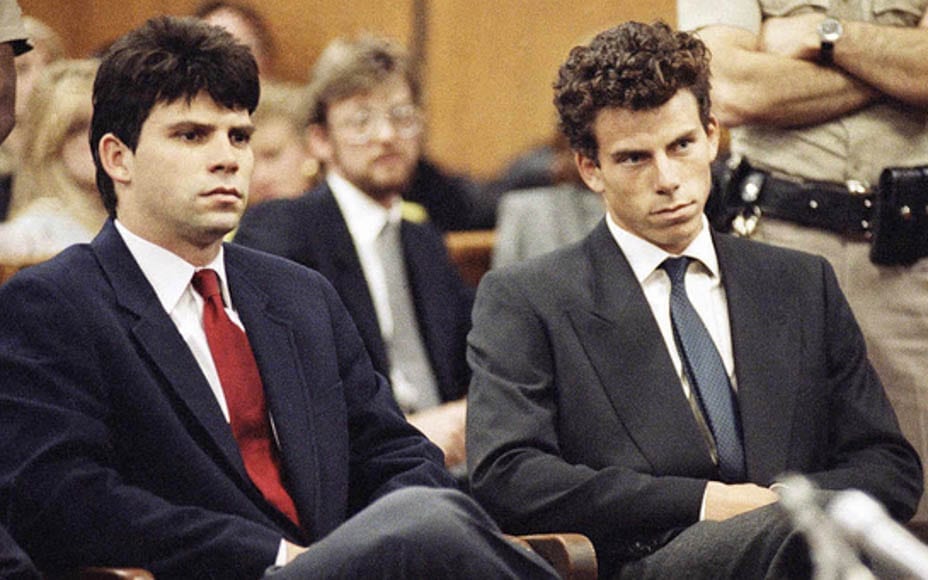
As Lyle Menéndez creates a Facebook page about the case against him and his brother Erik, a juror contacts ‘The Steeple Times’ and brands their conviction for killing their wealthy parents “imperfect self-defence”
Renewed interest in the 1989 murders of the multi-millionaires José and Mary ‘Kitty’ Menéndez by their sons, Erik and Lyle, has accompanied NBC’s screening of their fascinating new eight-part Law & Order True Crime: The Menendez Murders.
Consequently discussion has intensified and aside from Lyle Menéndez creating a Facebook page this month where interested parties can read about the slayings and the alleged abuse he and his brother were subjected to, a juror in the first trial contacted The Steeple Times to share her thoughts on the eventual outcome.
In an email to editor-in-chief Matthew Steeples, a juror in the first case brought against Erik Menéndez and author of Hung Jury: The Diary of a Menendez JurorHazel Thornton remarked:
We were given the choice of:
– First degree murder (what the men wanted)
– Second degree murder
– Voluntary manslaughter (what the women wanted)
– Involuntary manslaughter
It was widely reported that the women were 1) in love with the M brothers, 2) enamored with defense attorney Leslie Abramson (that part is true; I consider her to be a hero and am thrilled that LOTC [Law & Order True Crime] Menendez is focused on her character), 3) voting emotionally, not logically, and 4) too stupid to understand the jury instructions.
Also, that we wanted to let them go free. No one voted to acquit. Acquittal was not on the table. We didn’t even vote for Involuntary manslaughter.
But we did think the defense was strong enough that it may have happened exactly as they said –that they were in fear of their lives, rightly or wrongly, at the very moment of the killings. It’s called ‘imperfect self-defense’.
Elsewhere in today’s The Steeple Times, we interview Zach Tinker – the actor who plays Erik Menéndez’s classmate, Craig Cignarelli.
Lyle Menéndez (left) and Erik Menéndez (right) in prison photographs in more recent years
The brothers continue to allege they were abused by the wealthy parents they slayed, Kitty and José Menéndez
722 North Elm Drive, Beverly Hills, CA 90210 – The home where the Menéndez brothers committed their crimes on 20th August 1989; the house had previously been the residence of both Elton John and Prince in years prior
A tweet by juror in first trial Hazel Thornton containing a Facebook post by Lyle Menéndez about his views on her book
Law & Order True Crime: The Menendez Murders is available to watch in the UK on Sky Living and below an unedited Facebook post from Lyle Menéndez follows:
I thank my family for helping me with this page. I don’t have internet access so this site depends on them. I have been told that setting up this page will open me up to ridicule and criticism. That’s probably true, but it’s something I’m already used to. It is very hard to accept that sexual assault can be the punchline of jokes or the subject of ridicule, but it has occurred–to me–and to many others. If I am mocked for this page, the shame of that belongs on the mocker and not on me or anyone who shares their story here. There is, quite simply, nothing funny about child rape or other abuse.
The purpose of this page is not to debate the clearly wrong actions that I took. The purpose is to provide a safe place for people to talk about their similar experiences and find comfort in others who have suffered in silence in the same way. Those of us who have suffered abuse understand the healing power of sharing our experiences.
I have received thousands of letters from people all over the world who have heard about my experiences and connected with them or simply had empathy for me and my brother. When I first started to receive the letters, I answered every one. But, eventually, I became overwhelmed. Still – whether I answered them or not – I read all the letters and my heart ached for each person brave enough to share, and I was inspired by the strength it took every person to take pen to paper and pour out their hearts.
In fact, I testified every day at my trial in 1993 with a letter of an abuse survivor in my pants pocket to give me courage. The letters I receive to this day continue to give me courage and strength.
With the resurgence of interest in our case and the prevalence of social media, I’m now in a better position to be able to create a place for those of you who want to reach out to me. Even more, this format gives us all the opportunity to create a community of compassion, empathy, inspiration and strength. I hope you will share your stories here and that we can build something positive from something so negative. I hope that we can all be survivors, lift each other up when we need it, and show everyone that by supporting each other, we can not just survive but thrive.
If you write to me here, I will be read your posts, through my family, and I will respond sometimes. We can help each other. But this page is less about me and more about all of us helping each other. There is a community here. But please keep in mind that neither I nor anyone in my family is a professional counselor, therapist, or any type of professional equipped to deal with the psychological and/or emotional issues that child abuse causes. I will be offering my support and advice as a fellow sufferer and survivor and not as any type of expert.
Like I said, I do not have the internet. This site depends on my family. If you see an “-a” after a comment that means that the administrator is the one commenting. And many conversations will be started by the administrator.
One final note: I have heard that social media can be the opposite of what I just described. Please know that hateful posts will not be approved and hurtful/hateful comments will be deleted by an administrator. Let’s make this a safe space.
For more information Hung Jury: The Diary of a Menendez Juror about by Hazel Thornton, click here.