 This Ugandan-born journalist is a self-confessed racist who loathes “white, middle class men”, yet describes herself as being a “leftie liberal, anti-racist, feminist, Muslim, part-Pakistani, and … a very responsible person”. She believes Osama bin Laden didn’t get a “respectful burial” and asked: “Why does anyone black, Asian or Arab ever vote Tory?” on Twitter in July 2013 before talking about the urinal her husband had “pissed in” at a pub in Loughton, Essex in August of the same year. A true mouthpiece, Alibhai-Brown is just the kind of person no right-minded person would ever invite to dinner.
Tag: Tory
-
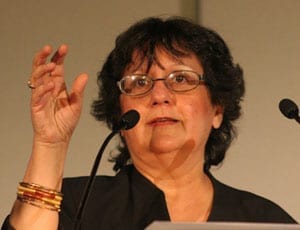
Yasmin Alibhai-Brown (born Yasmin Damji)
-

The Rt. Hon. the Baroness Neville-Jones DCMG PC
 This real life ‘M’ is a former Minister of State for Security and Counter Terrorism and has also been a BBC Governor and Chairman of the British Joint Intelligence Committee. Oxford educated Neville-Jones is said to be “sparky” and collects antiques and enjoys cooking and gardening. Dame Judi Dench could quite easily be her body double.
-

Picture of the week: Downing Street’s “shocker” parodied
David Cameron and Nick Clegg as Titanic stars and an analysis of the “sensational love affair” shocking Westminster
The talk of Westminster and Twitter is the Mail on Sunday’s story about the identity of a mystery pair who have been involved in a “sensational love affair” that has “potentially significant political implications” for David Cameron and his government.
-
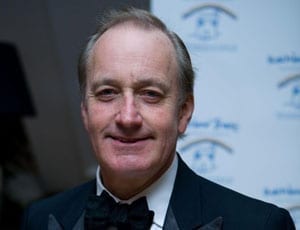
Neil Hamilton: “What’s on your mantelpiece?”
The Steeple Times asks writer, broadcaster and entertainer Neil Hamilton: “What’s on your mantelpiece?”
The Steeple Times shares “wit and wisdom”. What’s your guiding force?
Christine.
“Don’t get even, get medieval” is, in our humble opinion, a great motto. What’s yours?
If you say so dear.
-
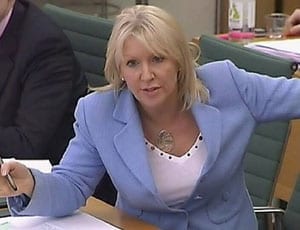
My career is not over… It’s only just beginning
Nadine Dorries lays out her future plans
Nadine Dorries appeared on Andrew Neil’s Sunday Politics yesterday and declared: “My career is not over… It’s only just beginning.”
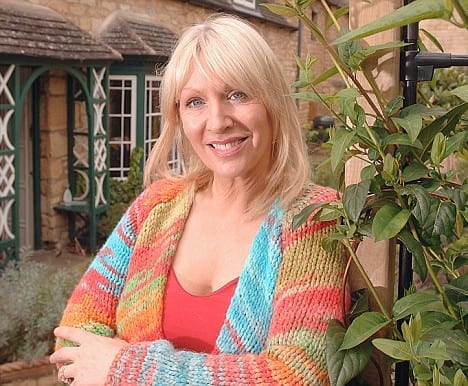
Nadine Dorries The MP for Mid-Bedfordshire may be a bit of her mouthpiece and though her time in I’m a Celebrity… Get Me Out of Here! was cringeworthy and tasteless, she’s the one having the last laugh. Her critics mock her as “Mad Nad”, but they are wrong. Dorries has made headway to share the issues she believes in and she has indeed become a household name.
Ms Dorries declared that she went on the show: “For the greater good of the Conservative Party” but as her parliamentary whip remains withdrawn, she plainly fails to understand that her colleagues are still less than thrilled with her. If they were sensible though, they should relent before she decides to jump.
Neil repeatedly asked Dorries if she would defect to UKIP and she tacitly denied such a possibility. One guest commented: “They [the Conservative Party] would be crazy to make her a UKIP martyr” and we agree with Andre Neil in his suggestion that: “She’ll live to fight another day.”
Follow Nadine Dorries on Twitter at: http://www.twitter.com/nadinedorriesmp
-
The Woman Who’ll Make Politicians Jealous
Jilly Cooper’s state of the nation style summary strikes chords with Matthew Steeples
Best-selling bonkbuster author Jilly Cooper might be best known for novels such as Riders and Jump! but in the 1980s and 90s she was equally lauded as “one of the Conservative Party’s most ardent supporters.”
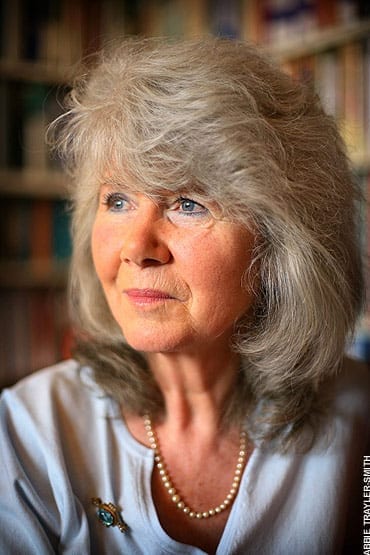
Jilly Cooper Cooper, born in 1937, showed she still has a grip on the nation’s pulse yesterday when she declared that the Conservative Party is “full of terrible people now” to The Spectator’s “Steerpike.”
Separately, in a comment to The Telegraph’s “Mandrake,” Mrs Cooper shared her thoughts on Pippa Middleton’s first book, Celebrate:
“[It] wasn’t a good idea. I don’t blame her – I think that she was ill-advised… All I can say is that I hope the British don’t demonise her because of it. She seems a lovely girl and her sister is wonderful.”
Ever the diplomat, Jilly Cooper, in these comments, shows herself as a truly brilliant wordsmith. She has tact and decency but at the same time doesn’t hold back when it comes to honesty.
Nigel Farage should put in a call. Mrs Cooper could be just the asset UKIP needs to transform them from a “bunch of loons” to electability.
-
When good men should do nothing
Matthew Steeples responds to the recommendations of Leveson
“All that is necessary for the triumph of evil is that good men do nothing” was one of Edmund Burke’s most famous observations.
Today, David Cameron’s former spin doctor Andy Coulson and ex-News International chief executive Rebekah Brooks were in court to face charges of having conspired to pay Ministry of Defence employee Bettina Jordan-Barber around £100,000 for information. How terribly convenient for our Prime Minister that this court appearance coincided with Lord Justice Leveson issuing his report into press standards.
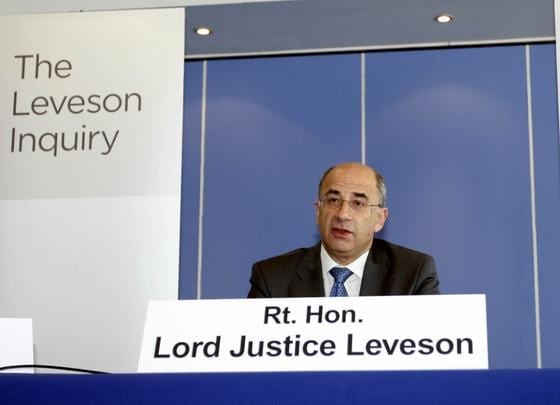
Rt. Hon. Lord Justice Leveson issues his report today 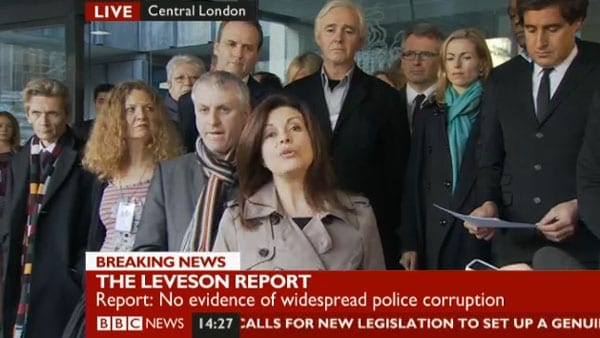
A spokeswoman for Hacked Off (http://hackinginquiry.org) responds to Leveson’s report. Kate McCann stands to her rear. 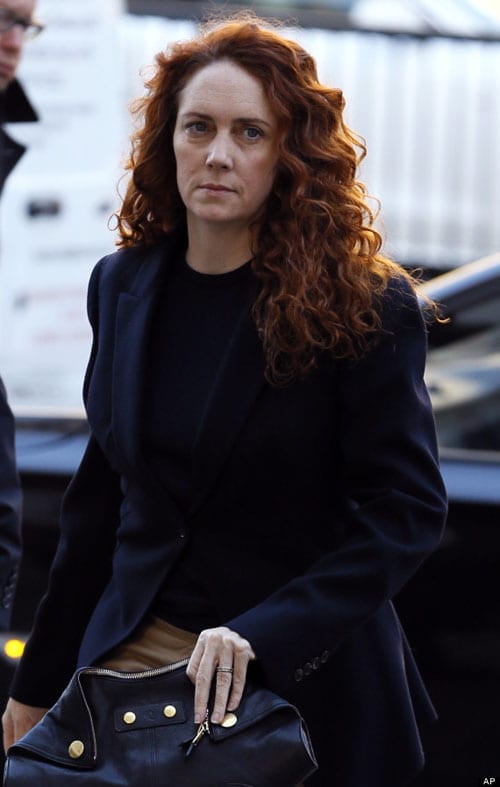
Rebekah Brooks arrives at Westminster Magistrates Court this morning In the inevitable media firestorm in the run up to today’s report being issued, one question has been missed and that question is: “Did we really need a £4 million inquiry to tell us that there are elements of the press that have done wrong and did we really need a 9-month inquiry to tell us that the Press Complaints Commission was a “toothless poodle”?
Inevitably, the media and politicians have reacted against many of Leveson’s suggestions and “victims” have suggested he should have gone further. The main suggestion made was that there should be a “new independent system of self-regulation underpinned by the law.” It’s hardly a revelation and it’s hardly a solution.
“Bad men and foreigners shouldn’t be allowed to run our press,” commented Conservative MP Sir Peter Tapsell of the report. He added: “[Media] ownership should be confined to British nationals.” This utterly ludicrous suggestion shows how out of touch certain politicians in this country are. We live in a global society in which the Internet allows information to be shared across transnational boundaries and as a result our media has to operate globally.
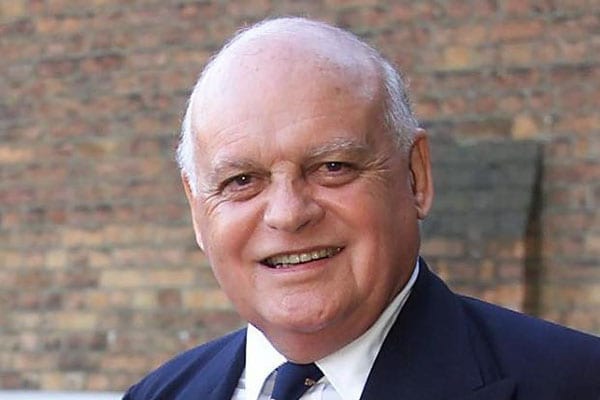
Sir Peter Tapsell MP Our own audience is illustrative: 38% of our readers are based in the UK, but 31% are American. We have an ever-growing readership in Russia and China and receive countless comments from individuals in places as far apart as New Zealand and Finland. Though many may loathe him, the person whom Tapsell’s attack was directed at, Rupert Murdoch, is not a force for evil. He’s simply a tycoon who wishes to make money and get on with running his business. He should be left to do such and the media should be left to self-regulate.
Sir Christopher Meyer and Baroness Buscombe, appointed cronies who were put in place to regulate the media in the UK were responsible for the mess created at the PCC. They failed because they were busybodies with political agendas and they failed because they did not go the whole hog when it came to dealing with the bad apples. As a result, public trust disintegrated and the PCC will deservedly be scrapped.
The bad behavior of a small number of people should not destroy the free press as a cornerstone of our free society. Today is an illustration of a case where good men actually should do nothing.
To read Leveson’s report, go to: http://www.levesoninquiry.org.uk
-
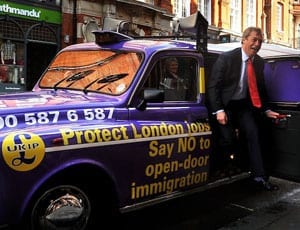
Fostering lunacy
Matthew Steeples takes a view on the story of David Cameron, UKIP, racism and foster homes
First David Cameron described UKIP supporters as “mostly racist” and then a pair of ex-Labour supporting foster parents from Rotherham had three children taken from their care due to their support for that party. Sane people are rightly asking: “What is going on?” and also wondering: “What on earth is ‘Call Me Dave’ playing at?”
The UK Independence Party is an organisation that reflects the views of many in this country and a significant segment of our readership back them too. Equally, many do not and UKIP rightly accepts that. Of course, by their very existence they are a party whose stances polarize opinion and their naff logo and the proclamations of some of their odder members do make rational individuals cringe from time to time.
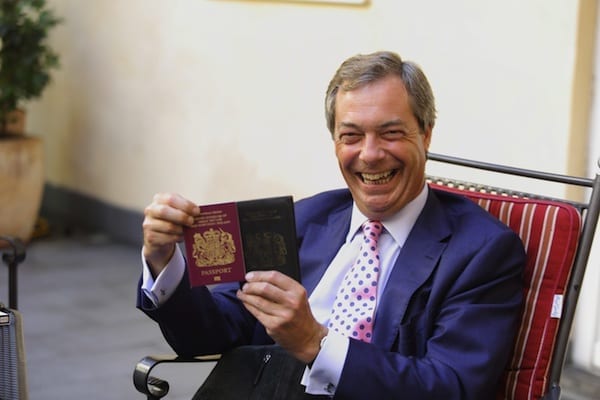
Nigel Farage Nigel Farage, the party’s best asset, is a man guided by sense. He has pointed out many of the significant failings of the European Union and he does it boldly and with a belief bolstered by a dedication to improving Great Britain’s lot. Like or loathe him, here is a politician with passion and one whose influence is growing.
A site that proclaims itself as: “Britain’s most-read political blog,” PoliticalBetting.com, takes a different view and backs Cameron’s statement in suggesting: “There is an Islamophobic element to UKIP that mirrors many parties in Europe.” They refer to “golliwog supporters” and even add:
“David Cameron is right to stand his ground and not apologise for his earlier remarks about UKIP. What should worry him more is the growing number of people in his own party who seem quite relaxed with working with them. They are either blissfully unaware of what lies underneath the party’s anti-European statements or worse are prepared to tolerate them for electoral gain.”
All a decent couple did was to attempt to care for unfortunate children and their political alliegances are an irrelevance. PoliticalBetting.com and David Cameron’s generalisations about UKIP are also wrong and Rotherham council’s actions are utterly abhorrent. Have none of these people learnt anything from how the media firestorm of the Jimmy Savile saga was fueled? Isn’t it about time that they woke up and got their own houses in order instead of ranting about racism and foster parenting?
-
The badgers of Albany
Matthew Steeples delves into the history of Albany, Piccadilly and discovers an affordable way of living there
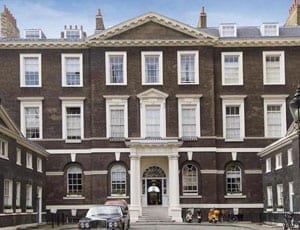
Albany, off Piccadilly in Mayfair, was most probably London’s first apartment block and it’s certainly the city’s most exclusive. It may be next to the Royal Academy and opposite Fortnum & Mason but surprisingly few have even heard of it.
Considering its location, Albany, which some make the mistake of referring to as “The Albany,” is an amazingly quiet oasis of peace and tranquility but, equally, it is a place of intrigue and drama. Residents, or “proprietors,” as they prefer to be known, of the 69 “sets” are particular about the “the” part of the name as they’d rather their residence not be confused with a public house and they are even more protective of their privacy. A porters’ lodge guards the entrance to the building and it is staffed mostly by ex-servicemen, who, until the early 2000s, had to wear top hats and tailcoats. Those allowed to pass enter a rarefied world frequented by what the Irish novelist Marmion Savage (1803 – 1872) identified as “incurable oddities” and “superannuated fops” in The Bachelor of Albany.
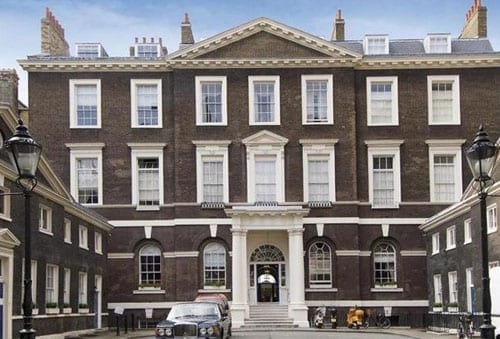
The front courtyard and façade of Albany, Piccadilly, Mayfair, London, W1J 0AL 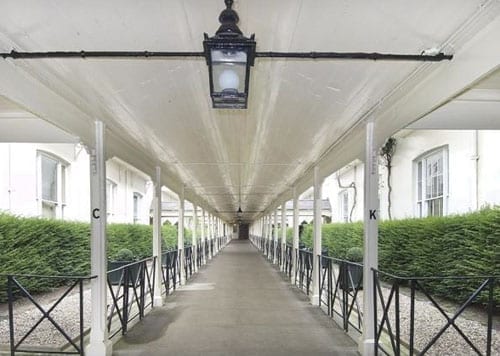
The rope-walk connecting the various sets of Albany has been traversed by some of the greatest names in history Built by Sir William Chambers (1723 – 1796), who also designed Somerset House and the pagoda at Kew, between 1770 and 1774 for 1st Viscount Melbourne (1745 – 1828), Albany was originally known as Melbourne House and conceived as a three-storey mansion, seven bays wide with a pair of service wings flanking a front courtyard. From 1791 to 1802, the property was occupied by George III’s son, Prince Frederick, Duke of York and Albany (1763 – 1827), but after he left, the renowned architect Henry Holland (1745 – 1806) sub-divided the existing house and added two parallel sets of buildings running the length of the garden to create 69 “bachelor apartments” which he named “sets.”
The “roll call” of residents since could easily fill our very own pages thrice over. They number royalty, politicians, artists, playwrights, academics and philosophers and here is a brief selection:
– Anthony Armstong-Jones, later 1st Earl of Snowdon
– Sir Thomas Beecham
– Sir Isaiah Berlin
– Lord Byron
– George Canning
– Sir Kenneth Clark
– Baroness Pauline de Rothschild
– William Ewart Gladstone
– Sir Edward Heath
– David Hicks
– Aldous Huxley
– Sir Simon Jenkins
– Rupert Lycett Green
– Malcolm Muggeridge
– Sir Harold Nicholson
– J. B. Priestley
– Sir Terence Rattigan
– Roger Scruton
– Baroness Sharples
– W. Somerset Maugham
– Terence Stamp
– Sir Denis and Lady Thatcher
– Sir Herbert Beerbohm Tree
Each had to pass the vetting of a committee of trustees of this Grade I listed building. That committee forbids children under 14, pets, musical instruments and commercial activities and each approved resident has undoubtedly added to the history of this den dominated by a central walkway named the “rope-walk.” Incidentally, an example of a curious quirk at Albany is that no resident is allowed to speak to another on this walkway. If they do, a fine is incurred. Albany, indeed, is rather like a college in its systems of rules, regulations, order and hierarchy.
For several centuries, women were not even allowed to cross the threshold and one legendary tale tells of Lady Caroline Lamb (1785 – 1828), disguised as a page boy, stealing into Lord Byron’s (1788 – 1824) set in 1815 to leave a note: “Remember me, Byron.” He replied with a simple verse:
Remember thee, aye, doubt it not:
Thy husband too shall think of thee.
By neither shalt thou be forgot —
Thou false to him, thou fiend to me.
The strict and formal structure that controls Albany and ensured its maintenance has succeeded in the main because 34 of the 69 sets are owned by Peterhouse College, Cambridge. They and the other owners are highly particular in whom they lease to and on one occasion on hearing of an “unsuitable tenant,” the secretary of the trustees is reported to have shouted:
“He’s a foreigner. Don’t like him. Don’t trust him.”
Needless to say, that application didn’t progress and nor did one from a physiotherapist who planned to operate from the building. Bone bashing in Albany just wouldn’t do.
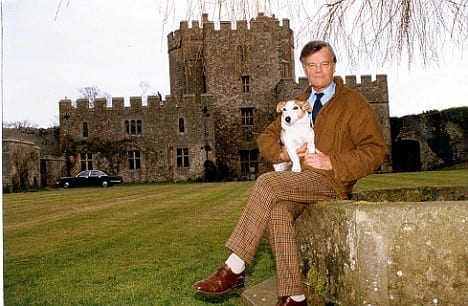
The Rt. Hon. Alan Clark MP (1928 – 1999) in the grounds of his main home, Saltwood Castle, near Hythe in Kent in 1993 A horsewhip, however, nearly crossed the threshold of set B5 in 1994, as it was here that the late Alan Clark MP (1928 – 1999) lived. The affable philanderer seduced the wife and both daughters of a certain South African named Judge Harkess and the wronged man stated he would “have horse-whipped Clark if he had known how comprehensively he had violated his honour.” B5, itself, was described as having the feel of “the straitened quarter of an Edwardian bachelor on his uppers” and the dotty, English attitude of the residents is best summed up by the reaction of Clark’s neighbour when he accidentally flooded their basement. When asked what he could do to make amends, their answer was quite simple: “Go and lie down in Piccadilly and wait for a double-decker bus.”
The dandy and journalist John Morgan (1959 – 2000) typified social change at Albany in the 20th century just as much as he himself redefined etiquette and manners at Debrett’s and The Times. Of “humble origins,” Morgan was brought up in a “modest” bungalow in St Madoes, Perth, Scotland but is credited with persuading William Hague to remove his baseball cap whilst Conservative leader and offering advice ranging from “how to eat a banana” to “how best to tell friends that the partner you would like to bring to their wedding will be of the same sex as you.”
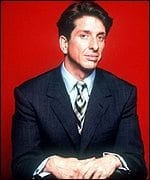
Dandy and etiquette expert John Morgan (1959 – 2000) For the bachelor and GQ style director, living in Albany was symbolic of his own personal social elevation but he did not disown his past. This modern day Beau Brummell was a man of social contradictions who cashed his cheques at Claridge’s but was a member of the National Union of Journalists. He was a Tory but still regularly attended chapel meetings as he had done in his youth. Here was a man of paradoxes who seemed unable to come to terms with the fact that he was a homosexual.
Morgan, an asthma sufferer, fell to his death from a fourth floor window on 9th July 2000. He was found in just a white shirt in a basement below a window whose sill was strangely undisturbed. The coroner left an open verdict with a suspicion of suicide and it was widely reported that police found 60 made-to-measure Savile row suits, 300 monogrammed shirts and 90 pairs of shoes in the etiquette expert’s small set. Mystery shrouds the story of his tragic demise to this day but Johnny Morgan will forever be remembered as an arbiter of both good taste and behaviour.
Whilst Morgan represented continuation of the trend of bachelors living in Albany, change also came in the 20th century when the building’s committee removed the restriction that allowed only bachelors to be resident. With that females were allowed in and amongst them Fleur Fenton Cowles (1908 – 2009) was one of the most fascinating.
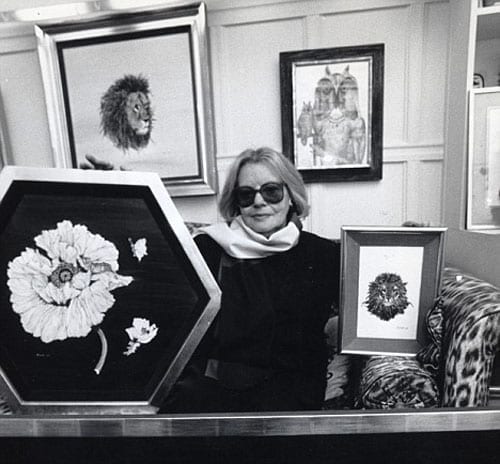
Fleur Fenton Cowles (1908 – 2009) in her set at Albany with some of her paintings and one by Salvador Dali This writer and artist occupied five sets knocked into one with her fourth husband, timber merchant Tom Montague Meyer, and according to the Daily Mail’s Geoffrey Levy, hosted “elite soirees of the powerful and famous.” Levy recounts them at length but here is a flavour:
“On a Wednesday evening, a typical dinner party… would include Foreign Secretary Selwyn Lloyd, Labour leader Hugh Gaitskell, entertainer Danny Kaye and film star Douglas Fairbanks Jr. The Queen Mother regularly came to tea and was once joined by Pavarotti who sang Happy Birthday for the royal guest. ‘I don’t want her to die,’ said Fleur. ‘I couldn’t bear to think she doesn’t live just down the street.’ ”
Fenton Cowles, founder of the ill-fated Flair magazine and a “woman who knew everyone,” loved Albany and an exact replica of her “windowless, milk-yellow” study there has even been recreated at the University of Texas.
Another known for hosting extravagant bashes in Albany was my late friend, the Russian icon dealer John Gaze (1947 – 2011). Gaze had, as a boy, asked his father about the building when he passed it as a child and immediately declared he would live there one day. He took F2, the former set of Edward Heath that overlooked Savile Row to the rear, in the mid 1990s as he craved the safety that the building offered after having been kidnapped at gunpoint by an Oxford graduate conman named Sacheverell de Houghton in April 1991 from his then home in Fournier Street, E1. He made the most of his tenancy.
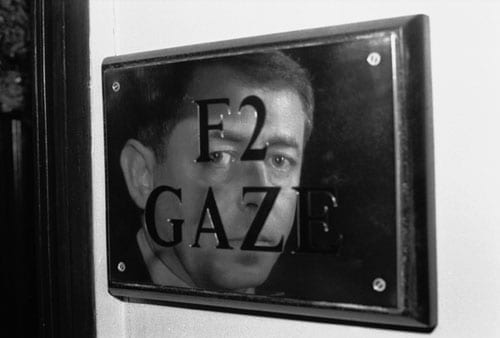
Russian icon dealer John Gaze (1947 – 2011) reflected in the brass plaque outside his Albany set, F2. It was formerly occupied by Sir Edward Heath. Gaze’s parties included a fundraiser for people with AIDS hosted by a drag queen. This sparked fury with certain other residents and coverage in the Daily Telegraph and another incident there involved him encountering Alan Clark on the ropewalk carrying a portrait of Lenin. “Where the fuck are you taking that?” Clark supposedly bellowed but was “reassured” when he was told it was “destined for a less salubrious address in Whitechapel.” John Gaze remained at Albany for several years but, like a number of others I know, was forced out by ever rising rents and moved first to Chelsea and then Ennismore Gardens, Knightsbridge. He always remembered his time at Albany fondly and as a bon vivant, he truly belonged there.
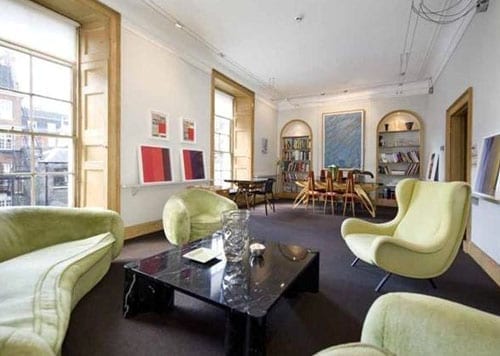
The main reception room in a £1,400 a week set currently available in Albany 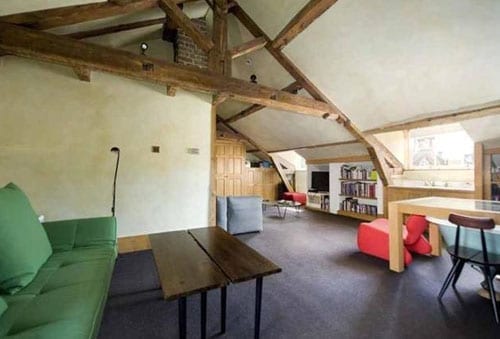
An attic room in the set that could be used as a second reception room or second bedroom 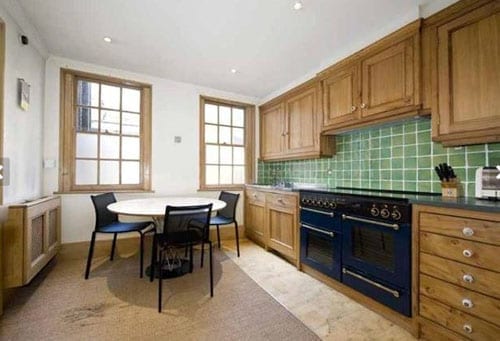
The kitchen is lacking in character but offers ample space for informal dining Contrary to what you’d expect, living in Albany is not quite as expensive as one might think. A 2-bedroomed 1,970 square foot set is currently available through Knight Frank for £1,400 a week: a figure that seems quite reasonable given the location, history and size of this property. Available on a minimum 8-year rental term, it includes a formal reception room, a dining kitchen, 2 bedrooms and 2 bathrooms.
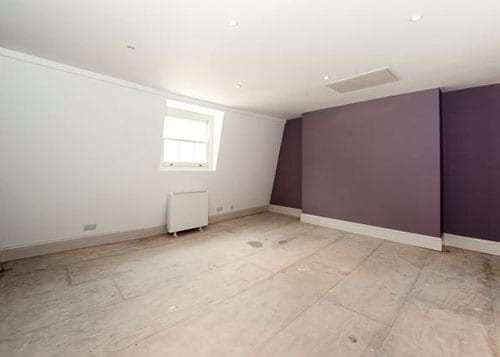
This £300 per week set, D2, consists of just one room 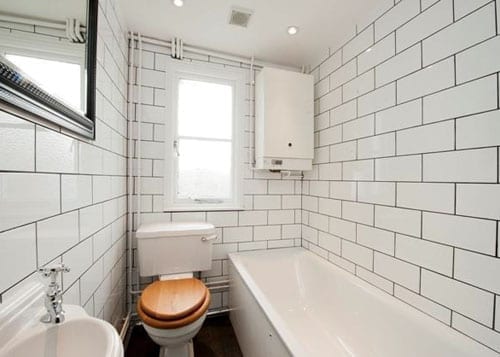
The communal bathroom D2 shares with other sets is basic but clean For those looking for something cheaper, Savills offer D2 Albany at £300 per week. This set consists of a 221 square foot third floor attic room with access to a communal bathroom and the agents suggest that it: “would make an ideal reading or writing room or an occasional bedroom for a pied-a-terre.” It’s effectively a posh form of tenement but what a way to impress your peers and subordinates.

Damon and Sandra de László in their “duplex” in Albany Those renting either of these sets would find the likes of the industrialist Damon de László, a descendant of the Hungarian painter Philip Alexius de László (1869 – 1937), as their neighbour. The couple occupy Lord Byron’s former set, A2, and have, on occasions, opened it for a charity dinner with Matthew Parris at £1,000 a ticket as well and for members of The Portrait Institute to view their collection of de László’s works.
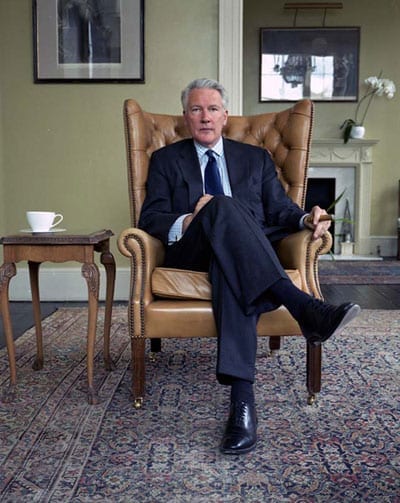
Professor Philip C. Bobbitt in his grand freehold set Another present day resident is a man Henry Kissinger calls “the outstanding philosopher of our times,” Professor Philip C. Bobbitt. This Texan lawyer is a nephew of Lyndon B. Johnson and the author of Terror and Consent, which Tony Blair describes as “required reading for political leaders.” Bobbitt owns an impressive flying freehold set that is described as having a masculine style of décor and a “kitchen he has designed to look like a bar.” In an interview for The Independent he states that he finds Albany: “a propitious place to work.”
Though governments and bankers come and go, behind this quintessentially English façade, order and disorder have always been maintained. The wildcards of this hidden haven have a knack for living by the doctrine “to live at Albany is to live in history” and indeed they make the most of that. Those who are lucky enough to be let in, do, indeed, truly find themselves in the “Paradise of Piccadilly.”
For more information about the £1,400 per week 2-bedroomed set in Albany, contact Knight Frank on +44 (0) 20 3641 2489 or go to: http://www.primelocation.com/to-rent/details/21089526?search_identifier=561863685a1a55b5da85141e12cfeec7
For more information about the £300 per week attic room in Albany, contact Savills on +44 (0) 20 3641 2584 or go to: http://www.primelocation.com/to-rent/details/26791351?search_identifier=561863685a1a55b5da85141e12cfeec7
-
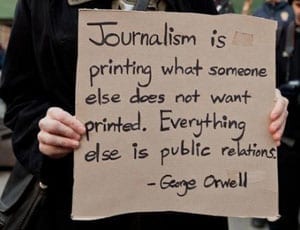
Picture of the Week: Journalism and public relations
A George Orwell quotation sums up the current media firestorm perfectly
We at The Steeple Times thought this image of a lady holding up a piece of cardboard summed up the events of the weekend perfectly.
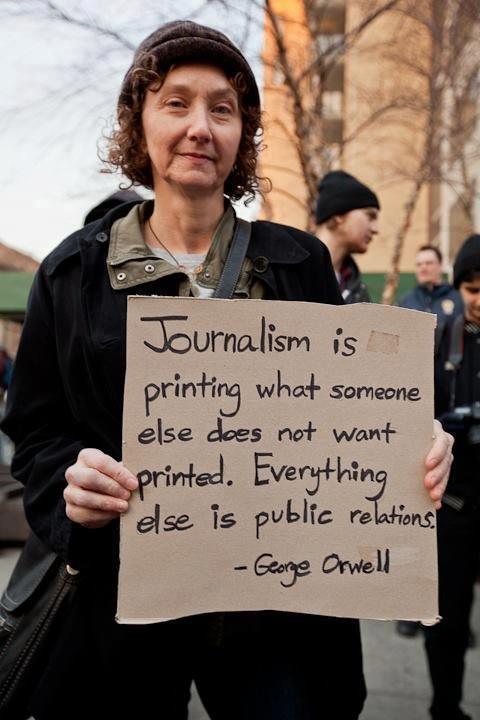
As a debate rages about the future of the BBC and the role of social media in the “outing” of personalities in connection to alleged stories of abuse, the words of George Orwell ring utterly true:
“Journalism is printing what someone else does not want printed. Everything else is public relations.”
For this simple reason, we make it our picture of the week. This scandal should not be brushed under the carpet.