 In the autumn of 2012, an ITV1 series, Mrs Biggs, dramatised the life story of this headmaster’s daughter from Reigate, Surrey. In it, Sheridan Smith (pictured here with the real Mrs Biggs) portrayed a lady of steely reserve who is intelligent, articulate and courageous. The former wife of the Great Train Robber Ronnie Biggs has now built a new life for herself in Melbourne, Australia as an editor, publisher and journalist and on crime, her views are simple: “[It] doesn’t pay in any way, shape or form.”
Tag: Money
-

Charmian Brent (better known as Charmian Biggs)
-
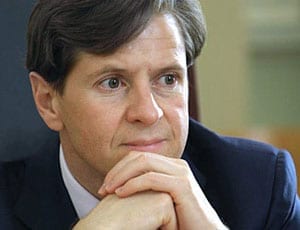
Andrey Borodin
 This billionaire former president of the Bank of Moscow lives in exile in London and is on the Interpol Red Notices wanted list as a suspect in a £136 million (13 billion rouble) fraud. (more…)
 -
Hugh Bonneville
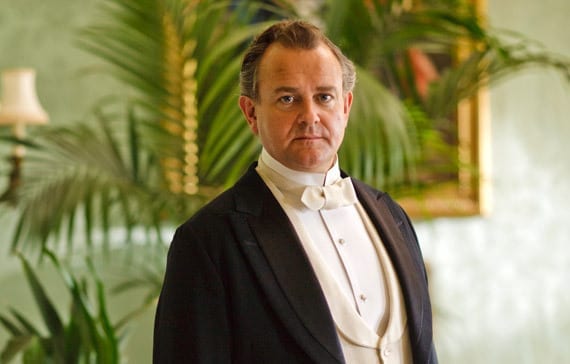 In his role as Downton Abbey’s Lord Grantham, this actor warned that “scandals” always have a habit of coming out. He graduated in Theology at Cambridge but, according to Adam Helliker of the Daily Express, Bonneville wasn’t especially keen to show Christian compassion towards Lord Archer at a party at The Cadogan Hotel when it was requested that the pair be photographed together.
 -
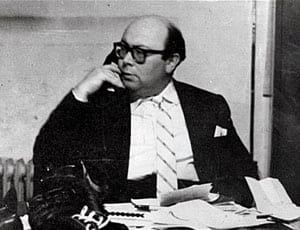
Redefining Rachman
A different side to Peter Rachman is revealed
Whenever the name Rachman is mentioned, the first things that come to mind are greed, extortion and intimidation. The word is so engrained in such that “Rachmanism” now features in the dictionary, defined as:
“The exploitation of tenants of slum properties by unscrupulous landlords.”
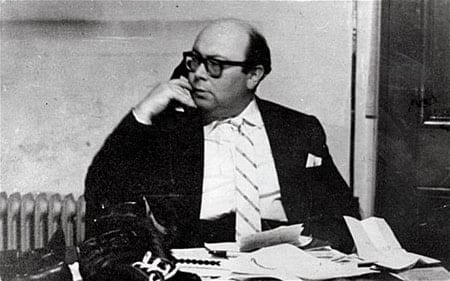
“Notorious slum landlord” Peter Rachman (1920 – 1962) Perec “Peter” Rachman (1920 – 1962) was born in Poland and the son of a Jewish dentist. He is best known for having built up a property empire of over 100 mansion blocks in London’s Westbourne Grove and Notting Hill areas in the 1950s where he evicted longstanding sitting tenants and replaced them with prostitutes and immigrants from the West Indies. Due to the relaxation of rent controls by the Conservative government in 1957 and as no other landlord was prepared to take them, he was able to charge these unfortunates whatever he wished.
Rachman came to public attention after the Labour MP for Paddington North, Ben Parkin (1906 – 1969), became vocal about the poor housing conditions of his tenants. Parkin coined the phrase “Rachnamism” in his quest to put a stop to the activities of “rent racketeers” and highlighted him as someone who used violence to maintain control of “his manor.” The MP even went as far as to suggest that Peter Rachman’s death was merely a ploy to distract from his activities and the result was to leave the public engrained with a belief that this landlord was a “manipulative, grasping Jew” who symbolised the moral decay of Great Britain.
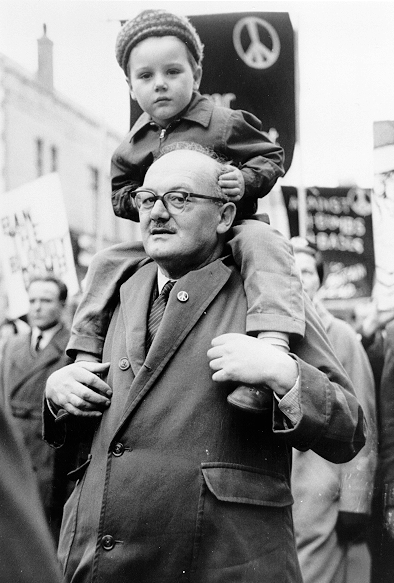
Ben Parkin MP (1906 – 1969) on a CND march A Radio 4 programme this week, however, highlighted an entirely different side to Rachman. In The Real Rachman – Lord of the Slums, a “barrister turned investigative reporter” named Joshua Levine suggested that those who believe Peter Rachman just to be a sordid intimidator fail to see the true persona of the man.
Levine’s witnesses, who number former tenants and Rachman’s biographer Shirley Green, do describe him as a “chancer” who was prepared to use the system to make money, but they also portray another side of this supposed “figure of evil’s” character.

Nicholas van Hoogstraten (born 1945) One immigrant tenant stated: “He was the only one who ever did anything for us” whilst others added that Rachman was “well-liked” and “too soft to be a landlord.” He was a “benefactor” and “jolly” commented others who’d rented from him and a truly notorious modern-day landlord, Nicholas van Hoogstraten, failed to see the opportunist in Rachman at all: “It’s laughable. He had no wealth. It’s an invented moral [mission].” Rachman, equally, was defined as a man “affected” by his imprisonment in a Soviet labour camp in the Second World War by his former lover Mandy Rice-Davis and as someone who suffered true sorrow over the deaths of his family there.
Levine’s examination recounts how Rachman, who drove a navy blue Rolls-Royce with a white interior, was built into a symbol of corruption and moral decay. Rachman, like so many other mythical scapegoats, it turns out only died with only one conviction: parking without lights. The truth, indeed, is often stranger than fiction.
Listen to BBC Radio 4’s The Real Rachman – Lord of the Slums at: http://www.bbc.co.uk/programmes/b01ng4h3
Follow Joshua Levine on Twitter at: http://www.twitter.com/Joshua_Levine
-
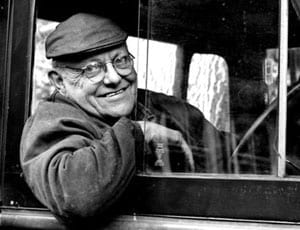
Where Dibnah mucked around
As Fred Dibnah’s former home comes to the market, Matthew Steeples is reminded of a true BBC legend
As the nation continues to cringe in horror every time the name “Savile” is mentioned, memories of another BBC relic of the 1980s resurfaced when it was revealed that Fred Dibnah’s former home is for sale.
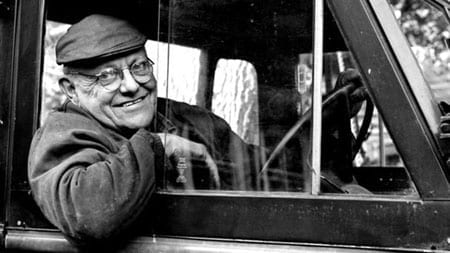
Dr. Frederick “Fred” Dibnah MBE (1938 – 2004) 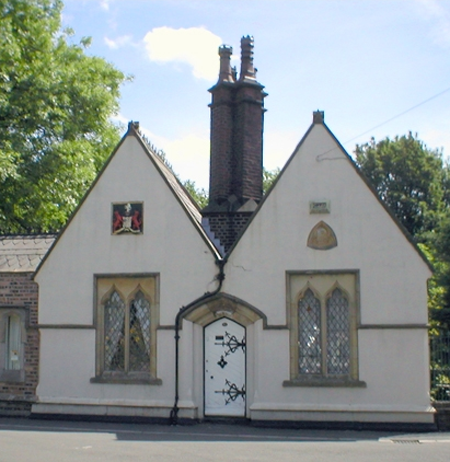
121 Radcliffe Road, The Haulgh, Bolton, Lancashire, BL2 1NU (originally known as Park Cottage) For those of our readers who weren’t fortunate enough to be alive when Dibnah graced our screens, he, unlike Savile, was a legend who truly deserves the accolade of such a title. This thrice-married Lancastrian was a steeplejack who became a television personality just as his breed died out. He didn’t understand why he’d become famous and of it commented:
“It’s a funny thing, this celebrity. If you don’t wave back you’re a miserable bugger, if you do wave back you’re a big-headed bugger. I don’t know.”
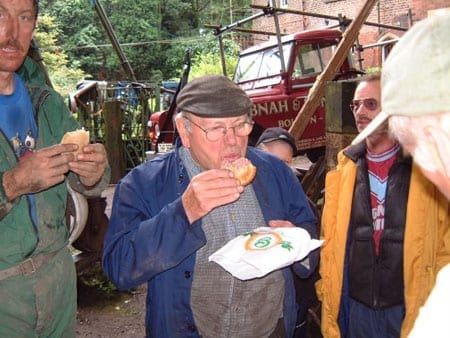
Fred Dibnah in his garden 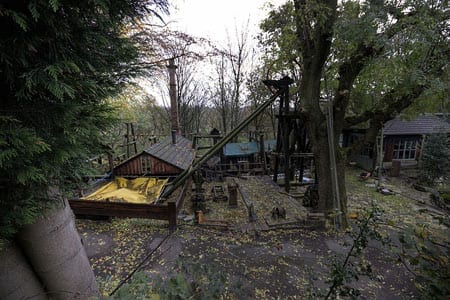
A view of the “garden” Fred Dibnah preferred to think of himself as “just a bum who climbs chimneys” but he ought instead be remembered for his forthright manner. Amongst the legendary comments this “chimney feller” came out with were remarks like:
“The modern world stinks… We’ve become a nation of con men, living by selling double-glazing to each other… Teaching boys to bake cakes? That’s no way to maintain an industrial empire… Them fancy London types don’t know the pleasure of eating chips with fingers… I prefer the past to the present. Because life today, with all its modern technology, isn’t very good, is it? And the future looks even worse.”
Dibnah bought 121 Radcliffe Road in Bolton in 1967 for £5,000. A Grade II listed former park keeper’s lodge, the building is known as “Two Cats” locally because of the coat of arms of the Earl of Bradford on one of the gables features two leopards and is said to have been built in 1854.
The cottage was the setting of the filming of many scenes from Dibnah’s shows and it was here also in 2003, whilst undergoing chemotherapy, that Dibnah decided to embark on the construction of a replica coal mine with his friend Alf Molyneux. His rationale for this was simple: “It’s not everyone who has a coal mine in their back garden.”
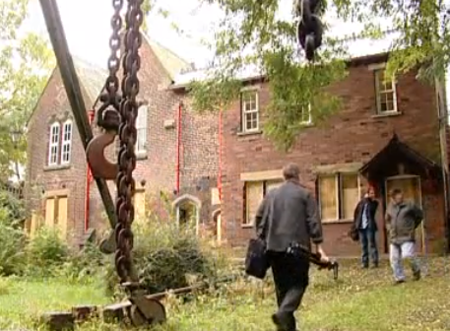
An attempt to auction the house with a guide price of £300,000 to £350,000 in 2007 failed because of a boundary dispute 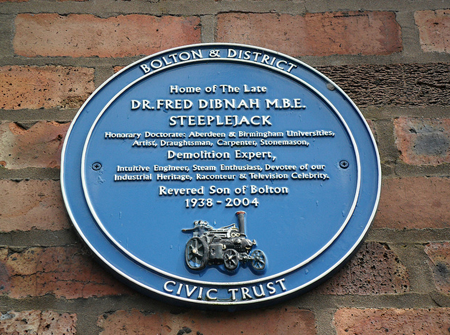
A Bolton & District Civic Trust plaque commemorates Dibnah having lived there from 1967 until 2004 Leon and Jeanette Powsney purchased the derelict property in 2009 for £185,000 and set about turning part of it into a 5-bedroomed home for themselves and the remainder into The Fred Dibnah Heritage Centre.
Visitors, who come by the coachload, are able to tour the yard and see Dibnah’s machinery. Amongst that on show are steam-powered workshop with a circular saw, a band saw and a hydraulic hammer. The 70ft mine shaft remains and in addition there is a 50ft chimney, a gift shop and a small tearoom. The venture turns over about £100,000 per annum and is now for sale through agents Intelligent Business Transfer.
Mr Powsney, who is planning to move abroad, commented:
“We’re selling it as a going concern. It was a business set up against all the odds, we saved it from being flattened and from being redeveloped. We have worked hard to make the centre what it is, and have invested a lot of money in it. We think there’s potential for a buyer to make a tidy profit from it, but we’re looking to relax a bit more now.”
If the asking price of £1,250,000 sought by Mr & Mrs Powsney is achieved, I’m sure the legendary steeplejack wouldn’t disagree that here is a case of: “Where there’s muck, there’s brass.”
For further details about 121 Radcliffe Road, The Haulgh, Bolton, Lancashire, BL2 1NU contact Intelligent Business Transfer on +44 800 612 7718 or go to: http://www.intelligentbusinesstransfer.com/index.php/heritage-centre-meseum.html
To visit the museum contact Leon Pownsey on +44 (0) 1204 531303 or via email at: [email protected]
Watch a video of Fred Dibnah in his garden: http://www.youtube.com/watch?v=FFJq2zayy1s
-
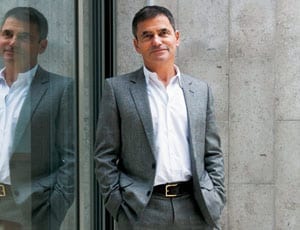
Harry Handelsman
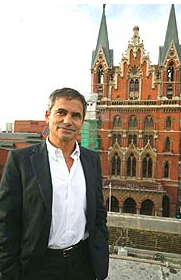 This German-born property developer is best known as the pioneer who brought “loft living” to London in the early 1990s with his Manhattan Loft Corporation. His redevelopment of the Grade I listed St Pancras railway station has resulted in accolades galore and his personal fortune has allowed him to build up a collection featuring works by Andy Warhol, Anish Kapoor, Gerald Laing, Sarah Lucas and Gerhard Richter. Handelsman’s view on money is simple: “[It’s] cynical, sometimes you have it and sometimes you don’t. You can’t take anything for granted.”
 -
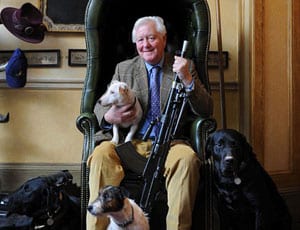
Sir Benjamin Slade Bt.: “What’s on your mantelpiece?”
The Steeple Times asks the right-wing businessman and owner of Maunsel House and Woodlands Castle, Sir Benjamin Slade: “What’s on your mantelpiece?”
The Steeple Times shares “wit and wisdom.” What’s your guiding force?
Money, power, sex, success, land, trees, books and fine wine.
“Don’t get even, get medieval” is, in our humble opinion, a great motto. What’s yours?
“If it f**ks, floats or flies: Rent it, don’t buy it and don’t marry it!”
Kerry Katona was considered unacceptable in 2007. Who or what is unacceptable in 2012?
David Cameron and Sir Mervyn King.
Tony Blair misses being Prime Minister. What do you miss most in your life?
Being in London full-time.
What might you swap all your wealth for?
Good health and two healthy sons.
Donald Trump was once a case of: “If you owe the bank a thousand, they close you down; but if you owe the bank a billion, you own the bank.” What’s your view on the banking crisis?
It’s like putting bartenders on commission and allowing them to give credit to alcoholics who die and go bankrupt.
What phrase or word do you most loathe?
I’ve got three: 1. “Sustainability.” 2. “Stakeholder.” 3. “Human rights.”
In the UK, some people consider charity to “begin at home.” What’s your view and what causes do you personally support?
UKIP and Help for Heroes.
The judge in “Law Abiding Citizen” states: “I can pretty do whatever I want” before being blown up whilst answering her mobile phone. What’s your view on the appropriate use of such devices?
They are useful for ringing up if late, doing deals and arranging dinners with girls.
If you could fill a carriage on The Orient Express, who would be your fellow passengers?
Warren Buffett, Bobby Faber, Philip Gibbs, Bettany Hughes, Brian Kingham, Lady Kitchener-Fellowes, Francis Fulford, Robert Lyle, Sir John Madejski, David Ord, General Sir Michael Rose, Roger Seelig, Alexander Stockton, Jonathan Sumption PC, Norman Tebbit, Lord Westbury, the Duke of Westminster and Mrs William Worsley. Adrian de Ferranti can sit in the luggage car and serve wine.
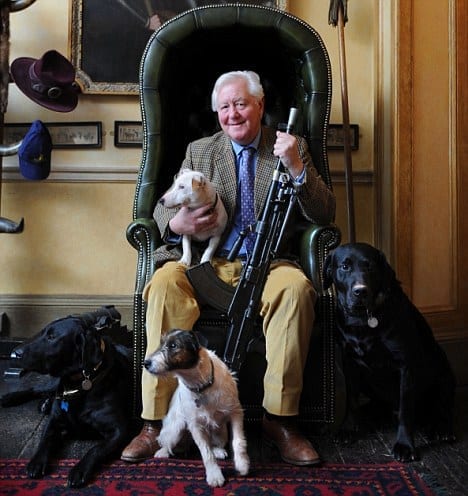
Sir Benjamin Slade Bt. If you were unfortunate enough to end up on death row, what would be your last meal and where would you eat it?
It’d have to be at La Tour d’Argent in Paris.
What time is it acceptable to consume the first drink of the day?
1pm and 6pm.
A Negroni, a martini or a cup of tea?
Green tea.
Whose parties do you enjoy the most and why?
Sotheby’s and Christie’s and those hosted by Liz Floyd and Philip Gibbs.
Who is the most positive person you know?
My friend Bobby Faber.
What’s your most guilty pleasure?
Drinking claret at £100 per bottle.
If a tattoo were to sum you up, what would it be of?
A big castle with lots of walnut trees, good books and bottles of wine. And girls’ hips.
If you were a car, what marque would you be?
A Ford Fiesta.
Cilla Black presented “Surprise, Surprise.” Tell us the most surprising thing about you.
I’m self-made, have a great knowledge of history and am a seriously good doctor with over 120 patients. And, you’ll be surprised to learn that I was a spy in the Middle East for Britain.
What’s currently sitting on your mantelpiece?
Tankards, invites, various Mouser and Walther pistols, cows horns, Roman artifacts, decanters, pewter cups, silver, an 18th century bottle of port and a Russian machine gun.
Maunsel House, North Newton, Near Taunton, Somerset, TA7 0BU. Telephone: +44 (0) 1278 661076. Website: http://www.maunselhouse.co.uk
Woodlands Castle, Ruishton, Taunton, Somerset, TA3 5LU. Telephone: +44 (0) 1823 444955. Website: http://www.woodlandscastle.co.uk
Read Sir Benjamin Slade’s blog at: http://sirbenslade.blogspot.co.uk/ and follow him on Twitter at: http://www.twitter.com/sirbenslade
-
Rocking with royalty
A £26 million residence with connections to rock, royalty and rectors
Built in the early 1500s, The Old Rectory is Wimbledon’s oldest house. Standing in grounds of 2.5 acres, this 16,200 square foot property was once described by a biographer of Sir Henry Cecil as being “not luxurious, but adequate” but now once again it finds itself in an entirely different league.
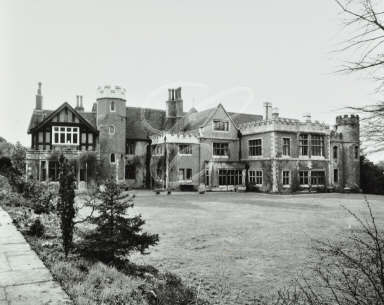
An image of The Old Rectory, 82 Church Road, Wimbledon, London, SW19 5AA in 1978. Present day imagery has been removed at the request of agents acting for the current owners. Priced at £26,000,000, it is almost certainly one of the most expensive homes to ever come to the market in Wimbledon and whoever moves there next will undoubtedly be either an oligarch, an A-list personality or a top achieving business person.
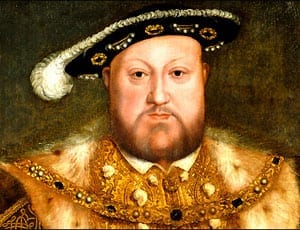
The purchaser will follow in the footsteps of a fascinating array of historically important residents, the first of whom was Henry VIII (1491 – 1547). The King took up residence in 1547 in the months prior to his death and is said, as he was so bloated, to have been unable to climb the stairs to his sleeping chambers. His bed was relocated to the great hall of the house and here he slept next to the fire. Historical research recounts that, with a brewhouse, beer and wine cellars, a coal cellar, meat room, buttery and two dairy rooms, this was a “house fit for a king.”
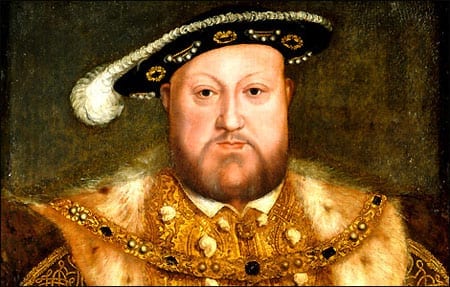
Henry VIII (1491 – 1547) 
Catherine Parr (1512 – 1548) Henry VIII gave The Old Rectory, which was originally called The Parsonage House, to his sixth and final wife, Catherine Parr (1512 – 1548). Preferring a residence in Chelsea, Parr left and the Dean and Chapter of Worcester Cathedral took possession. A lease was sold to Sir William Cecil (1520 – 1598), later Lord Burgley, and the manor then passed to his son Thomas Cecil (1542 – 1623), the 1st Earl of Exeter.
In 1639, Charles I (1600 – 1649) bought the entire manor and gave it to Queen Henrietta Maria (1609 – 1669) but with the era of Comwell, The Old Rectory found itself occupied by General John Lambert (1619 – 1684). Shortly after, when a grander house was built next door, the property became first a laundry house and then servant accommodation and gradually fell into decline.
The Old Rectory passed next to Sir Theodore Janssen (1658 – 1748) in 1720. This French-born English financier, who was said to be worth the staggering sum of £250,000 at the time of his purchase of the house, was a founder member of the Bank of English but later disgraced for his part in the South Sea Bubble. He was expelled from the House of Commons and with his ruination, The Old Rectory saw yet another chapter of abandonment.
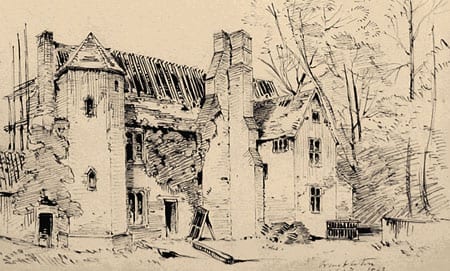
The garden front of The Old Rectory by Charles Henry Money Mileham (1837 – 1917) By 1802, the house was described as an “uninhabited” ruin. A speculator credited with developing “modern Wimbledon” named John Augustus Beaumont bought it and restored and extended it but when it was sold to a Samuel Wilson in 1882 for £6,000, an era of truly comprehensive upgrades was to begin. Wilson added a pebble-dashed two-storey drawing room wing, carved oak doors and installed English, Flemish and Italian chimneypieces.
The next owner was a marine engineer named Matthias Jacobs who had been responsible for the construction of tunnels in Paris and New York. After having purchased The Old Rectory in 1909, he commissioned his brother to add a new single storey billiards room, a service wing and a study extension to mask the medieval chapel of the house. Jacobs sold up in 1923 to a Thomas Lethaby, who fitted oak paneling from Chantry House in Newark and a plaster ceiling based on the one at Knole House, Kent.
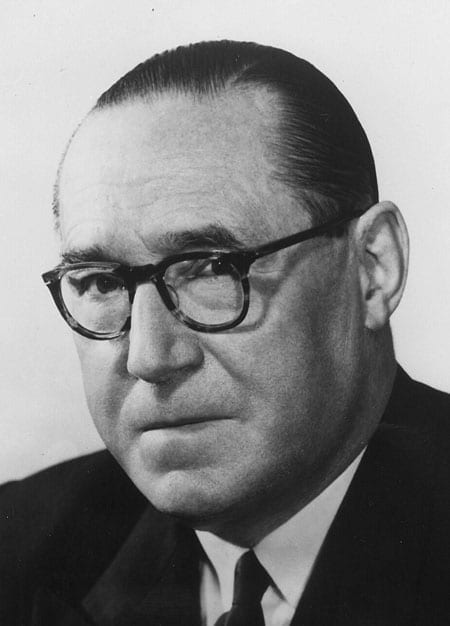
Lord Brock FRCS, FRCP (1903 – 1980) In 1953, the eminent London surgeon and cardiologist, Lord Brock FRCS, FRCP (1903 – 1980), took possession of The Old Rectory after having paid £13,750 for it. Brock is credited as on of the pioneers of modern open heart surgery and also founded the Lord Brock Memorial Trust that to this day funds the museum he founded, The Old Operating Theatre Museum and Herb Garret in Southwark, SE1.
Following the death of his first wife Germaine Louise Ladavèze, Brock sold to an Iraqi entrepreneur and philanthropist named Basil Faidhi in 1978. Faidhi had fled Iraq for Britain and though he spent vast sums restoring the house with assistance from English Heritage, he also created a basement discotheque for his daughter, Nina, and a bar. Aside from bringing the house into the “yuppie era,” Faidhi also commissioned a historian named Richard Milward MA to write a history of the building in 1992 entitled: The Rectory – Wimbledon’s Oldest House.
The Queen lead vocalist and anti-badger cull campaigner Brian May CBE purchased The Old Rectory in 1994 for £4,000,000 with the intention of living there with the Eastenders actress Anita Dobson.
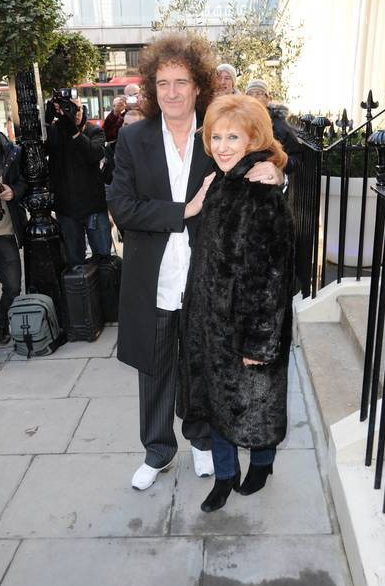
Brian May CBE with his second wife Anita Dobson Dobson, who didn’t marry May until 2008, had other ideas and refused to move in. It was suggested that she preferred a smaller house the pair occupied in Kensington and, at the time, a friend commented:
“[May] begged her to move into the new house so they can make a fresh start. Nobody can believe that Anita doesn’t want to be the lady of this fabulous house. But Brian says he can’t get through to her.”
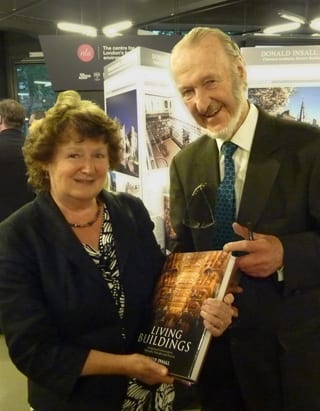
Sir Donald Insall CBE As a result, May never properly moved into The Old Rectory and eventually decided to sell. In 2006, it achieved a record price of £16,000,000 and in the ensuing years, an Italian architect-owner named Antonella Carminati and her husband have lavished time and money on further restorations with the help of Sir Donald Insall CBE’s Insall Associates firm of architects.
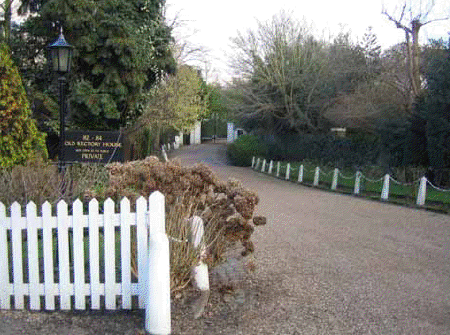
The driveway that leads to The Old Rectory from Church Road gives plenty of privacy New fittings have been installed throughout and substantial extensions to the house have included a new kitchen and breakfast room with garaging beneath. The couple have demolished an early 20th century porch and an “unsightly” oak conservatory, remodeled the billiards room as a drawing room and removed a “bilious” blue swimming pool from the east lawn.
Now featuring 12,882 square foot of accommodation in the main house and 3,320 square foot of additional accommodation, The Old Rectory has been planned to include 8 reception rooms; a vast kitchen with La Cornue appliances and an adjoining breakfast room; master bedroom suite with two dressing rooms, his and her bathrooms and a sitting room and 7 further bedrooms.
Outside, the gardens feature an original medieval fig tree trail, shaded paths, lawns and a large pond as well as garaging for six cars. Planning permission for an indoor swimming pool complex has also been granted and ample staff accommodation is provided above one of the garages and in the gate lodge.
Given the now limited financial resources of the traditional religious houses of Britain, will it be rock, royalty or new money that next takes possession of The Old Rectory? The historians of Wimbledon will undoubtedly be watching.
The Old Rectory, 82 Church Road, Wimbledon, London, SW19 5AA is for sale through the Wimbledon office of Knight Frank. For more information call: +44 (0) 20 8946 0026.
-
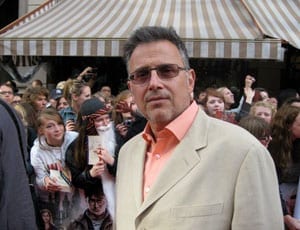
Stuart Graber: “What’s on your mantelpiece?”
The Steeple Times asks Stuart Graber, chairman of The Alternative Board London and former managing director of Time Warner International: “What’s on your mantelpiece?”
The Steeple Times shares “wit and wisdom.” What’s your guiding force?
Superior mind, superior attitude.
“Don’t get even, get medieval” is, in our humble opinion, a great motto. What’s yours?
A quote from Calvin Coolidge: “Nothing in this world can take the place of persistence. Talent will not; nothing is more common than unsuccessful people with talent. Genius will jot; unrewarded genius is almost a proverb. Education will not; the world is full of educated derelicts. Persistence and determination alone are omnipotent. The slogan ‘press on’ has solved and always will solve the problems of the human race.”
Kerry Katona was considered unacceptable in 2007. Who or what is unacceptable in 2012?
Piers Morgan.
Tony Blair misses being Prime Minister. What do you miss most in your life?
Good friends who have gone over to the other side.
What might you swap all your wealth for?
Continued good health.
Donald Trump was once a case of: “If you owe the bank a thousand, they close you down; but if you owe the bank a billion, you own the bank.” What’s your view on the banking crisis?
History has taught us time and time again that when there is money to be made certain individuals will do “anything” they possibly can to benefit and that includes breaking the established rules and regulations.
What phrase or word do you most loathe?
“What will be, will be.”
In the UK, some people consider charity to “begin at home.” What’s your view and what causes do you personally support?
My family and I believe that children and animals are most deserving of our charitable giving.
The judge in “Law Abiding Citizen” states: “I can pretty do whatever I want” before being blown up whilst answering her mobile phone. What’s your view on the appropriate use of such devices?
These highly lethal modern technological marvels form a new arsenal of weaponry. I would imagine that the use of these devices requires a good deal of professional training and skill. If they are “used appropriately” by the military and law enforcement then they should be utilised to save lives.
If you could fill a carriage on The Orient Express, who would be your fellow passengers?
A mixture of family, friends and acquaintances whose company I enjoy.
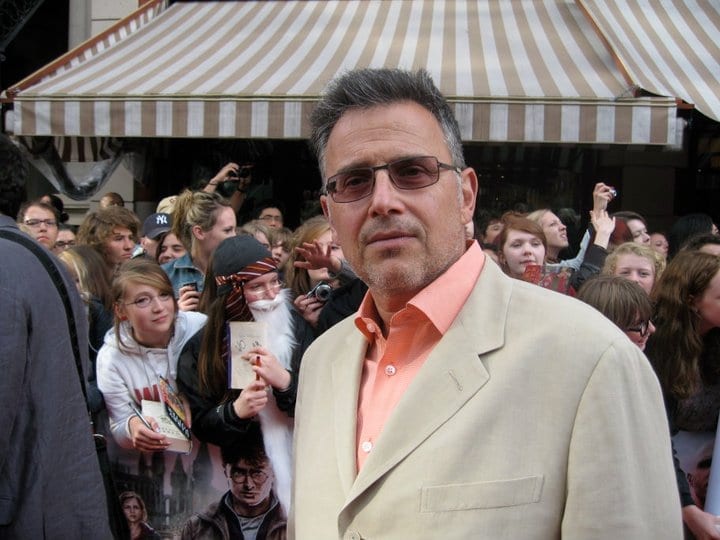
Stuart Graber If you were unfortunate enough to end up on death row, what would be your last meal and where would you eat it?
A Chinese ten-course dinner with the leader or person who could commute my death sentence. It would preferably be consumed on a private jet that can take off when I tell it to.
What time is it acceptable to consume the first drink of the day?
It depends on which country and what age you happen to be however if pressed I would say about 2-3 hours before you eat dinner.
A Negroni, a martini or a cup of tea?
Martini.
Whose parties do you enjoy the most and why?
LA based entertainment industry parties. They are much more experienced and better equipped to create the most amazing environments for a party.
Who is the most positive person you know?
My wife, Susan.
What’s your most guilty pleasure?
Smoking Cuban cigars.
If a tattoo were to sum you up, what would it be of?
A British bulldog, not because they are tough or mean looking but because they are the embodiment of loyalty and love.
If you were a car, what marque would you be?
A Grabercar. For those who don’t know, they are lightweight sports cars.
Cilla Black presented “Surprise, Surprise.” Tell us the most surprising thing about you.
I am an expert marksman and knife thrower.
What’s currently sitting on your mantelpiece?
Statues of my bulldogs, The Manoush and Cupcake.
A graduate of Harvard Business School, Stuart Graber is the chairman of the Alternative Board London. He lives in North London and was previously managing director of both Time Warner International and Music Choice Europe. He was also involved in developing, licensing and distributing culturally and linguistically adapted versions of Sesame Street and obtained the first commercial network radio license in the United Kingdom for Classic-FM.
-
Why pay less?
Living life to the full Donald G. Abbey style
“Why pay less when you can pay more?” is a mantra that some strangely choose to live by. In my time, I have encountered a couple with a different Ferrari for each day of the week, someone who proudly declared their home had a window for each day of the year and an heiress who insists upon the local baker feeding her dog daily with a freshly baked caviar pie.
When I discovered a house in California priced at $78,000,000, I didn’t expect to subsequently find out that the same vendor is also selling another of his homes in Montana at the very same price. Having done a little research into Donald G. Abbey, the commercial real estate tycoon who owns both The Bradbury Estate and Shelter Island, I discovered that here indeed is another personality whose excess knows no bounds.
I suppose when people sell homes of this worth, the asking price they set is quite irrelevant. “What,” I’m sure they ask, “is $5 million between friends?” Equally, when it comes to developing such properties, characters of this nature do not show any reserve. Bling is most definitely the order of the day and the larger and flashier one can build, I guess, the better.
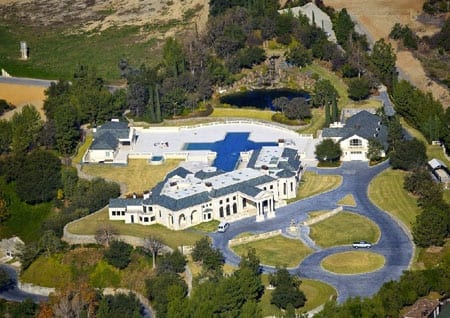
An aerial shot of The Bradbury Estate, 172 Bliss Canyon Road, Bradbury, California, CA 91008, USA 
The front elevation of the main house 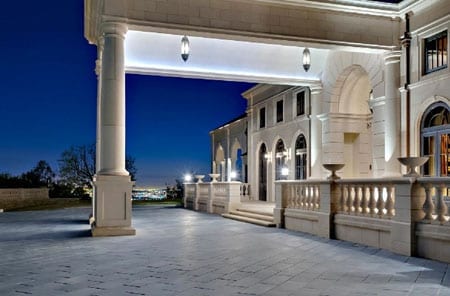
The owner and his guests need not get wet on arrival in their limousines Abbey’s Bradbury Estate is a case in point. This vast property consists of a 33,000 square foot main house with 7 bedrooms and 10 bathrooms. It is almost entirely made of French limestone and includes a chef’s kitchen with a pizza oven, a 2,000 bottle wine cellar, an oak paneled elevator and a leather paneled poker room. Bedrooms include domes with hand painted frescos and in addition there is a detached 6,700 square foot guest house above a 10 car garage and a 5,700 square foot pool house with a catering kitchen, gym, massage room and a subterranean EPA certified 25 yard rifle shooting range complete with a gun storage room and 2 large safes.
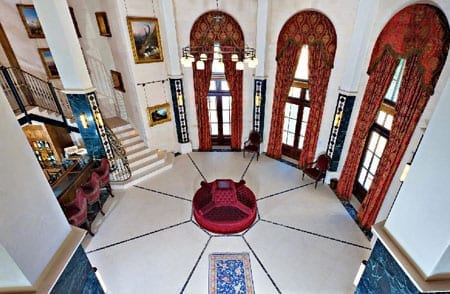
The hall of the main residence comes complete with a gallery and bar 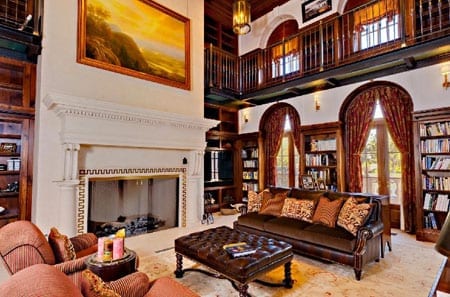
A vast library provides the perfect space to enjoy a good book 
The library’s glazed ceiling 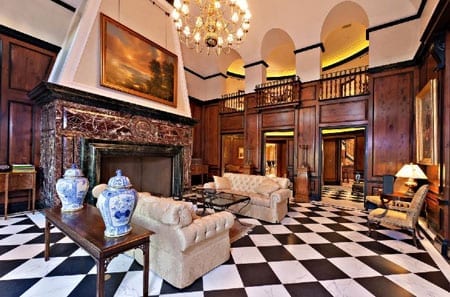
Another palatial reception room 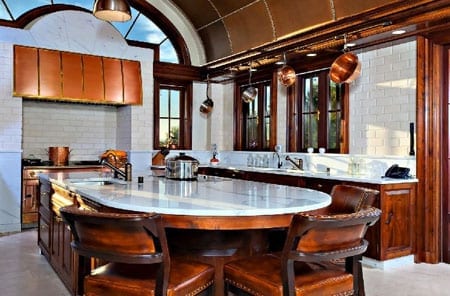
The house features a rather impressive kitchen 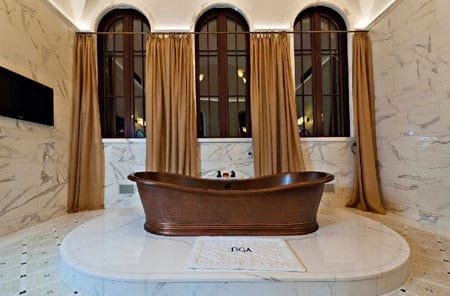
Mr Abbey’s copper bath tub comes complete with a mat displaying his initials in front of it Within the 8 acre grounds there is a cross shaped infinity-edged pool – perhaps Mr Abbey is religious – that is “just a few feet short of Olympic length.” It requires 350,000 gallons of water if it is to be filled to capacity. Adjoining this is something even more ludicrous: a 1,000,000 gallon, temperature-controlled rainbow trout pond that cost some $8,000,000 to construct. The pond is said to be “adorned with perennials,” is heated by a custom gravity separator with UV filters and is “chilled for the trout by a 300-tonne central cooling plant.” At Bradbury, thoughts of water crisis in Sudan and Ethiopia come way behind the needs of Abbey’s rainbows.
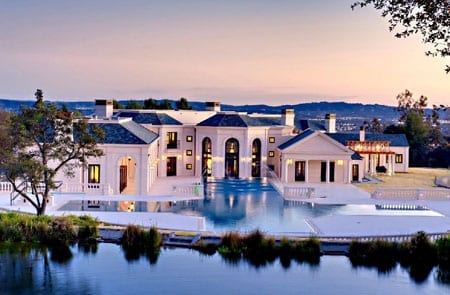
The rear of the house viewed from above The Bradbury Estate’s $8,000,000 trout pond 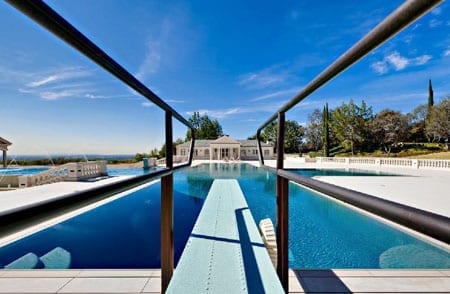
The estate’s 350,000 gallon near Olympic length cross shaped infinity edged swimming pool 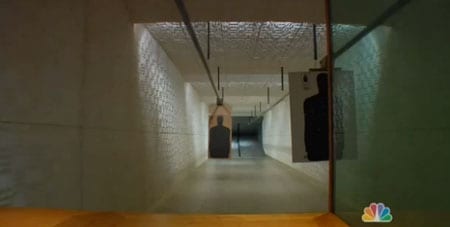
The property’s EPA certified 25 yard rifle range For those wanting to avoid California’s UV rays, Bradbury also boasts an acre of porches, decks, loggia and walkways. A 600ft blue stone driveway completes this “once in a lifetime trophy property” that “belongs in the portfolio of the most astute collector” and it has space for “60 foot truck access or multiple limousines.”
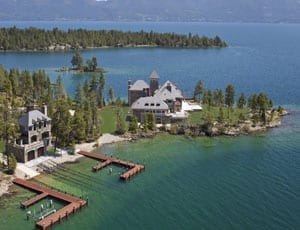
When Mr Abbey has tired of California, he is able to retreat to his own island in Montana. The 24 acre Shelter Island on Flathead Lake includes 7,000 feet of frontage to the water, a world class sporting clay course and 3 computer controlled tracks and docking systems that allow boats to be landed in the dry dock without riders ever leaving the craft or handling a line. The island is powered via an underground armoured utility cable that carry 12,000 amps to it along with CAT-5 computer cable and phonelines and the main entertaining space features a mammoth television of some 120-inches in size.
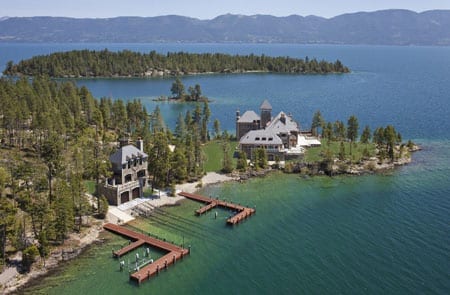
An aerial view of Donald G. Abbey’s Shelter Island 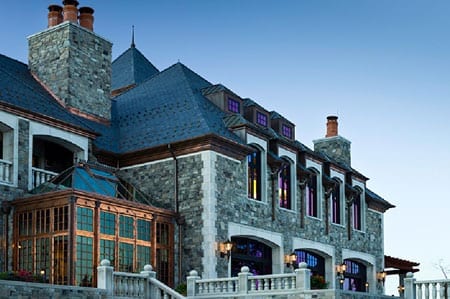
Mr Abbey’s passion for copper continues with a conservatory made out of the metal on the lakeside elevation of the main residence on Shelter Island 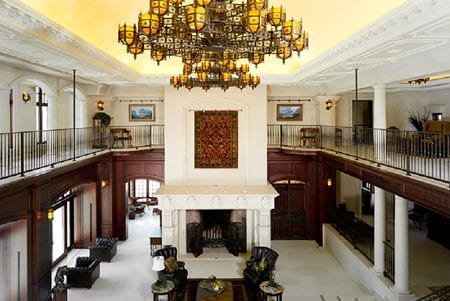
The Great Room of the main residence on Shelter Island 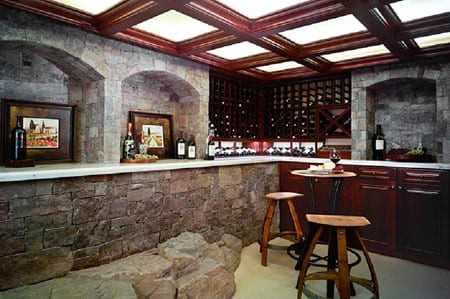
Mr Abbey’s passion for fine wines is displayed in a bar and tasting room in the property 
The owner and his guests can access their boats without having to go anywhere near the water Abbey has built over 44,000 square foot of accommodation on his island. The main house has 5 bedrooms and 8 bathrooms. His “Great Room” features ceilings of some 45 foot in height and in addition to yet another indoor shooting range, there is a kitchen that woudn’t look out of place in The Savoy hotel.
In the UK, the property most similar to anything Abbey has built has to be Updown Court at Windlesham in Surrey. Developed by a former bricklayer named Leslie Allen-Vercoe, the house was described by him as being: “The most important residence to be built in England since the 19th century.” Architectural critics did not agree and some went as far as to say that it looked like: “A cross between a Tesco superstore and Center Parcs.”
Allen-Vercoe’s behemoth of a house is gargantuan in size. With 103 rooms it includes 24 bedrooms, 5 swimming pools, a 2-lane bowling alley, a squash court, a floodlit tennis court, a 50-seat cinema and a panic room. The heated driveway that led to the house is entirely made of marble and cost some £2.5 million to construct but plainly none of this appealed to the market as it languished for sale at a price of £70,000,000 from 2006 to 2011 before being repossessed by the Irish National Asset Management Agency (NAMA). Updown Court was sold for half the original asking price to a foreign buyer in October 2011 and is, I believe, due to undergo extensive remodeling.
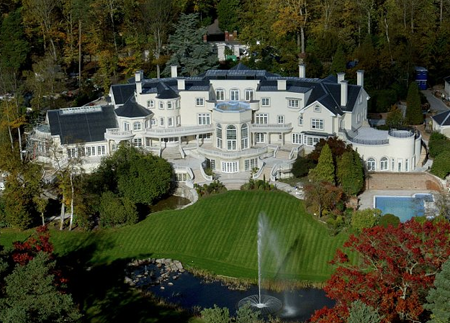
Updown Court, Chertsey Road, Windlesham, Surrey, GU20 6HY, UK Allen Vercoe once stated: “If Elton John were a house, he’d be Updown Court.” Equally, I imagine if Mr Abbey’s residences were to be compared to any celebrities they’d be the vulgar car crash that is Donatella Versace and the ludicrous money obsessed singer with a dollar sign in her name, Ke$ha.
Updown Court, Shelter Island and The Bradbury Estate all illustrate that money cannot buy you good taste. I suppose, though, that those who ultimately come to live in them will have plenty of space to choose how and where to enjoy their own form of misery.
For more information about Donald G. Abbey, go to: http://www.theabbeyco.com
For information on both The Bradbury Estate and Shelter Island, contact Bob Hurwitz of the Hurwitz James Company on +1 310-477-8865. Website: http://www.hurwitzjamesco.com
A website devoted to The Bradbury Estate can be viewed at: http://www.bradburyestate.com
A video of Shelter Island can be watched at: http://vimeo.com/11404637
For more details on Updown Court, go to: http://www.updowncourt.com/