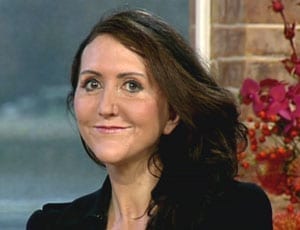
 This mouthpiece was born in Rettendon, Essex in 1958 and vents bile on all manner of subjects. Articles such as: “Why don’t more women moan like me?” and “Liz Jones’ baby craving drove her to steal husband’s sperm in ultimate deception” are frankly illustrative of why she’s so unpopular. After she got banned from the majority of fashion shows and her husband left her, she quit London for Somerset in 2007 to feed organic muesli to the rats in the barns of a 47-acre farm she purchased as her “rural idyll.” That misadventure came to a sticky end in November 2012 after she’d alienated the whole county by calling them, amongst other things, “smelly” and “faintly Amish.” Goodness knows whom she’ll choose to offend next. Phillip Schofield sums her up best: “She is inconsistent, bitter, nasty and unhinged.” Our advice: Just steer well clear of this acid tongued poison pen.
Tag: Money
-

Liz Jones
-
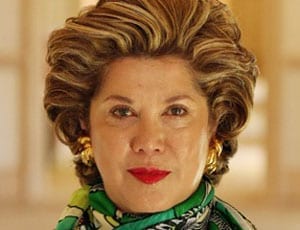
Patricia Kluge (née Rose)
 The rise and fall of the “wealthiest divorcee in history” has been extraordinary. A former nude model for her first husband’s Knave magazine and star of adult films such as “The Nine Acres of Nakedness,” Patricia Kluge is the daughter of an Englishman and a Scots-Iraqi. She married her second husband, the late John Kluge, chairman of Metromedia and once the richest man in America, in 1981 after belly dancing for him at a dinner party in New York. As part of her plan to dovetail herself into the top drawer of American society, the couple built a 24,000 square foot mock 18th century English-style mansion, Albermarle, in Virginia and stuffed it full of Chippendale furniture. She got this as part of her $100 million divorce settlement in 1990 and wisely invested part of the payoff in a highly successful business trading football cards but then vanity struck. The Kluge Estate Winery project that she started with her third husband, William Moses, bankrupted the pair in June 2011 and the Bank of America foreclosed on her properties. A lifeline came from “longtime friend” Donald Trump who purchased the vineyard and employed her, but even he’s now uttered the words: “You’re fired!” and sent her packing. Of her newfound predicament Kluge commented: “What did we lose? Material things, nothing too important. When something like this happens you really see who your friends are, those you can rely on, and we have many friends.” Here is a lady with fortitude that can only be described as admirable. It’s probably best, however, to keep her away from the cash register.
 -
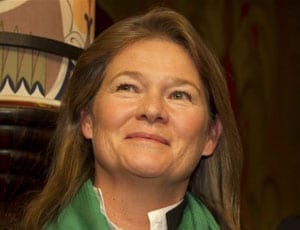
Charlene de Carvalho-Heineken
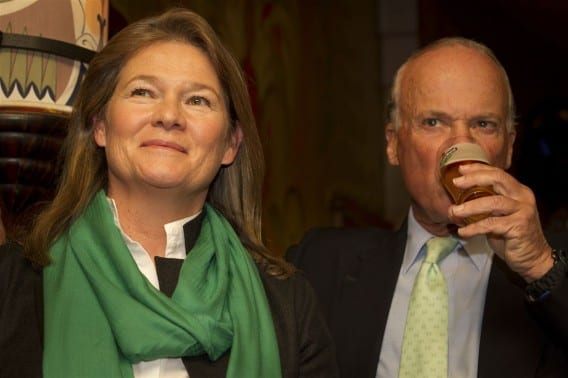 She owns a controlling interest in the world’s third largest brewer and is married to the child star of Lawrence of Arabia, Michel de Carvalho. They live together in London with their five children, are said to be worth £5.5 billion but live “quite modestly.” Of meeting his wife, de Carvalho commented: “I met the girl of my dreams, complete with free beer. I didn’t realise then that marriage is not just about free beer.”
 -
The battleaxe in the Beemer
Matthew Steeples examines the truth behind Liz Jones giving up on her “rural idyll”
The Mail’s Liz Jones is a waspish woman who knows the price of everything and the value of nothing. Those who’ve paid even a moment’s attention to her bleating, will be familiar with lines such as: “Last week, my brand new £1,300 MacBook Pro broke” and “Phil Spencer wanted his £46,000 and he wanted it now!” She never stops talking about money and the size of what she both owns and owes.
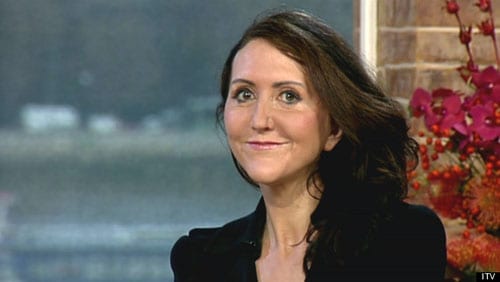
Liz Jones In today’s Femail, Jones bores on about about how she feels “like a cross-dresser” trying out the Kardashian Kollection of clothing in a pointed attack on Kim Kardashian, but it was for her diatribe yesterday that she truly got the goat of the nation in “[bidding] a ferocious farewell” to life in the country in an article entitled “Goodbye… and good riddance!” 2,151 people have commented so far and most of them have been far from sympathetic.
When Upcott Farm at Brushford, near Dulverton in Somerset came up for sale in 2007 at a price of £1.6 million, it featured in an article by The Telegraph’s Caroline McGhie. The 5-bedroomed farmhouse came with a 2-bedroom annexe, a courtyard of barns and stables and 47 acres of land. McGhie waxed lyrical about the merits of moving to this location: “People come here for the peace and quiet, the night skies, the dramatic coastline, and they work from home,” she stated before adding: “You can find everything here, including butchers, bakers, afternoon tea and cake, fish and chips, an art gallery and a shop selling fishing tackle.” Of Upcott Farm itself, she concluded:
“This would suit a member of the new wave of buyers dubbed Droppies (Disillusioned Relatively Ordinary Professionals Preferring Independent Employment Situations).”
McGhie got it half right: Upcott Farm sold to someone who considers herself far from “relatively ordinary” and someone who is far from “professional.” The purchaser, however, was certainly someone who’d become “disillusioned” with what she’d bought and someone whose desire to be “independent” and create a “situation” just alienated all she encountered. The buyer, you’ve guessed it, was none other than Elizabeth Ann Jones.
Jones was born in Brentwood, Essex in 1958 and studied journalism at the London College of Printing. She became editor of Marie Claire in 1999 but was sacked, she herself suggests, for “listing in the magazine the freebies she had been offered in the previous month.” Here, it seems, began Jones’s obsession with all things material and here she also met an Indian BBC radio journalist named Nirpal Dhaliwal in 2000.
Jones married Dhaliwal but the union was to prove an “utter disaster” as he had affairs with women she terms “younger, dimmer [and] slimmer.” “I’m no racist” Jones was divorced in 2007 and said goodbye to her “3,000 square foot of Islington real estate” and “easy, if super-busy, London life” in favour of the green, green grass of Somerset.

Upcott Farm, Brushford, Dulverton, Somerset, TA22 9RS Whoever’s side you see it from, five years of hell followed. Jones baited the locals and they grew to loathe her. She wrote columns and a book, The Exmoor Files, where she attacked them as “faintly Amish… feral, old and smelly” and another hack and neighbour, Jane Alexander of The Telegraph, responded: “Dulverton [was] positively fizzing with fury” after each and every publication.
Of the local restaurants, Jones stated:
“I have given up trying to eat out in restaurants here on Exmoor… It is still stuck in the Seventies, with only things in baskets and rum babas on the menu… If you tell the waiter you are vegetarian, you are stared at, incredulously, as if you are black.”
She whinged about her inability to find love:
”I will never, ever meet a man here in the middle of a moor, where even to be in possession of your own teeth is a bonus.”
And whined about fieldsports:
“I didn’t increase my popularity by being unable to pass a party of men and often children with guns, shooting rabbits and deer, without getting out of my BMW and saying: ‘Do you really have nothing better to do with your Saturday morning?’ The look of shock on their faces that I had the cheek to challenge them was priceless. I would stop, too, and shout at huntsmen on horses, galloping on tarmaced roads, one hand on the reins, the other clamping a mobile phone to their heads. ‘You will ruin your horses’ tendons!’ I would wail.”
Whilst Jones found little to like in her new community, they found nothing positive in her arrival either. Her dog was blamed for worrying lambs, and Jones’s inability to control it, locals say, was an indicator of the chasm between her life and theirs. In 2009, one neighbour went as far as to tell Danny Brierley of The Independent:
“We have got nothing in common with her, really. I think she may find it difficult to make any kind of life here now. She is not a very friendly person and we are all sick to death of talking about Liz Jones. A hatred has been building up for months. She is actually having a go at people and they are not going to tolerate that. She has feelings like all people, of course she has. But everyone wants her to leave and leave now. No one can make her, but we think she will go. I don’t see how you can live in such a small community with people who think that way about you.”
Matters came to a head when Jones’s precious black BMW convertible, “bought in 2005 for £26,000,” was pelted with eggs and teenagers fired shots at her letterbox with an air rifle. A local councilor even dressed up as her in the local carnival and yesterday Jones took revenge on those she blames for her “five-year prison sentence” and deprivation from Space NK, Cath Kidston and Illy coffee.
Instead, the article just shows the true reality of this bombastic harpy. The lines Jones penned speak for themselves. Country people don’t welcome someone who planned to “hack for miles across the open moorland in my Prada jodhpurs” anymore than the folk of Knightsbridge welcome Arabs treating their roads like racetracks. The gardener who had to endure Jones yelling “walk faster!” at him didn’t deserve such anymore than a bus driver in SW11 deserves abuse from his passengers. Jones concludes:
“I’m now a different person. I became so lonely. I would often get in my car, not just for the warmth, but for the kind voice of the satnav lady. I’ve learned that an amazing view and a pair of nesting grey herons are not enough to make me happy.”
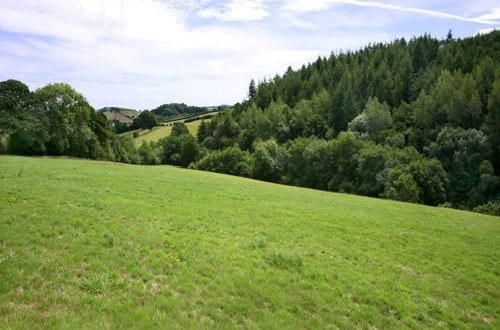
27 acres of land including paddocks and a fishing lake remain on the market through Savills and Strutt & Parker at a price of £200,000 at Upcott Farm Miss Jones bleats that she’s taken a £500,000 loss on Upcott Farm, which languished on the market at first at £1,900,000 and then £1,750,000 for three years. The “unexpected” sale of the property has given her the ability to “flee back to the city” but the locals and even the “Droopies” should be warned: there’s still 27 acres of the farm unsold and on the market at a price of £200,000. Halloween may have passed but the battleaxe in the Beemer could still call again.
Read yesterday’s “Goodbye… and good riddance!” article by Liz Jones for the Mail on Sunday at: http://www.dailymail.co.uk/femail/article-2231033/Goodbye–good-riddance-During-catastrophic-years-country-Liz-Jones-greeted-gun-attack-relentless-abuse-Now-flees-city-bids-ferocious-farewell.html
To purchase Liz Jones’s book, The Exmoor Diaries, go to: http://www.amazon.co.uk/Exmoor-Files-Husband-Found-Rural/dp/0297854437
For more information about the remaining 27 acres at Upcott Farm, contact Strutt & Parker on +44 (0) 1392 976005 or go to: http://www.primelocation.com/for-sale/details/18314693?search_identifier=71cbb8a2fb43a12182bfa7b79b5de0a3
-
Greed ain't that good
Matthew Steeples reports on the sentencing of Maria Michaela
Today, Maria Michaela was sentenced to 9 years in jail at Harrow crown court for her role as the lynchpin in a fraud of epic proportions.

Maria Michaela attempts to look remorseful as sobs in her mugshot 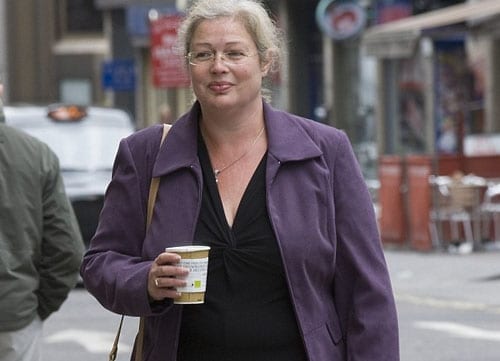
Convicted fraudster Mary-Jane Rathie Termed as “Britain’s biggest female fraudster” by the Evening Standard, Michaela is someone I came across in Lennox Gardens, London. In the building where I lived, she was often spotted with an associate collecting money from a tenant, Stephen Hunter-Scott, also known as Stephen Short, who was jailed alongside her.
In due course this Knightsbridge apartment was repossessed by an Irish bank but the aforementioned associate returned a year later and forcibly took possession. The apartment concerned was eventually taken back and sold on a short lease for just £200,000 recently.
Meanwhile Michaela disappeared but it was not until she appeared on the BBC’s Crimewatch wanted list that she again came to my attention. On the show, it was reported that this woman, who operated under countless aliases that numbered “Joanne Sarah Pier,” “Anjali Sharma,” “Mia Cul” and “Nadia Ali,” had, with the help of a corrupt chartered surveyor named Mary-Jane Rathie, obtained loans of £10.5 million from HBOS and £2.5 million from the Royal Bank of Scotland in 2007 and 2008.
Michaela, who may well in reality be called Bruna Louise, had posed as a wealthy South African heiress to secure the funds she supposedly required to fund the purchase of properties in Chelsea, Belgravia, Pimlico, Greenwich, Clapham, Stoke Newington and the Docklands. In reality, Rathie, who was bribed with £910,000 in cash, a £49,000 Range Rover Sport and a £143,000 Bentley Continental, vastly overvalued each allowing Michaela to pocket, for example, £6 million for a Cheyne Walk house that was in reality worth just £3.5 million.
Whilst Rathie, a former employee of Ashdown Lyons, was jailed for 6 years in July 2011, the fraudster Michaela managed to evade capture for three years. She was eventually caught this January in Bexleyheath working as a mortgage broker. In various preliminary hearings, her pleas of insanity did not help her cause and nor did her unwillingness to provide evidence of her true identity. This morning, she got just what she deserved.
Of her conviction, Detective Inspector Andy Fife of City of London Police commented:
“Maria Michaela created a web of deception that duped banks into handing over vast sums of money and then perpetuated her crimes by assuming a new alias to try and secure more loans. False identities and a corrupt property surveyor were the tools she used to make millions, turning herself into one of the, if not the, most prolific female fraudster the UK has ever seen.”
The lesson of Michaela and her cohorts, I’d argue, is simple. Greed may well be good in the eyes of Gordon Gekko, but the greedy generally get caught in the end and generally it is down to their own vanity. As she rots in her cell, perhaps she ought to consider this folly.
-
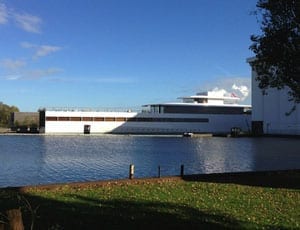
For the love of Jobs
Edward Kay takes a look at a yacht that forms part of the legacy of Steve Jobs
In a bittersweet moment, Steve Jobs’s yacht was launched on 29th October from the Feadship’s de Vries yard in Aalsmeer, The Netherlands with his wife and three children aboard. The Jobs family gave the members of the yard iPod’s inscribed with the name of the yacht to show their appreciation for the six-year build.
The unusual 256-foot yacht has been christened “Venus” after the Roman goddess of love and features huge floor to ceiling windows and teak decks.
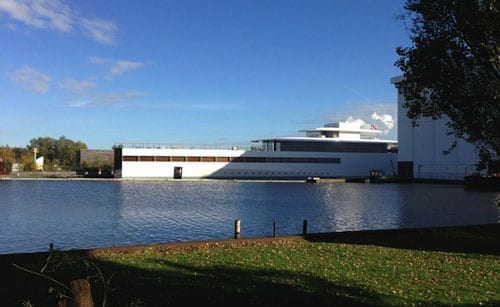
Venus emerges from the Feadship de Vries yard 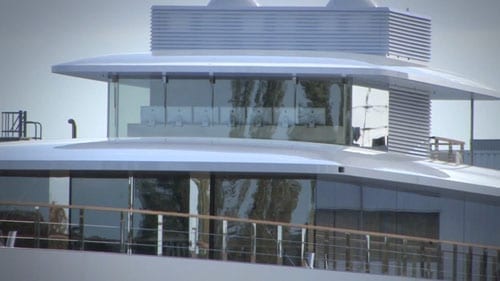
A closeup of the bridge deck of Venus shows seven 27-inch iMacs 
The iMacs in situ 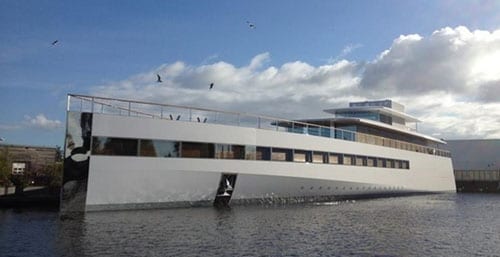
Venus in all her glory 
Steve Jobs (1955 – 2011) The minimalist Phillipe Starck designed aluminium vessel has been described as looking like an iPhone resting on an iPad resting on a MacBook Air and there are indeed seven 27-inch Mac screens clearly visible on the bridge deck.
Jobs told his biographer Walter Isaacson: “I know it’s possible I will die and leave Laurene [his wife] with a half built boat. But I have to keep going on it. If I don’t, it’s an admission that I’m about to die.”
Of the boat itself, Starck adds:
“The idea for the boat was very simple. It was mainly philosophical. It is not like a lot of mega yachts showing the vulgarity of money. It’s a boat showing the elegance of intelligence.”
Indeed, when Jobs saw the designs, he is said to have stated: “My God, it’s better than I could have dreamt.” I quite agree. Venus is a spectacular bequest.
Remembering Steve Jobs: http://www.apple.com/stevejobs/
To view more examples of the works of Feadship, go to: http://www.feadship.nl
-
Boujis in the basement?
Matthew Steeples explores the story of an empty Kensington mansion
A multi-million pound 8-bedroomed house in Kensington isn’t anything unusual. In fact, rather, they’re ten a penny. In this, one of the wealthiest boroughs in the land, large, expensive homes are just the norm.

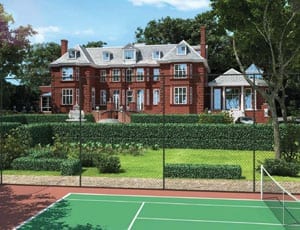
An image of the existing exterior of No. 1 Campden Hill, London, W8 7AD 
A rendered image of how the exterior of the renovated property might look 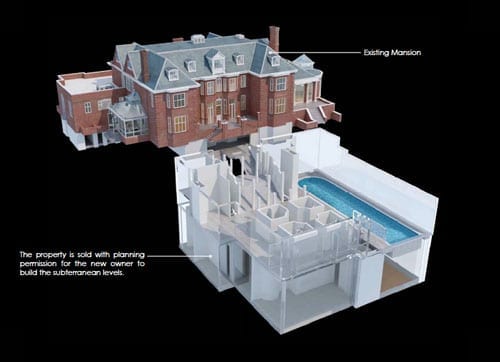
The plans show a vast subterranean development that will vastly increase the size of No. 1 Campden Hill No. 1 Campden Hill, which is being marketed for an undisclosed eight-figure sum, is in a quite different league. Here is a detached Edwardian house in an acre of grounds just to the north of Kensington High Street. It’s an unrenovated property but it attracted much press attention in October 2011 because it was place on the market in October 2011 at a price of £75,000,000. Yes, you heard it right: £75 million for a fixer-upper. Last week, Radio 4 made a hell of a fuss about a derelict semi-detached house in Newcastle selling for just £14,000 so this truly must be something special.

Architect Edward P. Warren (1856 – 1937), far right, in the offices of Bodley & Garner, 14 South Square, Gray’s Inn, London The architect of the house Edward Prioleau Warren (1856 – 1937), a Bristol born architect and archaeologist, was best known for “Oxford colleges and minor country houses” but also designed the War Cemetery at Basra. He was a friend and adviser to the American novelist Henry James and in addition to building No. 1 Campden Hill in 1915, he also designed a house at 5 Palace Green in 1906 and another, Estcort House in Kensington Palace Gardens, in 1904. Warren’s guiding style is described as having been to recreate an “understated revival of English late 17th century” architecture and at No. 1 Campden Hill he created just that.
Colonel Edmond Grove-Hills (1864 – 1922), born Edmond Hills, and his wife, Juliet Spencer-Bell, were the architect’s clients. A plaque on the building bares their names and the following dedication:
This House I built for Me & Mine
May it be of Peace A Shrine
And no Enmity or Sin
Ever find its way therein
AD 1915
Sadly for the Grove-Hills, the following year, their son, Second Lieutenant Charles Herbert-Hills (1895 – 1916) was killed on the Somme aged just 21. His father, meanwhile, was awarded a CBE in 1918 after having served as the Assistant Chief Engineer of Eastern Command during the war.
Aside from his military exploits, Edmond Grove-Hills is best known for his role as president of the Royal Astronomical Society. He took part in observations of eclipse of the sun in Japan in 1896, India in 1898 and Russia in 1914 and contributed papers analysing both this and the causes of the irregular movements of the earth’s axis of rotation.
In 1951, No. 1 Campden Hill was purchased by the government of Uruguay and it became the residence of their ambassador to the United Kingdom. For the next fifty years the building was barely altered but when the lease from the Phillimore Kensington Estate came to an end, there were legal problems as the 1951 transfer had never been stamped. Of this, Sharon Mulroney of Forsters, the legal representatives of Phillimore, commented:
“It is highly unusual to be faced with complications of this kind when dealing with a registered London title, but this made the transaction all the more fascinating. Even the decision to allow ambassadorial staff to return to the property for security purposes after completion was fraught with potential problems about security of tenure, employment and tax.”
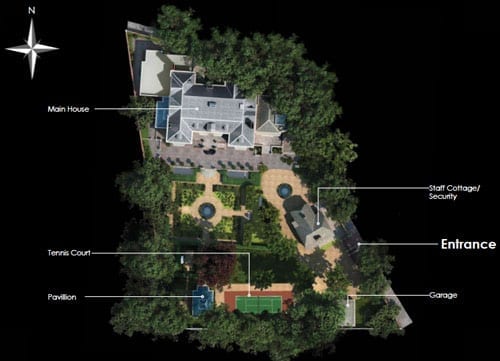
The proposed site plan shows the addition of a garden pavilion, staff/security cottage and a tennis court Eventually, without issue, the Phillimore Estate sold on the house in 2001 for a price of approximately £17,000,000. In the years since, the property was effectively mothballed as all the purchasers have done is to have obtained planning permission to redevelop the building into a mammoth mansion of epic proportions.
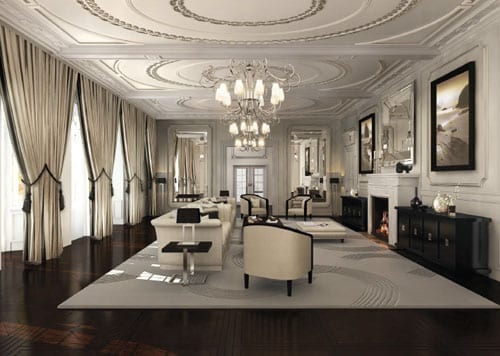
A computer rendered image of how the drawing room might look 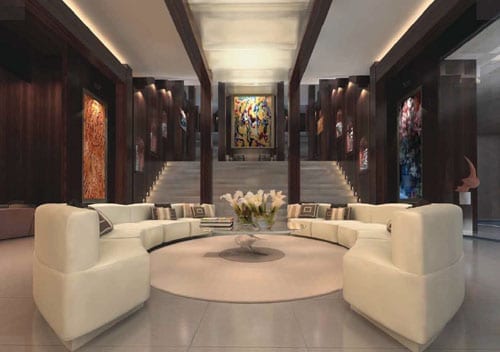
The “leisure area” is reminiscent of the entrance to The Mandarin Oriental Hyde Park Hotel 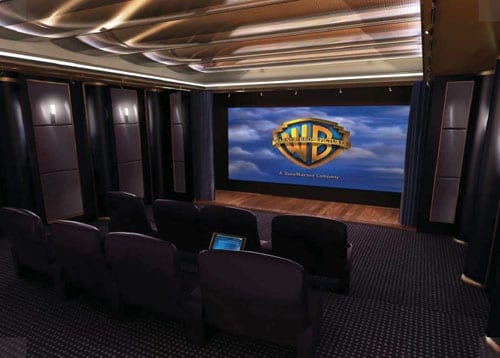
The private home cinema would be the envy of any movie buff 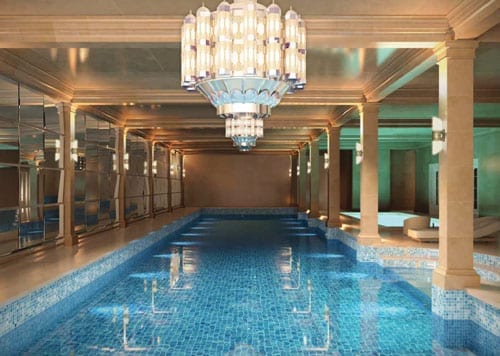
The swimming pool 
The wine cellar is rather like a contemporary take on Berry Bros. & Rudd’s flagship store in St. James’s Street 
And to complete it all… The plans include your own version of Boujis in the basement The approved plans show designs for something quite remarkable. Warren’s “understated” residence will be replaced with 8 vast bedroom suites, grand entertaining spaces, a lift and even bedrooms for 5 staff. In addition to a full-scale renovation of the original freehold house, there is scope to provide a total of 30,000 square feet of accommodation by adding a huge subterranean complex that will include a 25-metre swimming pool, court, squash court, gym, sauna, steam room, function room, entertainment room, home cinema, wine tasting room and even a nightclub to rival any of Kensington’s trendiest haunts.
On that basis alone, No. 1 Campden Hill is surely the ideal residence for Prince Harry: “Who needs Boujis?” we hear him cry.
No. 1 Campden Hill, London, W8 7AD is for sale through Knight Frank. For more details contact Roddy Craggs on +44 (0) 20 7938 4311 or go to: http://search.knightfrank.com/ken100161 to download a brochure.
For more information about The Phillimore Estate, go to: http://www.phillimore-kensington-estate.co.uk
-
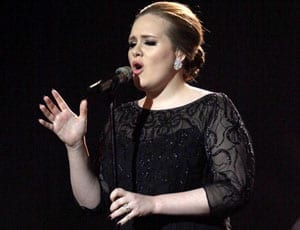
Adele Adkins
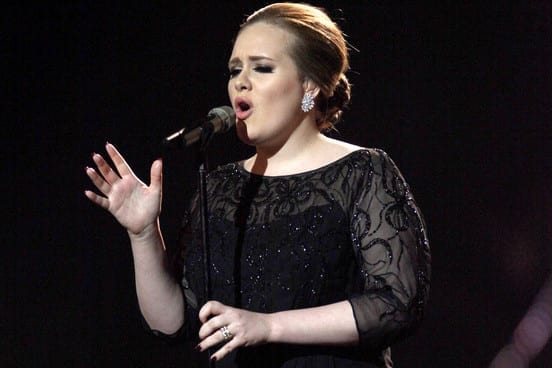 “I don’t know what’s going to happen if my music career goes wrong,” states this Tottenham born singer. Having been named “one of the most influential people in the world” by TIME Magazine and broken the record for the longest number-1 album by a woman in Billboard history, she really need not worry. Adele’s still “Someone Like You,” except she’s now worth in excess of £23 million and is guaranteed a place amongst the music greats. Gordon Brown wrote to this Labour supporter to tell her that she’s a “light end of the tunnel” but we prefer the view of former Guns N’ Roses guitarist Slash. Of her, he proclaims: “She’s great. She’s a shot in the arm for this industry.”
 -
Tom Ford
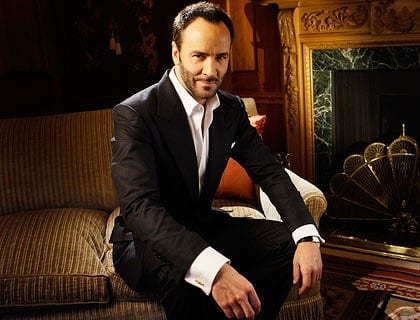 This Texan born designer and film director turned around the fortunes of Gucci and YSL and had a huge success with A Single Man. A fixture at New York’s Studio 54, his designs are hugely influenced by the club’s disco-era glamour and his love of all things black and square. Ford met his journalist partner, Richard Buckley, at a fashion show in 1986. They share a love for smooth fox terriers and announced the birth of their son, Alexander Buckley Ford, in September 2012. Of being “gay,” he comments: “I hate that word” but declares that he’ll marry when same-sex marriage is legalised in California. Of Ford, his partner, Buckley, adds: “There’s only one Tom for me.”
 -
Post-Fordism
The flexible £12.75 million former home of Tom Ford
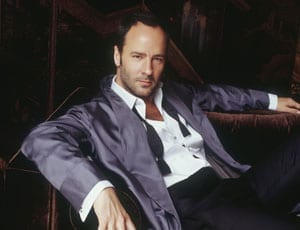
Number 26 Gilston Road in London’s SW10 is a property that has been on and off the market repeatedly in recent years. On each and every occasion it has been promoted as the “former home of the fashion icon Tom Ford” and though he hasn’t lived there in years, it is still just as he left it.
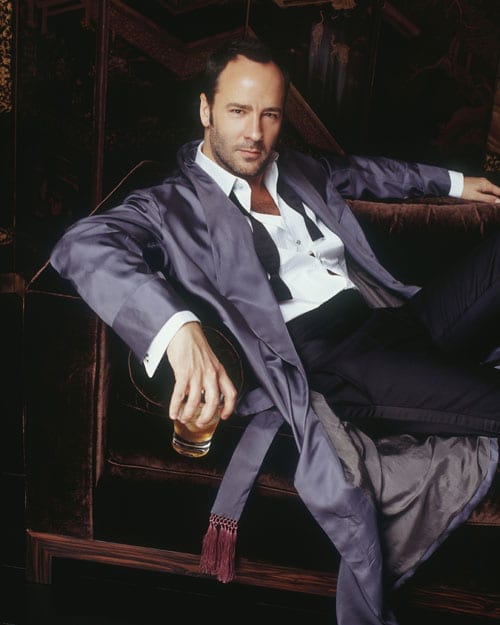
Designer and film producer Tom Ford 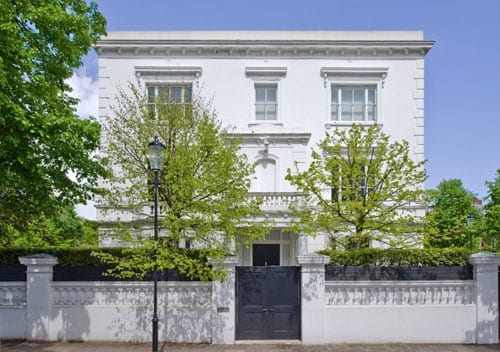
“The former home of design icon Tom Ford”: 26 Gilston Road, London, SW10 9SS Situated at the end of a terrace on the corner of Priory Walk, one can see why the house appealed to the Texan born designer credited with turning around the fortunes of Gucci and Yves Saint Laurent. Hidden behind a high wall and hedging, 26 Gilston Road is private yet minutes from the restaurants of Old Brompton and Fulham Roads.
This 4-storey townhouse was sold in June 1997 for £2,250,000 and again marketed in 2009 for £8,500,000 through Aylesford. In the time since, it has been available to let at prices ranging from £5,500 to £7,500 per week, but is now back for sale at the extraordinary figure of £12,750,00 through Russell Simpson.
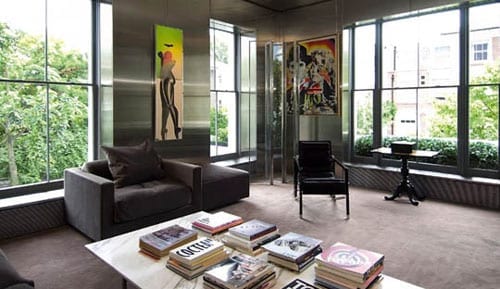
One of the reception rooms, just as Tom Ford left it 
Another of the Tom Ford styled rooms 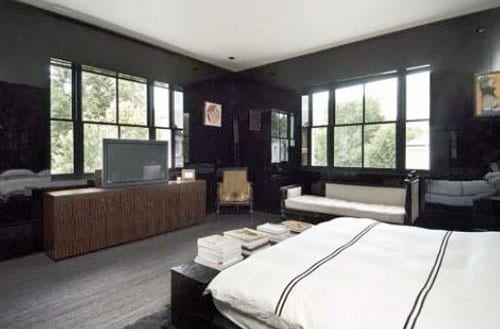
A Tom Ford designed bedroom 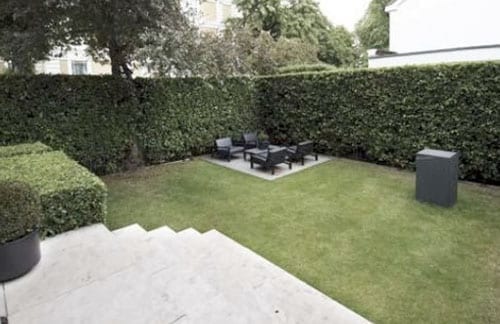
The garden of the property is extremely private What explains such a rise during a period of economic downturn? Well, it’s because developers Equilibrium have gained permission to “de-Ford” the house. As is now the trend in London, they have planned a total redesign. Their illustrations incorporate a new sub-basement and as a result the gross internal area will increase from just over 3,700 square feet to just under 5,300 square feet.
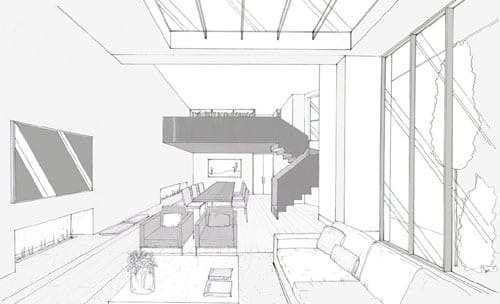
Equilibrium’s plans include a vast living-dining-kitchen with a study in the void over. The space is lit by a skylight. 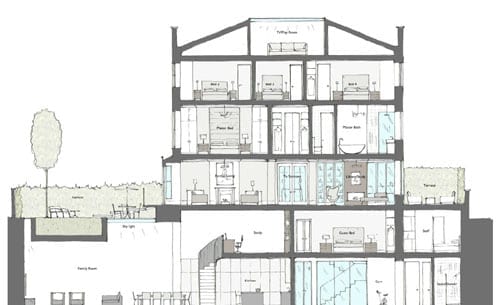
A cutaway shows the extent of the redevelopment planned 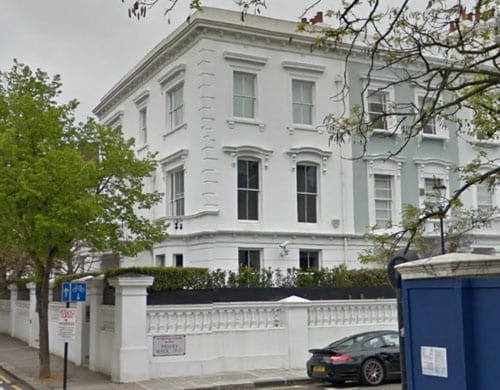
A view of 26 Gilston Road from the corner of Priory Walk Whilst the layout Tom Ford, himself a graduate in architecture from Parsons The New School of Design, created at 26 Gilston Road was ideal for A Single Man; the new floor plan with 4 bedrooms is much better suited to a family. Ford and his partner, Richard Buckley, announced the birth of their son, Alexander, in September. Perhaps they should put in a bid.
For more information about 26 Gilston Road, London, SW10 9SS, contact Russell Simpson, 5 Anderson Street, London, SW3 3LU. Telephone: +44 (0) 20 7225 0277. View a brochure for the property at: http://www.russellsimpson.co.uk/assets/12/06/15/5081/pdf_archive-1.pdf
View Equilibrium’s website at: http://www.equilibriumlondon.com
View Tom Ford’s website at: http://www.tomford.com