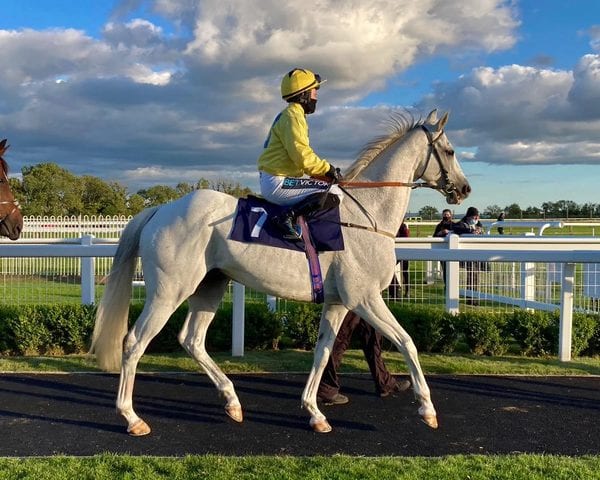
“Roy’s the boy” raged commentator Simon Holt as this legendary French born co-holder of the most number of wins at Brighton romped home after achieving nine 1st places along with two 2nd and six 3rd places at the course also.
With 1,300 followers on Twitter, grey gelding Roy Rocket was universally loved and to support him an octogenarian named Iris would “as he went to post… produce from one of her many voluminous handbags a flask of gin and tonic and insist that trainer John Berry took a swig for luck. It sometimes worked.”
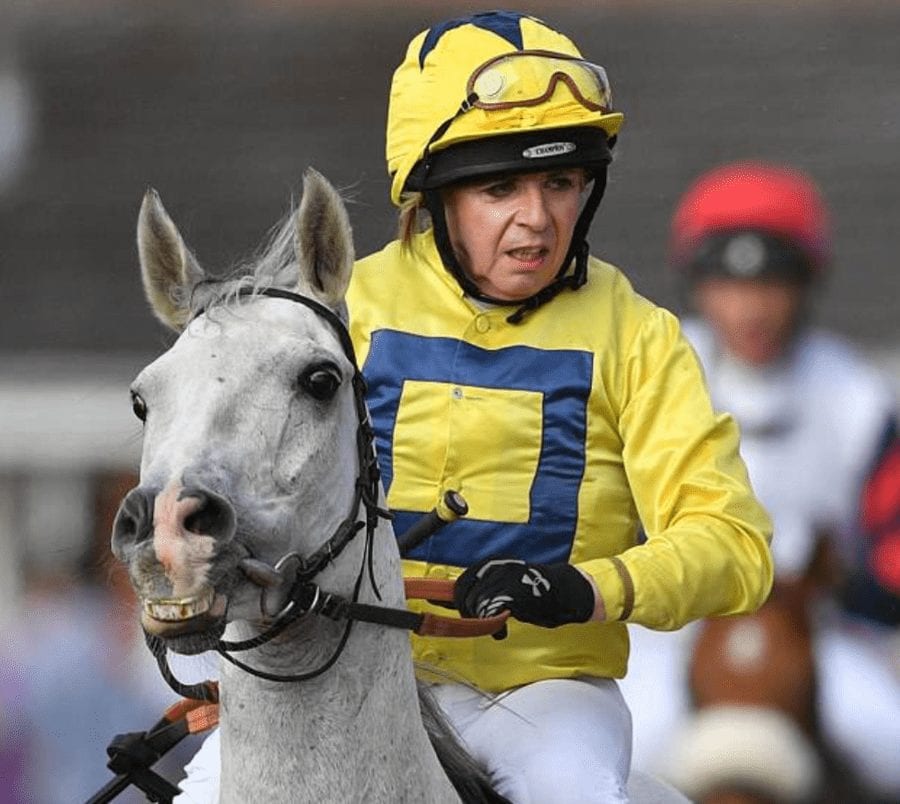
In May 2018, racing history was made when transgender jockey Victoria Smith – formerly known as Vince – rode Roy Rocket in a one-mile charity race as a woman at Warwick and became the first person to have competed in both male and female categories.
Of Roy Rocket, in July 2018, John Berry told the Racing Post: “He’s the most incredible horse… If I took him to a place he wasn’t used to going, we probably wouldn’t get there… He’d hate going somewhere different to where he normally goes and he hates not having a whole horse box to himself… He knows the yard so well, you could open up the French windows and bring him in the house… You can give him so much freedom without him being a danger… He loves carrots, his whole life’s a treat. The way the whole yard is run is pretty much around suiting him.”
A winner of the ROA Award for Flat Special Achievements also, Roy Rocket is eulogised by John Berry Racing as having “[given] some of the best days of racing of our lives.” This great favourite of punters everywhere will be forever missed.
‘The Steeple Times’ offers readers an extra special discount on the extra dry, extra sophisticated Gilpin’s Gin during Lockdown 2.0
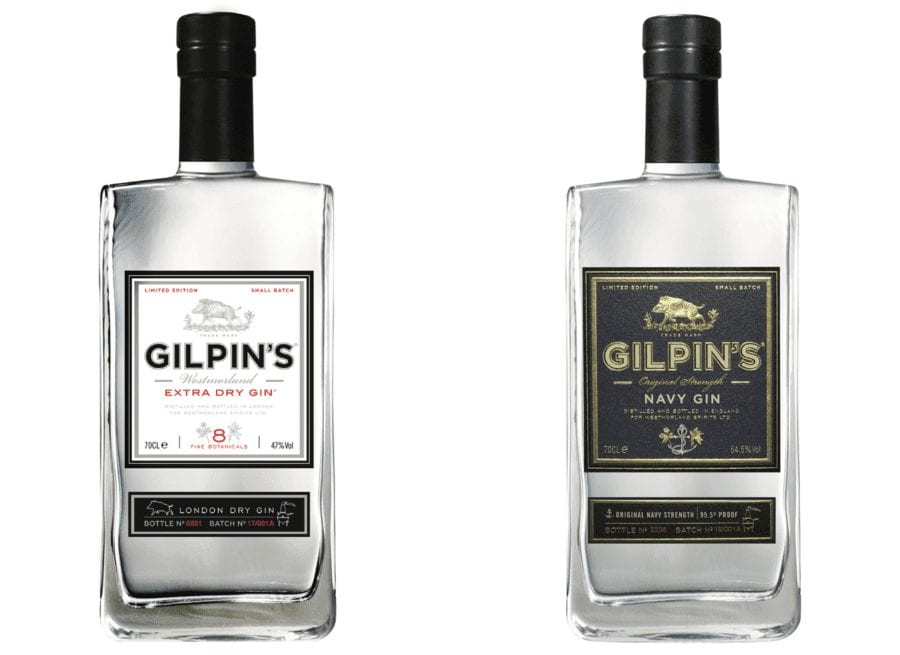
Gilpin’s Gin is a five-times distilled, premium London Dry Gin handcrafted in small batches with just eight botanicals: juniper, bitter orange, sage, borage, lime peel, lemon peel, coriander and angelica root.
Available at 47% and an even more punchy 54.5% ABV, this extra dry gin created by Matthew Gilpin is perfect for cocktails and makes an especially fine dry martini.
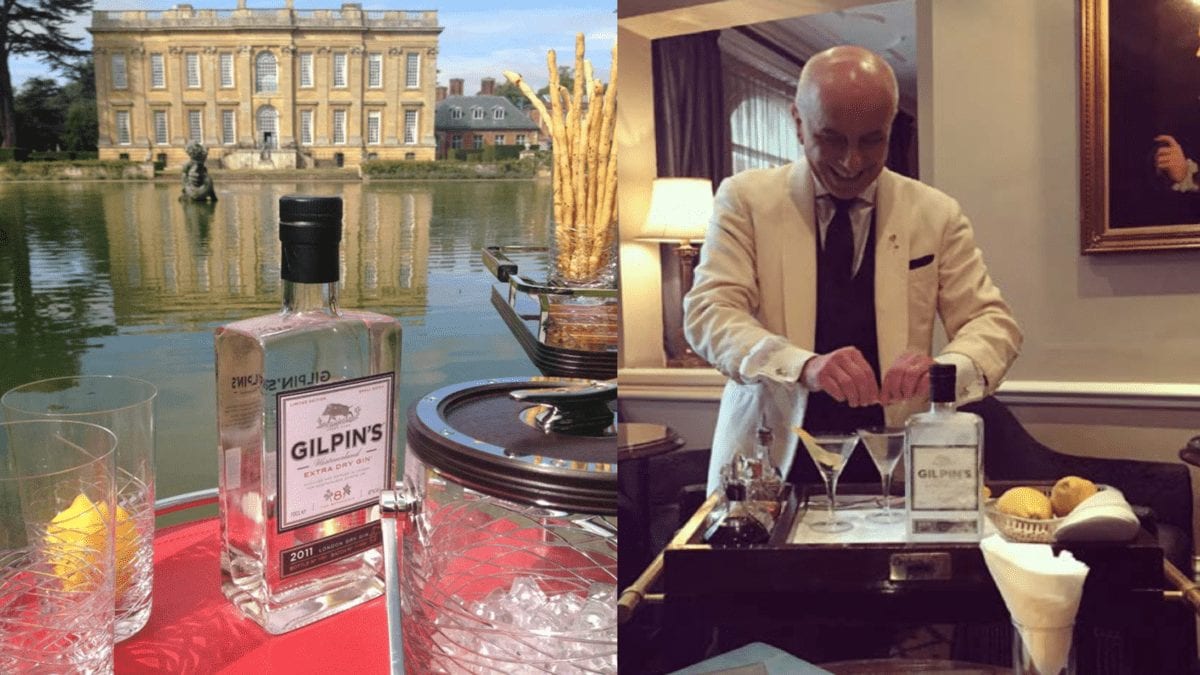
Pictured top: Gilpin’s Gin is to be found in the finest homes (pictured here at Easton Neston, now the country residence of Leon Max) and the ritziest establishments (pictured here being elegantly served by Alessandro Palazzi at Dukes Hotel).
Matthew Steeples visits Aldeburgh in Suffolk to learn the story of a business finding success in lockdown – he discovers Fishers Gin
Aldeburgh in Suffolk is famous for fish and chips. Two of its chippies are supposedly “amongst the best in the UK,” but now this seaside town is producing something just as quintessentially British – gin.
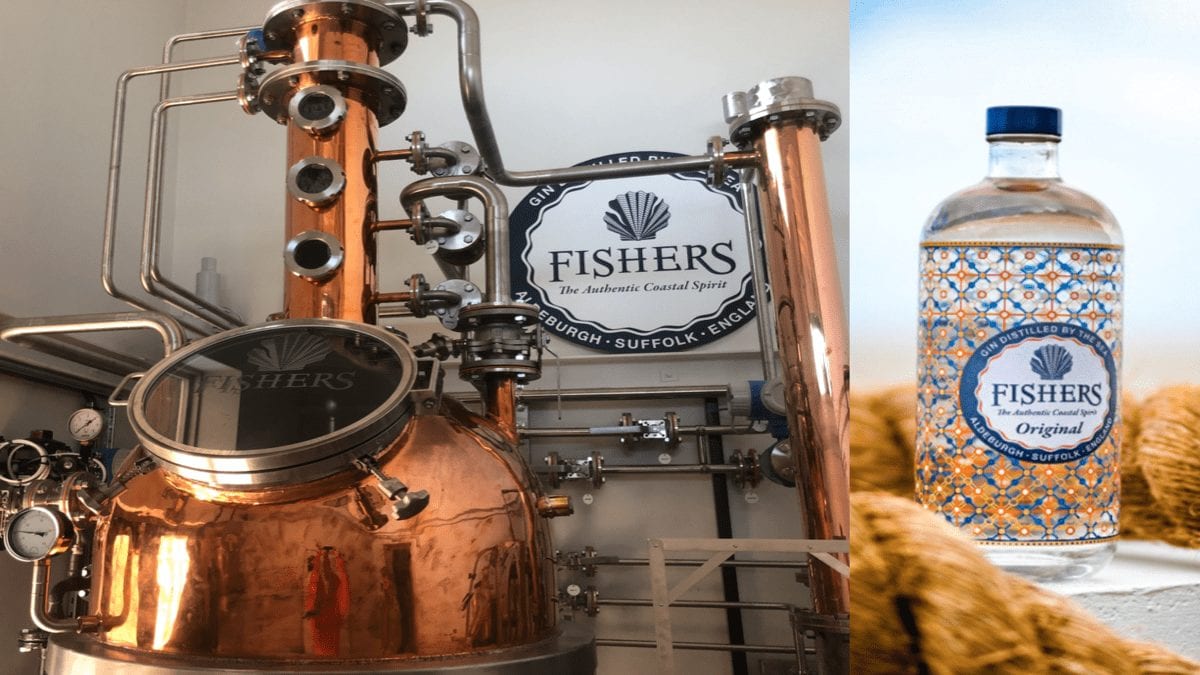
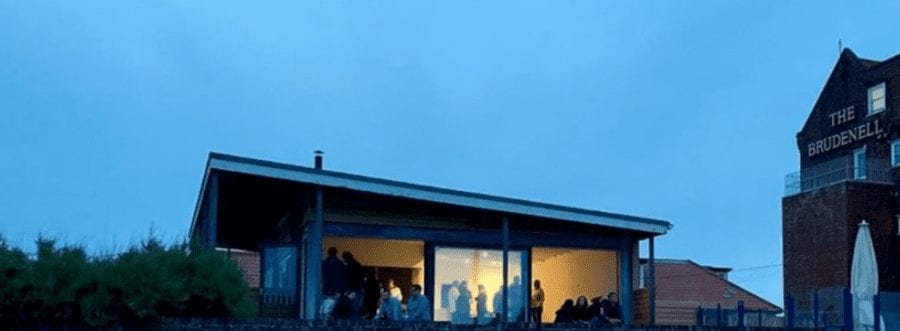
In a building, modestly described by Andrew Heald, the founder of Fishers Gin, as a ‘beach house’ – in the way that the Pritzkers and Vanderbilts referred to their colossal ‘summer mansions’ in the Hamptons as plain old ‘cottages’ – right on the seafront, is now a distillery and boy is it a smart one.
Unlike most distilleries I’ve visited and unsurprisingly to those that know me, I’ve been to many – normally quite unappealing places stuck in the middle of grim industrial estates in places like Warrington, a town sadly known for having Kerry Katona as its “finest export” – the Fisher’s Gin team work in an office that reminded me of the hideout of Pierce Brosnan as fictional Prime Minister Adam Lang in Martha’s Vineyard, Massachusetts in the 2010 film The Ghost Writer.
Though Fishers Gin was originally presented in colourful packaging that featured an anchor, the design now incorporates “a scallop shell in celebration of Maggi Hambling’s sculpture” – a famed 13-foot high landmark in the town. Named to reflect the history of the fishing village where it is produced, the bottle’s bright colours are said to reflect fishing nets whilst the gin itself has a taste dominated by coastal botanicals.
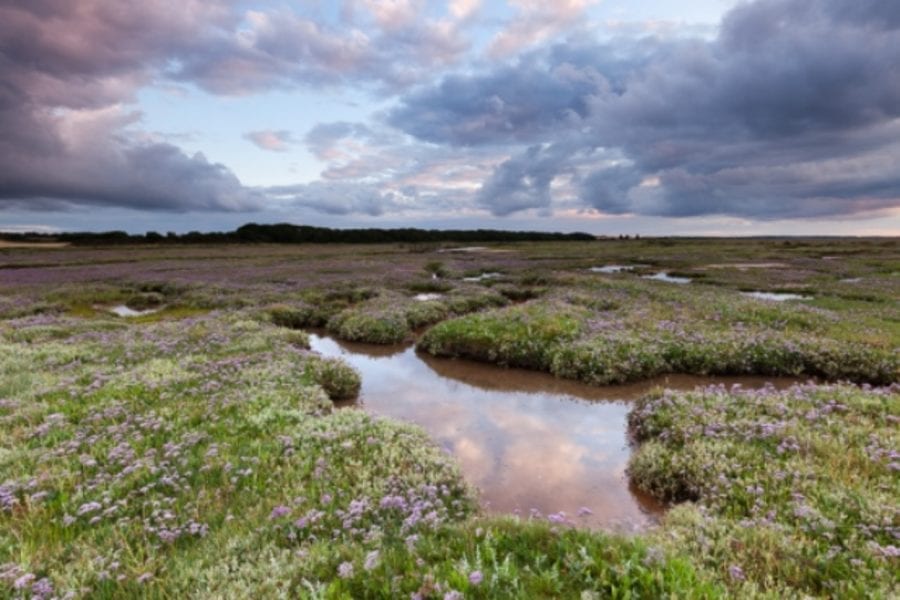
Stronger than your typical 40% ABV gin at 44%, here is a gin with notes of samphire and bog myrtle and one where hints of salt shine through. A slightly unusual taste follows, but it is refreshingly uplifting and with a team behind it who’ve moved over to selling directly on their own website, here is a business that has adapted to doing things differently due to the COVID-19 lockdown.
Fishers Gin is a gin of maritime origins and it’s a gin to be celebrated like one’s first catch; once you’ve tried it, you’ll be hooked.
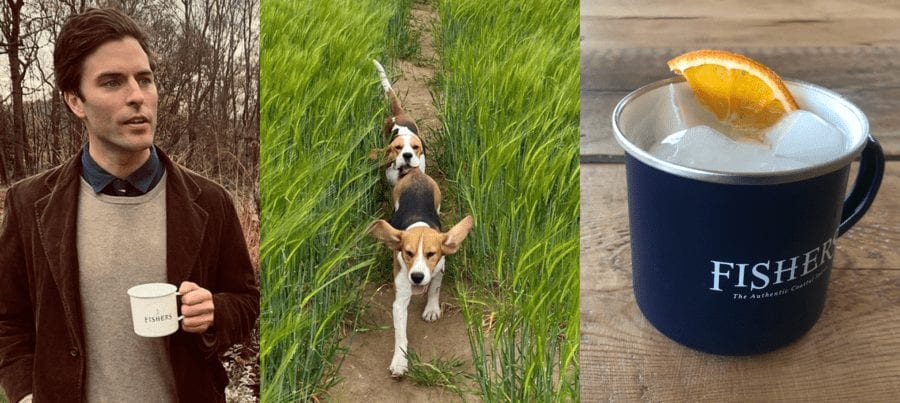
To purchase a bottle of Fishers Gin for £39.95 direct from its producers, click here. A Fishers Gin Navy coloured enamel mug can also be bought for £7.95.
The Founder and his Brace of Beagles – Andrew Heald, his hounds (one of which gave its name to the Fishers Gin still, ‘Watson’) and a Fishers Gin Navy enamel mug.The Botanicals of the Sea – The distinct taste of Fishers Gin comes from the locally sourced plants of the Suffolk coast that it is made with. These include spignel, wood avens, rock samphire flower and bog myrtle. These are sustainably foraged.
The Fishers Gin Distillery – Situated next to The Brudenell Hotel, a building used as a home for children evacuated from Belgium during the Second World War, this beachside building is due to open to visitors once lockdown is over. The view out to sea takes in a series of wind turbines – a topic of conversation best not raised with disapproving locals.‘The Ghost Writer’ – The actual filming location used in the 2010 Franco-German-British political thriller was not in Massachusetts, but in Germany. This was due to Roman Polanski being unable to enter Britain or America due to his evasion of justice since 1978. Pictured are the film’s stars Pierce Brosnan, Ewan McGregor and Kim Cattrall in a setting reminiscent to that where Fishers Gin is produced.‘Rebel With A Cause’ – Controversial British artist Maggi Hambling CBE (top) and her scallop sculpture at Aldeburgh (below). It was conceived as a celebration of Aldeburgh’s most famous resident, composer Benjamin Britten, and though opposed and covered in graffiti even by some in the locality, Andrew Heald chose to feature it on the label of his gin.
With neighbours putting gin and tonics on each other’s doorsteps during the COVID-19 lockdown, we select the most amusing quotes about this fine spirit
In a letter, published in The Telegraph on Tuesday, one Madeline Glancy remarked:
SIR – Every Friday in lockdown, my neighbour has left a delicious gin and tonic at my front door. Beats tinned tomatoes hands down.
Madeline Glancy
Prestwich, Lancashire
If only if all neighbours were so community minded.
Some of the best quotes about gin follow for your amusement:
Not so strangely, most of them are without citation – probably due to the fact that they were likely made when their originators were suitably imbibed in juniper flavoured heaven.
“Let the evening beGIN!” – Anon.
“I don’t know what reception I’m at, but for God’s sake, give me a gin and tonic” –the well-known gin lover and husband of Margaret Thatcher, Denis Thatcher.
“Life is too short for single gins” – Anon.
“Red meat and gin” – America’s answer to Keith Floyd, Julia Child, on the reason for her longevity.
“I love water, especially when it’s frozen and surrounded by gin” – Anon.
“I exercise strong self-control. I never drink anything stronger than gin before breakfast” – American actor and comedian W. C. Fields.
“Gin-drinking is a great vice in England, but wretchedness and dirt are a greater [vice]” – Charles Dickens, Sketches (1836).
“When life gives you juniper, make gin!” – Holistic health author Laurie Buchanan.
“Don’t cry over spilt milk, it could’ve been gin” – Anon.
Night school tutor: “Write a horror story in six words.”
Student: “I-have-run-out-of-gin” – Anon.
“A perfect martini should be made by filling a glass with gin then waving it in the general direction of Italy” – Noël Coward.
“The proper union of gin and vermouth is a great and sudden glory; it is one of the happiest marriages on earth, and one of the shortest lived” – American historian Bernard DeVoto.
“The gin and tonic has saved more Englishmen’s lives, and minds, than all the doctors in the Empire” – Winston Churchill.
“Of all the gin joints, in all the towns in all the world, she walks into mine” – Humphrey Bogart as Rick in Casablanca (1942).
“Gym? I thought you said: ‘Gin’” – Anon.
“The only time I ever enjoyed ironing was the day I accidentally got gin in the steam iron” – Comedian Phyllis Diller.
“Stop saying I’m hard to buy for… You know where the gin aisle is” – Anon.
“You’d learn more about the world by lying on the couch and drinking gin out of a bottle than by watching the news” – American radio personality Garrison Keillor.
“Fortunately there is gin, the sole glimmer in this darkness. Do you feel the golden, copper-coloured light it kindles in you? I like walking through the city of an evening in the warmth of gin” – French philosopher and journalist Albert Camus.
“I tried to say no to gin… But it’s 40% stronger than me” – Anon.
“I’ll stick with gin. Champagne is just ginger ale that knows somebody” – Dr. Hawkeye Pierce from M*A*S*H.
“Things, since you left, have not gone well with me: they have taken me from a place where there was gin to a place where there is no gin” – British barrister and detective story author Sarah Cockburn (pseudonym Sarah Caudwell).
“According to chemists, gin IS a solution” – Anon.
“Gin and drugs, dear lady, gin and drugs” – The reply of T. S. Eliot when asked about inspiration.
Irrational ‘Disgusted of Tunbridge Wells’ type correspondence is on the increase in national newspapers during the coronavirus lockdown; ‘Horrified of Haddenham’ cash-coronavirus conspiracist Garry May is a fine case in point
The coronavirus lockdown has no doubt resulted in a dramatic increase in the number of ‘Disgusted of Tunbridge Wells’ (and even paradoxically ‘Delighted of Tunbridge Wells’) types corresponding with both national and local newspapers. There are, after all, now many more people moping around at home with little else to do other than to ponder with a pen (or clatter on a keyboard).
Whilst in November 2019, The Telegraph stated that its letters editor received and read 600 missives per day from readers (and subsequently published 18 of them in their next edition) and in June that year, the Guardian referenced a by comparison meagre sum of 82 per day (citing 30,000 communications annually), one can only assume that both publications have seen huge spikes in their mailbags in the last few weeks – the content of which of course now mostly arrives by email rather than with the help of the Royal Mail.
Editors such as Christopher Howse – who has worked on The Telegraph’s letters pages for over twenty years – however, is plainly still favouring letters from his reliable riled-up regulars and yesterday was no exception. In publishing a totally irrational observation from one Garry May of Haddenham, Buckinghamshire linking cash to coronavirus (a totally nonsensical view very clearly empirically denied by the World Health Organisation in March), the paper fulfilled its ability to share views to spread yet more Eamonn Holmes-esque claptrap. This kind of 5G type twaddle will no doubt appeal to its stereotypical conspiracy theory believing old buffer audience, but it is without factual base.
SIR – I hope this pandemic cements the use of debit cards for all transactions, and thereby the end of cash.
Bank notes and coins spread diseases. Ruling out ready money could also put an end to most drug deals on our streets.
Garry May
Haddenham, Buckinghamshire
On a date exact unknown circa 2011, in a letter to The Telegraph, that was subsequently republished in the compilation book The Lunatics Have Taken Over The Asylum: Political Letters to The Daily Telegraph, Mr May previously shared his views on phone hacking. He presented yet another pastiche of days gone by and read:
SIR – The hacking scandal left my family debating who we can still rely on. Our shortlist of trustworthies came down to the Gurkhas, other ranks in our Armed Forces, postmen and Simon the pieman, who works in the butcher’s shop.
Garry May
Haddenham, Buckinghamshire
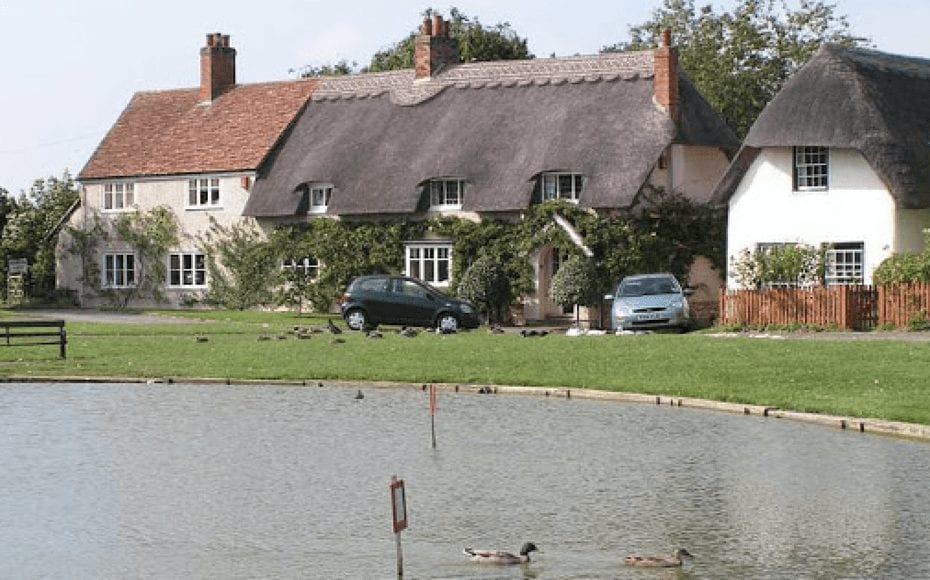
Mr May’s archaic idealism might resonate as charming and worthy, but what should be noted is that this prolific man of letters belonging in the 1950s lives in Haddenham, a quintessential English village that most definitely has Midsomer Murders-esque qualities (it was used as a location in eight episodes of the television drama even). One of only three ‘wychert’ settlements in the country and a place peppered with thatched cottages and a duck pond famed for breeding Aylesbury ducks, one can imagine the era of “old maids bicycling to holy communion through the morning mist” John Major-style still reigns in this parish.
Indeed, at this time, as countless rural residents turn to growing their own vegetables and even start going to their local ‘community shop’ in order to avoid queuing for hours whilst safe distancing at Tesco, many will join in eulogising a love of postmen and piemen and – quite rightly – a loathing for evil drug dealers also.
Sadly, however, getting rid of cash will not wipe out that particularly vile scourge on society and it will not stop the spread of coronavirus. Instead, maybe it’s time for ‘Horrified of Haddenham’ to find another topic to get het up about: Perhaps, indeed, Mr May could turn his pen to the squealing sickness of snitching ‘quarantine shaming’ or maybe he could just calm down and pour himself a large G&T.
An early example of ‘Disgusted of Tunbridge Wells’ correspondence:
SIR – Being present at the unveiling of the plaque on Thursday last week on the Pantiles, I was surprised when the National Anthem was played to see that in a place like Tunbridge Wells, which is noted for its loyalty and calls itself ‘Royal,’ there should be people who refused to remove their hats. Are such people Communists? If they are, Tunbridge Wells should be no place for such as they. We can do without them.
Letters to the Editor, ‘Tunbridge Wells Advertiser’ – 14th June 1929.
Pictured top: Haddenham, Buckinghamshire – a quintessentially quaint English village with a duck pond and thatched cottages from whence nosy parkers peer from behind net curtains.
Matthew Steeples takes tea in the delightful courtyard garden at Blakes Hotel in South Kensington, London
Blakes Hotel is synonymous with the now much overused description “boutique hotel” and is generally considered the world’s first. It opened in 1978, is a destination that is popular with the likes of Seal and Sharon Stone and was also the place The Steeple Times chose to launch exactly five years ago in June 2012.
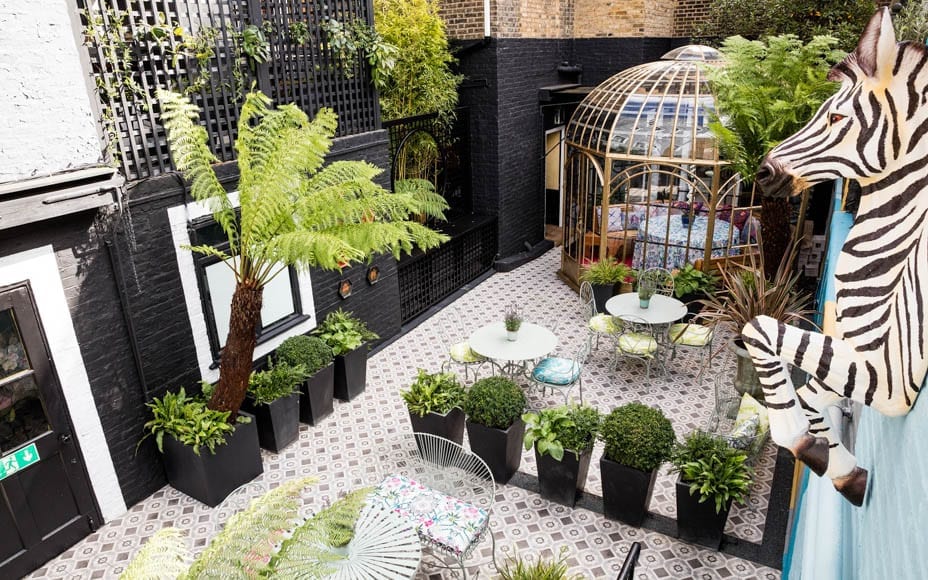
Aside from moving the restaurant of this enchanting South Kensington palace of opulence to the building’s ground floor last year, the hotel’s rear courtyard was transformed by designer Matthew Williamson in mid-2016. Featuring bright colours and such things as a prancing zebra, I recently enjoyed tea there in the summer heat with my friend Ekaterina Fields. I was charmed by not only the most attentive of staff but also the finest small-batch teas by a firm named Lalani & Co.
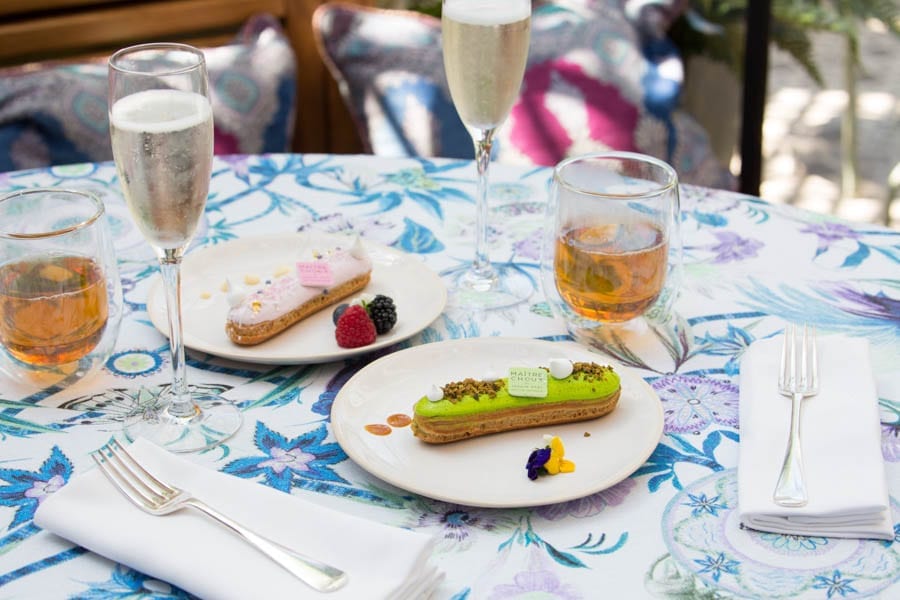
Available for £12.75 and each paired with éclairs by Maître Choux, Blakes have curated four teas that will take you on a journey through Kyoto, Megalaya and Nepal. They range from the fruity to the chocolaty in taste and accompanied by a glass of prosecco or gin and tonic, one is left asking: “What could be better on a balmy June afternoon?”
Blakes Hotel, 33 Roland Gardens, London SW7 3PF. Telephone: +44 (0) 20 7370 6701.