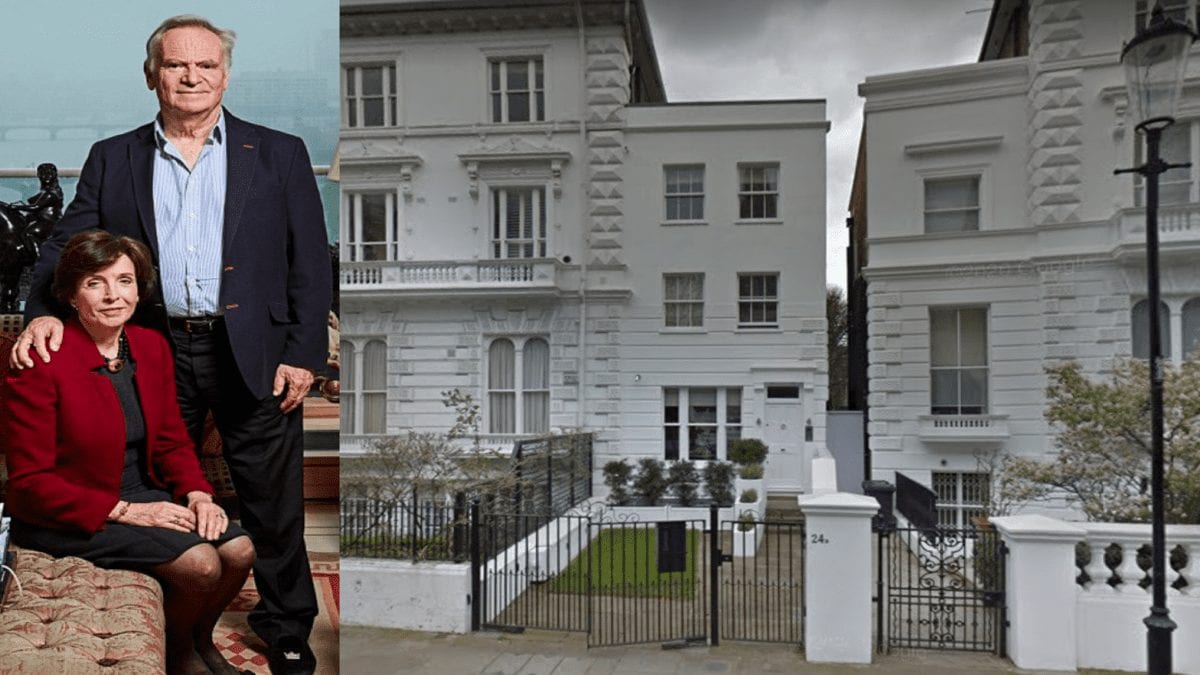
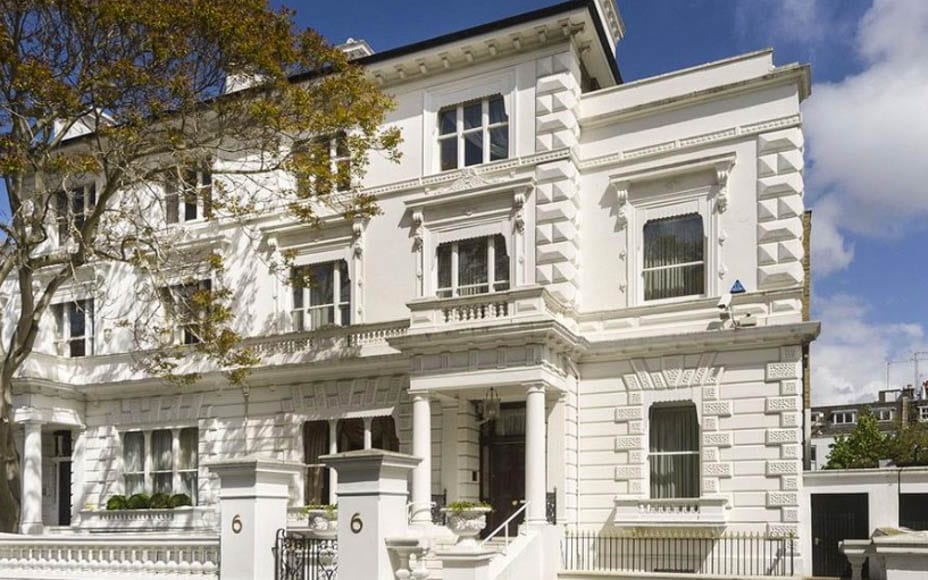
Cheapest, smallest house on the best side of one of London’s most sought after streets, The Boltons, comes up for sale; the tardis like building was home to novelist-politician Jeffrey Archer and his scientist wife Mary in the 1970s
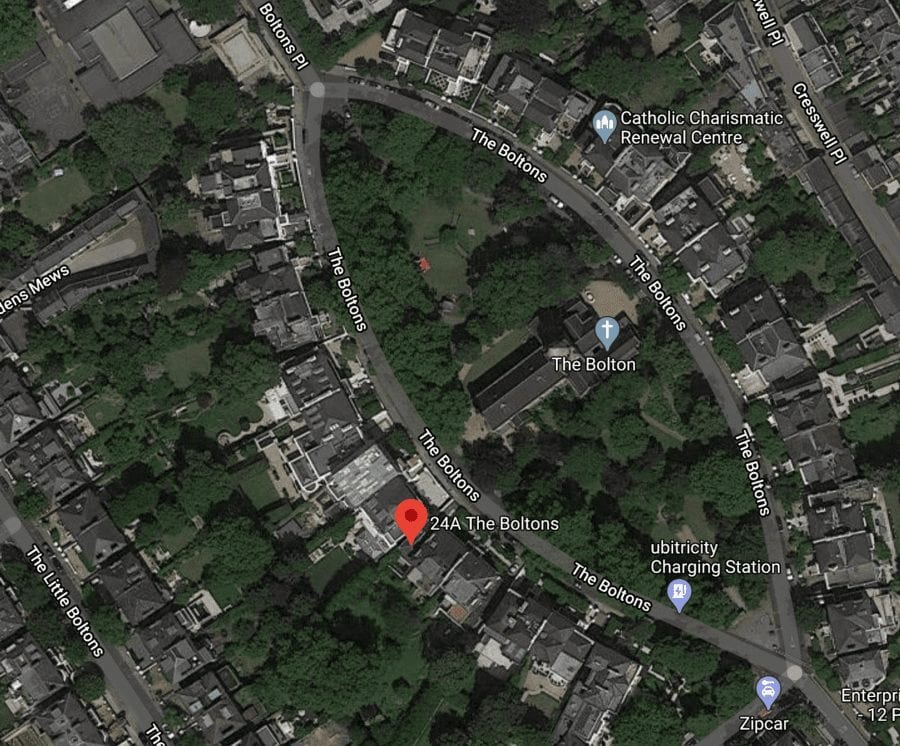
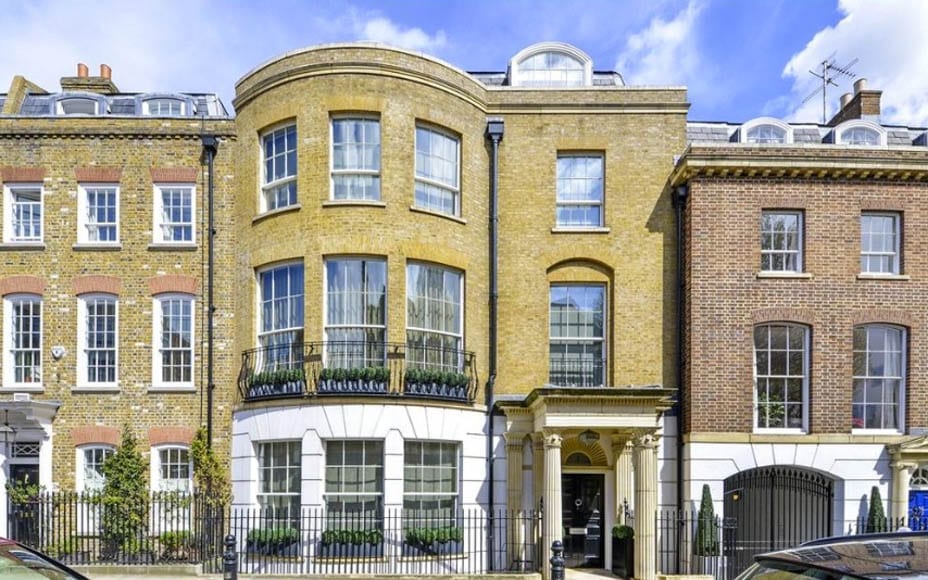
No. 24a The Boltons is one of the smallest houses on “the fourth most expensive street in Britain,” but it is still anything but insubstantial at 3,123 square feet.
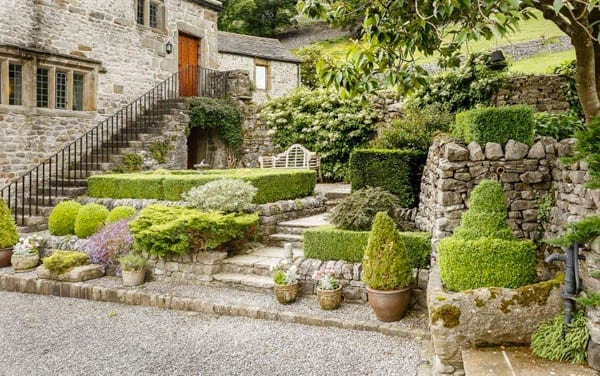
The tardis-like Victorian townhouse is wedged between two mansions and was converted from a coach house for Aston Martin racing team driver Noël Cunningham-Reid in 1960.
Novelist-politician Lord Archer and his scientist wife Dame Mary owned the property between 1972 and 1976.
The couple were forced to sell the house after Jeffrey Archer supposedly “lost over £400,000 in a bad investment” in the summer of 1974.
Jeffrey Archer subsequently made a fortune as a novelist and then after a glittering career in politics, was jailed in 2001 for perjury and perverting the course of justice.
The house was sold again subsequently for £3.8 million in 2007 and is now for sale for £6.5 million; the average price of houses on the street is £32.5 million according to Zoopla.
Other residents of The Boltons have variously included Arab royals, Madonna and Sir William Gilbert, one half of Gilbert and Sullivan.
In May 2017, we featured 6 The Boltons after its asking price was slashed from £39.5 million to ‘just’ £30 million, whilst in April 2015, a more modern house at the upper end of the street named One Boltons Place sold for £51 million on an asking price of £55 million. More recently in January 2018, when 22 The Boltons was sold to a British family for £40 million that sale was described as “one of the biggest deals in the last 12 months… a notable one.” Its asking price had been an even more punchy £57.5 million.
The Boltons was developed in the 19th century by the architect George Godwin (1813 – 1888) on 11.5 acres of land previously used as market gardens. The oval shaped street consists of 13 Italianate style houses on the “favoured” western crescent and 15 more in addition on the “less sought after” eastern side. In the centre, there is a communal garden and the church of St Mary The Boltons and whilst many residents employ private security, a number of the mansions are locked up, unloved and unoccupied also.
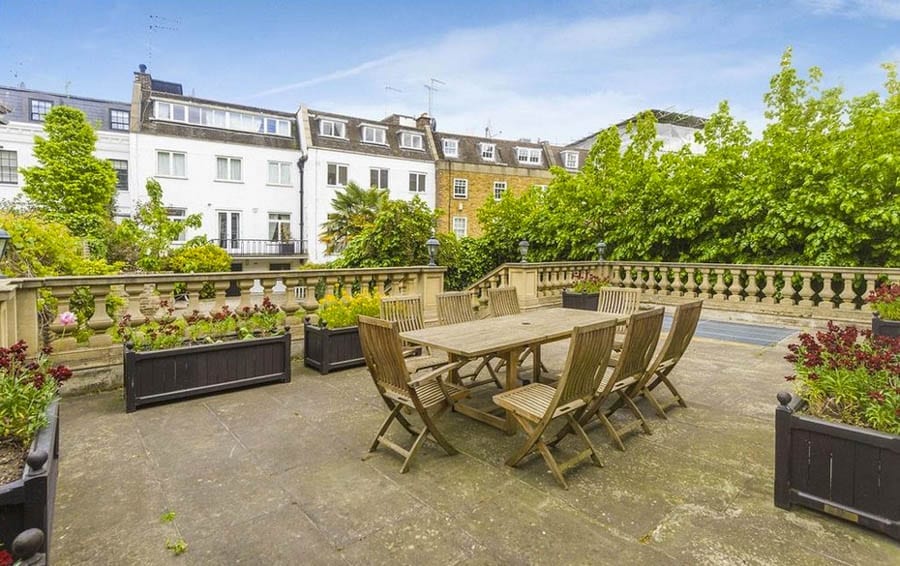
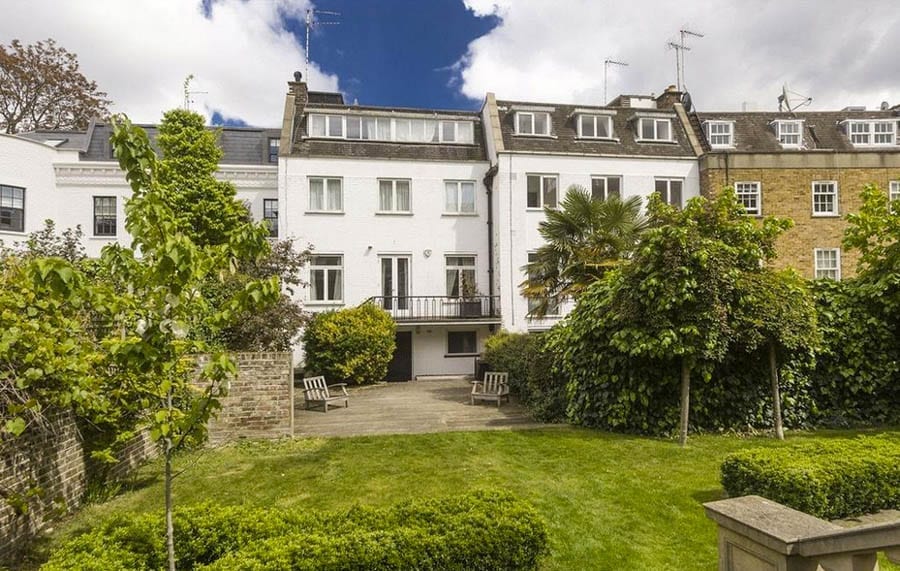
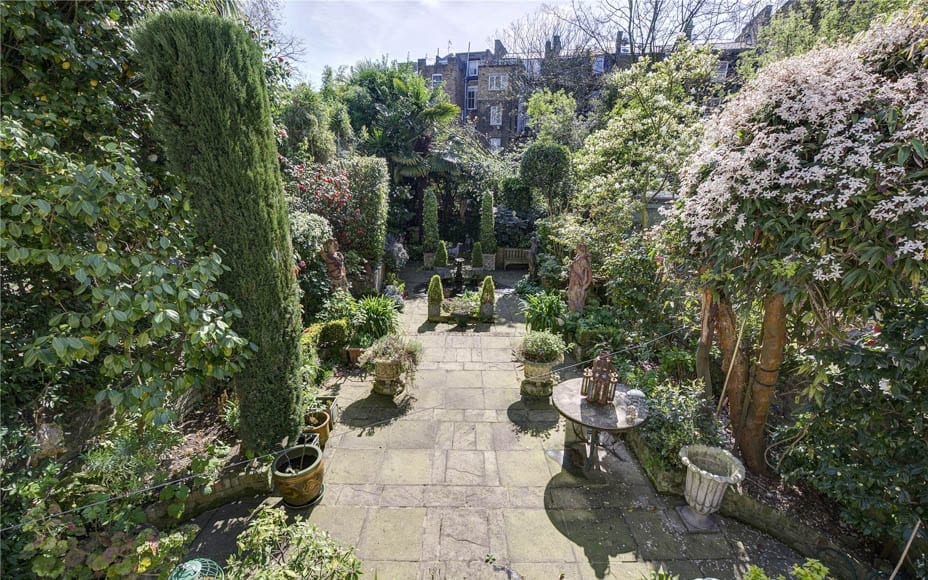
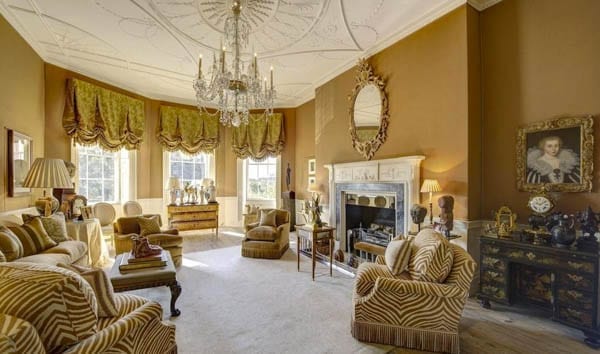
Now, an opportunity has arisen for someone to not “buy the worst house on the best street,” but instead “buy the cheapest house on the best side of the best street” in the form of what initially appears as a narrow townhouse wedged between two very much larger semi-detached villas. No. 24a The Boltons is actually deceptive as it not only widens as it goes backwards, but also provides a very surprising 3,123 square foot of usable accommodation over four floors.
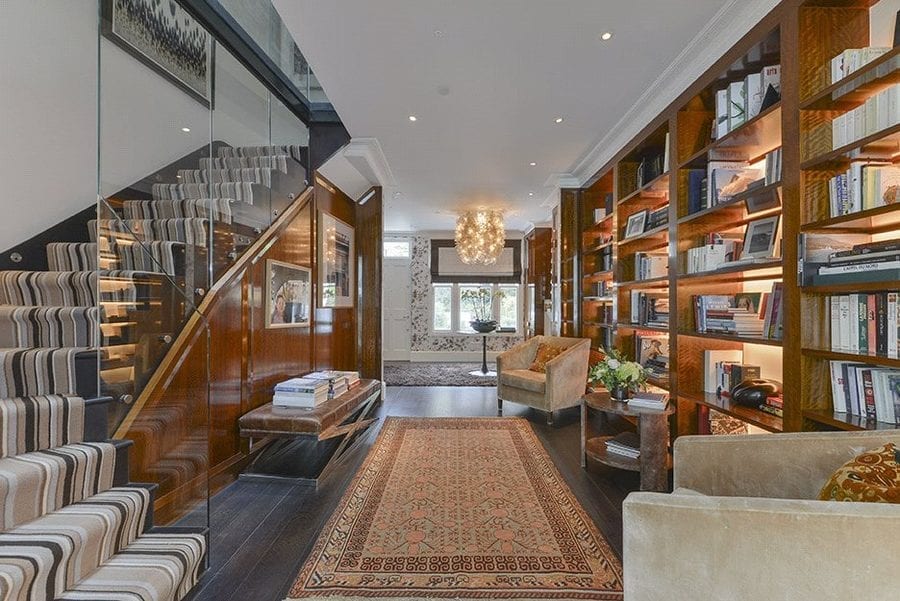
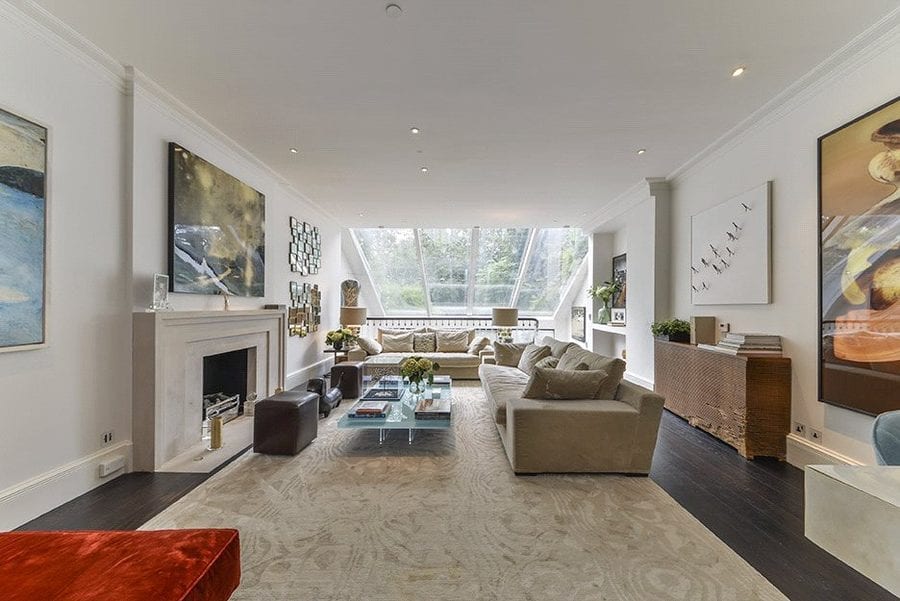
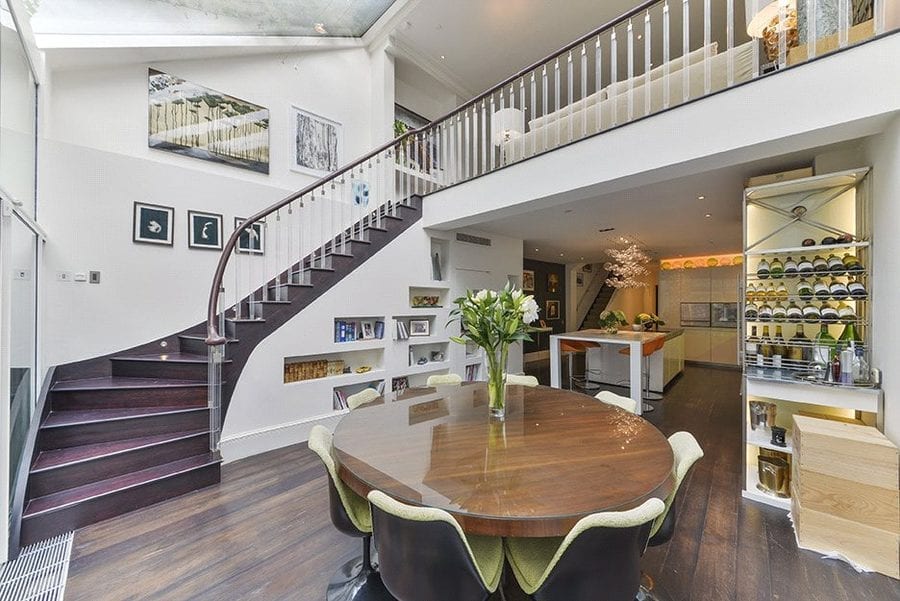
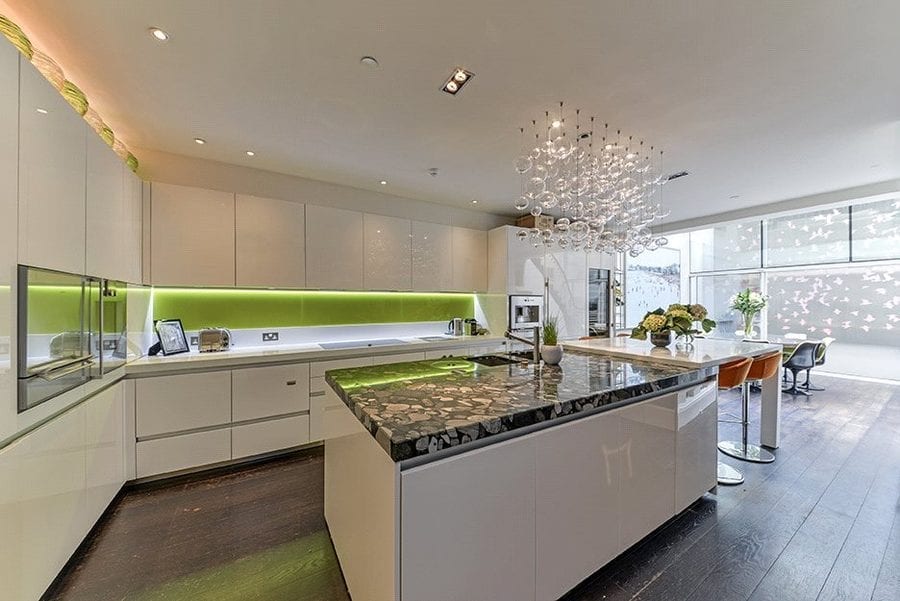
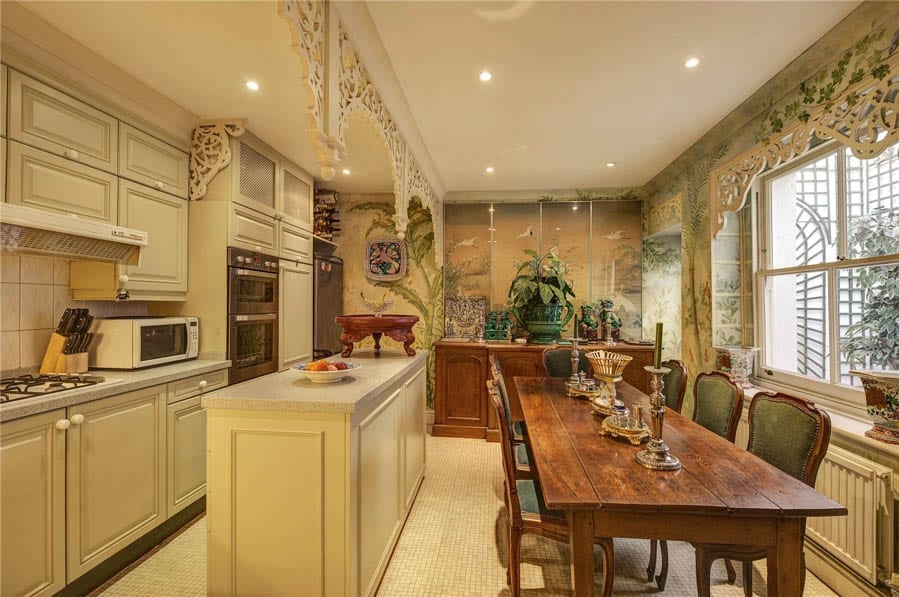
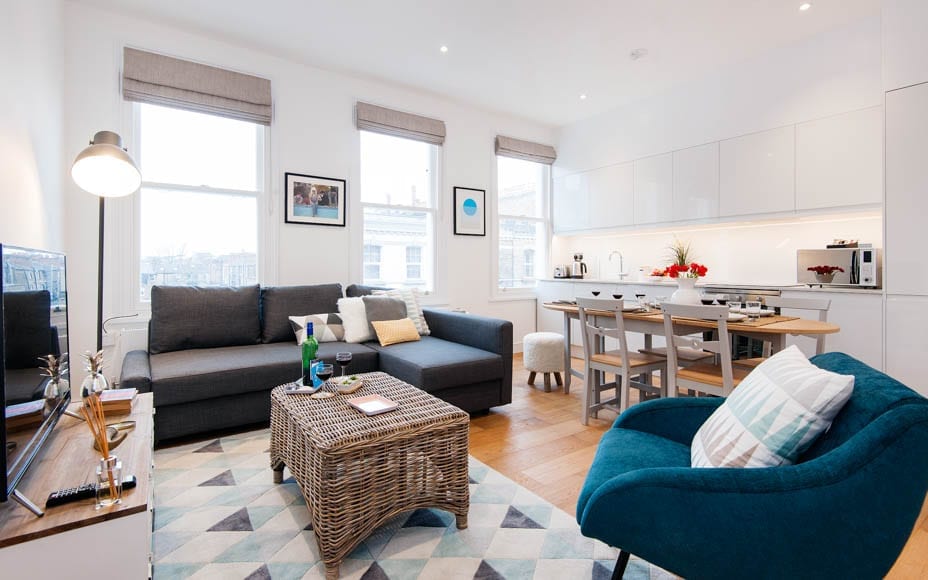
The entrance hall opens into a library area and a feeling of space is provided by a glass enclosure around the upward staircase.The drawing room space beyond has a vast window looking out westwards onto the gardens of the houses of The Little Boltons beyond.The lower ground floor dining kitchen is surprisingly bright and has a double height ceiling in part.
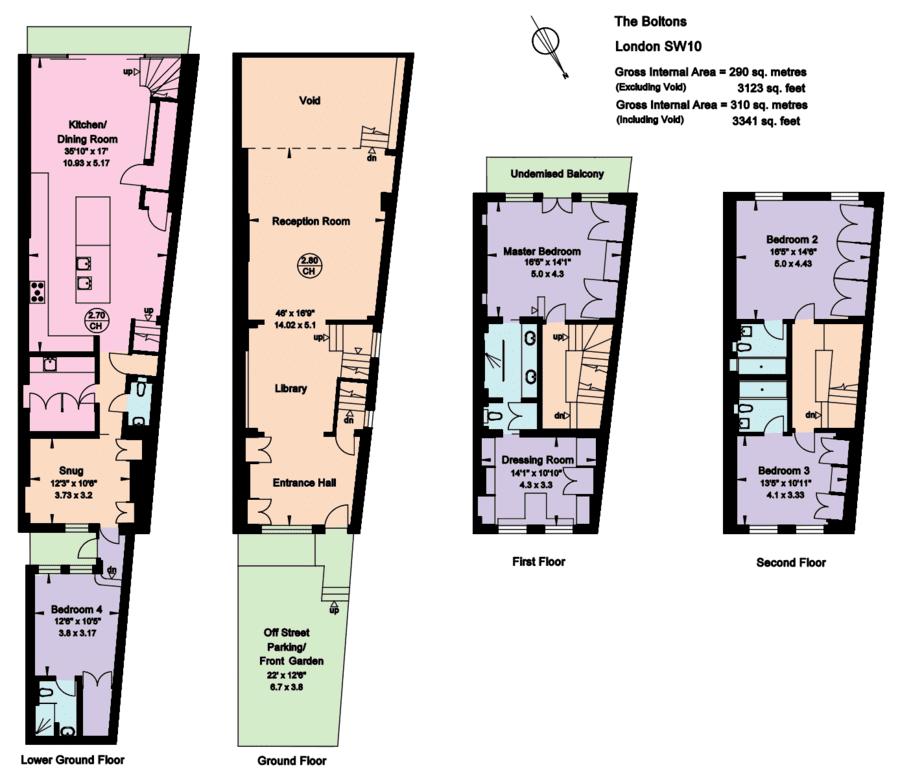
Laid out currently to give 3 reception rooms, 4 bedrooms and 4 bathrooms, the “highly unusual house with off-street parking” includes a 50-foot long interconnecting entrance hall, library and reception space on the ground floor. At the rear, that opens to a partially double height dining kitchen below measuring 36-feet in length.
No. 24a was home to Jeffrey and Mary Archer in the 1970s and the street features in the spectacularly successful novelist’s 2008 bestselling work A Prisoner of Birth and his 2015 ‘Clifton Chronicles’ series novel Mightier than the Sword. It was whilst living here that the couple’s two sons were born and they supposedly only sold what Dame Mary later described to a court in 2001 as their “lovely” home after “hugely incautious” investments almost bankrupted them. “We’ve explored the further reaches of ‘for better and for worse’ than most couples,” the solar power conversion expert subsequently added.
Agents Knight Frank seek £6.5 million or £2,081 per square foot for 24a The Boltons and whomever buys it will certainly be able to laud that they live in one of the best addresses in London without it being a work of fiction. In Hyacinth Bucket-esque fashion, however, they won’t, of course, bring up that they actually live in the cheapest and smallest house there.
The Names & Numbers – 24a The Boltons, London, SW10 9SU, Royal Borough of Kensington & Chelsea, United Kingdom
July 2020 – For sale for an asking price of £6.5 million ($8.2 million, €7.3 million or درهم30 million) through estate agents Knight Frank, a figure 71.1% higher than the 2007 sale price.
March 2007 – Sold for £3.8 million ($4.9 million, €4.2 million or درهم17.6 million).
1972 to 1976 – Home to Lord Archer and Dame Mary Archer DBE, then known as Mr Jeffrey and Dr Mary Archer. Their sons, James and William, were born during this period in 1972 and 1974.
Other Notable Residents of The Boltons
Between 1999 and 2006, Madonna owned a house in The Boltons and other well-known residents have included Sir Julian and Dame Paddy Ridsdale.
8 The Boltons – Douglas Fairbanks Jr. KBE (1909 – 2000), actor, lived there in the 1950s with his wife Mary Lee Hartford, former wife Huntington Hartford, the A&P supermarket heir.
14 The Boltons – Otho Stuart (1863 – 1930), Shakespearean actor-manager, lived there, exact dates unknown.
19 The Boltons – The Rt. Hon. Anthony Crosland (1918 – 1977), Labour Party politician, author and one-time lover of Roy Jenkins, lived there, exact dates unknown.
20 The Boltons (also known as ‘The Grove’) – Colin MacInnes (1914 – 1976), author, lived there, exact dates unknown. For a time in the 20th century, the building also served as Our Lady’s Convent along with 21 The Boltons.
24 The Boltons – Sir William Gilbert (1836 – 1911), playwright and one half of Gilbert and Sullivan, lived in the house between 1877 and 1884 and wrote six of his best known comic operas there beginning with The Sorcerer in 1877, HMS Pinafore in 1878, The Pirates of Penzance in 1879, Patience in 1881, Iolanthe in 1882 and Princess Ida in 1884. Gilbert moved from No. 24 The Boltons in 1884 to a newly built house nearby at No. 39 Harrington Gardens.
29 The Boltons – Used as an infant school for fifteen years after the Second World War.
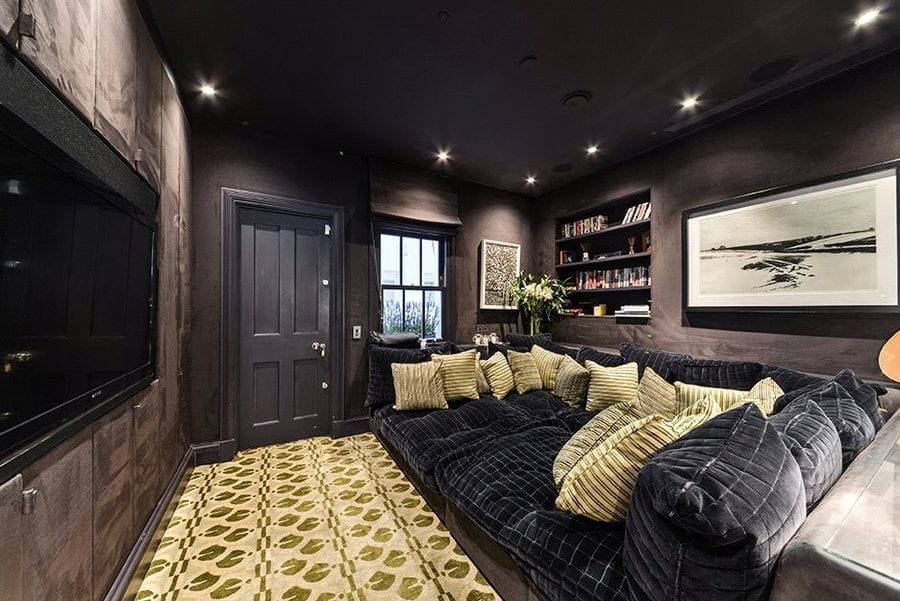
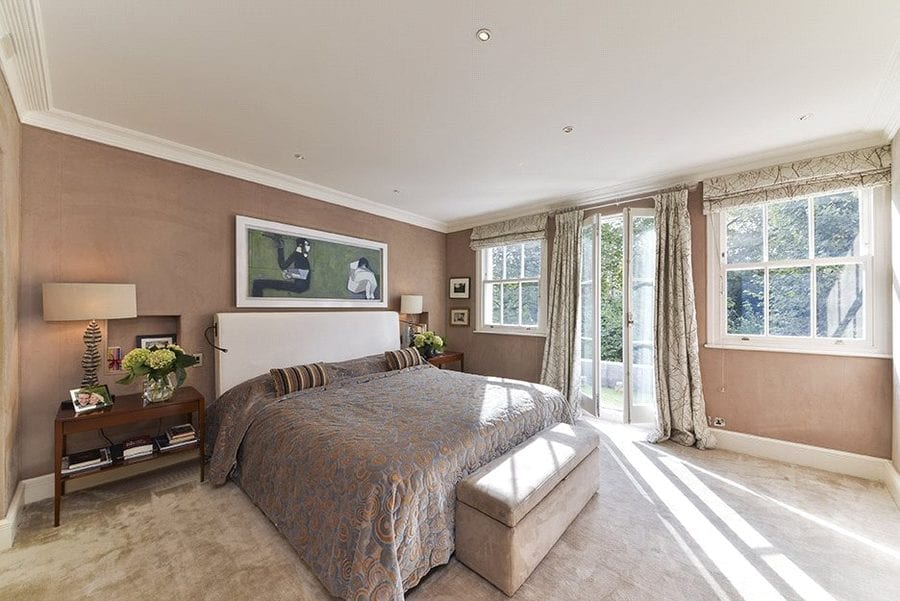
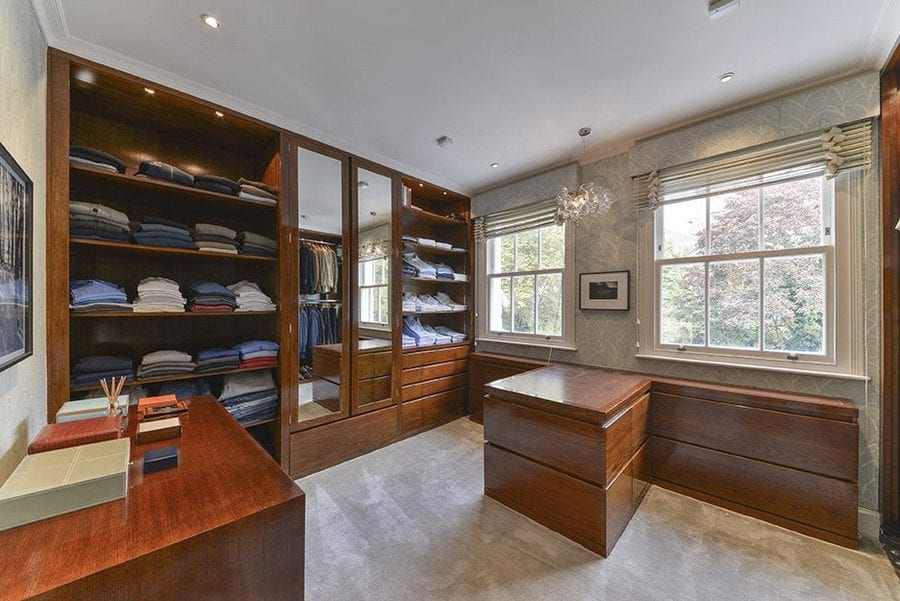
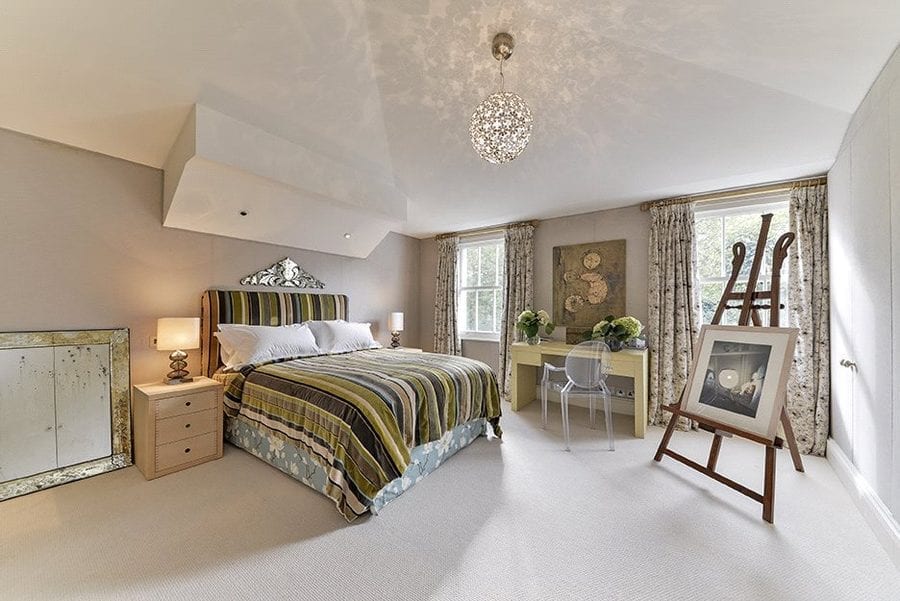
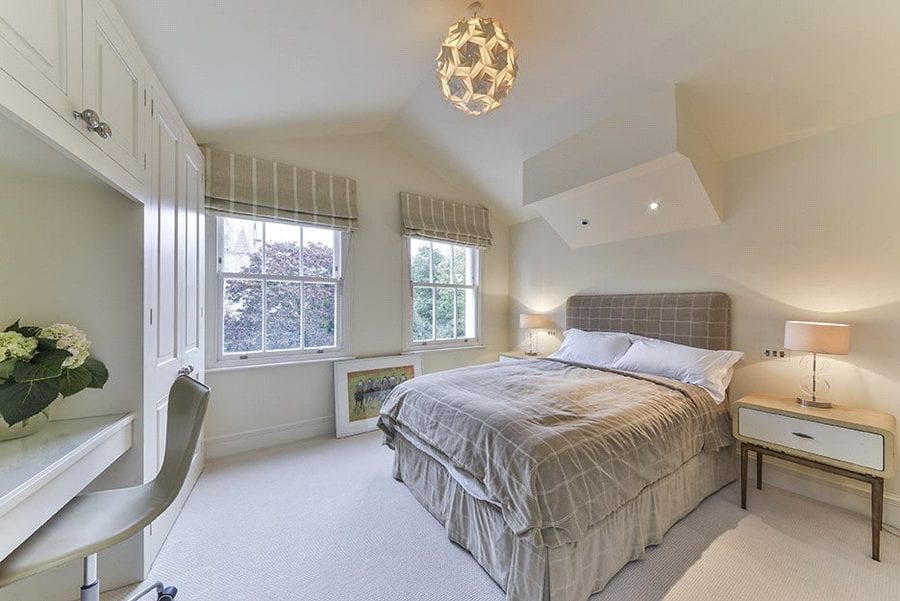
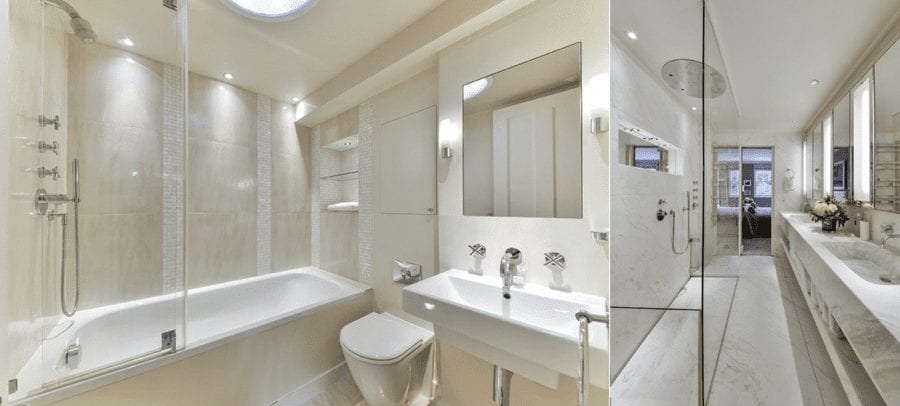
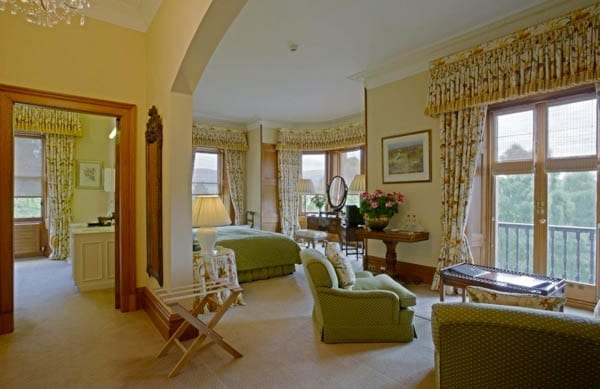
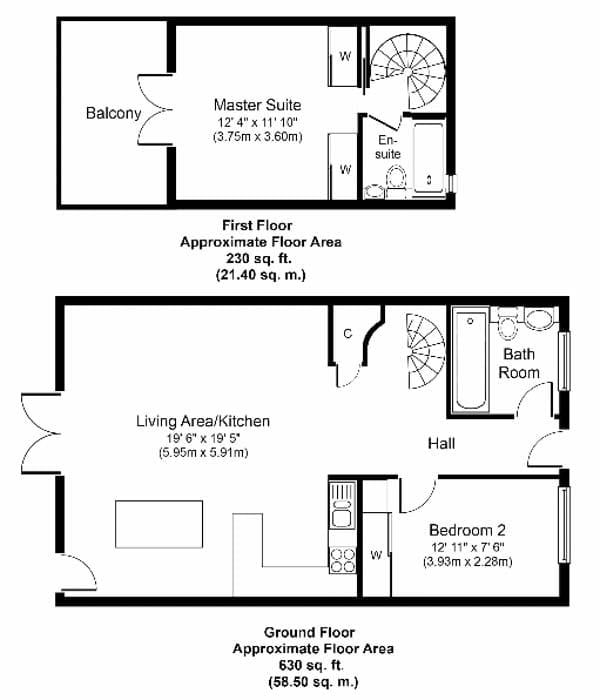
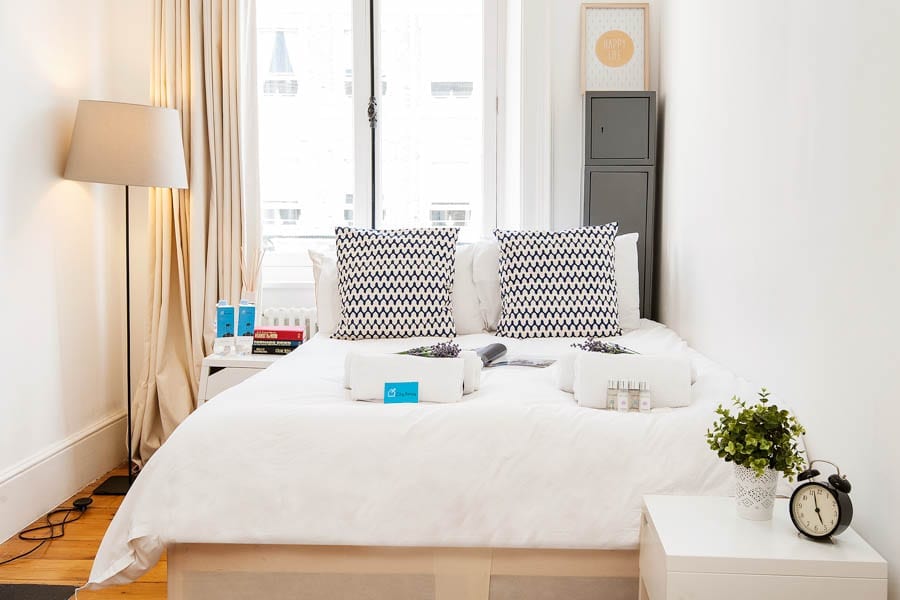
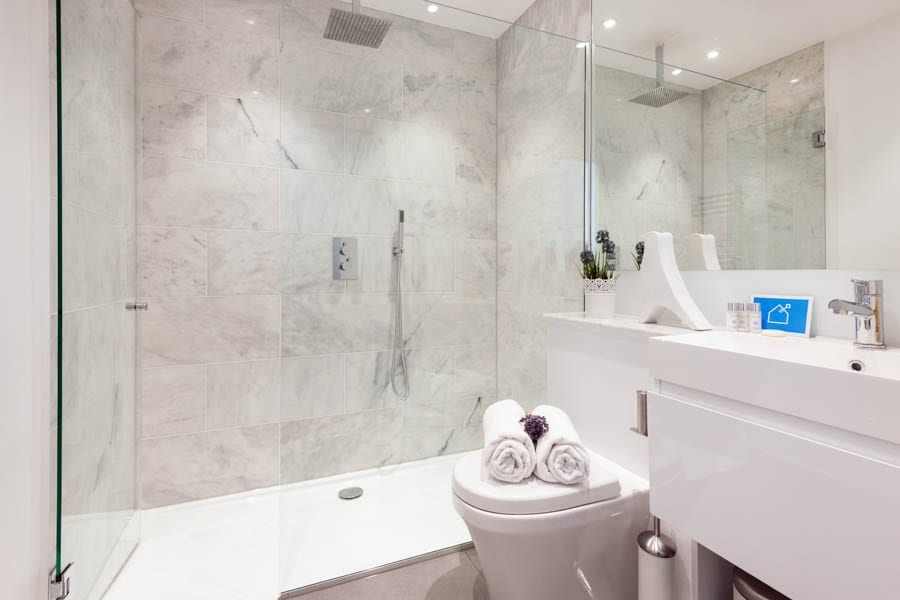
The kitchen itself is dominated by a central island unit.A lower ground floor room described as a “snug” is used presently as a space to watch television.The first floor consists of a master bedroom suite with a bedroom with an undemised balcony, a dressing room and a shower room.The dressing room itself.One of two bedrooms on the second floor.The other second floor bedroom.There are two bathrooms and two shower rooms in the house.The floor plan shows how the tardis like building gets bigger as you go further back into it.The situation of 24a The Boltons is on the “favoured” western crescent of this ritzy street.
Matthew Steeples suggests that at a time when public resources are totally overstretched, that the Met Police are set to waste more money on the plainly pointless search for Madeleine McCann is an outrage
Let’s be honest: Madeleine McCann will most likely never be found. Whatever people might say and however much they might hope, with nearly £12 million of public money and much more private cash wasted on a search that has achieved zilch, zero, nada, anything more is just throwing good wonga after bad.
Now, with news last night that the Met Police will be allocating further funds to continue the search (at a time when they’re asking for retired officers to return to help police the public during the coronavirus outbreak), the public will be rightly outraged.
Whilst I and others have for years argued that the disproportionate allocation of resources to this case stinks and that other missing children (whose cases get little to no financial aid) deserve parity, this latest announcement is a step too far. Speaking to The Sun yesterday, an unnamed police source stated:
“There has been some recent speculation that the investigation into Madeleine’s disappearance could be put on hold or discontinued because of the coronavirus epidemic and a shortage of officers working. This isn’t the case and we can’t see the outbreak causing a problem for this ongoing inquiry. Neither can the Home Office. We’ve been told there will hopefully be no problem with new funding.”
Gerry and Kate McCann’s closeness to the likes of Gordon Brown, David Cameron, Theresa May and Baroness Meyer has also aided their ability to keep the cash rolling in since their daughter ‘disappeared’ in May 2007. Equally, with mega rich ‘friends’ like the job killer Sir Richard Branson, the alleged sex abuser Sir Philip Green and the angry busybody J. K. Rowling on their side, the McCanns – unlike less wealthy parents of other missing children such as Kerry Needham – have been able to manipulate the media without good reason.
Frankly, nothing new has been uncovered in this case in years and now it is not the time to give more money. Instead, it’s time to shelve the search for Madeleine McCann and instead use precious and scarce financial resources to solve cases that can actually be solved.
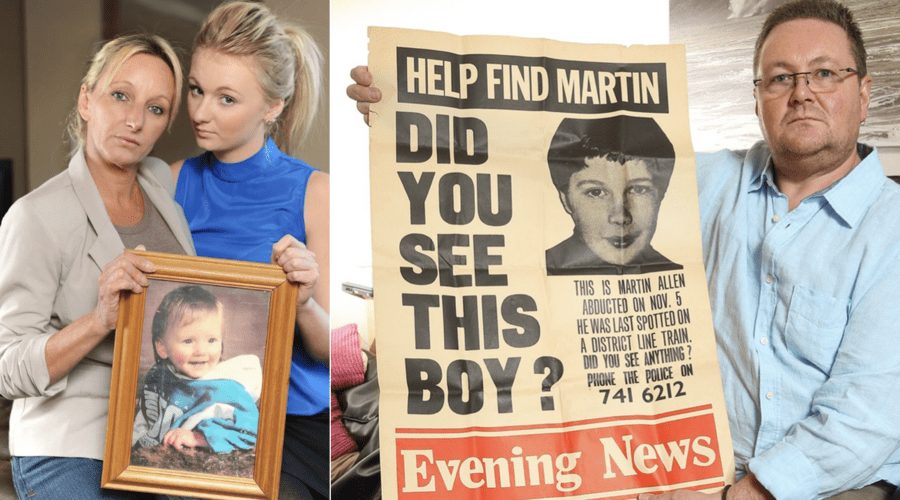
Missing still yet little to no police resources for their cases – Ben Needham disappeared in Kos, Greece on the 24th July 1991 aged 1 and his mother gets little help for her search; Martin Allen disappeared in London on 5th November 1979 aged 15 and though his brother, Kevin, keeps the case in the public eye as much as he can, he gets little to no help from the Metropolitan Police.Meanwhile, Madeleine McCann – whose parents left the doors and windows to the apartment they were staying in and did not pay for childcare on that fateful night – disappeared on the 3rd May 2007 in Praia da Luz, Portugal. The investigation into how she went ‘missing’ has cost nearly £12 million of British public money thus far and more is going to be given. Something, frankly, does not add up and interested individuals should take a look at our previous analysis: “Missing Madeleine – Questions without Answers.”
Off-the-wall 24-carat gold 1958 Austin Healey that would appeal to Liberace to be sold at auction in New York with an estimate of £420,000
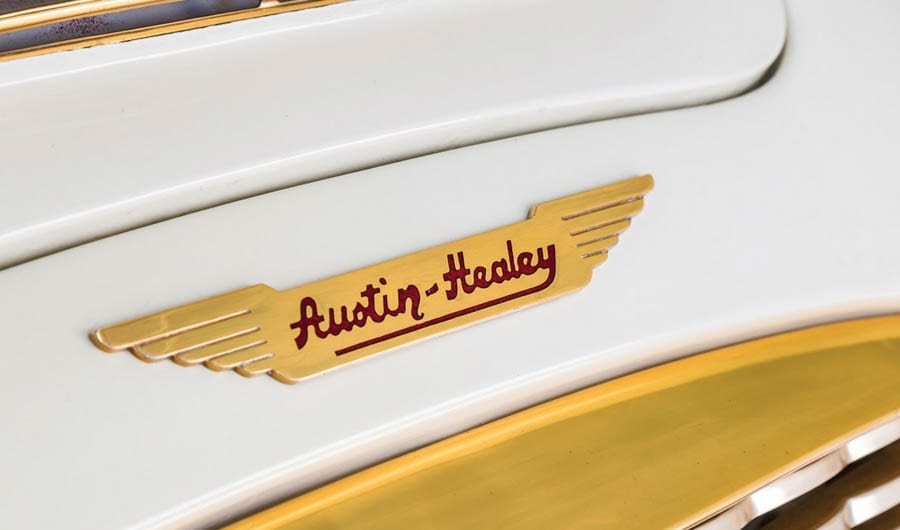
A truly bonkers one-off 1958 Austin-Healey 100-Six that was given the monikers ‘Goldie’ and ‘The Golden Child’ is to be sold at auction in December.
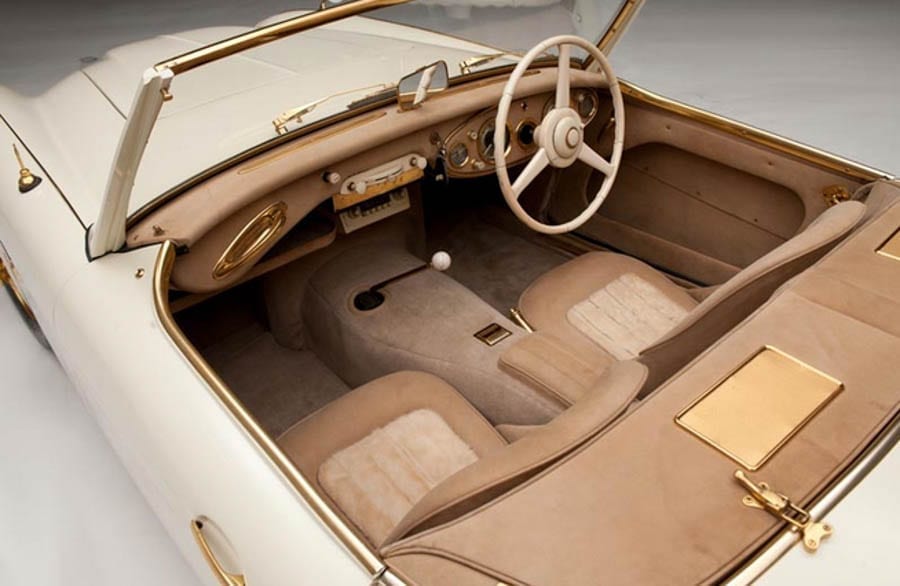
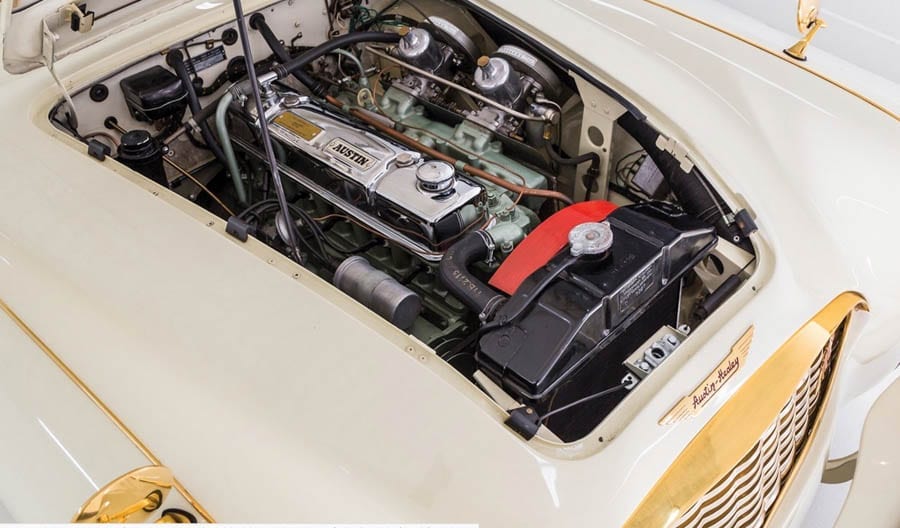
For sale for 165% less than it was offered for in 2013 but 781% more than it was valued at in 1958, ‘Goldie’ is capable of speeds of upto 120 miles per hour but what makes her unique is that all brightwork – including the trimming washers and screws, wire wheels, disc brakes, bumpers and instruments – are plated in 24-carat gold.
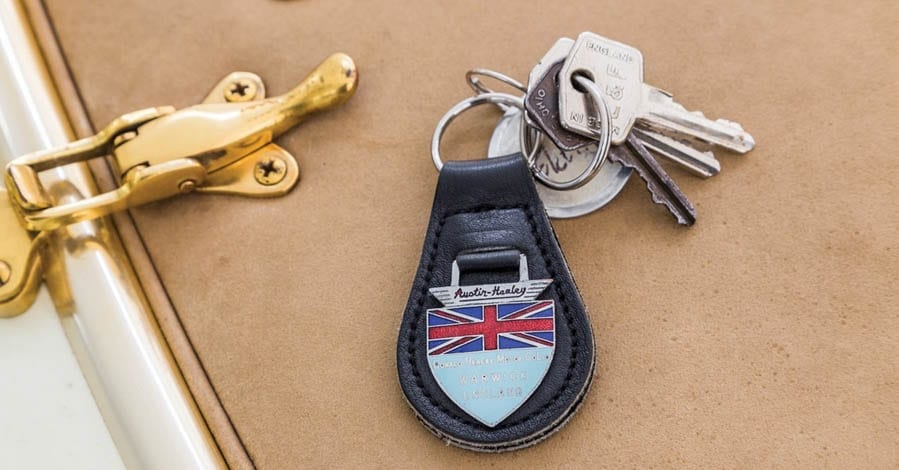
The car’s interior is trimmed in champagne Connolly kid leather and champagne diadem mink by London furrier Lorna Doon Snow adorn the inserts and back squabs of the bucket seats and the key ring comes complete with a solid-gold scale replica of the car itself.
The brainchild of Donald Healey’s then PR manager, Ken Gregory, in association with the Daily Express’s then motoring correspondent, Basil Cardew, ‘Goldie’ was the show-stopping car exhibited at the entrance to the 1958 London Motor Show at Earl’s Court. She reportedly wowed audiences and no doubt would have been dubbed a ‘dream machine’ by the motoring world’s most extravagant doyenne, Lady Docker.
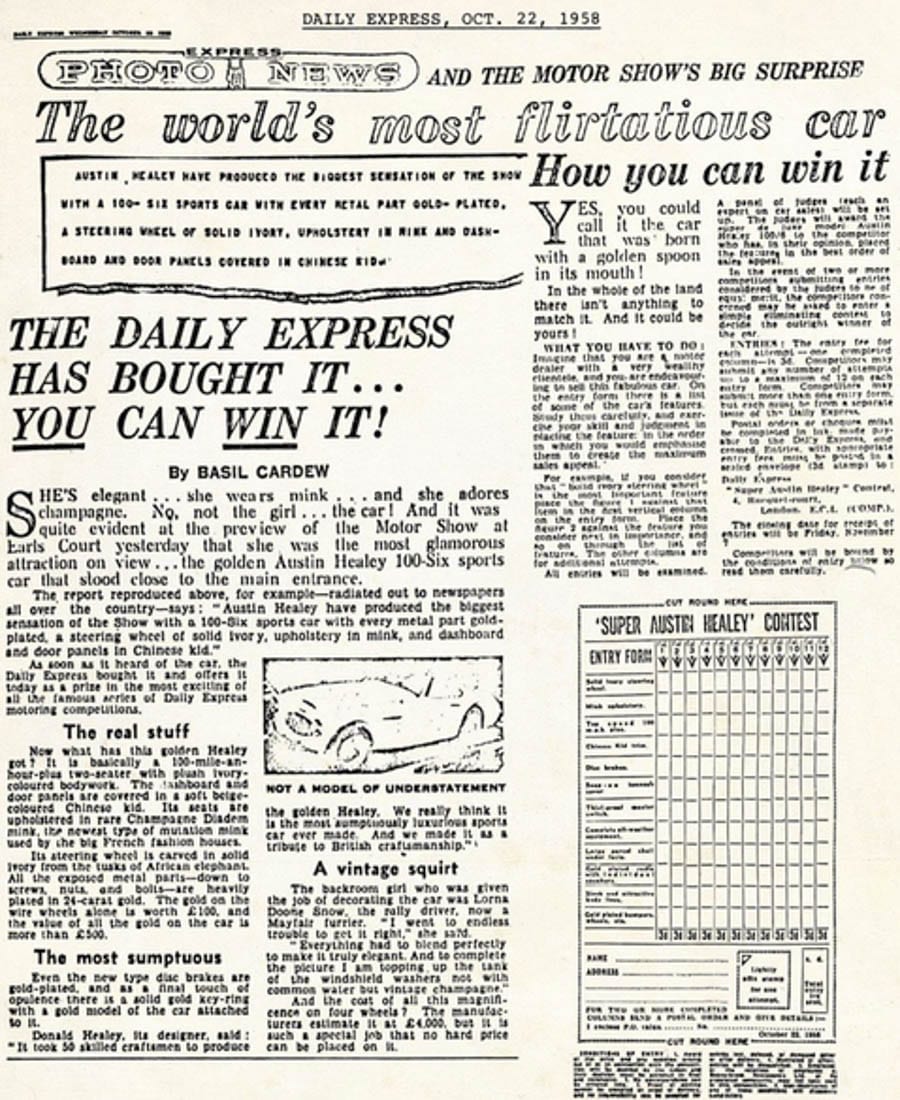
Sold immediately to the paper the Daily Express dedicated a page to the promotion of a reader competition to win ‘Goldie’ on 22nd October 1958. Of her, they remarked:
“[This is] the world’s most flirtatious car… The Daily Express has bought it… You can win it. She’s elegant… she wears mink… and she adores champagne. No, not the girl… the car!”
“The real stuff… The most sumptuous… A vintage squirt… The biggest sensation of the [Motor Show at Earl’s Court]… Yes, you could call it the car that was born with a golden spoon in its mouth!”
“In the whole of the land there isn’t anything to match it.”
Surprisingly, the winner of the competition decided to sell the vehicle immediately. She was first road-registered in February 1959 and then passed through various owners until being completely restored by Bruce and Inan Phillips of Healey Surgeons of Washington, D.C. between 1983 and 1986.
Speaking of what the current marketing catalogue entry describes as “the most spectacular Austin Healey ever produced,” Inan Phillips is said to have remarked: “[‘Goldie’ was] one fantastic running and driving car… The smoothest driving Austin Healey we’ve ever owned.”
In time sold to a wealthy businessman and Jeep restorer named Dennis Collins from Wylie, Texas, ‘Goldie’ was offered for sale first on eBay and then at auction in Houston, Texas for £758,000 in 2013 and 2014. It appears no sale went through and now an estimate of £265,000 to £417,000 has been set for this striking creation.
RM Sotheby’s will sell ‘Goldie’ at their annual New York ‘Icons’ sale on 6th December. They list the vehicle as being “without reserve.” If only Liberace were still around to put in a bid.
‘Goldie’ – The Numbers
December 2017 – Offered for sale at auction with no reserve and an estimate of £265,000 to £417,000 ($350,000 to $550,000, €300,000 to €471,000 or درهم1.3 million to درهم2 million) in New York.
January 2014 – Offered for sale with a ‘buy-it-now’ price of £758,000 ($1 million, €857,000 or درهم3.7 million) on eBay.
March 2013 – Offered for sale for £758,000 ($1 million, €857,000 or درهم3.7 million) in Houston, Texas by Collins Brothers Jeep owner Dennis Collins.
October 1958 – Valued at £4,000 (the equivalent of £86,000, $113,000, €97,000 or درهم417,000 today) prior to being sold to the Daily Express and offered in a reader competition in London.
Matthew Steeples asks Conservative candidate for Kensington Lady Borwick five questions; he put the same to the Liberal Democrats Annabel Mullin also whilst Labour’s Emma Dent Coad failed to respond
In the final hours of the 2017 General Election campaign, I asked the Conservative candidate for Kensington, Lady Borwick, five questions I considered relevant to voters in one of Britain’s most wealthy constituencies. I publish below her answers in full and unedited form and beneath also include the responses of the Liberal Democrat candidate, Annabel Mullin, to the same questions.
Emma Dent Coad, Labour’s candidate, was also given the opportunity to answer but failed to respond to several requests.
The five questions to Lady Borwick (initially and then more generally to Annabel Mullin and Emma Dent Coad) were:
Hidden homeless: “What will you do to help the ‘hidden homeless’ of Kensington?”
Money park Kensington: “How will you help local businesses counter such decline if re-elected?”
Brexit: “How, going forward, will you credibly represent the 48% who voted to ‘remain’, as someone who went on the phones to support ‘leave’?”
Answering constituents: “How will you improve your pathetically low 18% response rate to constituents’ correspondence, as registered on TheyWorkForYou.com if re-elected?”
Ivory: “Will you continue to lobby Theresa May about ivory in spite of such being highly unpopular with constituents and others such as Deborah Meaden?”
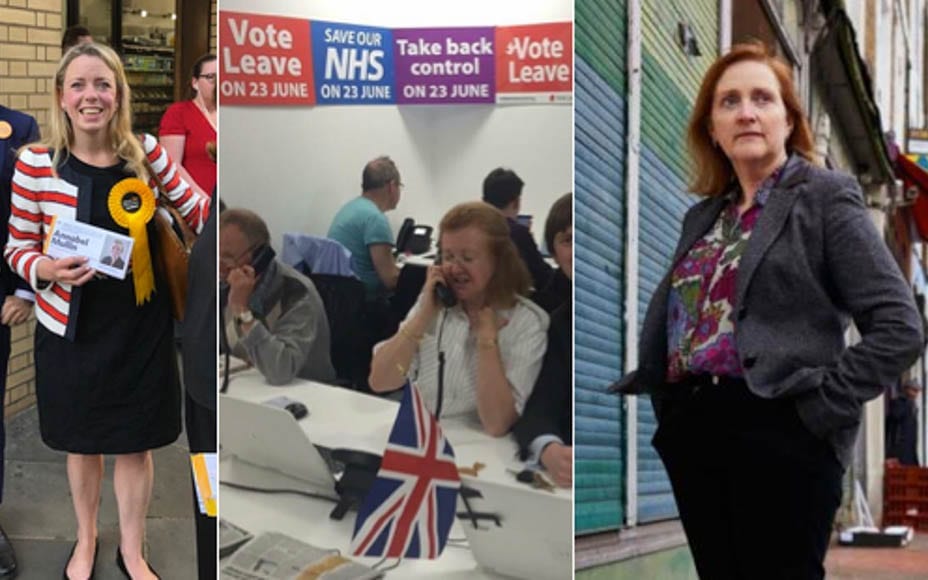
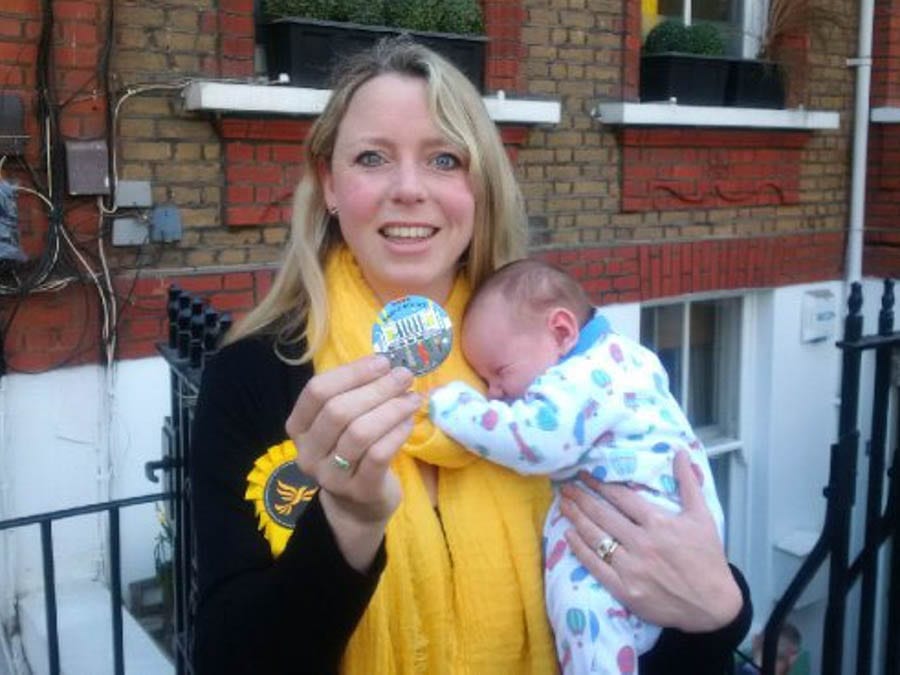
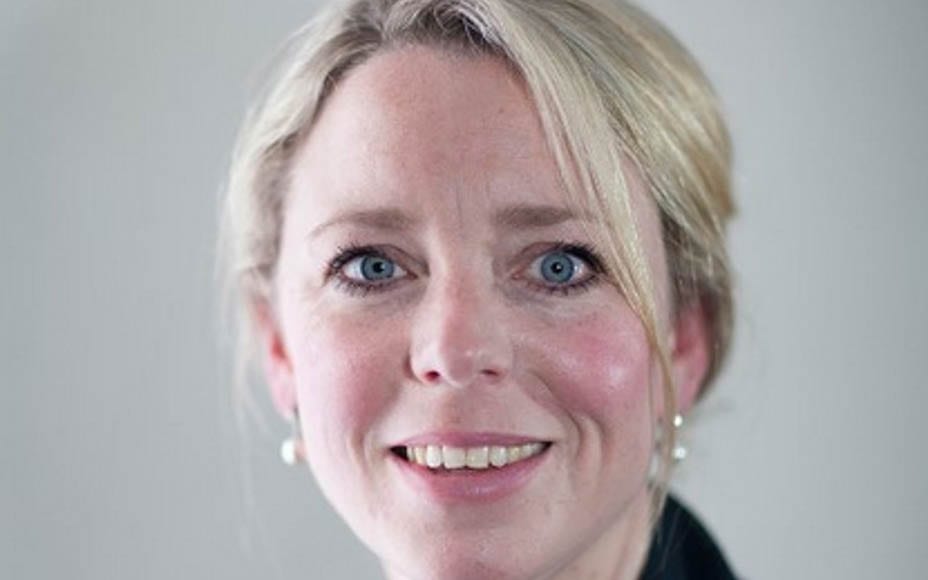
Pictured above: Annabel Mullin campaigning, Lady Borwick during the Brexit referendum and Emma Dent Coad
Pictured above: Annabel Mullin campaigning, Lady Borwick during the Brexit referendum and Emma Dent Coad
Victoria Borwick, Conservative Party
What will you do to help the ‘hidden homeless’ of Kensington?”
In Parliament, the Homeless Reduction Bill was recently passed –which was almost the last bill to be “signed off” before Parliament broke for the election. This puts pressure on local councillors to provide a range of early intervention solutions.
Current local services – There are a number of local churches who are working in this sector such as St Cuthbert’s (who I visited earlier this week) and our local charities.
From my previous work at the GLA, I know that although there is a hostel place for everyone that is not enough. People need more and longer-term help which is why there are some good charities working locally, for example the Glass Door Project and Homeless Link. I have also worked with several of the veterans’ charities whose aim is not “no second night out” but “no first night out”.
The situation with those that are “street homeless” – these are the people who, for a complex number of reasons, spend time living on the streets. Some do have somewhere to sleep at night, but spend the day on the streets and some live on the streets full time, including overnight.
The first port of call for street homeless people is a hostel and these fall into two categories. “Direct access” and those that require a referral from an agency. These agencies provide not only shelter but some way to address the terrible loneliness, mental health and other problems that most street homeless people feel. We need to look at the provision of hostels, but also work with the organisations that provide longer term support, to help people get over their crisis and get back on their feet – and this can take months, and sometimes longer.
There has to be short-term accommodation but also ways of dealing with the causes of street homelessness. There needs to be “move on” accommodation, for those that have managed to get themselves into a stable state, and where they are becoming independent, but may still need some ongoing support. I have visited services where they have a range of provision in the same location, I.E. those in immediate crisis and those that are more capable.
We need to provide services to help people with drug and alcohol problems which causes so many people to become street homeless, and also with the mental health problems that afflict so many of these people. The council’s Public Health Department has made this a high priority. I particularly welcome the changes to our mental health laws that the Prime Minister has pledged to bring in. These should make a big difference for homeless people with mental health problems.
Money park Kensington: “How will you help local businesses counter such decline if re-elected?”
I have grown up in Kensington and lived here all my life, with my family.
Supporting our small and medium sized local businesses is very important for all of us in Kensington. Local businesses are the backbone of our economy and provide employment and opportunities in our community.
Firstly we have to stop losing small independent businesses, as you have refereed to, so that people do not lose their opportunity to be working locally and also to start business locally. RBKC has continued with our planning exemptions, otherwise across London small businesses were being turfed out of their premises. Many local restaurants have sadly closed.
I have lobbied the Chancellor, and if re-elected will continue to lobby the Chancellor against the rash of additional regulations for small business – the proposed quarterly reporting, the apprenticeship levy – should be for larger firms, the pensions levy and of course the revaluation which has negatively impacted on our shops – and not on the out of town warehouses for mail order.
I recently undertook a survey of many local shops and businesses, either in writing or by visiting in person. On the basis of the response, I wrote to the Treasury, as indeed did the Borough, and also raised it personally with the Chancellor to see if there is any other way of looking at the rates – so that rateable value could be examined to take into account factors such as turnover, size of premises, whether the shop is independent or a chain of premises and so on. If re-elected, I shall continue to raise these concerns with other central London MPs as they affect us all.
I will continue to support local businesses by supporting any legislation in Parliament which will promote businesses and support our local economy.
Buy to Leave – This is a real issue in Central London, and this is something that, as an MP, I discussed with other Central London MPs from all parties. As we are aware this is “investment purchasing” where investors buy, usually a new property, and then do not live in it, and treat it as “money in the bank” which is why they don’t want it to be lived in as they want to keep it new.
When discussing this and researching what is actually happening – RBKC undertook a survey, as have Westminster Council on this topic. There is a pocket of properties where this is very prevalent, however there is not overall interest in this because it affect so very few nationally.
That does not make it any less of a problem – the previous Mayor tried to address this by saying that properties have to be marketed in the UK first, but we are often used to getting a mortgage first and these overseas buyers are cash buyers so naturally they can jump in. The new Mayor is also examining what measures can be taken.
There are examples in Switzerland and Australia where they have tried to tackle this issue. Buy to leave homes have a very negative effect on the community as there are less “eyes on the streets” less community activity and it is difficult for local business to survive.
By continuing to have schools and local amenities it brings together a community and encourages homes for families.
Brexit: “How, going forward, will you credibly represent the 48% who voted to ‘remain’, as someone who went on the phones to support ‘leave’?”
I previously worked for Open Europe which was working with the previous administration on renegotiation, which was my preferred stance. I had hoped that the EU would and could use this time to examine its own processes and undertake reform. I realise the result of the referendum is not the outcome for which everyone might have hoped. My chief concern was accountability, and it became clear there was little that could be done to persuade the Commission towards greater transparency.
As a country we voted to leave the EU. Parliament has voted on two occasions to implement the result, with cross-party support. All sides have agreed to respect the referendum and to get on with the re-negotiations. The Lib Dems may have also offered a second referendum on the result of the negotiations. Theresa May has said she will bring the final agreement to Parliament for a vote.
For Kensington, if re-elected, my role will be to lobby for reciprocal rights for all our long-term residents. Over 50% of the residents in Kensington were not born here and many have made Kensington their home for many years. We should continue to make sure they are welcomed and can continue to play an active part in our community. Many are also great contributors to voluntary and charitable works.
I will represent the views of Kensington in Westminster if I am re-elected; working closely with Ministers to make sure they understand the complexity of Kensington.
The choice for everyone is: “Who should be leading the Brexit negotiations?” Which team do you want? I am supporting Theresa May and her team. I support the PMs ambition to strive for a good outcome for the country.
Answering constituents: “How will you improve your pathetically low 18% response rate to constituents’ correspondence, as registered on TheyWorkForYou.com if re-elected?”
I have always prioritised urgent casework when responding to the vast amount of correspondence my office receives. I receive referrals and pleas for help from individual constituents, charities, churches, the mosque and other religious groups, along with organisations such as the Citizens Advice Bureau and free legal advice clinics. We have helped several thousand families over my time in Parliament. These referrals, usually from someone in crisis, do not come through “They Work for You” thus they are not logged in this way.
People tend to write to us on “They Work for You” if they are asking for our views on a particular campaign. If the campaign has nothing to do with Kensington residents, then I put my views on the website, so that people can see my opinion. However, I try not to comment on things that are not directly relevant to the majority of Kensington residents.
As a team – my priority is casework and dealing directly with residents, and meeting residents each week. I try to avoid “lobbying emails”. Obviously with complex cases we need to see the residents a number of times, and help them with their various meetings with officers or officials and if appropriate I also work with their local councillors (from any party) to make sure they are not left without support.
A Member of Parliament is often the last resort for people on housing, immigration and benefits. I have been able to help a great many residents since elected and I hope to continue to do this if re-elected.
Ivory: “Will you continue to lobby Theresa May about ivory in spite of such being highly unpopular with constituents and others such as Deborah Meaden?”
I supplied a full response to Deborah Meaden who said she was content with my response and why I am representing the antiques trade in Kensington and our great museums. She kindly offered to send my response to others who were concerned. I have offered to meet her should I get re-elected.
I support the current proposals which are to make sure we enforce the ban on trading in modern ivory.
No antique dealer wants to kill elephants; no antique dealer supports poaching. The only ivory that can be sold in this country is antique and carved. However, there are countries, including those in Europe who still permit the trading of tusks, although this is shortly to be outlawed – not before time.
We can and should preserve works of art that are our shared cultural inheritance for future generations, while at the same time doing everything in our power to ensure that these terrible assaults on wildlife do not continue. The next generation need to be able to grow up in a world with healthy herds of elephants. However, these are not mutually exclusive positions. This is a view expressed by some of our leading museums, such as the Victoria and Albert Museum and the British Museum.
As you will be aware many musical instruments contain ivory “tinkling the ivories – playing the piano” comes to mind as well as significant treasures in our churches. In our area we have three magnificent museums – the Natural History, V&A and Science Museums – and they all have ivory – antique and old ivory.
Both elephants and our shared cultural inheritance are there for us all; we need to work together to look after both, and I have no doubt that this is possible.
Annabel Mullin, Liberal Democratic Party
What will you do to help the ‘hidden homeless’ of Kensington?”
Rough sleepers and the homesless have had a very tough time of late. Funding has dried up, centres have closed and specialist help has become less frequent. We need to provide holistic care – that means that we must look at social care with mental health for these individuals alongside.
Money park Kensington: “How will you help local businesses counter such decline if re-elected?”
I would like to bring a private members’ bill to fundamentally change business rates as they are killing our local businesses.
Brexit: “How, going forward, will you credibly represent the 48% who voted to ‘remain’, as someone who went on the phones to support ‘leave’?”
As a passionate European and Remainer who feels we are best placed in the European Union, I will fight especially for being in the single market (not just access) and to protect the rights of all EU citizens and their freedom of movement.
Answering constituents: “How will you improve your pathetically low 18% response rate to constituents’ correspondence, as registered on TheyWorkForYou.com if re-elected?”
It has been an absolute pleasure getting to know people in and around Kensington over the last nearly seven weeks. It would be a privilege to serve Kensington and communicate with everyone.
Ivory: “Will you continue to lobby Theresa May about ivory in spite of such being highly unpopular with constituents and others such as Deborah Meaden?”
I find it incredible that China has a ban but the current MP for Kensington does not support it.
Emma Dent Coad, Labour Party
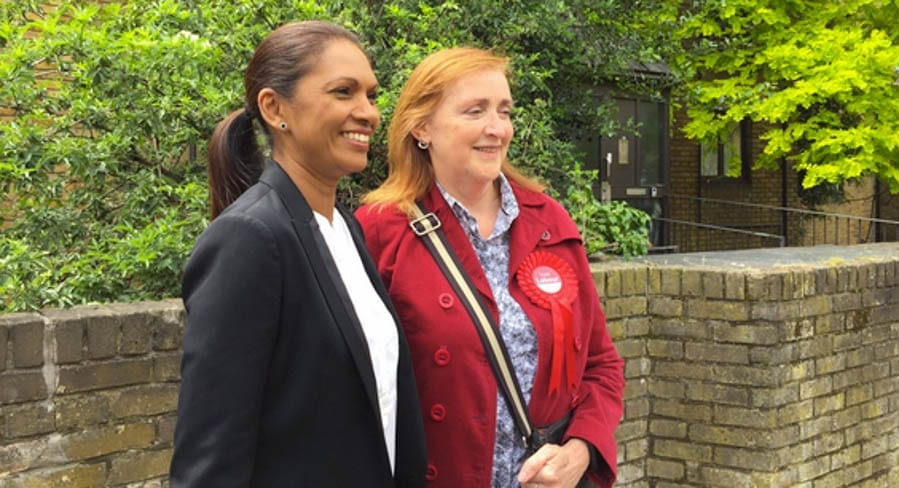
Emma Dent Coad (pictured with Gina Miller of Best For Britain)
Ms Dent Coad failed to respond to repeated requests from The Steeple Times to answer the five questions. They were put to her via email.
A 20-question interview with criminal justice expert, former police officer and Liberal Democrat candidate for Kensington Annabel Mullin
The Steeple Times shares “wit and wisdom”. What’s your guiding force?
To live every moment to the fullest and make the biggest difference to people’s lives that I can.
“Don’t get even, get medieval” is, in our humble opinion, a great motto. What’s yours?
I love the motto ‘carpe diem’ (seize the day). When I was younger, Dead Poets Society was one of my favourite films.
Kerry Katona was considered unacceptable in 2007. Who or what is unacceptable in 2017?
Brexit.
Tony Blair misses being Prime Minister. What do you miss most in your life?
Currently I’m missing not seeing my children much because I am campaigning so hard.
What might you swap all your wealth for?
Knowing that my children will have a great future.
Donald Trump was once a case of: “If you owe the bank a thousand, they close you down; but if you owe the bank a billion, you own the bank”. What’s your view on the state of the financial system?
One of the things I would like to see in Kensington is more support for small businesses and local shop owners that help to create our community. We are currently facing threats to our local services from business rates and that is something that needs to be addressed.
What phrase or word do you most loathe?
I loathe it when people say things they don’t mean. ‘Strong and Stable’ is currently high up there.
In the UK, some people consider charity to “begin at home”. What’s your view and what causes do you personally support?
I agree. I support that concept. Having worked at Crisis, I continue to support homeless charities. I also love shopping in our fabulous Kensington charity shops.
The judge in Law Abiding Citizen states: “I can pretty much do whatever I want” before being blown up whilst answering her mobile phone. What’s your view on the appropriate use of such devices?
Mobiles are amazingly useful and I’m a bit of an addict to my device. However, there is a time and a place for them.
If you could fill a carriage on The Orient Express, who would be your fellow passengers?
George Orwell, Harriet Harmen, Lawrence of Arabia, Margaret Thatcher, Winston Churchill, Sophie in’t Veld, Hercule Poirot, Hilary Clinton, Charlie Chaplin, Shirley Williams, Paula Radcliffe, Prince and Laura Kuenssberg.
If you were unfortunate enough to end up on death row, what would be your last meal and where would you eat it?
My meal would be steak, chips and red wine followed by tiramisu. I’d rather like to eat it high up in Petra overlooking the wondrous landscape.
What time is it acceptable to consume the first drink of the day?
That depends entirely on which time zone you are going by.
A Negroni, a martini or a cup of tea?
A martini, preferably an espresso martini.
Whose parties do you enjoy the most and why?
Now, dinner parties with close friends but when I was younger, more partying.
Who is the most positive person you know?
My husband.
What’s your most guilty pleasure?
The ‘Archers Appreciation’ group on Facebook… With wine.
If a tattoo were to sum you up, what would it be of?
A dragon.
If you were a car, what marque would you be?
A Mercedes-Benz Gullwing.
Cilla Black presented Surprise, Surprise. Tell us the most surprising thing about you.
That I was an ultra-marathon runner and completed the Marathon Des Sables in 2008.
What’s currently sitting on your mantelpiece?
An elephant – the house is littered with them, candlesticks and birthday cards for my eldest’ fifth birthday.
Annabel Mullin was born and brought up in Kensington and Chelsea. She is mother of three young children, a keen environmentalist and a cyclist. She is a criminal justice expert and has spent most of her life working in London as an analyst, a Metropolitan Police officer in Soho and Mayfair and as an assistant psychologist with prisoners with mental illness. Recently she has worked as a PhD researcher at UCL.
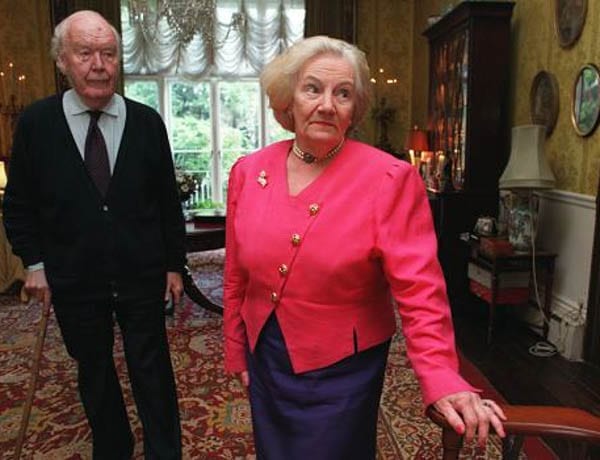
Dame Paddy Ridsdale, as she generally known, was an intelligence operative, secretary to Ian Fleming during WW2 and the inspiration for the Bond character Miss Moneypenny.
A Conservative Party stalwart and married to Member of Parliament for Harwich from 1954 to 1992 Sir Julian Ridsdale CBE (1915 – 2004), Dame Paddy – or Vicky, as she was known to some – is best known for her role in ‘Operation Mincemeat’, a “famous caper” concerning a “man who never was” in 1943.
In the war, Dame Paddy wrote love letters and telegrams that were planted on the body of ‘Major William Martin’, an invented, drowned naval officer, that was floated in the ocean off Spain. The body carried fictitious plans of a purported Allied invasion of Sardinia and Greece and formed part of a plot designed to deflect attention from the Allied landings in Sicily. Of it, she later remarked: “I was sent to buy clothes in all the best men’s shops and had to pose as his girlfriend. I had to go to post offices and rather loudly send this telegram to ‘my boyfriend’, hoping of course that somebody would overhear me”. In due course, the body was indeed found, the Axis powers completely taken in and “Mincemeat swallowed whole, hook, line, and sinker”. A BAFTA winning film directed by Ronald Neame, The Man Who Never Was, made about the deceptive scheme in 1956.
Dame Paddy was known as a “political hostess in the style of a bygone era”, lived in a mansion “sandwiched between a sheikh and a Saudi prince” in The Boltons for the majority of her adult life and is buried in the grounds of the church there. She had one daughter, became Lady Ridsdale when her husband was knighted in 1981 and was appointed Dame Commander of the British Empire (DBE) in her own right, for political services, in 1991.
Of her relationship with her one-time employer Fleming, she concluded: “Ian had so many girlfriends that I was not tempted to become one of them”.
Trophy house with a “dictator interior” in The Boltons has nearly £10 million sliced off its asking price; iceberg home behind reduced by £5 million
A house in London’s second most expensive street has returned to the market at the much reduced price of £30 million ($38.8 million, €35.5 million or درهم142.6 million) in spite of having an interior that would only appeal to the likes of Bashar al-Assad, Muammar Gaddafi or Saddam Hussein.
Previously marketed at £39.5 million ($47.1 million, €47.1 million or درهم188.3 million) in 2015 through Russell Simpson and now offered by Knight Frank, semi-detached 6 The Boltons extends to 9,781 square foot and comes with a 2,469 square foot mews house to the rear in Creswell Place.
Both buildings are described as “requiring modernisation throughout” and in total provide 5 reception rooms, 16 bedrooms and 11 bathrooms. The main house has a lift to all floors, air conditioning and as well as parking for 5 cars, there is an internal garage and an interconnecting garden.
For those with another £32.5 million ($42.1 million, €38.5 million or درهم154.5 million) to spare, Knight Frank also offer another house adjoining the Cresswell Place mews house. Featured in The Steeple Times last May, that house, Cresswell House, has also had a rather punchy £5 million ($6.5 million, €6 million or درهم23.8 million) sliced off its asking price. A super-compound anyone?
The 1,503 square foot flat in Penywern Road, Earl’s Court is described as “spectacular” and “at tranquil oasis with an atmosphere and grandeur reminiscent of one of Britain’s great countryside estates” by selling agents Russell Simpson.
Featuring a grand reception room, a bar, a dining kitchen, two bedrooms and two bathrooms, the share of freehold property is situated within a stucco fronted building that gives little indication of what lies within.
Matthew Steeples takes a look at the services offered by City Relay, a hassle free short-term rental management company
Established three years ago and based in Earl’s Court, City Relay offer the very best guest and host management services for over two hundred apartments and houses in Central and West London.
Primarily focused on taking away the hassle of managing bookings through marketing services such as Airbnb, City Relay’s 5-star hospitality team deal with check-ins, key holding and guest support. The firm also have their own property maintenance team to ensure properties are kept in immaculate condition between change-overs and can organise housekeeping services and supply fresh hotel quality linens also.
Of the firm’s services to those with apartments and houses to rent, the company’s Mathilde Le Bault comments:
“Brexit has brought a bonus for landlords and has encouraged many to opt for short-term rentals to tourists and business people rather than leaving their properties empty in a declining long-term market. Higher yields follow and with the ease and convenience of dealing with just City Relay’s team, we make it much easier to navigate the Airbnb process”.
“City Relay’s reception desk is located at 62 Kenway Road, London, SW5 0RD and the many international, mostly European clients we deal with find that having someone they can actually speak to and meet in person most useful”.
For further details about City Relay’s services, click here. Alternatively, telephone: +44 (0) 20 7993 5693.
Sales of super-prime properties in the UK fall by 86%
Yesterday, the property group London Central Portfolio released data that showed that sales of £10 million-plus properties in the UK had fallen 86% over the past year.
Blaming hefty Stamp Duty increases and Brexit uncertainty, the firm reported that just 5 “super-prime” properties had changed hands between June and August compared to a recorded 35 a year earlier. All of the sales in the period this year were in Central London whilst such properties accounted for just 30% of the figure in the year previous.
Top-end developers, whose sales accounted for 23% of the figure in 2015, were especially affected. They made zero sales in this price bracket in the period and now, according to Naomi Heaton, CEO of LCP, they are reworking their developments to create smaller, cheaper units.
Citygrove Securities PLC and McClaren Properties’ The Clearings development in Chelsea’s Milner Street is being reworked to include fewer super-prime properties
Of this, Ms Heaton commented:
“Many [developers are] looking to divide large, high-priced property into smaller flats to increase their attractiveness”.
Examples given by LCP include Clivedale’s Hanover Square development – where the scheme is being reworked to create four times as many units – and Citygrove Securities PLC and McClaren Properties’ The Clearings development in Chelsea’s Milner Street – where seven townhouses will be replaced with smaller properties.
Speaking more generally, Ms Heaton – who predicts the consequences of this development will be a £45 million fall in Stamp Duty receipts to the government – added:
“This slowdown in the luxury property market—a big contributor for the Exchequer and UK economy—is very concerning. As the government faces the daunting task of negotiating Brexit together with a potential slowdown in the UK economy, it should consider its strategy on residential-property taxation carefully to ensure it meets its objectives of increasing revenues”.
Stamp Duty on a £6 million property was £420,000 under the old system; it is now £633,750. On a £2 million property it was £100,000; it’s now £153,750 whilst in addition buyers of second homes and investment properties now have to pay an additional 3% surcharge also.