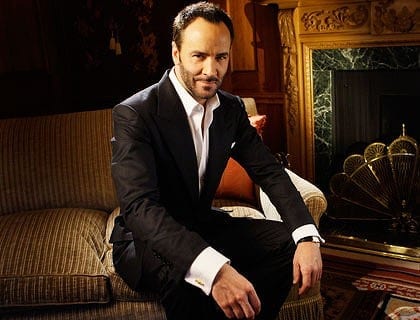
 This Texan born designer and film director turned around the fortunes of Gucci and YSL and had a huge success with A Single Man. A fixture at New York’s Studio 54, his designs are hugely influenced by the club’s disco-era glamour and his love of all things black and square. Ford met his journalist partner, Richard Buckley, at a fashion show in 1986. They share a love for smooth fox terriers and announced the birth of their son, Alexander Buckley Ford, in September 2012. Of being “gay,” he comments: “I hate that word” but declares that he’ll marry when same-sex marriage is legalised in California. Of Ford, his partner, Buckley, adds: “There’s only one Tom for me.”
Tag: children
-
Tom Ford
-
Post-Fordism
The flexible £12.75 million former home of Tom Ford
Number 26 Gilston Road in London’s SW10 is a property that has been on and off the market repeatedly in recent years. On each and every occasion it has been promoted as the “former home of the fashion icon Tom Ford” and though he hasn’t lived there in years, it is still just as he left it.
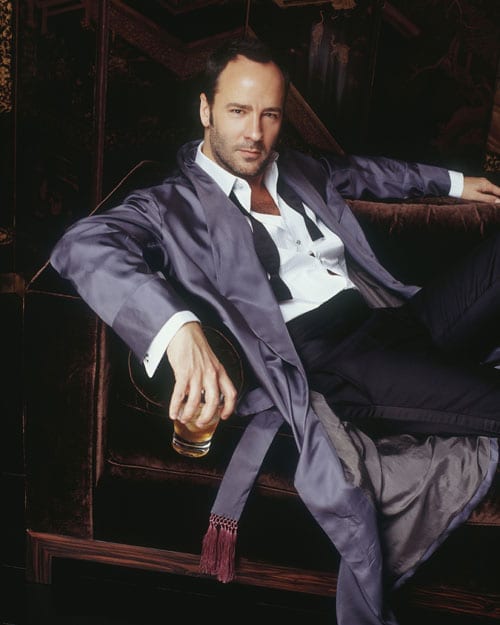
Designer and film producer Tom Ford 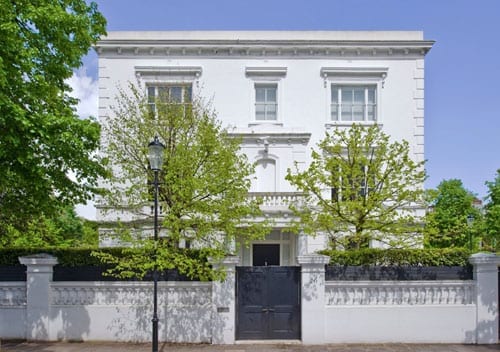
“The former home of design icon Tom Ford”: 26 Gilston Road, London, SW10 9SS Situated at the end of a terrace on the corner of Priory Walk, one can see why the house appealed to the Texan born designer credited with turning around the fortunes of Gucci and Yves Saint Laurent. Hidden behind a high wall and hedging, 26 Gilston Road is private yet minutes from the restaurants of Old Brompton and Fulham Roads.
This 4-storey townhouse was sold in June 1997 for £2,250,000 and again marketed in 2009 for £8,500,000 through Aylesford. In the time since, it has been available to let at prices ranging from £5,500 to £7,500 per week, but is now back for sale at the extraordinary figure of £12,750,00 through Russell Simpson.
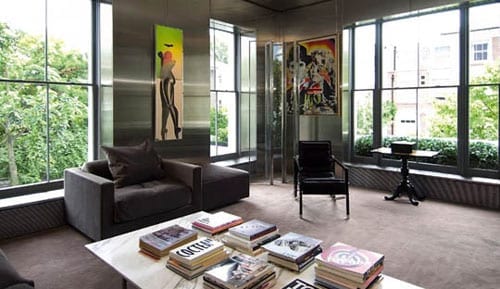
One of the reception rooms, just as Tom Ford left it 
Another of the Tom Ford styled rooms 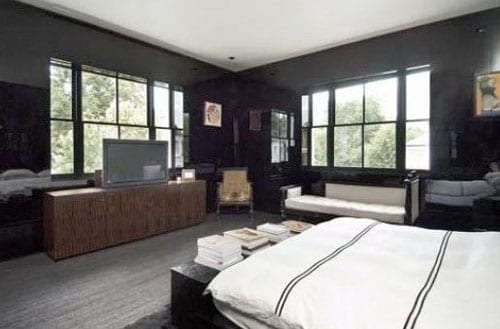
A Tom Ford designed bedroom 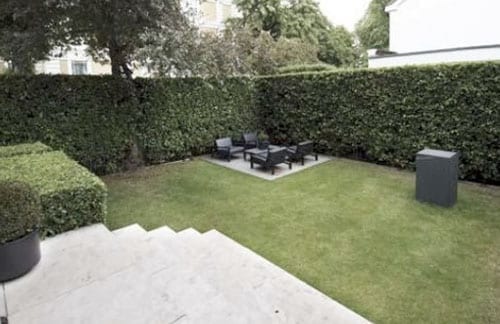
The garden of the property is extremely private What explains such a rise during a period of economic downturn? Well, it’s because developers Equilibrium have gained permission to “de-Ford” the house. As is now the trend in London, they have planned a total redesign. Their illustrations incorporate a new sub-basement and as a result the gross internal area will increase from just over 3,700 square feet to just under 5,300 square feet.
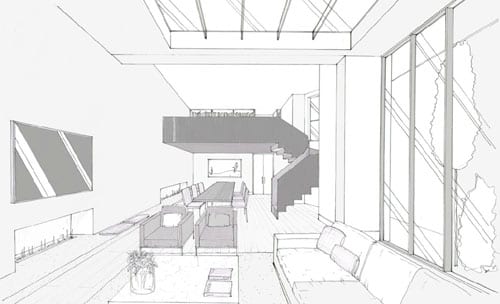
Equilibrium’s plans include a vast living-dining-kitchen with a study in the void over. The space is lit by a skylight. 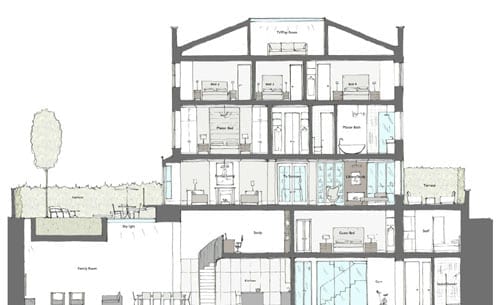
A cutaway shows the extent of the redevelopment planned 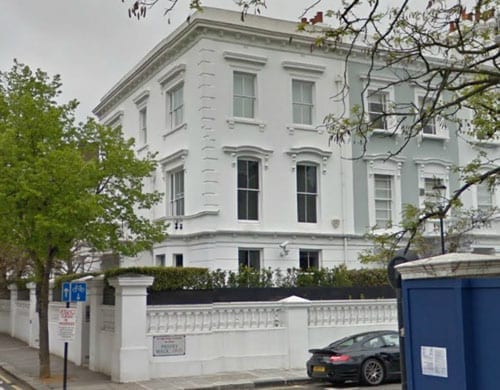
A view of 26 Gilston Road from the corner of Priory Walk Whilst the layout Tom Ford, himself a graduate in architecture from Parsons The New School of Design, created at 26 Gilston Road was ideal for A Single Man; the new floor plan with 4 bedrooms is much better suited to a family. Ford and his partner, Richard Buckley, announced the birth of their son, Alexander, in September. Perhaps they should put in a bid.
For more information about 26 Gilston Road, London, SW10 9SS, contact Russell Simpson, 5 Anderson Street, London, SW3 3LU. Telephone: +44 (0) 20 7225 0277. View a brochure for the property at: http://www.russellsimpson.co.uk/assets/12/06/15/5081/pdf_archive-1.pdf
View Equilibrium’s website at: http://www.equilibriumlondon.com
View Tom Ford’s website at: http://www.tomford.com
-

The Savile defence
Hugo Istay discovers Jimmy Savile’s most unlikely advocates: The Daily Mail
Here are some quotes from that bastion of the country’s morals, The Daily Mail. Apparently Jimmy Savile had been collecting ones like these for years to aid his defence should the proverbial hit the fan.

A screenshot of the somewhat “sexed-up” first version of the MailOnline article 
A screenshot of the somewhat “toned-down” second version of the MailOnline article
He was going to kick off his case with:
“Elle Fanning looks all grown up at 14.”
And then follow up with:
“She may be only 14, but rising star Elle Fanning isn’t counting on her good genes or youth to keep her slim. Wearing black cropped spandex jazz dance pants and orange Nike trainers, the little sister of Dakota had obviously been letting loose in the dance studio as her usually silky hair was hanging down in a sweaty tangle.”
No sexual innuendo there, then.
Next, he’d add:
”Dressed in a satin babydoll-style top, black skinny jeans and patent peep-toe wedges, Elle looked mature beyond her 14 years.”
Or this:
“She has a maturity that belies her years, so sometimes it’s difficult to remember that Elle Fanning is only fourteen years old.”
And, if all else failed:
“The 14-year-old took to Instagram to share a photograph of her Halloween outfit and wasn’t afraid to flaunt her curves for the camera.”
He then planned to sum up with:
“So it wasn’t my fault M’Lud, I was misled and egged on by the Daily Mail.”
Maybe there should be a crime of journalistic paedophilia.
Read the Mail Online’s original (now edited) article at: http://www.dailymail.co.uk/tvshowbiz/article-2226294/Halloween-2012-Elle-Fanning-pays-homage-New-Yorks-Statue-Liberty.html
This article was originally published on Hugo Istay’s blog. Follow him at: http://hugoistay.wordpress.com/
-
Angela Epstein
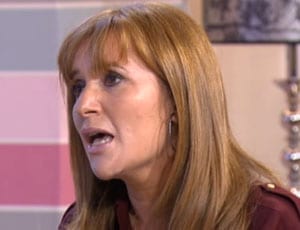
 The Daily Mail is renowned for enthusiastically bashing benefit scroungers but in November 2012, they gave Angela Epstein, whose household income is in excess of £100,000 a year, a platform to bleat that she wasn’t getting enough. This Manchester based mum of four has also penned articles speaking of her pride about driving her brats five minutes down the road to school and boasts that “being in the media puts a girl on the radar.” Epstein makes Samantha Brick seem positively sane and we really hope that someone will just turn this ridiculous woman’s antenna off.
-
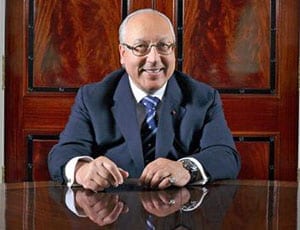
Urs Schwarzenbach
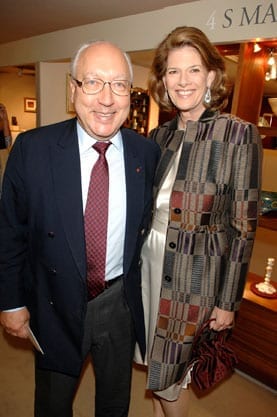 This Swiss born son of a printer has spent over £85 million buying up properties in the Henley-on-Thames area of Oxfordshire. Schwarzenbach also owns 123,000 acres in Australia, 26,000 acres in Scotland and has his own polo team, the Black Bears. This financier’s foreign exchange dealership, Interexchange, is the biggest in Switzerland and betting against the dollar has brought much success. He supposedly even named his Gulfstream G650 “George” as “ultimately it was Bush who paid for it.” Whilst Schwarzenbach’s Grand Hotel Dolder in Zurich wins plaudits galore. an investment in Mayfair’s Café Grand Prix was less successful. It is, however, for philanthropy and discretion that Schwarzenbach and his wife, a former Miss Australia, are known best.
-
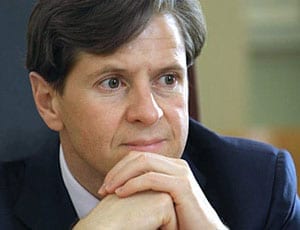
Andrey Borodin
 This billionaire former president of the Bank of Moscow lives in exile in London and is on the Interpol Red Notices wanted list as a suspect in a £136 million (13 billion rouble) fraud. (more…)
-

Charmian Brent (better known as Charmian Biggs)
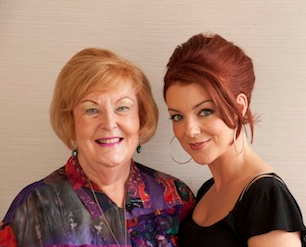 In the autumn of 2012, an ITV1 series, Mrs Biggs, dramatised the life story of this headmaster’s daughter from Reigate, Surrey. In it, Sheridan Smith (pictured here with the real Mrs Biggs) portrayed a lady of steely reserve who is intelligent, articulate and courageous. The former wife of the Great Train Robber Ronnie Biggs has now built a new life for herself in Melbourne, Australia as an editor, publisher and journalist and on crime, her views are simple: “[It] doesn’t pay in any way, shape or form.”
-
Robin Sheppard: “What’s on your mantelpiece?”
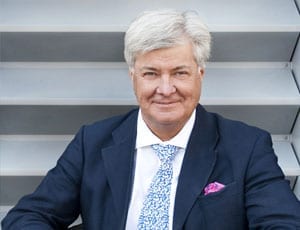
The Steeple Times asks hotelier and chairman of Bespoke Hotels Robin Sheppard: “What’s on your mantelpiece?”
The Steeple Times shares “wit and wisdom.” What’s your guiding force?
Hunger.
“Don’t get even, get medieval” is, in our humble opinion, a great motto. What’s yours?
“While I breath, I hope.”
Kerry Katona was considered unacceptable in 2007. Who or what is unacceptable in 2012?
Piers Morgan.
Tony Blair misses being Prime Minister. What do you miss most in your life?
The ability to fit into non-elasticated trousers.
What might you swap all your wealth for?
I might swap it for anything. However, I would swap it for nothing.
Donald Trump was once a case of: “If you owe the bank a thousand, they close you down; but if you owe the bank a billion, you own the bank.” What’s your view on the banking crisis?
I think it’s a great shame that people no longer consider their bank manager to be a friend. We’ve lost the trust. It’s very different now to how it once was.
What phrase or word do you most loathe?
“At this moment in time”: What a waste of words.
In the UK, some people consider charity to “begin at home.” What’s your view and what causes do you personally support?
I am affiliated with the Guillan-Barre Syndrome Support Group.
The judge in “Law Abiding Citizen” states: “I can pretty do whatever I want” before being blown up whilst answering her mobile phone. What’s your view on the appropriate use of such devices?
Turn them off when you’re on the loo. Or at least try not to use them.
If you could fill a carriage on The Orient Express, who would be your fellow passengers?
Are we murdering or sightseeing? Either way, the answer’s probably family.
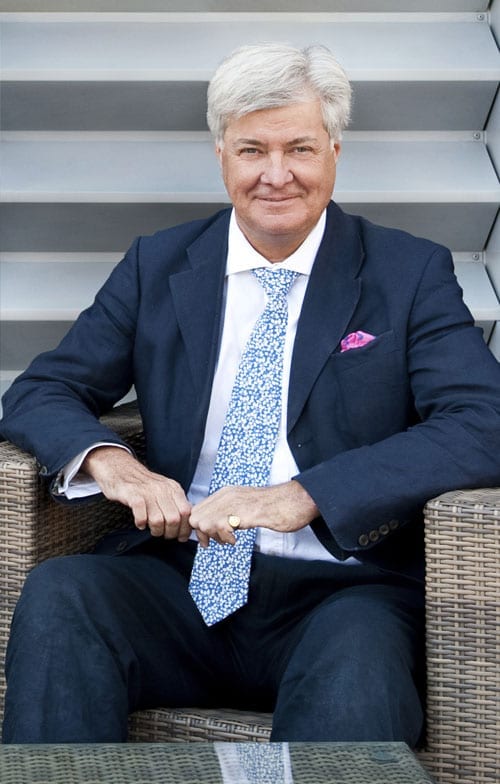
Hotelier Robin Sheppard If you were unfortunate enough to end up on death row, what would be your last meal and where would you eat it?
Presumably I’d have to eat it in the prison I doubt they’d let me go on a picnic. I think I’d have spaghetti bolognaise with a robust Chianti.
What time is it acceptable to consume the first drink of the day?
Immediately after you finish work. Whichever time that may be.
A Negroni, a martini or a cup of tea?
Cup of tea.
Whose parties do you enjoy the most and why?
If I remembered them, they can’t have been that much fun, can they?
Who is the most positive person you know?
My golf instructor. He’s always laughing whenever I take a shot.
What’s your most guilty pleasure?
Pork scratchings.
If a tattoo were to sum you up, what would it be of?
That festival in Edinburgh.
If you were a car, what marque would you be?
A monster truck.
Cilla Black presented “Surprise, Surprise.” Tell us the most surprising thing about you.
I’m an only child.
What’s currently sitting on your mantelpiece?
A handful of birthday cards.
Robin Sheppard is a classically trained hotelier and chairman of Bespoke Hotels. He is also managing director of Alfresco, designed the iconic bottle for Ty-Nant mineral water and is the author of A Solitary Confinement (2007).
To purchase a copy of Sheppard’s book, A Solitary Confinement, go to: http://www.amazon.co.uk/A-Solitary-Confinement-Robin-Sheppard/dp/1905823258. Watch a video interview with him about Guillan-Barre Syndrome at: https://www.youtube.com/watch?v=S9SQKayEQEo
For more information about Bespoke Hotels, go to: http://www.bespokehotels.com and for information on Alfresco: http://www.alfresco.co.uk
-
Cows don't wear Rolexes
Charles Mitford Cust asks: “Do the clocks really need to go back?”
Yesterday, once again, the clocks went back and now we are officially in winter. As is always the case on this sad annual occasion, I am left asking myself why we have do something so apparently illogical and what are the origins of this extraordinary ritual.

These “hairy beasties” definitely govern the clock rather than being governed by it I used to think it all started in World War Two but, in fact, having done some research, it transpires that we very sensibly did the exact opposite during the war years. Between 1940 and 1945 and also in 1947, we actually switched to “British Double Summer Time” (BDST). Why? We did so to save precious fuel as it was in limited supply. That should strike a chord today, don’t you think?
You bet it should. Supporters of BDST point out that 500,000 tonnes of CO2 would be saved this year if instead of putting the clocks back yesterday, we’d left them alone and then put them forward one further hour in the spring, thereby achieving British Double Summer Time (BDST). Half a million tonnes of CO2… Wow! That is the equivalent of permanently removing 185,000 cars from the road. Hang on, aren’t we meant to be concerned about the environment these days or am I missing something?
Where are the eco-warriors? Surely they should be screaming from the rooftops about CO2 savings like this. This makes all their bleating about wind turbines and solar panels seem stupid. Unlike these alternative energy sources, which we all know are only viable thanks to taxpayer subsidies, putting the clocks forward is free, and you can’t get anything greener than a free CO2 reduction. Yet strangely there is barely a whisper from the normally most vocal section of the green orchestra. Now, I am no conspiracy theorist, but I cannot help but feel that this is highly odd if not darn right suspicious.
There have always been myths concerning BDST, including strong if vague references to the requirements of farming being the reason for us being plunged into darkness earlier than necessary. This is something that, as a countryman, I have always found puzzling.
Farmers do not rely on the time indicated on their watches to go about their business. They do what their ancestors have done for thousands of years: they operate from first light to last light. The time that happens to be recorded on a watch face is all but irrelevant to them because unlike 90 per cent of the population, they do not have to catch trains or commute to work. What’s more, cows don’t wear watches, they just know when they want to be milked and they don’t care what Mr Rolex has to say about it.
Interestingly though, even this well used excuse seems to have been run off the road. In March 2010, in a survey of their membership, the National Farmers Union found that most respondent farmers were neutral about BDST and actually the only strong representation was from members supporting longer daylight in winter.
Another long-term excuse is that children in the north of Britain would be in more danger walking to school in the mornings if it were dark. “Walking to school?” When was the last time a kid walked to school in this country? 1951? Seriously though, with traffic density as it is today, no responsible parent would let their child walk to school even if they could do so. As Lord Archer has pointed out, this is outdated nonsense and therefore not a viable excuse for rejecting BDST.
The Royal Society for the Prevention of Accidents (RoSPA), the RAC and the AA have campaigned for years to reintroduce BDST as they argue that police accident records clearly indicate that more accidents occur in the dark evenings during rush hour when tired commuters are returning from work than when they are fresh in the mornings. According to their research, they estimate 600 lives per year could be saved. 600 lives: that’s the equivalent of a bloody massacre. The government moved heaven and earth to ban competitive handgun target shooting when 30 people were killed but have routinely ignored 600 lives per year for decades? What are these politicians doing?
A Conservative Member of Parliament, Rebecca Harris, put forward the Daylight Saving Bill 2010-12. It was debated in November 2011 and January 2012, but despite being supported by “Call Me Dave” himself, it was filibustered out of Parliament by largely Scottish based members who argued it would disadvantage Scotland.
These politicians used this argument despite a 2010 survey of 3,000 Scots indicating that they were actually in favour of BDST. I guess Scots like to save money on their heating bills too: oh, there’s a surprise. Anyway, the efforts of these objectors were enough to ensure that the bill’s time was used up and it will now proceed no further.
What? That’s it? 500,000 tonnes of CO2 and 600 lives a year swept under the carpet because a couple of whingeing Scottish MPs are out of touch with their the views of their own constituents? Does that sound right to you? Even if they didn’t vote for BDST, which with fuel prices the way they are, being canny Scots, they almost certainly would, why can’t Scotland have it’s own time zone? Many of them want independence, so here’s a good start. As an aside, evidence also shows that if Scots did adopt BDST, their suicide rate would drop dramatically as the statistics show this is clearly linked to long dark winter nights.
Either way, we have reached a point where political correctness simply has to be outweighed by common sense. You cannot let 85 per cent of the UK population suffer for the sake of the other 15 per cent. What of the adverse affect this is having on GNP at a time when the economy is struggling so much?
The thing about this clock moving business is that the more you search for answers, the more questions you are left asking. One is forced to conclude that it is either a deeply sinister conspiracy involving multi-billion pound energy companies who would rather we carried on paying for an extra half a million tonnes of unnecessary smog, or simply an old fashioned British farce of monstrous proportions.
All in all, I’m left rather perplexed. What’s your view? Isn’t it time that something changed?
-

The “i” wise monkeys
Gina Miller asks if today’s “i” generation can still embody the proverbial maxim “see no evil, hear no evil, speak no evil”
The hysteria and media attention around the iPhone 5 and the iPad mini has made me take note and observe “i” gadget usage over the last few weeks. The idea of people queuing outside Apple stores in these times of austerity when so many are struggling seems totally absurd to me. Even more absurd is that these individuals behave like addicts and do not question what mobile phones are doing to their lives. They just can’t wait for the next high.

Do the “i” generation truly understand this principle? My observations of “mobile junkies” started on the 21st September. During the day there was media coverage of the launch of the iPhone 5 and interviews with joyous consumers as they got their hands on these new toys. In the evening, I attended a truly inspiring concert to celebrate and publicise Peace for One Day. The concert marked the United Nations’ World Peace Day, which calls for a day of global ceasefire and non-violence. Prior to the music there were links from leaders around the world in support of the day including a speech about global action against domestic violence, an Afghan Leader in support of the day and the extraordinary director of Interpeace, Scott Webber. And what were the people at either side of me, above me, in front and behind me doing? They were texting, emailing, playing games and obsessively tinkering with their mobiles.
From the woman talking on her mobile as she steps into the road to cross without ever looking up, to the parents waiting in the playground for their children texting and emailing, the mobile has taken precedence over what we should really be paying attention to. In restaurants, couples and families do not talk to each other but instead have their mobiles in their hands as they eat and prop up mobiles or iPads playing cartoons for the children instead of talking to them. Have we lost all sense of propriety? When do we talk to each other? When do we get to know our children?
People text to ask someone out, they text to break up and they text to ask what is for supper. Trust in relationships is tested as women track their husband’s iPhones and if a partner doesn’t call or text at least five times a day then the other questions the depth of commitment or love. Children as young as seven demand iPads or mobiles from doting parents who don’t know how to say ‘no’ or instil the idea that you strive to attain the rewards of hard work. There are even reported increases in teenagers and a young adult complaining of aches and pains in their thumbs due to over-texting. 24/7 email access engenders expectations and stress that means people are never really shutting down from work mode. People on trains incessantly chatter and children get brutally attacked on their way home from school for their mobiles. All sense of privacy has been eroded as any celebrity or person in the public eye can be spied upon now that mobiles have cameras. All these negative trends are due to these gadgets but sales keep rocketing most especially amongst those who can least afford them.
I read with interest an account from a guide at the Sistine Chapel who said visitors come in, take photos on their phones and iPads and then move to the next room. No one, the guide suggested, really looks with their eyes, wonders or lingers at the beauty before, around and above them anymore. For these visitors, instead, it is all about taking the picture and instant gratification.
Whilst mobile phones keep us in touch and mean we can assure our loved ones we are safe, running late, find out about the children or ask whether grandmother is warm; this convenience appears to come at a very high price. Apple recently sold its 100 millionth iPad and reported profits of £5.08 billion in the three months to 29 September 2012. Apparently there were 2 million iPhone 5s ordered in the first 24 hours and similar figures are expected for the aggressively priced iPad mini. If you the average spend one of these new gadgets were to be conservatively calculated at £200, that gives a total spend of £400 million. Just think what a difference that amount of money would make if each person gave it instead to the extraordinary small community charities who battle at the coalface of the negative trends in our society?
The ancient three monkeys proverb associated with being of good mind, speech and action has been corrupted by gadgets and now in the modern world we turn a blind eye. We have grown an extra appendage that we appear unable to live without.
What if we all engaged in a national day of no phones or portable tablet? What if, as a social experiment, all networks were also to shut down for one day? Would we not have a different sort of ‘peace day’ that would start to rebuild our interaction, families, relationships and empathy? We would have to look into each other’s faces when we spoke and we might remember when we laughed more, talked more and maybe even tolerated more. If we took up this challenge, perhaps we might even rediscover some of our lost humanity and ‘we’ culture rather than the egotistical ‘i’ culture that sadly dominates society today.
Gina Miller, founder of Miller Philanthropy, is the host of Champions in the Community at The Hurlingham Club on 8th November 2012. For more information and to donate, go to: https://mydonate.bt.com/events/championsdinner