Matthew Steeples asks: “Are intimidation tactics at work with a suspected arson attack on the caravan storage site formerly owned by the mother of Luke Mitchell?” and speaks with Dr Sandra Lean and Shaun Attwood about this most curious case
On Friday, the caravan storage site formerly owned by Corrine Mitchell, the mother of Luke Mitchell, was mysteriously torched.
Whilst Mrs Mitchell, whose son was convicted of killing his then girlfriend Jodi Jones in 2003, no longer owns the aforementioned property in Midlothian, that it was likely the subject of an arson attack is indicative of how passions continue to run high in a case where many believe the wrong man was convicted.
Speaking exclusively to The Steeple Times on Saturday evening, Dr Sandra Lean remarked:
“Almost twenty years after the murder of 14-year-old Jodi Jones in Easthouses, Midlothian, a building was set ablaze in a nearby field on Friday, 17th March 2023. Gas bottles inside the building could be heard exploding from half a mile away and residents in houses directly across the street were terrified – there was a petrol station right next door.”
“But what do the two events – the murder of Jodi Jones and the burning of an apparently random building, have in common? On the surface, nothing. The building and the land on which it sits belong to the local council. But that is now. Until just over two years ago, the building was the former shop and workshop of a caravan sales business – Scotts Caravans – belonging Corinne Mitchell – the mother of the boy convicted of Jodi’s murder, Luke Mitchell.”
“Luke has always protested his innocence, but, such was the level of hostility and hatred instigated by the media coverage of the case, both at the time and over the years since, that Scotts Caravans was targeted repeatedly.”
“After Luke was convicted, a deliberately started fire destroyed a large number of caravans stored at the site. After his appeal failed, another fire destroyed the remainder. Corinne Mitchell, who was never convicted of any wrongdoing – whose only ‘crime’ was continuing to try to tell the world that her son was innocent – lost everything. Her home, her business, her son, her health.”
“She was, after her son, the most hated person in the area. In the end, she was homeless and penniless, living in the corrugated tin building that had once been the shop and workshop area of her thriving business. For six years, she lived there with no electricity, no running water, no toilet, no heating and no money.”
“When Channel Five filmed a documentary about the case – and the horrific circumstances in which Corinne was living – Midlothian Council finally housed her. The documentary attracted a huge amount of new – and this time, positive – attention to the case.”
“Local people were furious to discover they had been misled as the truth about the case began to be exposed – dishonesty by witnesses close to the victim’s family which deflected attention from them and guided it towards Luke. It was easy to do back in 2003 – the media decided, from the off, that he was Jodi’s killer, naming and photographing him, at the age of just 15, telling readers he was ‘the only suspect.’ Two ex-detectives in the documentary concluded otherwise – there were, they discovered, others much closer to the victim’s family, who should have aroused far more suspicion than Luke Mitchell.”
“For two years, debates have raged about this case, both locally and throughout Scotland. But in December last year, more wrongdoing was exposed – this time, Police Scotland were caught, red-handed, destroying evidence that could have taken the case back to the court of appeal and seen the conviction of Luke Mitchell overturned. Local attention turned to those identified in the documentary as other, potential ‘persons of interest.’ Those people fought back – there have been reports of threats, harassment and intimidation by those people, towards people now speaking out in support of Luke. Tensions, once again, were running high.”
“And then, on Friday, the last remaining reminder of Scotts caravans was set alight. Locals took to social media in droves, concluding that this was an act of outright intimidation, intended to scare those fighting to have the case re-examined, into silence. To hurt and punish Corinne Mitchell again, for having the audacity to stand by her son. If that was the intention, it did neither. While the symbolism wasn’t lost on many, ultimately, an old, abandoned building belonging to the council was burned to the ground and the campaign to have Luke Mitchell’s case re-examined carries on unhindered.”
Going further and also speaking exclusively to The Steeple Times this morning, the podcaster Shaun Attwood very clearly added:
“Everyone I have interviewed who has been in prison with Luke Mitchell has stated that they truly believe he is innocent.”
Today, I join with those demanding further investigation into this matter. Whether he is innocent or guilty, the potentially unsafe case of the conviction of Luke Mitchell requires a complete reinvestigation.
Editor’s Note – Unlike as is the case in many publications, this article was NOT sponsored or supported by a third-party. Follow Matthew Steeples on Twitter at @M_Steeples.
Was the fire on Friday at the caravan site formerly owned by the mother of Luke Mitchell a signal of intimidation at a time when Corinne Mitchell and others are campaigning for a review of the case of the murder of Jodi Jones? #LukeMitchell#JodiJoneshttps://t.co/YkMk1JWg67
This morning on Twitter, Matthew Steeples asked: “Was the fire on Friday at the caravan site formerly owned by the mother of Luke Mitchell a signal of intimidation at a time when Corinne Mitchell and others are campaigning for a review of the case of the murder of Jodi Jones?” As of 11:00am on Sunday 19th March 2023, a very clear majority of respondents (84%) favoured the second of the two options: “Yes, a definite warning.”The fire that took hold at Scotts Caravans on Friday 17th March 2023. Was this an accident or was it arson?If the wrong man is indeed in jail for the 2003 murder of Jodi Jones, her killer is likely still alive and still at large and still evading justice. If that is the case, Lothian and Borders Police have a lot of questions to answer as to why they didn’t correctly deal with the evidence available to them.
As it is revealed that Scottish police disgracefully destroyed evidence in the Luke Mitchell case, we highlight two other equally shocking examples of police evidence destruction and call for reinvestigations of all three cases
Last night, in what he justifiably called a “bombshell” and announced as an “exclusive,” The Scottish Sun’s Douglas Walker revealed that Luke Mitchell, convicted of killing his girlfriend Jodi Jones in Dalkeith, Midloathian in 2003, “could sue prosecutors after it emerged they sanctioned the police to destroy evidence from the murder case.”
According to the paper:
“Cops illicitly destroyed protected evidence from the Jodi Jones murder case, we can reveal. More than 100 legal productions including burnt clothes were secretly uplifted for disposal – against police rules.”
“Now it’s emerged that Mitchell’s legal team could sue prosecutors after it emerged they sanctioned the police to destroy evidence from the murder case.”
“An insider revealed he could argue his right to an appeal has been hampered with Crown Office lawyers now desperate for assurances he won’t take them to court.”
“A letter from the Lord Advocate’s government solicitors admitted the evidence had been taken away – and confirmed destruction had now been halted.”
Continuing, “an insider told The Scottish Sun” that:
“A load of officers from the Major Investigation Team went to Edinburgh to remove over 100 productions. This included some burnt clothes found about a thousand metres from the locus.”
“They loaded boxes into a police van and took them to Livingston police station. The Crown Office had signed off the items to be returned to the owner or destroyed. This is not normal procedure, especially in a murder case.”
“Mitchell could now argue his right to a fair appeal has been denied as evidence has been destroyed. This could lead to a judicial review which could even pave a way to his release.”
In the case of Bamber, critical evidence was burnt in the garden of White House Farm and taken home by officers by Essex Police even and in a further example, that of Mark Alexander, who has been in jail for killing his conman father since 2010, it was just as bad.
Found guilty without any forensic evidence and with the help of Midsomer Murders-esque “suspicious neighbours primarily, supporters of Alexander rightly highlight that the prosecution withheld critical information from trial that included that four potential suspects – who police never bothered to speak to – were never even mentioned to the jury.
Going further and summing up what led to the conviction of Alexander, Progressing Prisoners Maintaining Innocence (PPMI), observed: “Another example of typical factors in a wrongful conviction: no forensic evidence, impossible time frame for the crime to be committed, witness put off by the police, important witnesses not interviewed, lurid allegations in the press published before they could be countered, all racked up by such sad personal circumstances.”
It is time for all three cases to be revisited and at the very least those officers that destroyed key documents and items must be quite rightly be brought to book. Justice is never just if it is based on the police manipulating the evidence that gets that very justice.
Editor’s Note – Unlike as is the case in many publications, this article was NOT sponsored or supported by a third-party.
Pictured Top – Left to right: Luke Mitchell, Jeremy Bamber and Mark Alexander; three men who remain in prison and convicted of murder in spite of there being significant evidence of police mishandling of evidence in each of their unlinked cases.
Evidence Destruction By Police – Campaigns Supporting Mark Alexander, Jeremy Bamber and Luke Mitchell
Here are three men who continue to rot in prison. Each may or may not be guilty of the murders they were convicted of committing. However, though, the protests of innocence of each man should be judged on the merits and failings of each case alone, what links these three men is that the police very, very clearly shockingly botched the handling of evidence that led to each of their convictions.
Each man – Mark Alexander, Jeremy Bamber and Luke Mitchell – as a result of a questioning public and critical experts highlighting the flaws in their cases, has attracted large support. More details about the campaigns seeking reinvestigations into each of their cases follows:
MARK ALEXANDER – Convicted of the murder of his father in 2010; has never ceased maintaining his innocence
To follow the ‘Justice for Mark Alexander’ group on Facebook, click here, and to follow the campaign seeking a review of the case on Twitter go to @PatientCaptive. Prominent supporters include the former Conservative MP for Westminster The Rt. Hon. Mark Field, the Reverend Canon Grant Fellows, the Right Reverend Bishop Tim Stevens and the hostage-turned-humanitarian Terry Waite CBE
JEREMY BAMBER – Convicted of murder of 5 members of his family in 1986; has never ceased maintaining his innocence
To learn more about the Jeremy Bamber Innocence Campaign – whose supporters number former MP Andrew Hunter, barrister Flo Krause, human rights campaigner Peter Tatchell and magistrate Lady Waterlow – and to join those calling for a reinvestigation of this case, click here. Follow on Twitter at @BamberTweets and join the ‘Jeremy Bamber Justice Group’ by clicking here.
LUKE MITCHELL – Convicted of the murder of his girlfriend in 2005; has never ceased maintaining his innocence
To join the official Facebook group focused on highlighting the supposed flaws in the police investigation that led to the conviction of Luke Mitchell, click here. To join the 25,400 people who have already signed the Change.org petition requesting a “full, independent review” of the Luke Mitchell case, click here.
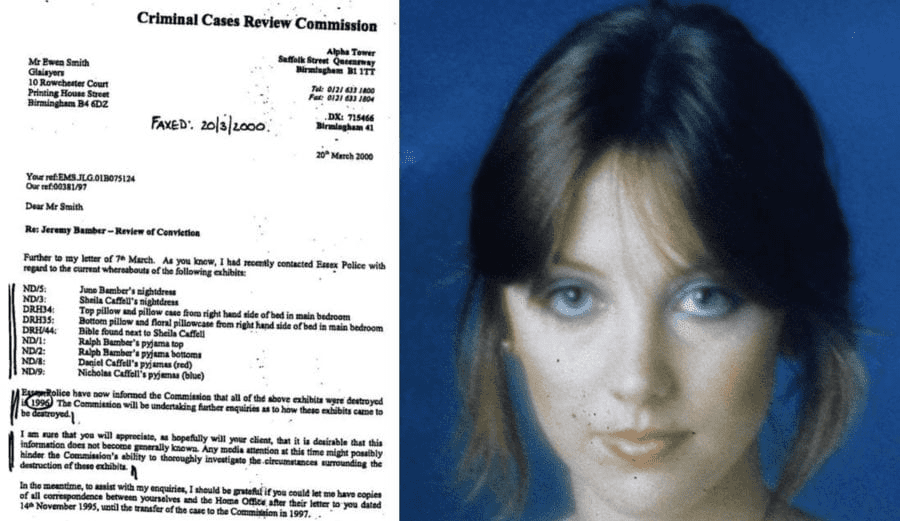
Earlier this month, Tom Halliday (pictured), a Midlothian car mechanic turned bathroom designer and fitter, revealed that he found a knife in a skip just 500 yards from where the body of schoolgirl Jodi Jones was found just days after her 30th June 2003 murder. He reported it the police and spoke out again now after recently finding out that his find was never even mentioned let alone submitted during the trial. Mr Halliday commented: “Nobody placed any importance on that knife. When I learned it wasn’t documented, it raised my suspicions the police may have tried to conceal the discovery.” Going further, a lawyer for Luke Mitchell, Scott Forbes, added: “This is the real missing knife… It was either destroyed went missing if it didn’t fit the police narrative.”Amongst items not only never shown to the court at the trial of Jeremy Bamber was this bible. Though photographed by Essex Police at the crime scene next to the body of Sheila Caffell – the only other suspect in these familial murders – it was shockingly destroyed. “What motivated officers to do this?” remains a question that very clearly ought to be answered.In April 2020, ‘The Steeple Times’ reported that “further questions about the conduct of Essex Police [were] raised as it [was] revealed they destroyed the bible, nightclothes and pillows that were found with the victims at White House Farm on the night of the 1985 murders. The 20th March 2000 letter from the Criminal Cases Review Commission to Glaisyers Solicitors LLP and Sheila Caffell is truly a shocking example of a bungling balls-up.Of how the police handled the investigation into his father’s murder in 2009 and the discovery of his body subsequently at his home at 2 Prospect Close, Drayton Parslow, Milton Keynes, Buckinghamshire, MK17 0JB, Mark Alexander observed: “Once I was in their sights, things went downhill pretty quickly. Supporting testimony offered by my mum in police interview wasn’t shared with my defence team. Samples taken at the burial site weren’t bagged correctly, so degraded in transit before they could ever be tested. When I gave officers a list of dad’s aliases, the leads weren’t followed. And despite there being no sign of the murder itself having taken place at the house, no efforts were made to search the local area for clues. Instead of being guided by the facts, the facts were reinterpreted to fit the suspect, me. The pathology reports gave a two-month window within which dad’s death might have occurred. Everything then focused on fixing the murder as close as possible to the beginning of that window in order to provide me with just enough time and motive to render what they already believed to be true plausible. It was classic confirmation bias.”
As a 25,000 strong petition is set to be delivered to the Scottish Parliament, we join those asking: “Could convicted killer Luke Mitchell be innocent of the murder of his girlfriend Jodi Jones?”
After hostage-turned-humanitarian Terry Waite CBE highlighted flaws in the September 2010 conviction of Mark Alexander, The Steeple Times examined that case and joined those campaigning for, at the very least, a review of the evidence gathered by a police force who we believe simply wanted a quick and easy conviction.
Often highlighted wrongly as the “Scottish ‘Black Dahlia’ case,” the case of the brutal murder of a 14-year-old schoolgirl named Jodie Jones in Dalkeith, Scotland on 30th June 2003 is another example of a case that continually attracts claims that the convicted perpetrator could actually be innocent.
Whilst Lothian and Borders Police successfully pinned the blame of Miss Jones’s murder on her boyfriend, Luke Mitchell, and secured his conviction in January 2005, tomorrow, Wednesday 16th November, his legal team will deliver a petition signed by 25,000 individuals to the Scottish Parliament demanding “an urgent and fully independent inquiry.” They believe the conviction to be unsafe and cite that “upto 122 items gathered as part of the investigation into the death were never forensically tested.”
Mitchell – who had been dating Jones for four months prior to her murder – was found guilty of killing her by hitting her on the head and body, compressing her neck, restricting her breathing and stabbing her both before and after she died in January 2005. He was sentenced to serve a minimum of twenty years in prison and though several attempts to overturn his conviction have failed, he continues to protest his innocence.
Recently, Scott Mitchell, who has been the lawyer for Mitchell since 2010 but also involved with the case since 2003, remarked:
“Forensic science has improved dramatically. I believe DNA samples that went untested will overhaul the conviction if we can examine them now. Without a doubt, that will prove Luke Mitchell did not kill Jodi.”
A full statement regarding the alleged failings in the case brought by Lothian and Borders Police follows after the videos and photographs beneath this article. It has been compiled by supporters of Luke Mitchell, a dedicated group who have been in touch with The Steeple Times for many months now.
To join the official Facebook group focused on highlighting the supposed flaws in the police investigation that led to the conviction of Luke Mitchell, click here.
To join the 25,400 people who have already signed the Change.org petition requesting a “full, independent review” of the Luke Mitchell case, click here.
Pictured Top – Luke Mitchell with his mother, Corrine.
Editor’s Note – Unlike as is the case in many publications, this article was NOT sponsored or supported by a third-party.
If the wrong man is indeed in jail for the 2003 murder of Jodi Jones, her killer is likely still alive and still at large and still evading justice. If that is the case, Lothian and Borders Police have a lot of questions to answer as to why they didn’t correctly deal with the evidence available to them.
It’s easy for police to pin the blame most especially on young men and in the case of the 2010 conviction of Mark Alexander – pictured here with hostage-turned-humanitarian Terry Waite CBE on the day he graduated in jail – the complete lack of forensic evidence in his conviction for his deviant father is very, very, very troubling. His case deserves to be revisited given all the new evidence that has been found.Two cases involving that of the 1986 conviction of Jeremy Bamber (left) and the 2001 murder of Stuart Lubbock (right) raise questions as to how Essex Police bungled the investigations by mismanaging evidence and making countless errors. We believe both cases should at the very, very least be reinvestigated due to the clear incompetence of this particular police force.In America, the July 1996 jailing of brothers Erik and Lyle Menendez for life without parole rightly continues to be condemned as an outrage given that the evil parents they slayed were clearly both guilty of having abused them consistently until their 20th August 1989 deaths in Beverly Hills, California. These repeatedly sexually abused brothers should have been convicted of manslaughter and they should now be freed.
Text supplied by a member of the Facebook group supporting Luke Mitchell that explains their take on why they believe him to be innocent of the 2003 murder…
The murder of Jodi Jones, a 14-year-old girl, took place in Dalkeith, Scotland on 30th June 2003. Her 14-year-old boyfriend, Luke Mitchell, came under suspicion, but it was several months before he was arrested.
Mitchell was tried for the murder and after Scotland’s longest single-accused trial at that time, Mitchell was convicted by a majority verdict in January 2005 despite there being no direct evidence against him. He was sentenced to a detention without limit of time with a minimum punishment part of 20-years. He has always maintained his innocence.
Jodi Jones left her house after exchanging a series of text messages with her boyfriend Luke Mitchell at around 5pm. She was found horrifically mutilated in a woodland strip behind a six-foot high wall at 11:35pm.
Her boyfriend Luke Mitchell and his dog Mia found her along with Jodi’s sister, Jodi’s sister’s boyfriend and her gran while they searched the path together.
Upon arrival the police separated Luke from the rest of the search party and took him to Dalkeith police station to be forensically examined. The police did not consider the rest of the search party as important witnesses until almost five hours into the investigation. Their clothing would not be taken for examination until around six days after the murder. By the time they were handed in they had either been laundered or different items to the ones said to be worn on that night were handed in to the police.
Forensics arrived at the scene at 8am the following morning, some time prior to this, two identification officers had gathered up all Jodi’s clothing and belongings but they didn’t record how they were collected or packaged.
Jodi was rolled onto a plastic sheet, branches were cut down to make the scene more accessible and the body was not covered leaving any potential evidence exposed to the rain. No attempt was made to estimate the time of death, there are no records of liver temperature, or signs of rigor or livor mortis.
Bin collections still went ahead that day, as did council hedge cutting, and the high school very close by was open as normal with students using the surrounding paths to access the school, while Jodi’s body still lay there uncovered.
Due to the way the crime scene was managed, a lot of potential evidence was destroyed. Despite this there was one full DNA sample recovered from Jodi’s clothing which was a match to another member of the search party, Jodi’s sister’s boyfriend, one semen sample from a condom nearby Jodi’s body and three full samples of DNA which have yet to be matched to anybody. There were many other partial samples found made up of blood, semen and saliva. There was no DNA from Luke Mitchell found.
Despite having other leads to follow and forensic evidence from the scene pointing away from Luke Mitchell, the investigation remained focused on him throughout. The general feeling in the area was that Luke Mitchell would be arrested any day now. In fact, it would take ten months for the police to make an arrest, one which was based on a wholly circumstantial case. During those ten months the media reported almost daily coverage of the case. Luke Mitchell and his mother, Corrine were shot to infamy overnight.
With no direct evidence linking Luke to the crime, the investigation focused in on music and ‘goth culture’ in an attempt to explain why Luke might have murdered Jodi. Both Luke and Jodi were a part of the ‘nu-metal wave’ that was popular during the early 2000s as were many of their friends. The police thought this was important to the investigation and told the media, only five days after the murder;
“We will be looking at what Jodi and her social circle were interested in and an obvious area will be their ties to the Goth movement. We will be examining if the manner in which she was killed has any links to the violent world that many Goths find fascinating and will be speaking to all her friends who had similar interests.”
Fear swept through Dalkeith and the rumour mill went into overdrive. Luke’s school jotters, with quotes from popular video games scrawled across the front were used to imply he had a fascination with the devil.
Police statements reveal that they were asked to search Luke Mitchell’s house for anything related to the singer Marilyn Manson. The police investigation believed that Luke was obsessed with Manson and in particular a series of paintings done by the artist depicting the body of murder victim Elizabeth Short, more commonly known as ‘The Black Dahlia.’
The crown put to the jury that Mitchell was attempting to replicate the killing of Elizabeth Short. In contrast to this, the pathologist who examined Jodi’s body said that there were markedly dissimilarities between the injuries sustained by Elizabeth Short and Jodi Jones and any similarities were superficial.
The only things related to Marilyn Manson that were found during the search of Mitchell’s home was a torn-up calendar and a CD that he had bought two days after the murder. There was no evidence found on Luke’s computer that he had accessed these paintings and the officer who found them online said they were not easy to find.
After ten months of press coverage naming 14-year-old Luke Mitchell as the only suspect and portraying him as a Satanist obsessed with Marilyn Manson, black magic and the occult, was there any need for evidence to convince the judge and jury?
At appeal the crown decided that the Marilyn Manson and Black Dahlia evidence was not to be founded upon. The evidence that had been the backbone of the investigation into Luke Mitchell for ten months, kept the focus on Luke when all other evidence was pointing away from him, and had led to a 14-year-old child being portrayed as already guilty in the press before he was arrested and charged was not to be founded upon.
Discarding the evidence that had been used to portray Luke Mitchell as a killer obsessed with occult rituals and the devil, the crown set out three main pillars of evidence with twenty adminicles of evidence interwoven between these main pillars, that they believe the jury was entitled to base a guilty verdict on. The guilty verdict was based on broad presumptions and inferences in the crown’s case which contradicts exculpatory evidence put forward by the defence.
The circumstantial evidence that was used to convict Luke Mitchell does not hold up to scrutiny.
Pillar one is concerned with guilty knowledge. The crown claimed that Luke Mitchell had knowledge of where Jodi’s body was and that he led the search party straight to it. During the trial the other three members of the search party claimed that on the night of 30th June, Luke had led them to the body and that he was cold and emotionless.
During the first month of the investigation statements taken by these other three members of the search party were consistent with Luke’s version of events – that he had walked past the V-break in the wall, his dog was ‘air sniffing’ and jumping up at the wall so he doubled back and climbed over the V-break. All of the statements began to change after that first month in similar ways to imply that Luke led them right to Jodi’s body.
Pillar two was the evidence of witness ‘AB’ who claimed she had seen a male and a female at the Easthouses end of the path. Despite the descriptions she gave not matching Luke or Jodi and the timing of the sighting contradicting two other witness sightings by people who knew Jodi and the witness herself failing to identify Luke Mitchell in the dock, this sighting was accepted by the jury and is used to infer that Luke Mitchell was at the Easthouses end of the path and in the company of Jodi before her death.
Pillar three, Luke’s alibi. Luke claimed that he was at home cooking dinner at the time of the murder, this is corroborated by two landline telephone calls until 16:25, and his mother and brother [Shane Mitchell, hereby referenced as ‘SM’] from 16:25 to 17:30. He left his house at around 17:30 to wait for Jodi at the end of his street, where he was seen acting normally and wearing the same clothes he had on earlier at school that day, by a couple of boys who knew him. The investigation would not accept Luke’s alibi.
Luke’s mum and brother were charged with perverting the course of justice. These charges would later be dropped without the jury’s knowledge, just before Luke’s mother gave evidence in the trial.
When he was arrested for perverting the course of justice, ‘SM’ was subjected to the same nature of questioning that the police had used on Luke.
At appeal, judges described the nature of this questioning as “abhorrent,” saying “at times the nature of the questioning was such that the questioner did not seem to be interested in a response from the appellant, but rather endeavouring to break him down into giving some hoped for confession by his over bearing and hostile interrogation” (2008 appeal).
‘SM’ was told that if he didn’t tell the police what they wanted to hear he would go to jail for three years. At trial, ‘SM’ told the court, not that his brother was not in that evening but that he couldn’t be sure. The actions of the liaison officer that was assigned to the Mitchell family and who took ‘SM’s’ statement also came under fire at trial. She refused to accept what ‘SM’ was telling her instead using leading phrases like “picture this” and telling ‘SM’: “I can’t accept that.” She eventually conceded on the stand that the investigation was a “shambles.”
This is a case where the police focused in on a suspect based on lifestyle and image, despite having knowledge of exculpatory evidence and ignored or at the very least did not thoroughly investigate incriminating evidence pointing to others.
Should a 14-year old child be imprisoned for life based on a weak circumstantial case when there is DNA evidence found on the victim that doesn’t match him and is yet to be identified?
When you see through the moral panic that swept through the police investigation and the small town of Dalkeith is there really enough evidence to convict Luke Mitchell of murder and can it really be said that justice has been served for Jodi Jones?