Katie Price tries to sell her pink Range Rover
Katie Price is a woman known for not being particularly refined. With the sale of her pink Range Rover, a buyer of equally poor taste could acquire this hideous vehicle for £69,950. (more…)

Katie Price tries to sell her pink Range Rover
Katie Price is a woman known for not being particularly refined. With the sale of her pink Range Rover, a buyer of equally poor taste could acquire this hideous vehicle for £69,950. (more…)
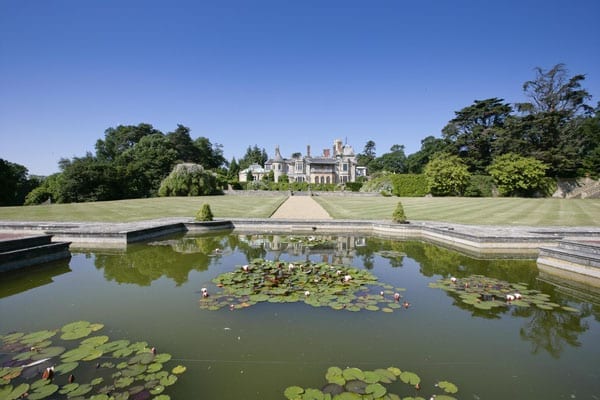
A review of Gilpin’s Gin and a call to save juniper
This week it was reported that there’s a crisis in the world of gin. Juniper, the plant that provides the botanical essential to create this remarkable spirit, is threatened by loss of habitat and a deadly new fungus.
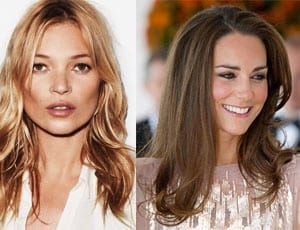
The Duchess of Cambridge usurps Kate Moss in a beauty poll
It’s just been announced that Kate Middleton has beaten Kate Moss in a poll of the UK’s most influential beauty icons.

Aldi’s £9.65 a bottle gin sees off premium spirits in a taste test
Gin, in its simplest form is effectively a neutral spirit plus juniper berries. Other botanicals, such as cassisa bark, saffron and grapefruit peel, are added and create the taste difference that distinguish Bombay Sapphire from Plymouth and Sipsmith from Martin Miller’s. Of course, the magic that sets a great gin apart from a bad‘un is a little more complex but though drinks industry “experts” bang on about this, does the layman really care?

Fever-Tree sells a 25% stake for £12 million
In recent years, the premium spirits market has boomed in both Britain and America. Drinkers have traded up and become more and more demanding in their choices. Spirits brands have seized on this trend and created what they claim to be better products and enclosed them in fancier packaging. Many, such as No. 3 gin, Sipsmith and Purity Vodka, are truly excellent but frankly a lot of it is marketing hype.
Accompanying the change has been a desire for a better mixer. The premise that it was illogical that a consumer buying a bottle of vodka for £50 would then mix it with cheap tonic water was the starting point that set Charles Rolls and Tim Warrilow on the road to create Fever-Tree.

Gina Miller reports on the death of the typewriter
I noted that Britain’s last ever typewriter rolled off the assembly line at Brother’s factory in Wales last week, the Brother CM1000 electronic typewriter. This was one of 5.8 million typewriters made at the factory since 1985 and it has been donated to the Science Museum in London.

Over the weekend, whilst perusing the Sunday newspapers, I shuddered at the disgraceful dumbing down of language. Then, last night, whilst watching the evening news, I was appalled by the grammar being used by newsreaders as my radar is now fully focused on honing in on grammatical sabotage.
It has struck me that with the death of the typewriter we are also experiencing the death of an era. An era in which the art and craft of writing, grammar, attention to detail, concentration and a love of words was celebrated has passed. Gone is a time where cutting and pasting required dexterity and glue. A time when mistakes, typos and bad grammar all had consequences; and when people enjoyed a romance with words has indeed moved on. Words that could be simple yet sophisticated have been sadly forgotten. I love the power of words. They are an amazing form of self-expression that can convey such beauty and such emotion. They have the power to make or break a person. They can lift or depress the spirit, they can make us rejoice or cry.
As a young girl I would sneak into the back of a courtroom and marvel as my father, a noted criminal barrister, defended a client. Years later reading the John Mortimer play, A Voyage Round My Father, I found the exact words to express my childhood wonderment. ‘He sent words into the darkness as if they were soldiers into battle,’ Mortimer wrote.
In the work environment we now use computers, which often means people are less productive and lack concentration as they are distracted by the Internet and auto spell checks which dull the intellect. Typewriters used to be chained to desks so they were not stolen or thrown out of windows. But now staff can steal time by using office hours to communicate with friends on Facebook or Twitter, shop online and book leisure activities and holidays.
Outside of work, letter writing is dying; people text to say thank you, to make up – even to break up. Communication lacks emotion, style, considered phrases and politeness. Written communications have been reduced to rough, short, sharp, harsh expressions of functionality.
I love how words taste just before you say them, how some of them have to roll around your mouth for a while before they can be uttered and how others explode off the pad of your tongue, excited to be leaving your thoughts and heading out into the world. Words like ‘strident’, ‘garrulous’, ‘mosquito’, ‘svelte’, ‘sanguine’, ‘parlour’. The word ‘rat’ that you can’t say and be tearful at the same time – it’s a great word to repeat several times when you can’t control your emotions. I love coming across words that I’ve never heard before – sometimes just hearing them is enough to satisfy my appetite but more often than not I need to get the full effect of them by thinking of how to use them. This I explore with my children where we have rhyming games, opposite games; if a word was a colour, what colour might it be?
There are some words that you can’t help but ‘feel’ as you say them – say the word ‘whisper’ and the very air around you changes as you say it. Words are beautiful to say and hear but they really come into their own when they are written down.
I’m certainly not as clever with the use of words and language as I would like to be and I probably use each and every forbidden type of style and grammar error known to man. But I firmly believe that in these fast-paced, hectic times we should all encourage a wider expansion and usage of vocabulary so that generations to come can enjoy the pleasure of words and language.
Like the health message of ‘eat 5 a day’ in terms of fruit and vegetables, I would encourage parents to ensure their children to ‘use 5 a day’ – at least 5 adjectives a day to ensure the beauty of language is kept alive.
Gina Miller is an entrepreneur, philanthropist and lover of words.
For more information about Miller Philanthropy, go to: http://www.millerphilanthropy.com

 This mouthpiece was born in Rettendon, Essex in 1958 and vents bile on all manner of subjects. Articles such as: “Why don’t more women moan like me?” and “Liz Jones’ baby craving drove her to steal husband’s sperm in ultimate deception” are frankly illustrative of why she’s so unpopular. After she got banned from the majority of fashion shows and her husband left her, she quit London for Somerset in 2007 to feed organic muesli to the rats in the barns of a 47-acre farm she purchased as her “rural idyll.” That misadventure came to a sticky end in November 2012 after she’d alienated the whole county by calling them, amongst other things, “smelly” and “faintly Amish.” Goodness knows whom she’ll choose to offend next. Phillip Schofield sums her up best: “She is inconsistent, bitter, nasty and unhinged.” Our advice: Just steer well clear of this acid tongued poison pen.

Matthew Steeples examines the truth behind Liz Jones giving up on her “rural idyll”
The Mail’s Liz Jones is a waspish woman who knows the price of everything and the value of nothing. Those who’ve paid even a moment’s attention to her bleating, will be familiar with lines such as: “Last week, my brand new £1,300 MacBook Pro broke” and “Phil Spencer wanted his £46,000 and he wanted it now!” She never stops talking about money and the size of what she both owns and owes.

In today’s Femail, Jones bores on about about how she feels “like a cross-dresser” trying out the Kardashian Kollection of clothing in a pointed attack on Kim Kardashian, but it was for her diatribe yesterday that she truly got the goat of the nation in “[bidding] a ferocious farewell” to life in the country in an article entitled “Goodbye… and good riddance!” 2,151 people have commented so far and most of them have been far from sympathetic.
When Upcott Farm at Brushford, near Dulverton in Somerset came up for sale in 2007 at a price of £1.6 million, it featured in an article by The Telegraph’s Caroline McGhie. The 5-bedroomed farmhouse came with a 2-bedroom annexe, a courtyard of barns and stables and 47 acres of land. McGhie waxed lyrical about the merits of moving to this location: “People come here for the peace and quiet, the night skies, the dramatic coastline, and they work from home,” she stated before adding: “You can find everything here, including butchers, bakers, afternoon tea and cake, fish and chips, an art gallery and a shop selling fishing tackle.” Of Upcott Farm itself, she concluded:
“This would suit a member of the new wave of buyers dubbed Droppies (Disillusioned Relatively Ordinary Professionals Preferring Independent Employment Situations).”
McGhie got it half right: Upcott Farm sold to someone who considers herself far from “relatively ordinary” and someone who is far from “professional.” The purchaser, however, was certainly someone who’d become “disillusioned” with what she’d bought and someone whose desire to be “independent” and create a “situation” just alienated all she encountered. The buyer, you’ve guessed it, was none other than Elizabeth Ann Jones.
Jones was born in Brentwood, Essex in 1958 and studied journalism at the London College of Printing. She became editor of Marie Claire in 1999 but was sacked, she herself suggests, for “listing in the magazine the freebies she had been offered in the previous month.” Here, it seems, began Jones’s obsession with all things material and here she also met an Indian BBC radio journalist named Nirpal Dhaliwal in 2000.
Jones married Dhaliwal but the union was to prove an “utter disaster” as he had affairs with women she terms “younger, dimmer [and] slimmer.” “I’m no racist” Jones was divorced in 2007 and said goodbye to her “3,000 square foot of Islington real estate” and “easy, if super-busy, London life” in favour of the green, green grass of Somerset.

Whoever’s side you see it from, five years of hell followed. Jones baited the locals and they grew to loathe her. She wrote columns and a book, The Exmoor Files, where she attacked them as “faintly Amish… feral, old and smelly” and another hack and neighbour, Jane Alexander of The Telegraph, responded: “Dulverton [was] positively fizzing with fury” after each and every publication.
Of the local restaurants, Jones stated:
“I have given up trying to eat out in restaurants here on Exmoor… It is still stuck in the Seventies, with only things in baskets and rum babas on the menu… If you tell the waiter you are vegetarian, you are stared at, incredulously, as if you are black.”
She whinged about her inability to find love:
”I will never, ever meet a man here in the middle of a moor, where even to be in possession of your own teeth is a bonus.”
And whined about fieldsports:
“I didn’t increase my popularity by being unable to pass a party of men and often children with guns, shooting rabbits and deer, without getting out of my BMW and saying: ‘Do you really have nothing better to do with your Saturday morning?’ The look of shock on their faces that I had the cheek to challenge them was priceless. I would stop, too, and shout at huntsmen on horses, galloping on tarmaced roads, one hand on the reins, the other clamping a mobile phone to their heads. ‘You will ruin your horses’ tendons!’ I would wail.”
Whilst Jones found little to like in her new community, they found nothing positive in her arrival either. Her dog was blamed for worrying lambs, and Jones’s inability to control it, locals say, was an indicator of the chasm between her life and theirs. In 2009, one neighbour went as far as to tell Danny Brierley of The Independent:
“We have got nothing in common with her, really. I think she may find it difficult to make any kind of life here now. She is not a very friendly person and we are all sick to death of talking about Liz Jones. A hatred has been building up for months. She is actually having a go at people and they are not going to tolerate that. She has feelings like all people, of course she has. But everyone wants her to leave and leave now. No one can make her, but we think she will go. I don’t see how you can live in such a small community with people who think that way about you.”
Matters came to a head when Jones’s precious black BMW convertible, “bought in 2005 for £26,000,” was pelted with eggs and teenagers fired shots at her letterbox with an air rifle. A local councilor even dressed up as her in the local carnival and yesterday Jones took revenge on those she blames for her “five-year prison sentence” and deprivation from Space NK, Cath Kidston and Illy coffee.
Instead, the article just shows the true reality of this bombastic harpy. The lines Jones penned speak for themselves. Country people don’t welcome someone who planned to “hack for miles across the open moorland in my Prada jodhpurs” anymore than the folk of Knightsbridge welcome Arabs treating their roads like racetracks. The gardener who had to endure Jones yelling “walk faster!” at him didn’t deserve such anymore than a bus driver in SW11 deserves abuse from his passengers. Jones concludes:
“I’m now a different person. I became so lonely. I would often get in my car, not just for the warmth, but for the kind voice of the satnav lady. I’ve learned that an amazing view and a pair of nesting grey herons are not enough to make me happy.”
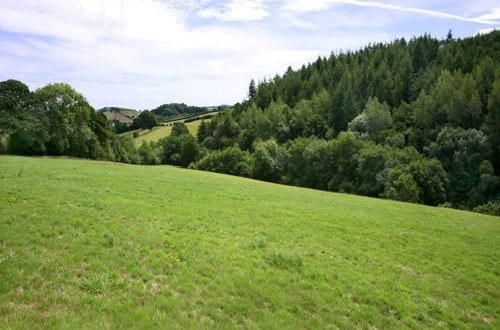
Miss Jones bleats that she’s taken a £500,000 loss on Upcott Farm, which languished on the market at first at £1,900,000 and then £1,750,000 for three years. The “unexpected” sale of the property has given her the ability to “flee back to the city” but the locals and even the “Droopies” should be warned: there’s still 27 acres of the farm unsold and on the market at a price of £200,000. Halloween may have passed but the battleaxe in the Beemer could still call again.
Read yesterday’s “Goodbye… and good riddance!” article by Liz Jones for the Mail on Sunday at: http://www.dailymail.co.uk/femail/article-2231033/Goodbye–good-riddance-During-catastrophic-years-country-Liz-Jones-greeted-gun-attack-relentless-abuse-Now-flees-city-bids-ferocious-farewell.html
To purchase Liz Jones’s book, The Exmoor Diaries, go to: http://www.amazon.co.uk/Exmoor-Files-Husband-Found-Rural/dp/0297854437
For more information about the remaining 27 acres at Upcott Farm, contact Strutt & Parker on +44 (0) 1392 976005 or go to: http://www.primelocation.com/for-sale/details/18314693?search_identifier=71cbb8a2fb43a12182bfa7b79b5de0a3
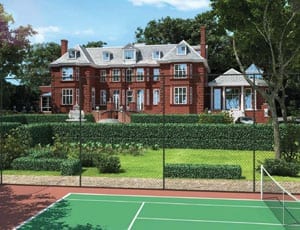
Matthew Steeples explores the story of an empty Kensington mansion
A multi-million pound 8-bedroomed house in Kensington isn’t anything unusual. In fact, rather, they’re ten a penny. In this, one of the wealthiest boroughs in the land, large, expensive homes are just the norm.


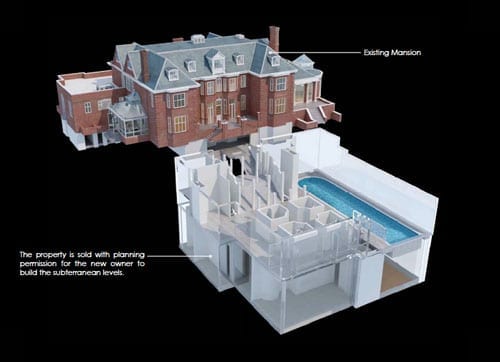
No. 1 Campden Hill, which is being marketed for an undisclosed eight-figure sum, is in a quite different league. Here is a detached Edwardian house in an acre of grounds just to the north of Kensington High Street. It’s an unrenovated property but it attracted much press attention in October 2011 because it was place on the market in October 2011 at a price of £75,000,000. Yes, you heard it right: £75 million for a fixer-upper. Last week, Radio 4 made a hell of a fuss about a derelict semi-detached house in Newcastle selling for just £14,000 so this truly must be something special.

The architect of the house Edward Prioleau Warren (1856 – 1937), a Bristol born architect and archaeologist, was best known for “Oxford colleges and minor country houses” but also designed the War Cemetery at Basra. He was a friend and adviser to the American novelist Henry James and in addition to building No. 1 Campden Hill in 1915, he also designed a house at 5 Palace Green in 1906 and another, Estcort House in Kensington Palace Gardens, in 1904. Warren’s guiding style is described as having been to recreate an “understated revival of English late 17th century” architecture and at No. 1 Campden Hill he created just that.
Colonel Edmond Grove-Hills (1864 – 1922), born Edmond Hills, and his wife, Juliet Spencer-Bell, were the architect’s clients. A plaque on the building bares their names and the following dedication:
This House I built for Me & Mine
May it be of Peace A Shrine
And no Enmity or Sin
Ever find its way therein
AD 1915
Sadly for the Grove-Hills, the following year, their son, Second Lieutenant Charles Herbert-Hills (1895 – 1916) was killed on the Somme aged just 21. His father, meanwhile, was awarded a CBE in 1918 after having served as the Assistant Chief Engineer of Eastern Command during the war.
Aside from his military exploits, Edmond Grove-Hills is best known for his role as president of the Royal Astronomical Society. He took part in observations of eclipse of the sun in Japan in 1896, India in 1898 and Russia in 1914 and contributed papers analysing both this and the causes of the irregular movements of the earth’s axis of rotation.
In 1951, No. 1 Campden Hill was purchased by the government of Uruguay and it became the residence of their ambassador to the United Kingdom. For the next fifty years the building was barely altered but when the lease from the Phillimore Kensington Estate came to an end, there were legal problems as the 1951 transfer had never been stamped. Of this, Sharon Mulroney of Forsters, the legal representatives of Phillimore, commented:
“It is highly unusual to be faced with complications of this kind when dealing with a registered London title, but this made the transaction all the more fascinating. Even the decision to allow ambassadorial staff to return to the property for security purposes after completion was fraught with potential problems about security of tenure, employment and tax.”
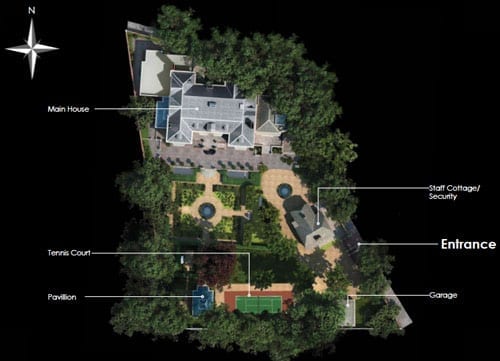
Eventually, without issue, the Phillimore Estate sold on the house in 2001 for a price of approximately £17,000,000. In the years since, the property was effectively mothballed as all the purchasers have done is to have obtained planning permission to redevelop the building into a mammoth mansion of epic proportions.
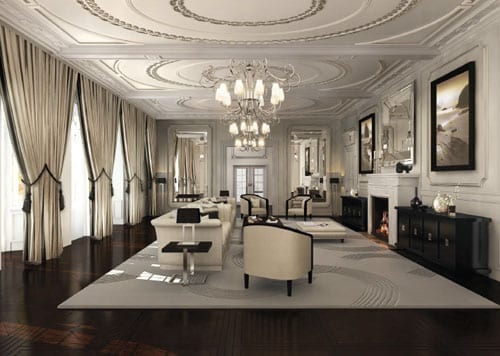
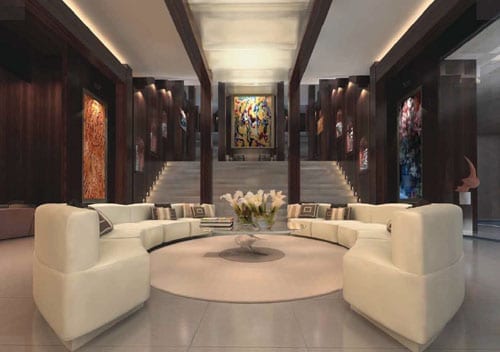

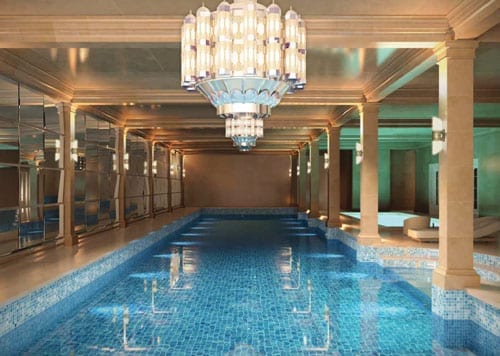


The approved plans show designs for something quite remarkable. Warren’s “understated” residence will be replaced with 8 vast bedroom suites, grand entertaining spaces, a lift and even bedrooms for 5 staff. In addition to a full-scale renovation of the original freehold house, there is scope to provide a total of 30,000 square feet of accommodation by adding a huge subterranean complex that will include a 25-metre swimming pool, court, squash court, gym, sauna, steam room, function room, entertainment room, home cinema, wine tasting room and even a nightclub to rival any of Kensington’s trendiest haunts.
On that basis alone, No. 1 Campden Hill is surely the ideal residence for Prince Harry: “Who needs Boujis?” we hear him cry.
No. 1 Campden Hill, London, W8 7AD is for sale through Knight Frank. For more details contact Roddy Craggs on +44 (0) 20 7938 4311 or go to: http://search.knightfrank.com/ken100161 to download a brochure.
For more information about The Phillimore Estate, go to: http://www.phillimore-kensington-estate.co.uk