The latest arrest in Operation Yewtree illustrates the muddle that this investigation has become
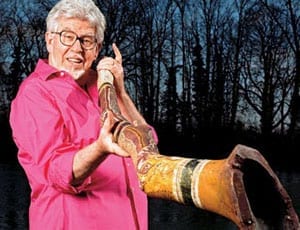
British newspapers have decided not to name the 82-year old “celebrity” arrested in Berkshire on suspicion of sexual offences as part of Operation Yewtree.
The political blog Guido Fawkes and other news sources have decided to name the individual, however, as “there was no legal reason not to report this news”. They suggest that the individual supposedly is the Australian entertainer Rolf Harris AO, CBE.
A modern day Robin Hood who claimed to have been “sent by God to take back some of the wealth that the outrageously rich had taken from the rest of us”. This Belfast born cat burglar was a meticulous planner whose roll call of marks numbered Sophia Loren, Zsa Zsa Gabor, John Aspinall and Maria Callas. He quoted Confucius, Oscar Wilde and Proust and targeted “rich prats” as it gave him a “sexual thrill”. The 1965 film He Who Rides a Tiger starring Tom Bell and Judi Dench was based on Scott and concluded that: “If I rob Ivana Trump, it is just a meeting of two different kinds of degeneracy on a dark rooftop”. Raffles would have been proud.
I first visited the St. Ermin’s Hotel close to Scotland Yard in St James’s in June 2012 for the first Intelligence Book of the Year Awards. Today, I will return there to attend a reception to announce the second winner of this annual prize by judges Andrew Lownie, Dan Mulvenna, Glenmore Trenear-Harvey, Michael Smith and Nigel West.
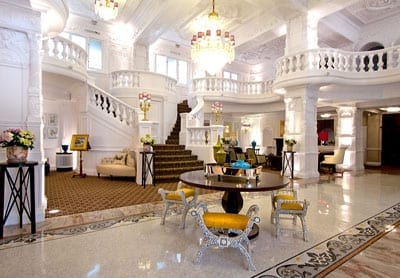
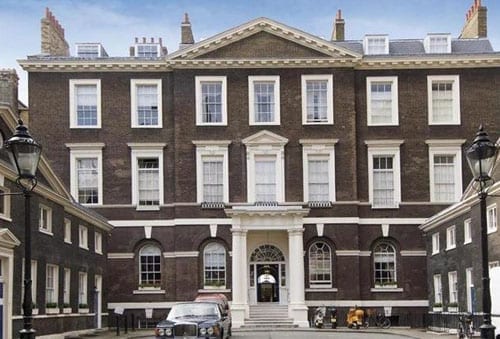
The courtyard entrance to the St. Ermin’s Hotel, 2 Caxton St, London, SW1H 0QWThe grand entrance lobby of the hotel
As I reported in my last article on this Victorian property, the St. Ermin’s Hotel’s links with the worlds of politics and espionage are indeed strong. Built in the Queen Anne revival style to the designs of Edwin T. Hall (1851 – 1923) in 1887 and completed in 1889, the horse-shoe shaped building was originally a mansion block prior to being converted to a hotel that opened in 1899 after a major refurbishment by the theatre architect J. P. Briggs (1869 – 1944). Briggs remodeled the public areas and created a spectacular neo-Baroque entrance with balconies, ornate plasterwork and a double staircase.
Due to the building’s proximity to the powerhouses of government, the St. Ermin’s Hotel became a meeting point for officers of the Secret Intelligence Service and, as a result, various traitors and spies. Some worked from offices in the building and amongst them were Kim Philby, Guy Burgess, Laurence Grand and Eric Maschwitz. Others came there to be interviewed and the hotel’s bar, The Caxton Bar, is renowned as having been a noted meeting place for secret intelligence officers.
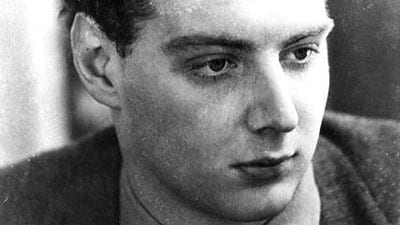
Intelligence officer turned Cambridge Five spy ring member Guy Francis de Moncy Burgess (1911 – 1963)
One of the most notable meetings at the St. Ermin’s Hotel was held in 1940 when Winston Churchill brought together a group to join him in “Setting Europe Ablaze”. These founding members of what was to become the Special Operations Executive (SOE) took over an entire floor of the hotel and carried out covert operations from there throughout the Second World War. MI6 were stationed two floors above and then in the 1950s, the hotel’s bar was the meeting point of Guy Burgess and his Soviet counterpoint when he passed intelligence to the USSR.
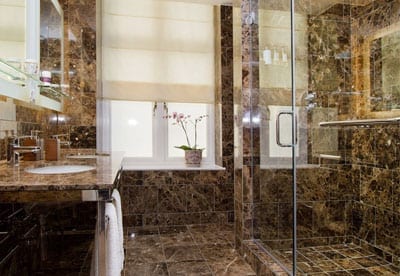
A typical bedroomA luxuriously appointed shower room
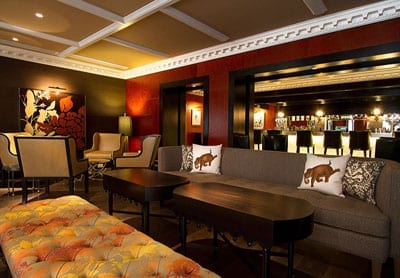
Following on from a £30 million refurbishment to designs by Dayna Lee of Los Angeles-based Powerstrip Studio, the 331 rooms and suites at the St. Ermin’s Hotel are now comfortable, well appointed and decorated in a contemporary style. The two that I inspected, whilst perhaps lacking the charm of a boutique hotel such as Blakes, are absolutely ideal for a business traveller or tourist given the location close to the Houses of Parliament and Westminster Abbey. They are well worthy of their four star rating and I slept well given how centrally located the hotel is.
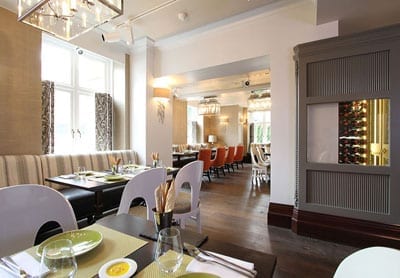
The Caxton GrillThe Caxton Bar
The Caxton Grill, the hotel’s restaurant, continues the traditions of the St. Ermin’s in that it plainly is the haunt of politicians and policeman. Whilst dining there, I met an officer from Scotland Yard who was involved with Operation Yewtree. I can report that, though I had a most fascinating conversation with him about Savile, Davidson and Clifford, I did not leave with any state secrets that I could share here. The restaurant also featured on a recent episode of the BBC One’s MasterChef with Gregg Wallace and John Torode and frankly one could also imagine Hercule Poirot having taken rather a liking to it also. It is modern in style and features wooden flooring, bright décor and snazzy seating.
The restaurant features a menu that focuses on a Josper grill. This £17,000 hybrid barbeque–oven, which I saw so cleverly used by Chris Golding at Beauchamp Place’s Galoupet, allows a chef to cook, barbeque and roast at the same time over charcoal embers at temperatures of upto 600 degrees. Filled with Kentish hardwood every morning, the Josper recirculates smoke via adjustable draughts and, for example, as a result, it takes only about a minute to char infuse lamb and thick-cut beef sirloins. The real thrill of it, though, is that the Josper process ensures that none of the flavor or natural moistness of whatever is cooked in it is lost.
I began with a salad of soured plums, gorgonzola and blackberries (£8) that was colourful and most welcome on a grim winter’s day. My companion tried a roast celeriac and truffle veloute (£7) that though perfectly adequate, did not truly excite.
I continued with a half Temple Farm chicken (£20) that was cooked on the Josper Grill. Well presented and served with a green peppercorn sauce and some garlic and parsley French fries (£4), the cooking process was clearly illustrated. The meat was tender and I must say it was one of the best pieces of chicken I have eaten in years. My companion, an Icelandic financial titan, maxed out on a 300g vintage dry aged sirloin steak (£30) served with béarnaise sauce. Again, cooked to perfection, he was impressed.
Though more than amply fed, we finished by sharing a chocolate fondant (£7). This simple dish melted in the mouth and the accompanying ice cream was just superb.
Wines in the restaurant start at a very reasonable £19.95 for the house white and rise upwards to the £300 a bottle range. A Chablis is priced at £41 and a Gavi di Gavi at £33. The restaurant’s bar, the Caxton Bar, offers a huge array of cocktails but I must say I was rather sad that none of them were spy themed.
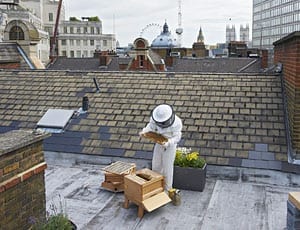
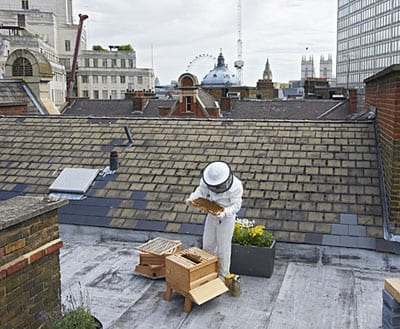
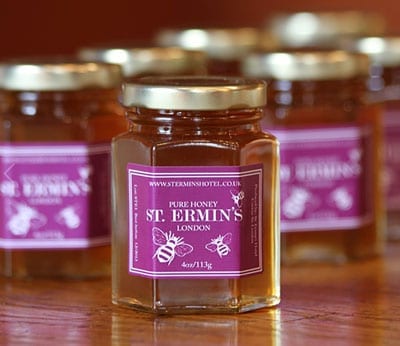
The hotel’s rooftop is home to 200,000 Buckfast beesThe honey they produce is truly delicious
The most quirky thing about the St. Ermin’s Hotel is that it has its own colony of bees. “Bees… In Wesminster?”, I hear you cry. Yes, indeed, 200,000 of them prosper on the roof of the hotel and produce the most delicious honey that is available to guests. From three hives, the Buckfast bees, described as being “good tempered”, have fantastic access to London’s parks and travel within a three mile radius collecting pollen and nectar. “London”, states the hotel’s website, is “a perfect environment for bees as… cities actually trap heat, which means they can start foraging earlier in the year than rural bees and continue later into the autumn”. Who’d have thought it? Where once lived spies, now prospers a colony of bees.
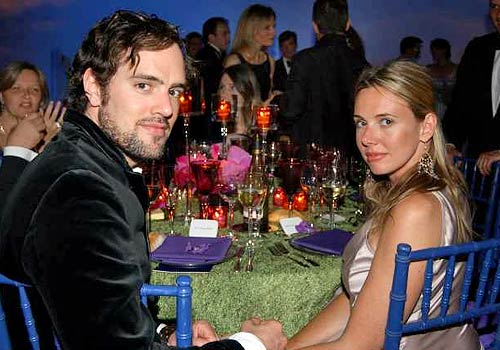
Their story is a modern day equivalent of that of Romeo and Juliet and Vanity Fair chronicled their deaths as The Golden Suicides. “Handsome” Blake, a digital artist and painter who worked with Malcolm McLaren and Fox Searchlight, and “sexy” Duncan, a writer, game designer and filmmaker best known for the “girl-centric” game Chop Suey, were the toast of New York but became obsessed with those they felt threatened them and their works. Personally wounded by a rejection from the post-modern rocker Beck to work with her on making a film out of one of her scripts, Duncan blamed his church, the Church of Scientology, and stated: “They are furious because he valued our way of life far more than Celebrity Center sex trash”. As more rejections came, this talented pair who “supported one another totally” became more and more irrational and in July 2007, a week apart, both committed suicide.
A former supporter of Julian Assange denounces his behavior
Jemima Khan has shown great courage in turning on Julian Assange. In a feature in the New Statesman, she described him as being “more like an Australian L. Ron Hubbard” than the crusader he has portrayed himself. Suggesting Assange thinks himself like a real life Jason Bourne, she commented:
“It may well be that the serious allegations of sexual assault and rape are not substantiated in court, but I have come to the conclusion that these are all matters for Swedish due process and that Assange is undermining both himself and his own transparency agenda – as well as doing the US department of justice a favour – by making his refusal to answer questions in Sweden into a human rights issue.”
Jemima Khan
‘There have been three rounds in the UK courts and the UK courts have upheld the European Arrest Warrant in his name three times.”
“The women in question have human rights, too, and need resolution. Assange’s noble cause and his wish to avoid a US court does not trump their right to be heard in a Swedish court.”
“I don’t regret putting up bail money for Assange but I did it so that he would be released while awaiting trial, not so that he could avoid answering to the allegations.”
In a firm but fair article, Khan stated: “I remain convinced that if Assange is prosecuted for espionage the future of investigative journalism everywhere would be in jeopardy” but added “[Julian Assange] has been guilty of the same obfuscation and misinformation as those it sought to expose, while its supporters are expected to follow, unquestioningly, in blinkered, cultish devotion.”
Jemima Khan talks sense. Some of what Assange did was in the public interest but his behaviour now is ridiculous and his attitude to justice perverse. Julian Assange should walk out into Hans Crescent and hand himself in.
Matthew Steeples leaves a tribute to Michael Winner
As I’ve said before, Michael Winner (30th October 1935 – 21st January 2013) was like Marmite. He was loved and loathed in equal measure. Restaurants put up signs announcing “This restaurant is a Michael Winner free zone” after banning him for the most obnoxious and sometimes truly unfair reviews but his fans celebrated him in equal measure.
Winner is best known both for his Death Wish films and as a restaurant critic and I would suggest that the world is a poorer place for his passing. Yes, he was a preposterous buffoon with a capability to offend but surprisingly he also often stood for all that was right and decent.
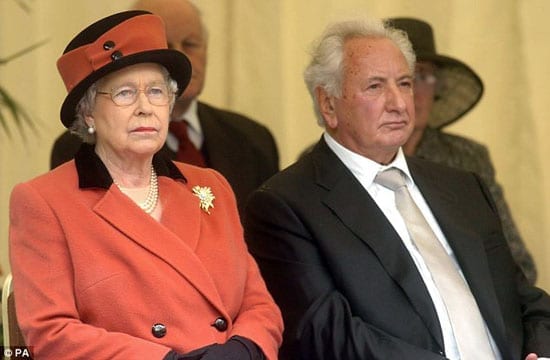
The Queen and Michael Winner
He took the view that “an OBE is what you get if you clean the toilets well at King’s Cross station” and once told Richard Littlejohn that he was an “arsehole”. Given my views on some of the names that have recently been honoured and thoughts on Littlejohn’s bile, I would suggest that shows someone who was actually quite reasonable. This is echoed further in his comment about Gordon Ramsay, whom he described as someone who suffers from “verbal diarrhoea”.
Michael Winner was a man who lived life to the full and in the end that was what took its toll. He suffered with a bacterial infection in Barbados after eating oysters and got food poisoning from eating steak tartare for four days in a row.
Towards the end, after doctors gave him just two years to live, Winner accepted his end was nigh and here we conclude with the last paragraph of his final column for The Sunday Times:
“Gstaad is packed with famous names, all fighting not to be in this column. I totally understand. It’s a miracle they speak to me. If it were known that they associated with me, they’d be barred from right-thinking society. Tell you about it later. Now I need a rest.”
A review of Channel 4’s Millionaire Playboy Races by Matthew Steeples
I watched last night’s Millionaire Playboy Racers expecting to find myself in agreement with Knightsbridge residents complaining about the noise generated by Arabs and their supercars. In many instances I would have previously agreed that they are bloody pests but surprisingly, by the end of the 45-minute Channel 4 documentary, I was left with feelings quite to the contrary.
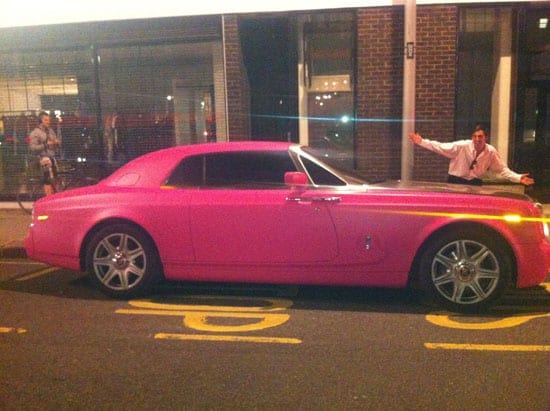
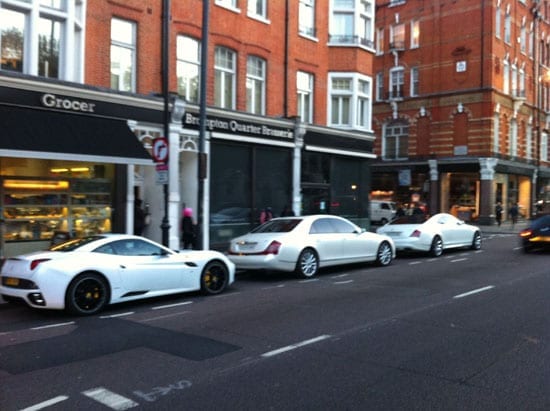
My followers on Facebook often comment on the snaps I take of the supercars that come to London from Dubai, Kuwait and Saudi Arabia. Some are impressive and amazing. Others are vulgarity personified. A few are shown below.
A pink Rolls-Royce PhantomA purple Mercedes-Benz G-ClassThe white way to go?
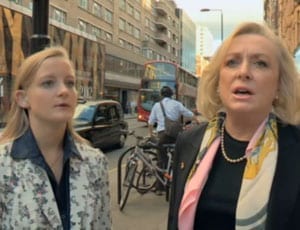
Millionaire Playboy Racers was commissioned, like most television these days, to provoke. It failed. The whingeing residents of The Royal Borough complaining about the cars, one of whom was bizarrely named “Panda” Morgan-Thomas, came across as spoilt and obnoxious whilst it was a Kuwaiti named Abdul Aziz Al Rashed who came across best.
Panda Morgan-Thomas and her daughter in Sloane Street
Abdul Aziz Al Rashed in one of his supercars
This sensible young man expressed his views clearly. He understood the situation and though the British police treated him unfairly at one point, he remained reasonable. As the show ended he stated:
“I be very serious with you… At 12am I stop using this car as many people are sleeping… My friends are very sad to go back to Kuwait… I feel very sad to leave this nice place to go back to my desert… Give us London and we give you Kuwait.”
Morgan-Thomas, her daughter and their friends on the other hand came across as weird busybodies. These resentful, hectoring pests showed the people of this wealthy enclave in their worst light. As an example, Ms Morgan-Thomas showed the cameras a tree made out of roses that she had dried in her flat that she was building up towards her ceiling. She stated that when the top was reached she might marry her partner. Who on earth would do such a bizarre thing? The woman is plainly a loon.
Justin Downes, another of their number, did not help the cause of the anti-supercar crusaders with comments like:
“[They’ve created] a kingdom of Qatar in the middle of London… Idiots… I’ve seen the area move from being a very quiet residential area to being cosmopolitan in a way that is extreme… These Gulfies come in and use the area to drive recklessly. If they were UK citizens they’d be prosecuted… I am angry.”
Here were people who came across as racists and bigots. They damaged their cause and of the residents the only one I felt sorry for was an elderly lady who lived in a basement studio near Harrods. This poor woman came was indeed being disturbed late at night and if more like her had been interviewed then an entirely different perspective would have been presented. Instead, Channel 4, to satisfy their viewers, allowed a woman who lived in one of London’s main shopping streets to make residents come across as a bunch of utter weirdos and freaks.
I am still of the opinion that many of these Arab drivers are reckless and vulgar but having watched this programme, the ridiculousness of the “Knightsbridge girl” Panda and her chums has now truly been exposed. In fact, I’d rather it be her who is kept off the streets of SW1.
Sarah Tucker shares her experiences on a panel discussing the outcomes of Leveson
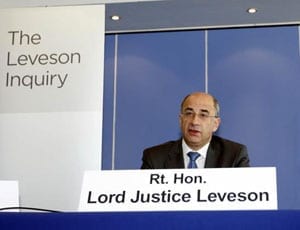
Journalist and author Sarah Tucker was one of the panelists at a talk at the Richmond Literary Festival on Thursday evening. By chance, since it coincided with the publication of the Leveson Report, the panel’s discussion naturally focused on that. Here Tucker share her thought in an article first published on her own blog:
Will the outcome of Leveson change the media?
I was in excellent company last night as part of a panel at the Richmond Literary Festival that felt almost weirdly timed to coincide with the day of the Leveson announcement.
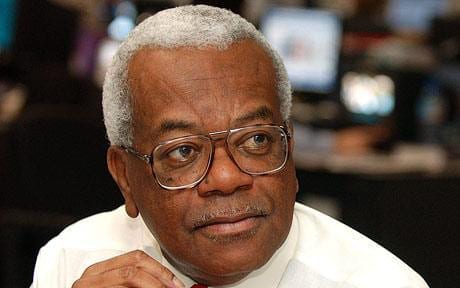
I appeared on a panel with Sir Trevor MacDonald (who needs no introduction, but got one any way), the editor of the Sheengate Titles, Richard Nye; Claire Fox, the director of the wonderfully named Institute of Ideas (which I thought sounded like something out of Hogwarts) and Matthew Syed, illustrious columnist, Times writer and former Commonwealth table tennis champion (I wanted to ask him about table tennis but felt it oddly irrelevant in context of the debate). We discussed if the media were ‘friend or foe’ (though it wasn’t specified ‘to whom’) this of course had been perfectly timed to coincide with the Leveson findings. It was pure fluke but that’s timing for you.
Sir Trevor felt Leveson would change nothing. Everything, he suggested, would be bogged down in committees and sub committees and nothing would be done. Ever. Fox and Syed felt if statute was put in place, it would potentially be very dangerous especially if you had the likes of Blair or Thatcher in charge again or some lesser megalomaniac.
As for my view, I think the politicians are playing a game. They are losers all of them, we are the biggest ones (the punter, the voter, the onlooker), but to think they could come out and out say one way or another would be a nonsense and would take a great deal of courage, which they don’t have.
When I look at politicians now I think of them as actors upon a stage, not meaning anything they are saying, not even understanding most of it, just reciting it. I don’t feel contempt because it takes courage to get up on that stage. And Sir Trevor noted that many journalists and reporters now treat politicians with barely restrained contempt when they interview them. As he noted, at least politicians enter the process to do something of good for their community (although I think some do enter it for ego), something you can never say about those who work in the city.
Sir Trevor McDonald OBE
And who will be in this ‘organisation’ that will monitor the press? Who on earth, on this earth, is so honourable, so without fault, so incorruptible to be considered for this position? A politician? No. A banker? You’re joking. A policeman. Perhaps.
I think you need a ‘common man’, or woman who has a sense, a common sense and an ability to see through the emperor with no clothes phenomenon of what is bullshit and what isn’t, what is in the public interest and what isn’t. It isn’t someone who has risen to the top. If this year has proved anything the shit rises to the top more regularly than the cream does. Although I must say I do like Eddie George. I think his contempt for the city mirrors that of my own, but then he deals with them on a daily basis so that’s understandable.
In many ways the media has been it’s own worst enemy. Editors allowing for lazy journalism – the recent article about Canada in The Telegraph being an example. I met the head of PR for Canada in the UK for lunch this week and she despaired that they usual cliché about Canadians came up without anything relevant or up to date on a country that had a government which managed to manage their bankers – something our politicians have not. As she commented: “It’s harmless but it’s pathetic.”
Then there’s the phone hacking which hacked into ‘common man’ rather than celebrity, who I am afraid I have absolutely no sympathy with. That includes the royals, both the young and old. They are sold to us as though we know them. We don’t have a clue who they are. We just think we do.
Editors encourage journalists to get stories, to hit the negative angles because they are told ‘it makes better news’ and people are more interested in bad news than good. I think it’s been proven somewhere, with stats or something, but then so have a lot of other things which also turn out to be rubbish. And all media are businesses so their bottom line is more important than anything else. Associated Papers are making money, The Times is running on a subsidy, the rest of the papers I think are losing money. The BBC may have been dented but they are respected around the world and like the NHS should not be tampered with. They should not be interested in profit and should aim in their production values at all times and at all cost. Every panelist agreed on that point.
The weave between the institutions of the police, the law, the church, the city, the media, the royals, the politicians has become so entwined. This is like a lover’s tiff that will pass over because the end game is more important. There is too much money, too much power and far far too much ego invested in these institutions for morality and integrity to get in the way of profit.
This has been a year of revelation but not revolution. And if it were it would be the wrong heads that would roll.
Sarah Tucker is an award winning travel journalist, novelist, producer and broadcaster. She has edited, produced and presented her own radio and TV series as well as presenting reports for BBC Holiday Programme and anchored I Want That House on ITV. She is the author of best selling novels The Playground Mafia (short listed for the Good Housekeeping book of the year 2007) The Battle for Big School, The Last Year of Being Single, and The Control Freak Chronicles.
Matthew Steeples delves into the history of Albany, Piccadilly and discovers an affordable way of living there
Albany, off Piccadilly in Mayfair, was most probably London’s first apartment block and it’s certainly the city’s most exclusive. It may be next to the Royal Academy and opposite Fortnum & Mason but surprisingly few have even heard of it.
Considering its location, Albany, which some make the mistake of referring to as “The Albany,” is an amazingly quiet oasis of peace and tranquility but, equally, it is a place of intrigue and drama. Residents, or “proprietors,” as they prefer to be known, of the 69 “sets” are particular about the “the” part of the name as they’d rather their residence not be confused with a public house and they are even more protective of their privacy. A porters’ lodge guards the entrance to the building and it is staffed mostly by ex-servicemen, who, until the early 2000s, had to wear top hats and tailcoats. Those allowed to pass enter a rarefied world frequented by what the Irish novelist Marmion Savage (1803 – 1872) identified as “incurable oddities” and “superannuated fops” in The Bachelor of Albany.
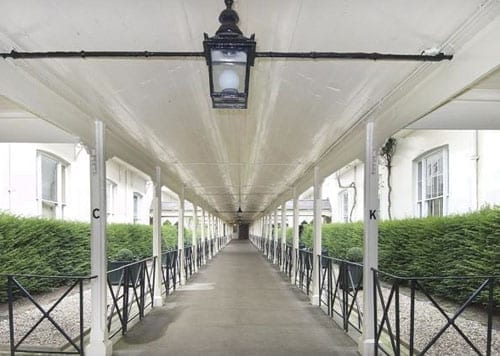
The front courtyard and façade of Albany, Piccadilly, Mayfair, London, W1J 0ALThe rope-walk connecting the various sets of Albany has been traversed by some of the greatest names in history
Built by Sir William Chambers (1723 – 1796), who also designed Somerset House and the pagoda at Kew, between 1770 and 1774 for 1st Viscount Melbourne (1745 – 1828), Albany was originally known as Melbourne House and conceived as a three-storey mansion, seven bays wide with a pair of service wings flanking a front courtyard. From 1791 to 1802, the property was occupied by George III’s son, Prince Frederick, Duke of York and Albany (1763 – 1827), but after he left, the renowned architect Henry Holland (1745 – 1806) sub-divided the existing house and added two parallel sets of buildings running the length of the garden to create 69 “bachelor apartments” which he named “sets.”
The “roll call” of residents since could easily fill our very own pages thrice over. They number royalty, politicians, artists, playwrights, academics and philosophers and here is a brief selection:
– Anthony Armstong-Jones, later 1st Earl of Snowdon
– Sir Thomas Beecham
– Sir Isaiah Berlin
– Lord Byron
– George Canning
– Sir Kenneth Clark
– Baroness Pauline de Rothschild
– William Ewart Gladstone
– Sir Edward Heath
– David Hicks
– Aldous Huxley
– Sir Simon Jenkins
– Rupert Lycett Green
– Malcolm Muggeridge
– Sir Harold Nicholson
– J. B. Priestley
– Sir Terence Rattigan
– Roger Scruton
– Baroness Sharples
– W. Somerset Maugham
– Terence Stamp
– Sir Denis and Lady Thatcher
– Sir Herbert Beerbohm Tree
Each had to pass the vetting of a committee of trustees of this Grade I listed building. That committee forbids children under 14, pets, musical instruments and commercial activities and each approved resident has undoubtedly added to the history of this den dominated by a central walkway named the “rope-walk.” Incidentally, an example of a curious quirk at Albany is that no resident is allowed to speak to another on this walkway. If they do, a fine is incurred. Albany, indeed, is rather like a college in its systems of rules, regulations, order and hierarchy.
For several centuries, women were not even allowed to cross the threshold and one legendary tale tells of Lady Caroline Lamb (1785 – 1828), disguised as a page boy, stealing into Lord Byron’s (1788 – 1824) set in 1815 to leave a note: “Remember me, Byron.” He replied with a simple verse:
Remember thee, aye, doubt it not:
Thy husband too shall think of thee.
By neither shalt thou be forgot —
Thou false to him, thou fiend to me.
The strict and formal structure that controls Albany and ensured its maintenance has succeeded in the main because 34 of the 69 sets are owned by Peterhouse College, Cambridge. They and the other owners are highly particular in whom they lease to and on one occasion on hearing of an “unsuitable tenant,” the secretary of the trustees is reported to have shouted:
“He’s a foreigner. Don’t like him. Don’t trust him.”
Needless to say, that application didn’t progress and nor did one from a physiotherapist who planned to operate from the building. Bone bashing in Albany just wouldn’t do.
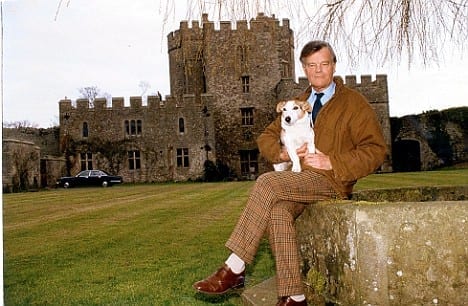
The Rt. Hon. Alan Clark MP (1928 – 1999) in the grounds of his main home, Saltwood Castle, near Hythe in Kent in 1993
A horsewhip, however, nearly crossed the threshold of set B5 in 1994, as it was here that the late Alan Clark MP (1928 – 1999) lived. The affable philanderer seduced the wife and both daughters of a certain South African named Judge Harkess and the wronged man stated he would “have horse-whipped Clark if he had known how comprehensively he had violated his honour.” B5, itself, was described as having the feel of “the straitened quarter of an Edwardian bachelor on his uppers” and the dotty, English attitude of the residents is best summed up by the reaction of Clark’s neighbour when he accidentally flooded their basement. When asked what he could do to make amends, their answer was quite simple: “Go and lie down in Piccadilly and wait for a double-decker bus.”
The dandy and journalist John Morgan (1959 – 2000) typified social change at Albany in the 20th century just as much as he himself redefined etiquette and manners at Debrett’s and The Times. Of “humble origins,” Morgan was brought up in a “modest” bungalow in St Madoes, Perth, Scotland but is credited with persuading William Hague to remove his baseball cap whilst Conservative leader and offering advice ranging from “how to eat a banana” to “how best to tell friends that the partner you would like to bring to their wedding will be of the same sex as you.”
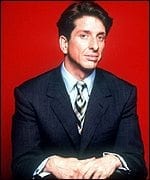
Dandy and etiquette expert John Morgan (1959 – 2000)
For the bachelor and GQ style director, living in Albany was symbolic of his own personal social elevation but he did not disown his past. This modern day Beau Brummell was a man of social contradictions who cashed his cheques at Claridge’s but was a member of the National Union of Journalists. He was a Tory but still regularly attended chapel meetings as he had done in his youth. Here was a man of paradoxes who seemed unable to come to terms with the fact that he was a homosexual.
Morgan, an asthma sufferer, fell to his death from a fourth floor window on 9th July 2000. He was found in just a white shirt in a basement below a window whose sill was strangely undisturbed. The coroner left an open verdict with a suspicion of suicide and it was widely reported that police found 60 made-to-measure Savile row suits, 300 monogrammed shirts and 90 pairs of shoes in the etiquette expert’s small set. Mystery shrouds the story of his tragic demise to this day but Johnny Morgan will forever be remembered as an arbiter of both good taste and behaviour.
Whilst Morgan represented continuation of the trend of bachelors living in Albany, change also came in the 20th century when the building’s committee removed the restriction that allowed only bachelors to be resident. With that females were allowed in and amongst them Fleur Fenton Cowles (1908 – 2009) was one of the most fascinating.
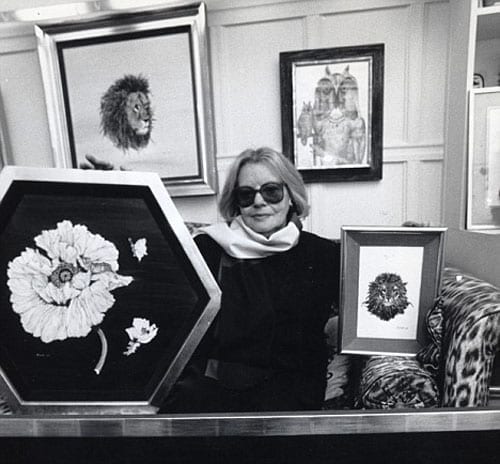
Fleur Fenton Cowles (1908 – 2009) in her set at Albany with some of her paintings and one by Salvador Dali
This writer and artist occupied five sets knocked into one with her fourth husband, timber merchant Tom Montague Meyer, and according to the Daily Mail’s Geoffrey Levy, hosted “elite soirees of the powerful and famous.” Levy recounts them at length but here is a flavour:
“On a Wednesday evening, a typical dinner party… would include Foreign Secretary Selwyn Lloyd, Labour leader Hugh Gaitskell, entertainer Danny Kaye and film star Douglas Fairbanks Jr. The Queen Mother regularly came to tea and was once joined by Pavarotti who sang Happy Birthday for the royal guest. ‘I don’t want her to die,’ said Fleur. ‘I couldn’t bear to think she doesn’t live just down the street.’ ”
Fenton Cowles, founder of the ill-fated Flair magazine and a “woman who knew everyone,” loved Albany and an exact replica of her “windowless, milk-yellow” study there has even been recreated at the University of Texas.
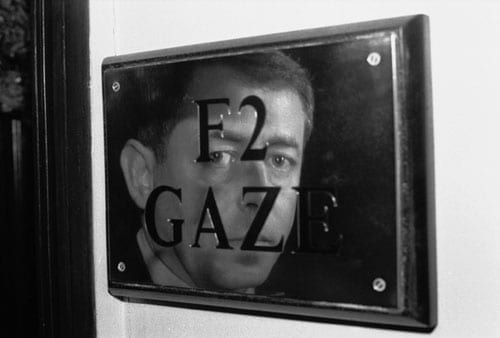
Another known for hosting extravagant bashes in Albany was my late friend, the Russian icon dealer John Gaze (1947 – 2011). Gaze had, as a boy, asked his father about the building when he passed it as a child and immediately declared he would live there one day. He took F2, the former set of Edward Heath that overlooked Savile Row to the rear, in the mid 1990s as he craved the safety that the building offered after having been kidnapped at gunpoint by an Oxford graduate conman named Sacheverell de Houghton in April 1991 from his then home in Fournier Street, E1. He made the most of his tenancy.
Russian icon dealer John Gaze (1947 – 2011) reflected in the brass plaque outside his Albany set, F2. It was formerly occupied by Sir Edward Heath.
Gaze’s parties included a fundraiser for people with AIDS hosted by a drag queen. This sparked fury with certain other residents and coverage in the Daily Telegraph and another incident there involved him encountering Alan Clark on the ropewalk carrying a portrait of Lenin. “Where the fuck are you taking that?” Clark supposedly bellowed but was “reassured” when he was told it was “destined for a less salubrious address in Whitechapel.” John Gaze remained at Albany for several years but, like a number of others I know, was forced out by ever rising rents and moved first to Chelsea and then Ennismore Gardens, Knightsbridge. He always remembered his time at Albany fondly and as a bon vivant, he truly belonged there.
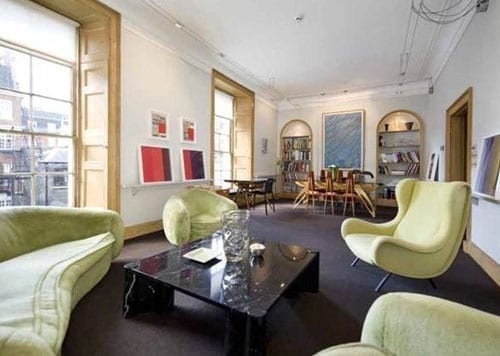
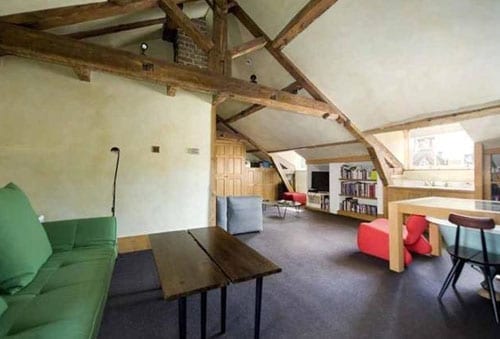
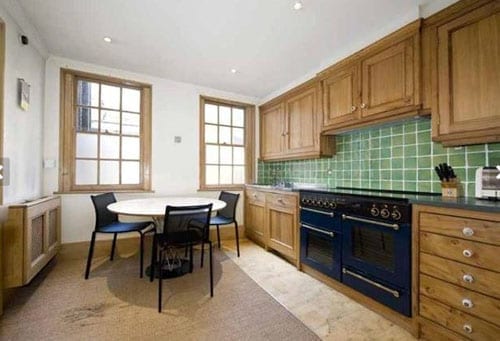
The main reception room in a £1,400 a week set currently available in AlbanyAn attic room in the set that could be used as a second reception room or second bedroomThe kitchen is lacking in character but offers ample space for informal dining
Contrary to what you’d expect, living in Albany is not quite as expensive as one might think. A 2-bedroomed 1,970 square foot set is currently available through Knight Frank for £1,400 a week: a figure that seems quite reasonable given the location, history and size of this property. Available on a minimum 8-year rental term, it includes a formal reception room, a dining kitchen, 2 bedrooms and 2 bathrooms.
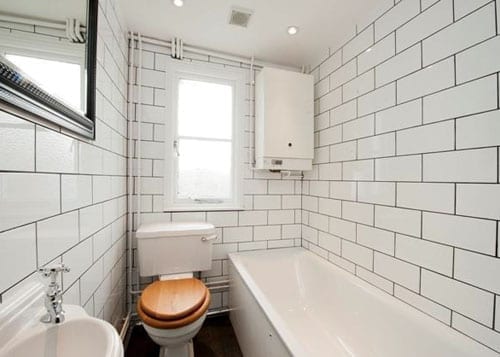
This £300 per week set, D2, consists of just one roomThe communal bathroom D2 shares with other sets is basic but clean
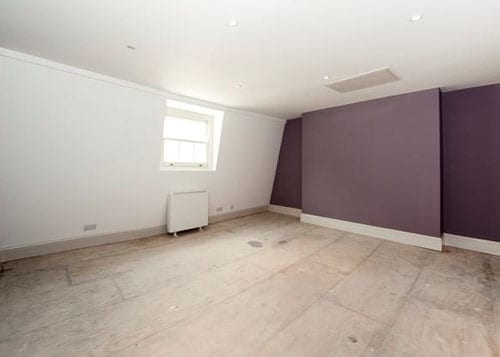
For those looking for something cheaper, Savills offer D2 Albany at £300 per week. This set consists of a 221 square foot third floor attic room with access to a communal bathroom and the agents suggest that it: “would make an ideal reading or writing room or an occasional bedroom for a pied-a-terre.” It’s effectively a posh form of tenement but what a way to impress your peers and subordinates.
Damon and Sandra de László in their “duplex” in Albany
Those renting either of these sets would find the likes of the industrialist Damon de László, a descendant of the Hungarian painter Philip Alexius de László (1869 – 1937), as their neighbour. The couple occupy Lord Byron’s former set, A2, and have, on occasions, opened it for a charity dinner with Matthew Parris at £1,000 a ticket as well and for members of The Portrait Institute to view their collection of de László’s works.
Professor Philip C. Bobbitt in his grand freehold set
Another present day resident is a man Henry Kissinger calls “the outstanding philosopher of our times,” Professor Philip C. Bobbitt. This Texan lawyer is a nephew of Lyndon B. Johnson and the author of Terror and Consent, which Tony Blair describes as “required reading for political leaders.” Bobbitt owns an impressive flying freehold set that is described as having a masculine style of décor and a “kitchen he has designed to look like a bar.” In an interview for TheIndependent he states that he finds Albany: “a propitious place to work.”
Though governments and bankers come and go, behind this quintessentially English façade, order and disorder have always been maintained. The wildcards of this hidden haven have a knack for living by the doctrine “to live at Albany is to live in history” and indeed they make the most of that. Those who are lucky enough to be let in, do, indeed, truly find themselves in the “Paradise of Piccadilly.”
This mouthpiece was born in Rettendon, Essex in 1958 and vents bile on all manner of subjects. Articles such as: “Why don’t more women moan like me?” and “Liz Jones’ baby craving drove her to steal husband’s sperm in ultimate deception” are frankly illustrative of why she’s so unpopular. After she got banned from the majority of fashion shows and her husband left her, she quit London for Somerset in 2007 to feed organic muesli to the rats in the barns of a 47-acre farm she purchased as her “rural idyll.” That misadventure came to a sticky end in November 2012 after she’d alienated the whole county by calling them, amongst other things, “smelly” and “faintly Amish.” Goodness knows whom she’ll choose to offend next. Phillip Schofield sums her up best: “She is inconsistent, bitter, nasty and unhinged.” Our advice: Just steer well clear of this acid tongued poison pen.