
 A gentleman who is at the top of the nightclub business. (more…)
Tag: Italy
-
We're backing Frankie
The Steeple Times backs Frankie Dettori to win Celebrity Big Brother 2013
Though Frankie Dettori split from Sheikh Mohammed and Godolphin in October and was banned from racing for six months in December 2012, he began his comeback last night by entering the Celebrity Big Brother house.
-
A Gipsy flies
The story of a 1929 bi-plane with a truly fascinating pedigree
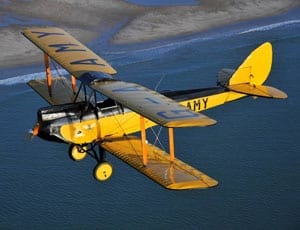
Britain’s best-known wartime Prime Minister piloted a Gipsy Moth aeroplane that will be sold by auctioneers Bonhams in February 2013 at a guide of £120,000. The same craft was also featured in an iconic 1980s film and was also supposedly flown by a member of the Fiennes family who mysteriously disappeared in 1998.
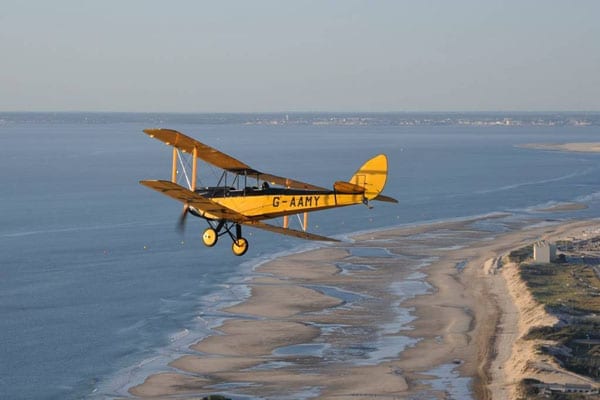
The 1929 De Havilland DH 60 GMW Gipsy Moth bi-plane G-AAMY that will be sold by Bonhams at the Grand Palais in Paris in February 2013 
Sir Winston Churchill (1874 – 1965) Piloted several times by Sir Winston Churchill (1874 – 1965) and used in the Oscar award winning Out of Africa, this 1929 De Havilland Gipsy Moth bi-plane is 24-foot long and has a 30-foot wingspan. It is capable of a maximum speed of 105mph and “wears” a yellow and black livery. It’s registration is G-AAMY in homage to the pioneering English aviatrix Amy Johnson (1903 – 1941).
In the film, the plane was flown by Robert Redford but though the life of the big game hunter Denys Finch Hatton he played is intriguing; the exploits of Redford’s aviator double are just as fascinating a story.
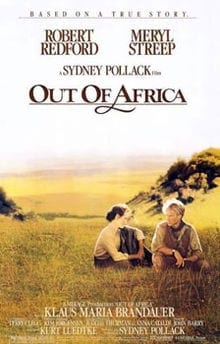
Sydney Pollack’s “Out of Africa” (1985) starred Robert Redford and Meryl Streep 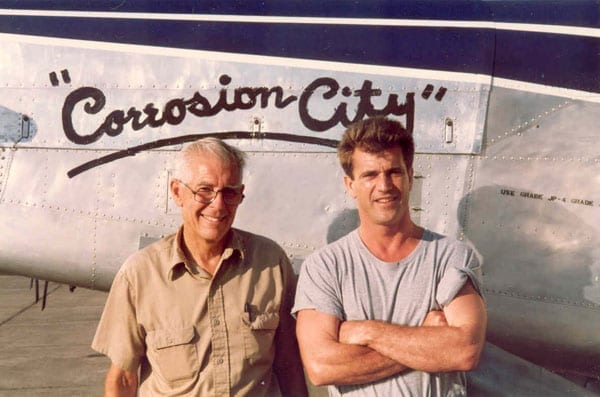
Tom Danaher pictured whilst filming with Mel Gibson Few outside of the aviation world will have heard of Tom Danaher (1929 – ) but aside from Out of Africa, he’s pretty much done it all. After graduating from a high school in Dallas in 1941, he became a Marine Corps fighter pilot. Stationed on Okiwana in August 1945, he shot down the last Japanese bomber on the final night of the Second World War and also made history, aged 21, for downing three other Japanese “Betty” bombers in the eight nights before the ceasefire.
Recalled to active service in 1951, Danaher flew one of the earliest jets, the F3D Skynight, with the Marines in Korea on night combat patrols and then was part of the last combat mission on a high altitude bombing strike over Pyongyang, North Korea in July 1953.
Danaher’s passion for flying continued after the war and in 1954 he flew his own plane, a 1948 Bonanza, to England to visit friends he’d made from the RAF whilst in Korea. To make the journey, he built a 109-gallon auxiliary fuel tank so that he could fly straight across the Atlantic. On the way home he called in for an audience with Pope Pius XII in Rome.
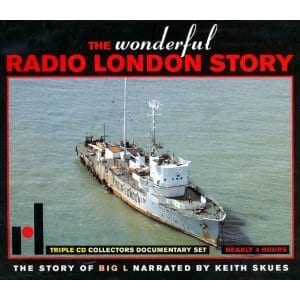
The surplus Second World War minesweeper from which Wonderful Radio London operated in the 1960s Danaher’s visits to England led to him becoming involved in a pirate radio station in from 1944 to 1967 named Wonderful Radio London. Like many others, Danaher was not impressed by the BBC’s monopolistic attitude to radio programming and so helped build a 17,000-watt station on a surplus Second World War minesweeper. It was anchored three and a half miles off the English coast and outside of Britain’s territorial limit. Of the experience, Danaher told Airport Journals:
“We had someone in Dallas who would record KLIF, a top 40 station, and we put it right on the air… The Englishmen over there just ate it up… The station programmed news and top 40 music and was very successful. It had the largest listening audience of any of any commercial broadcast station at the time.”
Back in America, Danaher owned three car dealerships in Wichita Falls, Texas but sold them in 1972 to open his own airport, the Tom Danaher Airport. Lake Wichita Airport (7TXO), as it was also known, kept the aviator busy but he has also piloted in films numbering Empire of the Sun, Sky Bandits, Air America, Bad Medicine, The Pleasure of Love, White Hunter Black Heart, Cliffhanger and Goldeneye.
In 1985, Danaher was recruited to fly Gipsy Moth G-AAMY by Sydney Pollack (1934 – 2008), the American director of Out of Africa. He recounted his six week experience on set in Masai Mara, Kenya in an interview for his local Texan newspaper, the TimesRecordNews, in 2008. Here, he highlighted the problems of trying to film with a vintage plane that “has no brakes and is difficult to steer”:
“Robert Redford couldn’t make the thing turn. It took considerable finesse to turn it on the ground… The third time, he gave it full throttle… The left wing contacted a thick thorn bush and it tore some of the fabric off the lower left wing of the plane. We couldn’t fly it the rest of the day.”
Other dramas arose with G-AAMY in terms of Meryl Streep’s body double refusing to fly in it and the craft struggling to reach the high altitudes necessary to film a sweeping shot of the plane flying past a waterfall. Danaher took charge stating: “If I can get a piece of string and a ruler, I can fix this.” He found just such, cleverly installed them and Pollack: “got every single shot he wanted.”
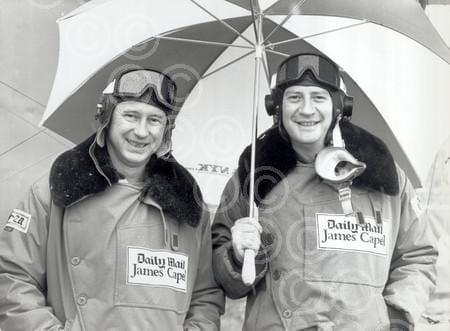
Pilot Roger Fiennes (1944 – 1998) pictured with Alexy Zaitov during the 1989 Glasmoth project expedition to Moscow and back Another person to have piloted the Gipsy Moth G-AAMY, according to a comment left in the PPRuNe Professional Pilots Rumour Network forum, was a man named Roger Fiennes. Whether this “rumour” is true or not, the cousin of the actor Ralph Fiennes and the explorer Sir Ranulph Fiennes, is another character with a flying history as fascinating as his true family name – which turns out to be “Twisleton-Wykeham-Fiennes” when presented in full. Of why he did not use this lengthy and historic surname, Fiennes is said to have once commented:
“You try writing that signature on a 6 foot long cheque book.”
Fiennes flew many hours in a variety of planes and one of the best documented was an expedition supported by the Daily Mail from White Waltham Airfield in Berkshire to Sheremetyevo Airport in the Soviet Union in April 1989 and back. He flew one of three Tiger Moth bi-planes with a Russian navigator named Alexy Zaitov. The journey took three weeks to complete, involved 33 perilous stops and covered 5,000 miles.
On 19th April 1998, Fiennes was piloting a 1941 DH82A Tiger Moth, G-BALX, from Dieppe to Headcorn Aerodrome in Kent but he failed to reach his destination. The Air Accidents Investigation Branch (AAIB) report into the disappearance concluded:
“Although the pilot contacted Paris Information by radio, in the absence of a specific request, the flight plan was not activated. Lashenden was therefore unaware of the flight’s departure and ETA. When the aircraft was reported missing overdue action, and the subsequent Search and Rescue operation, which was activated on the morning of 21 April 1998. Since then there has been no sign of the aircraft or pilot.”
Articles at the time and forums since are sparse in detail but several forum posters and articles suggest that Mr Fiennes had “mounting debts and a string of business collapses.” Whilst some go as far as to suggest a “Lord Lucan” style disappearance and make references to “paddling canoes” and “check[ing] the Panamanian register,” others remember a “nice guy, sadly missed.” Whatever really happened that fateful day, though, will probably never be solved.
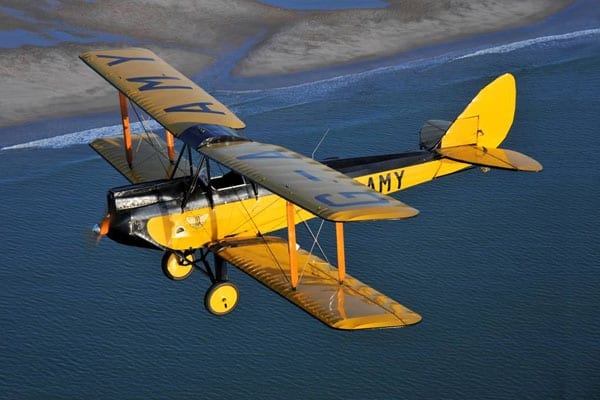
Another image of Gipsy Moth G-AAMY G-AAMY, which was marked G-AAMT for the filming of Out of Africa, is a plane with a remarkable past. We suspect there’ll be a few more dramas for this craft yet.
The 1929 De Havilland DH 60 GMW Gipsy Moth bi-plane G-AAMY will be sold by Bonhams at the Grand Palais in Paris, France sale during Rétromobile week (6th to 7th February 2013). For more information telephone +33 1 42 61 10 11 or go to: http://www.bonhams.com
To learn more about Tom Danaher’s experience flying G-AAMY in Out of Africa, read the full TimesRecordNews report by Lara K. Richards at: http://www.timesrecordnews.com/news/2008/jun/08/fly/?print=1
To read the AAIB account of the disappearance of Roger Fiennes and DH82A Tiger Moth, G-BALX, go to: http://www.aaib.gov.uk/cms_resources.cfm?file=/dft_avsafety_pdf_502449.pdf
-
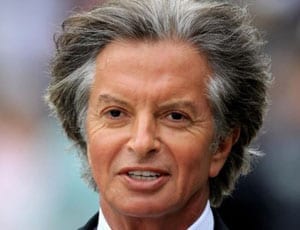
Richard Caring
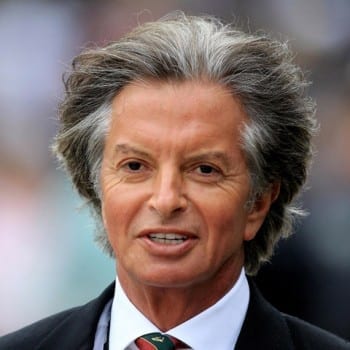 Of Italian-Jewish descent, Caring is of the “supermarket-sweep” school of empire building. This billionaire started out in the rag trade but now controls the majority of the top restaurants and clubs in Central London. He survived the 2004 Indian Ocean tsunami and viewed that to be a wakeup call. Since then he’s donated millions to charity and focused on his two passions: golf and shooting. This buccaneering businessman generally passes on breakfast and lunch and lives between a converted stable block set in 500 acres near Dulverton and a mansion on The Bishops Avenue. What will he buy next?
 -
All work and no bunga bunga makes Versace a good boy
A Modernist masterpiece based upon simple rationalism
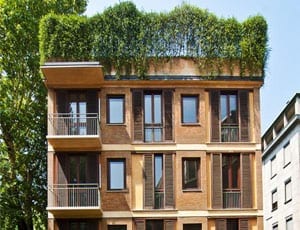
Two buildings were designed by architects Carlo di Carli and Antonio Carminati in 1953 – 1954 in Milan’s Via dei Giardini. Both are considered Modernist masterpieces and both stand proudly in this, the city’s only tree lined street.
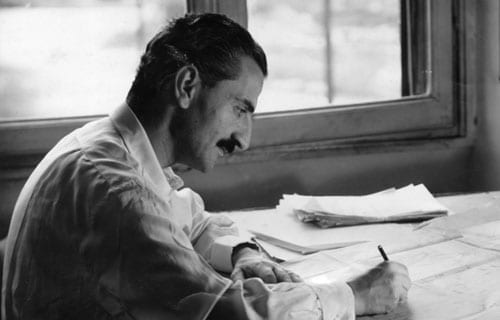
Architect and designer Carlo di Carli (1910 – 1999) 
Carli’s awarding winning 683 Cassina chair Carlo di Carli (1910 – 1999) is considered to be amongst the “master[s] of Italian design” and is best known for a chair named the 683 Cassina that won him the Compasso d’Oro award in 1954. He was a leading figure at the Polytechnic of Milan and worked extensively with Longhi and Cinoca. An exhibition of his works was held at the Triennale Design Museum in 2011.
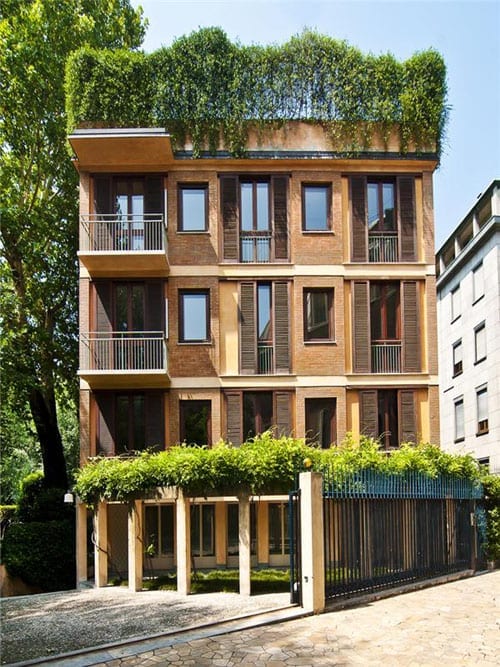
Santos Versace’s residence in the Via dei Giardini, Milan 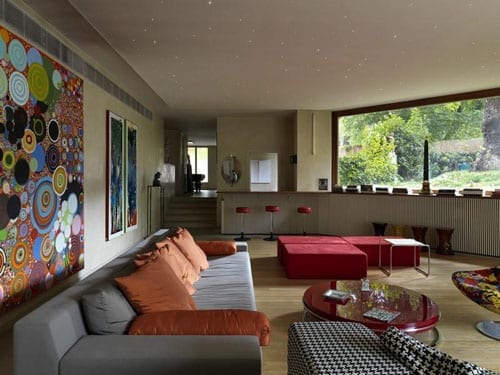
A colourful, simplistic Versace designed reception room 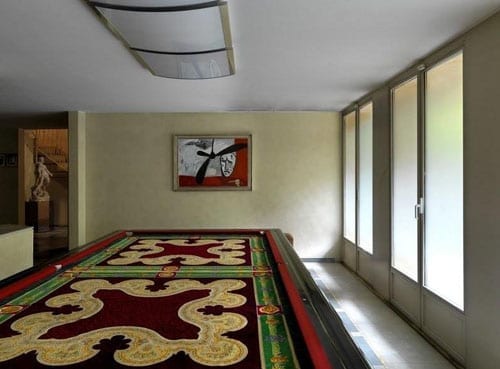
Versace’s design influences continue in the property’s games room 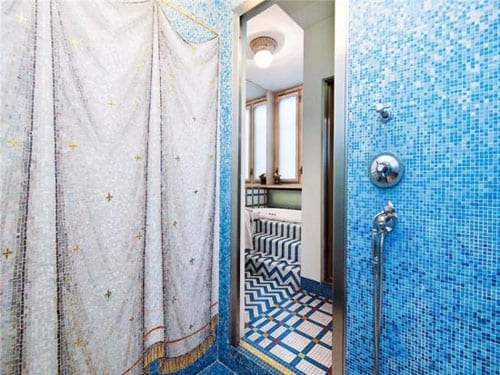
Versace’s influence is clear in a shower room in the property 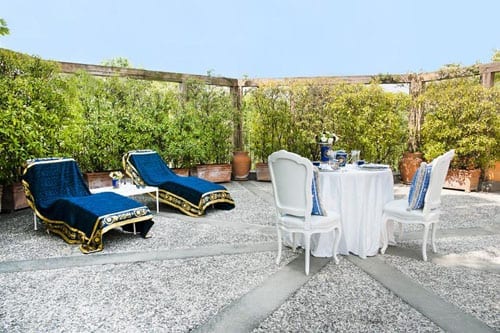
Whilst one could definitely have imagined Gianni Versace relaxing on this roof terrace Laid out in the shape of an octagon overlapping a rectangle, one of these rationalist buildings is a five-storey 22,000 square foot single family residence. It boasts an elevator, a private garden and a roof top terrace and in last week’s Evening Standard, Lorenzo Mercolini of Sotheby’s, who is selling it for Santo Versace, president and co-CEO of Gianni Versace SpA and a Member of the Chamber of Deputies of the Italian Republic, commented: “There is simply no other property in Milan like it.”
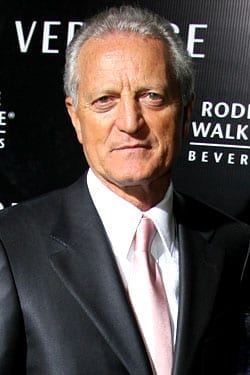
Santo Versace Santo Versace (born 1944), like his late brother Gianni and sister Donatella, is a colourful character. A graduate of the University of Messina, he worked first as a banker and then as an accountant. He gave this up in 1976 to support his brother in his rising career as a designer and effectively was the business brains behind the house of Versace. The company now generates over $1 billion a year in retail sales.
Married with two children, Santo Versace launched his political career in 2008 with Silvio Berlusconi’s The People of Freedom party before sensationally quitting in September 2011. His parting words to the “king of bunga bunga” were:
“I like to work. And in (Mr Berlusconi’s political party), there’s no need for people who work.”
He is now a member of the Alliance for Italy party and regularly speaks out against corruption in Italian politics. Mr Versace has not given a comment as to why he is selling his base at the heart of Milan’s shopping district.
You’d have to be Gaga about Versace to purchase this Via dei Giardini mansion though. The asking price is a staggering £40,000,000.
For more details about Santo Versace’s Via dei Giardini home, contact Ricardo Bergamo of Sotheby’s on +39 02 8707 8300 or go to: http://www.milan-sothebysrealty.com/eng/sales/detail/289-l-1952-4000032335/a-one-of-a-kind-glamourous-property-in-milan-milano-mi-
-
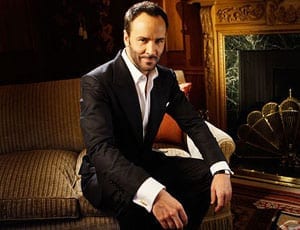
Tom Ford
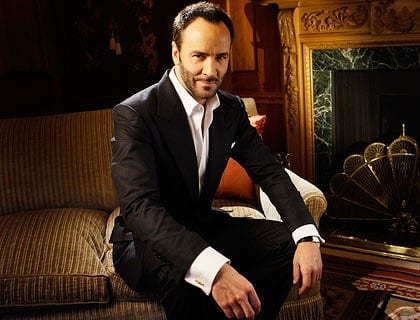 This Texan born designer and film director turned around the fortunes of Gucci and YSL and had a huge success with A Single Man. A fixture at New York’s Studio 54, his designs are hugely influenced by the club’s disco-era glamour and his love of all things black and square. Ford met his journalist partner, Richard Buckley, at a fashion show in 1986. They share a love for smooth fox terriers and announced the birth of their son, Alexander Buckley Ford, in September 2012. Of being “gay,” he comments: “I hate that word” but declares that he’ll marry when same-sex marriage is legalised in California. Of Ford, his partner, Buckley, adds: “There’s only one Tom for me.”
 -
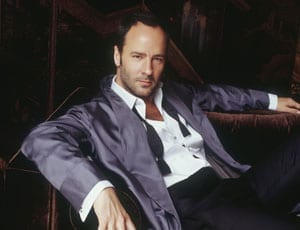
Post-Fordism
The flexible £12.75 million former home of Tom Ford
Number 26 Gilston Road in London’s SW10 is a property that has been on and off the market repeatedly in recent years. On each and every occasion it has been promoted as the “former home of the fashion icon Tom Ford” and though he hasn’t lived there in years, it is still just as he left it.
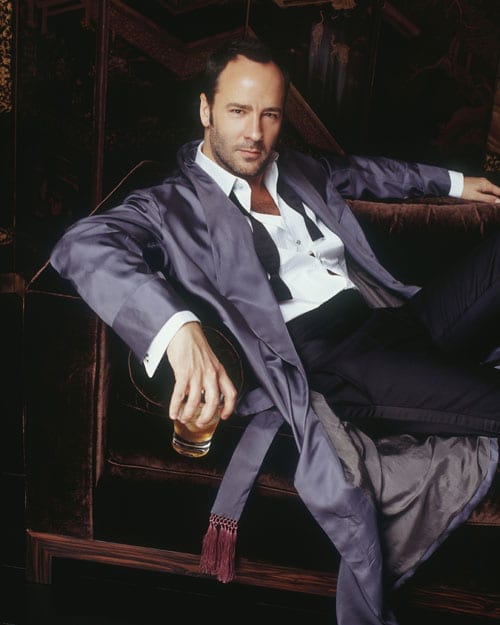
Designer and film producer Tom Ford 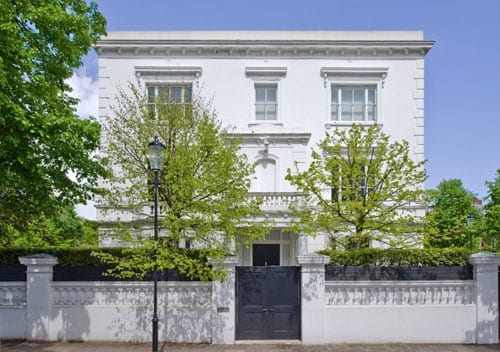
“The former home of design icon Tom Ford”: 26 Gilston Road, London, SW10 9SS Situated at the end of a terrace on the corner of Priory Walk, one can see why the house appealed to the Texan born designer credited with turning around the fortunes of Gucci and Yves Saint Laurent. Hidden behind a high wall and hedging, 26 Gilston Road is private yet minutes from the restaurants of Old Brompton and Fulham Roads.
This 4-storey townhouse was sold in June 1997 for £2,250,000 and again marketed in 2009 for £8,500,000 through Aylesford. In the time since, it has been available to let at prices ranging from £5,500 to £7,500 per week, but is now back for sale at the extraordinary figure of £12,750,00 through Russell Simpson.
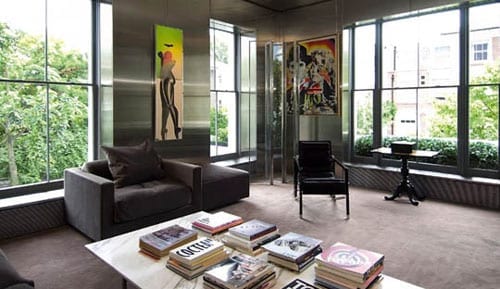
One of the reception rooms, just as Tom Ford left it 
Another of the Tom Ford styled rooms 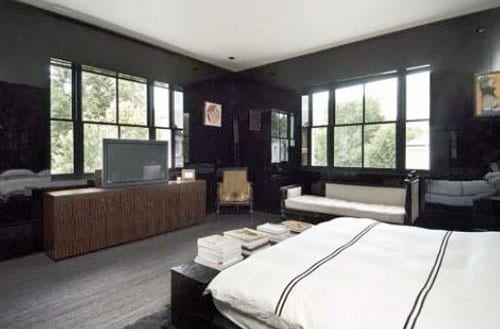
A Tom Ford designed bedroom 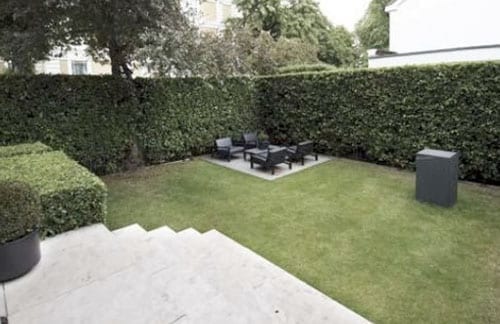
The garden of the property is extremely private What explains such a rise during a period of economic downturn? Well, it’s because developers Equilibrium have gained permission to “de-Ford” the house. As is now the trend in London, they have planned a total redesign. Their illustrations incorporate a new sub-basement and as a result the gross internal area will increase from just over 3,700 square feet to just under 5,300 square feet.
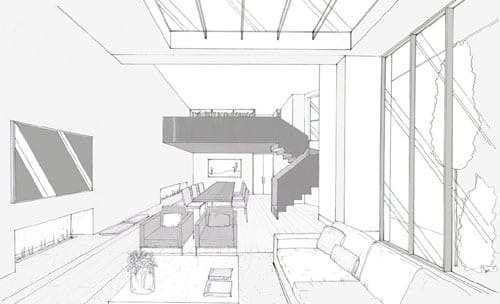
Equilibrium’s plans include a vast living-dining-kitchen with a study in the void over. The space is lit by a skylight. 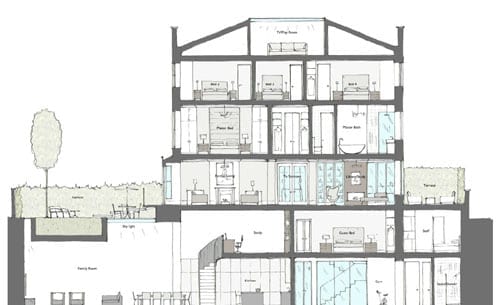
A cutaway shows the extent of the redevelopment planned 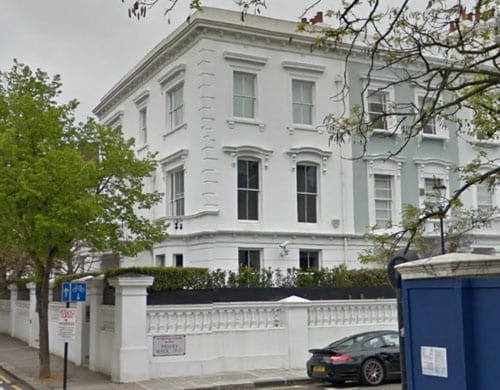
A view of 26 Gilston Road from the corner of Priory Walk Whilst the layout Tom Ford, himself a graduate in architecture from Parsons The New School of Design, created at 26 Gilston Road was ideal for A Single Man; the new floor plan with 4 bedrooms is much better suited to a family. Ford and his partner, Richard Buckley, announced the birth of their son, Alexander, in September. Perhaps they should put in a bid.
For more information about 26 Gilston Road, London, SW10 9SS, contact Russell Simpson, 5 Anderson Street, London, SW3 3LU. Telephone: +44 (0) 20 7225 0277. View a brochure for the property at: http://www.russellsimpson.co.uk/assets/12/06/15/5081/pdf_archive-1.pdf
View Equilibrium’s website at: http://www.equilibriumlondon.com
View Tom Ford’s website at: http://www.tomford.com
-
Docked excess
Matthew Steeples compares two comparable examples of motoring excess: the “Golden Zebra” and the Fulda Maybach Exelero
In recent weeks I’ve received a number of messages about an $8,000,000 car named a Fulda Maybach Exelero. One of them referred to it as “one of the most over the top cars on the planet” and so it piqued my interest.
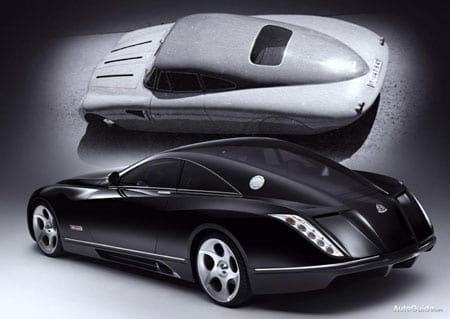
The 2005 Fulda Maybach Exelero concept car was inspired by the design of the 1939 Maybach SW38 Stromlinie 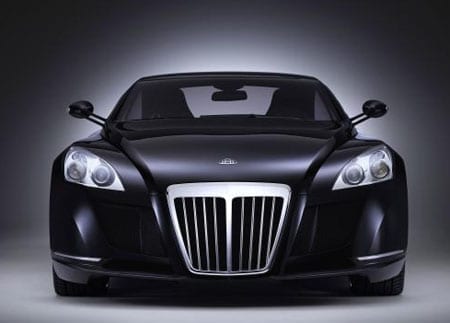
The front of the car is dominated by an aggressively styled grille 
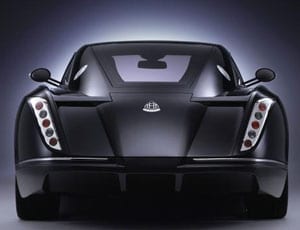
Whilst the rear would most definitely appeal to Batman 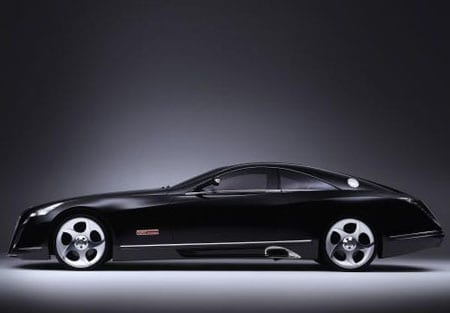
A view from the side illustrates just how long this 5890mm vehicle truly is In these straightened times, such a figure seems quite a lot for a car but what, you may ask, makes it so special? Well, for a start it was a one off and commissioned in 2005 by the tyre company Fulda to showcase their Carat Exelero range. Designed for them by a 24-year old student named Fredrik Burchhardt of the Pforzheim Polytechnic Department of Transport Design and built on the chassis of a Maybach 57 limousine, this 2-seater coupé is 5890mm long and 2140mm wide. The vehicle, which weighs a not so insubstantial 2.6 tonnes, has a 5.9 litre V12 twin turbo engine and in testing achieved a top speed of 218mph at southern Italy’s Motodrom Nardo.
In due course the Exelero was sold to André Action Diakité Jackson, a diamond industrialist, for €5,000,000. Jackson allowed Jay-Z to use the car in his Lost One music video before selling it to a “European entrepreneur” named Arnaud Massartic. Subsequently, various reports state that Massartic sold the vehicle on to the rapper Bryan “Birdman” Williams for $8,000,000 in April 2011 but other articles suggest that he failed to pay for the vehicle. Who knows where it is now.
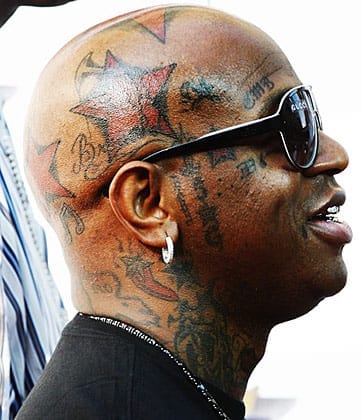
Rapper Bryan Williams (AKA “Birdman”) is best known as one half of the Big Tymers and is also the co-founder of Cash Money Records (http://birdmanstunna.com) 
Birdman in another of his cars, a Maybach 62s Landaulet 
Sir Bernard and Lady Docker 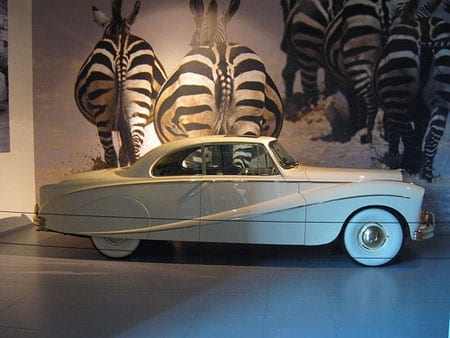
The ex-London Motor Show 1955 Daimler DK400 “Golden Zebra” coupé with coachwork by Hooper & Company. Registration number: TYL 575, chassis number: 92705 and engine number: 48771. 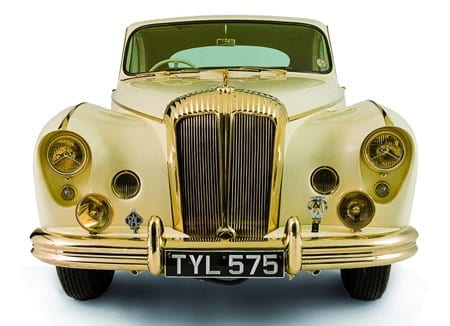
The front of the “Golden Zebra” Whether or not this piece of “automotive art” is indeed in the ownership of a “bling-king,” there are countless other examples of individually designed vehicular excess but amongst the most extravagant has to be an example commissioned by Lady Docker in 1955.
Norah Docker (1905 – 1983), whose third husband was Sir Bernard Docker, chairman of Birmingham Small Arms and its subsidiary the Daimler Motor Company, spent £12,000 in 1955 creating the “Golden Zebra” coupé on the chassis of a DK400 limousine. She replaced anything on the car that would have normally been made in chrome with gold and upholstered it in real zebra hide. Black, white and gold-trimmed accessories completed the look and amongst them were picnic stools, folding rear seats complete with a cocktail bar and an elephant ivory dashboard makeup table with a mirror, compact, comb, brush, cigarette case and cream jars.
Commenting as to why she chose to use zebra for the car’s upholstery, Lady Docker’s justification, in a quote that Barbara Amiel could only dream of having come up with, was simple:
“Because mink is too hot to sit on.”
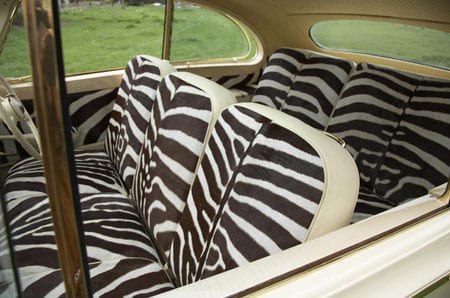
The zebra hide upholstered interior of “The Golden Zebra” 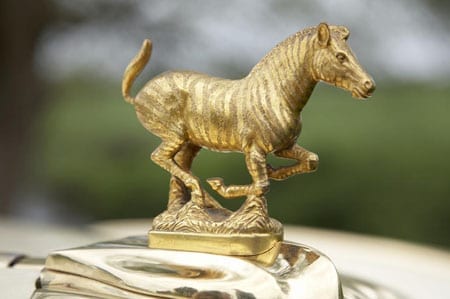
The car even features a golden zebra as a mascot 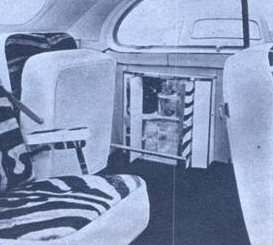
Lady Docker, considered a visionary in her design skills by some and as vulgar and brash by others, even thought to include a drinks cabinet within the folding rear seats. 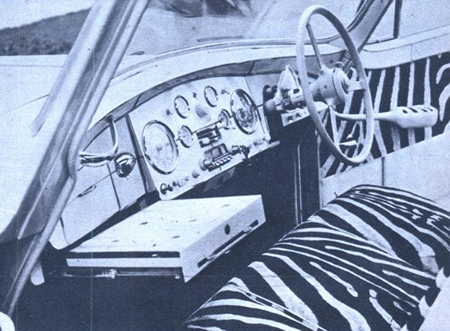
In the front, an elephant ivory dashboard makeup table with a mirror, compact, comb, brush, cigarette case and cream jars show how much thought she put into the vehicle’s creation. 
Conrad Black and his wife Barbara Amiel have been much discussed in the press in recent days for their “extravagance.” They had nothing on Sir Bernard and Lady Docker. The 4.6 litre “Golden Zebra” was to be last of the cars created to Lady Docker’s designs as shortly afterwards, in May 1956, Sir Bernard Docker was sacked from BSA’s board for squandering the company’s cash. In addition to the extravagance of the “Docker Daimlers,” he’d used shareholder money, in a manner that could indeed be compared to Lord and Lady Black’s days at Hollinger, to buy his wife a castle in Wales and maintain a 212ft motor yacht named Shemara.
Daimler forced the Dockers to return the Daimler vehicles Lady Docker had so diligently designed and in revenge she bought a Bentley Continental from the firm’s rival, Rolls-Royce. The “Golden Zebra” and the other “Docker Daimlers” were stripped of their expensive trimmings and sold. In 1966, the car was offered for sale by Daimler distributors Henlys of Chester for just £1,400 and after passing through the hands of several other owners ended up in California.
In 1988, the “Golden Zebra” was purchased by a Daimler collector named John Wentworth. He restored the vehicle to its original glory with the help of experienced craftsmen and even managed to locate Kenyan zebra hides at a tannery in South Africa. Wentworth died prior to the completion of the car’s restoration and in 2006, it achieved £177,500 at Bonhams. The “Golden Zebra” came up for sale again in 2011 for £175,000 in Florida. It is now on display in the Louwman Museum in The Hague, Netherlands.
“The Golden Zebra” was certainly a car that reflected the excesses of the 1950s and the Exelero was without doubt the equivalent for the 2000s. What on earth could usurp these two moving monuments of extravagence next? We are on the lookout.
Watch a video of Sir Bernard and Lady Docker at: http://www.britishpathe.com/video/sir-bernard-counted-out-1
View the Louwman Museum entry for the 1955 “Golden Zebra” Daimler at: http://www.louwmanmuseum.nl/asp/appmain.asp?appactie=collectiedetail&taalcd=en&collsq=5486
View Fulda’s website dedicated to the Fulda Maybach Exelero at: http://www.das-projekt.com/EN/maybach_homepage_en.html
-
Video of the Week: The Queen morphs
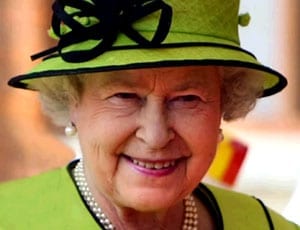
The Queen’s life in 3 minutes and 24 seconds
This week we must thank Dan Large for having alerted us to an amazing YouTube video showing Her Majesty The Queen’s life in 3 minutes and 24 seconds.
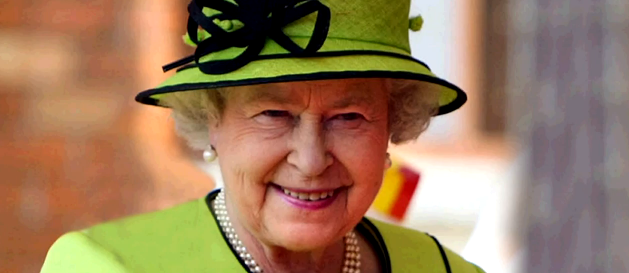
Elizabeth II Created by “an old retired guy who likes to play with computers” named “HerBunk” and using the technological wizardy of FantaMorph, the video has attracted nearly 6,000 likes and 300 dislikes. We look forward to hearing what readers of The Steeple Times make of it.
Watch the video at: http://www.youtube.com/watch?v=E8nJhG1xE5o&feature=share
-
The perils of fusion
Christian Huhnt reports on recent changes at Cassis restaurant
As I work in the arts and also collect wines, I find Cassis Bistro in South Kensington most comfortable as here I find myself surrounded by great works by Julian Opie, Gary Hume and Henri Matisse alongside as a humongous and well-stocked wine rack at the back of the restaurant. Cassis is part of Marlon Abela’s restaurant group, Marc, which also includes The Greenhouse, Umu, Morello Bistro and Morton’s.
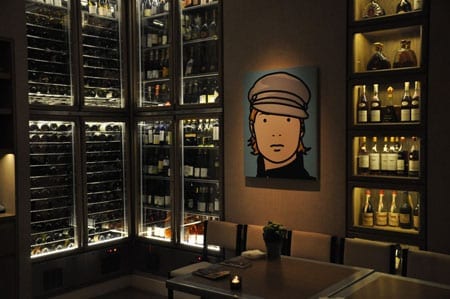
Cassis Bistro’s decor cleverly combines wine and art 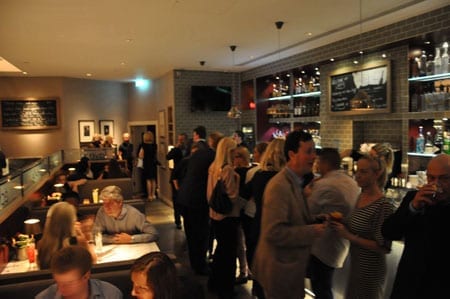
Party guests at Cassis Bistro, 232 – 236 Brompton Road, London, SW3 2BB It was with anticipation, therefore, that I accepted an invitation to celebrate the arrival of Cassis’s new head chef, “le nouveau moteur de cuisine,” Massimiliano Blasone. Wait a minute: “Blasone”? That doesn’t sound to French to me. And indeed, he isn’t. This Italian chef made his name at Heinz Beck’s Michelin-starred Apsleys at The Lanesborough Hotel on Hyde Park Corner.
The first thing that I asked myself was: “What is an Italian chef doing in a French kitchen?” More importantly: “What is an Italian chef doing in a restaurant that has made its goal,” according to their own marketing material, “to deliver: The finest Provençal cuisine in London?”
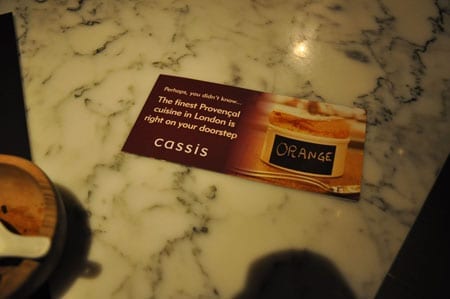
A leaflet promoting the “Provençal” cuisine on offer at Cassis After consulting the restaurant’s PR she told me the new idea is to “cook Provençal cuisine with an Italian influence.” What the heck? Why not add a Nigerian limbo dancer making sushi or a Muslim serving pork pies?
Continuing, she told me that the former chef had left as he’d decided to open his own restaurant. I recall once having a delightful lunch when that particular chef was still at Cassis, roughly one year ago, and remember how tasteful and typically Provençal it actually was.
Starting, as ever, with the drinks, I let the waiter choose my first one. He gave me a “Cassis Collins” which is supposedly the house cocktail. A mix of gin, crème de cassis soda, blackcurrant purée and lemon juice. Sadly, I could only really taste the lemon and overall it was too watery. It tasted as if it had been mixed 30-minutes prior to my arrival.
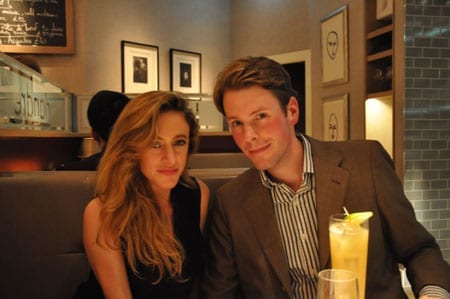
Jessica Patterson and Steffen Timm at Cassis I quickly changed to an Italian classic, a Negroni, which was strong but cool. This was far more impressive. Steffen Timm, my companion and food connoisseur, went for a non-alcoholic cocktail with the notion to spare his palate for tasting the food later on, but while sipping at it he almost got a sugar shock and therefore turned to the booze too.
While sat at the bar, I found myself surrounded by some delightful locals and regulars. Things were most definitely on the up. After nibbling one grissini after another, finally the food arrived, but it came at such a speed that I struggled to keep up. Not even finished with a typically Italian dish of tagliatelle con tartufo bianco, the kind waiter offered me some superb raw tuna served in a Middle East Asian style with bulgur. Having barely swallowed this, the next dishes presented to me were a pumpkin tortellini with truffles, followed by oysters with sour cream and cucumber. Quail’s eggs with truffles, a lamb saddle with ratatouille (which was probably the only ‘kind-of-Provençal’ canapé) and finally some perfectly made risotto with yet more truffles brought things to a crescendo. My love affair with truffles is well known and some readers may recall my sharing that with you in my review of Honky Tonk. I must say, however, that this particular dish was more reminiscent of something that one might find in a chic restaurant in St Tropez than in the Provençal settings I am used to.
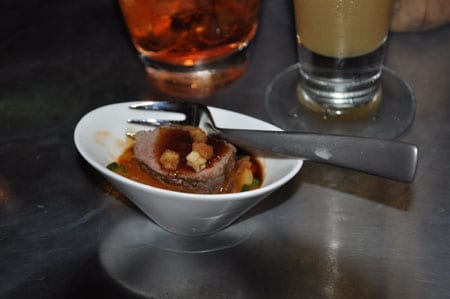
Provençal-style lamb saddle with ratatouille Although Cassis is delightful and I enjoyed an evening of conversation and company, sadly, this new kitchen seems to have lost its ethos and now lacks the authentic Provençal character that made it so good. I urge the management to return to the quintessentially rustic and traditional roots that first made the place so appealing.
Cassis Bistro, 232 – 236 Brompton Road, London, SW3 2BB. Telephone: +44 (0) 20 7581 1101. Website: http://www.cassisbistro.co.uk