Our reaction to the BBC Lab UK’s Great British class calculator
Yesterday, Twitter and Facebook were abuzz with talk of a new class calculator created by the BBC Lab UK and a pair of academics that claimed it could grade the position of each and every one of us in society.
Gone, they say, are the 20th century definitions of working, middle and upper classes and the restrictive Downton Abbey type pigeonholing of individuals by birth and social standing. In their place, modern Britons, they suggest, are identifiable by an astonishing seven categories that range from the “elite” to the “precariat”.
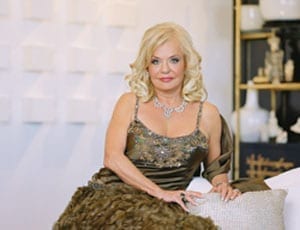
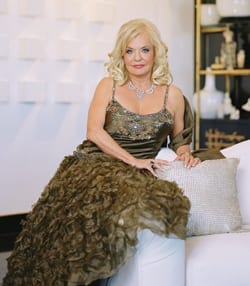
Co-owner of the Four Seasons in Beverly Hills with her husband R. J., Cohen is of surprisingly humble origins. She grew up on a chicken farm in Cleveland, Ohio but moved to LA with her divorced mother aged 13 when she opened a Kosher chicken killing plant on Santa Monica Boulevard. This hardworking lady now instead hosts the likes of Rod Stewart, John Tavolta, Quentin Tarrantino, Mel Gibson, Britney Spears and Ryan Seacrest. On an occasion Matthew McConaughey has even been known to park his Airstream on the front lot to barbeque steak for passersby.
The Steeple Times asks the financier turned fashion designer Jax Martin: “What’s on your mantelpiece?”
The Steeple Times shares “wit and wisdom.” What’s your guiding force?
Love.
“Don’t get even, get medieval” is, in our humble opinion, a great motto. What’s yours?
“If the glove don’t fit, you must acquit.”
Kerry Katona was considered unacceptable in 2007. Who or what is unacceptable in 2012?
Reality TV personalities are unacceptable in any year (but to be clear Kerry Katona is still unacceptable).
Tony Blair misses being Prime Minister. What do you miss most in your life?
Sleep.
What might you swap all your wealth for?
High quality education for all children.
Donald Trump was once a case of: “If you owe the bank a thousand, they close you down; but if you owe the bank a billion, you own the bank.” What’s your view on the banking crisis?
Bankers who created complex financial instruments should not receive the brunt of the blame. Let us not forget the inept regulators who permitted these activities to flourish, causing the crisis to become much worse than it might have been.
What phrase or word do you most loathe?
“Reaching out.”
In the UK, some people consider charity to “begin at home.” What’s your view and what causes do you personally support?
Good actions give strength to ourselves and inspire good actions in others.” Plato. I anonymously support several charitable causes related to: education, medical research, the arts and women’s and children’s issues.
The judge in “Law Abiding Citizen” states: “I can pretty do whatever I want” before being blown up whilst answering her mobile phone. What’s your view on the appropriate use of such devices?
You can’t live with them and you can’t live without them. But, I have no interest in listening to other people’s loud conversations on their mobiles.
If you could fill a carriage on The Orient Express, who would be your fellow passengers?
Oscar de La Renta, His Holiness the Dalai Lama, Mao Tse Tung, Madonna and Ronald McDonald.
Fashion designer Jax Martin
If you were unfortunate enough to end up on death row, what would be your last meal and where would you eat it?
I LOVE to eat; I would have a very large meal comprised of chateaubriand with shallot sauce, Cajun chicken and fries from Le Bilboquet and a bacon cheeseburger with grilled onions from Corner Bistro. All of the aforementioned would be served with a bottle of Gevrey-Chambertin. For dessert, I would have a slice of mille-feuille with fresh cut strawberries on the side. If I were allowed to dine outside of death row, I would have the meal served in either Trancoso in Bahia, Brazil or José Ignacio in Punta del Este, Uruguay.
What time is it acceptable to consume the first drink of the day?
This question makes the assumption that somehow one has stopped partying from the previous evening.
A Negroni, a martini or a cup of tea?
A martini.
Whose parties do you enjoy the most and why?
It doesn’t matter who throws the party, it’s the company you carry that makes the party.
Who is the most positive person you know?
Lucy.
What’s your most guilty pleasure?
Can’t say.
If a tattoo were to sum you up, what would it be of?
A phoenix.
If you were a car, what marque would you be?
A Koenigsegg Agera R.
Cilla Black presented “Surprise, Surprise.” Tell us the most surprising thing about you.
While I was in engineering school, I was also a professional dancer.
What’s currently sitting on your mantelpiece?
An antique Buddha, candles and a couple of black and white family photographs.
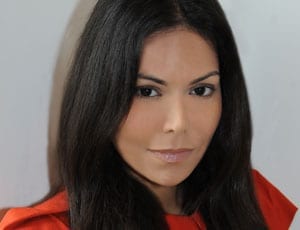
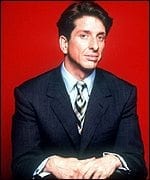
British designer Jax Martin is a former financier and professional dancer. A graduate of Columbia University, Martin also has an MBA from the Wharton School at the University of Pennsylvania and began her career in the hedge fund business. She now creates “chic clothing for today’s woman” and states: “I live to make women feel great and look fabulous”.
Matthew Steeples delves into the history of Albany, Piccadilly and discovers an affordable way of living there
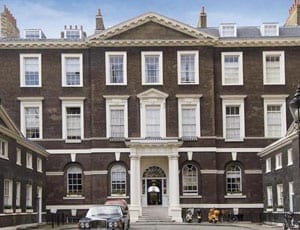
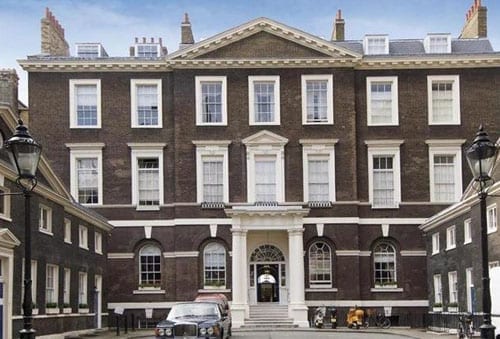
Albany, off Piccadilly in Mayfair, was most probably London’s first apartment block and it’s certainly the city’s most exclusive. It may be next to the Royal Academy and opposite Fortnum & Mason but surprisingly few have even heard of it.
Considering its location, Albany, which some make the mistake of referring to as “The Albany,” is an amazingly quiet oasis of peace and tranquility but, equally, it is a place of intrigue and drama. Residents, or “proprietors,” as they prefer to be known, of the 69 “sets” are particular about the “the” part of the name as they’d rather their residence not be confused with a public house and they are even more protective of their privacy. A porters’ lodge guards the entrance to the building and it is staffed mostly by ex-servicemen, who, until the early 2000s, had to wear top hats and tailcoats. Those allowed to pass enter a rarefied world frequented by what the Irish novelist Marmion Savage (1803 – 1872) identified as “incurable oddities” and “superannuated fops” in The Bachelor of Albany.
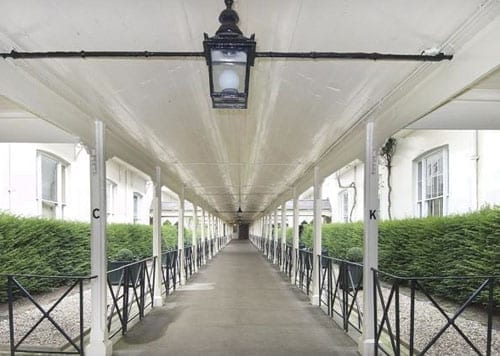
The front courtyard and façade of Albany, Piccadilly, Mayfair, London, W1J 0ALThe rope-walk connecting the various sets of Albany has been traversed by some of the greatest names in history
Built by Sir William Chambers (1723 – 1796), who also designed Somerset House and the pagoda at Kew, between 1770 and 1774 for 1st Viscount Melbourne (1745 – 1828), Albany was originally known as Melbourne House and conceived as a three-storey mansion, seven bays wide with a pair of service wings flanking a front courtyard. From 1791 to 1802, the property was occupied by George III’s son, Prince Frederick, Duke of York and Albany (1763 – 1827), but after he left, the renowned architect Henry Holland (1745 – 1806) sub-divided the existing house and added two parallel sets of buildings running the length of the garden to create 69 “bachelor apartments” which he named “sets.”
The “roll call” of residents since could easily fill our very own pages thrice over. They number royalty, politicians, artists, playwrights, academics and philosophers and here is a brief selection:
– Anthony Armstong-Jones, later 1st Earl of Snowdon
– Sir Thomas Beecham
– Sir Isaiah Berlin
– Lord Byron
– George Canning
– Sir Kenneth Clark
– Baroness Pauline de Rothschild
– William Ewart Gladstone
– Sir Edward Heath
– David Hicks
– Aldous Huxley
– Sir Simon Jenkins
– Rupert Lycett Green
– Malcolm Muggeridge
– Sir Harold Nicholson
– J. B. Priestley
– Sir Terence Rattigan
– Roger Scruton
– Baroness Sharples
– W. Somerset Maugham
– Terence Stamp
– Sir Denis and Lady Thatcher
– Sir Herbert Beerbohm Tree
Each had to pass the vetting of a committee of trustees of this Grade I listed building. That committee forbids children under 14, pets, musical instruments and commercial activities and each approved resident has undoubtedly added to the history of this den dominated by a central walkway named the “rope-walk.” Incidentally, an example of a curious quirk at Albany is that no resident is allowed to speak to another on this walkway. If they do, a fine is incurred. Albany, indeed, is rather like a college in its systems of rules, regulations, order and hierarchy.
For several centuries, women were not even allowed to cross the threshold and one legendary tale tells of Lady Caroline Lamb (1785 – 1828), disguised as a page boy, stealing into Lord Byron’s (1788 – 1824) set in 1815 to leave a note: “Remember me, Byron.” He replied with a simple verse:
Remember thee, aye, doubt it not:
Thy husband too shall think of thee.
By neither shalt thou be forgot —
Thou false to him, thou fiend to me.
The strict and formal structure that controls Albany and ensured its maintenance has succeeded in the main because 34 of the 69 sets are owned by Peterhouse College, Cambridge. They and the other owners are highly particular in whom they lease to and on one occasion on hearing of an “unsuitable tenant,” the secretary of the trustees is reported to have shouted:
“He’s a foreigner. Don’t like him. Don’t trust him.”
Needless to say, that application didn’t progress and nor did one from a physiotherapist who planned to operate from the building. Bone bashing in Albany just wouldn’t do.
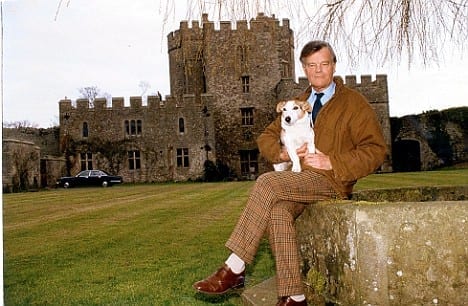
The Rt. Hon. Alan Clark MP (1928 – 1999) in the grounds of his main home, Saltwood Castle, near Hythe in Kent in 1993
A horsewhip, however, nearly crossed the threshold of set B5 in 1994, as it was here that the late Alan Clark MP (1928 – 1999) lived. The affable philanderer seduced the wife and both daughters of a certain South African named Judge Harkess and the wronged man stated he would “have horse-whipped Clark if he had known how comprehensively he had violated his honour.” B5, itself, was described as having the feel of “the straitened quarter of an Edwardian bachelor on his uppers” and the dotty, English attitude of the residents is best summed up by the reaction of Clark’s neighbour when he accidentally flooded their basement. When asked what he could do to make amends, their answer was quite simple: “Go and lie down in Piccadilly and wait for a double-decker bus.”
The dandy and journalist John Morgan (1959 – 2000) typified social change at Albany in the 20th century just as much as he himself redefined etiquette and manners at Debrett’s and The Times. Of “humble origins,” Morgan was brought up in a “modest” bungalow in St Madoes, Perth, Scotland but is credited with persuading William Hague to remove his baseball cap whilst Conservative leader and offering advice ranging from “how to eat a banana” to “how best to tell friends that the partner you would like to bring to their wedding will be of the same sex as you.”
Dandy and etiquette expert John Morgan (1959 – 2000)
For the bachelor and GQ style director, living in Albany was symbolic of his own personal social elevation but he did not disown his past. This modern day Beau Brummell was a man of social contradictions who cashed his cheques at Claridge’s but was a member of the National Union of Journalists. He was a Tory but still regularly attended chapel meetings as he had done in his youth. Here was a man of paradoxes who seemed unable to come to terms with the fact that he was a homosexual.
Morgan, an asthma sufferer, fell to his death from a fourth floor window on 9th July 2000. He was found in just a white shirt in a basement below a window whose sill was strangely undisturbed. The coroner left an open verdict with a suspicion of suicide and it was widely reported that police found 60 made-to-measure Savile row suits, 300 monogrammed shirts and 90 pairs of shoes in the etiquette expert’s small set. Mystery shrouds the story of his tragic demise to this day but Johnny Morgan will forever be remembered as an arbiter of both good taste and behaviour.
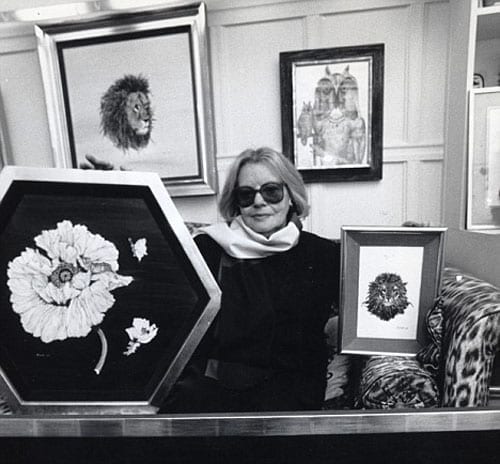
Whilst Morgan represented continuation of the trend of bachelors living in Albany, change also came in the 20th century when the building’s committee removed the restriction that allowed only bachelors to be resident. With that females were allowed in and amongst them Fleur Fenton Cowles (1908 – 2009) was one of the most fascinating.
Fleur Fenton Cowles (1908 – 2009) in her set at Albany with some of her paintings and one by Salvador Dali
This writer and artist occupied five sets knocked into one with her fourth husband, timber merchant Tom Montague Meyer, and according to the Daily Mail’s Geoffrey Levy, hosted “elite soirees of the powerful and famous.” Levy recounts them at length but here is a flavour:
“On a Wednesday evening, a typical dinner party… would include Foreign Secretary Selwyn Lloyd, Labour leader Hugh Gaitskell, entertainer Danny Kaye and film star Douglas Fairbanks Jr. The Queen Mother regularly came to tea and was once joined by Pavarotti who sang Happy Birthday for the royal guest. ‘I don’t want her to die,’ said Fleur. ‘I couldn’t bear to think she doesn’t live just down the street.’ ”
Fenton Cowles, founder of the ill-fated Flair magazine and a “woman who knew everyone,” loved Albany and an exact replica of her “windowless, milk-yellow” study there has even been recreated at the University of Texas.
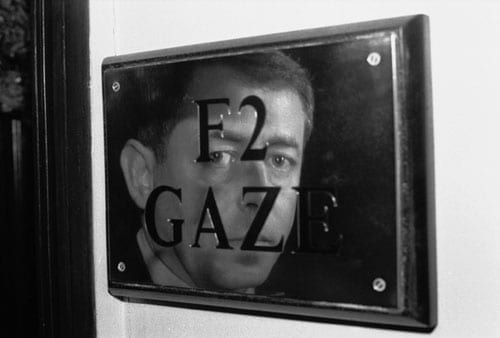
Another known for hosting extravagant bashes in Albany was my late friend, the Russian icon dealer John Gaze (1947 – 2011). Gaze had, as a boy, asked his father about the building when he passed it as a child and immediately declared he would live there one day. He took F2, the former set of Edward Heath that overlooked Savile Row to the rear, in the mid 1990s as he craved the safety that the building offered after having been kidnapped at gunpoint by an Oxford graduate conman named Sacheverell de Houghton in April 1991 from his then home in Fournier Street, E1. He made the most of his tenancy.
Russian icon dealer John Gaze (1947 – 2011) reflected in the brass plaque outside his Albany set, F2. It was formerly occupied by Sir Edward Heath.
Gaze’s parties included a fundraiser for people with AIDS hosted by a drag queen. This sparked fury with certain other residents and coverage in the Daily Telegraph and another incident there involved him encountering Alan Clark on the ropewalk carrying a portrait of Lenin. “Where the fuck are you taking that?” Clark supposedly bellowed but was “reassured” when he was told it was “destined for a less salubrious address in Whitechapel.” John Gaze remained at Albany for several years but, like a number of others I know, was forced out by ever rising rents and moved first to Chelsea and then Ennismore Gardens, Knightsbridge. He always remembered his time at Albany fondly and as a bon vivant, he truly belonged there.
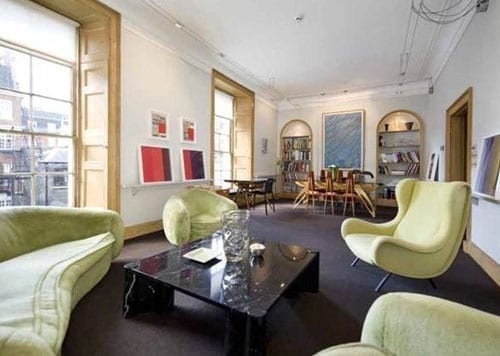
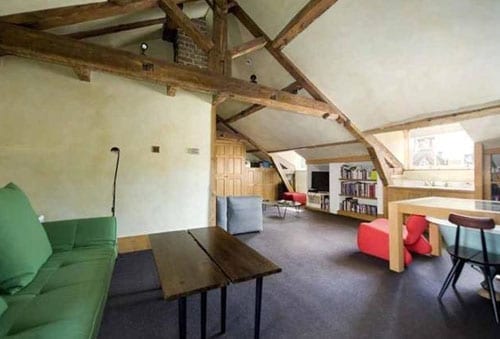
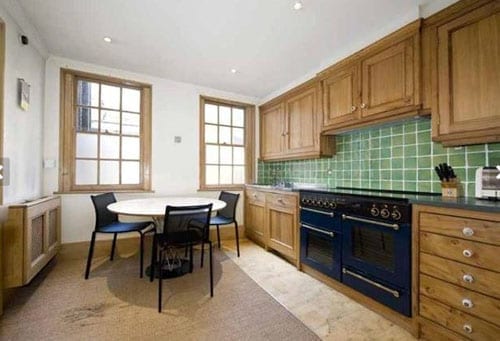
The main reception room in a £1,400 a week set currently available in AlbanyAn attic room in the set that could be used as a second reception room or second bedroomThe kitchen is lacking in character but offers ample space for informal dining
Contrary to what you’d expect, living in Albany is not quite as expensive as one might think. A 2-bedroomed 1,970 square foot set is currently available through Knight Frank for £1,400 a week: a figure that seems quite reasonable given the location, history and size of this property. Available on a minimum 8-year rental term, it includes a formal reception room, a dining kitchen, 2 bedrooms and 2 bathrooms.
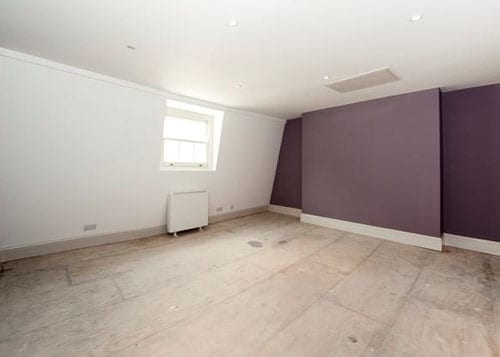
This £300 per week set, D2, consists of just one roomThe communal bathroom D2 shares with other sets is basic but clean
For those looking for something cheaper, Savills offer D2 Albany at £300 per week. This set consists of a 221 square foot third floor attic room with access to a communal bathroom and the agents suggest that it: “would make an ideal reading or writing room or an occasional bedroom for a pied-a-terre.” It’s effectively a posh form of tenement but what a way to impress your peers and subordinates.
Damon and Sandra de László in their “duplex” in Albany
Those renting either of these sets would find the likes of the industrialist Damon de László, a descendant of the Hungarian painter Philip Alexius de László (1869 – 1937), as their neighbour. The couple occupy Lord Byron’s former set, A2, and have, on occasions, opened it for a charity dinner with Matthew Parris at £1,000 a ticket as well and for members of The Portrait Institute to view their collection of de László’s works.
Professor Philip C. Bobbitt in his grand freehold set
Another present day resident is a man Henry Kissinger calls “the outstanding philosopher of our times,” Professor Philip C. Bobbitt. This Texan lawyer is a nephew of Lyndon B. Johnson and the author of Terror and Consent, which Tony Blair describes as “required reading for political leaders.” Bobbitt owns an impressive flying freehold set that is described as having a masculine style of décor and a “kitchen he has designed to look like a bar.” In an interview for TheIndependent he states that he finds Albany: “a propitious place to work.”
Though governments and bankers come and go, behind this quintessentially English façade, order and disorder have always been maintained. The wildcards of this hidden haven have a knack for living by the doctrine “to live at Albany is to live in history” and indeed they make the most of that. Those who are lucky enough to be let in, do, indeed, truly find themselves in the “Paradise of Piccadilly.”
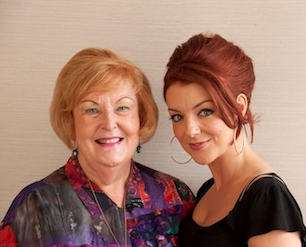
In the autumn of 2012, an ITV1 series, Mrs Biggs, dramatised the life story of this headmaster’s daughter from Reigate, Surrey. In it, Sheridan Smith (pictured here with the real Mrs Biggs) portrayed a lady of steely reserve who is intelligent, articulate and courageous. The former wife of the Great Train Robber Ronnie Biggs has now built a new life for herself in Melbourne, Australia as an editor, publisher and journalist and on crime, her views are simple: “[It] doesn’t pay in any way, shape or form.”
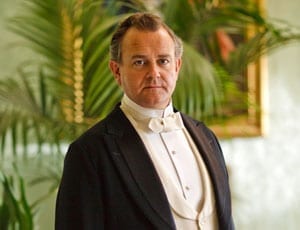
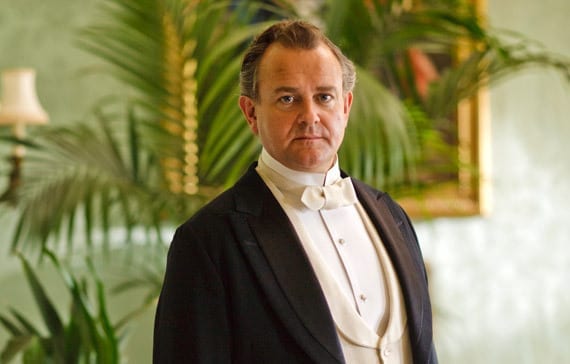
In his role as Downton Abbey’s Lord Grantham, this actor warned that “scandals” always have a habit of coming out. He graduated in Theology at Cambridge but, according to Adam Helliker of the Daily Express, Bonneville wasn’t especially keen to show Christian compassion towards Lord Archer at a party at The Cadogan Hotel when it was requested that the pair be photographed together.
This talented author was born in South Africa but educated at Eton and New College, Oxford. The Drowning People, his first novel, gained him a “vast” advance and was published during his first year at university. It’s been translated into 22 languages and has sold over 3 million copies. Richard Mason funds a foundation in memory of his sister that pays for gifted South African children from poor backgrounds to attend the country’s top private schools and with a writing style that’s been compared to “Henry James on Viagra”, he’s definitely got many more pages to pen. An early critic, who told him he “should have killed [himself] rather than publish”, is now writing reviews of home décor shows.
Georgea Blakey shares her experiences of Miss World 2012
“Welcome to the holly [sic] land of Genghis Khan. The city of green and pleasant cool.”
These are the words written on the side of the car collecting me from Ordos airport. The light summer breeze blowing through this wealthy oil and mineral rich town in the middle of the verdant grasslands of Inner Mongolia is indeed known as the coolest place in China. It now has another reason for the accolade: it is hosting Miss World 2012.
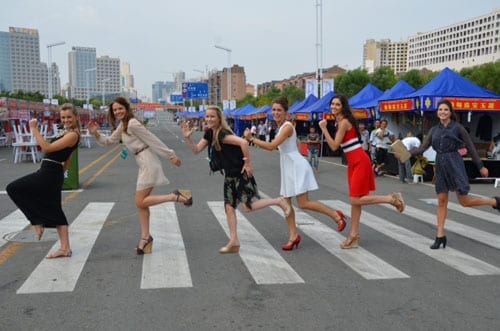
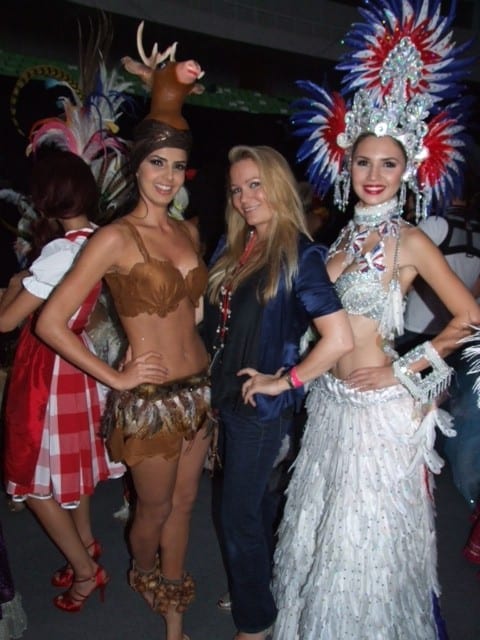
Recreating Abbey Road with Misses Northern Ireland, Scotland, UK, Wales and USAGeorgia Blakey does the Miss World pose with Misses Mexico and Panama
I’m going to be sharing the same itinerary as the contestants during the last week of this month long competition. We are being spoilt rotten at The Crowne Plaza Hotel, a huge swanky palace of a building that wouldn’t be out of place in Dubai. Normally reserved for visiting heads of state and presidents, there is marble everywhere.
The enormous glass dome above the lobby floods sun light onto a throng of beauty contestants. Their chaperones, friends and family are all tapping onto their mobile devices. It is the only place to get the odd burst of WiFi.
The Chinese government has banned Facebook for political reasons, much to the chagrin of these young ladies. Miss Scotland knows that she has 54 messages awaiting her and she can’t wait to open them as soon as she touches down at Gatwick.
The song, Puff the Magic Dragon springs to mind as the air reeks of nicotine, the Chinese are smoking enthusiastically as though it was England pre-2007. Amidst this chaos, I’m trying to have a coffee and a chat with another glamorous brunette, Julia Morley, the irreducible core of Miss World.
In the UK, the media perceived political correctness resulted in the show being yanked off our screens around the same time that the Benny Hill show was pulled. Showing too many scantily clad girls plainly didn’t go down well with the UK’s liberal elite.
In fact, the opposition to the wearing of bikinis led to their replacement with more modest swimwear after only the first contest. In 1959, the BBC started broadcasting Miss World. The pageant’s popularity grew during the 1960s and 1970s and the competition would normally be the highest rated programme of the year, regularly pulling in around 30 million viewers.
I ask Morley how she feels about being exiled from the mainstream channels in her home country: “It does bother me,” she says, “because Britain has a load of old trash on TV nowadays and…. I’m British!”
I nod in agreement, having long been stunned by the hypocrisy. I think of the hapless victims that are lined up in front of Julien MacDonald and Elle Macpherson to be told they can’t get ahead because they are: “Too boring, ordinary, nothing special, cross eyed, have no personality and look average.” This is just some of the charming critique heard on the current series of Britain’s Next Top Model. That is pure and simple exploitation for TV ratings.
Morley goes on to say: “I think the public would like to see it back. We’ve evolved so much. We even have a series of new and interesting features including special awards for talent, charitable projects, media and sporting skills.”
“If it was just girls gyrating on stage in bikinis I wouldn’t be here,” says Morley. “It really is the most fascinating job you can have.’”
“We have such a mixture of entrants; teachers, architects and even a trainee nuclear physicist. It wouldn’t matter if we had a check out assistant from Tesco’s. All are welcome.”
I personally don’t think Julia Morley need worry about Britain’s lack of interest as there is more than enough coverage elsewhere around the globe. Google and Sina (the vast Chinese internet network) are partners and over 100 countries will be broadcasting it live to over a billion. It will be shown on the popular American satellite channel E! entertainment, which also airs in the UK and Ireland. Because of their success, they are engaged for at least the next five years.
Bready, steady, go!
It’s lunchtime and I’m curious to find out what a modern day beauty queen eats.
The girls have been rehearsing in the impressive newly built Dongsheng stadium, a sort of Mongolian O2. This “glossy posse” have been on their feet since 7.30am and are so ravenous that like gazelles in stilettos they leap off the fleet of buses used to ferry them about and then do a Usain like bolt to the hotel restaurant.
Shock horror. Miss England eats carbs. They all do. Chips, pastries, pasta and anything starchy are the favourites. They are all desperate to avoid getting a dodgy stomach so like to stick to plain and filling food and steer well clear of the crispy chicken claws and pig’s willows.
It’s survival of the fittest at the buffet bar. Sporty Charlotte Holmes, representing the UK as Samantha Brick was otherwise engaged in the Celebrity Big Brother house, advises me to use my elbows otherwise I won’t get a look in. They eat like soldiers about to go on manoeuvres.
Miss Paraguay and Miss Israel practice their winning faces
Spontaneous choruses of happy birthday ring out in Cantonese, Chinese, Spanish and English as Miss Colombia is celebrating turning 21. She is presented with a chocolate cake, a Miss World tradition. She is delighted and trills: “It’s not often you get to spend your birthday with 115 other girls and get sung to in four different languages.”
I take a seat next to Sophie Moulds, the jaw-droppingly beautiful Miss Wales. She may be studying for a degree in business management but tells me she has a thing about jam. She likes it on everything: crackers, croissants and even noodles. She’s not fussy. She went as far as to ask for some on her toast this morning. With her very strong lilt it’s no easy task for a Mongolian waitress to understand her. Hardly any of the locals speak English, so an awful lot gets lost in translation.
She had to resort to miming the action of spreading jam onto a slice of bread. She thought she’d had a break through when the perplexed attendant at last nodded vociferously and shot back into the kitchen. Thirty minutes later (it takes a long time to get anything done here), to her chagrin, Miss Wales was presented with a tube of wasabi paste.
I am happy to report that these girls eat well. No stick insects here, just healthy and curvy women. Sorry to disappoint, but there is no artifice, no fake tan, not even a nail or hair extension. Natural is key but there is a more practical reason. Any of these beauty aids would be impossible to maintain over five weeks on the road without access to professional salons.
Yakkety Yak
There are 116 contestants staying here along with their 16 chaperones. Each chaperone has 6-8 girls to look after. There are also the Miss World crew, technicians, cameramen, judges, presenters, production staff, security, translators and volunteers. All in all there are about 500 of us.
When you imagine Mongolia, you think of yaks and yurts but it’s not like that at all. That might be the case in the countryside, but Ordos is a thriving city. The wide tree-lined boulevards, studded with modern apartment blocks look like anything you may see in a big American city. The only yakking going on around here comes from the girls. It’s obvious they all adore one another and chat and gossip happily. I notice no bitchiness. They have genuinely become friends after so long on the road with each other.
We are all at the stadium for another rehearsal. The floor manager, Stickie, has just finished directing a cast of 16,000 at the Olympic opening ceremony and is now directing an equally mesmerising cast of 116 here. The circular stage is shaped like a traditional yurt, the amphitheatre is filled with the sound of Mongolian drums beating like the hooves of galloping horses. It feels like the start of an epic opening music sequence from a Hollywood film or a Mongolian River Dance. A crash of symbols and then a rainbow of girls appear, quickly followed by excited toddlers in traditional embroidered outfits, and balletic warriors pirouette with swords. It is a kaleidoscope of colour. This is Mollywood!
Various international guests have been booked to perform, one of them a renowned black opera star, Rodrick Dixon, fresh from a stint at the New York Met, appears in jeans and a khaki shirt and practices “Somewhere” from West Side Story. It is sung so powerfully that we are all in tears, cheering. He gets a standing ovation and it’s only half past two.
Even though it isn’t even a dress rehearsal these Amazonian young women look like they just stepped out of the pages of Vogue. All the participants agree that Miss Venezuela definitely has the best wardrobe. She arrived with eight suitcases brimming with designer garb and kindly leant some of it to the unfortunate few whose suitcases were lost in transit.
Donna, the choreographer, helps 116 drained damsels learn their steps. She makes sure that when they walk onto the stage they are comfortable and confident. The contest is a 5-week “festival of beauty” that has toured China and Mongolia, visiting all the top attractions. This is a contest where there are photo shoots at sunrise in the singing dunes of the Gobi Desert for which they had to start hair and make up at 3.30am.
A particular highlight was recounted by Miss England, Charlotte Holmes, who if she had won would have been the first ever IVF Miss World. She recalls visiting a nomadic tribe in the midst of a traditional wedding ceremony:
“Basically they got the bride drunk, saddled her with a massive head dress that effectively blinded her, put her on a horse, led her round a field for a bit and then came back to the yurt and drank some more. It was my kind of wedding,” she chirps.
She and her comrades also formed a camel train across the desert, catwalked the silk route, churned yoghurt in a local ger (yurt) and were treated to a front row seat at the archery, wrestling and horse riding competitions that form the basis of the centuries old Nadaam Festival that formally commemorates the 1921 revolution when Mongolia declared itself a free country. Without exception, everyone of these young lovelies has learnt so much from their Mongolian adventure.
The girls always rehearse in their vertiginous pumps as it is paramount to get the correct ambulatory timings from exits left to right. Flats would give a false reading. Agglutinant Cola is liberally spattered across the stage to stop the girls slipping.
Though the girls do have every opportunity to change into trainers when they have finished, that would be unthinkable. Morley states that unless you tell them that they are going to be walking through mud and slush they won’t be separated from their sparkly platforms: “You know young girls love their heels but as far as I’m concerned they can wear what they bloody well like!”
“One world, one dream, let us share our hearts together in a place where we all belong”
The bearded musical director, Mike Dixon, is conducting the candidates as they sing The Miss World song. More usually found working with such acclaimed artists as Dame Shirley Bassey and the team of We Will Rock You, he loves toiling on this: “You have to remember that these women are all essentially amateurs, I enjoy getting the best I can out of them.”
“Hey Brazil, you dropped your phone.”
“Oh thank you Iceland!” The girls all call each other by country names as they’re easier to remember.
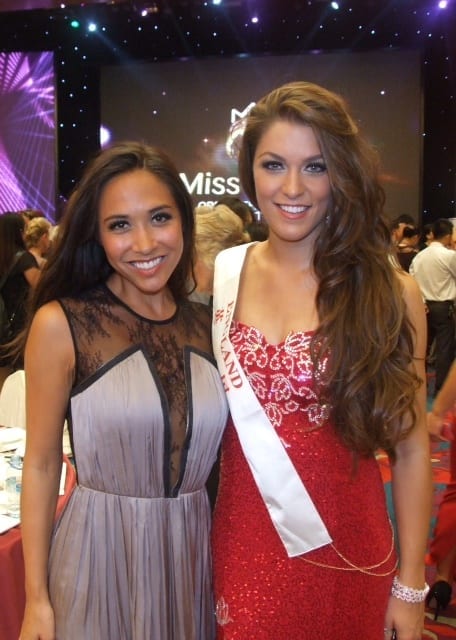
Mylene Klass and Miss England
I’m wondering if things could get any more surreal when I bump into a sequin clad, Myleene Klass emerging from her dressing room. Klass has been called upon not only for her mixed race appeal but for her extremely competent presenting skills. Svelte, graceful and smart, she is the epitome of the Miss World philosophy. She has been paired up with an American soap star, Days of Our Lives heartthrob, Jason Cook. The two of them are practicing reading from the autocue machine. There is a lot of jokey banter and Cook is quite the comedian:
“Myleene, I hear you are an internationally famous presenter, or is that just Hear’Say?” Myleene groans and retorts: “Gosh, an American with a British sense of humour.”
Suddenly there is the sound of rapid gunfire. Jason quips: “Are we under attack?!” Thankfully, it’s just some wedding fireworks going off outside. There are certainly no protestors or feminist flour bombers here. The local populace is thrilled to bits to have us and think any mention of sexism or exploitation is a load of old pigs’s willows.
Myleene is wowed by the calibre of the entrants this year. For every girl that enjoys movies, fashion and baking there are another three who are studying economics, medicine and psychology. “These are my kind of ladies,” she states.
Miss Northern Ireland, a sailing champion and budding presenter, approaches her for some advice and Myleene helpfully allows her to listen to her in her earpiece.
Bird Flu
Having been sequestered in the auditorium for four days I get the rare opportunity to take some of the girls out for a much needed break from the Ground Hog Day like slog of rehearsals. We are window (or rather stall) shopping in a busy local market. Rows of little blue tents are adorned with their wares; dangling dead ducks and insects, a myriad of crystals and PVC handbags. I find it rather reminiscent of Portobello Market.
We had intended to visit Genghis Khan’s mausoleum but our head security guard, a very debonair ex-military man, whom the ladies call James Bond, said the schedule was far too tight to risk the 2-hour round trip in case of traffic. “00 Heaven” is accompanying us to stop us getting mobbed. Wherever this “caravan of contestants” travels, it attracts a lot of attention.
Like the Beatles hitting America, everyone goes wild behind their little white facemasks. I presume they wear them as they are worried about catching avian flu. With so many birds around, it’s not an unreasonable precaution. They’re also constantly hacking up what could be fur balls of phlegm and lift up their masks to spit them onto the pavement.
Crouching Lady, Hidden Toilet
I ask someone where the loo is: “Over there, Good Luck!” Why the words of encouragement? It all became horrifyingly clear. I opened the door and climbed tentatively up some wooden steps to the portaloo from hell. There was no actual toilet to speak of. I thought: “Has it been nicked?” I looked down and saw that it was just a shallow hole in an aluminium floor. In the reeking recess was a large stool neatly coiled into the shape of a cinnamon twirl. There was a 3 cm high curved metal edge on one side of the perimeter. Perhaps this was a helpful bum rest should one unwisely decide to actually sit down or perhaps it was a splashguard in case you squatted. There wasn’t any loo paper or a washbasin but there was a handy mirror.
Miss Israel outside the rather lovely portaloos
The camera guys find it a fairly unpleasant experience so imagine how ghastly it is for the girls. It’s rather tricky gathering up their flowing dresses and crouching down in their Jimmy Choo’s. They have taken to crossing their long thoroughbred legs and holding it for as long as they can. They are drinking so much water to avoid getting dehydrated under the heat of the stadium lights, that when they do finally go they pee like racehorses.
Beauty with a Purpose
You cannot talk about Miss World without mentioning the aspect of it that separates it from every other international beauty pageant. The contestants have to be passionate about charitable causes and they work hard to prove themselves.
The premise of this award is simple: Use your talents to help those less fortunate. Comediennes utilise their funny bones to raise money for Comic Relief, well think of this as Beauty Relief.
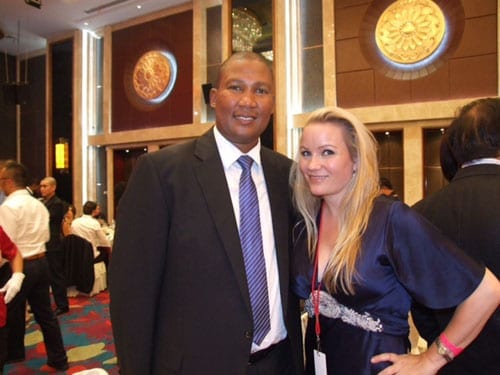
Chief Mandela and Georgea Blakey
I have been invited to Morley’s hotel suite and am sitting on a sofa between a former Asian Miss World and all 6’4″ of Chief Mandela, here representing his grandfather, Nelson, who is himself a strong supporter of The Miss World Organisation. The Chinese word “Junzi” would describe him well: “A man of noble character or status who is upright and benevolent.”
We are shown gut wrenching videos of each contestant’s chosen cause. There is harrowing footage of disadvantaged children from around the planet. There is a lot more to the modern day beauty queen than meets the eye. I’m astounded as I see Miss Kazakstan, a qualified paediatrician, hold a stethoscope to sick children’s chests. In hers, Miss India campaigns for the education of not only the slum children of Mumbai but also their mothers too. Miss Portugal is shown visiting an old people’s home in a protest against the abandonment of the elderly and Miss Canada is trying to highlight the atrocities of human trafficking.
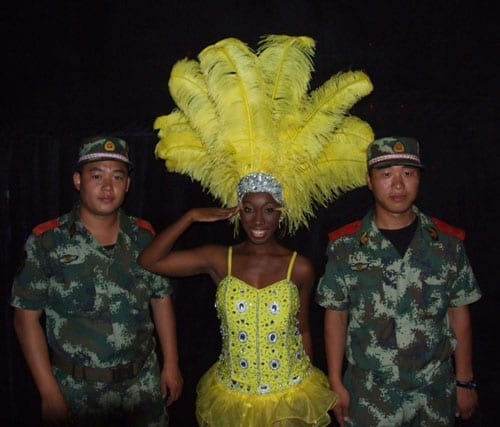
Miss US Virgin Islands, a reserve in the US army, salutes
Miss US Virgin Islands is a reserve in the US army and is only recently back from a year in Afghanistan where she narrowly missed a shell attack which destroyed the shower block. Miss France is a beauty that helps the beasts. She supports the Gallic version of the Battersea Dogs & Cats Home.
Misses aren’t afraid to get their hands dirty and I watch Nigeria and Kenya mucking in with the inhabitants of rural villages, crusading for clean water and waste disposal systems. The sanitation is so poor that I will never complain about a Mongolian loo again.
These videos are humbling, they put everything in perspective. I hear Chief Mandela sigh heavily, as upset as I am at man’s inhumanity to man.
That’s the emotional factor I have found about Miss World. One minute you are laughing hysterically, the next crying uncontrollably and we haven’t even got to the final yet.
The genuine dedication of these ladies to their causes fills me with awe and shame at my own lack of sisterly love. So often a Beauty Queen is mocked for the moniker: “I want to help heal the world and save the little children.”
I don’t see much difference between the Misses and Bob Geldof. He said he wanted to feed the world and he got knighted for his efforts.
This is Miss World goddammit. What the hell do you think they should look like?! Why are we opposed to beauty? How would Hollywood work if it went all PC on us? Do you think that Halle Berry (a former Miss USA) gets cast for her acting talent alone?
Life is inherently a beauty contest. Good looks open doors, but if they can also open a treasure chest and the spoils be divided amongst the poor, why not?
The Miss World Effect
I am chatting to the financial director, Michael Macario, about some of the other attractive figures involved. Miss World to date has raised over £250 million for charity.
Governments and tourist boards invite Miss World to their countries to promote tourism. When the show was broadcast from Sanya in China, the massive rise in visitors to the area was put down to the Miss World effect. The organisation was credited with changing the face of the industry. Ordos are hoping the same will happen here. Pretty girls make good marketing sense.
Let’s not forget though that the Morley family, (Julia’s son Stephen and grandson Ben are by her side) have run an incredibly successful business with a multi-million pound turnover for 62 years now. The brand is jealously guarded but has never been tarnished. Macario says there could have been loads more opportunities to make money but that is not their primary concern, BWAP is.
An auction held at a charity dinner last night raised enough money to send 30 local students to university. The contestants bring any item of cultural interest with them and supportive local businessmen bid furiously. It got quite competitive with many of the objects fetching over £10,000 each. Even Miss Seychelles’ s coconut shell achieved several hundred Yen. She told me she needed a permit to get it through customs. Craftily she removed the nut so it was lighter. It’s demanding enough lugging your suitcases half way across the world without the weight of a oversized nut adding to your excess baggage.
Dress rehearsal
I’m having a natter in the foyer with Miss Lebanon. In vest, shorts and flip flops with her hair in rollers she tells me how much she will miss her new friends.
Happy that their big day is finally upon them but devastated to be leaving one another the girls do at least have one bonus. Never again will any of them have to pay for a hotel room again, they can now travel the world staying with various members of their recently acquired family.
A very old and obviously myopic old man approaches and asks to have his picture taken with us. He points at my chest quizzically, alluding to my lack of a name badge.
“Wish Miss, Wish Miss?” Hurrah: I’ve just been mistaken for a contestant. I knew slapping on the war paint today was a good idea. “Miss Stake,” I jovially reply.
We board the buses for the stadium. I’m on number one bus, AKA “the party bus,” as the girls are most raucous, containing as it does, Miss England and the other Celts.
Today is the penultimate day of the competition and the girls are pre-recording the “Dances of the World” section in their national costumes.
Miss Equatorial Guinea’s grass skirt and boob tube combo are from a real tribal leader, so she apologises that it whiffs a bit. Her dance is rather vigorous to say the least so she needs tit tape to secure the top half.
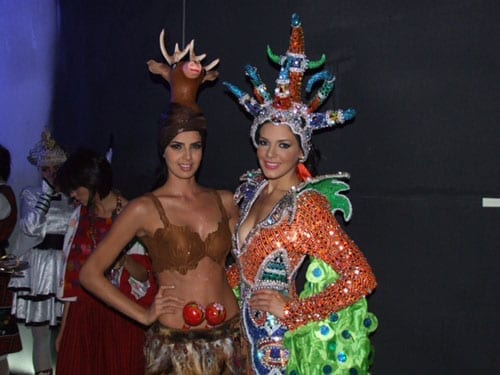
Some of the costumes are utterly bizarre. Poor Miss Mexico has a replica of a deer head strapped onto her barnet. Miss Fiji, dressed as an eagle is sweating in her head to toe feather combo and Miss Bermuda could be mistaken for a traffic cop. Only Miss USA bucks the trend and skips out in cowboy boots and a T-shirt.
Miss Mexico and Miss Puerto Rico in national costumesMiss America with local children
It’s now time for the dress rehearsal and the girls can’t wait to rip off their costumes and slither into their more flattering final dresses. I zip up Miss Vietnam and lend Miss Bolivia some lip-gloss.
I shall announce the results in reverse order
It’s the day of the final. The hotel lounge is more packed than usual as a Chinese wedding is taking place. Bemused guests don’t know whether to take photos of the bride or the contestants. If I were the bride, I’d be a bit miffed! Aptly a Chinese cover version of Joe Jackson’s Stepping Out is being piped through the speakers.
It’s the last lunch and the girls aren’t holding back. Locust-like they descend on the feast before them ignoring any concerns about bloating. Perhaps they’ve packed some back up spanx so they can squeeze into their finery?
Andrew, the hair and make up guy, is late for lunch as he’s been bubbling over with adrenaline and nerves. He swears he can’t eat a thing. Just as well as there’s bugger all left.
I’m having some tea in the bar with Roderick and his graceful wife Alfreda, also an operatic name in her own right. We are nervously approached by a local student volunteer and her mother who timidly ask if they could tempt us with some home made noodles and dumplings that they’ve specially made for the singing superstars.
So, already full but not wanting to offend such a sweet gesture we sample some of their delicious offering. With the chances of me wearing my slinky party dress tonight diminishing with each bite I’m going to ask Miss Equatorial Guinea if I can borrow her grass skirt.
On every floor of every corridor hair and make up stations have been set up to process the competitors as they get ready for their big night. Imagine 116 brides fretting before their big day and you have some idea. It’s a flurry of eye shadow, powder and paint. Andrew is in charge of a team of Chinese beauticians wielding brushes and straighteners. Translators are on hand to prevent any jam-wasabi like mix ups. When Miss Israel asks for pink eye shadow, it wouldn’t do to start applying green.
The excited gaggle of girls alight the buses for the last time and toddle into the bowels of the stadium in a phalanx Genghis Khan would have been proud of. Tonight, we are an intimate audience of 6,000 in contrast to the opening ceremony, where there was an image of a jumbo jet projected onto an illuminated backdrop. It was so realistic that an audience of 40,000 ducked.
Apart from a slight mishap when Miss Malawi trod on Miss New Zealand’s dress, the show went smoothly and was a smash hit with the audience. I particularly liked some of the entertainment in particular a performance by an army of Mongolian horse cellists who could make their instruments whinny rhythmically.
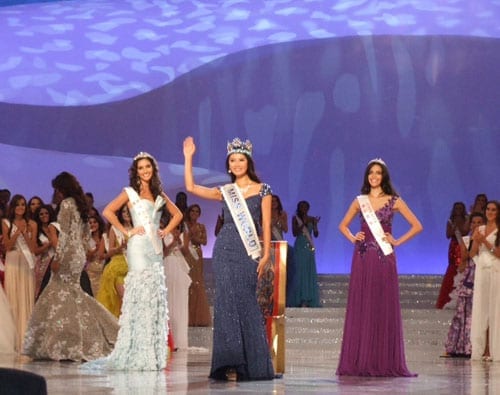
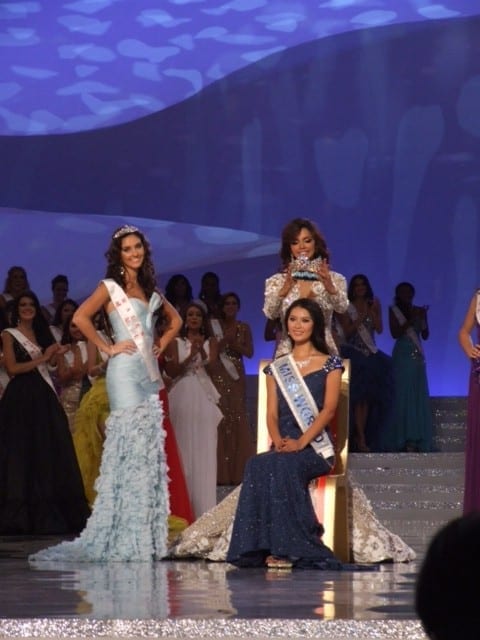
The top threeMiss China get crowned Miss World 2012 by Miss World 2011 as Miss Wales looks on
“I shall announce the results, as is customary, in reverse order,” announces the lady in red, a resplendent Mrs Morley. The climax of a 3-hour extravaganza is upon us.
“Miss Australia, Miss Wales and Miss World 2012 is…,” drum roll…, “Miss… China!”
The flag waving home crowd are on their feet, sobbing and cheering. Though not everyone is as thrilled. Some of the foreign contingent are grumbling that the crowning of 23-year old music student, Wenxia Yu, was a political move. I’m not so sure as it’s undeniable that she was a worthy winner. Not only did she raise huge amounts for charity, but in the talent section of the contest, she sang so unbelievably beautifully that she made Katherine Jenkins sound like a strangled cat.
My conclusions
What have I learned from my week at Miss World?
– Never have your picture taken next to a beauty queen unless they’re in bare feet.
Georgea Blakey is a portrait artist, specialising in equestrian and wildlife subjects. Her commissions have taken her from the polo farms of Argentina and Palm Beach to the game reserves of South Africa. She was the art scholar at St Paul’s Girls School in London and went on to study at the prestigious Chelsea College of Art. She is equally at home painting humans and her subjects have included a portrait of His Royal Highness Prince Charles with his polo pony. She has produced numerous commissions, and some of her notable clients include Viscount and Viscountess Cowdray, the Sultan of Pahang, Sir Tim Rice, David Soul, Teddy Sherringham and Miss World.
Sarah Tucker shares the latest of her “playground politics” experiences
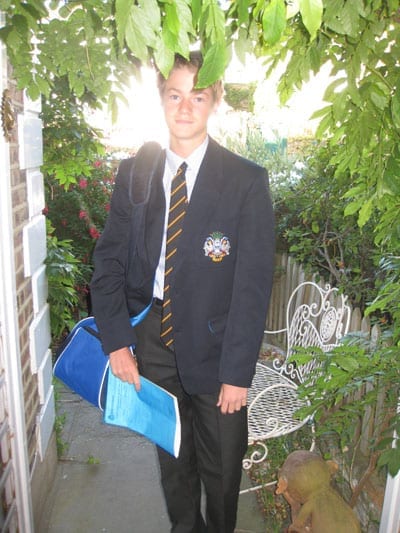
My son started at a new school a few weeks back. Five foot eleven, half of him at 13 he is now taller than me.
Journalist and author Sarah Tucker’s son, Tom
He was a bit nervous, I cried in the car after I dropped him off and he refused to hug me in public, but that’s normal and natural – the crying and the non-hugging. Seems only yesterday he was three foot nothing and starting infant school. This time is so precious, still even in the teenage years which many parents dread, it’s the last chance to have any semblance of nurturing. I feel I can tell you that.
The other stuff, the negative stuff, well, I’ll leave that to fiction. Because you should never wash dirty linen in public or so the saying goes although it’s become the sure fire way of getting the 1/2 hour of fame. If it’s to sell a book, film or make more money then it has a purpose: a potentially positive end result where others learn from your mistake and you learn from your mistake and it’s not just a matter of ogling you as a loser. If you are doing it because you want to be famous for fame itself, then it has none.
Jeremy Kyle and all the chat shows get the common man to be open and honest about themselves. Celebrities rarely, if ever, are honest, because they realise or fear that the masses wouldn’t like them if they were. Real people don’t have publicists to guide them through the media mire, and lay themselves open to ridicule by laying themselves open.
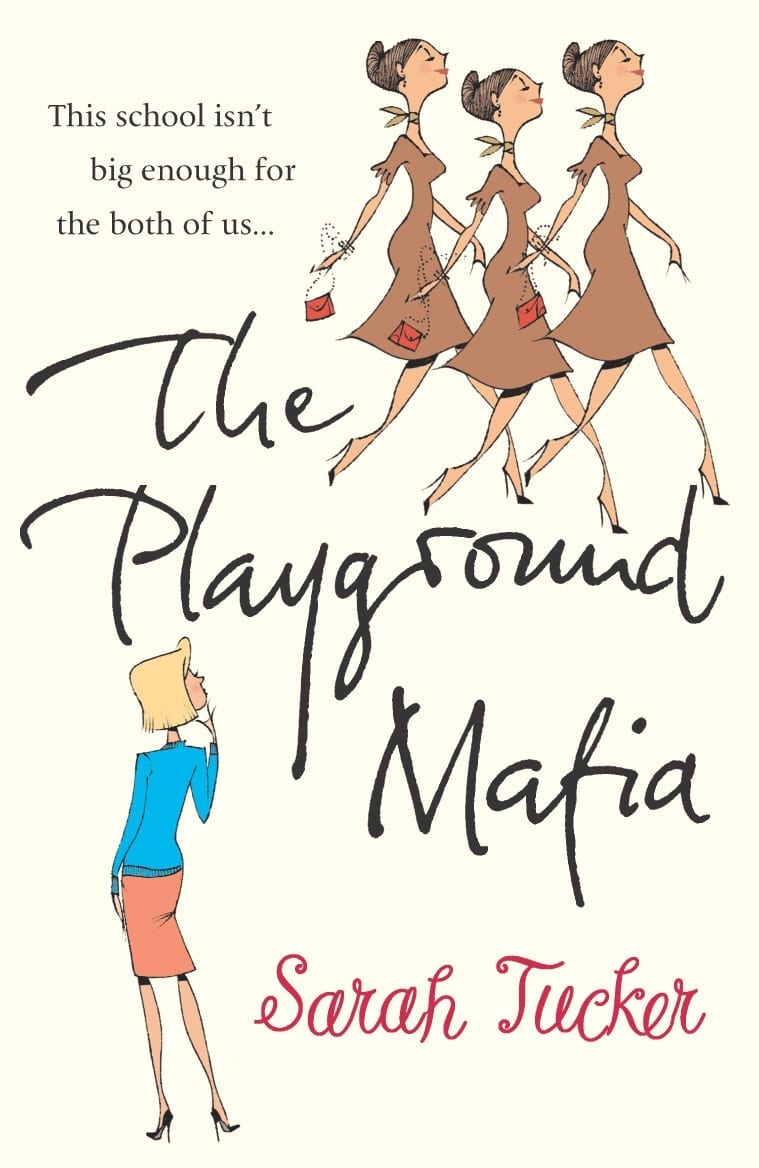
“The Playground Mafia” by Sarah Tucker
So, when I was asked on ITV1’s Lorraine show a few weeks ago to talk about playground politics I was excited. Here was an opportunity to talk about an issue that is relevant not just in this country but globally, the bullying that goes on between mothers. A subject I know a lot about. I have the stats, done the research, written the book, devised the app (Mummy Mafia), rehearsed the stage play but no, they wanted me to talk about my own ‘personal journey’ dealing with playground politics. Nope. Not going to do it. I’ll talk about how to deal with it, Ill talk about the book and the numerous funny, sad, ridiculous anecdotes but as my son is still at school (albeit he’s moved to a new one), there are repercussions.
The TV wanted a ‘victim’ and I wasn’t going to be it, even one that had recovered. In the end, they chose a woman who was prepared to talk about her experience of it.
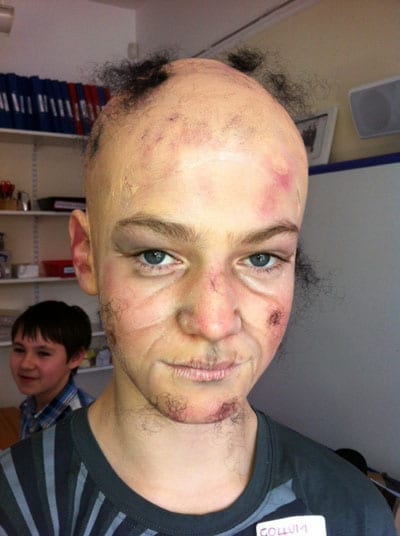
Sarah Tucker’s son, Tom, as Gollom
That week, I saw the mothers from my old school at my son’s school’s superb production of The Hobbit – the production is so good it made the Evening Standard and BBC London News, my son plays a wonderfully dark Gollum) and had a coffee morning with the new mums, who were the usual suspects of the previous playgrounds, I will say no more. Not until my son has left for college or university will I talk directly, but until then the books will always be fictionalised, the interviews about the experience of others and all linen will be washed but under the guise of creative imagination.
Sarah Tucker is an award winning travel journalist, novelist, producer and broadcaster. She has edited, produced and presented her own radio and TV series as well as presenting reports for BBC Holiday Programme and anchored I Want That House on ITV. She is the author of best selling novels The Playground Mafia (short listed for the Good Housekeeping book of the year 2007) The Battle for Big School, The Last Year of Being Single, and The Control Freak Chronicles.