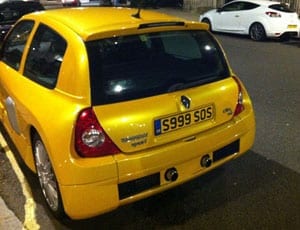
15 more of the best plates spotted by readers of ‘The Steeple Times’
Continuing our series, below we feature 15 more unusual, laughable and entertaining number plates (more…)

Claire Rubinstein attends a party but doesn’t strike gold
The invite read: “Fashion Brands Viewing & Party At LFW – PRESS INVITE – must RSVP”. Surely, I thought, this must be something exclusive. (more…)
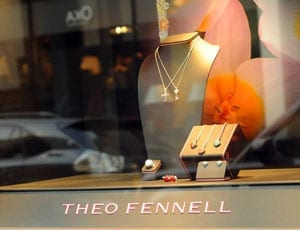
David Kerr captures an evening showcasing the craftsmanship of Theo Fennell
It was not only the silver in Theo Fennell’s Fulham Road showroom that glistened on Thursday 5th September. (more…)

Claire Rubinstein laments this year’s Father’s Day offerings
As far as celebrations go, Father’s Day seems to be a decidedly tepid affair if the dismal offerings from the High Street are anything to go by.
A review of the St. Ermin’s Hotel
I first visited the St. Ermin’s Hotel close to Scotland Yard in St James’s in June 2012 for the first Intelligence Book of the Year Awards. Today, I will return there to attend a reception to announce the second winner of this annual prize by judges Andrew Lownie, Dan Mulvenna, Glenmore Trenear-Harvey, Michael Smith and Nigel West.

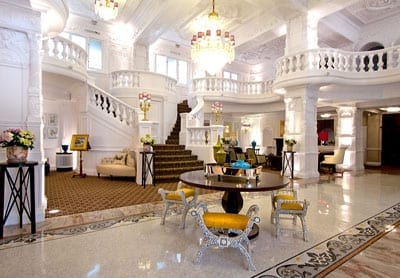
As I reported in my last article on this Victorian property, the St. Ermin’s Hotel’s links with the worlds of politics and espionage are indeed strong. Built in the Queen Anne revival style to the designs of Edwin T. Hall (1851 – 1923) in 1887 and completed in 1889, the horse-shoe shaped building was originally a mansion block prior to being converted to a hotel that opened in 1899 after a major refurbishment by the theatre architect J. P. Briggs (1869 – 1944). Briggs remodeled the public areas and created a spectacular neo-Baroque entrance with balconies, ornate plasterwork and a double staircase.
Due to the building’s proximity to the powerhouses of government, the St. Ermin’s Hotel became a meeting point for officers of the Secret Intelligence Service and, as a result, various traitors and spies. Some worked from offices in the building and amongst them were Kim Philby, Guy Burgess, Laurence Grand and Eric Maschwitz. Others came there to be interviewed and the hotel’s bar, The Caxton Bar, is renowned as having been a noted meeting place for secret intelligence officers.
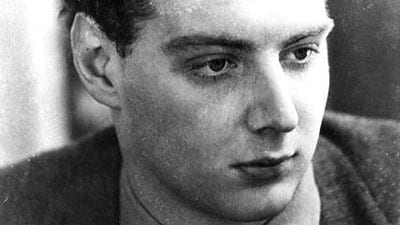
One of the most notable meetings at the St. Ermin’s Hotel was held in 1940 when Winston Churchill brought together a group to join him in “Setting Europe Ablaze”. These founding members of what was to become the Special Operations Executive (SOE) took over an entire floor of the hotel and carried out covert operations from there throughout the Second World War. MI6 were stationed two floors above and then in the 1950s, the hotel’s bar was the meeting point of Guy Burgess and his Soviet counterpoint when he passed intelligence to the USSR.

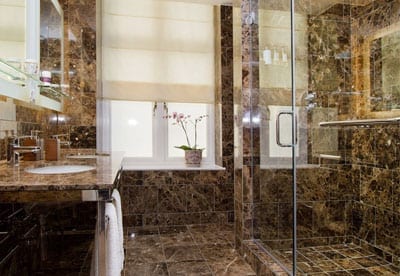
Following on from a £30 million refurbishment to designs by Dayna Lee of Los Angeles-based Powerstrip Studio, the 331 rooms and suites at the St. Ermin’s Hotel are now comfortable, well appointed and decorated in a contemporary style. The two that I inspected, whilst perhaps lacking the charm of a boutique hotel such as Blakes, are absolutely ideal for a business traveller or tourist given the location close to the Houses of Parliament and Westminster Abbey. They are well worthy of their four star rating and I slept well given how centrally located the hotel is.
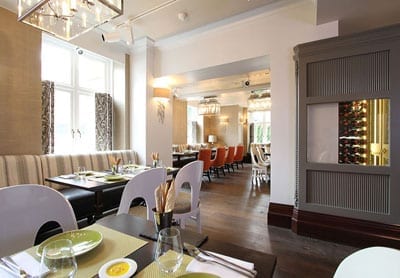
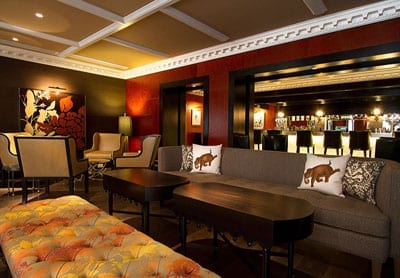
The Caxton Grill, the hotel’s restaurant, continues the traditions of the St. Ermin’s in that it plainly is the haunt of politicians and policeman. Whilst dining there, I met an officer from Scotland Yard who was involved with Operation Yewtree. I can report that, though I had a most fascinating conversation with him about Savile, Davidson and Clifford, I did not leave with any state secrets that I could share here. The restaurant also featured on a recent episode of the BBC One’s MasterChef with Gregg Wallace and John Torode and frankly one could also imagine Hercule Poirot having taken rather a liking to it also. It is modern in style and features wooden flooring, bright décor and snazzy seating.
The restaurant features a menu that focuses on a Josper grill. This £17,000 hybrid barbeque–oven, which I saw so cleverly used by Chris Golding at Beauchamp Place’s Galoupet, allows a chef to cook, barbeque and roast at the same time over charcoal embers at temperatures of upto 600 degrees. Filled with Kentish hardwood every morning, the Josper recirculates smoke via adjustable draughts and, for example, as a result, it takes only about a minute to char infuse lamb and thick-cut beef sirloins. The real thrill of it, though, is that the Josper process ensures that none of the flavor or natural moistness of whatever is cooked in it is lost.
I began with a salad of soured plums, gorgonzola and blackberries (£8) that was colourful and most welcome on a grim winter’s day. My companion tried a roast celeriac and truffle veloute (£7) that though perfectly adequate, did not truly excite.
I continued with a half Temple Farm chicken (£20) that was cooked on the Josper Grill. Well presented and served with a green peppercorn sauce and some garlic and parsley French fries (£4), the cooking process was clearly illustrated. The meat was tender and I must say it was one of the best pieces of chicken I have eaten in years. My companion, an Icelandic financial titan, maxed out on a 300g vintage dry aged sirloin steak (£30) served with béarnaise sauce. Again, cooked to perfection, he was impressed.
Though more than amply fed, we finished by sharing a chocolate fondant (£7). This simple dish melted in the mouth and the accompanying ice cream was just superb.
Wines in the restaurant start at a very reasonable £19.95 for the house white and rise upwards to the £300 a bottle range. A Chablis is priced at £41 and a Gavi di Gavi at £33. The restaurant’s bar, the Caxton Bar, offers a huge array of cocktails but I must say I was rather sad that none of them were spy themed.
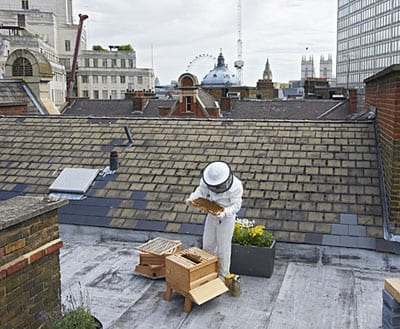
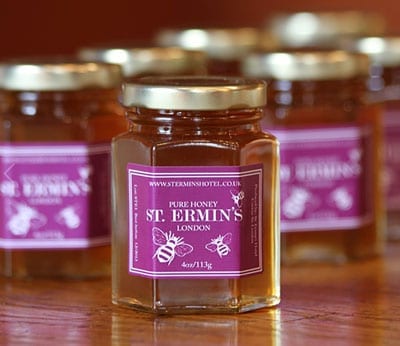
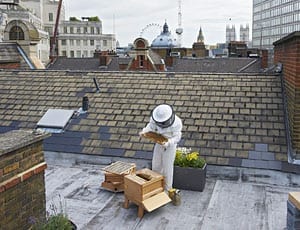
The most quirky thing about the St. Ermin’s Hotel is that it has its own colony of bees. “Bees… In Wesminster?”, I hear you cry. Yes, indeed, 200,000 of them prosper on the roof of the hotel and produce the most delicious honey that is available to guests. From three hives, the Buckfast bees, described as being “good tempered”, have fantastic access to London’s parks and travel within a three mile radius collecting pollen and nectar. “London”, states the hotel’s website, is “a perfect environment for bees as… cities actually trap heat, which means they can start foraging earlier in the year than rural bees and continue later into the autumn”. Who’d have thought it? Where once lived spies, now prospers a colony of bees.
St. Ermin’s Hotel, 2 Caxton Street, London, SW1H 0QW. Telephone: +44 (0) 20 7222 7888. Website: http://www.sterminshotel.co.uk
Follow the St. Ermin’s Hotel on Twitter at: http://www.twitter.com/sterminshotel
Read our report on the first Intelligence Book of the Year Awards at: http://thesteepletimes.com/da-steeps-speaks/long-live-the-spies
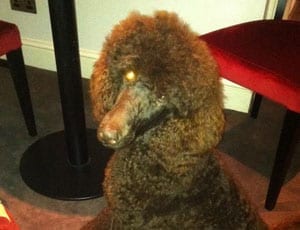
 His life was short but he brought joy throughout it and wherever he went. He looked like Colonel Gadaffi, loved the voice of Radio 4’s Jenni Murray and was particularly partial to a visit to Chelsea’s Sette restaurant. He even liked travelling by bus. This boisterous Standard Poodle will be greatly missed.
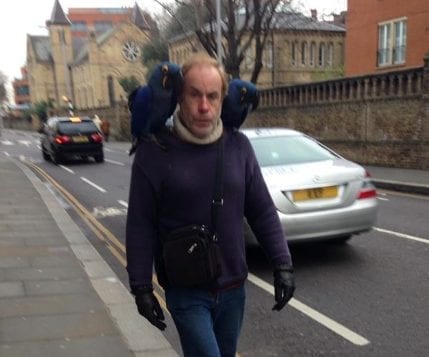
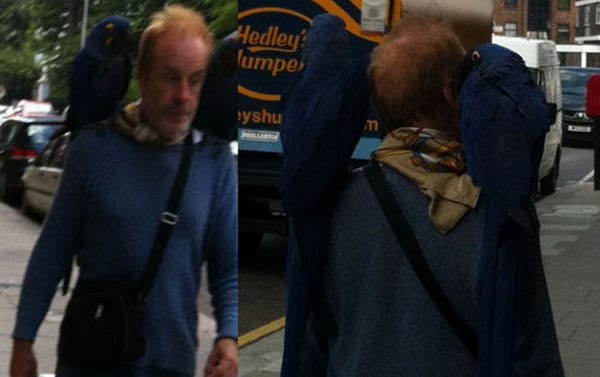
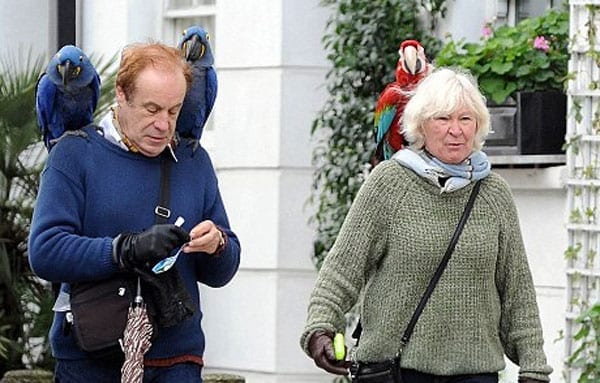 Parrot Man is often to be spotted in London’s Fulham Road with his glorious birds. (more…)
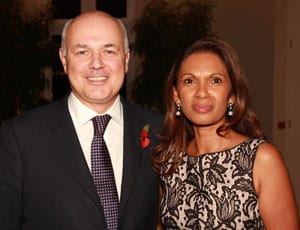
Andreas Kirchberger captures guests and performers at the Champions in the Community fundraising dinner
On Thursday 10th November 2012, Gina and Alan Miller and The Rt. Hon. Iain Duncan Smith MP hosted a dinner at London’s Hurlingham Club to raise funds for the charities supported by Miller Philanthropy and The Centre for Social Justice.
Guests at the event numbered Aliona Adrianova, Carlos Bey Fisher, Jackie Branston, Bridget Convey, Karen Cummings Palmer, Diane Henry Lepart, Katie Gerrard, Hannah Gerrard, Iain Gibbs, Mariana Haseldine, Christian Huhnt, Francesca Mathieu, Ferdinand Miller, Georgina Moffat, Charles Mitford Cust, Claire Rubinstein, June Sarpong, Angelo Valentino, Timo Weber and Haydn Williams.
Performances by Antony Costa, Beverley Craven, the Magpie Dance group and Derek Paravacini were interspersed with speeches from Gina Miller and The Rt. Hon. Iain Duncan Smith MP and items sold in the auction numbered a couture dress by Ralph & Russo, a long weekend on a country estate in Devon and a Rolls-Royce experience.
Of the success of the night, Gina Miller commented:
“The Champions in the Community dinner acknowledged the underappreciated individuals involved in charity in the UK. The evening was a great success in terms of raising funds and awareness for these unsung heroes and we thank all who attended and supported our efforts for those working at the coalface of the negative trends in our society.”
For more details about The Centre for Social Justice, go to: http://www.centreforsocialjustice.org.uk
For more information about Miller Philanthropy, go to: http://www.millerphilanthropy.com
All images © Andreas Kirchberger/Photography-Factory 2012

Zach Topley reports on a Wellington College teacher who lost his battle with cancer who is now topping the iTunes chart
Jimmy Higham, who sadly lost his battle with cancer last year, has soared through the iTunes download charts with a beautiful cover of Stevie Wonder’s Isn’t She Lovely. Higham, a Lancashire born teacher at Wellington College in West Berkshire, recorded the song just months before his tragic death in December 2011, aged just 26.
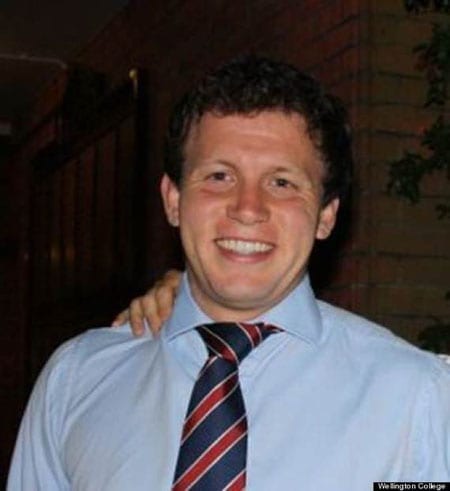
After being released on iTunes last week, the song quickly rose through the charts and now stands at number 15. All proceeds go towards the Jimmy Higham Bursary Fund, set up in his memory to enable 16-year-olds from the north of England to attend the school and play sport.
“Jimmy was an instant hit at Wellington with students and staff, hard-working, dedicated, wise, funny, kind, helpful, a gifted teacher with amazing promise. The students loved his dry humour and willingness to listen,” the College said in a statement.
Students at Wellington have got behind the cause, spreading the word via Facebook and Twitter with the hashtag #jimmyhigham.
A student commented: “We’re all hoping it can get to Christmas number one. We need support from everyone, both in buying the song on iTunes, as well as telling friends about Jimmy’s story.”
Follow the campaign for the Jimmy Higham song to top the charts on Twitter at: http://www.twitter.com/JimmyHighamSong
Donate to the Jimmy Higham Bursary Fund at: http://www.justgiving.com/wco
Watch the official music video for the single at: http://youtu.be/RDYOHmQWFcU
To purchase the single for just 79p, go to: https://itunes.apple.com/gb/music-video/isnt-she-lovely/id587014296