Scotland’s most expensive estate comes to the market
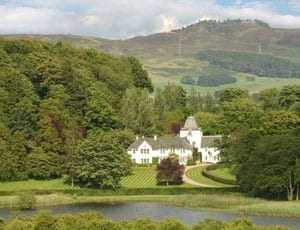
In Downton Abbey last week, the Grantham family talked about selling off parts of their estate to cover the costs of death duties. In Scotland, the death of Sir James Cayzer has led to his family selling off one of their estates. (more…)
21st century gauche replaces 20th century elegance
A hidden enclave opposite the V&A museum in South Kensington was home to two of the twentieth century’s most fascinating individuals. London club owner and arbiter of good taste Mark Birley lived at Thurloe Lodge for nearly thirty years until his death in 2007 and for a time, the British ballerina Dame Margot Fonteyn resided next door at Amberwood House. (more…)
Our reaction to the BBC Lab UK’s Great British class calculator
Yesterday, Twitter and Facebook were abuzz with talk of a new class calculator created by the BBC Lab UK and a pair of academics that claimed it could grade the position of each and every one of us in society.
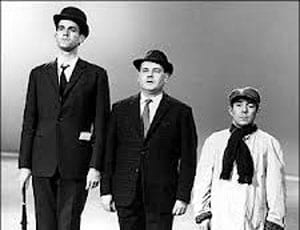
Gone, they say, are the 20th century definitions of working, middle and upper classes and the restrictive Downton Abbey type pigeonholing of individuals by birth and social standing. In their place, modern Britons, they suggest, are identifiable by an astonishing seven categories that range from the “elite” to the “precariat”.
Westminster is one of the most intriguing parts of London but it can also be one of the most soulless. It’s an area that is inhabited by politicians and civil servants and it is the haunt of tourists. It’s a place of regal pageantry and ceremony but equally, it’s not a place that true Londoners flock to for food or drinks. Yes, of course, the tourists head to see the Houses of Parliament, Westminster Abbey and 10 Downing Street, but locals don’t venture to these historical landmarks all that readily apart from if summoned by Her Majesty, the Archbishop of Westminster or David Cameron.
With the opening of the Intercontinental London Westminster next to Scotland Yard, city centre residents truly have good reason to reconsider their reluctance to consider the culinary offerings of this area. The restaurant and bar at this new hotel, the Blue Boar Smokehouse, is, I would suggest, a great addition to the London restaurant scene and head chef Jon Ingram’s “testosterone-fuelled menu” of meaty delights is most definitely innovative, unusual and spectacular.
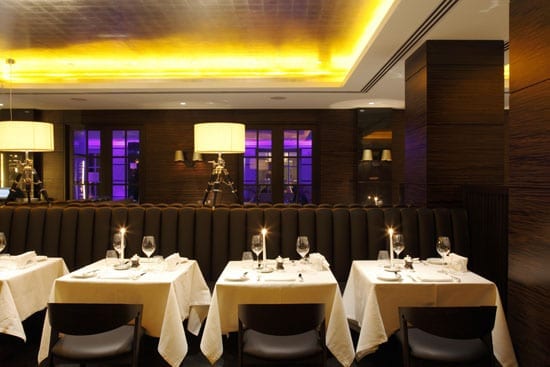
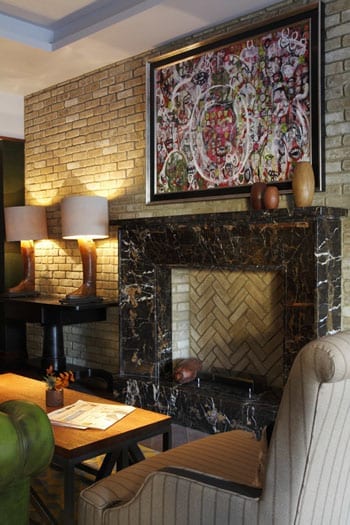
The dining room at the Blue Bar Smokehouse & BarThe bar area is typical of those found in most hotels other than it boasts an amazing collection of gins
I dined at the Blue Boar on a quiet Monday lunchtime with their vivacious PR Jennifer-Anne Sutcliffe. I had sadly missed the launch party Sutcliffe had organised earlier in the month and it was fascinating to learn from her that The Steeple Times roll call and party loving stalwart David Pun had turned up with Mick Jagger’s ex, Jerry Hall. We did laugh about how such an odd union could have come to being. Perhaps one of our readers will be able to conjure up a suitable explanation.
The restaurant itself is named after the 14th century Blue Boar’s Head Inn that stood on the site until it was demolished in 1899 but apart from its name, it bares little resemblance to a public house. The decoration is simple yet elegant and one could just imagine Francis Urquhart of House of Cards legend plotting the downfall of his contemporaries here. No doubt budding future Cameronites and Millibands will indeed be spotted whispering over pulled lamb shoulders and perhaps, even, a Blair-Brown style Granita pact could even happen at a table at the Blue Boar.
Artwork depicts many political subjects including the eras of Blair and Major
Mayor of London Boris Johnson even makes an appearance
The art collection of the Intercontinental London Westminster has been sourced by a specialist curator named Peter Millard. It is described as capturing “the essence of British political life” and is themed around being “knowing about the way the world works”. Alongside Gerald Scarfe and Martin Rowson cartoons are two works by Agamaria Pasternak. These contain the faces of every current Member of Parliament and in addition montages of the eras of Tony Blair and John Major before him illustrate memories of recent political history. Much thought has plainly gone into this collection and it is indeed appropriate given the setting.
The restaurant’s menu cleverly combines the use of the best quality British produce with the American pit style cooking of Tennessee and the Deep South. Slow cooked meats and wood-grilled steaks are the order of the day and Ingrams’ 12 spice rub is certainly his signature.
To start, we began with sautéed wild mushrooms served with a crispy duck egg on toast (£8). This simple dish was well executed but the true highlight were the Blue Boar ribs that followed (£8/£15). Spicy and not too sweet, these were as far away from what you’d traditionally expect of ribs as Ken Livingstone is from ever owning a Rolls-Royce. The tender, fleshy meat, which is smoked for some 24 hours, was exceptional and I can genuinely state that I’ve never had ribs as good before.
Though the option of a “carpetbag” Hereford fillet steak stuffed with oysters sounded tempting (£27), I opted for a Yorkshire rose T-bone veal steak. I very much enjoyed it and other dishes such as glazed pork belly served with Coleman’s English mustard and honey (£14.50) sounded equally tempting. To accompany the steak, I tried a portion of the smoky bacon baked beans recommended by Miss Sutcliffe and the restaurant manager. The flavor was perfectly balanced and these are well worth trying.
To conclude, the offering includes options very much suited to the political classes. With dishes similar to what might be found in the dining rooms of the Houses of Parliament, diners can try Cambridge cream (£7), vanilla baked pineapple (£7) or sticky toffee pudding (£5). I plumped for a bread and butter pudding served with marmalade ice cream (£5) and found it most satisfactory. All in all, I’d conclude that this was a meal deserving of a mention in anyone’s edition of political dispatches. Jon Ingram is a chef worthy of great accolade and a plot will no doubt ensue to ensure that this restaurant receives the accolades that it truly deserves.
An old bottle of Booth’s Gin is on display in the bar along with a number of other more unusual examples of this spirit
The wine list at the Blue Boar offers a mix suitable for both wealthy lobbyists and those suffering as a result of George Osborne’s latest budget. Wines start at around £26 a bottle but what truly impressed me – and what I shall certainly return for – is the collection of vintage gins. This is a paradise for any gin lover and with Booth’s Gin topping the list, it is plain that much research has gone into this element of the bar’s conception.
Additionally, for those looking for a new place to brunch on a Sunday, the Blue Boar has a “feasting table” each week. Available from 12.30pm to 3pm each week and priced at £45 per adult and £15 per child, the deal includes unlimited Bloody Mary’s and Buck’s Fizz. In addition to what the Blue Boar call a “butcher’s board” featuring ham hocks, venison and smoked chicken, the offering also includes a seafood bar with oysters, prawns and herrings and a whole selection of salads.
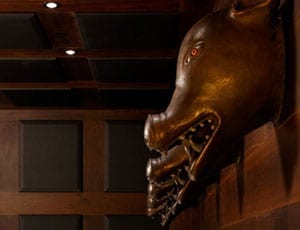
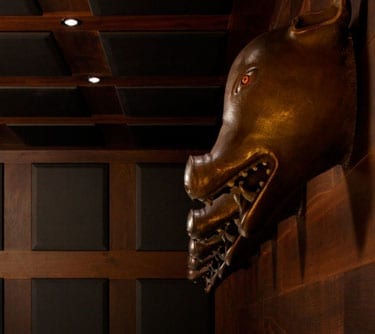
A scary looking boar’s head looks over the political plotting at the Blue Boar
If you are passionate about fine meats, make a beeline for the Blue Boar. Just be sure also to keep an eye out for Bo-Jo under a hog’s head in a hidden corner. It’s probably not as surreal as it sounds.
The sale of a $100 million Californian estate with a catch
If you were to spend $100,000,000 on a house, you’d expect something impressive. I imagine you’d want acreage, vast amounts of space and something luxurious. Stunning views and a prime location would be a must but at the bottom of your list, no doubt, would be something that someone purchasing a place for even a $1 would expect – that being that you’d be able to actually move in.
A £26 million residence with connections to rock, royalty and rectors
Built in the early 1500s, The Old Rectory is Wimbledon’s oldest house. Standing in grounds of 2.5 acres, this 16,200 square foot property was once described by a biographer of Sir Henry Cecil as being “not luxurious, but adequate” but now once again it finds itself in an entirely different league.
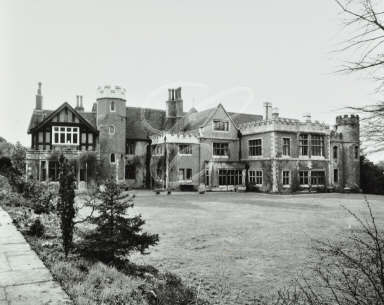
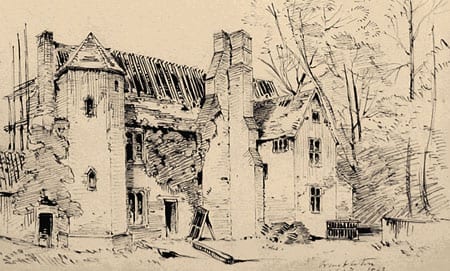
An image of The Old Rectory, 82 Church Road, Wimbledon, London, SW19 5AA in 1978. Present day imagery has been removed at the request of agents acting for the current owners.
Priced at £26,000,000, it is almost certainly one of the most expensive homes to ever come to the market in Wimbledon and whoever moves there next will undoubtedly be either an oligarch, an A-list personality or a top achieving business person.
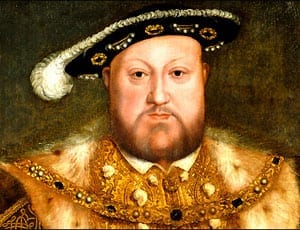
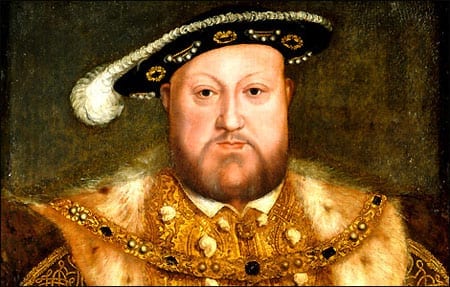
The purchaser will follow in the footsteps of a fascinating array of historically important residents, the first of whom was Henry VIII (1491 – 1547). The King took up residence in 1547 in the months prior to his death and is said, as he was so bloated, to have been unable to climb the stairs to his sleeping chambers. His bed was relocated to the great hall of the house and here he slept next to the fire. Historical research recounts that, with a brewhouse, beer and wine cellars, a coal cellar, meat room, buttery and two dairy rooms, this was a “house fit for a king.”
Henry VIII (1491 – 1547)Catherine Parr (1512 – 1548)
Henry VIII gave The Old Rectory, which was originally called The Parsonage House, to his sixth and final wife, Catherine Parr (1512 – 1548). Preferring a residence in Chelsea, Parr left and the Dean and Chapter of Worcester Cathedral took possession. A lease was sold to Sir William Cecil (1520 – 1598), later Lord Burgley, and the manor then passed to his son Thomas Cecil (1542 – 1623), the 1st Earl of Exeter.
In 1639, Charles I (1600 – 1649) bought the entire manor and gave it to Queen Henrietta Maria (1609 – 1669) but with the era of Comwell, The Old Rectory found itself occupied by General John Lambert (1619 – 1684). Shortly after, when a grander house was built next door, the property became first a laundry house and then servant accommodation and gradually fell into decline.
The Old Rectory passed next to Sir Theodore Janssen (1658 – 1748) in 1720. This French-born English financier, who was said to be worth the staggering sum of £250,000 at the time of his purchase of the house, was a founder member of the Bank of English but later disgraced for his part in the South Sea Bubble. He was expelled from the House of Commons and with his ruination, The Old Rectory saw yet another chapter of abandonment.
The garden front of The Old Rectory by Charles Henry Money Mileham (1837 – 1917)
By 1802, the house was described as an “uninhabited” ruin. A speculator credited with developing “modern Wimbledon” named John Augustus Beaumont bought it and restored and extended it but when it was sold to a Samuel Wilson in 1882 for £6,000, an era of truly comprehensive upgrades was to begin. Wilson added a pebble-dashed two-storey drawing room wing, carved oak doors and installed English, Flemish and Italian chimneypieces.
The next owner was a marine engineer named Matthias Jacobs who had been responsible for the construction of tunnels in Paris and New York. After having purchased The Old Rectory in 1909, he commissioned his brother to add a new single storey billiards room, a service wing and a study extension to mask the medieval chapel of the house. Jacobs sold up in 1923 to a Thomas Lethaby, who fitted oak paneling from Chantry House in Newark and a plaster ceiling based on the one at Knole House, Kent.
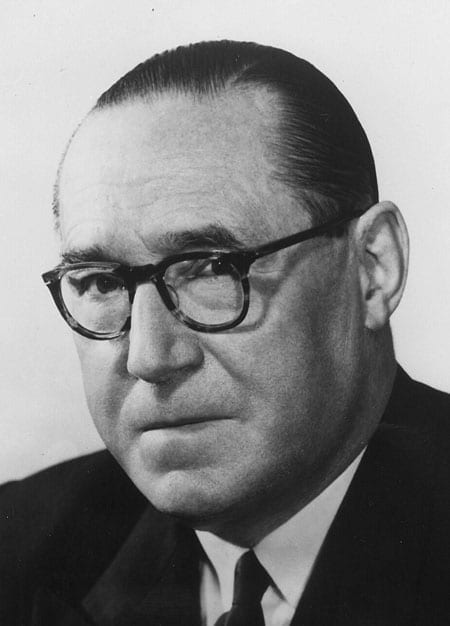
Lord Brock FRCS, FRCP (1903 – 1980)
In 1953, the eminent London surgeon and cardiologist, Lord Brock FRCS, FRCP (1903 – 1980), took possession of The Old Rectory after having paid £13,750 for it. Brock is credited as on of the pioneers of modern open heart surgery and also founded the Lord Brock Memorial Trust that to this day funds the museum he founded, The Old Operating Theatre Museum and Herb Garret in Southwark, SE1.
Following the death of his first wife Germaine Louise Ladavèze, Brock sold to an Iraqi entrepreneur and philanthropist named Basil Faidhi in 1978. Faidhi had fled Iraq for Britain and though he spent vast sums restoring the house with assistance from English Heritage, he also created a basement discotheque for his daughter, Nina, and a bar. Aside from bringing the house into the “yuppie era,” Faidhi also commissioned a historian named Richard Milward MA to write a history of the building in 1992 entitled: The Rectory – Wimbledon’s Oldest House.
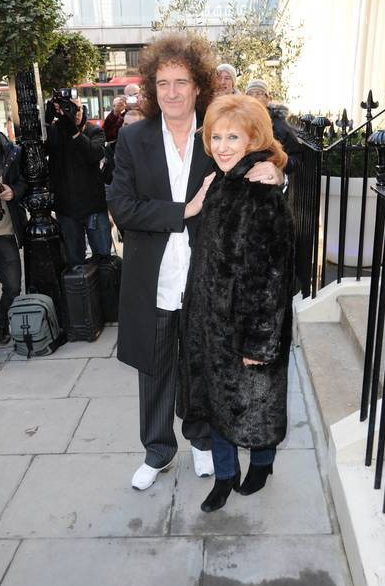
The Queen lead vocalist and anti-badger cull campaigner Brian May CBE purchased The Old Rectory in 1994 for £4,000,000 with the intention of living there with the Eastenders actress Anita Dobson.
Brian May CBE with his second wife Anita Dobson
Dobson, who didn’t marry May until 2008, had other ideas and refused to move in. It was suggested that she preferred a smaller house the pair occupied in Kensington and, at the time, a friend commented:
“[May] begged her to move into the new house so they can make a fresh start. Nobody can believe that Anita doesn’t want to be the lady of this fabulous house. But Brian says he can’t get through to her.”
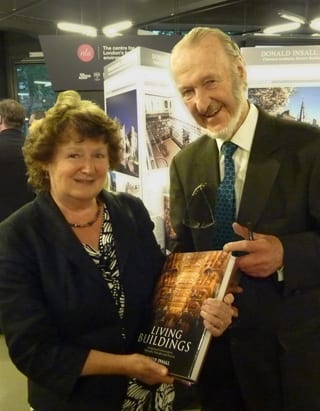
Sir Donald Insall CBE
As a result, May never properly moved into The Old Rectory and eventually decided to sell. In 2006, it achieved a record price of £16,000,000 and in the ensuing years, an Italian architect-owner named Antonella Carminati and her husband have lavished time and money on further restorations with the help of Sir Donald Insall CBE’s Insall Associates firm of architects.
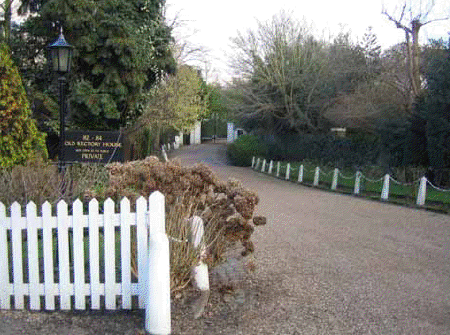
The driveway that leads to The Old Rectory from Church Road gives plenty of privacy
New fittings have been installed throughout and substantial extensions to the house have included a new kitchen and breakfast room with garaging beneath. The couple have demolished an early 20th century porch and an “unsightly” oak conservatory, remodeled the billiards room as a drawing room and removed a “bilious” blue swimming pool from the east lawn.
Now featuring 12,882 square foot of accommodation in the main house and 3,320 square foot of additional accommodation, The Old Rectory has been planned to include 8 reception rooms; a vast kitchen with La Cornue appliances and an adjoining breakfast room; master bedroom suite with two dressing rooms, his and her bathrooms and a sitting room and 7 further bedrooms.
Outside, the gardens feature an original medieval fig tree trail, shaded paths, lawns and a large pond as well as garaging for six cars. Planning permission for an indoor swimming pool complex has also been granted and ample staff accommodation is provided above one of the garages and in the gate lodge.
Given the now limited financial resources of the traditional religious houses of Britain, will it be rock, royalty or new money that next takes possession of The Old Rectory? The historians of Wimbledon will undoubtedly be watching.
The Old Rectory, 82 Church Road, Wimbledon, London, SW19 5AA is for sale through the Wimbledon office of Knight Frank. For more information call: +44 (0) 20 8946 0026.