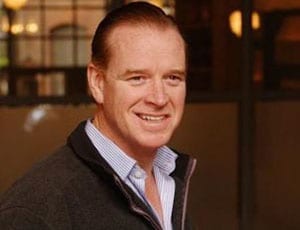
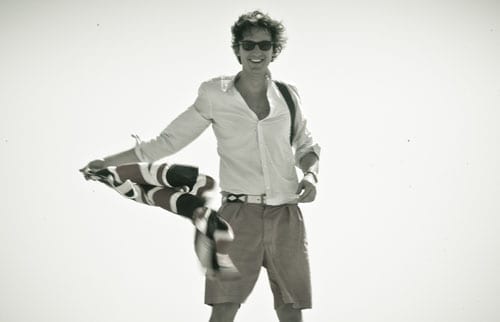
In the first of a new series, we seek to find out what has become of well-known individuals who have faded into obscurity or moved on into others arenas.
Our first subject, James Hewitt, will forever be remembered for two things: One will be his affair with Princess Diana. The second will be his “caddish” attempts to sell stories and information relating to this.
Five of the best places to enjoy a great lunch deal in The Royal Borough
It being January, we’re all after a deal. Here are a few places that you can enjoy on a budget in the country’s most expensive borough.
Sette, 4 Sydney Street, SW3, 6PP
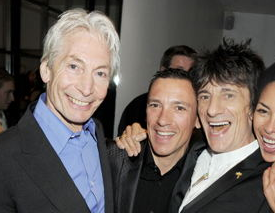
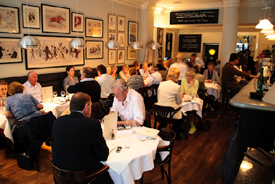
Situated in the heart of Chelsea, this stylish Italian restaurant is popular with locals and visitors alike. Owned by Frankie Dettori MBE, where else can you get to sit amongst rock and racing stars for just £15 for a two course set lunch that includes a glass of wine?
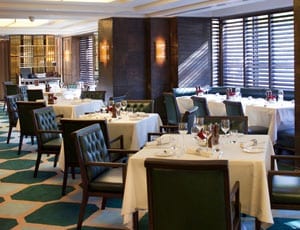
The Rib Room Bar & Restaurant, Jumeirah Carlton Tower, 1 Cadogan Place, London, SW1X 9PY
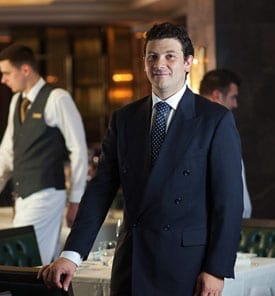
Ably managed by Michele Caggianese, this Knightsbridge institution offers a 3 course set lunch for £29 including a glass of champagne during January and February. The bar is the perfect spot to start as the offering here includes some of the finest English gins and a great selection of aromatic bitters.
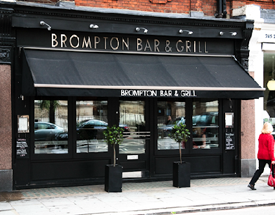
Brompton Bar & Grill, 243 Brompton Road, London, SW3 2EP
François O’Neill pulled off a masterstroke in opening this neighbourhood bar and grill. With a set lunch menu priced at £18.50 for two courses, here you’ll find not only great English classics but if you daring enough abinsthe served traditionally with a water fountain.
Maggie Jones’s, 6 Old Court Place, London, W8 4PL
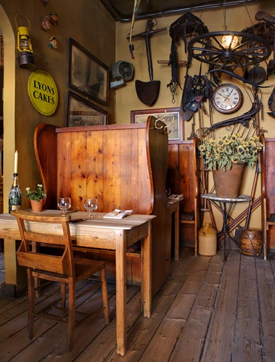
If you are on a real budget but feel like living like a royal, head to the restaurant named after Princess Margaret off Kensington Church Street. For just £10, they offer a soup and a salad. The sister restaurant of Belgravia’s La Poule au Pot is a must visit for anyone shopping in Kensington.
Blakes Hotel, 33 Roland Gardens, London, SW7 3PF
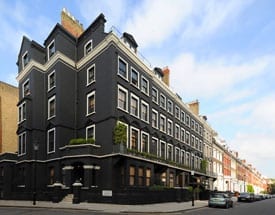
The world’s ultimate boutique hotel offers a tremendous set lunch if you’re on a date or want to impress. If you want privacy and discretion, this is the place to go. With 2 courses for just £19 and 3 courses for £24.50, you can dine amongst the opulence and splendour of this hidden secret without blowing the bank.
Andreas Kirchberger captures the atmosphere at a private view of the works of Robert Fry
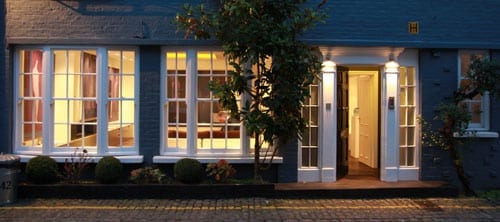
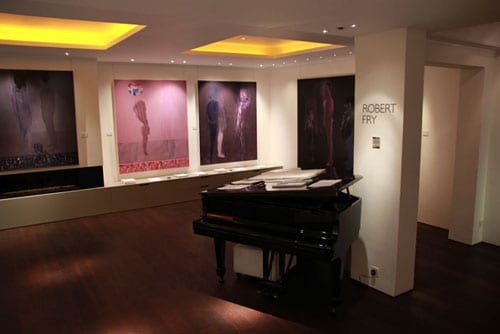
On Thursday 25th October, Ilona Pacia and Jesper Thomsen of Mews42 Gallery hosted a private view of the works of Robert Fry in Princes Gate, South Kensington.
Artist Robert Fry pictured with exhibition sponsor Andrew Harding of Qube Property ManagementThe exterior of Mews 42 Gallery, 42 Princes Gate Mews, London, SW7 2PRRobert Fry’s works on display at Mews42 Gallery
Andreas Kirchberger was on hand on behalf of The Steeple Times and captured an exotic array of guests who numbered Bianca Boscu Brandinelli, Esther Osorio, Ivan Rosenschein, Alexander Batchvarov, David Stoddart, Marco Calmisani Calzorali, Zuqiang Lin, Oonagh Shanley-Toffolo, Aurelia Bonito, Wendy Coumantaros, Klas Nilsson, Georgina Budge and Robin Dutt.
For those yet to discover his works, Robert Fry is a London based painter with an impressive CV. Born in 1980, he has already exhibited at the Saatchi Gallery and Alexia Goethe Arts & Co. in his home city, Moscow’s Atelier 2 and Los Angeles’s François Ghebaly Gallery.
Fry is described as having an “obsession with the concepts of form and norm, symmetry and deformation and that of mutation and maturity.” Martin Coomer of Time Out suggests he leads us “back to Picasso via the spatial experiments and fine line of David Hockney” and adds that he has: “Found a fruitful way of using the traditional skills shunned by most artists of his age.”
Robert Fry’s works are on show at Mews42 Gallery, 42 Princes Gate Mews, London, SW7 2PR until 2nd December 2012.
Viewing is by appointment and can be arranged by telephoning +44 (0) 798 000 0264 or emailing Ilona Pacia at [email protected]. Website:http://www.mews42.com
The Steeple Times asks photographer J.Harry Edmiston: “What’s on your mantelpiece?”
The Steeple Times shares “wit and wisdom.” What’s your guiding force?
The idea that the photographs I take may still be admired long after I’m gone.
“Don’t get even, get medieval” is, in our humble opinion, a great motto. What’s yours?
“If you’re given lemons, make lemonade.”
Kerry Katona was considered unacceptable in 2007. Who or what is unacceptable in 2012?
Instagram.
Tony Blair misses being Prime Minister. What do you miss most in your life?
Sunsets in Georgian Bay, Canada.
What might you swap all your wealth for?
Taking an iconic photograph that touches people around the world.
Donald Trump was once a case of: “If you owe the bank a thousand, they close you down; but if you owe the bank a billion, you own the bank.” What’s your view on the banking crisis?
While the crisis has had many bad consequences, the one bright spot has been the many people of my generation turning to creativity and entrepreneurialism in order to earn a living. The world will see the benefit.
What phrase or word do you most loathe?
“Not possible.”
In the UK, some people consider charity to “begin at home.” What’s your view and what causes do you personally support?
I am lucky to have many friends actively involved in charitable work and I look to support them when I can across a wide variety of causes.
The judge in “Law Abiding Citizen” states: “I can pretty do whatever I want” before being blown up whilst answering her mobile phone. What’s your view on the appropriate use of such devices?
Clearly using a phone that will blow you up does not seem to be a good idea. In general, so many people to do not see the world around them because they spend so much time staring at their iPhones. Keep it to a minimum and look up occasionally.
If you could fill a carriage on The Orient Express, who would be your fellow passengers?
The characters from Wes Anderson’s film The Life Aquatic.
J.Harry Edmiston
If you were unfortunate enough to end up on death row, what would be your last meal and where would you eat it?
The leaves of the female Encephalartos woodii plant. No examples have ever been found in nature and therefore their search should give me plenty of time to plan my escape. Fresh grilled lobster and a cold beer on the beach on an unnamed Caribbean island would be my reward.
What time is it acceptable to consume the first drink of the day?
After breakfast.
A Negroni, a martini or a cup of tea?
A Moscow mule at Montgomery Place. They make the best cocktails in London.
Whose parties do you enjoy the most and why?
I always look forward to my friends Istvan and Theo’s periodic parties at Daquise, a polish restaurant in South Kensington. Good vodka, good food, good music and good friends are never a bad combination.
Who is the most positive person you know?
Marta de la Mata, a DJ and club owner in Brazil and Ibiza. She has limitless energy and is amazingly fun to be around.
What’s your most guilty pleasure?
My mother’s extraordinary Christmas cake. The cognac content seems to be increasing every year.
If a tattoo were to sum you up, what would it be of?
Something by M. C. Escher.
If you were a car, what marque would you be?
A DeLorean with “Flux Capacitor.”
Cilla Black presented “Surprise, Surprise.” Tell us the most surprising thing about you.
If I had not pursued photography, I would probably be making guns with my father.
What’s currently sitting on your mantelpiece?
Some lenses, some invitations and some gold, frankincense and myrrh.
J.Harry Edmiston is a London based photographer who has also worked in film, television and commercial production. A solo exhibition of his works will be held at the Alpha Gallery at 23 Cork Street, London, W1S 3NJ from 10th to 14th December 2012.
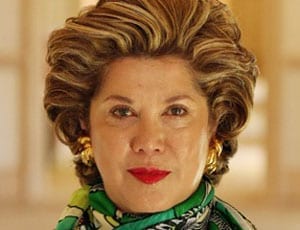
The rise and fall of the “wealthiest divorcee in history” has been extraordinary. A former nude model for her first husband’s Knave magazine and star of adult films such as “The Nine Acres of Nakedness,” Patricia Kluge is the daughter of an Englishman and a Scots-Iraqi. She married her second husband, the late John Kluge, chairman of Metromedia and once the richest man in America, in 1981 after belly dancing for him at a dinner party in New York. As part of her plan to dovetail herself into the top drawer of American society, the couple built a 24,000 square foot mock 18th century English-style mansion, Albermarle, in Virginia and stuffed it full of Chippendale furniture. She got this as part of her $100 million divorce settlement in 1990 and wisely invested part of the payoff in a highly successful business trading football cards but then vanity struck. The Kluge Estate Winery project that she started with her third husband, William Moses, bankrupted the pair in June 2011 and the Bank of America foreclosed on her properties. A lifeline came from “longtime friend” Donald Trump who purchased the vineyard and employed her, but even he’s now uttered the words: “You’re fired!” and sent her packing. Of her newfound predicament Kluge commented: “What did we lose? Material things, nothing too important. When something like this happens you really see who your friends are, those you can rely on, and we have many friends.” Here is a lady with fortitude that can only be described as admirable. It’s probably best, however, to keep her away from the cash register.
Matthew Steeples discovers a map of London with a difference
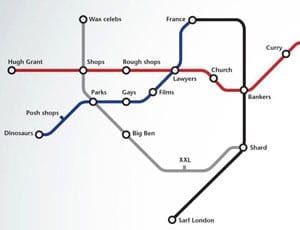
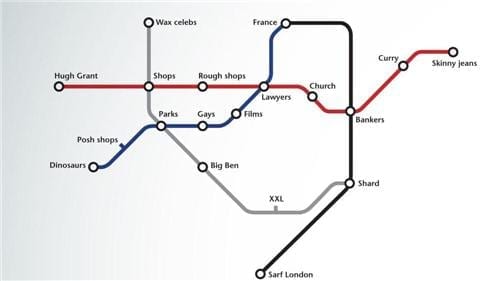
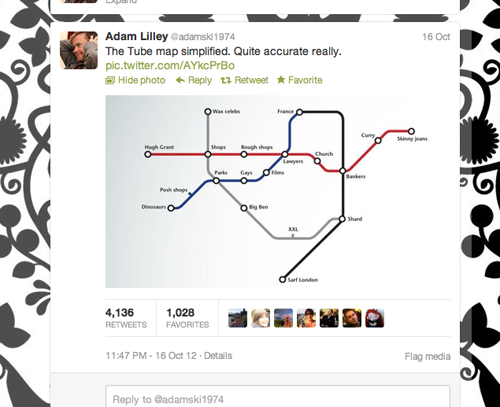
On the 16th October, an actor named Adam Lilley Tweeted an image based on a simplified version of a map of the London Underground. The creator had adapted it so that the names of the stations supposedly are indicative of what they believe the area around each station is best summed up by. Plainly it amused as over 4,000 Retweeted it.
A revised version of the London Underground mapAdam Lilley’s revised London Underground Map has been Retweeted 4,136 times
Knightsbridge is replaced by “posh shops” and South Kensington is all about “dinosaurs.” Westminster becomes “Big Ben” and Notting Hill Gate is simply “Hugh Grant.” Bethnal Green is replaced with “curry” and Leicester Square, “films.” Somewhere south of the river is simply “XXL” and out in Essex, another station is renamed “skinny jeans.” Irony is the order of the day.
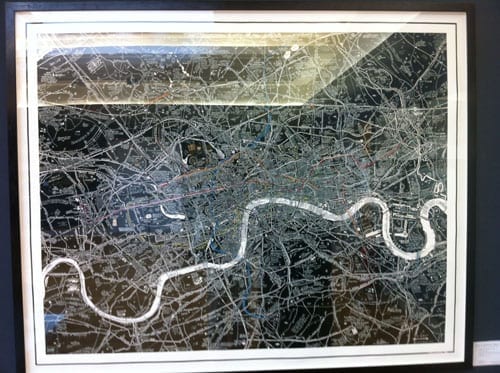
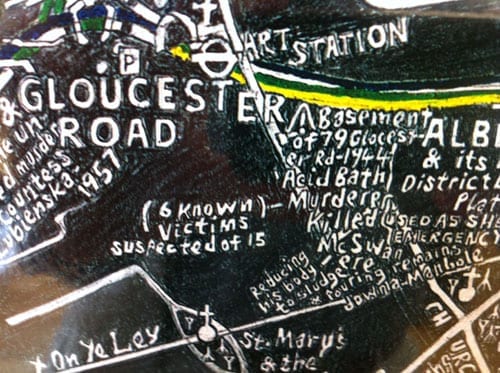
Stephen Walter’s “London Subterranea”The section of the map detailing the exploits of “the acid bath murderer”And the section all Sloane Rangers should examine more closely
Altering maps in this manner is nothing new and an especially brilliant one I saw at Christie’s in Old Brompton Road in their 3rd September sale depicted the location of events and discoveries I’d never heard of. In Stephen Walter’s London Subterranea, for example:
– The basement of 79 Gloucester Road was the location of the discovery of an “acid bath murderer” who killed at least 6 and is suspected of 15 murders. According to the depiction, he killed someone named “McSwan ‘ere and poured the remains down a manhole, reducing his body to sludge.”
– Harvey Nichols is shown as a plague pit.
– Brompton Oratory is described as aa “MI6 agent meeting place and dead letter office.”
Such maps provide a little light relief and for that reason we make Lilley’s image The Steeple Times picture of the week. We invite readers to submit their very own versions. We shall publish the best.
Henrik Fisker: a man who creates automotive winners
Readers of The Steeple Times will know that we are big fans of the designs of Henrik Fisker and most especially his Fisker Karma – a car that has sadly not yet made it to Britain’s roads.
We very much hope that this superb automobile does arrive soon, but a newsletter we received this morning from Hexagon Classics reminded us that Fisker has been responsible for many other groundbreaking vehicles, amongst them the BMW Z8.
Automotive designer Henrik Fisker with a Fisker KarmaRepublican Mitt Romney during the first in a series of debates with President Barrack Obama
Mr Fisker hit the news last week when the foolish Republican who desires to be President, Mitt Romney, made the following comment during his first debate with Barrack Obama:
“You put $90 billion, like 50 years’ worth of breaks, into solar and wind, to Solyndra and Fisker and Tester [we think he pulled a “Bushism” and meant Tesla] and Ener1… I mean, I had a friend who said you don’t just pick the winners and losers, you pick the losers, all right?”
Fisker Automotive’s spokesman, Roger Ormisher, rubbished this nonsense with the following riposte:
“We don’t consider ourselves a loser having sold 1,500 cars already, raised over $1.2 billion of private equity and are now expanding our export markets to GCC and China. We believe that is a quite an achievement for a small American business.”
Ormisher raises valid points and, in our humble opinion, Romney is wrong not to support this pioneering brand. Fisker is an innovative company that is now holding its own and setting the agenda in eco-friendly vehicles. That the especially pernickety Top Gear team love the Karma speaks volumes and frankly, this silly politician should just keep his oar out.
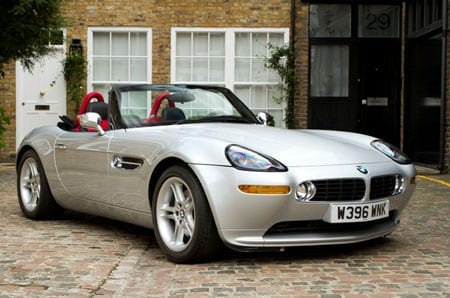
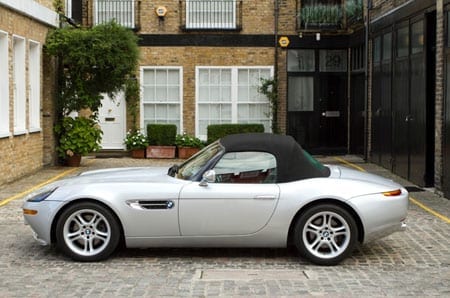
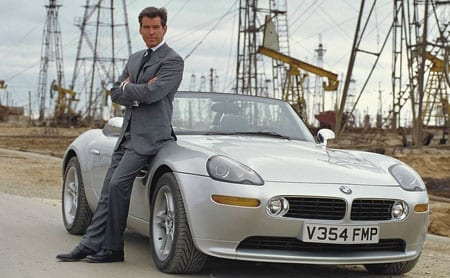
The Henrik Fisker designed BMW Z8 roadster offered by Hexagon ClassicsThe car with the roof upThe rather bold red and black interiorPierce Brosnan with a BMW Z8 in the 1999 James Bond film “The World Is Not Enough”
Hexagon Classics offer a 2002 BMW Z8 5.0 litre roadster in titanium silver with a sports red and black Nappa hide interior at a price of £119,995. The car has only 9,013 miles on the clock and can achieve a top speed of 155mph.
The Z8 roadster was good enough for Pierce Brosnan in the 1999 James Bond film The World Is Not Enough and if you’re in the market for a roadster, this particular vehicle could definitely “give you the world.”
Christian Huhnt reports on recent changes at Cassis restaurant
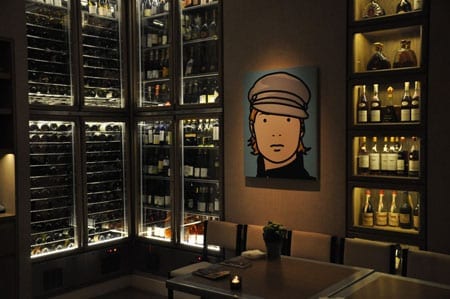
As I work in the arts and also collect wines, I find Cassis Bistro in South Kensington most comfortable as here I find myself surrounded by great works by Julian Opie, Gary Hume and Henri Matisse alongside as a humongous and well-stocked wine rack at the back of the restaurant. Cassis is part of Marlon Abela’s restaurant group, Marc, which also includes The Greenhouse, Umu, Morello Bistro and Morton’s.
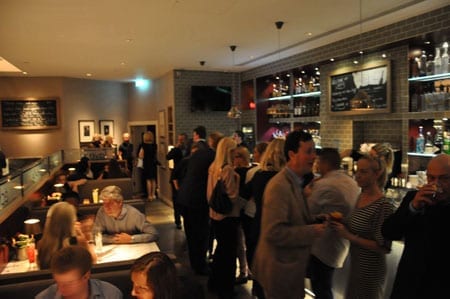
Cassis Bistro’s decor cleverly combines wine and artParty guests at Cassis Bistro, 232 – 236 Brompton Road, London, SW3 2BB
It was with anticipation, therefore, that I accepted an invitation to celebrate the arrival of Cassis’s new head chef, “le nouveau moteur de cuisine,”Massimiliano Blasone. Wait a minute: “Blasone”? That doesn’t sound to French to me. And indeed, he isn’t. This Italian chef made his name at Heinz Beck’s Michelin-starred Apsleys at The Lanesborough Hotel on Hyde Park Corner.
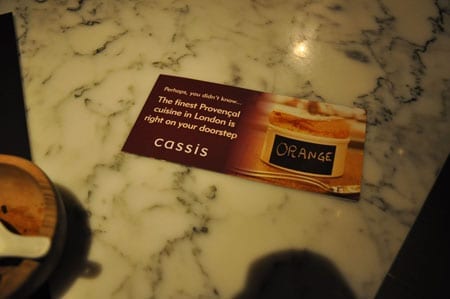
The first thing that I asked myself was: “What is an Italian chef doing in a French kitchen?” More importantly: “What is an Italian chef doing in a restaurant that has made its goal,” according to their own marketing material, “to deliver: The finest Provençal cuisine in London?”
A leaflet promoting the “Provençal” cuisine on offer at Cassis
After consulting the restaurant’s PR she told me the new idea is to “cook Provençal cuisine with an Italian influence.” What the heck? Why not add a Nigerian limbo dancer making sushi or a Muslim serving pork pies?
Continuing, she told me that the former chef had left as he’d decided to open his own restaurant. I recall once having a delightful lunch when that particular chef was still at Cassis, roughly one year ago, and remember how tasteful and typically Provençal it actually was.
Starting, as ever, with the drinks, I let the waiter choose my first one. He gave me a “Cassis Collins” which is supposedly the house cocktail. A mix of gin, crème de cassis soda, blackcurrant purée and lemon juice. Sadly, I could only really taste the lemon and overall it was too watery. It tasted as if it had been mixed 30-minutes prior to my arrival.
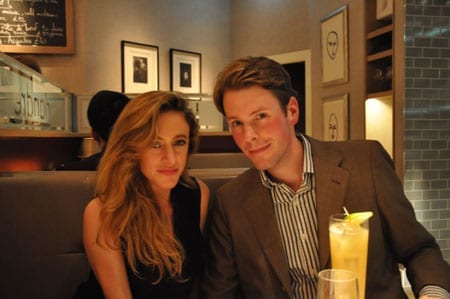
Jessica Patterson and Steffen Timm at Cassis
I quickly changed to an Italian classic, a Negroni, which was strong but cool. This was far more impressive. Steffen Timm, my companion and food connoisseur, went for a non-alcoholic cocktail with the notion to spare his palate for tasting the food later on, but while sipping at it he almost got a sugar shock and therefore turned to the booze too.
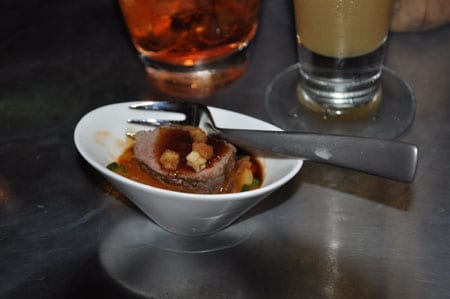
While sat at the bar, I found myself surrounded by some delightful locals and regulars. Things were most definitely on the up. After nibbling one grissini after another, finally the food arrived, but it came at such a speed that I struggled to keep up. Not even finished with a typically Italian dish of tagliatelle con tartufo bianco, the kind waiter offered me some superb raw tuna served in a Middle East Asian style with bulgur. Having barely swallowed this, the next dishes presented to me were a pumpkin tortellini with truffles, followed by oysters with sourcream and cucumber. Quail’s eggs with truffles, a lamb saddle with ratatouille (which was probably the only ‘kind-of-Provençal’ canapé) and finally some perfectly made risotto with yet more truffles brought things to a crescendo. My love affair with truffles is well known and some readers may recall my sharing that with you in my review of Honky Tonk. I must say, however, that this particular dish was more reminiscent of something that one might find in a chic restaurant in St Tropez than in the Provençal settings I am used to.
Provençal-style lamb saddle with ratatouille
Although Cassis is delightful and I enjoyed an evening of conversation and company, sadly, this new kitchen seems to have lost its ethos and now lacks the authentic Provençal character that made it so good. I urge the management to return to the quintessentially rustic and traditional roots that first made the place so appealing.
A most curious tale of playboys, socialites, lawyers and real estate moguls
This week the mystery buyer of Clarendon Court, the former marital home of Claus and Martha “Sunny” Von Bülow (1932 – 2008), was revealed as a restaurateur and real estate mogul named Paul Roiff. Separately, the New York Post reported that Mr Von Bülow’s former lawyer, Alan Dershowitz, had purchased an apartment in Sutton Place, New York at the same time as a postal worker was on trial for killing his sister. The lives of the rich and famous are never anything other than dramatic.
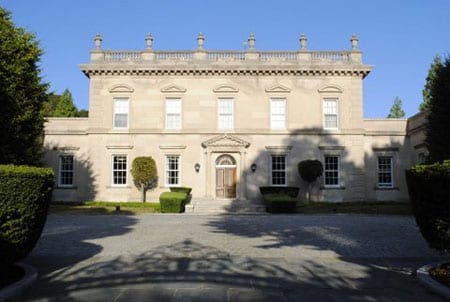
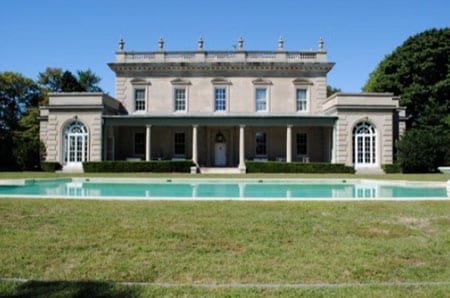
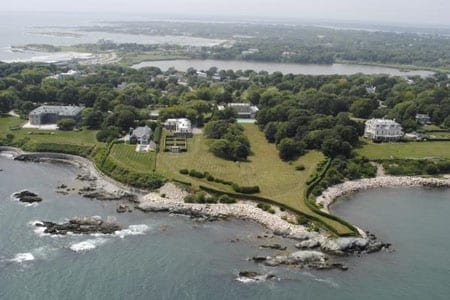
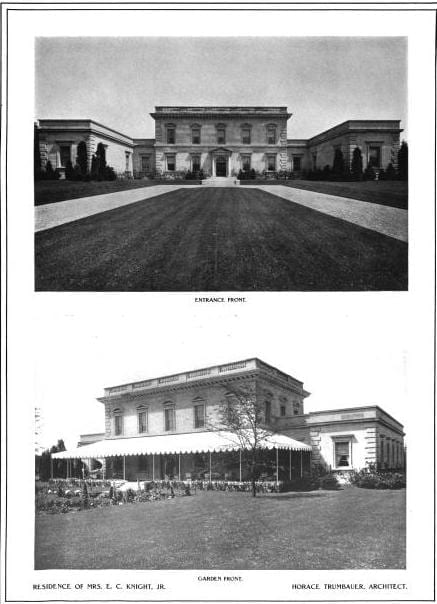
The front elevation of the former residence of Claus von Bulow: Clarendon Court, 626 Bellvue Avenue, Newport, Rhode Island, RI 02840The rear elevation of Clarendon Court, 626 Bellvue Avenue, Newport, RI 02840An aerial shot of Clarendon Court from the Atlantic Ocean
8-bedroomed Clarendon Court on Bellvue Avenue in Newport, Rhode Island is best known for the events surrounding the utilities heiress Martha Crawford Von Bülow falling into a 28-year coma there and her husband subsequently being tried, convicted and then acquitted for her attempted murder, but this fine residence has much else in its past as well.
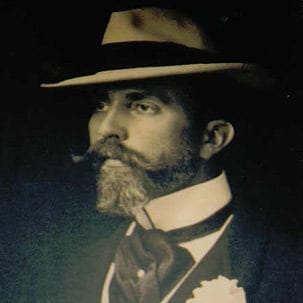
Edward Collings Knight, Jr. (1863 – 1936)
Designed by the most prominent Ameircan architect of the “Gilded Age,” Horace Trumbauer (1868 – 1938), this Palladian style villa was commissioned in 1903 by Edward Collings Knight, Jr. (1863 – 1936), a sugar-refiner and railroad executive, and his wife, Clara. It was built on an acre plot with views of the Narragansett Bay and is most curiously termed “one of Newport’s finest cottages.” The mansion that was constructed for the couple is an almost exact replica of a proposed house by Colin Campbell at Chester-le-Street in County Durham, England and features Doric columns, quoins and an urn-embellished balustrade. It provided a suitable illustration of Mr and Mrs Knight’s wealth and status.
Claradon Court in the early 1900s
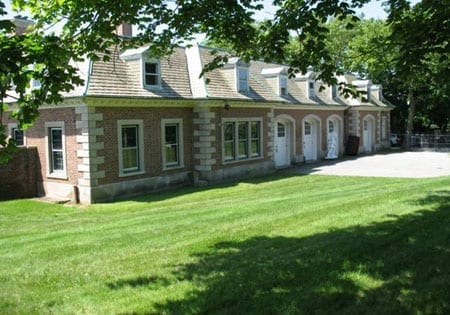
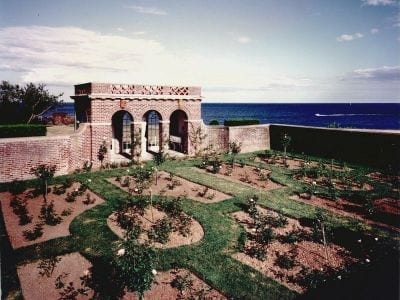
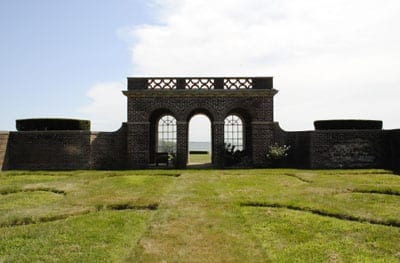
Edward Knight, who was once described as exhibiting “more talent at spending money than making it,” named the house Claradon Court in honour of his wife and shortly before it was completed in 1904, he acquired an additional six acres of land behind the plot with direct frontage to the Atlantic. Here, he had Trumbauer design a vast carriage house in an early Georgian vernacular as well as a series of high brick walls to protect the gardens from the ocean winds.
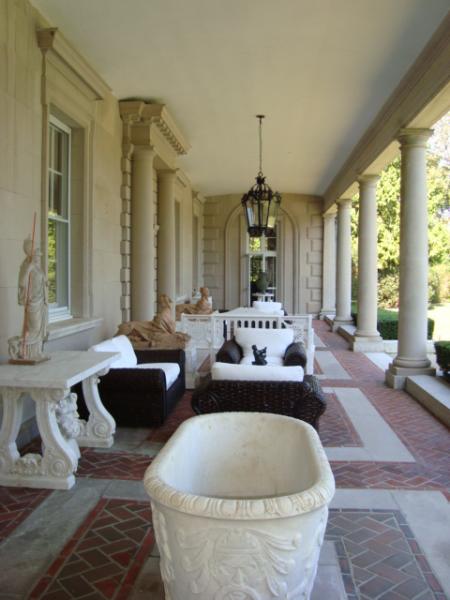
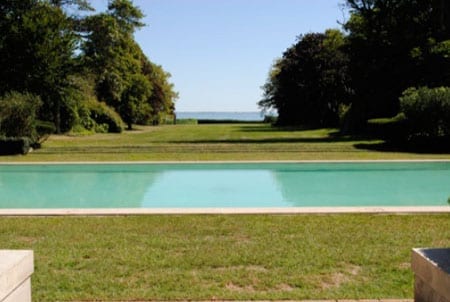
The coach house at Clarendon Court todayThe rear loggia was added by Mr & Mrs Knight at a later dateThis arch and walling was added to provide protection against the force of the AtlanticA more recent shot illustrates that the flower beds have been laid to lawn
The Knights engaged a Parisian decorator named Jules Allard to decorate Claradon Court in the English Georgian manner and after several seasons in residence added two wings onto the back of the house. Following Clara Knight’s death in 1928, her husband sold the estate, moved to a more modest Trumbauer designed house in neighbouring Middleton and remarried. His second wife, Marie Louise LeBel, is remembered as a “foul-mouthed, hard-drinking [woman], who thought nothing of killing a neighbour’s dog with a shot from her pearl-handled pistol.” Together they went on to spend the vast sum of constructing a $383,000 mansion in North Carolina as a hunting lodge. It is now the home of the Whalehead Club.
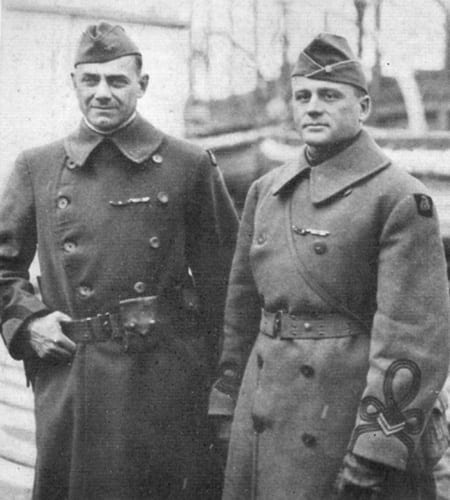
Colonel William Hayward with Major Arthur W. Little
The purchaser of Claradon Court was a First World War hero named Colonel William Hayward (1877 – 1944) and his wife, Mae (1880 – 1956). Whilst the colonel is remembered as the commander of the “Harlem Hellfighters,” a regiment that “never lost a man captured, a trench, or a foot of ground,” his wife was truly a character.
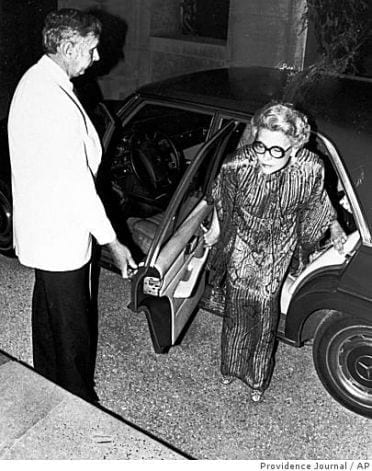
Born in Connecticut, Mae Cadwell had divorced her first husband Selden B. Manwaring of Hartford in 1914 to marry the older and richer Morton F. Plant of New York and New London, Connecticut. Morton Plant adopted her son by her first marriage, Philip “Paul” Morgan Manwaring Plant (1901 – 1941), and when he married the well-known actress Constance Bennett (1904 – 1965) in 1925 more controversy followed. The millionaire socialite Plant’s life is well documented not only as it was for him that the term “playboy” was originally created but also because of his bitter divorce from Bennett in 1929.
Following their purchase, Colonel and Mrs Hayward decided to have the name of Claradon Court changed to Clarendon Court to distance any lingering associations with Clara Knight and she is said to have filled the building with fine and decorative art. The colonel died in 1944 and his widow married for the fourth time, this time taking the president of the American Car & Foundry Company, John E. Rovensky, as her husband. After her death in 1956, Rovensky continued to use Clarendon Court until his own death in 1970 and even allowed it to be used as the set of the 1956 American musical comedy film High Society that starred Bing Crosby, Grace Kelly and Frank Sinatra.
Martha “Sunny” Von Bülow (1932 – 2008)Claus Von Bülow during one of his trials
In 1970, Clarendon Court’s most notorious chapter commenced when the utilities heiress Sunny Von Bülow and her husband Claus purchased the house as it was here in December 1980 that Mrs Von Bülow fell into the irreversible coma that she was to remain in until her death in December 2008. The story of Claus Von Bülow’s trials for the attempted murder of his wife is well known and the 1990 film Reversal of Fortune, starring Jeremy Irons, Glenn Close and Ron Silver, is most definitely a true masterpiece.
Considered a couple of “exceptional taste,” the Von Bülows were described as having filled Clarendon Court with exceptional 18th and 19th century English furniture. They also significantly improved the grounds by hiring the landscapers Innocenti & Webel to create an elegant allée to the sea by removing a hillock that had always deprived the ground floor rooms of an ocean view.
The Von Bülow landcaped the grounds to create a better view from Clarendon Court towards the Atlantic Ocean
In 1974, Claus Von Bülow wrote of Clarendon Court in an article for the Bulletin of the Newport Historical Society:
“The author of this article has lived happily at ‘Clarendon’ for the past four years. As a European he has found much to admire in Newport, with its sense of history and its preservation of a unique architectural heritage. He hopes some future writer will cover the occupancy of his family at ‘Clarendon’ with as much wistful charity as he has endeavored to extend to its previous owners.”
Von Bülow, at that time, plainly could not have imagined the tragic event that was to follow in December 1980 and for what the house would indeed become best known.
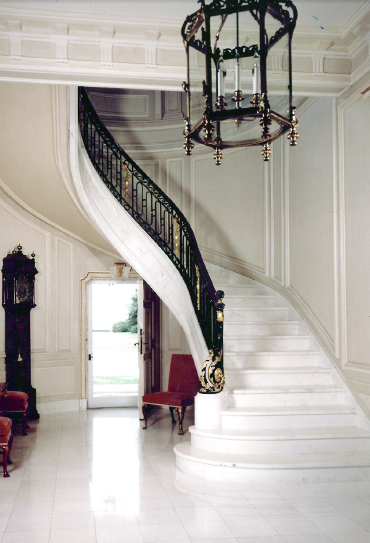
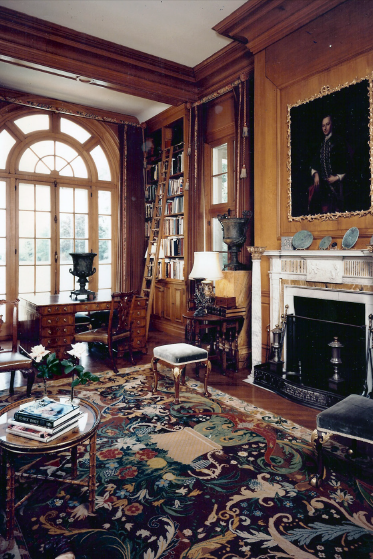
The main staircase at Clarendon CourtA study at Clarendon Court
A committee managing Sunny Von Bülow’s affairs sold Clarendon Court in 1988 to a fine art and antique dealer named Glenn C. Randall and his wife Patricia for $4,300,000. The couple converted the service wing into a gallery for their collection and lived there until Mrs Randall died after a battle with cervical cancer in May 2010. The 12,800 square foot house and it’s 10,000 square foot coach house were placed on the market for $17,800,000 in October 2010 and whilst the price was subsequently was brought down to $15,800,000, it languished until being sold in July 2012.
The new master of Clarendon Court, Paul G. Roiff, is a graduate of Boston University and Suffolk Law School. He is the president of a real estate company named Heath Properties and also co-owns a number of restaurants in Boston including Mistral, Mooo, Teatro and Sorellina as well as a 63-bedroom hotel named XV Beacon.
Paul G. Roiff
Plainly publicity shy, Roiff, who also owns homes in Florida and Michigan, used one of his employees, Keith Beardsley, to purchase Clarendon Court on his behalf. He paid $13,126,000 for the estate.
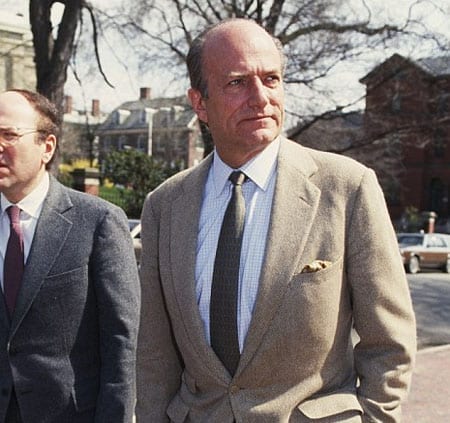
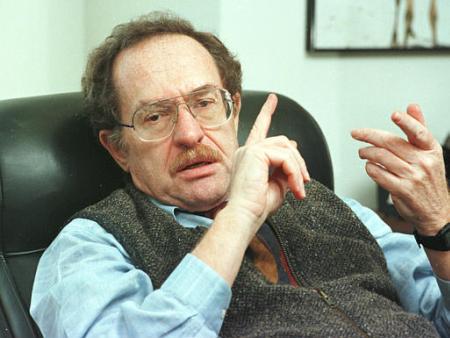
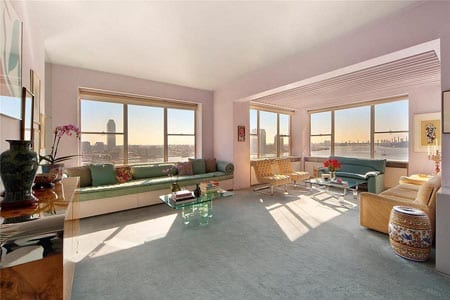
Celebrity lawyer Alan DershowitzAlan Dershowitz’s new pied-à-terre at 45 Sutton Place, New York, NY 10022, USA
In another development, on the 25th September The New York Observer reported that the lawyer who became famous representing Claus Von Bülow, Alan M. Dershowitz, had bought a 3-bedroomed apartment in the “stronghold of old money,” 45 Sutton Place, for $1,680,000. Plainly Mr Dershowitz, who subsequently represented O. J. Simpson, has done well and is plainly now richer than his first “celebrity” client. He also owns a 6-bedroom residence in Cambridge, Massachusetts and was able to use his verbal talent to persuade the sellers of the Sutton Place co-op downwards from their original $2,290,000 asking price.
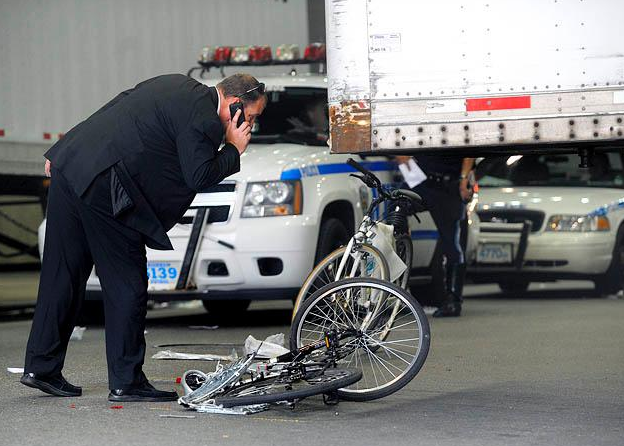
Separately, late last month, Dershowitz and his family were in court for the trial of a postal worker named Ian Clement. A 7-tonne truck driven by Clement had crushed and killed Marilyn, the 68-year old sister-in-law of Alan Dershowitz, in New York in July 2011. Dershowitz, a retired special referee for the New York court system, had been out for a bicycle ride with her husband, Nathan, a partner at Dershowitz, Eiger & Anderson.
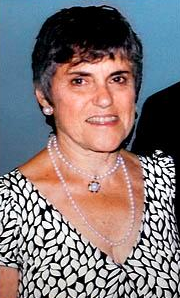
Marilyn DershowitzThe scene of the fatal accident that killed Marilyn Dershowitz
Surprisingly and much to the distaste of the Dershowitz family, Clement, who had been charged with leaving the scene of a fatal accident, was acquitted by a jury on the 20th September. Of this, Alan Dershowitz commented:
“The facts clearly justified a guilty verdict… I think a stronger presentation might have brought about justice. Instead, we have an injustice.”
Both the Von Bülows and the Dershowitz family have endured loss and a huge amount of media attention since the events of the early 1980s. Perhaps these most recent moves will bring with them a new chapter for both Clarendon Court and Mr Dershowitz himself. Meanwhile, Claus Von Bülow, though not quite as wealthy as he was in his days at Clarendon, prospers in London and is considered one of the city’s “finest wits.” How fortunes do indeed revolve.
Contact Alan M. Dershowitz at: Hauser Hall 520, 1575 Massachusetts Avenue, Cambridge, Massachusetts, MA 02138. Telephone: +1 (617) 495-4617. View his official website at: http://www.alandershowitz.com/or follow him on Twitter at: http://www.twitter.com/alandersh
The agent for Glenn C. Randall in the sale of Clarendon Court was Paul Leys of Gustave White who can be contacted on +1 (401) 848-6706 or by email at:[email protected]