In the first of a new series, we seek to find out what has become of well-known individuals who have faded into obscurity or moved on into others arenas.
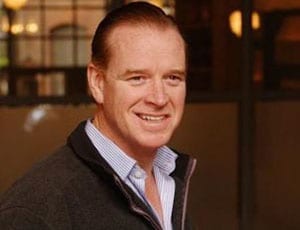
Our first subject, James Hewitt, will forever be remembered for two things: One will be his affair with Princess Diana. The second will be his “caddish” attempts to sell stories and information relating to this.
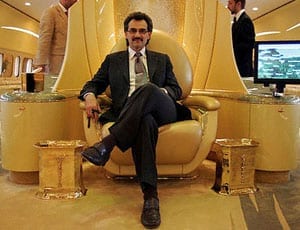
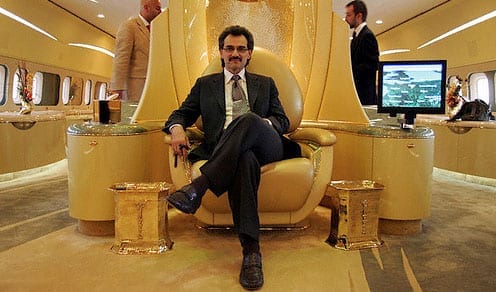
Ranked as “the most influential Arab in the world”, Al-Waleed has at various times held investments in News Corp, AOL, Apple Inc., Motorola, Fox News, Eastman Kodak, TWA, Twitter, The Savoy, the Four Seasons hotel chain and Euro Disney SCA. Not afraid to back his beliefs financially, the “Buffett of Arabia” gave £18.5 million to the families of Palestinian “martyrs” in 2002 and sent a cheque for $10 million to New York City Mayor Rudy Giuliani after the 9/11 attacks. In exchange he requested “a more balanced stance toward the Palestinian cause”. The cheque was returned. When Forbes magazine listed him as being worth £13 billion in March 2013 he was irate at the use of “incorrect data” that “seemed designed to disadvantage Middle Eastern investors”. Al-Waleed, whom rival publication Bloomberg list as being worth £18.5 billion, indignantly told Steve Forbes to remove him from his list and announced through his office that would he would “sever ties” with it. Surely, this dispute could be easily solved as, after all, what’s a billion or two between friends?
The sale of The Duchess of Cambridge’s uncle’s holiday villa, La Maison de Bang Bang
Just as it is reported that the pregnant Duchess of Cambridge is said to be furious about photographers having managed to capture her in a bikini on a beach on the private island of Mustique, another of her previous holiday destinations has come to the market.
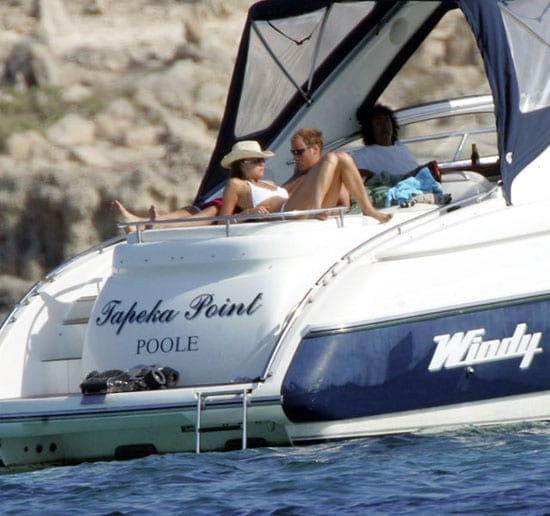
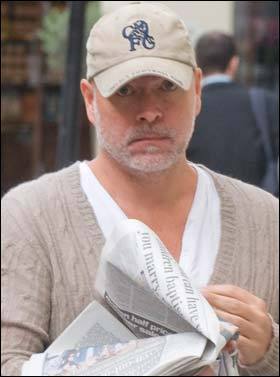
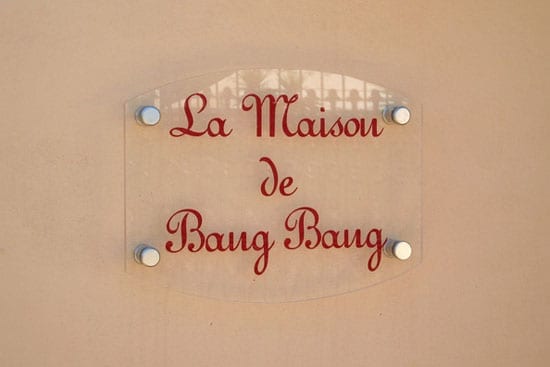
Kate Middleton and Prince William aboard Tapeka Point during their 2006 holiday in Ibiza.Carole Middleton’s brother businessman Gary Goldsmith.La Maison de Bang Bang’s sign.
The Duchess, as Kate Middleton, stayed with Prince William at the holiday home of her uncle, Gary Goldsmith’s in Ibiza in 2006. During the break at the exotically named La Maison de Bang Bang, the Prince and Miss Middleton were photographed on a motor launch, Tapeka Point, that was subsequently put up for auction in April 2012 for £120,000.
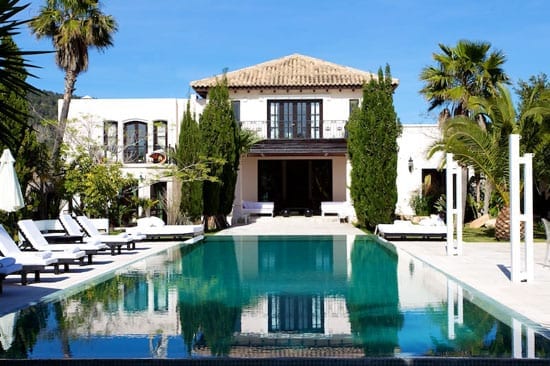
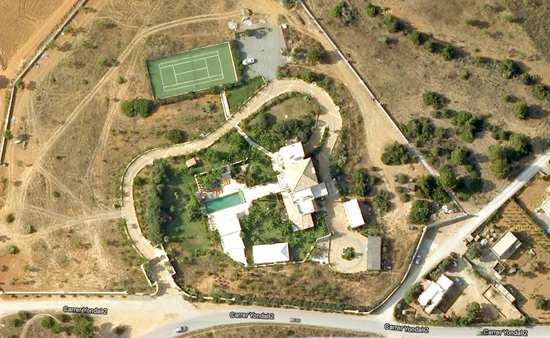
La Maison de Bang BangAn aerial shot of the property
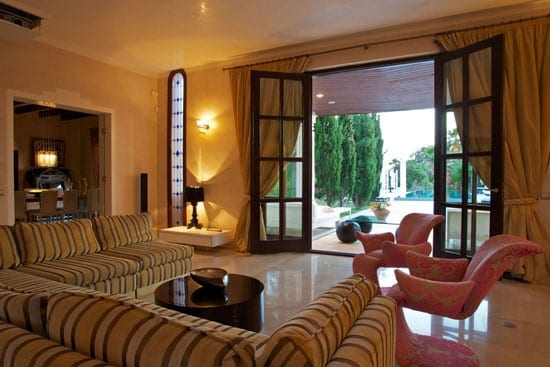
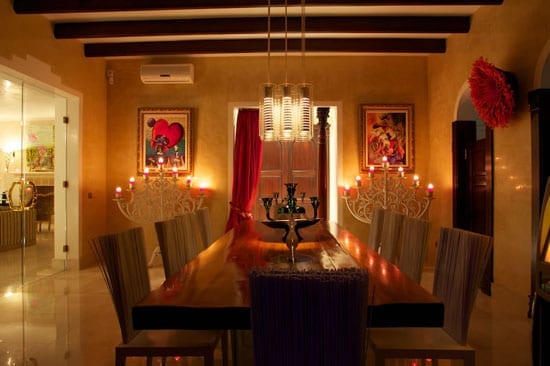
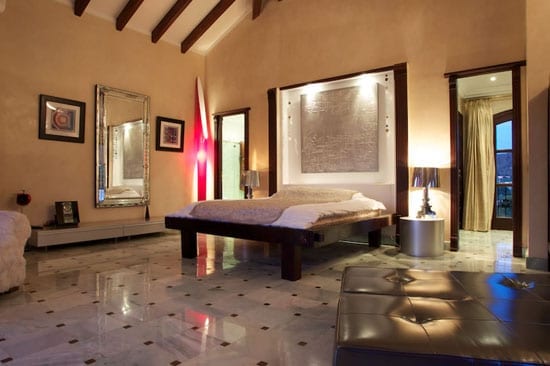
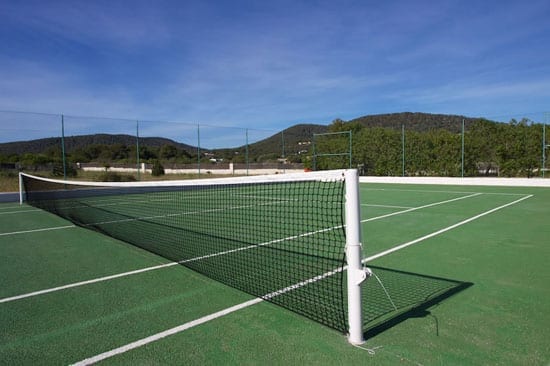
The 4 double bedroom villa, named according to its official website, after “Ibiza’s famous banging house music”, is just five minutes from the Cala Jondal beach and the “hip” Blue Marlin beach bar. The house stands on a plot of 23,850 square metres and includes a large reception room, 4 dining areas and a fully equipped gym. In addition there is a staff bungalow, swimming pool and tennis court.
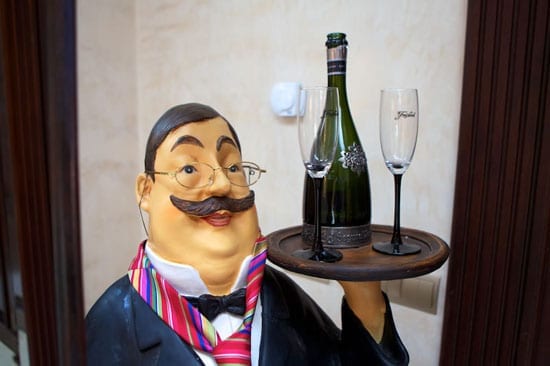
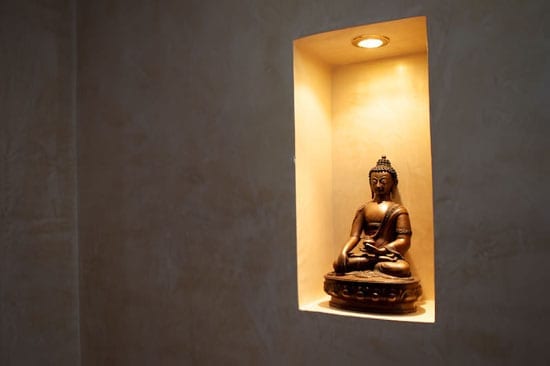
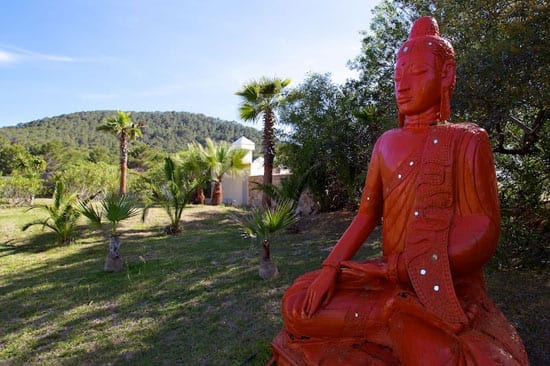
The main reception area in the house.One of four dining areas.One of four double en-suite bedrooms.An example of Mr Goldsmith’s humour.Buddhas can be found throughout the villa.And also in the garden.As well as an outdoor swimming pool, there is a full sized tennis court.
In a statement to the Daily Telegraph’s “Mandrake”, Goldsmith, who was subject to a News of the World sting at La Maison de Bang Bang in 2009, commented:
“I’m looking to buy a bigger house in London, given that I have only been there myself once in the last two year… After what seems like a million years of fun, fun, fun, I’m selling Bang Bang, folks”.
Of the house itself, Mr Goldsmith told the Daily Mail’s Richard Kay:
“It’s on for 6.5 million Euro. Despite the Spanish economy, it’s a good time to sell because the Euro is very strong at the moment, plus Ibiza isn’t like mainland Spain. It has a micro-economy all of its own”.
Knight Frank’s particulars for La Maison de Bang Bang were prepared last September and though Mr Goldsmith, who made £275 million selling his recruitment business in 2005, may be a canny businessman, it seems as if he may have to wait some time before someone else decides to put their bucks into the Bang Bang.
For more information on La Maison de Bang Bang, contact Knight Frank on +44 (0) 203 641 5161.
Matthew Steeples shares his views on the untimely death of a hospital receptionist
Suicide is sadly something that is at the forefront of my mind this week. My friend Andrew Embiricos sadly died exactly a year ago but when I read that a hotel receptionist who had been the victim of a prank had committed suicide, I was truly saddened.
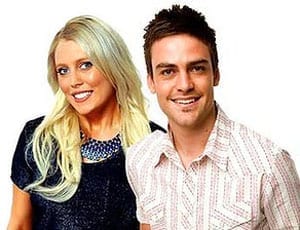
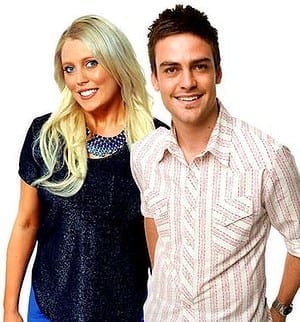
Radio presenters Mel Greig and Michael Christian
A hoax call by two foolish Australian radio presenters to the private hospital which treated the Duchess of Cambridge is said to have been the trigger for the suicide and frankly the two morons who caused this should hold their heads in shame. 2Day FM is already serving two five-year probations for breaching the code’s radio stations have to adhere to and presenters Michael Christian and Mel Greig ought to be sent to The Tower. Their’s was a prank too far. Off with their heads.
Jilly Cooper’s state of the nation style summary strikes chords with Matthew Steeples
Best-selling bonkbuster author Jilly Cooper might be best known for novels such as Riders and Jump! but in the 1980s and 90s she was equally lauded as “one of the Conservative Party’s most ardent supporters.”
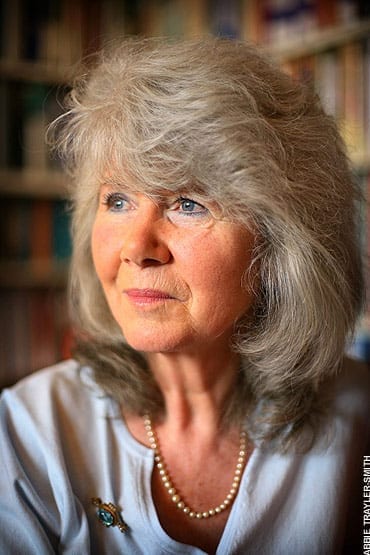
Jilly Cooper
Cooper, born in 1937, showed she still has a grip on the nation’s pulse yesterday when she declared that the Conservative Party is “full of terrible people now” to The Spectator’s “Steerpike.”
Separately, in a comment to The Telegraph’s “Mandrake,” Mrs Cooper shared her thoughts on Pippa Middleton’s first book, Celebrate:
“[It] wasn’t a good idea. I don’t blame her – I think that she was ill-advised… All I can say is that I hope the British don’t demonise her because of it. She seems a lovely girl and her sister is wonderful.”
Ever the diplomat, Jilly Cooper, in these comments, shows herself as a truly brilliant wordsmith. She has tact and decency but at the same time doesn’t hold back when it comes to honesty.
Nigel Farage should put in a call. Mrs Cooper could be just the asset UKIP needs to transform them from a “bunch of loons” to electability.
Matthew Steeples delves into the history of Albany, Piccadilly and discovers an affordable way of living there
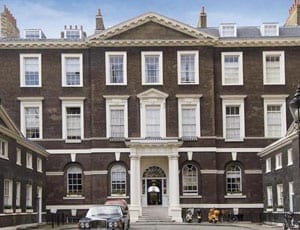
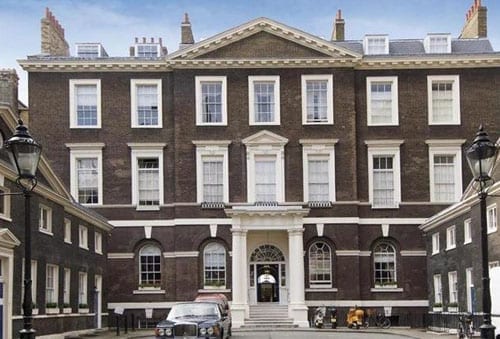
Albany, off Piccadilly in Mayfair, was most probably London’s first apartment block and it’s certainly the city’s most exclusive. It may be next to the Royal Academy and opposite Fortnum & Mason but surprisingly few have even heard of it.
Considering its location, Albany, which some make the mistake of referring to as “The Albany,” is an amazingly quiet oasis of peace and tranquility but, equally, it is a place of intrigue and drama. Residents, or “proprietors,” as they prefer to be known, of the 69 “sets” are particular about the “the” part of the name as they’d rather their residence not be confused with a public house and they are even more protective of their privacy. A porters’ lodge guards the entrance to the building and it is staffed mostly by ex-servicemen, who, until the early 2000s, had to wear top hats and tailcoats. Those allowed to pass enter a rarefied world frequented by what the Irish novelist Marmion Savage (1803 – 1872) identified as “incurable oddities” and “superannuated fops” in The Bachelor of Albany.
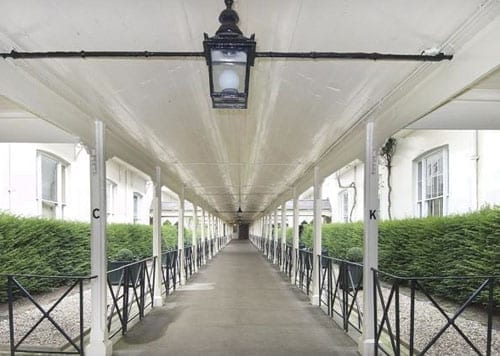
The front courtyard and façade of Albany, Piccadilly, Mayfair, London, W1J 0ALThe rope-walk connecting the various sets of Albany has been traversed by some of the greatest names in history
Built by Sir William Chambers (1723 – 1796), who also designed Somerset House and the pagoda at Kew, between 1770 and 1774 for 1st Viscount Melbourne (1745 – 1828), Albany was originally known as Melbourne House and conceived as a three-storey mansion, seven bays wide with a pair of service wings flanking a front courtyard. From 1791 to 1802, the property was occupied by George III’s son, Prince Frederick, Duke of York and Albany (1763 – 1827), but after he left, the renowned architect Henry Holland (1745 – 1806) sub-divided the existing house and added two parallel sets of buildings running the length of the garden to create 69 “bachelor apartments” which he named “sets.”
The “roll call” of residents since could easily fill our very own pages thrice over. They number royalty, politicians, artists, playwrights, academics and philosophers and here is a brief selection:
– Anthony Armstong-Jones, later 1st Earl of Snowdon
– Sir Thomas Beecham
– Sir Isaiah Berlin
– Lord Byron
– George Canning
– Sir Kenneth Clark
– Baroness Pauline de Rothschild
– William Ewart Gladstone
– Sir Edward Heath
– David Hicks
– Aldous Huxley
– Sir Simon Jenkins
– Rupert Lycett Green
– Malcolm Muggeridge
– Sir Harold Nicholson
– J. B. Priestley
– Sir Terence Rattigan
– Roger Scruton
– Baroness Sharples
– W. Somerset Maugham
– Terence Stamp
– Sir Denis and Lady Thatcher
– Sir Herbert Beerbohm Tree
Each had to pass the vetting of a committee of trustees of this Grade I listed building. That committee forbids children under 14, pets, musical instruments and commercial activities and each approved resident has undoubtedly added to the history of this den dominated by a central walkway named the “rope-walk.” Incidentally, an example of a curious quirk at Albany is that no resident is allowed to speak to another on this walkway. If they do, a fine is incurred. Albany, indeed, is rather like a college in its systems of rules, regulations, order and hierarchy.
For several centuries, women were not even allowed to cross the threshold and one legendary tale tells of Lady Caroline Lamb (1785 – 1828), disguised as a page boy, stealing into Lord Byron’s (1788 – 1824) set in 1815 to leave a note: “Remember me, Byron.” He replied with a simple verse:
Remember thee, aye, doubt it not:
Thy husband too shall think of thee.
By neither shalt thou be forgot —
Thou false to him, thou fiend to me.
The strict and formal structure that controls Albany and ensured its maintenance has succeeded in the main because 34 of the 69 sets are owned by Peterhouse College, Cambridge. They and the other owners are highly particular in whom they lease to and on one occasion on hearing of an “unsuitable tenant,” the secretary of the trustees is reported to have shouted:
“He’s a foreigner. Don’t like him. Don’t trust him.”
Needless to say, that application didn’t progress and nor did one from a physiotherapist who planned to operate from the building. Bone bashing in Albany just wouldn’t do.
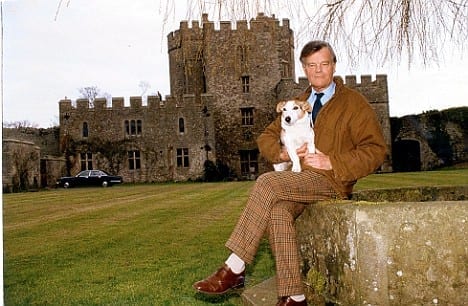
The Rt. Hon. Alan Clark MP (1928 – 1999) in the grounds of his main home, Saltwood Castle, near Hythe in Kent in 1993
A horsewhip, however, nearly crossed the threshold of set B5 in 1994, as it was here that the late Alan Clark MP (1928 – 1999) lived. The affable philanderer seduced the wife and both daughters of a certain South African named Judge Harkess and the wronged man stated he would “have horse-whipped Clark if he had known how comprehensively he had violated his honour.” B5, itself, was described as having the feel of “the straitened quarter of an Edwardian bachelor on his uppers” and the dotty, English attitude of the residents is best summed up by the reaction of Clark’s neighbour when he accidentally flooded their basement. When asked what he could do to make amends, their answer was quite simple: “Go and lie down in Piccadilly and wait for a double-decker bus.”
The dandy and journalist John Morgan (1959 – 2000) typified social change at Albany in the 20th century just as much as he himself redefined etiquette and manners at Debrett’s and The Times. Of “humble origins,” Morgan was brought up in a “modest” bungalow in St Madoes, Perth, Scotland but is credited with persuading William Hague to remove his baseball cap whilst Conservative leader and offering advice ranging from “how to eat a banana” to “how best to tell friends that the partner you would like to bring to their wedding will be of the same sex as you.”
Dandy and etiquette expert John Morgan (1959 – 2000)
For the bachelor and GQ style director, living in Albany was symbolic of his own personal social elevation but he did not disown his past. This modern day Beau Brummell was a man of social contradictions who cashed his cheques at Claridge’s but was a member of the National Union of Journalists. He was a Tory but still regularly attended chapel meetings as he had done in his youth. Here was a man of paradoxes who seemed unable to come to terms with the fact that he was a homosexual.
Morgan, an asthma sufferer, fell to his death from a fourth floor window on 9th July 2000. He was found in just a white shirt in a basement below a window whose sill was strangely undisturbed. The coroner left an open verdict with a suspicion of suicide and it was widely reported that police found 60 made-to-measure Savile row suits, 300 monogrammed shirts and 90 pairs of shoes in the etiquette expert’s small set. Mystery shrouds the story of his tragic demise to this day but Johnny Morgan will forever be remembered as an arbiter of both good taste and behaviour.
Whilst Morgan represented continuation of the trend of bachelors living in Albany, change also came in the 20th century when the building’s committee removed the restriction that allowed only bachelors to be resident. With that females were allowed in and amongst them Fleur Fenton Cowles (1908 – 2009) was one of the most fascinating.
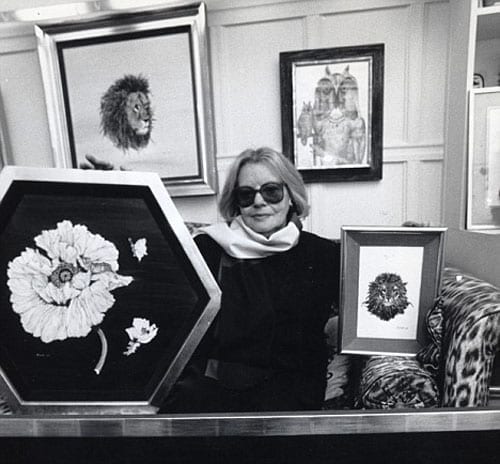
Fleur Fenton Cowles (1908 – 2009) in her set at Albany with some of her paintings and one by Salvador Dali
This writer and artist occupied five sets knocked into one with her fourth husband, timber merchant Tom Montague Meyer, and according to the Daily Mail’s Geoffrey Levy, hosted “elite soirees of the powerful and famous.” Levy recounts them at length but here is a flavour:
“On a Wednesday evening, a typical dinner party… would include Foreign Secretary Selwyn Lloyd, Labour leader Hugh Gaitskell, entertainer Danny Kaye and film star Douglas Fairbanks Jr. The Queen Mother regularly came to tea and was once joined by Pavarotti who sang Happy Birthday for the royal guest. ‘I don’t want her to die,’ said Fleur. ‘I couldn’t bear to think she doesn’t live just down the street.’ ”
Fenton Cowles, founder of the ill-fated Flair magazine and a “woman who knew everyone,” loved Albany and an exact replica of her “windowless, milk-yellow” study there has even been recreated at the University of Texas.
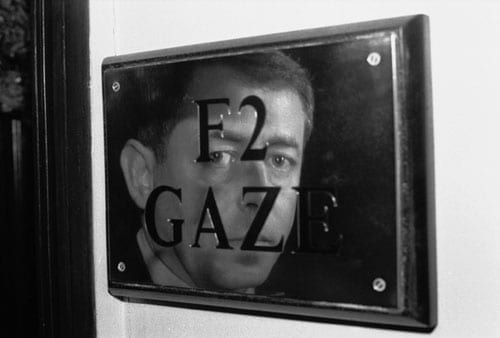
Another known for hosting extravagant bashes in Albany was my late friend, the Russian icon dealer John Gaze (1947 – 2011). Gaze had, as a boy, asked his father about the building when he passed it as a child and immediately declared he would live there one day. He took F2, the former set of Edward Heath that overlooked Savile Row to the rear, in the mid 1990s as he craved the safety that the building offered after having been kidnapped at gunpoint by an Oxford graduate conman named Sacheverell de Houghton in April 1991 from his then home in Fournier Street, E1. He made the most of his tenancy.
Russian icon dealer John Gaze (1947 – 2011) reflected in the brass plaque outside his Albany set, F2. It was formerly occupied by Sir Edward Heath.
Gaze’s parties included a fundraiser for people with AIDS hosted by a drag queen. This sparked fury with certain other residents and coverage in the Daily Telegraph and another incident there involved him encountering Alan Clark on the ropewalk carrying a portrait of Lenin. “Where the fuck are you taking that?” Clark supposedly bellowed but was “reassured” when he was told it was “destined for a less salubrious address in Whitechapel.” John Gaze remained at Albany for several years but, like a number of others I know, was forced out by ever rising rents and moved first to Chelsea and then Ennismore Gardens, Knightsbridge. He always remembered his time at Albany fondly and as a bon vivant, he truly belonged there.
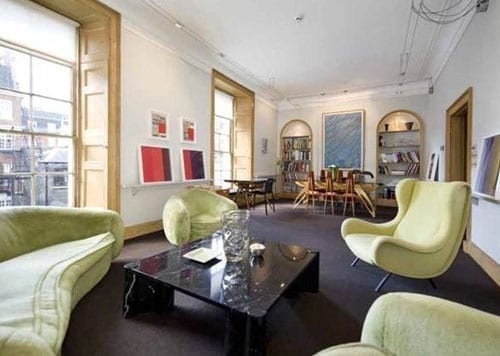
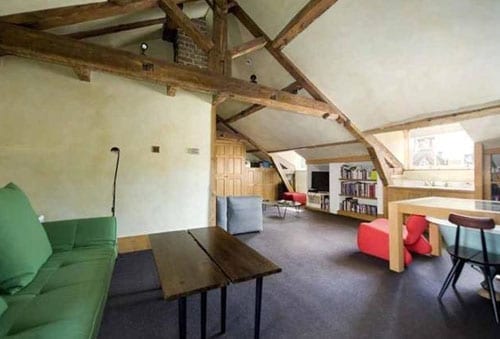
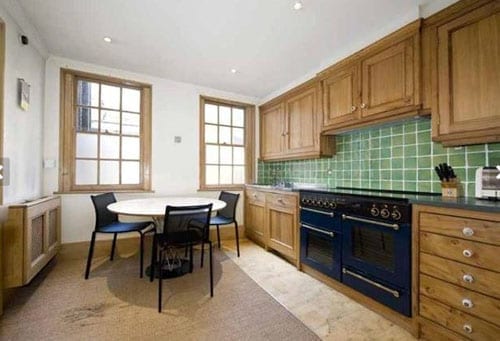
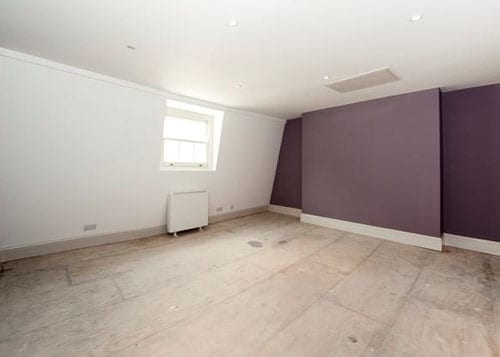
The main reception room in a £1,400 a week set currently available in AlbanyAn attic room in the set that could be used as a second reception room or second bedroomThe kitchen is lacking in character but offers ample space for informal dining
Contrary to what you’d expect, living in Albany is not quite as expensive as one might think. A 2-bedroomed 1,970 square foot set is currently available through Knight Frank for £1,400 a week: a figure that seems quite reasonable given the location, history and size of this property. Available on a minimum 8-year rental term, it includes a formal reception room, a dining kitchen, 2 bedrooms and 2 bathrooms.
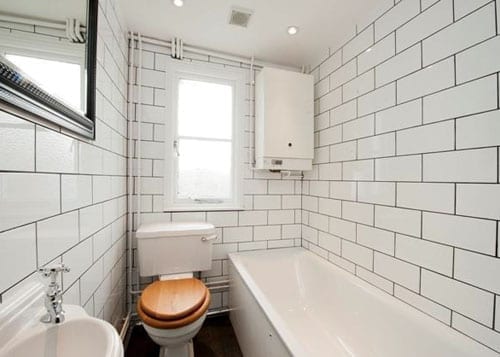
This £300 per week set, D2, consists of just one roomThe communal bathroom D2 shares with other sets is basic but clean
For those looking for something cheaper, Savills offer D2 Albany at £300 per week. This set consists of a 221 square foot third floor attic room with access to a communal bathroom and the agents suggest that it: “would make an ideal reading or writing room or an occasional bedroom for a pied-a-terre.” It’s effectively a posh form of tenement but what a way to impress your peers and subordinates.
Damon and Sandra de László in their “duplex” in Albany
Those renting either of these sets would find the likes of the industrialist Damon de László, a descendant of the Hungarian painter Philip Alexius de László (1869 – 1937), as their neighbour. The couple occupy Lord Byron’s former set, A2, and have, on occasions, opened it for a charity dinner with Matthew Parris at £1,000 a ticket as well and for members of The Portrait Institute to view their collection of de László’s works.
Professor Philip C. Bobbitt in his grand freehold set
Another present day resident is a man Henry Kissinger calls “the outstanding philosopher of our times,” Professor Philip C. Bobbitt. This Texan lawyer is a nephew of Lyndon B. Johnson and the author of Terror and Consent, which Tony Blair describes as “required reading for political leaders.” Bobbitt owns an impressive flying freehold set that is described as having a masculine style of décor and a “kitchen he has designed to look like a bar.” In an interview for TheIndependent he states that he finds Albany: “a propitious place to work.”
Though governments and bankers come and go, behind this quintessentially English façade, order and disorder have always been maintained. The wildcards of this hidden haven have a knack for living by the doctrine “to live at Albany is to live in history” and indeed they make the most of that. Those who are lucky enough to be let in, do, indeed, truly find themselves in the “Paradise of Piccadilly.”
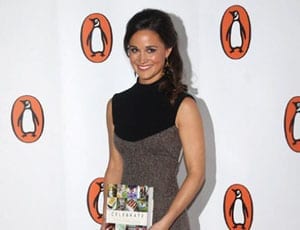
The sister of The Duchess of Cambridge was paid a £400,000 advance by Penguin for her first book, Celebrate. A graduate of the University of Edinburgh, Middleton’s view of her changed circumstances is simple: “It’s been a crazy few years since my sister’s wedding.” Whilst the chattering classes attack her and her family for cashing in on their connections to royalty, she’s also raised thousands for charity and is making her mark as an author. Good for her.
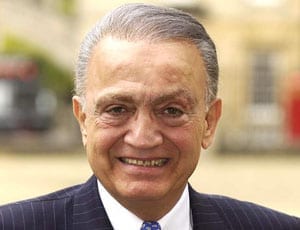
This billionaire was born in Damascus in 1939 and declares his loves to be music, architecture, art and horse racing. His home is the £50 million neo-Georgian mansion Tusmore Park near Bicester in Oxfordshire and he supposedly paid Robbie Williams in excess of a million to perform at his daughter’s May 2012 wedding to PR Khaled Khawaja at The Palace of Versailles. Saïd was one of Margaret Thatcher’s biggest supporters but is also said to have been a confidant of Peter Mandelson. As chairman of Saïd Holdings Limited, he presides over an empire with investments in hedge funds and real estates but he’s better known for the £23 million endowment he provided to establish the Saïd Business School in Oxford in 1996.
A £26 million residence with connections to rock, royalty and rectors
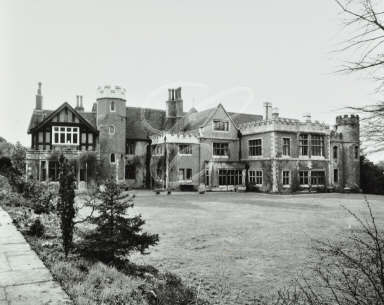
Built in the early 1500s, The Old Rectory is Wimbledon’s oldest house. Standing in grounds of 2.5 acres, this 16,200 square foot property was once described by a biographer of Sir Henry Cecil as being “not luxurious, but adequate” but now once again it finds itself in an entirely different league.
An image of The Old Rectory, 82 Church Road, Wimbledon, London, SW19 5AA in 1978. Present day imagery has been removed at the request of agents acting for the current owners.
Priced at £26,000,000, it is almost certainly one of the most expensive homes to ever come to the market in Wimbledon and whoever moves there next will undoubtedly be either an oligarch, an A-list personality or a top achieving business person.
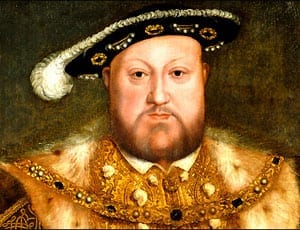
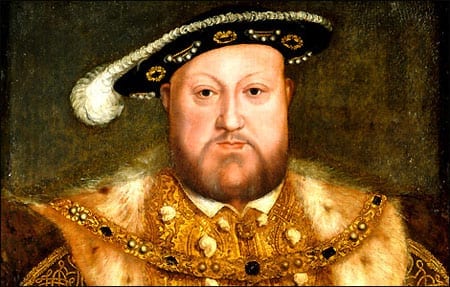
The purchaser will follow in the footsteps of a fascinating array of historically important residents, the first of whom was Henry VIII (1491 – 1547). The King took up residence in 1547 in the months prior to his death and is said, as he was so bloated, to have been unable to climb the stairs to his sleeping chambers. His bed was relocated to the great hall of the house and here he slept next to the fire. Historical research recounts that, with a brewhouse, beer and wine cellars, a coal cellar, meat room, buttery and two dairy rooms, this was a “house fit for a king.”
Henry VIII (1491 – 1547)Catherine Parr (1512 – 1548)
Henry VIII gave The Old Rectory, which was originally called The Parsonage House, to his sixth and final wife, Catherine Parr (1512 – 1548). Preferring a residence in Chelsea, Parr left and the Dean and Chapter of Worcester Cathedral took possession. A lease was sold to Sir William Cecil (1520 – 1598), later Lord Burgley, and the manor then passed to his son Thomas Cecil (1542 – 1623), the 1st Earl of Exeter.
In 1639, Charles I (1600 – 1649) bought the entire manor and gave it to Queen Henrietta Maria (1609 – 1669) but with the era of Comwell, The Old Rectory found itself occupied by General John Lambert (1619 – 1684). Shortly after, when a grander house was built next door, the property became first a laundry house and then servant accommodation and gradually fell into decline.
The Old Rectory passed next to Sir Theodore Janssen (1658 – 1748) in 1720. This French-born English financier, who was said to be worth the staggering sum of £250,000 at the time of his purchase of the house, was a founder member of the Bank of English but later disgraced for his part in the South Sea Bubble. He was expelled from the House of Commons and with his ruination, The Old Rectory saw yet another chapter of abandonment.
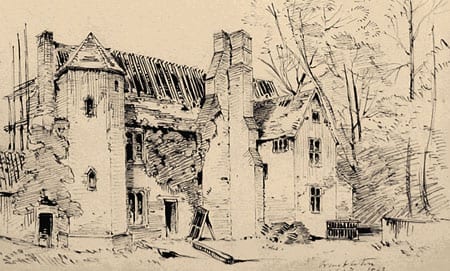
The garden front of The Old Rectory by Charles Henry Money Mileham (1837 – 1917)
By 1802, the house was described as an “uninhabited” ruin. A speculator credited with developing “modern Wimbledon” named John Augustus Beaumont bought it and restored and extended it but when it was sold to a Samuel Wilson in 1882 for £6,000, an era of truly comprehensive upgrades was to begin. Wilson added a pebble-dashed two-storey drawing room wing, carved oak doors and installed English, Flemish and Italian chimneypieces.
The next owner was a marine engineer named Matthias Jacobs who had been responsible for the construction of tunnels in Paris and New York. After having purchased The Old Rectory in 1909, he commissioned his brother to add a new single storey billiards room, a service wing and a study extension to mask the medieval chapel of the house. Jacobs sold up in 1923 to a Thomas Lethaby, who fitted oak paneling from Chantry House in Newark and a plaster ceiling based on the one at Knole House, Kent.
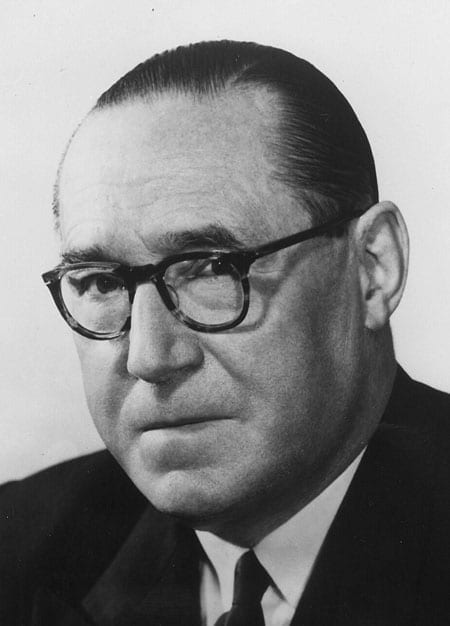
Lord Brock FRCS, FRCP (1903 – 1980)
In 1953, the eminent London surgeon and cardiologist, Lord Brock FRCS, FRCP (1903 – 1980), took possession of The Old Rectory after having paid £13,750 for it. Brock is credited as on of the pioneers of modern open heart surgery and also founded the Lord Brock Memorial Trust that to this day funds the museum he founded, The Old Operating Theatre Museum and Herb Garret in Southwark, SE1.
Following the death of his first wife Germaine Louise Ladavèze, Brock sold to an Iraqi entrepreneur and philanthropist named Basil Faidhi in 1978. Faidhi had fled Iraq for Britain and though he spent vast sums restoring the house with assistance from English Heritage, he also created a basement discotheque for his daughter, Nina, and a bar. Aside from bringing the house into the “yuppie era,” Faidhi also commissioned a historian named Richard Milward MA to write a history of the building in 1992 entitled: The Rectory – Wimbledon’s Oldest House.
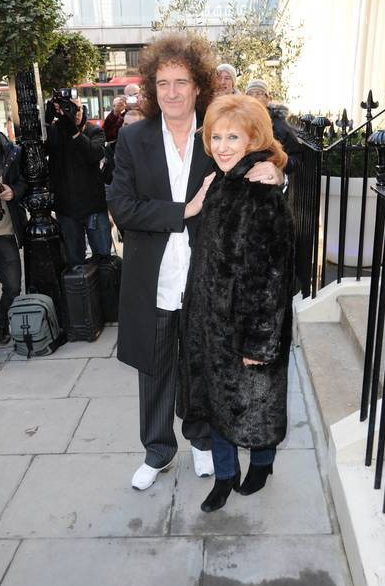
The Queen lead vocalist and anti-badger cull campaigner Brian May CBE purchased The Old Rectory in 1994 for £4,000,000 with the intention of living there with the Eastenders actress Anita Dobson.
Brian May CBE with his second wife Anita Dobson
Dobson, who didn’t marry May until 2008, had other ideas and refused to move in. It was suggested that she preferred a smaller house the pair occupied in Kensington and, at the time, a friend commented:
“[May] begged her to move into the new house so they can make a fresh start. Nobody can believe that Anita doesn’t want to be the lady of this fabulous house. But Brian says he can’t get through to her.”
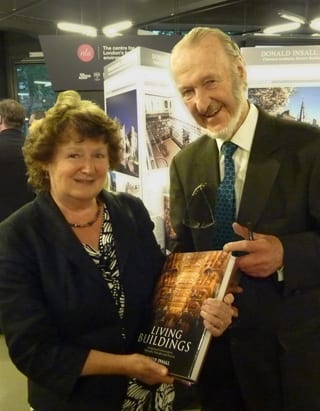
Sir Donald Insall CBE
As a result, May never properly moved into The Old Rectory and eventually decided to sell. In 2006, it achieved a record price of £16,000,000 and in the ensuing years, an Italian architect-owner named Antonella Carminati and her husband have lavished time and money on further restorations with the help of Sir Donald Insall CBE’s Insall Associates firm of architects.
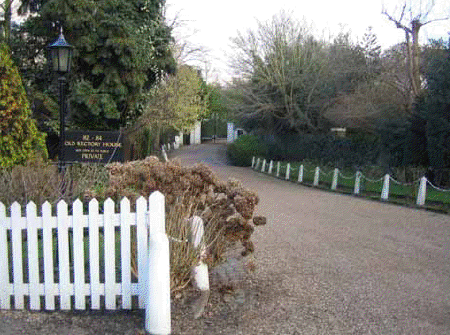
The driveway that leads to The Old Rectory from Church Road gives plenty of privacy
New fittings have been installed throughout and substantial extensions to the house have included a new kitchen and breakfast room with garaging beneath. The couple have demolished an early 20th century porch and an “unsightly” oak conservatory, remodeled the billiards room as a drawing room and removed a “bilious” blue swimming pool from the east lawn.
Now featuring 12,882 square foot of accommodation in the main house and 3,320 square foot of additional accommodation, The Old Rectory has been planned to include 8 reception rooms; a vast kitchen with La Cornue appliances and an adjoining breakfast room; master bedroom suite with two dressing rooms, his and her bathrooms and a sitting room and 7 further bedrooms.
Outside, the gardens feature an original medieval fig tree trail, shaded paths, lawns and a large pond as well as garaging for six cars. Planning permission for an indoor swimming pool complex has also been granted and ample staff accommodation is provided above one of the garages and in the gate lodge.
Given the now limited financial resources of the traditional religious houses of Britain, will it be rock, royalty or new money that next takes possession of The Old Rectory? The historians of Wimbledon will undoubtedly be watching.
The Old Rectory, 82 Church Road, Wimbledon, London, SW19 5AA is for sale through the Wimbledon office of Knight Frank. For more information call: +44 (0) 20 8946 0026.
Who would have imagined seeing a Phantom and a Mulsanne drag racing?
In London, people do strange things with supercars. Arabs like His Highness Sheikh Rashid Bin Humaid Al Nuaimi, aged 28, don’t bother to insure their wrapped orange £230,000 Ferrari FF’s and find them impounded by the Metropolitan Police whilst Iraqi playboys race Ferrari 599’s down Sloane Street at 120 mph. Meanwhile, the Qatarai royals plainly don’t understand the concept of parking charges and strangely prefer to leave their £1.2million Koenigsegg CCXR’s to be clamped. The world of the super rich and their chariots is, indeed, nothing other than bemusing.
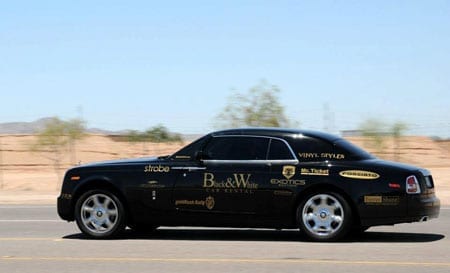
A Rolls-Royce Phantom and a Bentley Mulsanne drag racing in the 2012 goldRush Rally
When, yesterday, Thilo Martin, a director of Rolls-Royce Motor Cars Geneva, kindly shared an image on Facebook, I truly saw two luxury cars being used in a manner that I could never have expected. In a photograph taken at the 2012 goldRush Rally readers will see a £253,000 Rolls Royce Phantom and a £225,000 Bentley Mulsanne drag racing.
The Rolls-Royce PhantomThe Bentley Mulsanne
We at The Steeple Times found this strange use of two vehicles that normally are more likely to be found on Rodeo Drive, Park Avenue or Bond Street most amusing and for that reason it had to be our picture of the week.