A Modernist masterpiece based upon simple rationalism
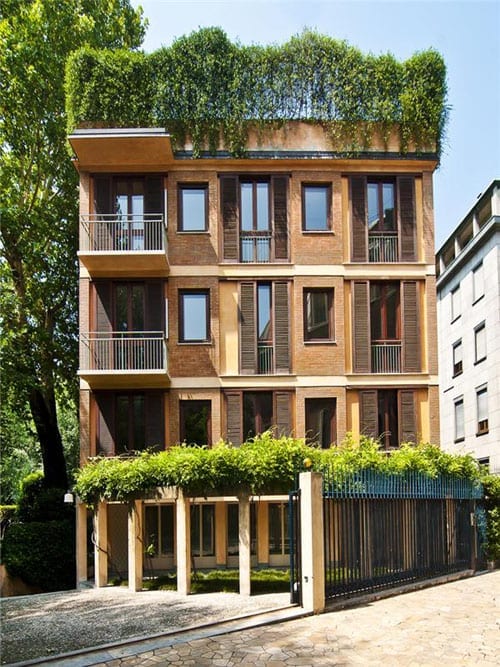
Two buildings were designed by architects Carlo di Carli and Antonio Carminati in 1953 – 1954 in Milan’s Via dei Giardini. Both are considered Modernist masterpieces and both stand proudly in this, the city’s only tree lined street.
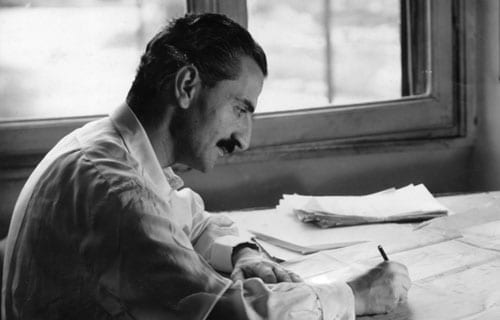
Architect and designer Carlo di Carli (1910 – 1999)Carli’s awarding winning 683 Cassina chair
Carlo di Carli (1910 – 1999) is considered to be amongst the “master[s] of Italian design” and is best known for a chair named the 683 Cassina that won him the Compasso d’Oro award in 1954. He was a leading figure at the Polytechnic of Milan and worked extensively with Longhi and Cinoca. An exhibition of his works was held at the Triennale Design Museum in 2011.
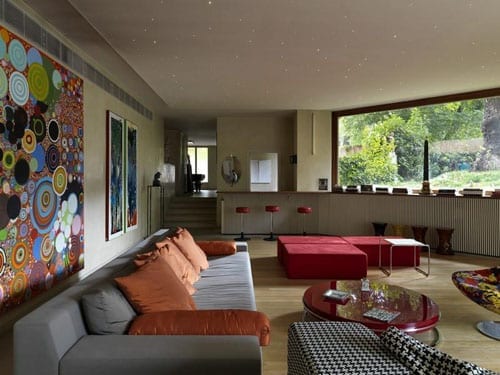
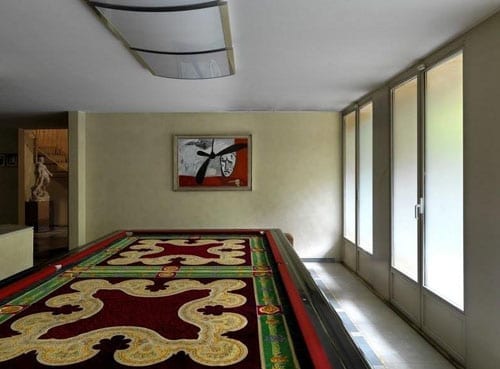
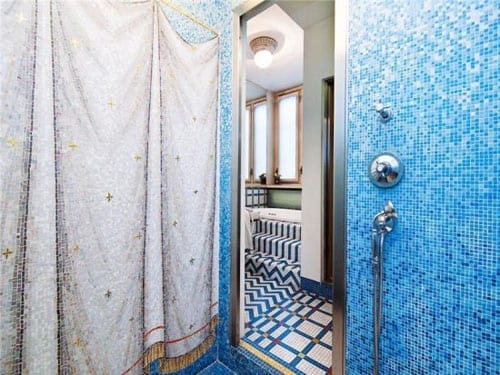
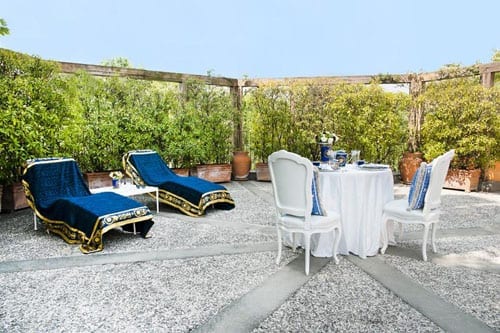
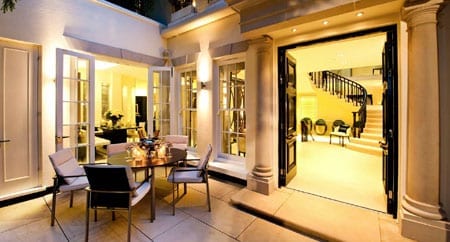
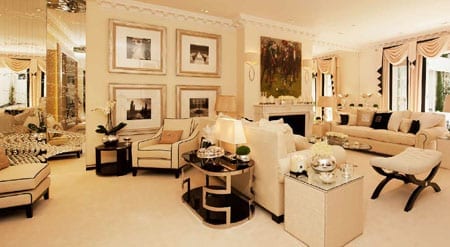
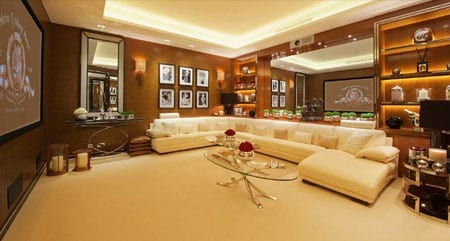
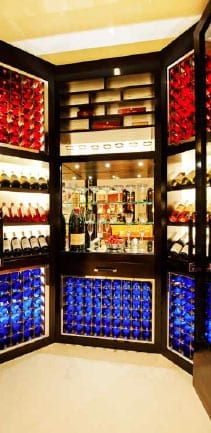
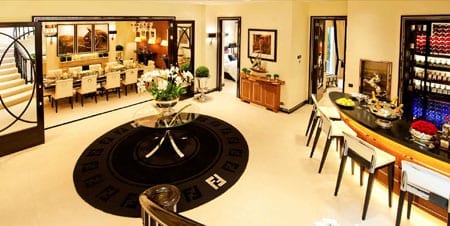
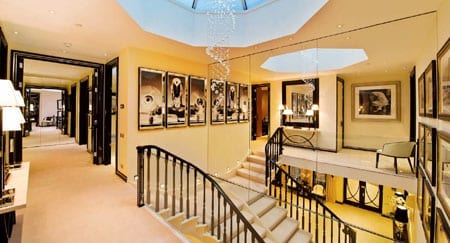
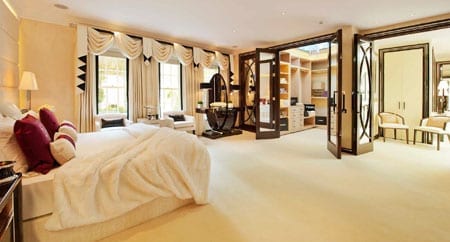
Santos Versace’s residence in the Via dei Giardini, MilanA colourful, simplistic Versace designed reception roomVersace’s design influences continue in the property’s games roomVersace’s influence is clear in a shower room in the propertyWhilst one could definitely have imagined Gianni Versace relaxing on this roof terrace
Laid out in the shape of an octagon overlapping a rectangle, one of these rationalist buildings is a five-storey 22,000 square foot single family residence. It boasts an elevator, a private garden and a roof top terrace and in last week’s Evening Standard, Lorenzo Mercolini of Sotheby’s, who is selling it for Santo Versace, president and co-CEO of Gianni Versace SpA and a Member of the Chamber of Deputies of the Italian Republic, commented: “There is simply no other property in Milan like it.”
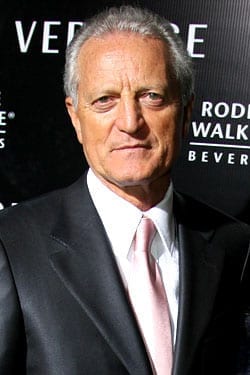
Santo Versace
Santo Versace (born 1944), like his late brother Gianni and sister Donatella, is a colourful character. A graduate of the University of Messina, he worked first as a banker and then as an accountant. He gave this up in 1976 to support his brother in his rising career as a designer and effectively was the business brains behind the house of Versace. The company now generates over $1 billion a year in retail sales.
Married with two children, Santo Versace launched his political career in 2008 with Silvio Berlusconi’s The People of Freedom party before sensationally quitting in September 2011. His parting words to the “king of bunga bunga” were:
“I like to work. And in (Mr Berlusconi’s political party), there’s no need for people who work.”
He is now a member of the Alliance for Italy party and regularly speaks out against corruption in Italian politics. Mr Versace has not given a comment as to why he is selling his base at the heart of Milan’s shopping district.
You’d have to be Gaga about Versace to purchase this Via dei Giardini mansion though. The asking price is a staggering £40,000,000.
Matthew Steeples delves into the history of Albany, Piccadilly and discovers an affordable way of living there
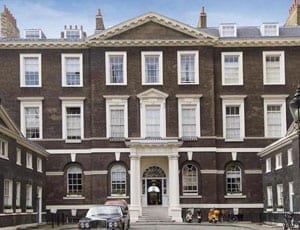
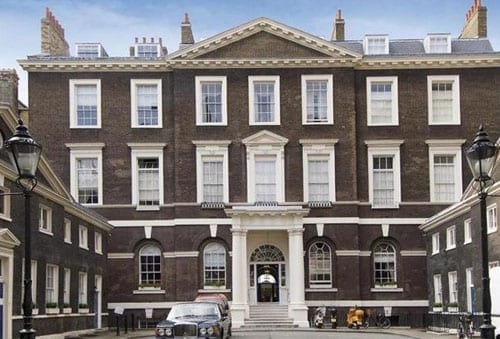
Albany, off Piccadilly in Mayfair, was most probably London’s first apartment block and it’s certainly the city’s most exclusive. It may be next to the Royal Academy and opposite Fortnum & Mason but surprisingly few have even heard of it.
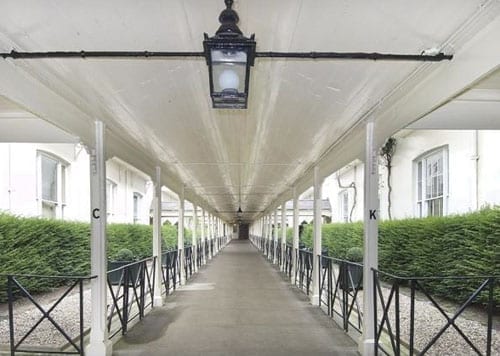
Considering its location, Albany, which some make the mistake of referring to as “The Albany,” is an amazingly quiet oasis of peace and tranquility but, equally, it is a place of intrigue and drama. Residents, or “proprietors,” as they prefer to be known, of the 69 “sets” are particular about the “the” part of the name as they’d rather their residence not be confused with a public house and they are even more protective of their privacy. A porters’ lodge guards the entrance to the building and it is staffed mostly by ex-servicemen, who, until the early 2000s, had to wear top hats and tailcoats. Those allowed to pass enter a rarefied world frequented by what the Irish novelist Marmion Savage (1803 – 1872) identified as “incurable oddities” and “superannuated fops” in The Bachelor of Albany.
The front courtyard and façade of Albany, Piccadilly, Mayfair, London, W1J 0ALThe rope-walk connecting the various sets of Albany has been traversed by some of the greatest names in history
Built by Sir William Chambers (1723 – 1796), who also designed Somerset House and the pagoda at Kew, between 1770 and 1774 for 1st Viscount Melbourne (1745 – 1828), Albany was originally known as Melbourne House and conceived as a three-storey mansion, seven bays wide with a pair of service wings flanking a front courtyard. From 1791 to 1802, the property was occupied by George III’s son, Prince Frederick, Duke of York and Albany (1763 – 1827), but after he left, the renowned architect Henry Holland (1745 – 1806) sub-divided the existing house and added two parallel sets of buildings running the length of the garden to create 69 “bachelor apartments” which he named “sets.”
The “roll call” of residents since could easily fill our very own pages thrice over. They number royalty, politicians, artists, playwrights, academics and philosophers and here is a brief selection:
– Anthony Armstong-Jones, later 1st Earl of Snowdon
– Sir Thomas Beecham
– Sir Isaiah Berlin
– Lord Byron
– George Canning
– Sir Kenneth Clark
– Baroness Pauline de Rothschild
– William Ewart Gladstone
– Sir Edward Heath
– David Hicks
– Aldous Huxley
– Sir Simon Jenkins
– Rupert Lycett Green
– Malcolm Muggeridge
– Sir Harold Nicholson
– J. B. Priestley
– Sir Terence Rattigan
– Roger Scruton
– Baroness Sharples
– W. Somerset Maugham
– Terence Stamp
– Sir Denis and Lady Thatcher
– Sir Herbert Beerbohm Tree
Each had to pass the vetting of a committee of trustees of this Grade I listed building. That committee forbids children under 14, pets, musical instruments and commercial activities and each approved resident has undoubtedly added to the history of this den dominated by a central walkway named the “rope-walk.” Incidentally, an example of a curious quirk at Albany is that no resident is allowed to speak to another on this walkway. If they do, a fine is incurred. Albany, indeed, is rather like a college in its systems of rules, regulations, order and hierarchy.
For several centuries, women were not even allowed to cross the threshold and one legendary tale tells of Lady Caroline Lamb (1785 – 1828), disguised as a page boy, stealing into Lord Byron’s (1788 – 1824) set in 1815 to leave a note: “Remember me, Byron.” He replied with a simple verse:
Remember thee, aye, doubt it not:
Thy husband too shall think of thee.
By neither shalt thou be forgot —
Thou false to him, thou fiend to me.
The strict and formal structure that controls Albany and ensured its maintenance has succeeded in the main because 34 of the 69 sets are owned by Peterhouse College, Cambridge. They and the other owners are highly particular in whom they lease to and on one occasion on hearing of an “unsuitable tenant,” the secretary of the trustees is reported to have shouted:
“He’s a foreigner. Don’t like him. Don’t trust him.”
Needless to say, that application didn’t progress and nor did one from a physiotherapist who planned to operate from the building. Bone bashing in Albany just wouldn’t do.
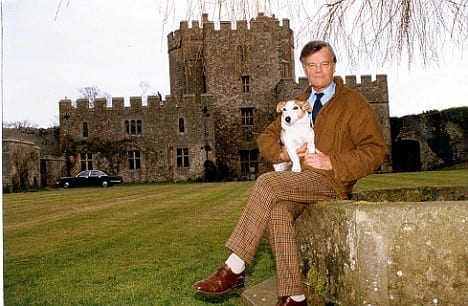
The Rt. Hon. Alan Clark MP (1928 – 1999) in the grounds of his main home, Saltwood Castle, near Hythe in Kent in 1993
A horsewhip, however, nearly crossed the threshold of set B5 in 1994, as it was here that the late Alan Clark MP (1928 – 1999) lived. The affable philanderer seduced the wife and both daughters of a certain South African named Judge Harkess and the wronged man stated he would “have horse-whipped Clark if he had known how comprehensively he had violated his honour.” B5, itself, was described as having the feel of “the straitened quarter of an Edwardian bachelor on his uppers” and the dotty, English attitude of the residents is best summed up by the reaction of Clark’s neighbour when he accidentally flooded their basement. When asked what he could do to make amends, their answer was quite simple: “Go and lie down in Piccadilly and wait for a double-decker bus.”
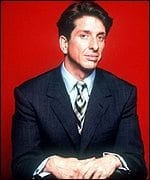
The dandy and journalist John Morgan (1959 – 2000) typified social change at Albany in the 20th century just as much as he himself redefined etiquette and manners at Debrett’s and The Times. Of “humble origins,” Morgan was brought up in a “modest” bungalow in St Madoes, Perth, Scotland but is credited with persuading William Hague to remove his baseball cap whilst Conservative leader and offering advice ranging from “how to eat a banana” to “how best to tell friends that the partner you would like to bring to their wedding will be of the same sex as you.”
Dandy and etiquette expert John Morgan (1959 – 2000)
For the bachelor and GQ style director, living in Albany was symbolic of his own personal social elevation but he did not disown his past. This modern day Beau Brummell was a man of social contradictions who cashed his cheques at Claridge’s but was a member of the National Union of Journalists. He was a Tory but still regularly attended chapel meetings as he had done in his youth. Here was a man of paradoxes who seemed unable to come to terms with the fact that he was a homosexual.
Morgan, an asthma sufferer, fell to his death from a fourth floor window on 9th July 2000. He was found in just a white shirt in a basement below a window whose sill was strangely undisturbed. The coroner left an open verdict with a suspicion of suicide and it was widely reported that police found 60 made-to-measure Savile row suits, 300 monogrammed shirts and 90 pairs of shoes in the etiquette expert’s small set. Mystery shrouds the story of his tragic demise to this day but Johnny Morgan will forever be remembered as an arbiter of both good taste and behaviour.
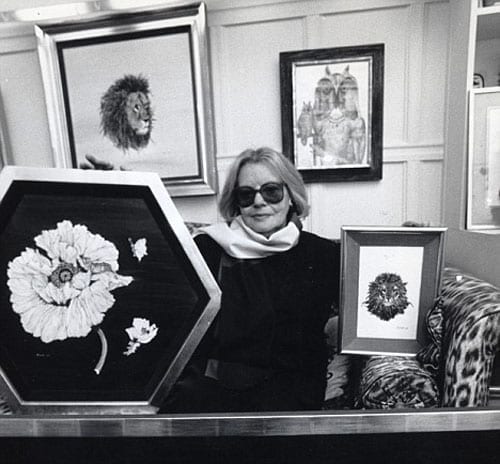
Whilst Morgan represented continuation of the trend of bachelors living in Albany, change also came in the 20th century when the building’s committee removed the restriction that allowed only bachelors to be resident. With that females were allowed in and amongst them Fleur Fenton Cowles (1908 – 2009) was one of the most fascinating.
Fleur Fenton Cowles (1908 – 2009) in her set at Albany with some of her paintings and one by Salvador Dali
This writer and artist occupied five sets knocked into one with her fourth husband, timber merchant Tom Montague Meyer, and according to the Daily Mail’s Geoffrey Levy, hosted “elite soirees of the powerful and famous.” Levy recounts them at length but here is a flavour:
“On a Wednesday evening, a typical dinner party… would include Foreign Secretary Selwyn Lloyd, Labour leader Hugh Gaitskell, entertainer Danny Kaye and film star Douglas Fairbanks Jr. The Queen Mother regularly came to tea and was once joined by Pavarotti who sang Happy Birthday for the royal guest. ‘I don’t want her to die,’ said Fleur. ‘I couldn’t bear to think she doesn’t live just down the street.’ ”
Fenton Cowles, founder of the ill-fated Flair magazine and a “woman who knew everyone,” loved Albany and an exact replica of her “windowless, milk-yellow” study there has even been recreated at the University of Texas.
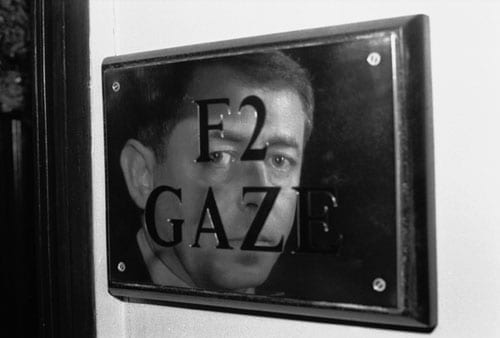
Another known for hosting extravagant bashes in Albany was my late friend, the Russian icon dealer John Gaze (1947 – 2011). Gaze had, as a boy, asked his father about the building when he passed it as a child and immediately declared he would live there one day. He took F2, the former set of Edward Heath that overlooked Savile Row to the rear, in the mid 1990s as he craved the safety that the building offered after having been kidnapped at gunpoint by an Oxford graduate conman named Sacheverell de Houghton in April 1991 from his then home in Fournier Street, E1. He made the most of his tenancy.
Russian icon dealer John Gaze (1947 – 2011) reflected in the brass plaque outside his Albany set, F2. It was formerly occupied by Sir Edward Heath.
Gaze’s parties included a fundraiser for people with AIDS hosted by a drag queen. This sparked fury with certain other residents and coverage in the Daily Telegraph and another incident there involved him encountering Alan Clark on the ropewalk carrying a portrait of Lenin. “Where the fuck are you taking that?” Clark supposedly bellowed but was “reassured” when he was told it was “destined for a less salubrious address in Whitechapel.” John Gaze remained at Albany for several years but, like a number of others I know, was forced out by ever rising rents and moved first to Chelsea and then Ennismore Gardens, Knightsbridge. He always remembered his time at Albany fondly and as a bon vivant, he truly belonged there.
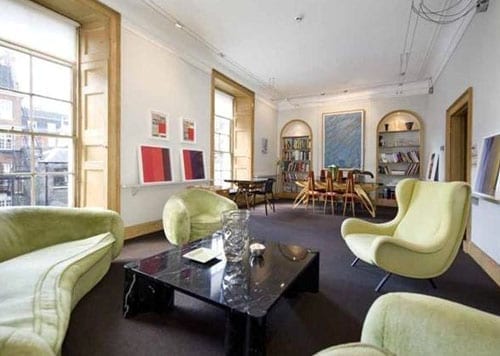
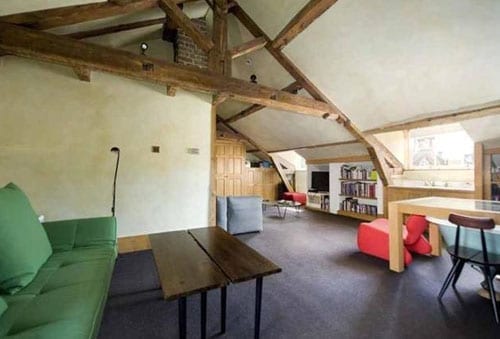
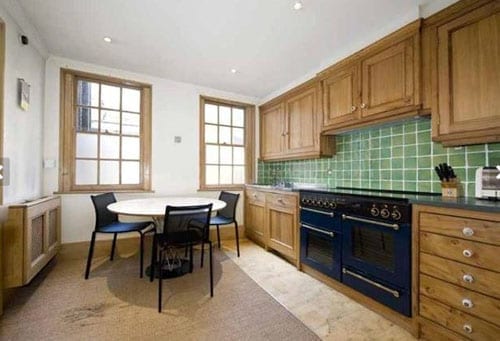
The main reception room in a £1,400 a week set currently available in AlbanyAn attic room in the set that could be used as a second reception room or second bedroomThe kitchen is lacking in character but offers ample space for informal dining
Contrary to what you’d expect, living in Albany is not quite as expensive as one might think. A 2-bedroomed 1,970 square foot set is currently available through Knight Frank for £1,400 a week: a figure that seems quite reasonable given the location, history and size of this property. Available on a minimum 8-year rental term, it includes a formal reception room, a dining kitchen, 2 bedrooms and 2 bathrooms.
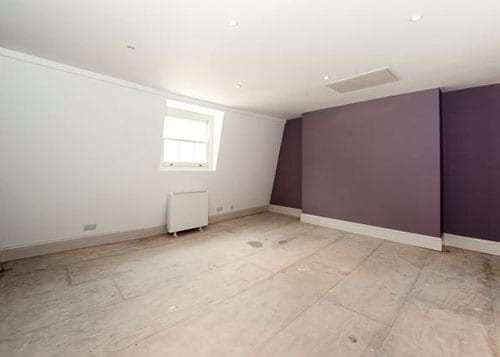
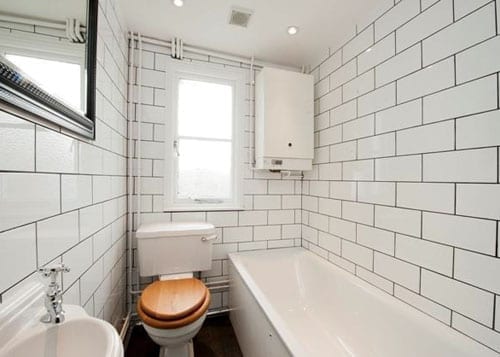
This £300 per week set, D2, consists of just one roomThe communal bathroom D2 shares with other sets is basic but clean
For those looking for something cheaper, Savills offer D2 Albany at £300 per week. This set consists of a 221 square foot third floor attic room with access to a communal bathroom and the agents suggest that it: “would make an ideal reading or writing room or an occasional bedroom for a pied-a-terre.” It’s effectively a posh form of tenement but what a way to impress your peers and subordinates.
Damon and Sandra de László in their “duplex” in Albany
Those renting either of these sets would find the likes of the industrialist Damon de László, a descendant of the Hungarian painter Philip Alexius de László (1869 – 1937), as their neighbour. The couple occupy Lord Byron’s former set, A2, and have, on occasions, opened it for a charity dinner with Matthew Parris at £1,000 a ticket as well and for members of The Portrait Institute to view their collection of de László’s works.
Professor Philip C. Bobbitt in his grand freehold set
Another present day resident is a man Henry Kissinger calls “the outstanding philosopher of our times,” Professor Philip C. Bobbitt. This Texan lawyer is a nephew of Lyndon B. Johnson and the author of Terror and Consent, which Tony Blair describes as “required reading for political leaders.” Bobbitt owns an impressive flying freehold set that is described as having a masculine style of décor and a “kitchen he has designed to look like a bar.” In an interview for TheIndependent he states that he finds Albany: “a propitious place to work.”
Though governments and bankers come and go, behind this quintessentially English façade, order and disorder have always been maintained. The wildcards of this hidden haven have a knack for living by the doctrine “to live at Albany is to live in history” and indeed they make the most of that. Those who are lucky enough to be let in, do, indeed, truly find themselves in the “Paradise of Piccadilly.”
This mouthpiece was born in Rettendon, Essex in 1958 and vents bile on all manner of subjects. Articles such as: “Why don’t more women moan like me?” and “Liz Jones’ baby craving drove her to steal husband’s sperm in ultimate deception” are frankly illustrative of why she’s so unpopular. After she got banned from the majority of fashion shows and her husband left her, she quit London for Somerset in 2007 to feed organic muesli to the rats in the barns of a 47-acre farm she purchased as her “rural idyll.” That misadventure came to a sticky end in November 2012 after she’d alienated the whole county by calling them, amongst other things, “smelly” and “faintly Amish.” Goodness knows whom she’ll choose to offend next. Phillip Schofield sums her up best: “She is inconsistent, bitter, nasty and unhinged.” Our advice: Just steer well clear of this acid tongued poison pen.
Matthew Steeples examines the truth behind Liz Jones giving up on her “rural idyll”
The Mail’s Liz Jones is a waspish woman who knows the price of everything and the value of nothing. Those who’ve paid even a moment’s attention to her bleating, will be familiar with lines such as: “Last week, my brand new £1,300 MacBook Pro broke” and “Phil Spencer wanted his £46,000 and he wanted it now!” She never stops talking about money and the size of what she both owns and owes.
Liz Jones
In today’s Femail, Jones bores on about about how she feels “like a cross-dresser” trying out the Kardashian Kollection of clothing in a pointed attack on Kim Kardashian, but it was for her diatribe yesterday that she truly got the goat of the nation in “[bidding] a ferocious farewell” to life in the country in an article entitled “Goodbye… and good riddance!” 2,151 people have commented so far and most of them have been far from sympathetic.
When Upcott Farm at Brushford, near Dulverton in Somerset came up for sale in 2007 at a price of £1.6 million, it featured in an article by The Telegraph’s Caroline McGhie. The 5-bedroomed farmhouse came with a 2-bedroom annexe, a courtyard of barns and stables and 47 acres of land. McGhie waxed lyrical about the merits of moving to this location: “People come here for the peace and quiet, the night skies, the dramatic coastline, and they work from home,” she stated before adding: “You can find everything here, including butchers, bakers, afternoon tea and cake, fish and chips, an art gallery and a shop selling fishing tackle.” Of Upcott Farm itself, she concluded:
“This would suit a member of the new wave of buyers dubbed Droppies (Disillusioned Relatively Ordinary Professionals Preferring Independent Employment Situations).”
McGhie got it half right: Upcott Farm sold to someone who considers herself far from “relatively ordinary” and someone who is far from “professional.” The purchaser, however, was certainly someone who’d become “disillusioned” with what she’d bought and someone whose desire to be “independent” and create a “situation” just alienated all she encountered. The buyer, you’ve guessed it, was none other than Elizabeth Ann Jones.
Jones was born in Brentwood, Essex in 1958 and studied journalism at the London College of Printing. She became editor of Marie Claire in 1999 but was sacked, she herself suggests, for “listing in the magazine the freebies she had been offered in the previous month.” Here, it seems, began Jones’s obsession with all things material and here she also met an Indian BBC radio journalist named Nirpal Dhaliwal in 2000.
Jones married Dhaliwal but the union was to prove an “utter disaster” as he had affairs with women she terms “younger, dimmer [and] slimmer.” “I’m no racist” Jones was divorced in 2007 and said goodbye to her “3,000 square foot of Islington real estate” and “easy, if super-busy, London life” in favour of the green, green grass of Somerset.
Whoever’s side you see it from, five years of hell followed. Jones baited the locals and they grew to loathe her. She wrote columns and a book, The Exmoor Files, where she attacked them as “faintly Amish… feral, old and smelly” and another hack and neighbour, Jane Alexander of The Telegraph, responded: “Dulverton [was] positively fizzing with fury” after each and every publication.
Of the local restaurants, Jones stated:
“I have given up trying to eat out in restaurants here on Exmoor… It is still stuck in the Seventies, with only things in baskets and rum babas on the menu… If you tell the waiter you are vegetarian, you are stared at, incredulously, as if you are black.”
She whinged about her inability to find love:
”I will never, ever meet a man here in the middle of a moor, where even to be in possession of your own teeth is a bonus.”
And whined about fieldsports:
“I didn’t increase my popularity by being unable to pass a party of men and often children with guns, shooting rabbits and deer, without getting out of my BMW and saying: ‘Do you really have nothing better to do with your Saturday morning?’ The look of shock on their faces that I had the cheek to challenge them was priceless. I would stop, too, and shout at huntsmen on horses, galloping on tarmaced roads, one hand on the reins, the other clamping a mobile phone to their heads. ‘You will ruin your horses’ tendons!’ I would wail.”
Whilst Jones found little to like in her new community, they found nothing positive in her arrival either. Her dog was blamed for worrying lambs, and Jones’s inability to control it, locals say, was an indicator of the chasm between her life and theirs. In 2009, one neighbour went as far as to tell Danny Brierley of The Independent:
“We have got nothing in common with her, really. I think she may find it difficult to make any kind of life here now. She is not a very friendly person and we are all sick to death of talking about Liz Jones. A hatred has been building up for months. She is actually having a go at people and they are not going to tolerate that. She has feelings like all people, of course she has. But everyone wants her to leave and leave now. No one can make her, but we think she will go. I don’t see how you can live in such a small community with people who think that way about you.”
Matters came to a head when Jones’s precious black BMW convertible, “bought in 2005 for £26,000,” was pelted with eggs and teenagers fired shots at her letterbox with an air rifle. A local councilor even dressed up as her in the local carnival and yesterday Jones took revenge on those she blames for her “five-year prison sentence” and deprivation from Space NK, Cath Kidston and Illy coffee.
Instead, the article just shows the true reality of this bombastic harpy. The lines Jones penned speak for themselves. Country people don’t welcome someone who planned to “hack for miles across the open moorland in my Prada jodhpurs” anymore than the folk of Knightsbridge welcome Arabs treating their roads like racetracks. The gardener who had to endure Jones yelling “walk faster!” at him didn’t deserve such anymore than a bus driver in SW11 deserves abuse from his passengers. Jones concludes:
“I’m now a different person. I became so lonely. I would often get in my car, not just for the warmth, but for the kind voice of the satnav lady. I’ve learned that an amazing view and a pair of nesting grey herons are not enough to make me happy.”
27 acres of land including paddocks and a fishing lake remain on the market through Savills and Strutt & Parker at a price of £200,000 at Upcott Farm
Miss Jones bleats that she’s taken a £500,000 loss on Upcott Farm, which languished on the market at first at £1,900,000 and then £1,750,000 for three years. The “unexpected” sale of the property has given her the ability to “flee back to the city” but the locals and even the “Droopies” should be warned: there’s still 27 acres of the farm unsold and on the market at a price of £200,000. Halloween may have passed but the battleaxe in the Beemer could still call again.
Philip Schofield and the protection of powerful paedophiles
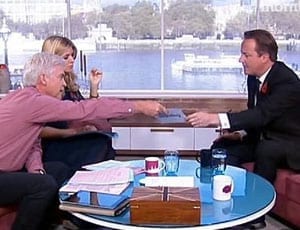
Yesterday, when Phillip Schofield showed the Prime Minister a note containing the names of alleged politician paeodophiles who have been named on Twitter, little did he realise what he’d set in motion.
Phillip Schofield handing David Cameron a list of names of alleged politician paedophiles on ITV1’s “This Morning”
Amongst the names was that of Lord McAlpine who also appears on the website of the former BBC sports presenter David Icke along with a former MP who is now a television presenter and a number of others. The same site contains references to an MP who died in a house fire in Hampshire in 2000 and all manner of other suggestions.
Steve Messham, the victim who appeared on Newsnight to state that he’d been sexually abused in a Welsh children’s home by a “prominent Conservative” last week, has now come forward to state that McAlpine was not his attacker. Separately, the peer has given a detailed rebuttal and threatened to sue those who have accused him.
We all know that David Icke is a bit of a wildcard and that his views about aliens are just ludicrous but one has to think of smoke and fire. If even one of those Icke accuses is guilty, any investigation would be worthwhile. Whoever they may be, powerful paedophiles should not be protected and equally, however wild their views, those with relevant information should not be censored.
Whenever the name Rachman is mentioned, the first things that come to mind are greed, extortion and intimidation. The word is so engrained in such that “Rachmanism” now features in the dictionary, defined as:
“The exploitation of tenants of slum properties by unscrupulous landlords.”
“Notorious slum landlord” Peter Rachman (1920 – 1962)
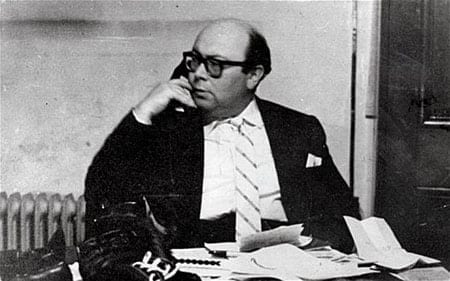
Perec “Peter” Rachman (1920 – 1962) was born in Poland and the son of a Jewish dentist. He is best known for having built up a property empire of over 100 mansion blocks in London’s Westbourne Grove and Notting Hill areas in the 1950s where he evicted longstanding sitting tenants and replaced them with prostitutes and immigrants from the West Indies. Due to the relaxation of rent controls by the Conservative government in 1957 and as no other landlord was prepared to take them, he was able to charge these unfortunates whatever he wished.
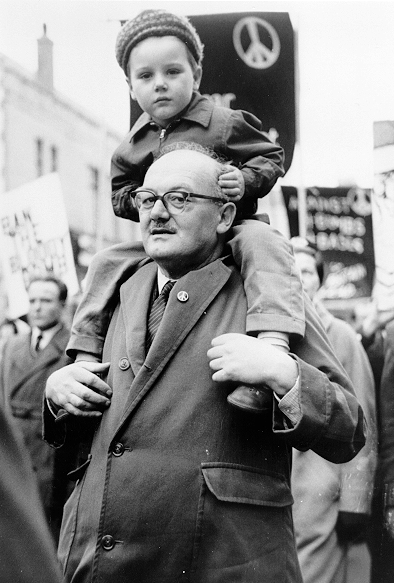
Rachman came to public attention after the Labour MP for Paddington North, Ben Parkin (1906 – 1969), became vocal about the poor housing conditions of his tenants. Parkin coined the phrase “Rachnamism” in his quest to put a stop to the activities of “rent racketeers” and highlighted him as someone who used violence to maintain control of “his manor.” The MP even went as far as to suggest that Peter Rachman’s death was merely a ploy to distract from his activities and the result was to leave the public engrained with a belief that this landlord was a “manipulative, grasping Jew” who symbolised the moral decay of Great Britain.
Ben Parkin MP (1906 – 1969) on a CND march
A Radio 4 programme this week, however, highlighted an entirely different side to Rachman. In The Real Rachman – Lord of the Slums, a “barrister turned investigative reporter” named Joshua Levine suggested that those who believe Peter Rachman just to be a sordid intimidator fail to see the true persona of the man.
Levine’s witnesses, who number former tenants and Rachman’s biographer Shirley Green, do describe him as a “chancer” who was prepared to use the system to make money, but they also portray another side of this supposed “figure of evil’s” character.
Nicholas van Hoogstraten (born 1945)
One immigrant tenant stated: “He was the only one who ever did anything for us” whilst others added that Rachman was “well-liked” and “too soft to be a landlord.” He was a “benefactor” and “jolly” commented others who’d rented from him and a truly notorious modern-day landlord, Nicholas van Hoogstraten, failed to see the opportunist in Rachman at all: “It’s laughable. He had no wealth. It’s an invented moral [mission].” Rachman, equally, was defined as a man “affected” by his imprisonment in a Soviet labour camp in the Second World War by his former lover Mandy Rice-Davis and as someone who suffered true sorrow over the deaths of his family there.
Levine’s examination recounts how Rachman, who drove a navy blue Rolls-Royce with a white interior, was built into a symbol of corruption and moral decay. Rachman, like so many other mythical scapegoats, it turns out only died with only one conviction: parking without lights. The truth, indeed, is often stranger than fiction.
Matthew Steeples discovers a map of London with a difference
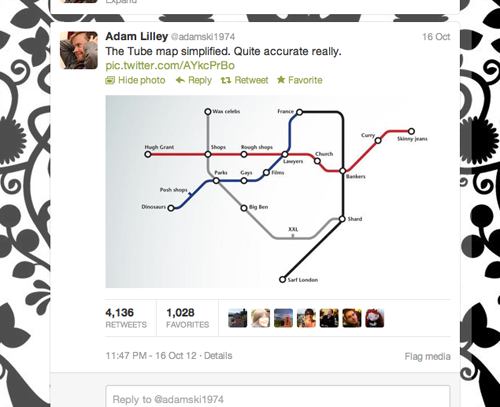
On the 16th October, an actor named Adam Lilley Tweeted an image based on a simplified version of a map of the London Underground. The creator had adapted it so that the names of the stations supposedly are indicative of what they believe the area around each station is best summed up by. Plainly it amused as over 4,000 Retweeted it.
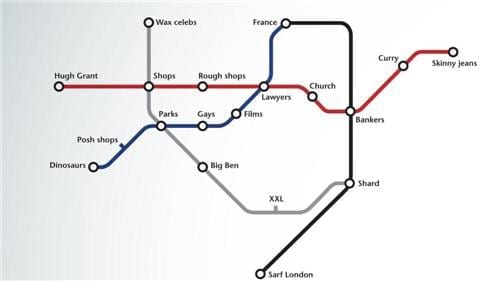
A revised version of the London Underground mapAdam Lilley’s revised London Underground Map has been Retweeted 4,136 times
Knightsbridge is replaced by “posh shops” and South Kensington is all about “dinosaurs.” Westminster becomes “Big Ben” and Notting Hill Gate is simply “Hugh Grant.” Bethnal Green is replaced with “curry” and Leicester Square, “films.” Somewhere south of the river is simply “XXL” and out in Essex, another station is renamed “skinny jeans.” Irony is the order of the day.
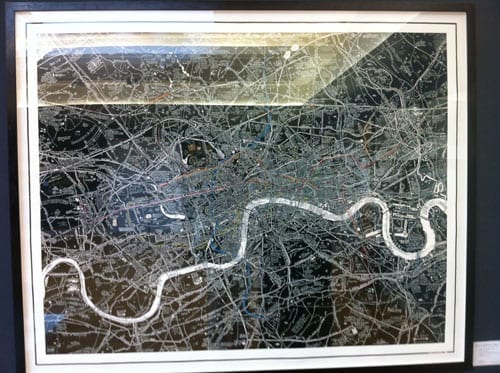
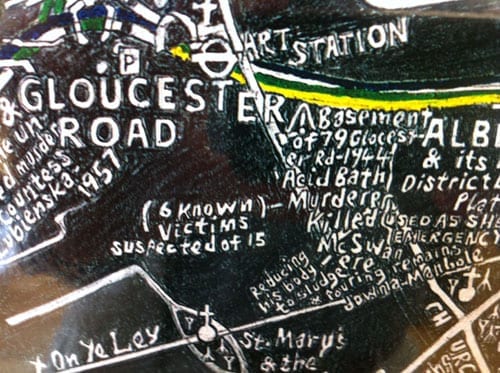
Stephen Walter’s “London Subterranea”The section of the map detailing the exploits of “the acid bath murderer”And the section all Sloane Rangers should examine more closely
Altering maps in this manner is nothing new and an especially brilliant one I saw at Christie’s in Old Brompton Road in their 3rd September sale depicted the location of events and discoveries I’d never heard of. In Stephen Walter’s London Subterranea, for example:
– The basement of 79 Gloucester Road was the location of the discovery of an “acid bath murderer” who killed at least 6 and is suspected of 15 murders. According to the depiction, he killed someone named “McSwan ‘ere and poured the remains down a manhole, reducing his body to sludge.”
– Harvey Nichols is shown as a plague pit.
– Brompton Oratory is described as aa “MI6 agent meeting place and dead letter office.”
Such maps provide a little light relief and for that reason we make Lilley’s image The Steeple Times picture of the week. We invite readers to submit their very own versions. We shall publish the best.
I first visited 32a Ovington Square in September 2009. At the time, this “hidden house” was the home of Lord Carrington and it had just come on the market at a price, if I recall correctly, of circa £3,000,000.
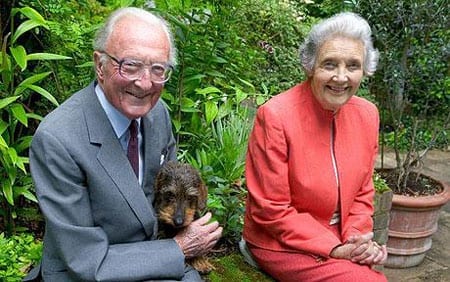
The newly redeveloped Carrington House, 32a Ovington Square, London, SW3 1LRThe Rt. Hon. The Lord Carrington KG, GCMG, CH, MC, PC, DL (born 6th June 1919) with his wife Lady Carrington (1920 – 2009) and their dog Edward
A friend was looking for somewhere to buy in London and I’d somehow come across the aforementioned property in a magazine. A detached house in Knightsbridge at this price seemed like a bargain and as he was keen to take a look and I lived round the corner, we arranged to see it together.
During this period, I had unfortunately made the mistake of making the acquaintance of a former ambassador’s wife who thought herself rather grand. Said woman somehow found out about my friend going to what Americans might term an “open house” at 32a Ovington Square and somehow muscled in. This individual happened to be selling her own home nearby and I reckon she, like my friend, thought she’d be onto a bargain. She’d previously unsuccessfully tried to persuade my friend to buy her individually styled, Ralph Lauren wallpapered home but as it actually rattled every time an underground train went underneath and as it was far from a bargain, he’d sensibly declined.
We arrived at the 2,240 square foot 32a Ovington Square to be told by a rather unhelpful estate agent that we’d have to just wander round by ourselves and that there was no brochure or floor plan. As a merry throng trailed through the house, Lord Carrington stood in the garden looking bemused and his secretary fussed around him. The pair plainly weren’t comfortable with all the interlopers and all in all, who could blame them.
The ex-ambassador’s wife, whose carelessness Rupert Everett most amusingly made reference to in his recent memoirs, spent the entire visit whingeing about the house being dark and stinking of damp. I had to agree with her as the neighbouring buildings towered over it and there was mould on the walls. My friend simply said: “It needs a fortune spending on it.” We left and later I heard that it sold for well above the asking price. The wife of the ex-ambassador thankfully departed from our lives soon after.
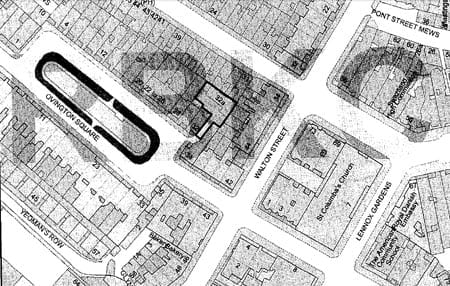
A site plan shows how hidden away 32a Ovington Square truly is – ideal for a government minister or indeed a wayward celebrity
About a year and a half later, I saw 32a Ovington Square for sale with planning permission to construct a far larger residence with a basement and sub-basement pool complex. The price was in the order of £14,000,000. I thought that somewhat ludicrous but now that the very same property is on the market at a price of £23,00,000, it seems that the world has just gone mad.
The brochure for the new residence, which has been renamed, Carrington House, reveals a three-storey low-built freehold building with 5,300 square foot of accommodation. Though 32a Ovington Square has been more than doubled in size by a developer named London City Developments, the sub-basement leisure complex has not been constructed. Could this have been because of planning problems or simply because such construction wasn’t deemed to add value?
In August 2002, Lord Carrington, whom The Mirror described as being “doddery” in a Scurra diary piece, was said to have objected to a bar named Townhouse behind his former home being given a 1am licence. That bar has since closed but as seven of the residents of Ovington Square and Beauchamp Place also took a dislike to the prospect of subterranean developments at his former home, only proposals for a single basement level were included in the January 2010 plans submitted by a Mr & Mrs R. Garner.
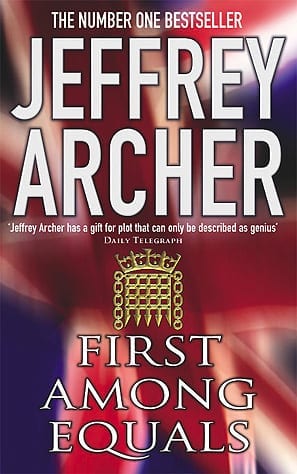
Jeffrey Archer’s 1984 novel “First Among Equals” (published in the UK by Hodder & Stoughton, ISBN: 0-340-35266-3)
Aside from controversy with residents and planning officials, this “heavily overlooked,” “dark” house gets a brief credit in Jeffrey Archer’s 1984 novel, First Among Equals:
“Charles would not have normally accepted the invitation. Lately he found cocktail parties to consist of nothing but silly little bits of food, never being able to get the right drink and rarely enjoying the trivial conversation. But when he glanced on his mantelpiece and saw an ‘At Home’ from Lady Carrington he felt it might be an amusing break from the routine he had fallen into since Fiona left. He was keen to discover more about the rumoured squabbles in Cabinet over expenditure cuts. He checked his tie in the mirror, removed an umbrella from the hat stand and left Eaton Square for Ovington Square… He arrived at Lord Carrington’s front door a little after six forty-five. A maid answered his knock, and he walked straight through to a drawing room that could have held fifty guests and very nearly did. He even managed to be served with the right blend of whiskey before joining his colleagues from both the Upper and Lower Houses.”
Turning to the real Lord Carrington, here is a man who has led a remarkable life. He served as Foreign Secretary in Margaret Thatcher’s cabinet between 1979 and 1982 and as Secretary General of NATO from 1984 to 1988. The last surviving member of the Cabinets of both Harold Macmillan and Sir Alec Douglas-Home was British High Commissioner in Australia between 1956 and 1959 and also chaired the 1979 Lancaster House conference that brought Zimbabwe’s revolutionary war to an end. In 1991, Carrington presided over diplomatic talks in the former Yugoslavia and commented:
“When I first talked to Presidents Milošević and Tudjman, it was quite clear that both of them had a solution which was mutually satisfactory – which was that they were going to carve up Bosnia between them.”
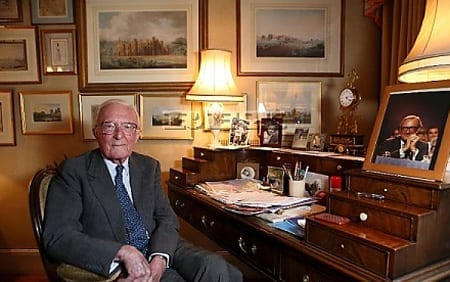
Lord Carrington at his desk in 32a Ovington Square, KnightsbridgeThe Manor House, Bledlow, Buckinghamshire, HP27 9PB is the country home of Lord Carrington
Milošević was found dead in his cell in 2006 but it is quite possible that Lord Carrington’s name will be mentioned in the trial of Goran Hadzic at the International Criminal Tribunal for the Former Yugoslavia that has just commenced at The Hague. It is amazing to think that matters involving this 93-year old politician are still current but Carrington’s stamina is shown in his roles as the longest serving member of the House of Lords and the second longest serving member of the Privy Council after HRH The Duke of Edinburgh.
Aside from politics, there is much on the internet, a considerable amount of it written by wildcards and fantasists whose number includes David Icke, about Carrington’s involvement with Henry Kissinger, the Illuminati, the Bilderberg Group and the Committee of 300. The consensus of these conspiracy theorists generally borders on the ludicrous, but it is without doubt that Lord Carrington had and continues to have influence in many high places. He was chairman of Christie’s International PLC from 1988 to 1993 and has held directorships on the boards of companies that have included Barclays Banks PLC, Hambros PLC, Cadbury Schweppes PLC, Amalgamated Metal Corporation PLC, British Metal Corpoation PLC, Rio Tinto PLC, Kissinger Associates Inc. and Hollinger Inc.
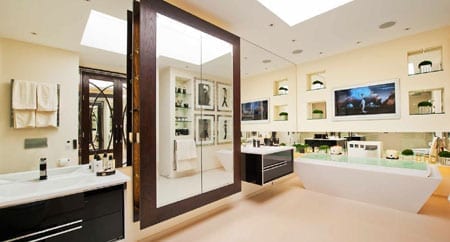
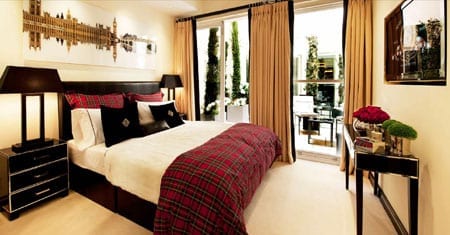
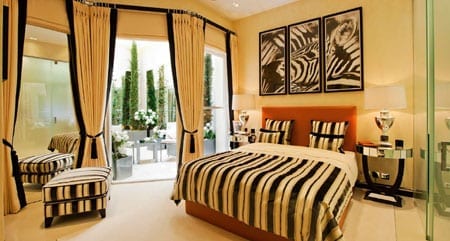
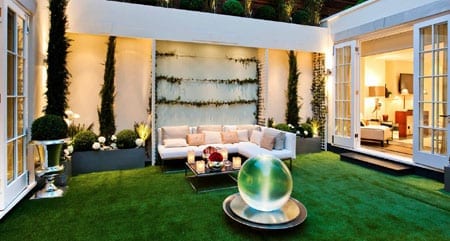
The main entrance to Carrington HouseThe main reception room of the house is decorated in a contemporary style and a far cry from the traditional decoration favoured by Lord and Lady CarringtonAn essential feature in any house priced over £10 million is a media roomCarrington House now boasts a bar that any dignitary would envyThe newly added basement level features an entertaining hall, dining room, bar, gym, media room and two bedroom suitesThe staircase is now lit by a glazed cupolaThe master bedroomThe master bathroomAnother bedroom, located at basement level, is decorated with a Scottish theme and has access to a shared courtyardThe other suite that shares the courtyard is decorated with an “Out of Africa” theme complete with an image of a zebra and matching linen and upholsteryWould the purchaser of a £23,000,000 home truly want an AstroTurf lawn?
Following on from this rather over the top redevelopment, a new chapter has certainly begun at 32a Ovington Square. Whether it is bought by a popstar or a Russian oligarch, they’ll definitely not be anywhere nearly as equal to Lord Carrington in terms of their league of influence.
Carrington House, 32a Ovington Square, London, SW3 1LR is for sale through Knight Frank. For further information contact Nick Vestey on +44 (0) 20 7591 8600. Full details of the house can be viewed at:http://search.knightfrank.com/sla100211
The bonfire sale of a monster of a mansion that has had a $15 million price reduction
A property was first built at 10425 West Sunset Boulevard in Lower Bel Air, Los Angeles in 1936. Here, in this most exclusive of districts, the homes of the prosperous residents are hidden from view and this address, this day, is no exception.
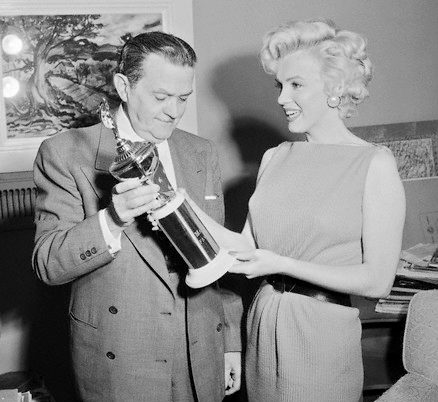
One of the original owners of a house on this site, which has a main access from the cul-de-sac Revuelta Way, was William R. Wilkerson (1890 – 1962), a nightclub owner and founder of The Hollywood Reporter. A compulsive gambler, he is also credited with contributing to Hollywood’s “Golden Era” through the venues he opened. These included Vendome, Café Tocadero, Sunset House, Ciro’s, LaRue, L’Aiglon and most famously The Flamingo Hotel. An involvement here with the ruthless gangster Ben “Bugsy” Siegel (1906 – 1947) turned sour in 1946 and resulted in him having to flee to Paris in fear of his life. Siegel’s death allowed him to return to Los Angeles in 1947 and having “quit gambling cold turkey” following the birth of a son in 1951, he led a much quieter life. He is remembered as being a man who preferred his “beloved French poodles to any wife or friend.”
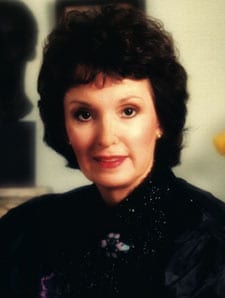
Media mogul William R. Wilkerson (1890 – 1962) pictured with Marilyn Monroe (1926 – 1962)American film personality and the publisher of “The Hollywood Reporter” Beatrice “Tichi” Wilkerson Kassel (1926 – 2004)
Wilkerson is first recorded as living at 10425 West Sunset Boulevard in the 1940 California Census with his fourth wife, Estelle Jackson Brown. He subsequently remained there with his fifth wife, Vivian DuBois, and sixth wife Beatrice “Tichi” Noble. After his death, Tichi Wilkerson (1926 – 2004) sold first 10425 West Sunset Boulevard and then, in 1988, The Hollywood Reporter for $26,700,000.
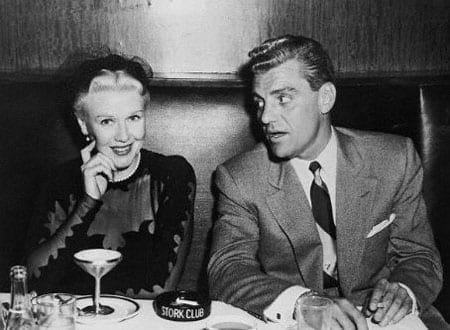
Another famous owner of 10425 West Sunset Boulevard was a “celebrity attorney” named Greg Bautzer (1911 – 1987). Bautzer is best known for having represented not only William R. Wilkerson but also Ginger Rogers, Ingrid Bergman, Joan Crawford, Kirk Kerkorian and Howard Hughes. He is described as having been “as dashing and popular as any successful Hollywood movie star” and was engaged to but did not marry the actresses Barbara Payton, Lana Turner and Dorothy Lamour. He did, however, make the actress Dana Wynter his second wife in 1956, then Buffy Cobb Chapman and finally Nicola Dantine. This “man-about-Beverly Hills,” it seems, was indeed plainly a magnet for anything dramatic.
Philanthropist and Bernini owner Yousuf Tar
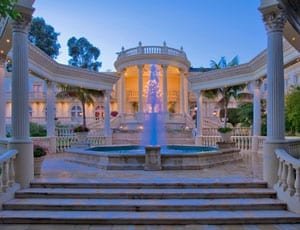
The current owner of the house, which is now somewhat ludicrously named Chateau d’Or or The House of Gold, is a man named Yousuf Tar. The president of the “faux-Italian mall fixture Bernini men’s clothing [company],” bought 10425 West Sunset Boulevard in 1992 for $6,000,000 and set about creating what his realtor, Sally Forster Jones, calls a “cross between The White House and Versailles.” The resulting remodeled residence isn’t quite either but frankly combines a mixture of one of the palaces of the deceased tyrant Colonel Gadaffi and the set of Dynasty.
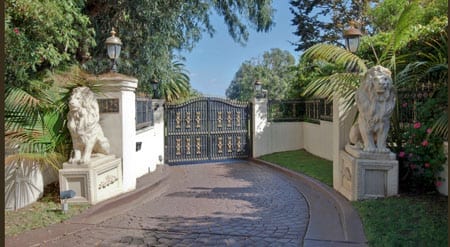
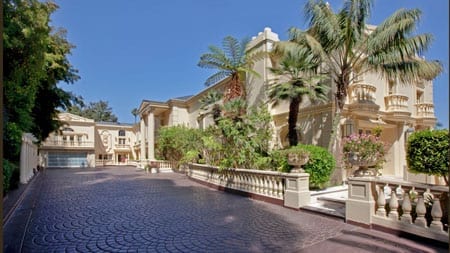
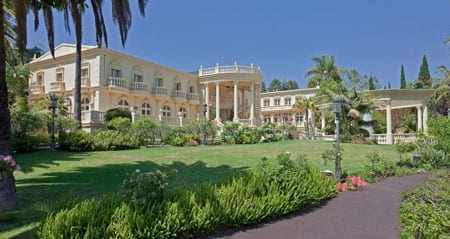
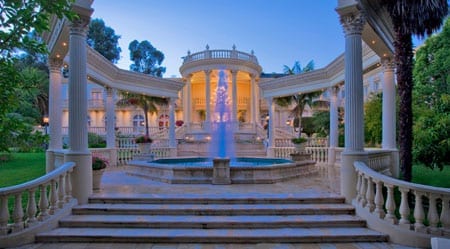
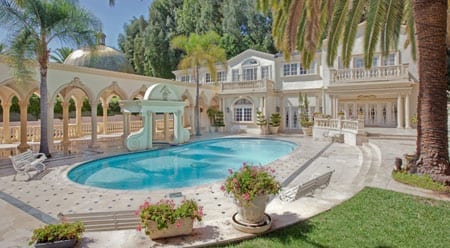
The gaudy gates to Chateau d’Or, 10425 West Sunset Boulevard, Bel Air, Los Angeles, California, CA 90077, USA are an indication of the “tackiness” that lies behindA 600ft main driveway leads to the front of the house from Revuelta Way. Secondary access comes from West Sunset Boulevard.The garden elevation of the Chateau d’OrThe exterior of Chateau d’Or is anything but understated
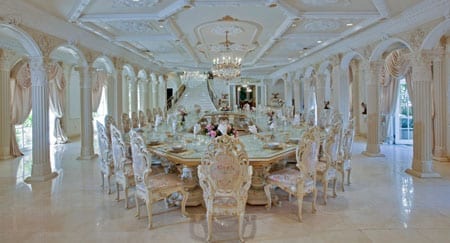
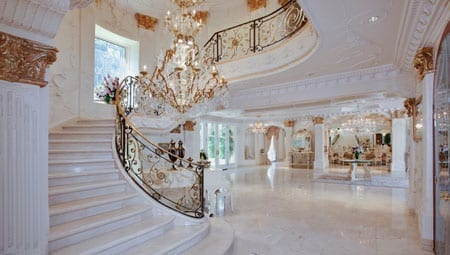
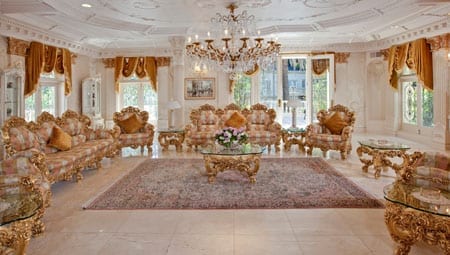
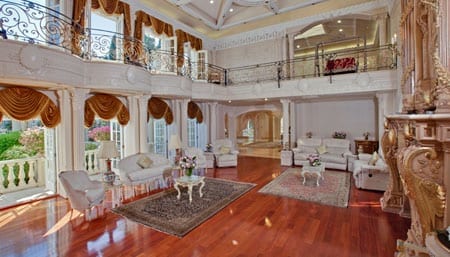
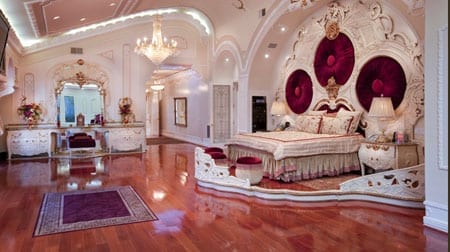
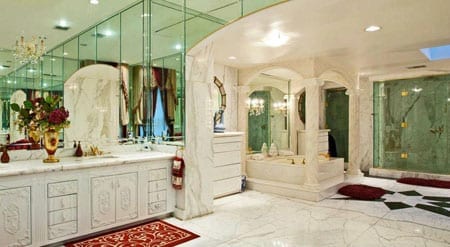
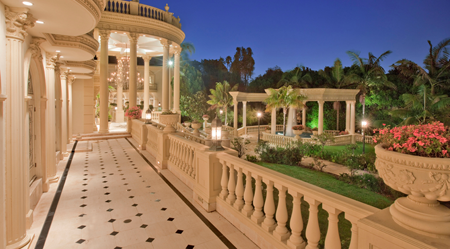
Decorated throughout in a white and gold, the aim of the redesign was to create the look of an 18th century palace complete with acres of marble, columns, cupolas, gold leaft and mouldings. Instead, the interpretation looks more Chigwell-esque than Parisian and has simply attracted criticism and mockery. An example, such as this from Curbed.com, gives a guide to the opinion of the majority about this ugly monstrosity:
“[The mansion] houses some of the cheapest-looking French-inspired interiors ever made, highlighted (or, rather, lowlighted) by a towering, clunky fireplace and a cartoon-worthy master suite, with gilded everything. Even San Simeon’s William Randolph Hearst would object to this level of pointless expenditure.”
The dining hall is currently furnished with a $300,000 table capable of seating upto eighty for a formal dinner. With an entirely gold dinner service, realtor Sally Forster Jones comments: “Food tastes so much better off gold.”The opulent meets gaudy theme continues with a marble hallway and staircaseA sitting room fit for Saddam HusseinChateau d’Or’s double height media room is supposedly “styled like an opera house”The master bedroom suite is as nearly as large as most homes and is some 5,000 square foot in sizeNo restraint is shown in the choice of bathroom fittings either
Chateau d’Or, according to the listing on Forster Jones’s website, features 25,953 square foot of living space with 15 bedrooms and 16.5 bathrooms. There is a vast dining hall capable of seating upto 80 for a formal dinner which currently features a $300,000 dining table and a 1,600 square foot “oversized gourmet kitchen” complete with 800 square foot of cupboards, an “indoor sunlit gazebo” and a double Viking oven. A double height media room styled as an opera house has also been created and there’s also a cigar and wine tasting room. The Chateau d’Or is nothing other than a “home” on a lavish and ludicrous scale.
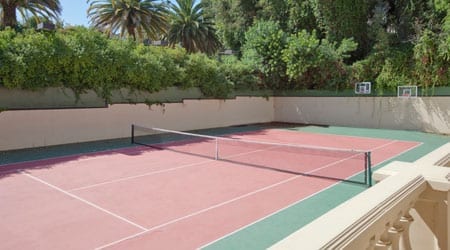
The pool sits alongside a 6-bedroomed guest houseChateau d’Or also has it’s own championship tennis courtOne of numerous terraces
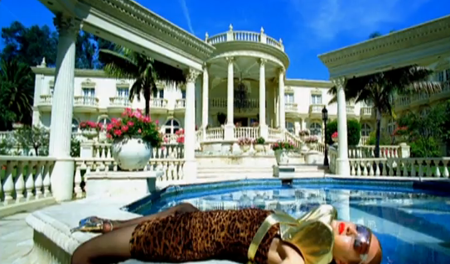
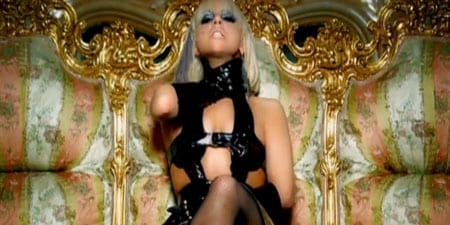
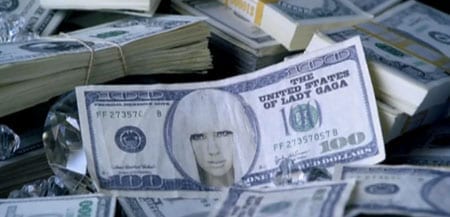
In addition to a swimming pool, spa and gym, Chateau d’Or also has a championship tennis court, guest accommodation and 1.7 acres of grounds. Accessed by a 600ft driveway and surrounded by privacy walls plainly designed to keep prying eyes out, the house featured in Lady Gaga’s 2009 video for her song Paparazzi. Mr Tar plainly isn’t that private at all.
Lady Gaga filmed the video for her 2009 song “Paparazzi” at Chateau d’OrStefani Joanne Angelina Germanotta (AKA Lady Gaga) in one of the “cheap looking” chairs at Chateau d’Or
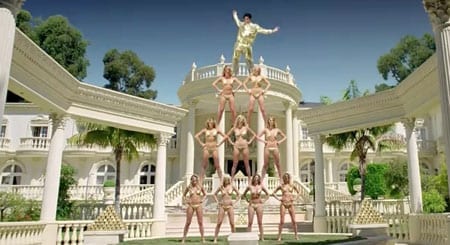
Not shy of renting the house out for other purposes, it has also been used for a photoshoot for Versace, a television advert for Foot Locker and Addidas starring Ken Jeong and as a venue for a Dubai themed party for Donald Trump where Christina Aguilera performed.
Ken Jeong in a 2010 advert for Foot Locker and Addidas at Chateau d’OrDonald Trump, Sr. with his daughter Ivanka Trump and son Donald Trump, Jr. at a party at Chateau d’Or
Yousuf Tar put Chateau d’Or on the market in 2009 for just shy of $40,000,000 and though Michael Jackson supposedly wanted to buy it to create a “new Neverland,” his sad demise meant that this fell through. Relisted repeatedly since and despite the best efforts of Sally Forster Jones, Chateau d’Or’s gaudiness plainly hasn’t appealed to the market.
You’d had to have been gaga to have paid $40,000,000 for Chateau d’Or
Reduced by nearly $15,000,000 to $25,000,000 this month, Chateau d’Or still doesn’t look like much of a bargain. Somehow, we suspect, it’ll have to be marked down a fair bit more before anyone’s even vaguely tempted.
For more information Chateau d’Or, 10425 West Sunset Boulevard, Bel Air, Los Angeles, California, CA 90077, USA contact Sally Forster Jones of the SFJ Group at +1 (310) 281 3999 or email her at:[email protected]
Matthew Steeples updates readers on John Goodman’s return to jail
The conviction of John Goodman in West Palm Beach earlier this year was a tragedy for all concerned but the twists and turns that have followed have been quite something else.
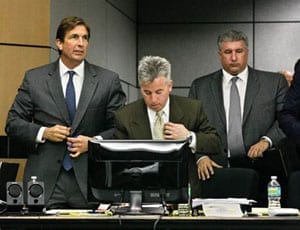
John Goodman in court prior to returning to jail on Friday 12th October 2012
Goodman, who sold his family business, Goodman Manufacturing, for $1.43 billion in 2004 and who also founded the International Polo Club Palm Beach, was found guilty of the offences of DUI Manslaughter and vehicular homicide on 23rd March.
In February 2010, Goodman had crashed his Bentley Continental GTC at speed into a Hyundai Sonata and in the process catapulted it into a canal. Whilst the driver, Scott Wilson, was left to drown, Goodman fled the scene of the accident and later claimed he did not know he’d hit another driver. On the night in question, Goodman had settled a $272 bar bill for himself and friends at The Players Club in Wellington, Florida at 12:52am and had later drunk more alcohol after the accident in a “man cave” to “alleviate [his] pain.”
Scott Wilson’s Hyundai after it was retrieved from the canal into which John Goodman’s Bentley catapulted it
In May 2012, Goodman was sentenced to 16 years in jail but shortly afterwards was released on a $7 million bond pending appeal. At exactly the same time, a juror in the case, Dennis DeMartin, self-published a “tell-all” book, Believing in the Truth, in which he revealed that he conducted drinking experiments to see if he could get drunk after three vodka and tonics. After DeMartin was called in for questioning by Palm Beach County Circuit Judge Jeffrey Colbath, he stated:
“I’m only human. I made a mistake, just like John Goodman made a mistake… What can I say? I’m getting senile.”
John Goodman has spent most of the year under house arrest at his hacienda at 3665 120th Avenue, Wellington with his girlfriend, whom he also adopted as his daughter to protect his wealth, Heather Laurso Hutchins (also known as Heather Colby). In a further twist, Goodman was caught at the property by two of the $2,000 a day off-duty deputies employed to monitor him at 11pm on Wednesday in an upstairs bathroom with a small mirror. He was allegedly using it to pry open his ankle monitor and disable it with water.
Though Goodman claimed he had hit the monitor on a shower door accidentally, Sheriff Ric Bradshaw of West Palm Beach County commented:
“I think he thought, you know, in my estimation he thought that was going to disable it. [It] doesn’t work like that… He paid the price for it because he’s back in the ‘Gun Club Hotel’ [Palm Beach County Jail]. That’s where he’s going to stay.”
“Think about what’s going on in America right now. You know you’ve got celebrities and people with a lot of money, they get arrested, they break the law. And, after a while they just think the rules don’t apply to them.”
“Well, guess what? That don’t happen here. He gets treated just like every other person that’s in my custody. He violates the rules, he’s back in jail.”
As a result, John Goodman will now temporarily remain in jail until the 26th November.
We await the next twist in this case with anticipation.