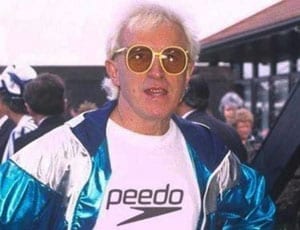
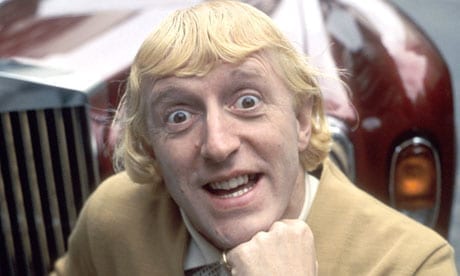
The Metropolitan Police report into the Jimmy Savile scandal is published
We’ve written much about the Jimmy Savile scandal and received countless information about it and Operation Yewtree in general from our readers.
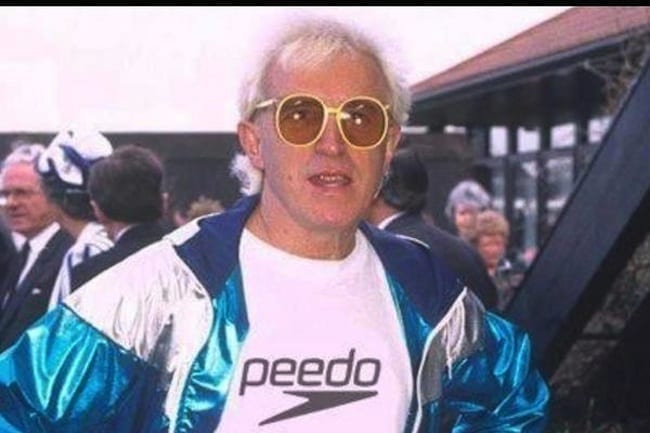
The late Jimmy Savile
The majority, we’re glad to report, were shocked and appalled by this monster’s conduct. Though several of Savile’s friends bizarrely wrote protesting his innocence, today’s publication of a report into the matter confirms just what we all sadly thought.
The Metropolitan Police report reveals that Savile abused 214 people, many of them under 10 years old. It is shocking that the BBC and others allowed him to get away with this for so long and we would argue that a few more heads ought to roll.
Matthew Steeples responds to the recommendations of Leveson
“All that is necessary for the triumph of evil is that good men do nothing” was one of Edmund Burke’s most famous observations.
Today, David Cameron’s former spin doctor Andy Coulson and ex-News International chief executive Rebekah Brooks were in court to face charges of having conspired to pay Ministry of Defence employee Bettina Jordan-Barber around £100,000 for information. How terribly convenient for our Prime Minister that this court appearance coincided with Lord Justice Leveson issuing his report into press standards.
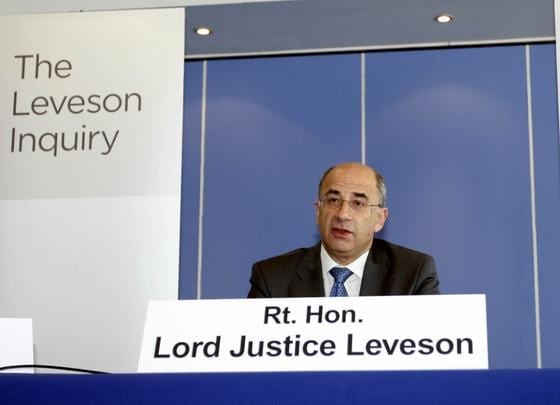
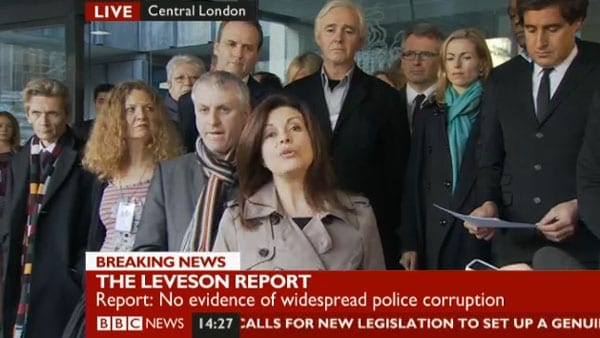
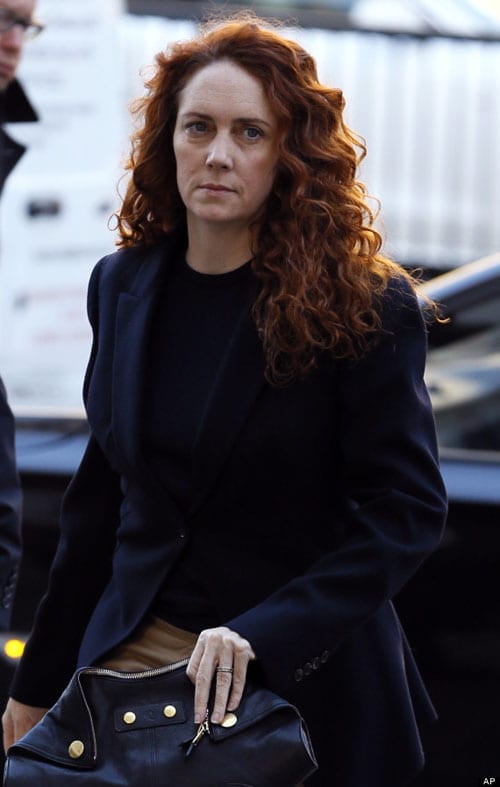
Rt. Hon. Lord Justice Leveson issues his report todayA spokeswoman for Hacked Off (http://hackinginquiry.org) responds to Leveson’s report. Kate McCann stands to her rear.Rebekah Brooks arrives at Westminster Magistrates Court this morning
In the inevitable media firestorm in the run up to today’s report being issued, one question has been missed and that question is: “Did we really need a £4 million inquiry to tell us that there are elements of the press that have done wrong and did we really need a 9-month inquiry to tell us that the Press Complaints Commission was a “toothless poodle”?
Inevitably, the media and politicians have reacted against many of Leveson’s suggestions and “victims” have suggested he should have gone further. The main suggestion made was that there should be a “new independent system of self-regulation underpinned by the law.” It’s hardly a revelation and it’s hardly a solution.
“Bad men and foreigners shouldn’t be allowed to run our press,” commented Conservative MP Sir Peter Tapsell of the report. He added: “[Media] ownership should be confined to British nationals.” This utterly ludicrous suggestion shows how out of touch certain politicians in this country are. We live in a global society in which the Internet allows information to be shared across transnational boundaries and as a result our media has to operate globally.
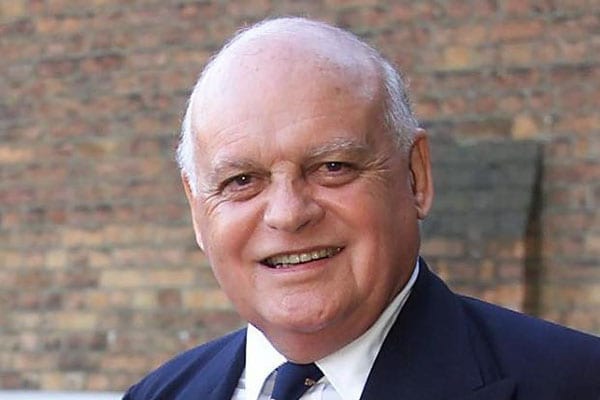
Sir Peter Tapsell MP
Our own audience is illustrative: 38% of our readers are based in the UK, but 31% are American. We have an ever-growing readership in Russia and China and receive countless comments from individuals in places as far apart as New Zealand and Finland. Though many may loathe him, the person whom Tapsell’s attack was directed at, Rupert Murdoch, is not a force for evil. He’s simply a tycoon who wishes to make money and get on with running his business. He should be left to do such and the media should be left to self-regulate.
Sir Christopher Meyer and Baroness Buscombe, appointed cronies who were put in place to regulate the media in the UK were responsible for the mess created at the PCC. They failed because they were busybodies with political agendas and they failed because they did not go the whole hog when it came to dealing with the bad apples. As a result, public trust disintegrated and the PCC will deservedly be scrapped.
The bad behavior of a small number of people should not destroy the free press as a cornerstone of our free society. Today is an illustration of a case where good men actually should do nothing.
A marine residence with a history tied to the Rolls-Royce Spirit of Ecstasy, the Special Operations Executive and Babycham
The House on the Shore on Thorns Beach at Beaulieu in Hampshire is a home that wouldn’t look out of place in the Hamptons or Rhode Island. Dramatically situated next to the Solent waters to the north of the Isle of Wight, this suitably named building wouldn’t have been out of place in the 1980s BBC series Howards’ Way. It could. Indeed, have been an ideal home for Gerald and Polly Urquhart. (more…)
Matthew Steeples delves into the history of Albany, Piccadilly and discovers an affordable way of living there
Albany, off Piccadilly in Mayfair, was most probably London’s first apartment block and it’s certainly the city’s most exclusive. It may be next to the Royal Academy and opposite Fortnum & Mason but surprisingly few have even heard of it.
Considering its location, Albany, which some make the mistake of referring to as “The Albany,” is an amazingly quiet oasis of peace and tranquility but, equally, it is a place of intrigue and drama. Residents, or “proprietors,” as they prefer to be known, of the 69 “sets” are particular about the “the” part of the name as they’d rather their residence not be confused with a public house and they are even more protective of their privacy. A porters’ lodge guards the entrance to the building and it is staffed mostly by ex-servicemen, who, until the early 2000s, had to wear top hats and tailcoats. Those allowed to pass enter a rarefied world frequented by what the Irish novelist Marmion Savage (1803 – 1872) identified as “incurable oddities” and “superannuated fops” in The Bachelor of Albany.
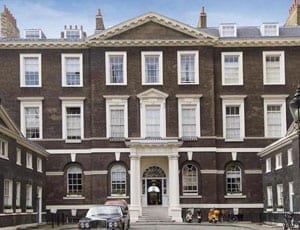
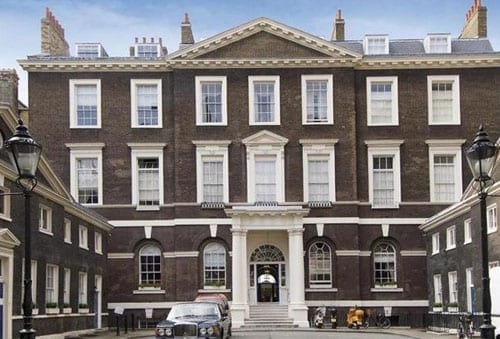
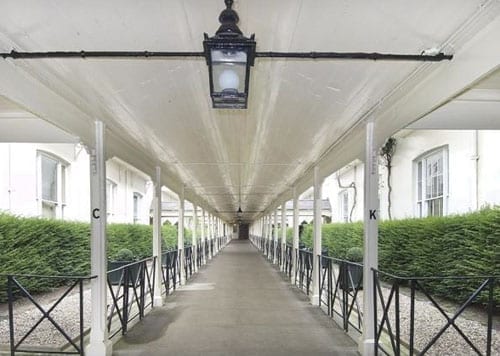
The front courtyard and façade of Albany, Piccadilly, Mayfair, London, W1J 0ALThe rope-walk connecting the various sets of Albany has been traversed by some of the greatest names in history
Built by Sir William Chambers (1723 – 1796), who also designed Somerset House and the pagoda at Kew, between 1770 and 1774 for 1st Viscount Melbourne (1745 – 1828), Albany was originally known as Melbourne House and conceived as a three-storey mansion, seven bays wide with a pair of service wings flanking a front courtyard. From 1791 to 1802, the property was occupied by George III’s son, Prince Frederick, Duke of York and Albany (1763 – 1827), but after he left, the renowned architect Henry Holland (1745 – 1806) sub-divided the existing house and added two parallel sets of buildings running the length of the garden to create 69 “bachelor apartments” which he named “sets.”
The “roll call” of residents since could easily fill our very own pages thrice over. They number royalty, politicians, artists, playwrights, academics and philosophers and here is a brief selection:
– Anthony Armstong-Jones, later 1st Earl of Snowdon
– Sir Thomas Beecham
– Sir Isaiah Berlin
– Lord Byron
– George Canning
– Sir Kenneth Clark
– Baroness Pauline de Rothschild
– William Ewart Gladstone
– Sir Edward Heath
– David Hicks
– Aldous Huxley
– Sir Simon Jenkins
– Rupert Lycett Green
– Malcolm Muggeridge
– Sir Harold Nicholson
– J. B. Priestley
– Sir Terence Rattigan
– Roger Scruton
– Baroness Sharples
– W. Somerset Maugham
– Terence Stamp
– Sir Denis and Lady Thatcher
– Sir Herbert Beerbohm Tree
Each had to pass the vetting of a committee of trustees of this Grade I listed building. That committee forbids children under 14, pets, musical instruments and commercial activities and each approved resident has undoubtedly added to the history of this den dominated by a central walkway named the “rope-walk.” Incidentally, an example of a curious quirk at Albany is that no resident is allowed to speak to another on this walkway. If they do, a fine is incurred. Albany, indeed, is rather like a college in its systems of rules, regulations, order and hierarchy.
For several centuries, women were not even allowed to cross the threshold and one legendary tale tells of Lady Caroline Lamb (1785 – 1828), disguised as a page boy, stealing into Lord Byron’s (1788 – 1824) set in 1815 to leave a note: “Remember me, Byron.” He replied with a simple verse:
Remember thee, aye, doubt it not:
Thy husband too shall think of thee.
By neither shalt thou be forgot —
Thou false to him, thou fiend to me.
The strict and formal structure that controls Albany and ensured its maintenance has succeeded in the main because 34 of the 69 sets are owned by Peterhouse College, Cambridge. They and the other owners are highly particular in whom they lease to and on one occasion on hearing of an “unsuitable tenant,” the secretary of the trustees is reported to have shouted:
“He’s a foreigner. Don’t like him. Don’t trust him.”
Needless to say, that application didn’t progress and nor did one from a physiotherapist who planned to operate from the building. Bone bashing in Albany just wouldn’t do.
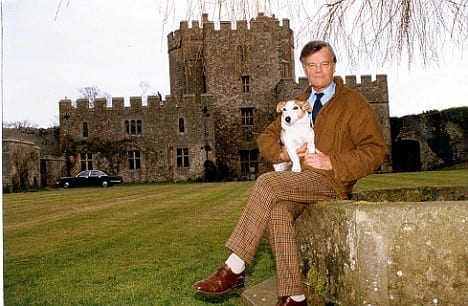
The Rt. Hon. Alan Clark MP (1928 – 1999) in the grounds of his main home, Saltwood Castle, near Hythe in Kent in 1993
A horsewhip, however, nearly crossed the threshold of set B5 in 1994, as it was here that the late Alan Clark MP (1928 – 1999) lived. The affable philanderer seduced the wife and both daughters of a certain South African named Judge Harkess and the wronged man stated he would “have horse-whipped Clark if he had known how comprehensively he had violated his honour.” B5, itself, was described as having the feel of “the straitened quarter of an Edwardian bachelor on his uppers” and the dotty, English attitude of the residents is best summed up by the reaction of Clark’s neighbour when he accidentally flooded their basement. When asked what he could do to make amends, their answer was quite simple: “Go and lie down in Piccadilly and wait for a double-decker bus.”
The dandy and journalist John Morgan (1959 – 2000) typified social change at Albany in the 20th century just as much as he himself redefined etiquette and manners at Debrett’s and The Times. Of “humble origins,” Morgan was brought up in a “modest” bungalow in St Madoes, Perth, Scotland but is credited with persuading William Hague to remove his baseball cap whilst Conservative leader and offering advice ranging from “how to eat a banana” to “how best to tell friends that the partner you would like to bring to their wedding will be of the same sex as you.”
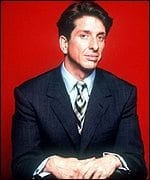
Dandy and etiquette expert John Morgan (1959 – 2000)
For the bachelor and GQ style director, living in Albany was symbolic of his own personal social elevation but he did not disown his past. This modern day Beau Brummell was a man of social contradictions who cashed his cheques at Claridge’s but was a member of the National Union of Journalists. He was a Tory but still regularly attended chapel meetings as he had done in his youth. Here was a man of paradoxes who seemed unable to come to terms with the fact that he was a homosexual.
Morgan, an asthma sufferer, fell to his death from a fourth floor window on 9th July 2000. He was found in just a white shirt in a basement below a window whose sill was strangely undisturbed. The coroner left an open verdict with a suspicion of suicide and it was widely reported that police found 60 made-to-measure Savile row suits, 300 monogrammed shirts and 90 pairs of shoes in the etiquette expert’s small set. Mystery shrouds the story of his tragic demise to this day but Johnny Morgan will forever be remembered as an arbiter of both good taste and behaviour.
Whilst Morgan represented continuation of the trend of bachelors living in Albany, change also came in the 20th century when the building’s committee removed the restriction that allowed only bachelors to be resident. With that females were allowed in and amongst them Fleur Fenton Cowles (1908 – 2009) was one of the most fascinating.
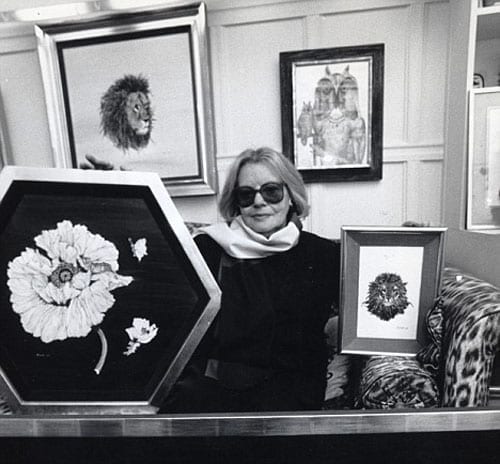
Fleur Fenton Cowles (1908 – 2009) in her set at Albany with some of her paintings and one by Salvador Dali
This writer and artist occupied five sets knocked into one with her fourth husband, timber merchant Tom Montague Meyer, and according to the Daily Mail’s Geoffrey Levy, hosted “elite soirees of the powerful and famous.” Levy recounts them at length but here is a flavour:
“On a Wednesday evening, a typical dinner party… would include Foreign Secretary Selwyn Lloyd, Labour leader Hugh Gaitskell, entertainer Danny Kaye and film star Douglas Fairbanks Jr. The Queen Mother regularly came to tea and was once joined by Pavarotti who sang Happy Birthday for the royal guest. ‘I don’t want her to die,’ said Fleur. ‘I couldn’t bear to think she doesn’t live just down the street.’ ”
Fenton Cowles, founder of the ill-fated Flair magazine and a “woman who knew everyone,” loved Albany and an exact replica of her “windowless, milk-yellow” study there has even been recreated at the University of Texas.
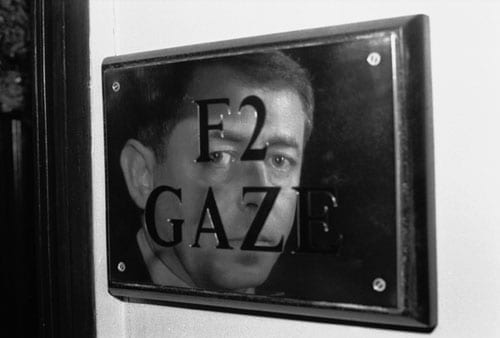
Another known for hosting extravagant bashes in Albany was my late friend, the Russian icon dealer John Gaze (1947 – 2011). Gaze had, as a boy, asked his father about the building when he passed it as a child and immediately declared he would live there one day. He took F2, the former set of Edward Heath that overlooked Savile Row to the rear, in the mid 1990s as he craved the safety that the building offered after having been kidnapped at gunpoint by an Oxford graduate conman named Sacheverell de Houghton in April 1991 from his then home in Fournier Street, E1. He made the most of his tenancy.
Russian icon dealer John Gaze (1947 – 2011) reflected in the brass plaque outside his Albany set, F2. It was formerly occupied by Sir Edward Heath.
Gaze’s parties included a fundraiser for people with AIDS hosted by a drag queen. This sparked fury with certain other residents and coverage in the Daily Telegraph and another incident there involved him encountering Alan Clark on the ropewalk carrying a portrait of Lenin. “Where the fuck are you taking that?” Clark supposedly bellowed but was “reassured” when he was told it was “destined for a less salubrious address in Whitechapel.” John Gaze remained at Albany for several years but, like a number of others I know, was forced out by ever rising rents and moved first to Chelsea and then Ennismore Gardens, Knightsbridge. He always remembered his time at Albany fondly and as a bon vivant, he truly belonged there.
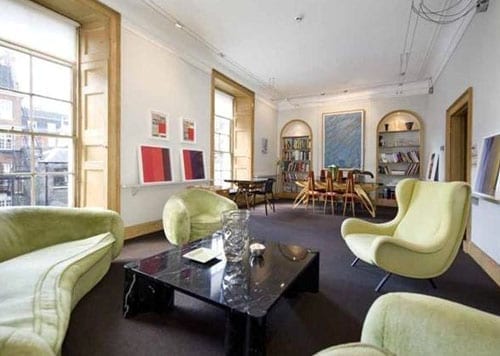
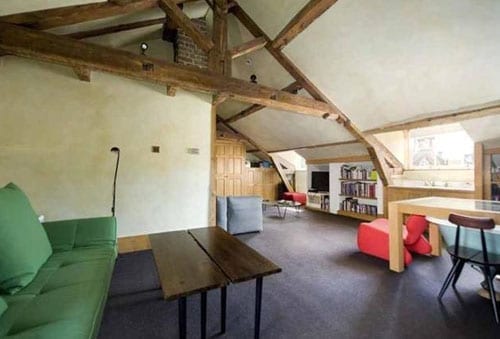
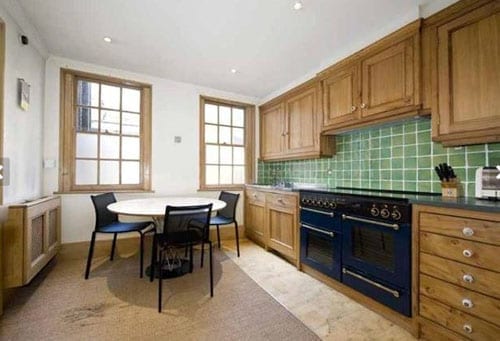
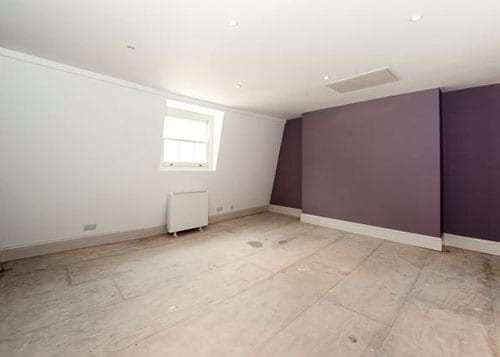
The main reception room in a £1,400 a week set currently available in AlbanyAn attic room in the set that could be used as a second reception room or second bedroomThe kitchen is lacking in character but offers ample space for informal dining
Contrary to what you’d expect, living in Albany is not quite as expensive as one might think. A 2-bedroomed 1,970 square foot set is currently available through Knight Frank for £1,400 a week: a figure that seems quite reasonable given the location, history and size of this property. Available on a minimum 8-year rental term, it includes a formal reception room, a dining kitchen, 2 bedrooms and 2 bathrooms.
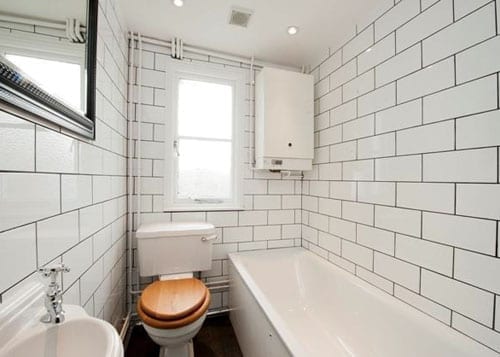
This £300 per week set, D2, consists of just one roomThe communal bathroom D2 shares with other sets is basic but clean
For those looking for something cheaper, Savills offer D2 Albany at £300 per week. This set consists of a 221 square foot third floor attic room with access to a communal bathroom and the agents suggest that it: “would make an ideal reading or writing room or an occasional bedroom for a pied-a-terre.” It’s effectively a posh form of tenement but what a way to impress your peers and subordinates.
Damon and Sandra de László in their “duplex” in Albany
Those renting either of these sets would find the likes of the industrialist Damon de László, a descendant of the Hungarian painter Philip Alexius de László (1869 – 1937), as their neighbour. The couple occupy Lord Byron’s former set, A2, and have, on occasions, opened it for a charity dinner with Matthew Parris at £1,000 a ticket as well and for members of The Portrait Institute to view their collection of de László’s works.
Professor Philip C. Bobbitt in his grand freehold set
Another present day resident is a man Henry Kissinger calls “the outstanding philosopher of our times,” Professor Philip C. Bobbitt. This Texan lawyer is a nephew of Lyndon B. Johnson and the author of Terror and Consent, which Tony Blair describes as “required reading for political leaders.” Bobbitt owns an impressive flying freehold set that is described as having a masculine style of décor and a “kitchen he has designed to look like a bar.” In an interview for TheIndependent he states that he finds Albany: “a propitious place to work.”
Though governments and bankers come and go, behind this quintessentially English façade, order and disorder have always been maintained. The wildcards of this hidden haven have a knack for living by the doctrine “to live at Albany is to live in history” and indeed they make the most of that. Those who are lucky enough to be let in, do, indeed, truly find themselves in the “Paradise of Piccadilly.”
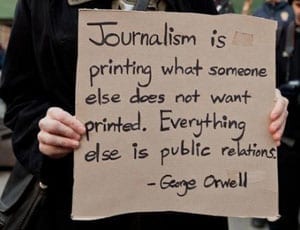
A George Orwell quotation sums up the current media firestorm perfectly
We at The Steeple Times thought this image of a lady holding up a piece of cardboard summed up the events of the weekend perfectly.
As a debate rages about the future of the BBC and the role of social media in the “outing” of personalities in connection to alleged stories of abuse, the words of George Orwell ring utterly true:
“Journalism is printing what someone else does not want printed. Everything else is public relations.”
For this simple reason, we make it our picture of the week. This scandal should not be brushed under the carpet.
Philip Schofield and the protection of powerful paedophiles
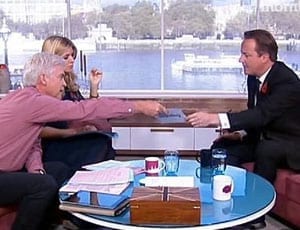
Yesterday, when Phillip Schofield showed the Prime Minister a note containing the names of alleged politician paeodophiles who have been named on Twitter, little did he realise what he’d set in motion.
Phillip Schofield handing David Cameron a list of names of alleged politician paedophiles on ITV1’s “This Morning”
Amongst the names was that of Lord McAlpine who also appears on the website of the former BBC sports presenter David Icke along with a former MP who is now a television presenter and a number of others. The same site contains references to an MP who died in a house fire in Hampshire in 2000 and all manner of other suggestions.
Steve Messham, the victim who appeared on Newsnight to state that he’d been sexually abused in a Welsh children’s home by a “prominent Conservative” last week, has now come forward to state that McAlpine was not his attacker. Separately, the peer has given a detailed rebuttal and threatened to sue those who have accused him.
We all know that David Icke is a bit of a wildcard and that his views about aliens are just ludicrous but one has to think of smoke and fire. If even one of those Icke accuses is guilty, any investigation would be worthwhile. Whoever they may be, powerful paedophiles should not be protected and equally, however wild their views, those with relevant information should not be censored.
We’re all Saviled out. It’s been more than eight weeks since revelations about Jimmy, formerly Sir Jimmy, Savile came to public attention. Yes, the horrors of his “activities” have appalled us all but frankly why do the media really keep this story running as a main news item?
It does what it says on the tin
We’ve been as much a part of this monstrous escapade as anyone else: our editor went on the BBC to talk about the scandal and we’ve even received messages of support from Savile’s twisted “friends.” We beat the Daily Mail in being the first to report on the sale of the paedophile’s flat in Leeds and spotted Sir George Young removing a photo of him and Savile from his website before any other. We admit it: our readers plainly are as intrigued by this story as much as we were curious enough to report on it.
It suited our Prime Minister very nicely to wheel out Theresa May yesterday to announce an inquiry into the activities of another supposed child molester who just happened to be a member of Margaret Thatcher’s government. “Why so?” we hear you justifiably ask. Well, just like the spinner Jo Moore “burying bad news” on 9/11, the US elections were the perfect opportunity to dispense of the activities of a certain magnate beneath the Tarmac®. Somehow, though, and as much as she tried to smooth things over, we don’t think May’s attempts at concreting over this particular highway will set satisfactorily.
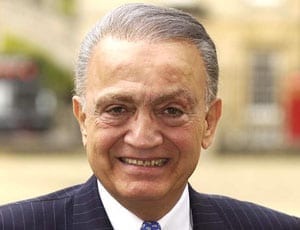
This billionaire was born in Damascus in 1939 and declares his loves to be music, architecture, art and horse racing. His home is the £50 million neo-Georgian mansion Tusmore Park near Bicester in Oxfordshire and he supposedly paid Robbie Williams in excess of a million to perform at his daughter’s May 2012 wedding to PR Khaled Khawaja at The Palace of Versailles. Saïd was one of Margaret Thatcher’s biggest supporters but is also said to have been a confidant of Peter Mandelson. As chairman of Saïd Holdings Limited, he presides over an empire with investments in hedge funds and real estates but he’s better known for the £23 million endowment he provided to establish the Saïd Business School in Oxford in 1996.
The Chief Whip erases mention of Jimmy Savile from his website
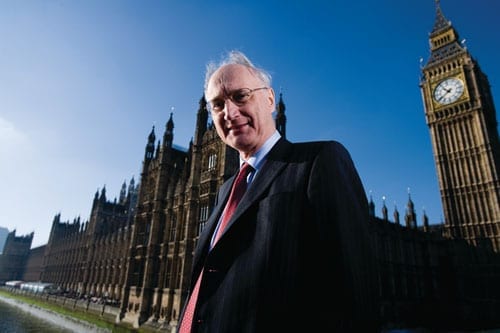
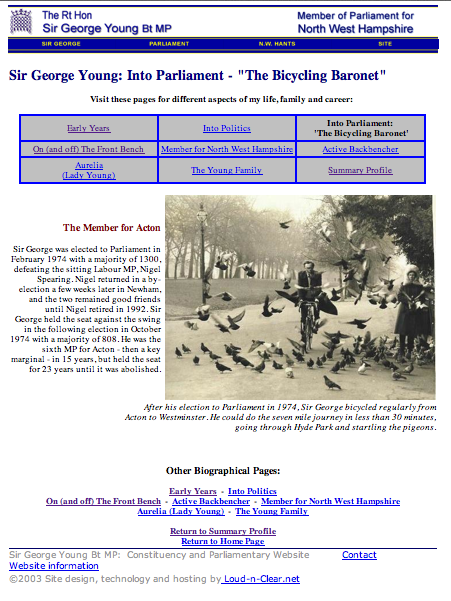
Yesterday, segments of the media shared an image of a poster taken from the website of the new Chief Whip of the House of Commons, Sir George Young.
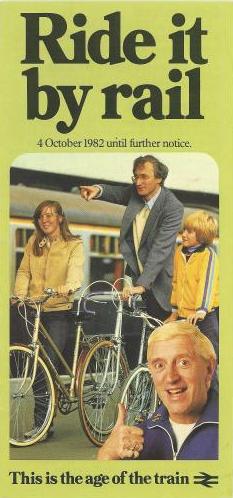
The Right Honourable Sir George Young Bt, CH, MP (born 1941)A 1982 British Rail advert featuring Sir George Young and his family and Sir Jimmy Savile
The text on the website read as follows:
The Youngs promote cycling by rail
On 1982, along with Jimmy Saville [sic], the Youngs featured on a British Rail poster promoting the transport of bicycles by rail.
Sir George had made a critical speech in the House, having found British Rail restrictive and at times unhelpful to cyclists.
Putting his bicycle in the guards van felt like invading someone’s private space. When they responded with some improvements, BR invited Sir George to help with their publicity.
(Some of these posters were still up at stations in Ealing during the 1983 General Election campaign. Ingeniously, Sir George’s opponents argued that British Rail’s publicity programme should be added to Sir George’s election expenses. They didn’t get very far, as Sir George’s name was not on the poster.)
The text about the advert featuring Sir George Young and Sir Jimmy Savile was shown alongside the advertisement on http://www.sirgeorgeyoung.org.uk/pages/biog3.htm (removed 20th October)The updated page on the 21st October 2012 minus the advertisement and reference to Savile
Sir George, who takes over from Andrew Mitchell, isn’t typical of David Cameron’s PR obsessed colleagues but plainly one of them has been at work. This morning it’s gone.
“The Bicycling Baronet,” like many others, may no longer wish to be associated with the vile paedophile Jimmy Savile but here we preserve it for posterity.
Visit The Rt. Hon. Sir George Young Bt MP’s now amended website at: http://www.sirgeorgeyoung.org.uk
I first visited 32a Ovington Square in September 2009. At the time, this “hidden house” was the home of Lord Carrington and it had just come on the market at a price, if I recall correctly, of circa £3,000,000.
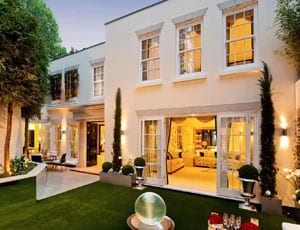
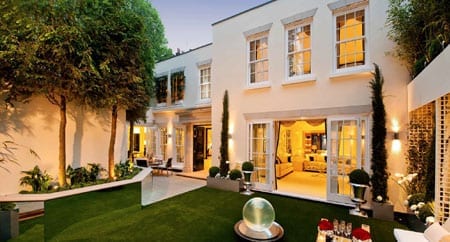
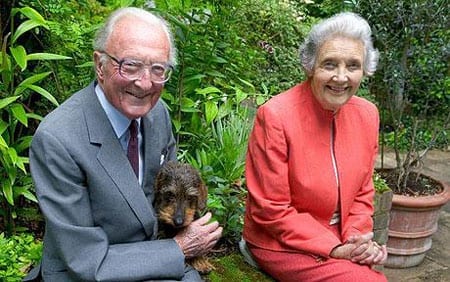
The newly redeveloped Carrington House, 32a Ovington Square, London, SW3 1LRThe Rt. Hon. The Lord Carrington KG, GCMG, CH, MC, PC, DL (born 6th June 1919) with his wife Lady Carrington (1920 – 2009) and their dog Edward
A friend was looking for somewhere to buy in London and I’d somehow come across the aforementioned property in a magazine. A detached house in Knightsbridge at this price seemed like a bargain and as he was keen to take a look and I lived round the corner, we arranged to see it together.
During this period, I had unfortunately made the mistake of making the acquaintance of a former ambassador’s wife who thought herself rather grand. Said woman somehow found out about my friend going to what Americans might term an “open house” at 32a Ovington Square and somehow muscled in. This individual happened to be selling her own home nearby and I reckon she, like my friend, thought she’d be onto a bargain. She’d previously unsuccessfully tried to persuade my friend to buy her individually styled, Ralph Lauren wallpapered home but as it actually rattled every time an underground train went underneath and as it was far from a bargain, he’d sensibly declined.
We arrived at the 2,240 square foot 32a Ovington Square to be told by a rather unhelpful estate agent that we’d have to just wander round by ourselves and that there was no brochure or floor plan. As a merry throng trailed through the house, Lord Carrington stood in the garden looking bemused and his secretary fussed around him. The pair plainly weren’t comfortable with all the interlopers and all in all, who could blame them.
The ex-ambassador’s wife, whose carelessness Rupert Everett most amusingly made reference to in his recent memoirs, spent the entire visit whingeing about the house being dark and stinking of damp. I had to agree with her as the neighbouring buildings towered over it and there was mould on the walls. My friend simply said: “It needs a fortune spending on it.” We left and later I heard that it sold for well above the asking price. The wife of the ex-ambassador thankfully departed from our lives soon after.
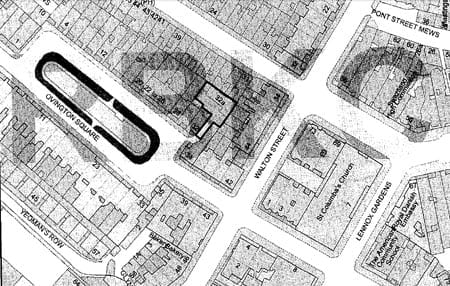
A site plan shows how hidden away 32a Ovington Square truly is – ideal for a government minister or indeed a wayward celebrity
About a year and a half later, I saw 32a Ovington Square for sale with planning permission to construct a far larger residence with a basement and sub-basement pool complex. The price was in the order of £14,000,000. I thought that somewhat ludicrous but now that the very same property is on the market at a price of £23,00,000, it seems that the world has just gone mad.
The brochure for the new residence, which has been renamed, Carrington House, reveals a three-storey low-built freehold building with 5,300 square foot of accommodation. Though 32a Ovington Square has been more than doubled in size by a developer named London City Developments, the sub-basement leisure complex has not been constructed. Could this have been because of planning problems or simply because such construction wasn’t deemed to add value?
In August 2002, Lord Carrington, whom The Mirror described as being “doddery” in a Scurra diary piece, was said to have objected to a bar named Townhouse behind his former home being given a 1am licence. That bar has since closed but as seven of the residents of Ovington Square and Beauchamp Place also took a dislike to the prospect of subterranean developments at his former home, only proposals for a single basement level were included in the January 2010 plans submitted by a Mr & Mrs R. Garner.
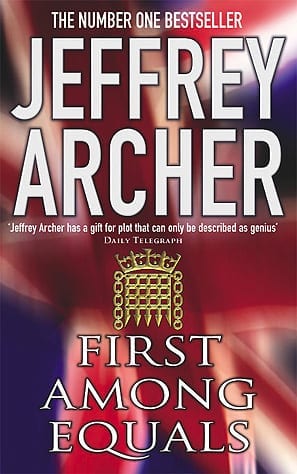
Jeffrey Archer’s 1984 novel “First Among Equals” (published in the UK by Hodder & Stoughton, ISBN: 0-340-35266-3)
Aside from controversy with residents and planning officials, this “heavily overlooked,” “dark” house gets a brief credit in Jeffrey Archer’s 1984 novel, First Among Equals:
“Charles would not have normally accepted the invitation. Lately he found cocktail parties to consist of nothing but silly little bits of food, never being able to get the right drink and rarely enjoying the trivial conversation. But when he glanced on his mantelpiece and saw an ‘At Home’ from Lady Carrington he felt it might be an amusing break from the routine he had fallen into since Fiona left. He was keen to discover more about the rumoured squabbles in Cabinet over expenditure cuts. He checked his tie in the mirror, removed an umbrella from the hat stand and left Eaton Square for Ovington Square… He arrived at Lord Carrington’s front door a little after six forty-five. A maid answered his knock, and he walked straight through to a drawing room that could have held fifty guests and very nearly did. He even managed to be served with the right blend of whiskey before joining his colleagues from both the Upper and Lower Houses.”
Turning to the real Lord Carrington, here is a man who has led a remarkable life. He served as Foreign Secretary in Margaret Thatcher’s cabinet between 1979 and 1982 and as Secretary General of NATO from 1984 to 1988. The last surviving member of the Cabinets of both Harold Macmillan and Sir Alec Douglas-Home was British High Commissioner in Australia between 1956 and 1959 and also chaired the 1979 Lancaster House conference that brought Zimbabwe’s revolutionary war to an end. In 1991, Carrington presided over diplomatic talks in the former Yugoslavia and commented:
“When I first talked to Presidents Milošević and Tudjman, it was quite clear that both of them had a solution which was mutually satisfactory – which was that they were going to carve up Bosnia between them.”
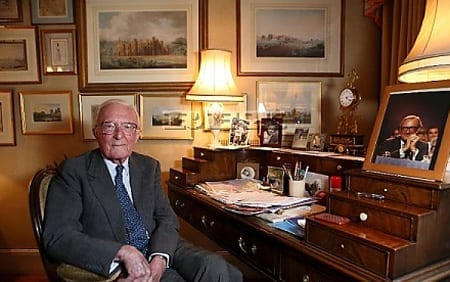
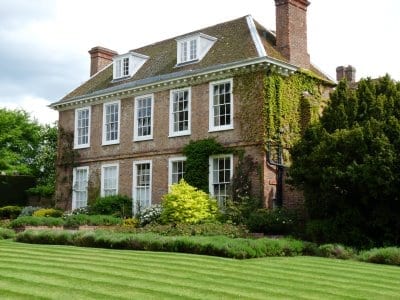
Lord Carrington at his desk in 32a Ovington Square, KnightsbridgeThe Manor House, Bledlow, Buckinghamshire, HP27 9PB is the country home of Lord Carrington
Milošević was found dead in his cell in 2006 but it is quite possible that Lord Carrington’s name will be mentioned in the trial of Goran Hadzic at the International Criminal Tribunal for the Former Yugoslavia that has just commenced at The Hague. It is amazing to think that matters involving this 93-year old politician are still current but Carrington’s stamina is shown in his roles as the longest serving member of the House of Lords and the second longest serving member of the Privy Council after HRH The Duke of Edinburgh.
Aside from politics, there is much on the internet, a considerable amount of it written by wildcards and fantasists whose number includes David Icke, about Carrington’s involvement with Henry Kissinger, the Illuminati, the Bilderberg Group and the Committee of 300. The consensus of these conspiracy theorists generally borders on the ludicrous, but it is without doubt that Lord Carrington had and continues to have influence in many high places. He was chairman of Christie’s International PLC from 1988 to 1993 and has held directorships on the boards of companies that have included Barclays Banks PLC, Hambros PLC, Cadbury Schweppes PLC, Amalgamated Metal Corporation PLC, British Metal Corpoation PLC, Rio Tinto PLC, Kissinger Associates Inc. and Hollinger Inc.
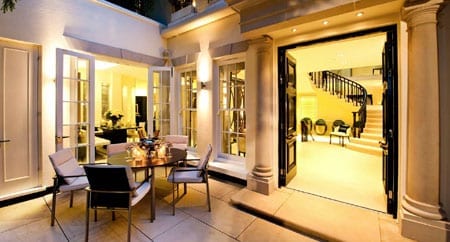
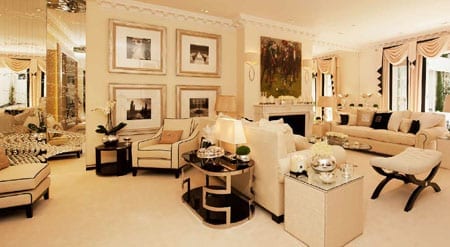
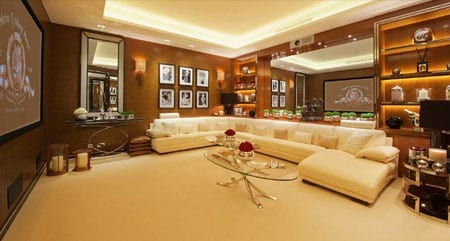
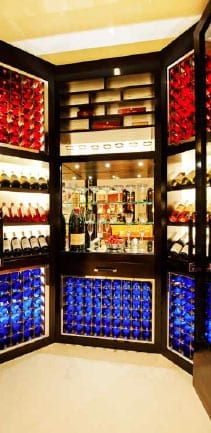
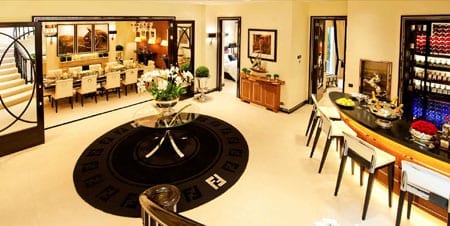
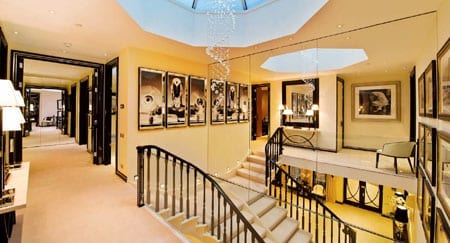
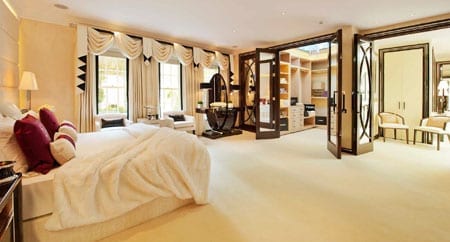
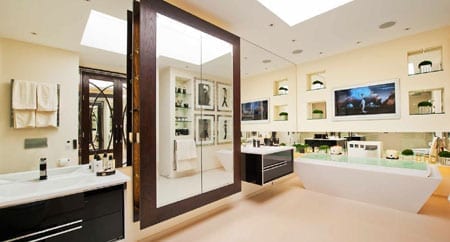
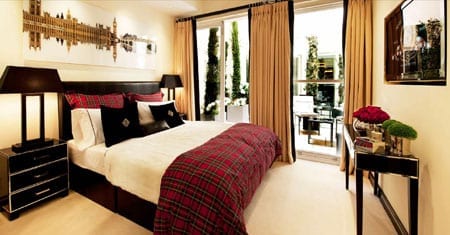
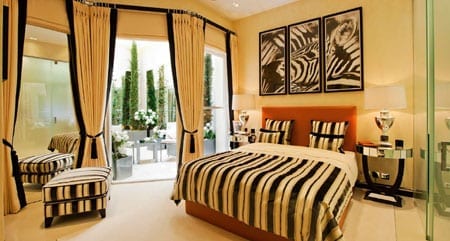
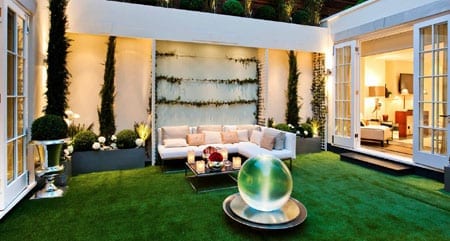
The main entrance to Carrington HouseThe main reception room of the house is decorated in a contemporary style and a far cry from the traditional decoration favoured by Lord and Lady CarringtonAn essential feature in any house priced over £10 million is a media roomCarrington House now boasts a bar that any dignitary would envyThe newly added basement level features an entertaining hall, dining room, bar, gym, media room and two bedroom suitesThe staircase is now lit by a glazed cupolaThe master bedroomThe master bathroomAnother bedroom, located at basement level, is decorated with a Scottish theme and has access to a shared courtyardThe other suite that shares the courtyard is decorated with an “Out of Africa” theme complete with an image of a zebra and matching linen and upholsteryWould the purchaser of a £23,000,000 home truly want an AstroTurf lawn?
Following on from this rather over the top redevelopment, a new chapter has certainly begun at 32a Ovington Square. Whether it is bought by a popstar or a Russian oligarch, they’ll definitely not be anywhere nearly as equal to Lord Carrington in terms of their league of influence.
Carrington House, 32a Ovington Square, London, SW3 1LR is for sale through Knight Frank. For further information contact Nick Vestey on +44 (0) 20 7591 8600. Full details of the house can be viewed at:http://search.knightfrank.com/sla100211