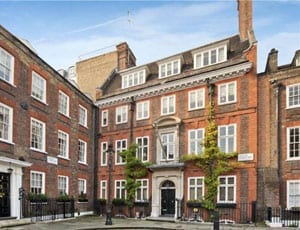
A property developer extraordinaire with a “passion for deals”. He has been involved in deals involving many of London’s most expensive properties and founded the Marcus Cooper Group in 1991. Cooper purchased the capital’s second largest home, Witanhurst on Highgate Hill, for £32 million in 2007 and put it back on the market five weeks later for £75 million and acquired One Cornwall Terrace, designed by Decimus Burton, for £80 million in 2013. Other transactions have included the former QVC building in Battersea and 16 Grosvenor Estate properties in Belgravia and Mayfair.
Tag: investment
-

Marcus Cooper
-
Bankrupt in Barton Street
The story of “fallen tycoon” Brian O’Donnell, the differences between bankruptcy in the UK and Ireland and an £11 million mansion
In these straightened times, the media in general and the Daily Mail in particular quickly latch on to stories about benefit scroungers living in luxury homes. They’re less quick, however, with the exception of the case of Grant Bovey (“Mr Anthea Turner”), to make reference to stories of bankrupt individuals remaining in multi-million pound mansions.

Brian O’Donnell with his wife Dr Mary “Pat” Patricia O’Donnell A most newsworthy example, though, has to be that of Irish property investor Brian O’Donnell and his psychiatrist wife Dr Mary Patricia “Pat” O’Donnell. Mr O’Donnell, who bought the Sanctuary Buildings in London for £170 million and paid $172.5 million for a 199,000 square foot property on Pennsylvania Avenue in Washington in 2008, started his career as a solicitor and eventually founded his own firm, Brian O’Donnell & Partners, in 1999. In time, he and his wife diversified into property investment and at the height of his success, Mr O’Donnell was described as “the Celtic Tiger poster child”. With the recession, however, came problems and by 2011, they owed Morgan Stanley €457 million, Aareal €235 million, and the Bank of Ireland circa €75 million.
-
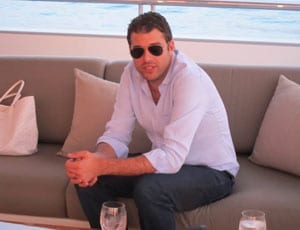
David Reuben Jr: “What’s on your mantelpiece?”
The Steeple Times asks emerging market investor David Reuben Jr: “What’s on your mantelpiece?”
The Steeple Times shares “wit and wisdom”. What’s your guiding force?
I try to follow the “Golden Rule”. Treat others the way you would prefer that they treat you. Be careful how you are with people on your way up, you just might meet them on the way down.
“Don’t get even, get medieval” is, in our humble opinion, a great motto. What’s yours?
If at first you don’t succeed, skydiving is probably not for you.
-
Love Money
Gina Miller investigates the links between Saint Valentine and transparency in investing
According to the wise font of all knowledge, which can be extremely accurate or extremely inaccurate, Wikipedia, Saint Valentine (in Latin, Valentinus) is a widely recognised third century Roman saint commemorated on February 14th and associated since the High Middle Ages with a tradition of courtly love. Nothing is reliably known of Saint Valentine except his name and the fact that he died on February 14th.
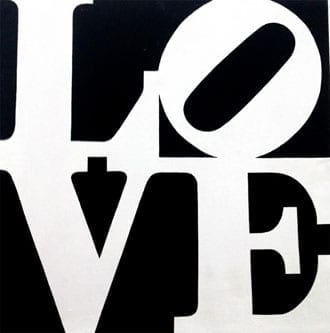
Love and money will forever be interlinked But many of the current legends that characterise Saint Valentine were invented in the fourteenth century in England, notably by Geoffrey Chaucer and his circle, when the feast day of February 14th first became associated with romantic love.
Whatever the truth is, most people today associate Valentine’s Day with romance. When one thinks of romance it is normally in the old fashioned Mills and Boon books or the more modern 50 Shades of Grey with some dashing man seducing his future conquest but once the charming good looks are pierced, below the surface they are often found to be pretty shallow and unedifying and after a while, maybe the real cardinal sin, boring. I say this as someone who once dated a famous model who was known across the UK for taking his jeans off in the laundrette revealing a great body but sadly not a lot of substance beneath.
Where is the connection with the world I work in, investments? Well a surprising amount when you consider it. The world of investment relies on seduction but the seduction is used for all the wrong reasons and normally with all the wrong results. There is a fine line between seduction and deception. Every day countless savings and investment managers cross this line.
When you meet your wonderfully charming or slick fund manager they try to seduce you with flowery words and jargon with no meaning or deliberately assembled to impress you with its complexity; but designed to prevent you from understanding how your money is really invested or how much your money is really costing. The smoke and mirrors are crafted to beguile and reassure that by being so complex, they must be amazing to do what they do and charge what they charge. Of course more often than not investing does not really need to be so complex or expensive to get sold returns.
If you think of most great inventors or inventions they are often based on a simple design or a simple concept. In investment the living Saint of investment is widely held to be Saint Buffet of Omaha, Nebraska. He has an annual convention where thousands flock to his temple to hear and learn from every word he says since he has probably the longest and best known and maybe most successful track records of anyone. He does not make things complicated or flowery he talks of common sense and old fashioned virtues that have stood the test of time and which people can understand. He simply tries to buy companies which he trusts, thinks are great franchises that can stand the test of time; and which for whatever reason are available at the right price. He does not hide from his investors how he invests, what he invests in or his charges for the services he provides. He works alongside his clients because he is managing his own money in the same way.
When you meet your fund manager or wealth adviser or whatever other name they call themselves, don’t be seduced by the initial lavish language or entertaining or lavish date because normally this does not last and it is you who ultimately is paying for it anyway. Often the more lavish the entertaining, the more likely that they are ‘after’ something and that something is to erode more of your returns in fees.
In economics there is a term called giffen goods. These are goods by which the more that is charged the more that it is demanded, these are luxury goods. If your XXX handbag was available for £10 rather than £1,000 it would quickly lose its panache or lustre. Investment managers try and make their services desirable through charging more in the knowledge that most clients wrongly think: “If I pay more I must be getting a better product or a better performance”. However the research shows the precise opposite and that if you pay more, it simply means more money has been deducted from your savings and in turn they are then worth less.

Gina Miller is spearheading the True & Fair Campaign with her husband, Alan 
The True and Fair Campaign’s poster is part of their call to action We have been working extremely hard via a True and Fair Campaign to force by law, the investment industry to stop this deception and reveal to customers exactly how much, in total, investments are really costing and how they are really invested. The scale of this deception is truly shocking.
Maybe, just like a good relationship, there needs to be substance and openness and trust or the relationship is not a real relationship but just an empty dalliance, fun at the time but not particularly rewarding thereafter. I implore you to trust your instincts, keep to your principles and do not be seduced by the flannel. Instead, do plan today for your tomorrows and the life you dream of as you grow older and go off into the sunset of retirement.
Happy Valentine’s Day.
For more information about the True and Fair Campaign, go to: http://www.trueandfaircampaign.com
-
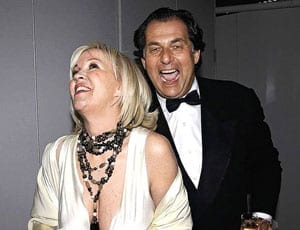
Robert Bourne and Sally Greene OBE
 Well-known for their numberplates “2 BE” and “NOT 2B,” this power couple live on Cheyne Walk and are a little bit like Marmite. In Chelsea, Bourne has aroused controversy by attempting to gain planning permission to turn George Best’s favourite boozer, The Phene, into a house and in Soho, Greene’s makeover of Ronnie Scott’s caused apoplectic outbursts amongst traditionalists. Labour supporting Bourne is described as a “property and leisure entrepreneur” whilst his wife just happens to control the luvvies favourite theatre, The Old Vic in Waterloo. Bourne and Greene are a duo who should not be underestimated.
-

Richard Caring
 Of Italian-Jewish descent, Caring is of the “supermarket-sweep” school of empire building. This billionaire started out in the rag trade but now controls the majority of the top restaurants and clubs in Central London. He survived the 2004 Indian Ocean tsunami and viewed that to be a wakeup call. Since then he’s donated millions to charity and focused on his two passions: golf and shooting. This buccaneering businessman generally passes on breakfast and lunch and lives between a converted stable block set in 500 acres near Dulverton and a mansion on The Bishops Avenue. What will he buy next?
-
Patricia Kluge (née Rose)
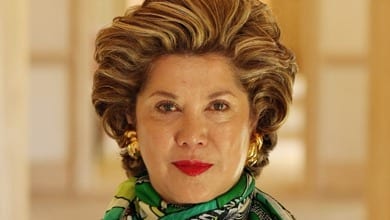 The rise and fall of the “wealthiest divorcee in history” has been extraordinary. A former nude model for her first husband’s Knave magazine and star of adult films such as “The Nine Acres of Nakedness,” Patricia Kluge is the daughter of an Englishman and a Scots-Iraqi. She married her second husband, the late John Kluge, chairman of Metromedia and once the richest man in America, in 1981 after belly dancing for him at a dinner party in New York. As part of her plan to dovetail herself into the top drawer of American society, the couple built a 24,000 square foot mock 18th century English-style mansion, Albermarle, in Virginia and stuffed it full of Chippendale furniture. She got this as part of her $100 million divorce settlement in 1990 and wisely invested part of the payoff in a highly successful business trading football cards but then vanity struck. The Kluge Estate Winery project that she started with her third husband, William Moses, bankrupted the pair in June 2011 and the Bank of America foreclosed on her properties. A lifeline came from “longtime friend” Donald Trump who purchased the vineyard and employed her, but even he’s now uttered the words: “You’re fired!” and sent her packing. Of her newfound predicament Kluge commented: “What did we lose? Material things, nothing too important. When something like this happens you really see who your friends are, those you can rely on, and we have many friends.” Here is a lady with fortitude that can only be described as admirable. It’s probably best, however, to keep her away from the cash register.
-
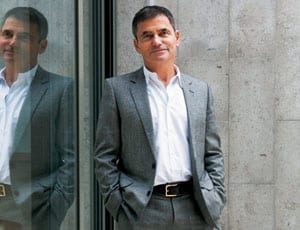
Harry Handelsman
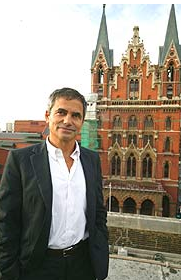 This German-born property developer is best known as the pioneer who brought “loft living” to London in the early 1990s with his Manhattan Loft Corporation. His redevelopment of the Grade I listed St Pancras railway station has resulted in accolades galore and his personal fortune has allowed him to build up a collection featuring works by Andy Warhol, Anish Kapoor, Gerald Laing, Sarah Lucas and Gerhard Richter. Handelsman’s view on money is simple: “[It’s] cynical, sometimes you have it and sometimes you don’t. You can’t take anything for granted.”
-

Crispin Odey
 He founded Odey Asset Management in 1991 and now manages some $6.2 billion of assets. This graduate of Christ Church, Oxford was first married to Rupert Murdoch’s daughter, Prudence, but after divorcing her Odey formed a union with a fellow financier, Nichola Pease. The couple, termed “The City’s Posh and Becks,” live between Chelsea and Gloucestershire. They hit the press in September 2012 when they applied for planning permission to build a “rather grandiose” hen house, costing some £150,000, in the grounds of their Grade II listed mansion, Eastbach Court.
-
Rowling on
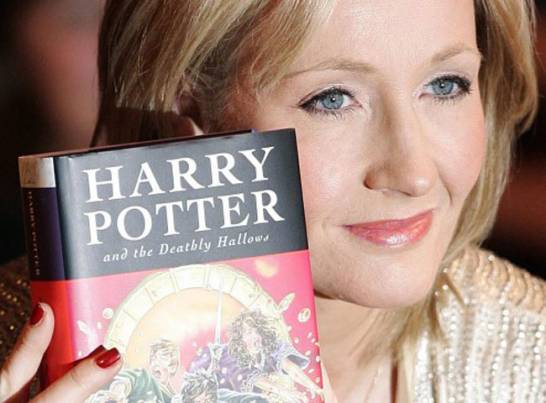
J.K. Rowling sells the home where she first moved after the initial success of her “Harry Potter” series
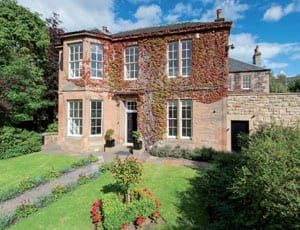
Harry Potter author J.K. Rowling is a lady said to be worth some $1 billion. Her path from “rags to riches” is well documented but the announcement of the sale of the Edinburgh home she first bought after the initial success of the books gives an insight into how she is also financially shrewd when it comes to property investment.

Joanne “Jo” Rowling OBE, FRSL, pen name J.K. Rowling Having paid £425,000 for a first floor flat in a 2-storey Victorian house at 1 Abbotsford Park in Edinburgh’s Merchiston neighbourhood, 2 miles from the city in 1999, Rowling bought the other half of the building in 2003 for £375,000. In turn, the property was converted back into an 8 bedroomed single family residence and became one of several residences the author lived in with her second husband, Dr. Neil Murray, and their children.
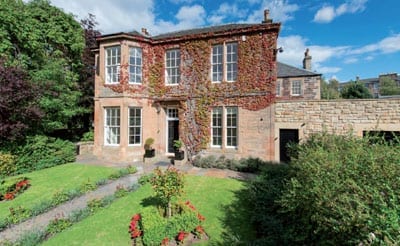
The front elevation of 1 Abbotsford Park 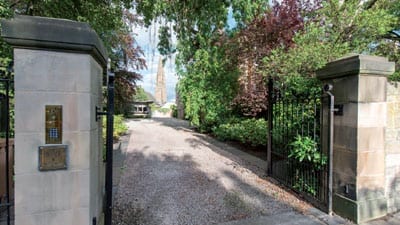
Security at the house was ramped up as Harry Potter sales soared due to the volume of fans appearing outside the property As well as extensively refurbishing and extending the property, in a submission to Edinburgh Council in December 2003, in the names of Mr. and Mrs Murray, the couple sought permission to install five CCTV cameras inside mock lamps at 1 Abbotsford Park. Though a neighbor objected on the grounds of invasion of privacy, the application was approved.
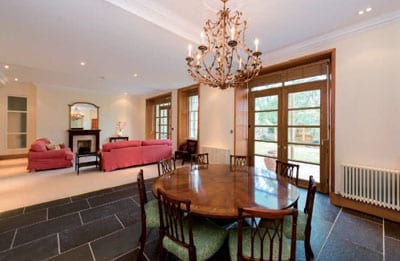
The house’s 35ft sitting-dining room 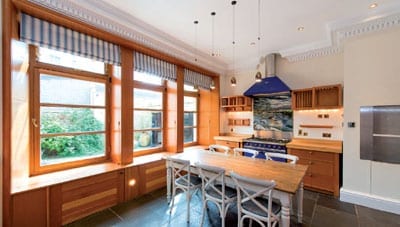
J.K. Rowling’s kitchen features free standing units, a Lacanche
range cooker and a mural of tiles that, from a distance, could even be a scene from a Harry Potter novel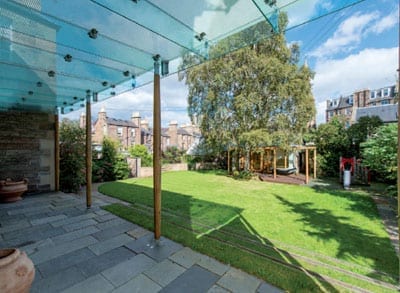
The garden of 1 Abbotsford Park J.K. Rowling also built a detached 656 square foot office complex in the grounds of the 3,240 square foot house during her occupation. Additionally, as well as a library, she fitted out a study where she wrote many of the series of books that have now sold more than 400 million copies.

An external shot of the garden office said to have been used by Rowling’s staff 
An internal shot of the office building Though Rowling permanently moved into another Edinburgh home she purchased for £2 million in December 2009 last year, whoever purchases 1 Abbotsford Park will have other authors to call neighbours. Ian Rankin and Alexander McCall Smith both live locally.
Rettie and Co. seek £2,250,000 on behalf of Dr. Murray and J.K. Rowling. Even allowing for their extensive renovations, the author’s initial £800,000 investment appears to have certainly paid off if this price is achieved.
For more information on 1 Abbotsford Park, Edinburgh, Scotland, EH10 5DX, contact James Whitson of Rettie & Co. at 11 Wemyss Place, Edinburgh, EH3 6DH or telephone: +44 (0) 131 624 9068. View full details including a PDF brochure at: http://www.rettie.co.uk/sales/EDI121294
J.K. Rowling’s official website can be viewed at: http://www.jkrowling.com. Her first adult book, The Casual Vacancy, is published by Little Brown on 27th September 2012.