Tag: Germany

  • Blind dining

    Blind dining

    Christian Huhnt takes his first foray into the world of supper clubs


    I don’t usually find myself in the east of London. It’s not because I don’t like it but simply because it’s just an awful journey to get there from where I live. Eventually, though, a “secret” was able to convince me to make this long journey. This “secret,” I was told, could only be revealed to me if I “attended” it. Of what, you may ask, am I am rambling on about? I am talking of something called: “The Secret Supper Club.”


    Next, you’ll be asking: “What the heck is a ‘supper club’?” Well, in essence, a “supper club” is essentially a dinner in the company of a bunch of total randoms. It is a bit like blind dating, although you get to speak to many more people than just the one opposite you. As I had heard and read so much about supper clubs, I became very curious about attending one. Normally these gatherings happen in someone’s own home without any professional help, but the one to which I was invited was quite something else.
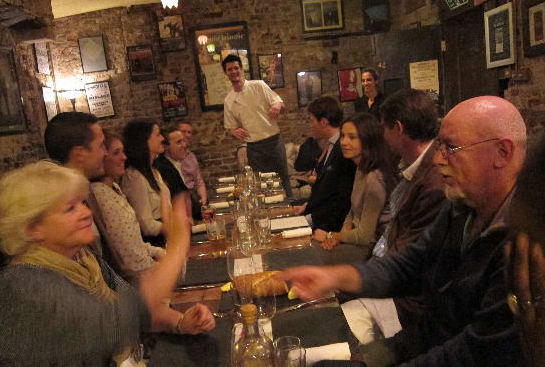
     

    Lime&Tonic’s Secret Supper Club

    This particular supper club is on another level. It is run by Lime&Tonic, an international firm of event planners and costs just £35 per head. Lime&Tonic made their philosophy to: “Save the world from boredom” according to its co-founder Stefan Cordiner and in the London supper club they operate I certainly found plenty that fascinated.


    The major idea of Lime&Tonic’s take on the supper club is to make new contacts. In this case it was as far reaching as it could get. We were 14 in total. None of us knew each other beforehand, but almost everyone came as a couple or with a friend. What, I realised, made it particularly special was how wide an array of people came: Where else would a pharmaceutical product developer from Birmingham have dinner with an F-15 pilot from the US?


    The “un-restaurant,” as it is also referred to by Lime&Tonic, happens every month at a “secret venue,” but never a private residence. The location is revealed to the attendees one day before the event. It’s usually held in a venue with a “unique feel” but wherever it may be, the focus is on somewhere with “authentic charm.”


    Suspense and surprise is the order of the day here as the “secret menu” is not revealed until guests sit down at the table either. On arrival we were told that our chef for the night was Paul Hannagen, a good-humoured young Irish professional who established his own catering operation, Cuisson, in August 2011. His passion for his craft was infectious.


    The one element of “surprise” that I found hard to deal with was the “bring your own” wine policy. Without knowing what would be served, how could I know what alcohol my wine buff companion ought to choose?


    The food itself, though, was delightful. We started with some small ‘lollipops’ stuffed with chicken liver and chunks of apple as an amuse-bouche. This was followed by a ham that had been cooked for 36 hours and served in a “British farmer’s style” with mini-cauliflower, sliced carrots, a rocket salad and a truly wonderful chutney. For a main we were served salmon, cooked  “hot and cold” on one side only at 44.5°C in basil oil served with marinated prawns, mashed potatoes and broccoli. It was a great dish but perhaps a little more salt could have made it perfect. The final course, equally, was a delight: chocolate fudge with Baileys ice cream and salted caramel. I was in heaven.


    In general, Hannagen’s approach to slow cooking and his use of local produce reminded me very much of that of Jason Atherton at Pollen Street Social. I was therefore not surprised when he later told me that Atherton was his mentor. He did a great job and my companion and I agreed that he deserves huge success.


    The meal over, we ended up downing Patrón XO Cafe shots together while happily exchanging numbers. Though I may have been sceptical in the beginning, this concept is brilliant. I am very much looking forward to attend the next Secret Supper Club soon.


    For more details about Lime&Tonic and their supper clubs, go to: http://www.limeandtonic.com/london/en/


    For more details about Paul Cuisson, go to: http://www.cuisson.co.uk
  • Harry Handelsman

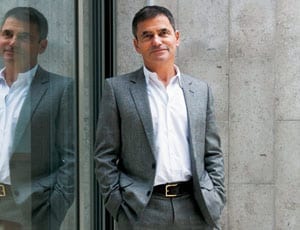
    Harry Handelsman

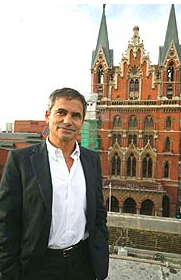
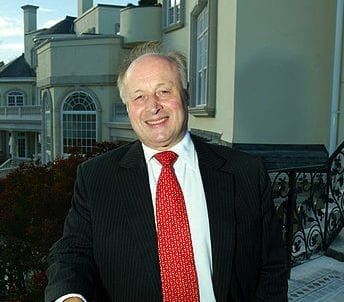
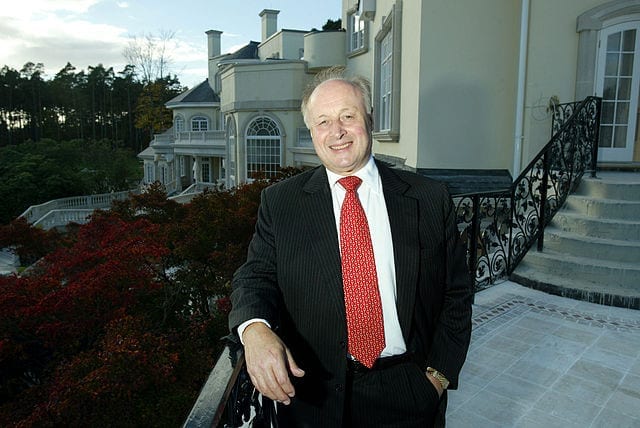
    This German-born property developer is best known as the pioneer who brought “loft living” to London in the early 1990s with his Manhattan Loft Corporation. His redevelopment of the Grade I listed St Pancras railway station has resulted in accolades galore and his personal fortune has allowed him to build up a collection featuring works by Andy Warhol, Anish Kapoor, Gerald Laing, Sarah Lucas and Gerhard Richter. Handelsman’s view on money is simple: “[It’s] cynical, sometimes you have it and sometimes you don’t. You can’t take anything for granted.”

  • Why pay less?

    Why pay less?

    Living life to the full Donald G. Abbey style


    “Why pay less when you can pay more?” is a mantra that some strangely choose to live by. In my time, I have encountered a couple with a different Ferrari for each day of the week, someone who proudly declared their home had a window for each day of the year and an heiress who insists upon the local baker feeding her dog daily with a freshly baked caviar pie.


    When I discovered a house in California priced at $78,000,000, I didn’t expect to subsequently find out that the same vendor is also selling another of his homes in Montana at the very same price. Having done a little research into Donald G. Abbey, the commercial real estate tycoon who owns both The Bradbury Estate and Shelter Island, I discovered that here indeed is another personality whose excess knows no bounds.


    I suppose when people sell homes of this worth, the asking price they set is quite irrelevant. “What,” I’m sure they ask, “is $5 million between friends?” Equally, when it comes to developing such properties, characters of this nature do not show any reserve. Bling is most definitely the order of the day and the larger and flashier one can build, I guess, the better.


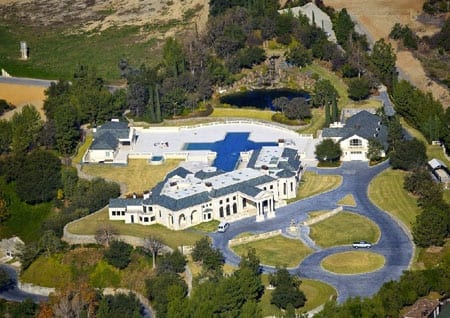
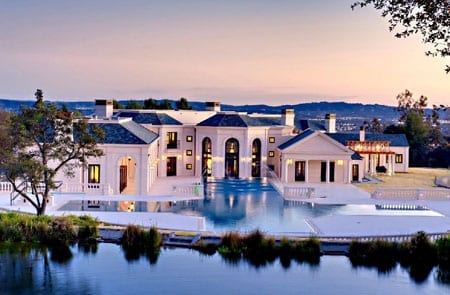
    An aerial shot of The Bradbury Estate, 172 Bliss Canyon Road, Bradbury, California, CA 91008, USA
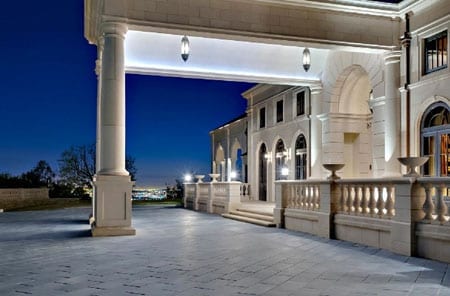
    The front elevation of the main house
    The owner and his guests need not get wet on arrival in their limousines


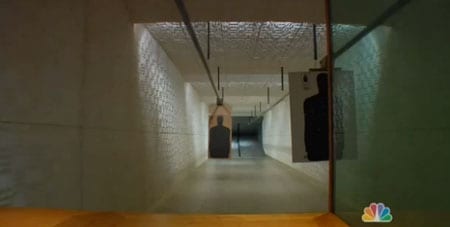
    Abbey’s Bradbury Estate is a case in point. This vast property consists of a 33,000 square foot main house with 7 bedrooms and 10 bathrooms. It is almost entirely made of French limestone and includes a chef’s kitchen with a pizza oven, a 2,000 bottle wine cellar, an oak paneled elevator and a leather paneled poker room. Bedrooms include domes with hand painted frescos and in addition there is a detached 6,700 square foot guest house above a 10 car garage and a 5,700 square foot pool house with a catering kitchen, gym, massage room and a subterranean EPA certified 25 yard rifle shooting range complete with a gun storage room and 2 large safes.


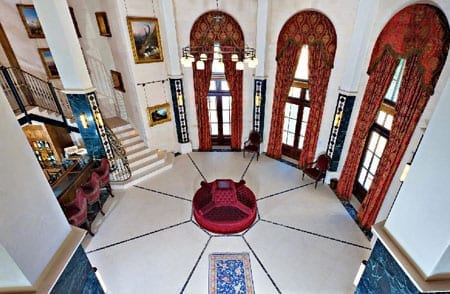
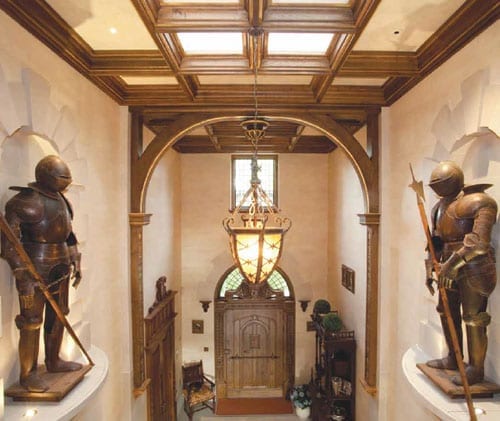
    The hall of the main residence comes complete with a gallery and bar
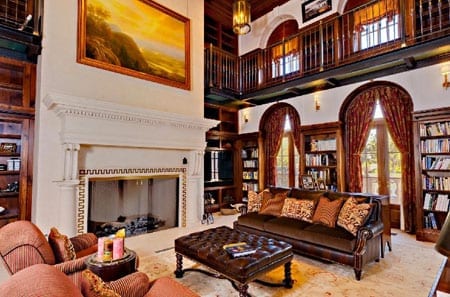
    A vast library provides the perfect space to enjoy a good book
    The library’s glazed ceiling
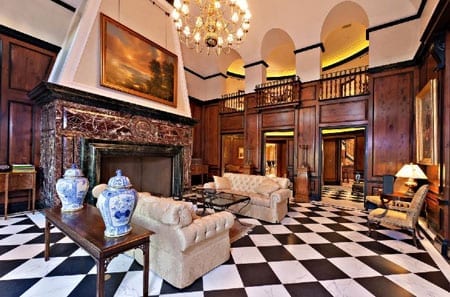
    Another palatial reception room
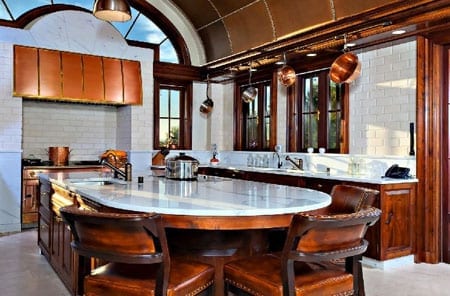
    The house features a rather impressive kitchen
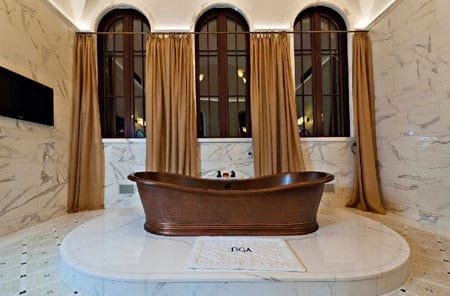
    Mr Abbey’s copper bath tub comes complete with a mat displaying his initials in front of it


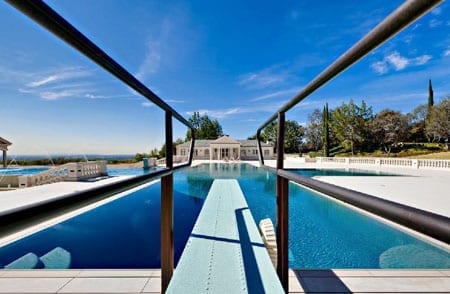
    Within the 8 acre grounds there is a cross shaped infinity-edged pool – perhaps Mr Abbey is religious – that is “just a few feet short of Olympic length.” It requires 350,000 gallons of water if it is to be filled to capacity. Adjoining this is something even more ludicrous: a 1,000,000 gallon, temperature-controlled rainbow trout pond that cost some $8,000,000 to construct. The pond is said to be “adorned with perennials,” is heated by a custom gravity separator with UV filters and is “chilled for the trout by a 300-tonne central cooling plant.” At Bradbury, thoughts of water crisis in Sudan and Ethiopia come way behind the needs of Abbey’s rainbows.


    The rear of the house viewed from above The Bradbury Estate’s $8,000,000 trout pond
    The estate’s 350,000 gallon near Olympic length cross shaped infinity edged swimming pool
    The property’s EPA certified 25 yard rifle range


    For those wanting to avoid California’s UV rays, Bradbury also boasts an acre of porches, decks, loggia and walkways. A 600ft blue stone driveway completes this “once in a lifetime trophy property” that “belongs in the portfolio of the most astute collector” and it has space for “60 foot truck access or multiple limousines.”


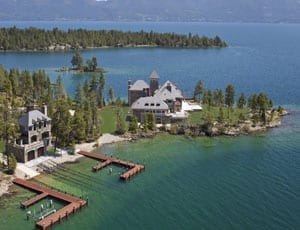
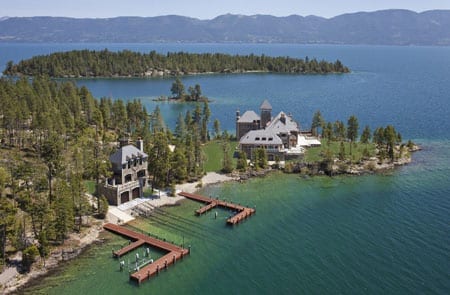
    When Mr Abbey has tired of California, he is able to retreat to his own island in Montana. The 24 acre Shelter Island on Flathead Lake includes 7,000 feet of frontage to the water, a world class sporting clay course and 3 computer controlled tracks and docking systems that allow boats to be landed in the dry dock without riders ever leaving the craft or handling a line. The island is powered via an underground armoured utility cable that carry 12,000 amps to it along with CAT-5 computer cable and phonelines and the main entertaining space features a mammoth television of some 120-inches in size.


    An aerial view of Donald G. Abbey’s Shelter Island
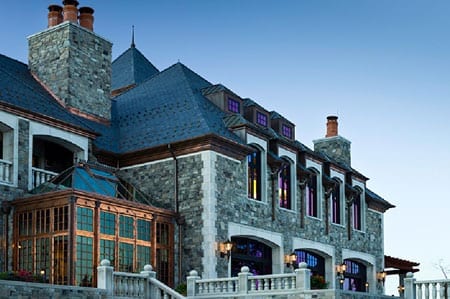
    Mr Abbey’s passion for copper continues with a conservatory made out of the metal on the lakeside elevation of the main residence on Shelter Island
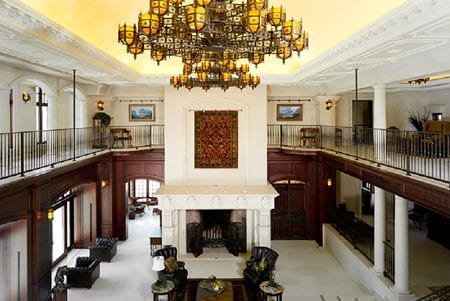
    The Great Room of the main residence on Shelter Island
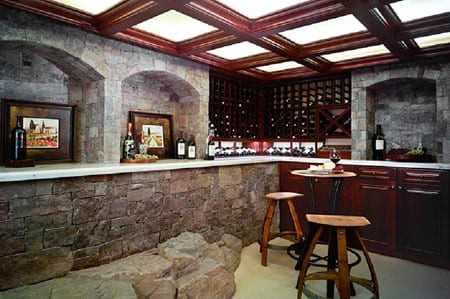
    Mr Abbey’s passion for fine wines is displayed in a bar and tasting room in the property
    The owner and his guests can access their boats without having to go anywhere near the water


    Abbey has built over 44,000 square foot of accommodation on his island. The main house has 5 bedrooms and 8 bathrooms. His “Great Room” features ceilings of some 45 foot in height and in addition to yet another indoor shooting range, there is a kitchen that woudn’t look out of place in The Savoy hotel.


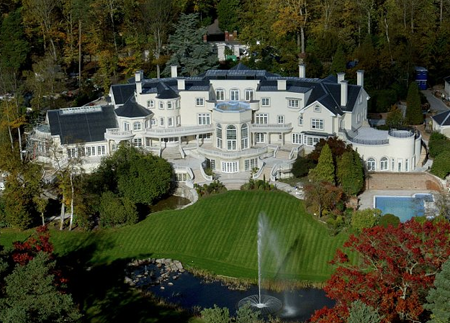
    In the UK, the property most similar to anything Abbey has built has to be Updown Court at Windlesham in Surrey. Developed by a former bricklayer named Leslie Allen-Vercoe, the house was described by him as being: “The most important residence to be built in England since the 19th century.” Architectural critics did not agree and some went as far as to say that it looked like: “A cross between a Tesco superstore and Center Parcs.”


    Allen-Vercoe’s behemoth of a house is gargantuan in size. With 103 rooms it includes 24 bedrooms, 5 swimming pools, a 2-lane bowling alley, a squash court, a floodlit tennis court, a 50-seat cinema and a panic room. The heated driveway that led to the house is entirely made of marble and cost some £2.5 million to construct but plainly none of this appealed to the market as it languished for sale at a price of £70,000,000 from 2006 to 2011 before being repossessed by the Irish National Asset Management Agency (NAMA). Updown Court was sold for half the original asking price to a foreign buyer in October 2011 and is, I believe, due to undergo extensive remodeling.


    Updown Court, Chertsey Road, Windlesham, Surrey, GU20 6HY, UK


    Allen Vercoe once stated: “If Elton John were a house, he’d be Updown Court.” Equally, I imagine if Mr Abbey’s residences were to be compared to any celebrities they’d be the vulgar car crash that is Donatella Versace and the ludicrous money obsessed singer with a dollar sign in her name, Ke$ha.


    Updown Court, Shelter Island and The Bradbury Estate all illustrate that money cannot buy you good taste. I suppose, though, that those who ultimately come to live in them will have plenty of space to choose how and where to enjoy their own form of misery.


    For more information about Donald G. Abbey, go to: http://www.theabbeyco.com


    For information on both The Bradbury Estate and Shelter Island, contact Bob Hurwitz of the Hurwitz James Company on +1 310-477-8865. Website: http://www.hurwitzjamesco.com


    A website devoted to The Bradbury Estate can be viewed at: http://www.bradburyestate.com


    A video of Shelter Island can be watched at: http://vimeo.com/11404637


    For more details on Updown Court, go to: http://www.updowncourt.com/


  • Winging it

    Winging it

    Sarah Tucker gives an update on goings on at the resort where Madeleine McCann vanished


    Four hundred and thirty euros, one bedroom apartment, one week at the height of season at a luxury family resort in Portugal. And oh yes, it’s the Ocean Club at Praia da Luz. There’s availability with two and three bedroom apartments as well. I asked about apartment 5a where Madeleine disappeared but the PR is coming back to me on that one. That was four days ago.


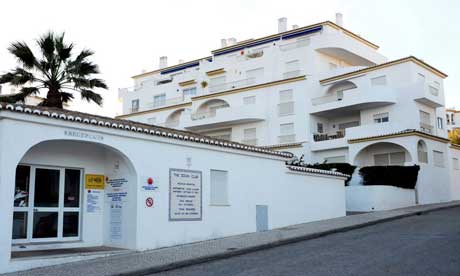
    The Ocean Club entrance and Apartment 5A at the top of the street

    I checked this out because having looked at the comments on The Steeple Times McCann roll call entry, I wanted to know what became of the resort where she disappeared.  Last year the lady who owned the property itself couldn’t sell it because women buyers were put off by it’s history.  I don’t blame them. I would never recommend buying from a divorcing couple, no matter how good the deal, so buying somewhere where a child has been allegedly kidnapped is a no no. Estate agents will say nonsense, but that’s a woman’s superstition for you. Or a mother’s superstition.


    I remember writing at the time about Mark Warner, a company synonymous with a reputation for keeping parents who treated parenting as a subject to be studied to A*, not as something to leave to instinct, God forbid.  Perhaps that’s an exaggeration, but having recently vox popped over 500 parents* asking if they would leave their children in their hotel room unsupervised while they ate in a restaurant on site, none of them, not one, said they would do so. I never mentioned the McCann case. The question about childcare was mixed in with other family travel related stuff, but some even mentioned the McCann’s case when they responded.  And all claimed they would take advantage of a babysitting service if it was offered or eat earlier and with the kids if it wasn’t.


    I was asked at the time if I would ever leave my son alone. I never have. Too risky and having lost him for ten minutes in the salubrious area that is East Sheen high street at five in the afternoon five years ago, because I refused to wait for him to tie up his shoe lace for the nth time, and getting no less than eighteen other men and women, all who had been either waiting for buses, serving or being served in shops, or in several cases drinking in the local pub, to run up and down, shouting his name, I understand the McCann’s need to go to the end of the earth, the prime minister, the Pope, to find their daughter. I completely understand this. What I never understood was their emotional reaction or rather lack of it.    In the meantime babysitting services are still offered at the Ocean Club.


    * Using social media (parents of three to six year olds).


  • Fighting Season

    Fighting Season

    A review of Fighting Season by Graham Lee


    At school, one of my classmates was a chap named Graham Lee. We used to travel home together on the same bus from Lancaster and as both our mothers worked at the same university and shared a love of all things equestrian, we had much in common.


    “Fighting Season: Tales of a British Officer in Afghanistan” by Graham Lee

    Naturally, as happens when one goes to university, we lost touch and it was the phenomenon that is Facebook that caused us to regain contact with one another recently. Whilst I may have enjoyed a somewhat colourful time working for a billionaire, launching drinks brands and writing, Lee has been involved in something far more important in the time since we left Lancaster Royal Grammar School in 1999.


    Lee, after Cambridge and Sandhurst, served in Kenya and Germany and then as an officer in the British Army’s spearhead Air Assault Brigade was sent to Afghanistan. In Fighting Season: Tales of a British Officer in Afghanistan, he recounts his experiences in a way that reveals that fighting a war there is very much different to how we see it in newspapers and on our televisions.


    Mixing the every day travails of being a soldier, though doing so unlike others who’ve written of the Afghan campaign without focusing too much on a lack of equipment and bashing the government, Lee paints a picture of a country where loyalty changes constantly. Alongside accounts of dealings with the “Bond villain” General Muhayadin, who goes mad when a consignment of tomato paste isn’t delivered on time, but whom “knew exactly what he was doing” when exploiting the British into building checkpoints; Lee graphically explains how power, dominance and sex are thought of by many soldiers:


    “ ‘Smash her in,’ was the phrase we’d been taught. It replaced ‘make love to her.’ It was a good phrase because it removed the necessity of being desired… Every man in the army knew how to dominate and be dominated. Power and violence were our bread and butter… Power. Domination. Violence. Sex.”


    The book is not without humour. A passage about an “ancient general,” for example, tells of how, for him, the phrase “well done” had become a “reflex action” as he’d used it so much:


    “Outside a country church he’d be introduced to a frail old lady with the line ‘this is Margaret. Her sister was killed in the blitz you know.’”


    The Taliban themselves are presented as the unseen enemy in the main but again wit is used to depict them in a passage about ICOM intercepts:


    “Taliban 1: Go and bring me the two headed thing that uses a lot of ammunition, not a pickaxe!


    (He was talking about a rocket propelled grenade)


    Taliban 2: OK.

    Taliban 1: One time, when I asked this someone brought me an actual pickaxe!”


    On a more serious note, the book deals with the death of Lee’s colleagues and delves into the psyche of being a soldier in passages such as:


    “I could remember seeing British soldiers in Northern Ireland when I was a boy on holiday, driving past them and watching them look down on our car from behind their guns. They’d seemed like a horrible bunch of bastards. Now it was me behind the machine gun, encased by armour and uniform, with the little boy in rags standing in front of me, the muzzle of my gun covering half of his tiny body. How strange is life, I thought.”


    Fighting Season is a book that points out the illogical nature of the Afghans and the seriously high level of bribery in their country. It details the horrors of war but also reveals how soldiers use humour to keep themselves sane.


    In his final paragraph, Lee talks about being in his officers’ mess bar discussing how girlfriends often compare Afghanistan to a “big game of Lazerquest” and do not understand the differences betweem artillery and guns. He concludes with the line:


    “And with that we bought ourselves another beer, and started talking about something else.”


    When we meet again, Graham, the beer is on me.


    Fighting Season by Graham Lee. Published by Duckworth Overlook, 2012. ISBN: 9780715644979. £16.99.


    To purchase a copy, go to: http://www.amazon.co.uk/Fighting-Season-Graham-Lee/dp/0715642979

  • Paul Burrell RVM

    Paul Burrell RVM

    A Royal servant turned blabbermouth. He calls himself a “noted authority on all things regal.” Is anyone listening? No, we think not.

  • Christian Gerhartsreiter (main alias Clark Rockefeller)

    Christian Gerhartsreiter (main alias Clark Rockefeller)

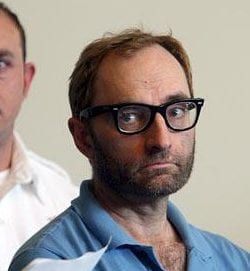
    A German who used many aliases but whose biggest pretence was to give the impression he was a member of the Rockefeller family. The Man in the Rockefeller Suit gives the best account of his exploits but it is for the 2009 parental kidnapping of his child, Reigh Storrow “Snooks” Mills Boss, by a Harvard graduate named Sandra Boss that he is best known. Jailed for four to five years after being convicted for kidnap, he was subsequently also charged with the 1985 murder of a Californian man named Jonathan Sohus. Whilst this fantasist of the first order rots in the clink, his former wife has built a new life in Knightsbridge, London.

  • Gerry & Kate McCann

    Gerry & Kate McCann

    Their daughter Madeleine disappeared on the evening 3rd May 2007 from a holiday apartment whilst they sat enjoying tapas with a bunch of friends. Some believe the poor child was kidnapped. Others have alternative theories. A public fund to find “Maddie” raised hundreds of thousands of pounds but Mrs McCann’s book, Madeleine, contains so many references to trips on private jets and meeting famous people that it makes one question whether the search for the child or fame has become the focus.

  • Leslie "Les" Allen-Vercoe (also known as Les Vercoe)

    Leslie "Les" Allen-Vercoe (also known as Les Vercoe)

    This property developer tried to sell Britain’s ugliest crib, Updown Court at Windlesham in Surrey, for £70 million in 2008. It languished on the market for years and looked like a cross between a Tesco store and Center Parcs. The mansion included five swimming pools, a heated marble driveway and 103 rooms. Nobody loved it but after it was repossessed in 2011, it was finally sold on for £35 million. Meanwhile, Allen-Vercoe appeared in the dock at Southwark Crown Court in 2012 in relation to a case involving the £10 million mortgage fraudster Joanne Sarah Pier (also known as Zoe May Fletcher and Maria Micheala). He was cleared.

  • Captain Simon Mann

    Captain Simon Mann

    This former army officer boldly led a coup d’état in Equatorial Guinea in 2004. He was imprisoned for 34 years but received a presidential pardon from President Teodoro Obiang Nguema in 2009. This Old Etonian’s account of the episode, Cry Havoc, is a great read and he now lives peacefully in Hampshire with his wife and seven children. Here is a top dollar chap who took the rap whilst others who were involved got off scot-free.