A marine residence with a history tied to the Rolls-Royce Spirit of Ecstasy, the Special Operations Executive and Babycham
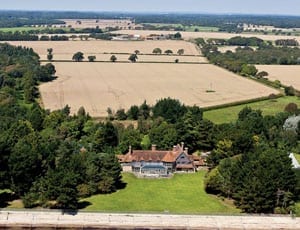
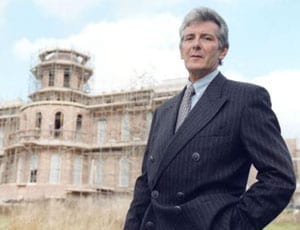
The House on the Shore on Thorns Beach at Beaulieu in Hampshire is a home that wouldn’t look out of place in the Hamptons or Rhode Island. Dramatically situated next to the Solent waters to the north of the Isle of Wight, this suitably named building wouldn’t have been out of place in the 1980s BBC series Howards’ Way. It could. Indeed, have been an ideal home for Gerald and Polly Urquhart. (more…)
Matthew Steeples explores the story of an empty Kensington mansion
A multi-million pound 8-bedroomed house in Kensington isn’t anything unusual. In fact, rather, they’re ten a penny. In this, one of the wealthiest boroughs in the land, large, expensive homes are just the norm.
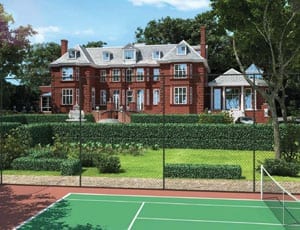
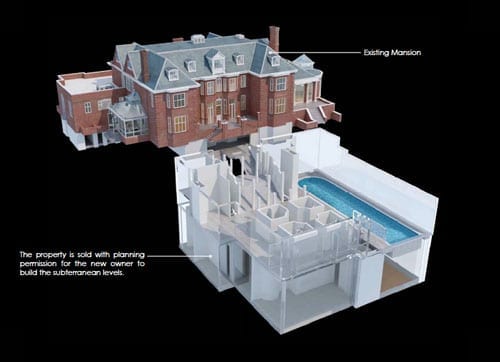
An image of the existing exterior of No. 1 Campden Hill, London, W8 7ADA rendered image of how the exterior of the renovated property might lookThe plans show a vast subterranean development that will vastly increase the size of No. 1 Campden Hill
No. 1 Campden Hill, which is being marketed for an undisclosed eight-figure sum, is in a quite different league. Here is a detached Edwardian house in an acre of grounds just to the north of Kensington High Street. It’s an unrenovated property but it attracted much press attention in October 2011 because it was place on the market in October 2011 at a price of £75,000,000. Yes, you heard it right: £75 million for a fixer-upper. Last week, Radio 4 made a hell of a fuss about a derelict semi-detached house in Newcastle selling for just £14,000 so this truly must be something special.
Architect Edward P. Warren (1856 – 1937), far right, in the offices of Bodley & Garner, 14 South Square, Gray’s Inn, London
The architect of the house Edward Prioleau Warren (1856 – 1937), a Bristol born architect and archaeologist, was best known for “Oxford colleges and minor country houses” but also designed the War Cemetery at Basra. He was a friend and adviser to the American novelist Henry James and in addition to building No. 1 Campden Hill in 1915, he also designed a house at 5 Palace Green in 1906 and another, Estcort House in Kensington Palace Gardens, in 1904. Warren’s guiding style is described as having been to recreate an “understated revival of English late 17th century” architecture and at No. 1 Campden Hill he created just that.
Colonel Edmond Grove-Hills (1864 – 1922), born Edmond Hills, and his wife, Juliet Spencer-Bell, were the architect’s clients. A plaque on the building bares their names and the following dedication:
This House I built for Me & Mine
May it be of Peace A Shrine
And no Enmity or Sin
Ever find its way therein
AD 1915
Sadly for the Grove-Hills, the following year, their son, Second Lieutenant Charles Herbert-Hills (1895 – 1916) was killed on the Somme aged just 21. His father, meanwhile, was awarded a CBE in 1918 after having served as the Assistant Chief Engineer of Eastern Command during the war.
Aside from his military exploits, Edmond Grove-Hills is best known for his role as president of the Royal Astronomical Society. He took part in observations of eclipse of the sun in Japan in 1896, India in 1898 and Russia in 1914 and contributed papers analysing both this and the causes of the irregular movements of the earth’s axis of rotation.
In 1951, No. 1 Campden Hill was purchased by the government of Uruguay and it became the residence of their ambassador to the United Kingdom. For the next fifty years the building was barely altered but when the lease from the Phillimore Kensington Estate came to an end, there were legal problems as the 1951 transfer had never been stamped. Of this, Sharon Mulroney of Forsters, the legal representatives of Phillimore, commented:
“It is highly unusual to be faced with complications of this kind when dealing with a registered London title, but this made the transaction all the more fascinating. Even the decision to allow ambassadorial staff to return to the property for security purposes after completion was fraught with potential problems about security of tenure, employment and tax.”
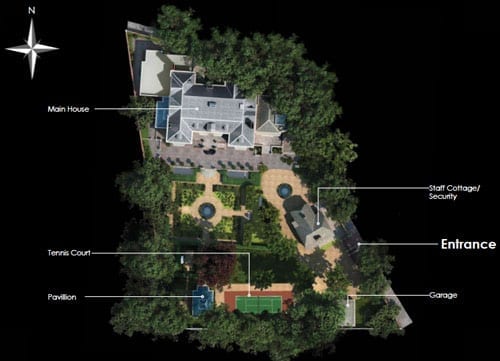
The proposed site plan shows the addition of a garden pavilion, staff/security cottage and a tennis court
Eventually, without issue, the Phillimore Estate sold on the house in 2001 for a price of approximately £17,000,000. In the years since, the property was effectively mothballed as all the purchasers have done is to have obtained planning permission to redevelop the building into a mammoth mansion of epic proportions.
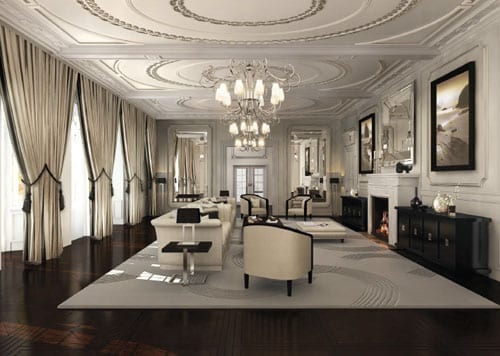
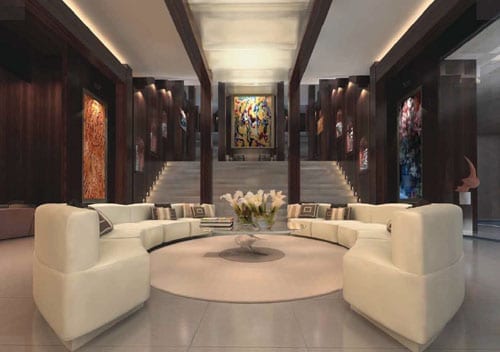
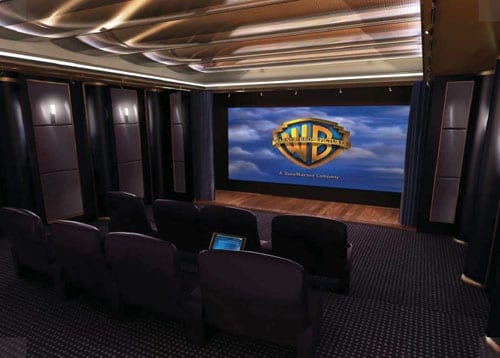
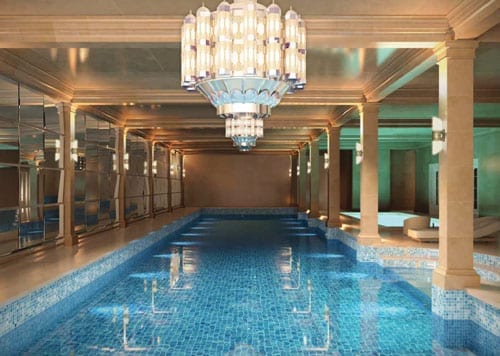
A computer rendered image of how the drawing room might lookThe “leisure area” is reminiscent of the entrance to The Mandarin Oriental Hyde Park HotelThe private home cinema would be the envy of any movie buffThe swimming poolThe wine cellar is rather like a contemporary take on Berry Bros. & Rudd’s flagship store in St. James’s StreetAnd to complete it all… The plans include your own version of Boujis in the basement
The approved plans show designs for something quite remarkable. Warren’s “understated” residence will be replaced with 8 vast bedroom suites, grand entertaining spaces, a lift and even bedrooms for 5 staff. In addition to a full-scale renovation of the original freehold house, there is scope to provide a total of 30,000 square feet of accommodation by adding a huge subterranean complex that will include a 25-metre swimming pool, court, squash court, gym, sauna, steam room, function room, entertainment room, home cinema, wine tasting room and even a nightclub to rival any of Kensington’s trendiest haunts.
On that basis alone, No. 1 Campden Hill is surely the ideal residence for Prince Harry: “Who needs Boujis?” we hear him cry.
No. 1 Campden Hill, London, W8 7AD is for sale through Knight Frank. For more details contact Roddy Craggs on +44 (0) 20 7938 4311 or go to:http://search.knightfrank.com/ken100161to download a brochure.
Charles Mitford Cust asks: “Do the clocks really need to go back?”
Yesterday, once again, the clocks went back and now we are officially in winter. As is always the case on this sad annual occasion, I am left asking myself why we have do something so apparently illogical and what are the origins of this extraordinary ritual.
These “hairy beasties” definitely govern the clock rather than being governed by it
I used to think it all started in World War Two but, in fact, having done some research, it transpires that we very sensibly did the exact opposite during the war years. Between 1940 and 1945 and also in 1947, we actually switched to “British Double Summer Time” (BDST). Why? We did so to save precious fuel as it was in limited supply. That should strike a chord today, don’t you think?
You bet it should. Supporters of BDST point out that 500,000 tonnes of CO2 would be saved this year if instead of putting the clocks back yesterday, we’d left them alone and then put them forward one further hour in the spring, thereby achieving British Double Summer Time (BDST). Half a million tonnes of CO2… Wow! That is the equivalent of permanently removing 185,000 cars from the road. Hang on, aren’t we meant to be concerned about the environment these days or am I missing something?
Where are the eco-warriors? Surely they should be screaming from the rooftops about CO2 savings like this. This makes all their bleating about wind turbines and solar panels seem stupid. Unlike these alternative energy sources, which we all know are only viable thanks to taxpayer subsidies, putting the clocks forward is free, and you can’t get anything greener than a free CO2 reduction. Yet strangely there is barely a whisper from the normally most vocal section of the green orchestra. Now, I am no conspiracy theorist, but I cannot help but feel that this is highly odd if not darn right suspicious.
There have always been myths concerning BDST, including strong if vague references to the requirements of farming being the reason for us being plunged into darkness earlier than necessary. This is something that, as a countryman, I have always found puzzling.
Farmers do not rely on the time indicated on their watches to go about their business. They do what their ancestors have done for thousands of years: they operate from first light to last light. The time that happens to be recorded on a watch face is all but irrelevant to them because unlike 90 per cent of the population, they do not have to catch trains or commute to work. What’s more, cows don’t wear watches, they just know when they want to be milked and they don’t care what Mr Rolex has to say about it.
Interestingly though, even this well used excuse seems to have been run off the road. In March 2010, in a survey of their membership, the National Farmers Union found that most respondent farmers were neutral about BDST and actually the only strong representation was from members supporting longer daylight in winter.
Another long-term excuse is that children in the north of Britain would be in more danger walking to school in the mornings if it were dark. “Walking to school?” When was the last time a kid walked to school in this country? 1951? Seriously though, with traffic density as it is today, no responsible parent would let their child walk to school even if they could do so. As Lord Archer has pointed out, this is outdated nonsense and therefore not a viable excuse for rejecting BDST.
The Royal Society for the Prevention of Accidents (RoSPA), the RAC and the AA have campaigned for years to reintroduce BDST as they argue that police accident records clearly indicate that more accidents occur in the dark evenings during rush hour when tired commuters are returning from work than when they are fresh in the mornings. According to their research, they estimate 600 lives per year could be saved. 600 lives: that’s the equivalent of a bloody massacre. The government moved heaven and earth to ban competitive handgun target shooting when 30 people were killed but have routinely ignored 600 lives per yearfor decades? What are these politicians doing?
A Conservative Member of Parliament, Rebecca Harris, put forward the Daylight Saving Bill 2010-12. It was debated in November 2011 and January 2012, but despite being supported by “Call Me Dave” himself, it was filibustered out of Parliament by largely Scottish based members who argued it would disadvantage Scotland.
These politicians used this argument despite a 2010 survey of 3,000 Scots indicating that they were actually in favour of BDST. I guess Scots like to save money on their heating bills too: oh, there’s a surprise. Anyway, the efforts of these objectors were enough to ensure that the bill’s time was used up and it will now proceed no further.
What? That’s it? 500,000 tonnes of CO2 and 600 lives a year swept under the carpet because a couple of whingeing Scottish MPs are out of touch with their the views of their own constituents? Does that sound right to you? Even if they didn’t vote for BDST, which with fuel prices the way they are, being canny Scots, they almost certainly would, why can’t Scotland have it’s own time zone? Many of them want independence, so here’s a good start. As an aside, evidence also shows that if Scots did adopt BDST, their suicide rate would drop dramatically as the statistics show this is clearly linked to long dark winter nights.
Either way, we have reached a point where political correctness simply has to be outweighed by common sense. You cannot let 85 per cent of the UK population suffer for the sake of the other 15 per cent. What of the adverse affect this is having on GNP at a time when the economy is struggling so much?
The thing about this clock moving business is that the more you search for answers, the more questions you are left asking. One is forced to conclude that it is either a deeply sinister conspiracy involving multi-billion pound energy companies who would rather we carried on paying for an extra half a million tonnes of unnecessary smog, or simply an old fashioned British farce of monstrous proportions.
All in all, I’m left rather perplexed. What’s your view? Isn’t it time that something changed?
The deportation of Abu Hamza and the story of Hassan Butt
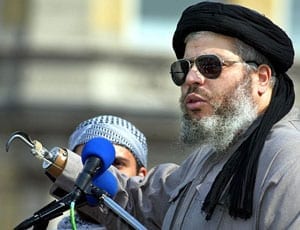
It’s taken far too long but thankfully the day of Abu Hamza al-Masri’s deportation has arrived. This evil one-eyed Egyptian-born Sunni preacher, best known for his hateful views and involvement in terrorism, has been in prison in Britain since 2004 and is now finally to be extradited to America to face terrorism charges.
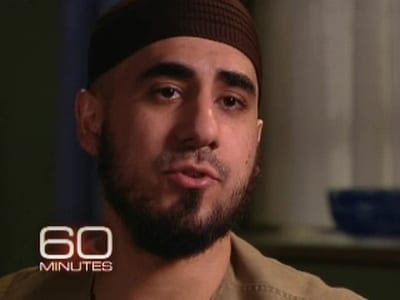
Abu Hamza al-MasriHassan Butt when he appeared on the American CBS television magazine news show “60 Minutes”
My only experience of such people involved meeting a young man named Hassan Butt in 2008. Butt, known in the Muslim community as the Al Qaeda supergrass,” was allegedly a former recruiter for the organisation. I met with him after he wrote an article for the Daily Mail in which he stated:
“My plea to fellow Muslims: you must renounce terror… My pleas to fellow Christians: you must renounce racism.”
These words came from a man, born in 1980, who had previously said of Britain:
“I feel absolutely nothing for this country. I have no problem with the British people… but if someone attacks them, I have no problem with that either.”
These words came from the very mouth of a man who had been a member of the now banned radical Islamist group Al-Muhajiroun. Butt claimed to have taken tea with Mohammad Sidique Khan, the leader of the 7 July bombings, recruited upto 200 people to undergo jihadist training in Pakistan and raised between £7,000 and £9,000 a month towards the “cause.” Here was someone who had concluded that:
“I would agree to being called a radical and one day I may even be called a terrorist, if Allah permits me. That is something it would be an honour to be called.”
On the day Butt’s “Damascene conversion” article was printed I was working with an American billionaire vodka tycoon on his various projects in the UK. The man concerned came to London on a periodic basis and always began his day by scouring his favourite right-wing paper for whatever took his fancy. If there were something or someone he liked the look of in it, he’d yell across the room: “Get ‘em round.” More often than not, when I made the call, such people would turn up as many sought funding for their projects. Few of them ever got whatever they were after as this individual was especially careful with his dollars.
On reading Butt’s article, which I admit I also found well written, the Jewish billionaire was thoroughly impressed. He said: “I like the sound of this guy. Get him round.” At the end of the article was a Gmail address so reluctantly, imagining that no doubt MI5 would begin monitoring my own account, I sent off a message. Within minutes, Mr Butt was on the phone.
Butt told me that he’d be in London in the following days to appear on Newsnight with Jeremy Paxman so I invited him to lunch. On the day in question, an extremely well presented 27-year old appeared in a brand new £50,000 Audi Q7. After he’d parked, I said: “That’s a nice car.” His response: “The BBC have loaned it to me.” I was perplexed and thought this unlikely, but let it go.
I introduced Mr Butt to the vodka tycoon and for the next hour, the Muslim and the Jew chatted about the differences and similarities between their religions and ways of life. The utterly charming Butt wanted the billionaire, who happened to own a publishing house, to pay for and print his autobiography. The aggressive billionaire had another agenda. His vision of how to unite the religions was to produce a leaflet. He ranted: “It’ll begin thus: ‘If I want to worship a tree, I’ll worship a tree’.” An impasse was reached.
Over lunch at Choy’s on the Kings Road, the conversation continued hopelessly in the same vein. When it was over and as Butt drove away in the Q7, all I could think of was that the security services would most probably now begin monitoring our business activities.
That night, Butt appeared on Newsnight and beat off all of Jeremy Paxman’s attacks. I suppose all who recruit for terror organisations are probably charm personified but Butt most definitely showed his utter brilliance of mind when put up against the media’s finest.
Butt’s strategy worked as he was subsequently invited by the then Minister of State for Security, Counter-terrorism, Crime and Policing, Tony McNulty, to advise them on how to stop young Muslims being “radicalised.” Butt, whom a government source described as having “understood the terrorist mindset perfectly,” had managed to get to the heart of the British government.
The next move of this man, who was arrested but released without charge on five counter-terrorism charges between 2002 and 2008, was to claim that Greater Manchester Police were harassing him. Many of his allegations, though, were illustrated to be pure fantasy in the transcripts of interviews held with them:
“I actually arranged myself to be stabbed in the shoulder, sorry in my arm and in my back because I knew if I said I had been attacked Shiv ([Malik] a freelance journalist and co-author of Butt’s autobiography, Leaving Al Qaeda: Inside The Life And Mind of A British Jihadist) was going to ask for some proof so basically I stabbed myself… you know it was just part of the whole scam.”
I do not know what has become of Butt now but the last reports of him I have been able to find were published in the Daily Mail in July 2009. Here, the paper reports that he “hurled an onslaught of race abuse at police” during an argument over where his Audi Q7 was parked. How odd that that vehicle, supposedly loaned by the BBC, had surfaced again but equally strange was that this educated man was accused of shouting such things as: “Do you like feeling Pakis up?” and calling police “Gestapo,” “bald dogs” and “members of the BNP.” This portrayal was most certainly at odds with the Butt that I met, but plainly he was the Jekyll and Hyde of Al Qaeda.
Whilst my encounter with the pseudo-terrorist Butt was almost certainly with a young man of fantasist tendencies, Abu Hamza truly is a preacher of hate and a force for evil. This hook-armed “terrorist facilitator with a global reach” claimed tens of thousands in benefits in Britain yet also incited others to blow up our citizens. He solicited murder and stirred up racial hatred yet happily ran up legal costs at this nation’s expense. As such, Abu Hamza’s downfall is very much welcomed and his deportation from the British Isles will be celebrated not just by Her Majesty the Queen but indeed by the whole nation.
Watch a Channel 4 News video clip featuring Hassan Butt at: http://www.youtube.com/watch?v=_t3uw2nZ7kY
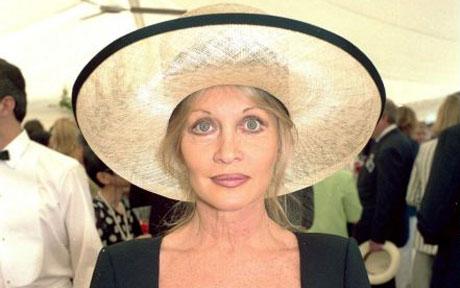
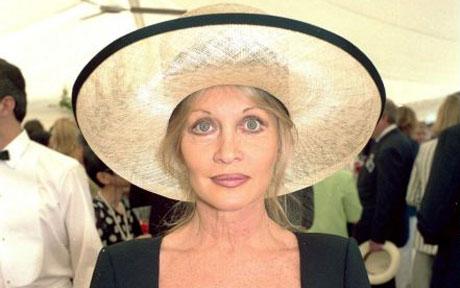
The founder of the world’s first boutique hotel moved to London in 1962 with just £10 to her name. She’s acted with Anton Rodgers in Zodiac and was in the 1969 James Bond film On Her Majesty’s Secret Service but it as a designer of global repute that she is best known. Married to Sir Mark Weinberg, the founder of St. James’s Place Wealth Management, Hempel was born on a boat sailing from Papua New Guinea to New Zealand. This society figure’s first hotel, Blakes, created in 1978, is the favourite of personalities such as Sharon Stone and Seal and still sets the barometer for style today.