As Fred Dibnah’s former home comes to the market, Matthew Steeples is reminded of a true BBC legend
As the nation continues to cringe in horror every time the name “Savile” is mentioned, memories of another BBC relic of the 1980s resurfaced when it was revealed that Fred Dibnah’s former home is for sale.
Dr. Frederick “Fred” Dibnah MBE (1938 – 2004)121 Radcliffe Road, The Haulgh, Bolton, Lancashire, BL2 1NU (originally known as Park Cottage)
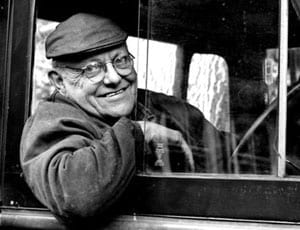
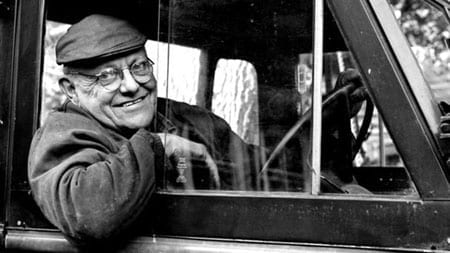
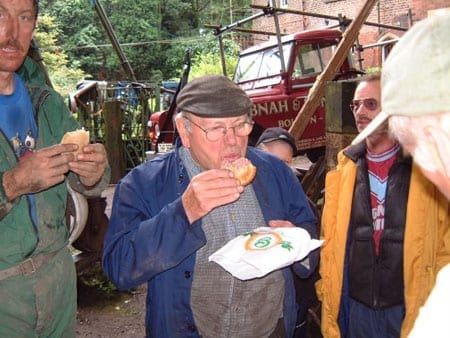
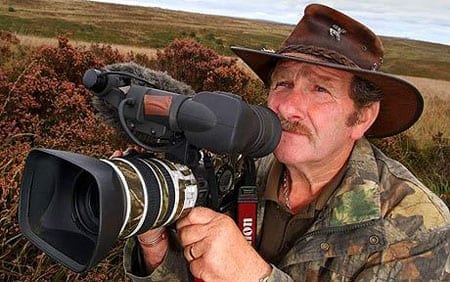
For those of our readers who weren’t fortunate enough to be alive when Dibnah graced our screens, he, unlike Savile, was a legend who truly deserves the accolade of such a title. This thrice-married Lancastrian was a steeplejack who became a television personality just as his breed died out. He didn’t understand why he’d become famous and of it commented:
“It’s a funny thing, this celebrity. If you don’t wave back you’re a miserable bugger, if you do wave back you’re a big-headed bugger. I don’t know.”
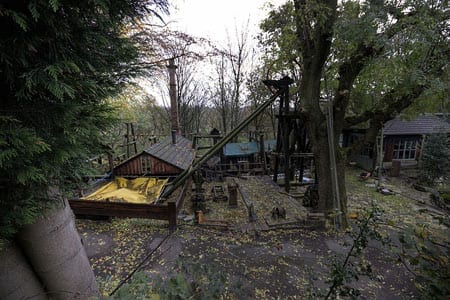
Fred Dibnah in his gardenA view of the “garden”
Fred Dibnah preferred to think of himself as “just a bum who climbs chimneys” but he ought instead be remembered for his forthright manner. Amongst the legendary comments this “chimney feller” came out with were remarks like:
“The modern world stinks… We’ve become a nation of con men, living by selling double-glazing to each other… Teaching boys to bake cakes? That’s no way to maintain an industrial empire… Them fancy London types don’t know the pleasure of eating chips with fingers… I prefer the past to the present. Because life today, with all its modern technology, isn’t very good, is it? And the future looks even worse.”
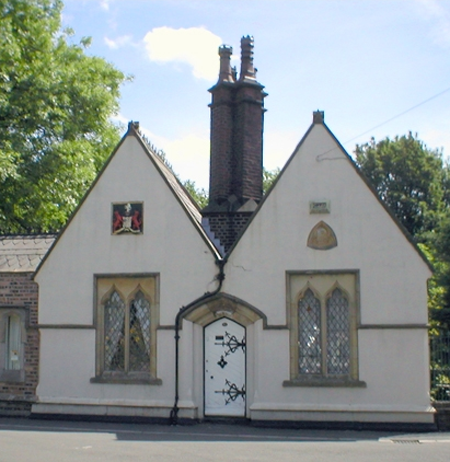
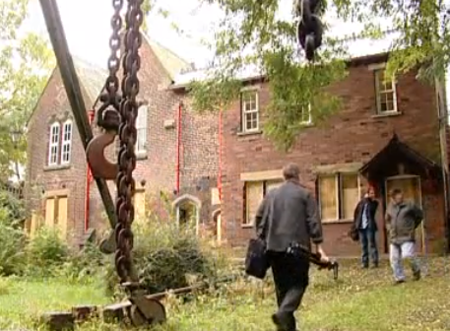
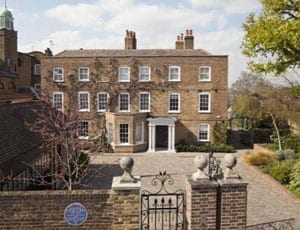
Dibnah bought 121 Radcliffe Road in Bolton in 1967 for £5,000. A Grade II listed former park keeper’s lodge, the building is known as “Two Cats” locally because of the coat of arms of the Earl of Bradford on one of the gables features two leopards and is said to have been built in 1854.
The cottage was the setting of the filming of many scenes from Dibnah’s shows and it was here also in 2003, whilst undergoing chemotherapy, that Dibnah decided to embark on the construction of a replica coal mine with his friend Alf Molyneux. His rationale for this was simple: “It’s not everyone who has a coal mine in their back garden.”
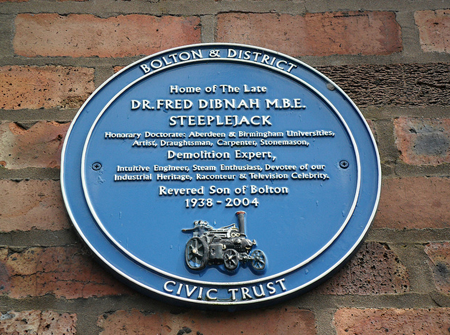
An attempt to auction the house with a guide price of £300,000 to £350,000 in 2007 failed because of a boundary disputeA Bolton & District Civic Trust plaque commemorates Dibnah having lived there from 1967 until 2004
Leon and Jeanette Powsney purchased the derelict property in 2009 for £185,000 and set about turning part of it into a 5-bedroomed home for themselves and the remainder into The Fred Dibnah Heritage Centre.
Visitors, who come by the coachload, are able to tour the yard and see Dibnah’s machinery. Amongst that on show are steam-powered workshop with a circular saw, a band saw and a hydraulic hammer. The 70ft mine shaft remains and in addition there is a 50ft chimney, a gift shop and a small tearoom. The venture turns over about £100,000 per annum and is now for sale through agents Intelligent Business Transfer.
Mr Powsney, who is planning to move abroad, commented:
“We’re selling it as a going concern. It was a business set up against all the odds, we saved it from being flattened and from being redeveloped. We have worked hard to make the centre what it is, and have invested a lot of money in it. We think there’s potential for a buyer to make a tidy profit from it, but we’re looking to relax a bit more now.”
If the asking price of £1,250,000 sought by Mr & Mrs Powsney is achieved, I’m sure the legendary steeplejack wouldn’t disagree that here is a case of: “Where there’s muck, there’s brass.”
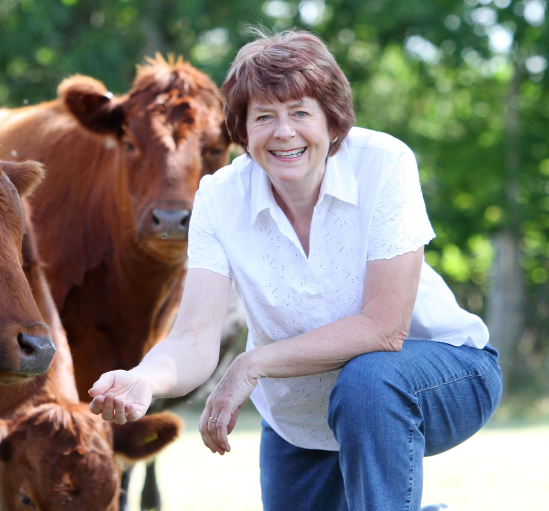
Yesterday, I found myself listening to a self-proclaimed “writer, broadcaster and entertainer” named Pam Ayres on BBC Radio 4.
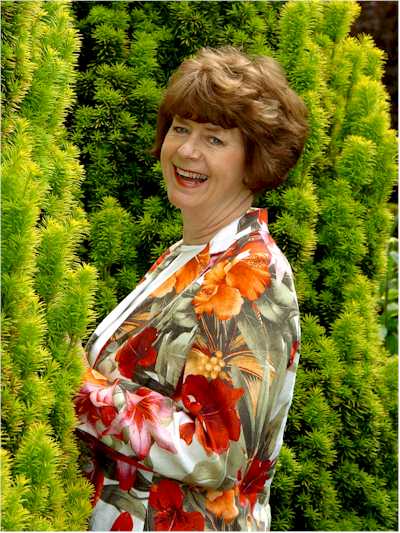
Pam Ayres
An example of her style numbers:
“I am sittin’ on the sofa. By the fire and stayin’ in. Me head is free of comfort. And me nose is free of skin. Me friends have run for cover, They have left me pale and sick. With me pockets full of tissues. And me nostrils full of Vick.”
I recall having first encountered the supposed “humour “of Ms Ayres, whom the Daily Telegraph once described as “the doyenne of doggerel,” at a dinner hosted by The Lady Taverners at The Savoy some years ago. As Ayres droned on, an American lady at my table tapped me on the shoulder and said: “What the hell is this strange woman on about?” Having never heard of this “poet,” I shrugged and simply responded: “I haven’t got a clue.” When, in desperation, it was suggested we vacate to the bar, I embraced the idea with gusto. Sat there with an extremely strong martini, I felt well again.
That, I assumed, would be the last my poor ears heard from Ayres but sadly it was not to be. Radio 4, which I listen to throughout the day, have chosen to give her airtime and yesterday, when she came on, the first comment from my friend Charles was: “Oh God, not her, she terrified me even when I was a kid.” The unwelcome ghostly voice of an evening past had returned to my life.
Having had my fill, I thought I’d share my thoughts with my Twitter followers and posted the following:
“I have to say @PamAyres is quite possibly the most tedious person on @BBCRadio4. Her attempt at “humour” is cringeworthy and annoying.”
Within minutes, I’d been bombarded with hatemail from furious fans of Ayres. Most curiously amongst them were missives from the former game show panelist Annabel Giles (@Annabel_Giles) and “Britain’s premiere [sic] Nazi hunter” Alan Stoob (@nazihunteralan). Plainly Ayres is “much loved” in all manner of circles.
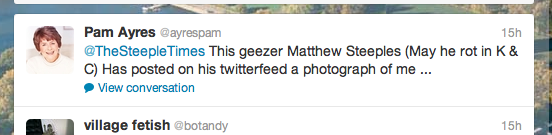
Later, a poem came from the woman herself. It reads as follows:
This geezer Matthew Steeples (May he rot in K & C)
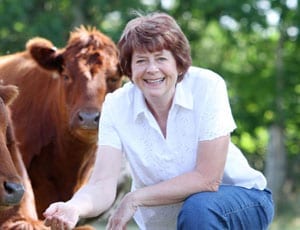
Has posted on his twitterfeed a photograph of me
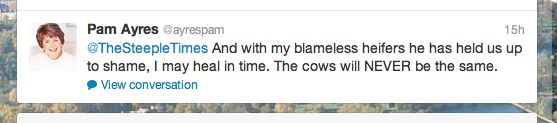
And with my blameless heifers he has held us up to shame,
I may heal in time. The cows will NEVER be the same.
“Blummin’ ‘ell:” I didn’t know whether to laugh or cry. Never could I have imagined that I’d find myself immortalised in a poem by Pam Ayres.
Learn more about Pam Ayres at: http://www.pamayres.com or follow her on Twitter:http://www.twitter.com/ayrespamShe might even pen a verse in your honour if you’re, erm, lucky.
This supposed “First Lady of Comedy” spouts lines like: “He had a bull name Floyd, but he was unemployed.” How long did it take her to come up with that? Her appearances on Radio 4 and elsewhere are peppered with references to “blummin’ people” and how she’s “stuck all [she] can stick.” Could someone please put her out to pasture before all our eardrums burst?
The North Devon countryside that inspired Henry Williamson, R. D. Blackmore and Charles Kingsley
Much of my childhood was spent reading the works of superb authors and amongst the best of them were Arthur Ransome (1884 – 1967), Denys Watkins-Pitchford (1905 – 1990), who wrote many of his works under the pseudonym “B.B.”, and Henry Williamson (1895 – 1977). As a youngster, I was lucky enough to be read to by Ransome’s nephew, a most captivating professional storyteller, and was given first editions of many of the works of all three of these early to mid twentieth century authors.
I had my first sailing lessons on Windermere, where Ransome set many of his works, and went shooting in the Forest of Bowland, a place dear to B.B. Though I also fished in many wonderful locations, until now I’d never been to the land of Henry Williamson and his most famous creation, Tarka the Otter. I currently find myself here enjoying a break from London and yesterday I randomly discovered, I am staying next to the setting of one of Williamson’s lesser known stories, Salar the Salmon, on the River Bray close to Exmoor.
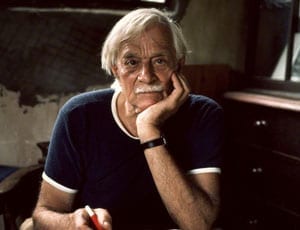
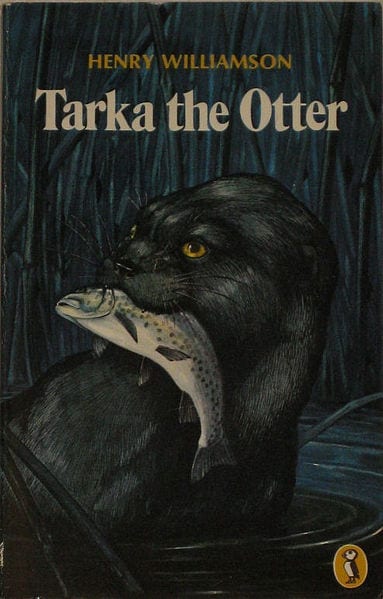
“Salar the Salmon” by Henry Williamson (1935)Henry Williamson (1895 – 1977) photographed by Mark Gerson, cibachrome print from original transparency, August 1970“Tarka the Otter” by Henry Williamson (1927)
Originally published in 1935, Salar the Salmon combines Henry Williamson’s great talent as a writer with his insight as a naturalist. The story tells the tale of a five-year old salmon named Salar, whose name means the “leaper,” and his return to the stream of his birth. Salar’s migration through the riverways of Devon involve him surviving porpoises, seals, nets, fishermen, otters, poachers and weirs and Williamson’s account truly gives the reader an insight into one of nature’s great journeys.
Henry Williamson wrote both Salar the Salmon and The Children of Shallowford (1939) whilst living beside the River Bray in a hamlet named Shallowford, near Lynton in Devon. The river plainly inspired him and whilst he lived there on the Fortescue Estate he also sired four children, joined Oswald Moseley’s British Union of Fascists, was briefly imprisoned for his views and conducted several extra-marital affairs.
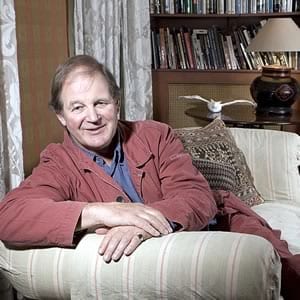
“War Horse” author Michael Morpurgo OBE
Salar the Salmon is a story I am not alone in recommending. Another Devon based author and poet, Michael Morpurgo OBE, best known for his acclaimed work, War Horse, speaks very fondly of Williamson and the novel in a dedication he prepared for a recent reprint of it:
“It is a rare gift indeed for a storyteller to be poet as much as a storyteller, to tell a tale so deeply engaging that the reader wants to know what will happen and never want it to end, and yet at the same time tells it in such a way as to leave a reader wide-eyed with amazement at the sheer intensity of feeling that can be induced by the word-magic of a poet. Henry Williamson is just such a story-maker poet.”
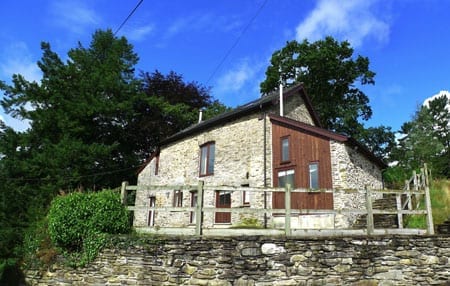
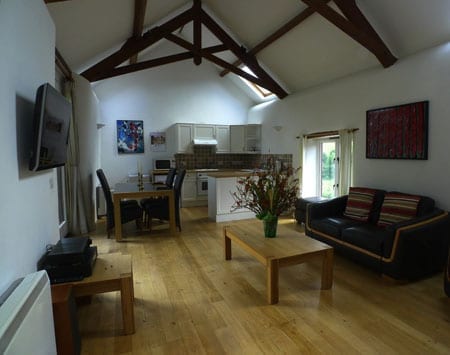
Where I am staying, I have a view of the very river on which Salar made his journey and here also a detached barn conversion is currently available to rent at a price of £1,150 per month. Malle’s Barn is a 2-bedroom stone-built property that includes a 25ft by 12ft open plan sitting room with a fully fitted kitchen and a dining area, as well as a study and shower room.
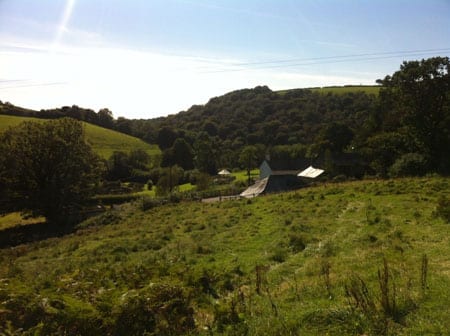
The exterior of Malle’s Barn, Brayford, Near Barnstaple, Devon, EX32 7QBA large open plan reception room includes sitting, dining and kitchen areasThe setting of Malle’s Barn overlooking the valley of the River Bray
Tenants of the house will have access to the owner’s 60-acre estate which includes a mile of salmon and brown trout fishing on both the Rivers Bray and Holewater, ancient woodland and a lake in addition to a private garden and adequate parking for several vehicles.
Malle’s Barn would make a perfect retreat for any author or artist and is just 10 minutes from South Molton, Barnstaple is 9 miles away and Exeter 40 miles. The location is 30 minutes from J27 of the M5 and Tiverton Parkway Station, which provides mainline links to London Paddington within 2 hours.
Close to Malle’s Barn are the prettiest sections of a footpath named the Tarka Trail. Consisting of over 180 miles of footpaths and cycle tracks that take in the Dartmoor and Exmoor National Parks and the North Devon Coast Area of Outstanding Natural Beauty. The trail takes in many of the locations described in Williamson’s most famous novel but this area of North Devon also galvanized the pens of a number of other authors.
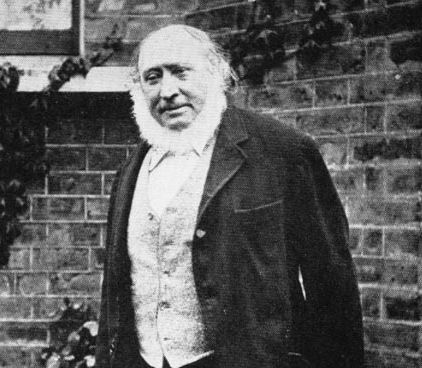
Richard Doddridge Blackmore (1825 – 1900)Professor Charles Kingsley (1819 – 1875)
Richard Doddridge Blackmore (1825 – 1900) set Lorna Doone: A Romance on Exmoor in the locality in 1869 and Professor Charles Kingsley (1819 – 1875) put pen to paper here when he wrote Westward Ho! in 1855. A village of the same name was subsequently established near Bideford in the 1860s by entrepreneurs, led by Lord Portsmouth, who saw an opportunity to capitalise on the novel’s success. Westward Ho! is the only place in the United Kingdom with an exclamation mark in its name. The only other place in the world that shares such is Saint-Louis-du-Ha! Ha! in Quebec, Canada.
Aside from literary connections, the locality is famous for its excellent fieldsports. The Earl and Countess of Arran’s Castle Hill and the Molland shoot are considered amongst two of England’s finest high bird pheasant shoots and both the Devon and Somerset Staghounds and Devon and Somerset Foxhounds hunt on Exmoor.
Johnny Kingdom
Johnny Kingdom, who describes himself as having been “a farmer, quarryman, forestry worker, gravedigger and, if truth be told, a poacher” in his youth, also lives in the locality and is well known as a wildlife photographer, filmmaker and television presenter. He sets many of his series on Exmoor because of the vast array of wildlife he comes across here and is, like Williamson before him, often to be found exploring the valley of the River Bray.
In a 1965 BBC interview Henry Williamson was asked: “What influence has this [the Devon] countryside had on you?”:
“Everything, I should say. I came down here as a youth, aged just 18 in 1914, spent a fortnight’s holiday here in the beginning of May, beginning of June. I walked 20 to 25 miles every day. Everything I saw was radiant and beautiful.”
This idyllic part of Devon that Williamson loved so much remains unspoilt to this day. If you haven’t visited yet, it really should be added to your bucketlist.
The Steeple Times picture of the week has to be of Pamela Burbery, a pensioner from Birmingham.
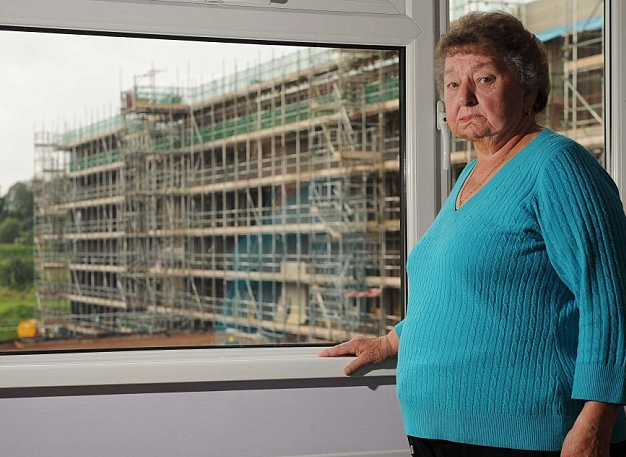
Pamela Burbery puts on her best face
Photographed for an article in the Daily Mail, this 76-year old told of how she feels like she’s “under siege” after a school was built at the end of her garden.
In typical whingeing Brit mode, Burbery stated:
“I’ve worked it out that I won’t even be able to make a cup of tea without being watched… My home will be like a goldfish bowl with nowhere to hide… I haven’t been in my garden for 12 months and it’s not going to change now.”
Deborah Carpenter, Burbery’s daughter, had to chip in as well:
“We’re just nothing to the council, it’s a joke how people can be treated like this. They just sit there shrugging their shoulders. It’s absolutely disgusting what can be done to a 76-year-old woman. The council should have bought my mum’s house under a compulsory purchase order.”
Who do this pair think they are? When soldiers are dying in Afghanistan and countries verge on bankruptcy, could the Daily Mail not have found something more worthy to write about? It plainly was a bad news day but the tortured face of this moaning old bag was just too good not to share.
The sale of the £22,500,000 Clarence House in Richmond
Built in 1696 for a haberdasher merchant named Nathaniel Rawlins, Clarence House in Richmond was subsequently extended by his daughter, Elizabeth, before it became a Catholic school in 1792.
The exterior of the Grade II listed Clarence House, 2 The Vineyard, Richmond Hill, Surrey, TW10 6AQ
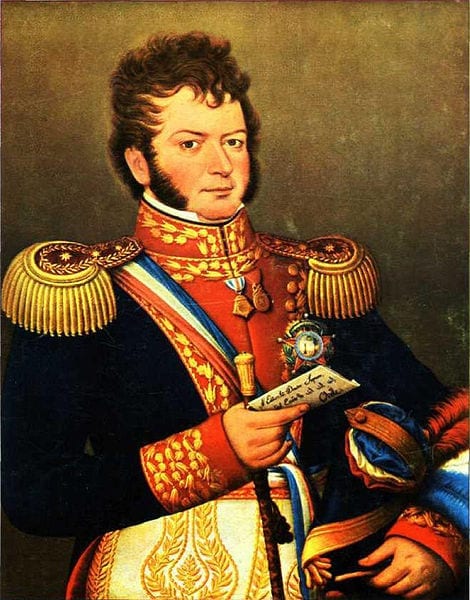
One student at the various schools that were subsequently run from the house was Bernardo O’Higgins, the liberator and founding father of Chile. Famous for his orders, which included such statements as: “Lads! Live with honour, or die with glory! He who is brave, follow me!” during the battle of El Roble, O’Higgins held office from 1817 to 1823. He was deposed by his former “closest ally” Ramón Freire in a conservative coup in January of that year, exiled to Peru and died due to cardiac problems in Lima in 1842.
Bernardo O’Higgins (1778 – 1842), 2nd Supreme Director of Chile
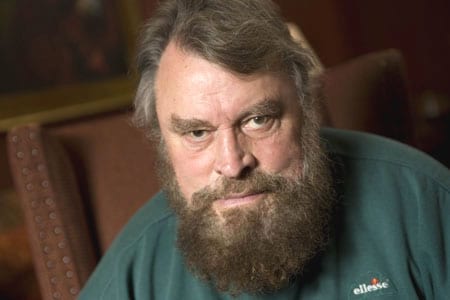
Between 1941 and 1947, Clarence House became a storage house for Fortnum & Mason. Their plans in 1943 to demolish the building and to replace it with a bakery, chocolate manufactory, store, tailoring shop and rooms for packing tea and coffee were not executed and in 1967 the house was purchased by the actor Brian Blessed.
Actor Brian Blessed (1936 – )
Blessed, known for his “sonorous voice and hearty, king-sized portrayals,” is a prolific performer who has appeared in Z-Cars, The Avengers, Lovejoy and Flash Gordon. After a successful campaign on the social network Facebook, Blessed became a voice option for TomTom’s satellite navigation devices in 2010 and he also holds the record being the oldest man to trek on foot to the magnetic North Pole. Married to Hildegarde Neil, an actress who appeared alongside Roger Moore in the The Man Who Haunted Himself, Blessed subsequently moved to Windlesham, also in Surrey.
A reception room designed by Taylor Howes DesignClarence House’s dining roomThe house’s ultra modern kitchen
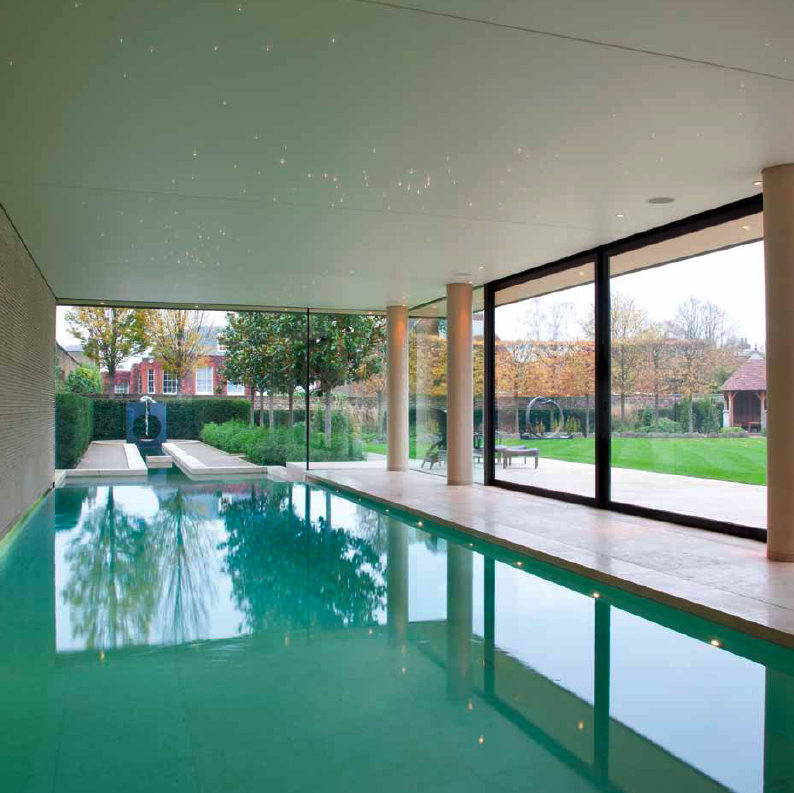
Considered “one of the finest houses in South West London,” Clarence House has been restored by Taylor Howes Design, who also designed the Hotel Meyrick in Galway, Ireland. It now includes 6 reception rooms, a master suite of bedroom, sitting room, dressing room and bathroom and 5 further bedroom suites. An indoor swimming pool with an infinity style design, gymnasium, 2,000-bottle wine cellar, artist’s studio and 1 bedroom guest cottage complete the offering whilst landscaped gardens by Ross Allan boast magnolia trees, a terrace and water features.
Clarence House’s swimming pool
Priced at £22,500,000, whoever buys this fine residence will indeed be blessed with more than 10,000 square foot of accommodation. The price, however, is a far cry from the £25,000 Blessed paid for it back in 1967.