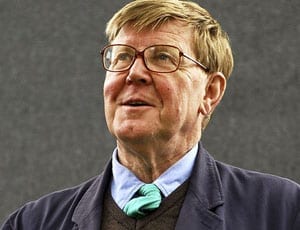
Playwright Alan Bennett chooses ‘hypocrisy’ as Britain’s best achievement (more…)
Tag: environment
-

Dame Shirley Porter DBE (née Shirley Cohen)
 Tesco heiress Dame Shirley Porter joined Twitter in August 2014 and describes herself there as “an English philanthropist and former UK politician residing in Israel”. (more…)
 -

Video of the Week: How wolves change rivers
George Monbiot film showing the consequences of reintroducing wolves into the Yellowstone National Park is a ‘must watch’
Shared on Facebook by both filmmaker Ellen Perry and financier turned vintner Michael Polenske, a video named “How wolves change rivers” is a 4:33 minute “must watch”. (more…)
-

Ben Goldsmith: “What’s on your mantelpiece?”
20 questions with leading clean technology investor Ben Goldsmith
The Steeple Times shares “wit and wisdom”. What’s your guiding force?
My love of the natural world.
“Don’t get even, get medieval” is, in our humble opinion, a great motto. What’s yours?
“Behold the turtle. He sticks his neck out”.
-
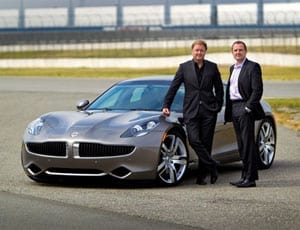
Oiling up brings the Karma a Destino
Could a V8 engine save the Fisker brand?
Yesterday, FoxNews.com asked: “Can the internal combustion engine save the electric car?” and answered: “In the case of the Fisker Karma, it just might be”.
-

Hofit Golan: “What’s on your mantelpiece?”
The Steeple Times asks TV presenter and model Hofit Golan: “What’s on your mantelpiece?”
The Steeple Times shares “wit and wisdom”. What’s your guiding force?
Know what makes you happy and build your life around that. People will always offer their opinion so know how to take the advice you need without compromising your own ambitions, dreams and drive. Where there is a will, there is a way, and the journey to your destination is the fun part. Finally, learn to be present in the moment.
“Don’t get even, get medieval” is, in our humble opinion, a great motto. What’s yours?
Mine is: “Actions speak louder than words”.
Kerry Katona was considered unacceptable in 2007. Who or what is unacceptable in 2013?
I don’t think its fair on Kerry to even start the question that way, but what’s unacceptable for me these days is the horrible biotech company Monsanto and the poisonous GMO foods they have given the world. They have a disregard for mother-nature, to livestock and to peoples’ health. Its truly sad they are even allowed to exist. I think everyone has the right to clean organic food and water. We shouldn’t be messing with nature and DNA
Tony Blair misses being Prime Minister. What do you miss most in your life?
I don’t miss anything. If I feel like something is missing, I do something about it. I find it, work for it, create it or replace it.
What might you swap all your wealth for?
The health and happiness of the people I love and even strangers if it came down to it. If I could keep them safe, it would be priceless to me.
Donald Trump was once a case of: “If you owe the bank a thousand, they close you down; but if you owe the bank a billion, you own the bank”. What’s your view on the banking crisis?
Greed: Corruption and carelessness have influenced the long-term economic effect that this greed has and will cause.
What phrase or word do you most loathe?
“No. It’s not possible”.
In the UK, some people consider charity to “begin at home”. What’s your view and what causes do you personally support?
Charity starts in your heart, then should grow and spread into everything we do. If you can help your local community you can see your work have an effect. Find small organisations you trust and support them. Kindness and love is the beauty of our human nature. We should try to spread as much of that and help people in need every chance we get.
The judge in Law Abiding Citizen states: “I can pretty much do whatever I want” before being blown up whilst answering her mobile phone. What’s your view on the appropriate use of such devices?
Appropriate usage of a mobile phone? A camera, a video phone, a mirror, for text, BBM, Whatsapp, Twitter, Facebook, Instagram. Oh and yeah, you can use it to call people.

Hofit Golan If you could fill a carriage on The Orient Express, who would be your fellow passengers?
An eclectic mix of everyone from every walk of life, every class group. I would be a fly on the wall and just be interested to see how people that normally don’t interact would react to one another. It would be so interesting.
If you were unfortunate enough to end up on death row, what would be your last meal and where would you eat it?
My last meal? So morbid. I don’t think I would have much of an appetite, maybe a dish from home that my mom made me while growing up. I guess I would eat it in jail.
What time is it acceptable to consume the first drink of the day?
I am teetotal. I’ve never drunk.
A Negroni, a martini or a cup of tea?
A cup of organic herbal jasmine green tea.
Whose parties do you enjoy the most and why?
I can’t really answer that as every event is lovely and every party has someone working hard to please their guests. They all have their charm. The people you know make a party fun, not the party itself.
Who is the most positive person you know?
My brother, Dror Golan. He always makes me laugh
What’s your most guilty pleasure?
Dark chocolate.
If a tattoo were to sum you up, what would it be of?
I’m not that easy to sum up.
If you were a car, what marque would you be?
I’m a girl… I don’t even understand this question… For women, make it about shoes!
Cilla Black presented Surprise, Surprise. Tell us the most surprising thing about you.
I am passionate about the environment, animal rights, organic clean living. I live a very glamourous life but love the most simple basic things like a good walk in the park and a yummy cup of tea.
What’s currently sitting on your mantelpiece?
Which one? … Photos of family and friends, Ralph Lauren candles and magazines.
Hofit Golan is a TV presenter and model. She is a brand ambassador for a number of companies and consults on media and press strategies for luxury goods brands.
Follow her on Twitter at: http://www.twitter.com/hofitgolan
-
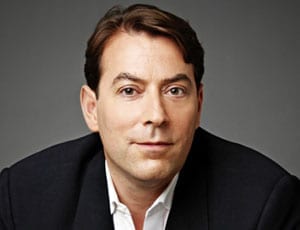
Alan Miller: “What’s on your mantelpiece?”
The Steeple Times asks fund manager Alan Miller: “What’s on your mantelpiece?”
The Steeple Times shares “wit and wisdom”. What’s your guiding force?
It’s a four letter word. It’s Gina, not the four letter word you were thinking about.
“Don’t get even, get medieval” is, in our humble opinion, a great motto. What’s yours?
Believe in what you do and have fun whilst you are doing it.
-
Let there be light!
Thomas James examines the Luzinterruptus art movement
Luzinterruptus is a Spanish artistic group, who create temporary urban interventions in public spaces. Using light as their primary component and the black of night as their canvas, the group consists of three anonymous artists from different artistic backgrounds. Interestingly, the artistic group’s name Luzinterruptus is of Latin origin and means: “Interrupted light.”
The group’s first artistic “urban intervention” took place on the streets of Madrid in 2008. The motive for it was to focus peoples’ attention on a problem they found in the city that seemed to go unnoticed. Some 50% of Madrid’s public drinking fountains have fallen into disrepair and Luzinterruptus wanted to address the city’s administration’s indifference to the need for public drinking water. With their installation, “Drinking Water Running Through The Streets,” they sought to provoke thought and highlight the issue.
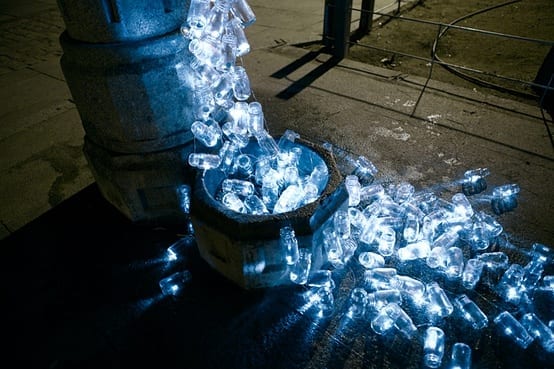
Drinking Water Running Through The Streets To create it, 200 glass containers were collected over the course of 4 months and these were used to fill four fountains with their signature luminous work. The installation lit up the city on a cold night in January and attracted great media interest.
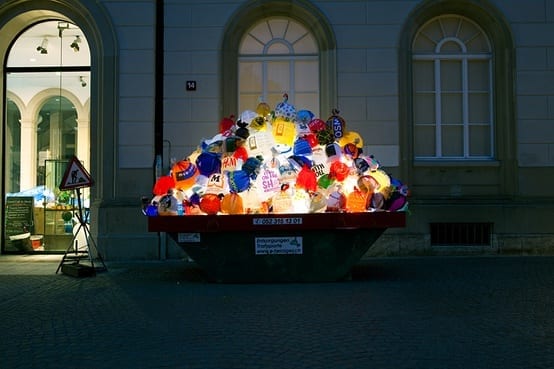
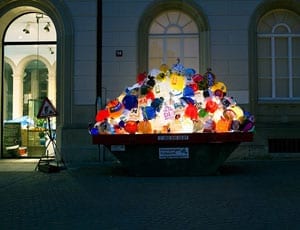
Plastic garbage guarding the museum Another fascinating work by the collective was named “Plastic garbage guarding the museum.” Installed directly in front of the Gewerbemuseum Winterthur in Switzerland, this featured approximately 5,000 plastic bags. They selected the most vibrant and colourful ones from those they had collected, filled each with air and lit them from within. Piled up in a dumpster, they looked more like treasures one would find in Santa’s sleigh. The installation was designed to provoke discussion about consumption and the issue of what damage not disposing of carrier bags properly does to the environment. The plastic bags deflated and deteriorated during the four-month installation and this was said to symbolise consumption and waste, as well as highlighting the damaging effects of mindless consumption. Luzinterruptus proceeded to give visitors to the exhibit an illuminated plastic bag to take away. Their aim by doing such was to: “Fill the sk[ies] with small plasticised full moons.”

1,000 poems by mail Luzinterruptus’s installation “1,000 poems by mail” was created for the “2010 poetas pr Km²” Spanish poetry festival in Madrid uniting light, literature, and public space. 1,000 white envelopes, each containing a small light and a poem written by one of 17 poets, were hung in the gardens where the poetry readings and performances happened. The radiant envelopes illuminated the gardens for three days and added atmosphere to the festival – especially at night. On the final evening, the envelopes were given to the public to keep or to send to someone special. Afterwards, Luzinterruptus mailed out the envelopes with their lights still burning bright.
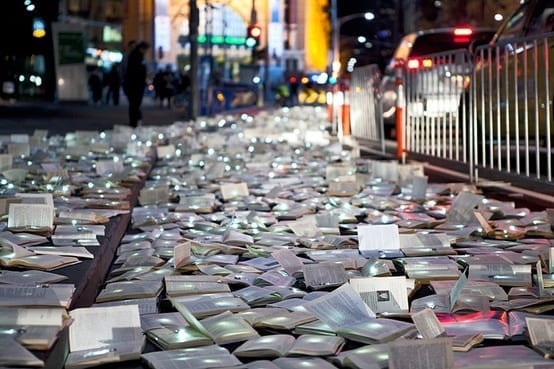
Literature versus Traffic This summer at the Federation Square in Melbourne, Luzinterruptus placed 10,000 illuminated books, which they acquired from local libraries, across the ground during a festival dedicated to reading. They placed LED lights behind the pages of each book to illuminate the printed words. The installation entitled “Literature versus Traffic” was created to portray a winding river going along the streets of the bustling public square. “The objective was to create a symbolic gesture in which literature took control of the streets and became the conqueror of the public space,” one the anonymous artists explained.
Look out. A Luzinterruptus exhibition could be interrupting the streets of your city soon. It’ll certainly be cleverly planned and it will definitely provoke you to think about whatever issue they decide to focus on next.
View the website of Luzinterruptus at: http://www.luzinterruptus.com
View Thomas James’s blog, The Gentledaneur, at: http://thegentleman-dandy-flaneur.tumblr.com
Follow Thomas James on Twitter at: http://www.twitter.com/thomasjames124
-
The death of the typewriter, the death of an era
Gina Miller reports on the death of the typewriter
I noted that Britain’s last ever typewriter rolled off the assembly line at Brother’s factory in Wales last week, the Brother CM1000 electronic typewriter. This was one of 5.8 million typewriters made at the factory since 1985 and it has been donated to the Science Museum in London.
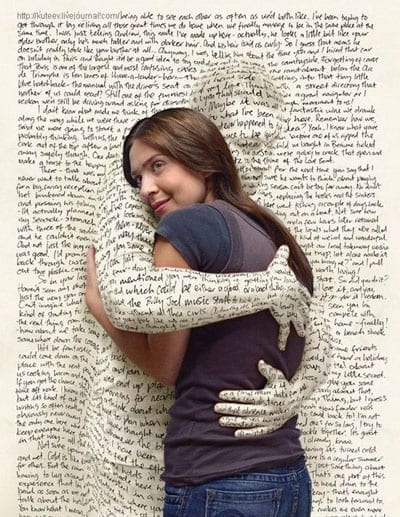
The power of words Over the weekend, whilst perusing the Sunday newspapers, I shuddered at the disgraceful dumbing down of language. Then, last night, whilst watching the evening news, I was appalled by the grammar being used by newsreaders as my radar is now fully focused on honing in on grammatical sabotage.
It has struck me that with the death of the typewriter we are also experiencing the death of an era. An era in which the art and craft of writing, grammar, attention to detail, concentration and a love of words was celebrated has passed. Gone is a time where cutting and pasting required dexterity and glue. A time when mistakes, typos and bad grammar all had consequences; and when people enjoyed a romance with words has indeed moved on. Words that could be simple yet sophisticated have been sadly forgotten. I love the power of words. They are an amazing form of self-expression that can convey such beauty and such emotion. They have the power to make or break a person. They can lift or depress the spirit, they can make us rejoice or cry.
As a young girl I would sneak into the back of a courtroom and marvel as my father, a noted criminal barrister, defended a client. Years later reading the John Mortimer play, A Voyage Round My Father, I found the exact words to express my childhood wonderment. ‘He sent words into the darkness as if they were soldiers into battle,’ Mortimer wrote.
In the work environment we now use computers, which often means people are less productive and lack concentration as they are distracted by the Internet and auto spell checks which dull the intellect. Typewriters used to be chained to desks so they were not stolen or thrown out of windows. But now staff can steal time by using office hours to communicate with friends on Facebook or Twitter, shop online and book leisure activities and holidays.
Outside of work, letter writing is dying; people text to say thank you, to make up – even to break up. Communication lacks emotion, style, considered phrases and politeness. Written communications have been reduced to rough, short, sharp, harsh expressions of functionality.
I love how words taste just before you say them, how some of them have to roll around your mouth for a while before they can be uttered and how others explode off the pad of your tongue, excited to be leaving your thoughts and heading out into the world. Words like ‘strident’, ‘garrulous’, ‘mosquito’, ‘svelte’, ‘sanguine’, ‘parlour’. The word ‘rat’ that you can’t say and be tearful at the same time – it’s a great word to repeat several times when you can’t control your emotions. I love coming across words that I’ve never heard before – sometimes just hearing them is enough to satisfy my appetite but more often than not I need to get the full effect of them by thinking of how to use them. This I explore with my children where we have rhyming games, opposite games; if a word was a colour, what colour might it be?
There are some words that you can’t help but ‘feel’ as you say them – say the word ‘whisper’ and the very air around you changes as you say it. Words are beautiful to say and hear but they really come into their own when they are written down.
I’m certainly not as clever with the use of words and language as I would like to be and I probably use each and every forbidden type of style and grammar error known to man. But I firmly believe that in these fast-paced, hectic times we should all encourage a wider expansion and usage of vocabulary so that generations to come can enjoy the pleasure of words and language.
Like the health message of ‘eat 5 a day’ in terms of fruit and vegetables, I would encourage parents to ensure their children to ‘use 5 a day’ – at least 5 adjectives a day to ensure the beauty of language is kept alive.
Gina Miller is an entrepreneur, philanthropist and lover of words.
For more information about Miller Philanthropy, go to: http://www.millerphilanthropy.com
-
Cows don't wear Rolexes
Charles Mitford Cust asks: “Do the clocks really need to go back?”
Yesterday, once again, the clocks went back and now we are officially in winter. As is always the case on this sad annual occasion, I am left asking myself why we have do something so apparently illogical and what are the origins of this extraordinary ritual.

These “hairy beasties” definitely govern the clock rather than being governed by it I used to think it all started in World War Two but, in fact, having done some research, it transpires that we very sensibly did the exact opposite during the war years. Between 1940 and 1945 and also in 1947, we actually switched to “British Double Summer Time” (BDST). Why? We did so to save precious fuel as it was in limited supply. That should strike a chord today, don’t you think?
You bet it should. Supporters of BDST point out that 500,000 tonnes of CO2 would be saved this year if instead of putting the clocks back yesterday, we’d left them alone and then put them forward one further hour in the spring, thereby achieving British Double Summer Time (BDST). Half a million tonnes of CO2… Wow! That is the equivalent of permanently removing 185,000 cars from the road. Hang on, aren’t we meant to be concerned about the environment these days or am I missing something?
Where are the eco-warriors? Surely they should be screaming from the rooftops about CO2 savings like this. This makes all their bleating about wind turbines and solar panels seem stupid. Unlike these alternative energy sources, which we all know are only viable thanks to taxpayer subsidies, putting the clocks forward is free, and you can’t get anything greener than a free CO2 reduction. Yet strangely there is barely a whisper from the normally most vocal section of the green orchestra. Now, I am no conspiracy theorist, but I cannot help but feel that this is highly odd if not darn right suspicious.
There have always been myths concerning BDST, including strong if vague references to the requirements of farming being the reason for us being plunged into darkness earlier than necessary. This is something that, as a countryman, I have always found puzzling.
Farmers do not rely on the time indicated on their watches to go about their business. They do what their ancestors have done for thousands of years: they operate from first light to last light. The time that happens to be recorded on a watch face is all but irrelevant to them because unlike 90 per cent of the population, they do not have to catch trains or commute to work. What’s more, cows don’t wear watches, they just know when they want to be milked and they don’t care what Mr Rolex has to say about it.
Interestingly though, even this well used excuse seems to have been run off the road. In March 2010, in a survey of their membership, the National Farmers Union found that most respondent farmers were neutral about BDST and actually the only strong representation was from members supporting longer daylight in winter.
Another long-term excuse is that children in the north of Britain would be in more danger walking to school in the mornings if it were dark. “Walking to school?” When was the last time a kid walked to school in this country? 1951? Seriously though, with traffic density as it is today, no responsible parent would let their child walk to school even if they could do so. As Lord Archer has pointed out, this is outdated nonsense and therefore not a viable excuse for rejecting BDST.
The Royal Society for the Prevention of Accidents (RoSPA), the RAC and the AA have campaigned for years to reintroduce BDST as they argue that police accident records clearly indicate that more accidents occur in the dark evenings during rush hour when tired commuters are returning from work than when they are fresh in the mornings. According to their research, they estimate 600 lives per year could be saved. 600 lives: that’s the equivalent of a bloody massacre. The government moved heaven and earth to ban competitive handgun target shooting when 30 people were killed but have routinely ignored 600 lives per year for decades? What are these politicians doing?
A Conservative Member of Parliament, Rebecca Harris, put forward the Daylight Saving Bill 2010-12. It was debated in November 2011 and January 2012, but despite being supported by “Call Me Dave” himself, it was filibustered out of Parliament by largely Scottish based members who argued it would disadvantage Scotland.
These politicians used this argument despite a 2010 survey of 3,000 Scots indicating that they were actually in favour of BDST. I guess Scots like to save money on their heating bills too: oh, there’s a surprise. Anyway, the efforts of these objectors were enough to ensure that the bill’s time was used up and it will now proceed no further.
What? That’s it? 500,000 tonnes of CO2 and 600 lives a year swept under the carpet because a couple of whingeing Scottish MPs are out of touch with their the views of their own constituents? Does that sound right to you? Even if they didn’t vote for BDST, which with fuel prices the way they are, being canny Scots, they almost certainly would, why can’t Scotland have it’s own time zone? Many of them want independence, so here’s a good start. As an aside, evidence also shows that if Scots did adopt BDST, their suicide rate would drop dramatically as the statistics show this is clearly linked to long dark winter nights.
Either way, we have reached a point where political correctness simply has to be outweighed by common sense. You cannot let 85 per cent of the UK population suffer for the sake of the other 15 per cent. What of the adverse affect this is having on GNP at a time when the economy is struggling so much?
The thing about this clock moving business is that the more you search for answers, the more questions you are left asking. One is forced to conclude that it is either a deeply sinister conspiracy involving multi-billion pound energy companies who would rather we carried on paying for an extra half a million tonnes of unnecessary smog, or simply an old fashioned British farce of monstrous proportions.
All in all, I’m left rather perplexed. What’s your view? Isn’t it time that something changed?