Contents of The Hempel Hotel to be sold at auction
The contents of Bayswater’s iconic The Hempel Hotel, originally designed by Anouska Hempel, are to be sold following the building’s sale to British Land for £33 million in March. (more…)
Contents of The Hempel Hotel to be sold at auction
The contents of Bayswater’s iconic The Hempel Hotel, originally designed by Anouska Hempel, are to be sold following the building’s sale to British Land for £33 million in March. (more…)
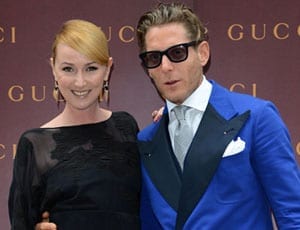
Fiat heir partners with Gucci to launch Lapo’s Wardrobe
Lapo Elkann, a member of the Italian Agnelli dynasty, recently launched a made-to-measure collection named Lapo’s Wardrobe in conjunction with Gucci. (more…)

 This Italian fashion duo founded their Dolce & Gabbana brand in 1985 and variously have been an on-off couple in the time since. Sentenced to 20 months in jail each in Milan in June 2013 for tax evasion, they closed nine of their stores and papered the windows with signs declaring: “CLOSED FOR INDIGNATION”. Their estimated worth still stands at £1.3 billion each nonetheless and an appeal is pending. When asked if he’d like to dress the Obamas in 2009, Dolce replied: “We don’t do politics”. They may, now, have changed their minds.
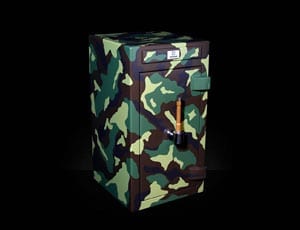
Stockinger’s safes represent the most secure of investments
Masterpiece 2013 closes today. This impressive showcase is something that has been crammed to the brim with some of the finest works of art, design and antiques currently on the market, but given that many of these items are of immense value, they need to be protected. German high-end safe producer Stockinger offer just the solution.

 Laurence Benson is an international jetsetting businessman who is based in Belgravia, Florida and the Seychelles. (more…)

Could a V8 engine save the Fisker brand?
Yesterday, FoxNews.com asked: “Can the internal combustion engine save the electric car?” and answered: “In the case of the Fisker Karma, it just might be”.

The Steeple Times asks author, designer and band manager Sasha Reid: “What’s on your mantelpiece?”
The Steeple Times shares “wit and wisdom”. What’s your guiding force?
“Anything is possible”. I love knowing that you can take a little idea and create anything out of it. The possibilities are endless.
“Don’t get even, get medieval” is, in our humble opinion, a great motto. What’s yours?
“Kill people with kindness”.
Kerry Katona was considered unacceptable in 2007. Who or what is unacceptable in 2013?
For me, people being cruel to animals is something I find unacceptable. I hate the fact innocent creatures are being killed. We should respect the animal kingdom and allow them to share our precious planet.
Tony Blair misses being Prime Minister. What do you miss most in your life?
I miss having Christmas with all my family. When I was growing up I was looked after by a nanny. She wasn’t my granny – she was a proper nanny and had looked after my mum and my uncle when they were little before coming to look after my brothers and me. Our Christmas used to be my mum, dad, 2 brothers and me, nanny and my grandparents.
What might you swap all your wealth for?
Happiness. What is the point of being able to have everything if you can’t be happy?
Donald Trump was once a case of: “If you owe the bank a thousand, they close you down; but if you owe the bank a billion, you own the bank”. What’s your view on the banking crisis?
I hope my money is safe.
What phrase or word do you most loathe?
The word “grand”.
In the UK, some people consider charity to “begin at home”. What’s your view and what causes do you personally support?
I was recently on tour with Kasabian and Jersey Budd who did the Teenage Cancer Trust gig at the Royal Albert Hall. I was inspired to see the good work that the charity does and meet some of the young people who have been helped and hear their stories. I also like to support animal charities.
The judge in Law Abiding Citizen states: “I can pretty much do whatever I want” before being blown up whilst answering her mobile phone. What’s your view on the appropriate use of such devices?
I think mobiles are great as long as they are used at the right time and place.

If you could fill a carriage on The Orient Express, who would be your fellow passengers?
I would want my mum and brothers (Charlie and Sam), and of course my mum’s little dog, Honeybear. I would also invite the Kasabian guys: Tom, Sergio, Dib, Kealey, Ian and Tim so that I could have great music.
If you were unfortunate enough to end up on death row, what would be your last meal and where would you eat it?
I hope I would never end up on death row but if I had to choose my last meal it would be risotto, pancakes, chocolate and a banana cupcake from the Chelsea Teapot on the Kings Road. I would want to eat it all on a beautiful beach watching the sunset.
What time is it acceptable to consume the first drink of the day?
Anytime: It’s always evening somewhere in the world.
A Negroni, a martini or a cup of tea?
A watermelon martini.
Whose parties do you enjoy the most and why?
Matthew Steeples has the best parties. They are full of the most interesting and lovely people in London.
Who is the most positive person you know?
My brother Charlie. He is always so calm and always sees the glass half-full .
What’s your most guilty pleasure?
I love watching American television shows. Nashville and Revenge are my favourites at the moment.
If a tattoo were to sum you up, what would it be of?
It would be a phoenix as I love what this mythical bird symbolises. There is going to be a phoenix on the scarves I’m designing.
If you were a car, what marque would you be?
I would be a red Cadillac.
Cilla Black presented Surprise, Surprise. Tell us the most surprising thing about you.
That I am related to General LaSalle who was first General to Napoleon and I can get married in Les Invalides in Paris. I’m sure the James Bond character was based on him. I am also related to Prince Yusupov who murdered Rasputin.
What’s currently sitting on your mantelpiece?
I have family photographs, candles, a clock that was my granny’s and my Kasabian AAA pass.
Sasha Reid trained to be a teacher before becoming a headmistress of a nursery school. She was then responsible for discovering a Leicester band called Kasabian and worked with them until they were signed to a major label. Currently, Sasha writes children’s stories, manages singer-songwriter Jersey Budd and is designing a range of rock and roll scarves.
Download Sasha Reid’s children’s stories onto your iPad at: http://store.interactivetouchbooks.com/books/sasha+reid+and+amy+withers+riedl
Follow her on Twitter at: http://www.twitter.com/rockchicksasha

 This Palm Beach based “Queen of Prep” was the daughter of a Standard Oil heiress who began her career selling orange juice on Worth Avenue. Customers loved Pulitzer’s bright dresses and seizing on this, she began to sell them. Soon, her creations became the favourites of Jacqueline Kennedy Onassis, Caroline Kennedy and members of the Rockefeller, Vanderbilt and Whitney families. Sales reached $15 million a year in the 1960s and 1970s and net sales in 2010, by which time the company was owned by Oxford Industries, were $122.6 million. Lily Pulitzer’s designs remain as “must-have” items in the wardrobes of wealthy socialites and jetsetters and “The Lilly” is a household name. When told a specific print could not be used for an exhibition of her works because it was expensive, she answered simply: “A budget… How embarrassing”.
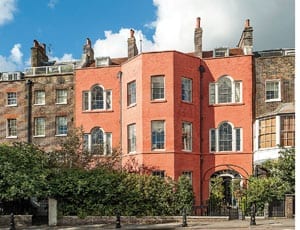
The sale of a historic £22 million residence on London’s Cheyne Walk
Cheyne Walk in Chelsea is amongst the addresses that an estate agent would describe as “the most sought after in London”. Up there in the company of the Bishops Avenue, Grosvenor Square and Cadogan Square, it has moved from having been home to artists such as Whistler, Turner and George Eliot to now being where such people as Mick Jagger, Roman Abramovich, Terry Venables and Sally Greene choose to live.
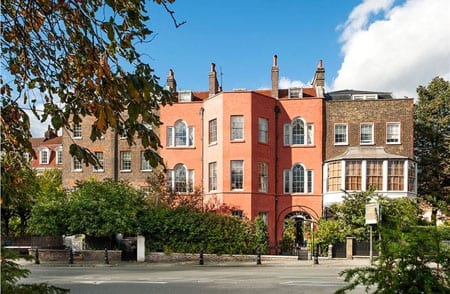
Of the houses there, No. 92, known as Belle Vue House is particularly impressive. Built in 1771, this terraced property stands in the original grounds of Beaufort House, the London residence of the Duke of Beaufort. It is currently for sale for £22,000,000.
The building was reputedly designed by Robert Adam and though no reference to this can be found in the collections of his designs at the Soane Museum, it certainly echoes his style. Constructed from stock brick, this Grade II listed house is nearly 50 foot wide and enjoys southward views across the River Thames.
The builder and first owner of Belle Vue House was John Hatchett, an “eminent 18th century coachbuilder”. He planted a mulberry tree in the garden of the house in 1776 that was described by the historian Faulkner as being what he “reckoned one of the finest trees of its kind in England”. It remains to this day. Hatchett let the house to Lady Prime from 1778 to 1797 and in due course the property passed to his son, Charles Hatchett F.R.S. (1765 – 1847), a chemist and “voluminous writer”.
The next resident was the Scottish pre-Raphaelite artist and poet William Bell Scott (1811 – 1890) and his wife, Laetitia. A friend and contemporary of Rosetti, he used the building as a “veritable museum” and lived there between 1871 and 1890.
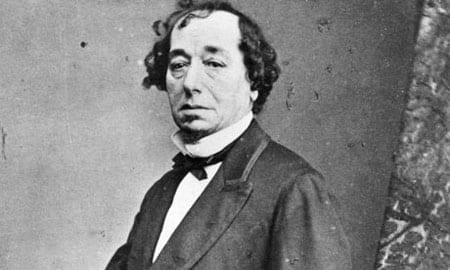
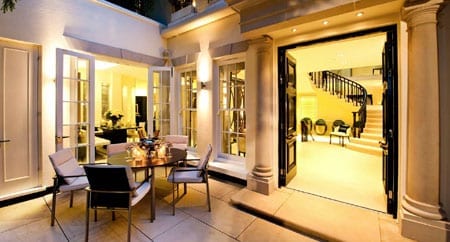
At various times, other distinguished occupiers have included John Marshall F.R.S. (1818 – 1891), a “distinguished anatomist” and professor of anatomy at the Royal Academy and the British Prime Minister, Benjamin Disraeli (1804 – 1881). Disraeli lived in the house for two years during his second premiership and is said to have constructed the canopy that links the front door of the house to the road so that Queen Victoria could “visit in privacy and be protected from the weather”.
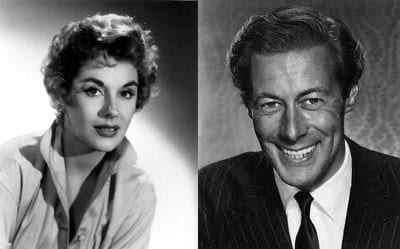
British film actor Sir Rex Harrison (1908 – 1990) lived in Belle Vue House in 1958 with his actress wife Kay Kendall (1927 – 1959). Their short-lived marriage from 1957 to 1959 ended a year later when the Genevieve star died from myeloid leukemia. Terence Rattigan later immortalised their love story in his 1973 play In Praise of Love and in it Harrison played himself.
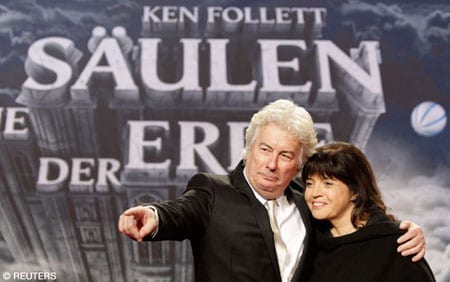
The politician and army officer Sir Patrick Wall (1916 – 1998) took up residence during the 1960s and he was followed by the author Ken Follett and his politican wife, Barbara. Famous for smartening up the Labour Party during the 1980s with what became known as “Folletting”, the house no doubt made the perfect base for the couple’s political salons. The view of the Thames no doubt also provided Mr Follett with inspiration for several of his best-selling novels.
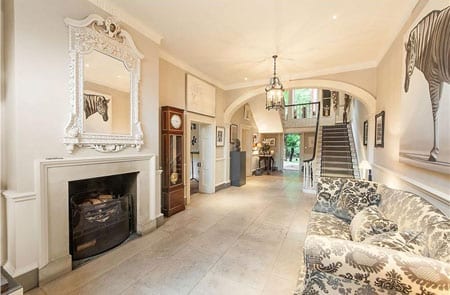
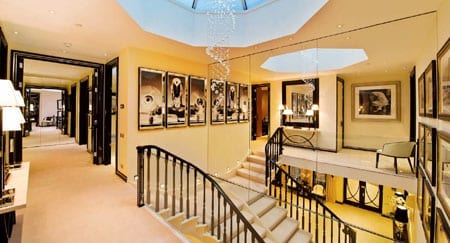
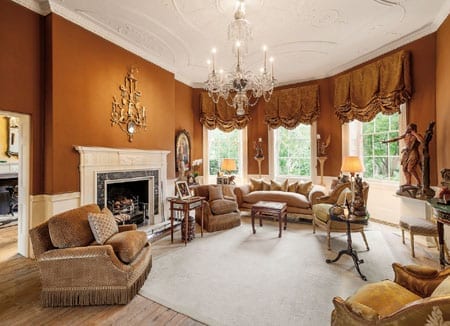
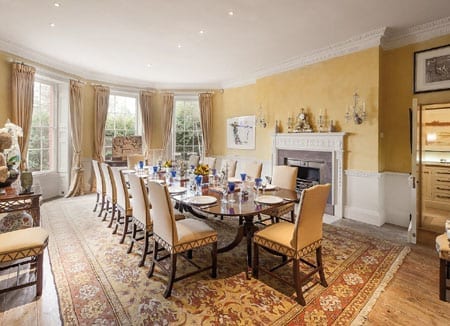
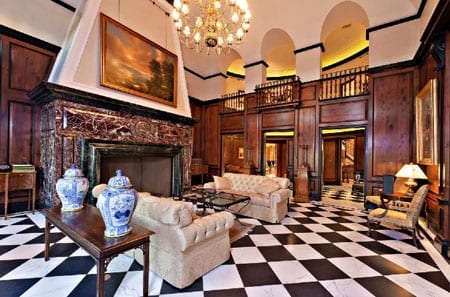
The last documented sale of Belle Vue House records that it was sold for £3,000,000 in May 2000. Since then, this house, now limewashed in a most distinctive Tuscan colour, has been sympathetically renovated and includes 8,400 square foot of internal accommodation. Grandly proportioned reception rooms number a first floor double drawing room, dining room, library and sitting room and in addition the house features a large kitchen, breakfast room, study, three bedroom suites, a gym and wine cellars.
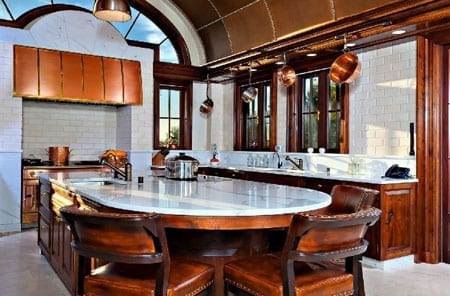
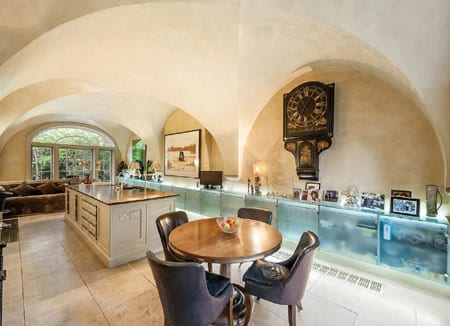
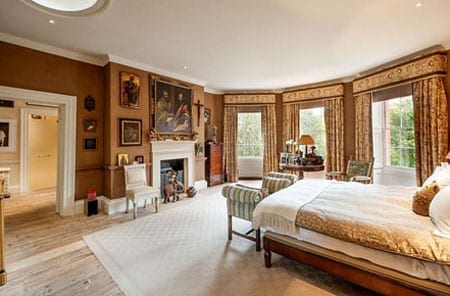
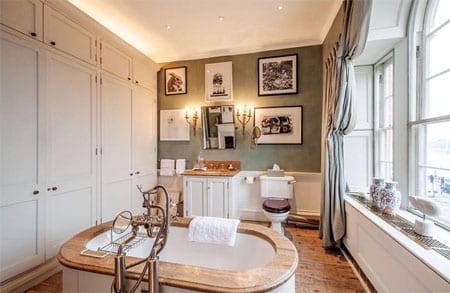
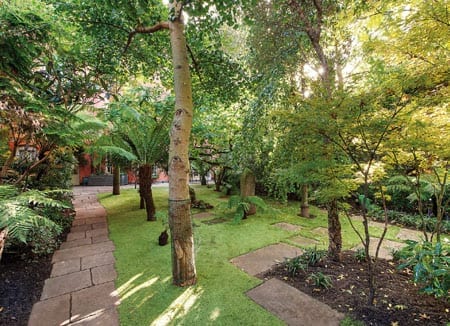
The rear garden is especially large for the location and measures some 64’2” by 47’7” and in addition there is a three car garage and additional parking.
Whilst the “beautiful view” has clearly changed since Belle Vue House was built, whoever purchases this house will undoubtedly be someone who will add to its remarkable history.
Belle Vue House, 92 Cheyne Walk, London, SW10 0DQ is for sale through Tancred Lidbury of Christie’s International Real Estate. For more information contact him on +44 (0) 20 7389 2478.
View further details at: http://www.christiesrealestate.com/eng/sales/detail/170-l-78252-302918/belle-vue-house-chelsea-london-en-sw3
A review of the St. Ermin’s Hotel
I first visited the St. Ermin’s Hotel close to Scotland Yard in St James’s in June 2012 for the first Intelligence Book of the Year Awards. Today, I will return there to attend a reception to announce the second winner of this annual prize by judges Andrew Lownie, Dan Mulvenna, Glenmore Trenear-Harvey, Michael Smith and Nigel West.

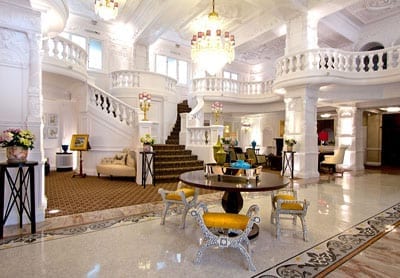
As I reported in my last article on this Victorian property, the St. Ermin’s Hotel’s links with the worlds of politics and espionage are indeed strong. Built in the Queen Anne revival style to the designs of Edwin T. Hall (1851 – 1923) in 1887 and completed in 1889, the horse-shoe shaped building was originally a mansion block prior to being converted to a hotel that opened in 1899 after a major refurbishment by the theatre architect J. P. Briggs (1869 – 1944). Briggs remodeled the public areas and created a spectacular neo-Baroque entrance with balconies, ornate plasterwork and a double staircase.
Due to the building’s proximity to the powerhouses of government, the St. Ermin’s Hotel became a meeting point for officers of the Secret Intelligence Service and, as a result, various traitors and spies. Some worked from offices in the building and amongst them were Kim Philby, Guy Burgess, Laurence Grand and Eric Maschwitz. Others came there to be interviewed and the hotel’s bar, The Caxton Bar, is renowned as having been a noted meeting place for secret intelligence officers.
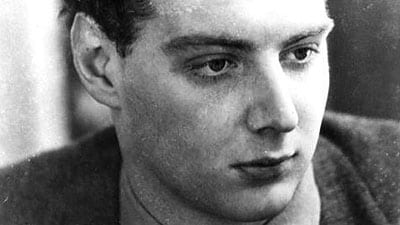
One of the most notable meetings at the St. Ermin’s Hotel was held in 1940 when Winston Churchill brought together a group to join him in “Setting Europe Ablaze”. These founding members of what was to become the Special Operations Executive (SOE) took over an entire floor of the hotel and carried out covert operations from there throughout the Second World War. MI6 were stationed two floors above and then in the 1950s, the hotel’s bar was the meeting point of Guy Burgess and his Soviet counterpoint when he passed intelligence to the USSR.

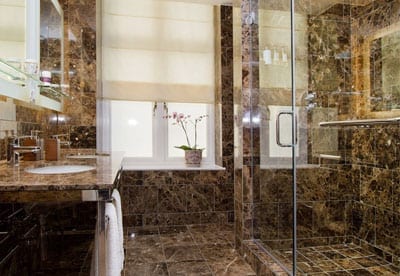
Following on from a £30 million refurbishment to designs by Dayna Lee of Los Angeles-based Powerstrip Studio, the 331 rooms and suites at the St. Ermin’s Hotel are now comfortable, well appointed and decorated in a contemporary style. The two that I inspected, whilst perhaps lacking the charm of a boutique hotel such as Blakes, are absolutely ideal for a business traveller or tourist given the location close to the Houses of Parliament and Westminster Abbey. They are well worthy of their four star rating and I slept well given how centrally located the hotel is.
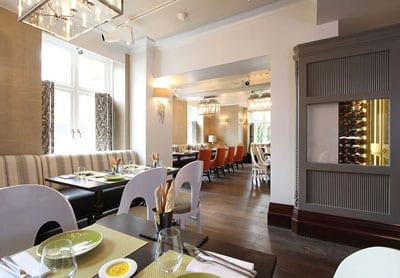
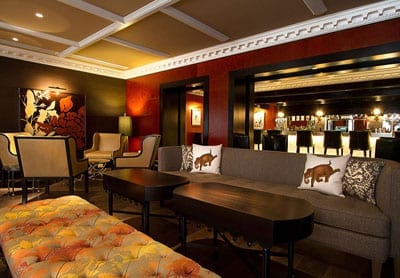
The Caxton Grill, the hotel’s restaurant, continues the traditions of the St. Ermin’s in that it plainly is the haunt of politicians and policeman. Whilst dining there, I met an officer from Scotland Yard who was involved with Operation Yewtree. I can report that, though I had a most fascinating conversation with him about Savile, Davidson and Clifford, I did not leave with any state secrets that I could share here. The restaurant also featured on a recent episode of the BBC One’s MasterChef with Gregg Wallace and John Torode and frankly one could also imagine Hercule Poirot having taken rather a liking to it also. It is modern in style and features wooden flooring, bright décor and snazzy seating.
The restaurant features a menu that focuses on a Josper grill. This £17,000 hybrid barbeque–oven, which I saw so cleverly used by Chris Golding at Beauchamp Place’s Galoupet, allows a chef to cook, barbeque and roast at the same time over charcoal embers at temperatures of upto 600 degrees. Filled with Kentish hardwood every morning, the Josper recirculates smoke via adjustable draughts and, for example, as a result, it takes only about a minute to char infuse lamb and thick-cut beef sirloins. The real thrill of it, though, is that the Josper process ensures that none of the flavor or natural moistness of whatever is cooked in it is lost.
I began with a salad of soured plums, gorgonzola and blackberries (£8) that was colourful and most welcome on a grim winter’s day. My companion tried a roast celeriac and truffle veloute (£7) that though perfectly adequate, did not truly excite.
I continued with a half Temple Farm chicken (£20) that was cooked on the Josper Grill. Well presented and served with a green peppercorn sauce and some garlic and parsley French fries (£4), the cooking process was clearly illustrated. The meat was tender and I must say it was one of the best pieces of chicken I have eaten in years. My companion, an Icelandic financial titan, maxed out on a 300g vintage dry aged sirloin steak (£30) served with béarnaise sauce. Again, cooked to perfection, he was impressed.
Though more than amply fed, we finished by sharing a chocolate fondant (£7). This simple dish melted in the mouth and the accompanying ice cream was just superb.
Wines in the restaurant start at a very reasonable £19.95 for the house white and rise upwards to the £300 a bottle range. A Chablis is priced at £41 and a Gavi di Gavi at £33. The restaurant’s bar, the Caxton Bar, offers a huge array of cocktails but I must say I was rather sad that none of them were spy themed.
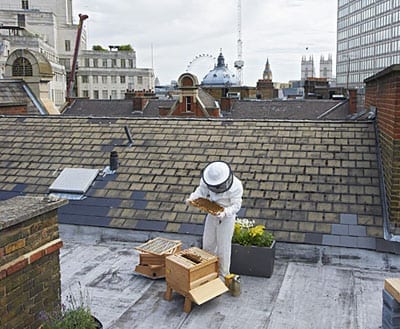
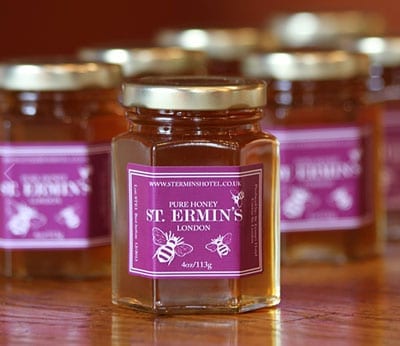
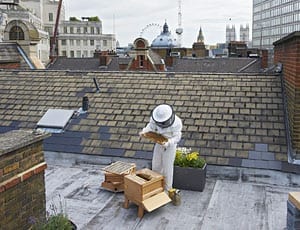
The most quirky thing about the St. Ermin’s Hotel is that it has its own colony of bees. “Bees… In Wesminster?”, I hear you cry. Yes, indeed, 200,000 of them prosper on the roof of the hotel and produce the most delicious honey that is available to guests. From three hives, the Buckfast bees, described as being “good tempered”, have fantastic access to London’s parks and travel within a three mile radius collecting pollen and nectar. “London”, states the hotel’s website, is “a perfect environment for bees as… cities actually trap heat, which means they can start foraging earlier in the year than rural bees and continue later into the autumn”. Who’d have thought it? Where once lived spies, now prospers a colony of bees.
St. Ermin’s Hotel, 2 Caxton Street, London, SW1H 0QW. Telephone: +44 (0) 20 7222 7888. Website: http://www.sterminshotel.co.uk
Follow the St. Ermin’s Hotel on Twitter at: http://www.twitter.com/sterminshotel
Read our report on the first Intelligence Book of the Year Awards at: http://thesteepletimes.com/da-steeps-speaks/long-live-the-spies