Author Sarah Tucker shares her thoughts on the reaction to the death of Margaret Thatcher
I can’t really remember much about when Maggie Thatcher was in power. I know my parents were full of praise for her because our country was almost third world when she became PM, strikes crippling industries, rubbish being left on the streets and she broke the unions – something that was thought impossible. She stood up to them and it took a lot of courage to do so.
I first visited the St. Ermin’s Hotel close to Scotland Yard in St James’s in June 2012 for the first Intelligence Book of the Year Awards. Today, I will return there to attend a reception to announce the second winner of this annual prize by judges Andrew Lownie, Dan Mulvenna, Glenmore Trenear-Harvey, Michael Smith and Nigel West.
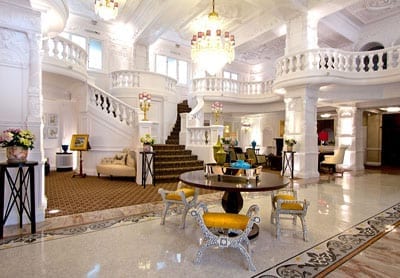
The courtyard entrance to the St. Ermin’s Hotel, 2 Caxton St, London, SW1H 0QWThe grand entrance lobby of the hotel
As I reported in my last article on this Victorian property, the St. Ermin’s Hotel’s links with the worlds of politics and espionage are indeed strong. Built in the Queen Anne revival style to the designs of Edwin T. Hall (1851 – 1923) in 1887 and completed in 1889, the horse-shoe shaped building was originally a mansion block prior to being converted to a hotel that opened in 1899 after a major refurbishment by the theatre architect J. P. Briggs (1869 – 1944). Briggs remodeled the public areas and created a spectacular neo-Baroque entrance with balconies, ornate plasterwork and a double staircase.
Due to the building’s proximity to the powerhouses of government, the St. Ermin’s Hotel became a meeting point for officers of the Secret Intelligence Service and, as a result, various traitors and spies. Some worked from offices in the building and amongst them were Kim Philby, Guy Burgess, Laurence Grand and Eric Maschwitz. Others came there to be interviewed and the hotel’s bar, The Caxton Bar, is renowned as having been a noted meeting place for secret intelligence officers.
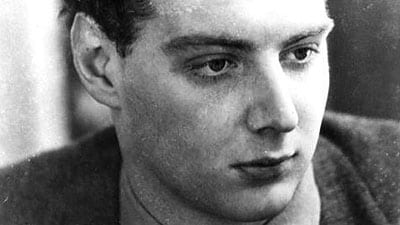
Intelligence officer turned Cambridge Five spy ring member Guy Francis de Moncy Burgess (1911 – 1963)
One of the most notable meetings at the St. Ermin’s Hotel was held in 1940 when Winston Churchill brought together a group to join him in “Setting Europe Ablaze”. These founding members of what was to become the Special Operations Executive (SOE) took over an entire floor of the hotel and carried out covert operations from there throughout the Second World War. MI6 were stationed two floors above and then in the 1950s, the hotel’s bar was the meeting point of Guy Burgess and his Soviet counterpoint when he passed intelligence to the USSR.
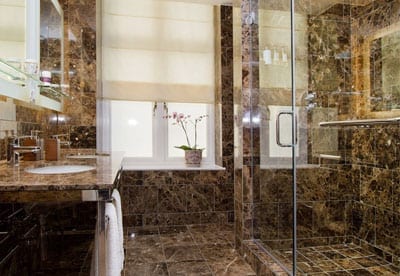
A typical bedroomA luxuriously appointed shower room
Following on from a £30 million refurbishment to designs by Dayna Lee of Los Angeles-based Powerstrip Studio, the 331 rooms and suites at the St. Ermin’s Hotel are now comfortable, well appointed and decorated in a contemporary style. The two that I inspected, whilst perhaps lacking the charm of a boutique hotel such as Blakes, are absolutely ideal for a business traveller or tourist given the location close to the Houses of Parliament and Westminster Abbey. They are well worthy of their four star rating and I slept well given how centrally located the hotel is.
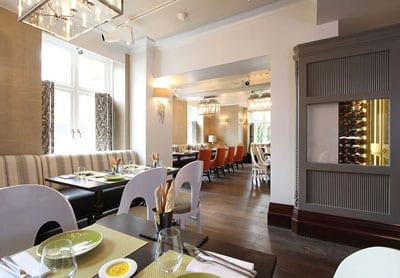
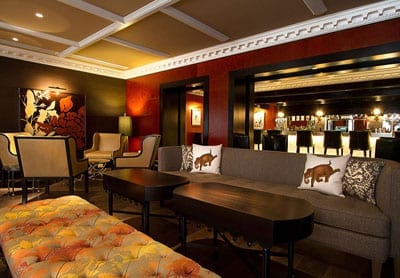
The Caxton GrillThe Caxton Bar
The Caxton Grill, the hotel’s restaurant, continues the traditions of the St. Ermin’s in that it plainly is the haunt of politicians and policeman. Whilst dining there, I met an officer from Scotland Yard who was involved with Operation Yewtree. I can report that, though I had a most fascinating conversation with him about Savile, Davidson and Clifford, I did not leave with any state secrets that I could share here. The restaurant also featured on a recent episode of the BBC One’s MasterChef with Gregg Wallace and John Torode and frankly one could also imagine Hercule Poirot having taken rather a liking to it also. It is modern in style and features wooden flooring, bright décor and snazzy seating.
The restaurant features a menu that focuses on a Josper grill. This £17,000 hybrid barbeque–oven, which I saw so cleverly used by Chris Golding at Beauchamp Place’s Galoupet, allows a chef to cook, barbeque and roast at the same time over charcoal embers at temperatures of upto 600 degrees. Filled with Kentish hardwood every morning, the Josper recirculates smoke via adjustable draughts and, for example, as a result, it takes only about a minute to char infuse lamb and thick-cut beef sirloins. The real thrill of it, though, is that the Josper process ensures that none of the flavor or natural moistness of whatever is cooked in it is lost.
I began with a salad of soured plums, gorgonzola and blackberries (£8) that was colourful and most welcome on a grim winter’s day. My companion tried a roast celeriac and truffle veloute (£7) that though perfectly adequate, did not truly excite.
I continued with a half Temple Farm chicken (£20) that was cooked on the Josper Grill. Well presented and served with a green peppercorn sauce and some garlic and parsley French fries (£4), the cooking process was clearly illustrated. The meat was tender and I must say it was one of the best pieces of chicken I have eaten in years. My companion, an Icelandic financial titan, maxed out on a 300g vintage dry aged sirloin steak (£30) served with béarnaise sauce. Again, cooked to perfection, he was impressed.
Though more than amply fed, we finished by sharing a chocolate fondant (£7). This simple dish melted in the mouth and the accompanying ice cream was just superb.
Wines in the restaurant start at a very reasonable £19.95 for the house white and rise upwards to the £300 a bottle range. A Chablis is priced at £41 and a Gavi di Gavi at £33. The restaurant’s bar, the Caxton Bar, offers a huge array of cocktails but I must say I was rather sad that none of them were spy themed.
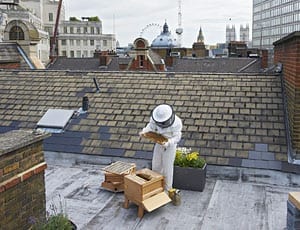
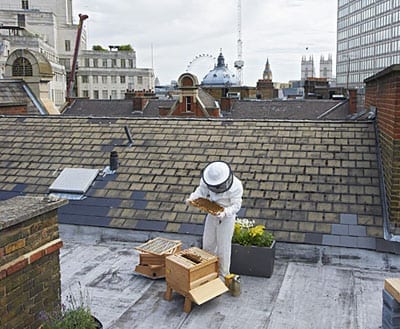
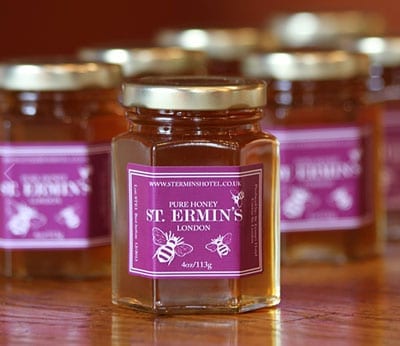
The hotel’s rooftop is home to 200,000 Buckfast beesThe honey they produce is truly delicious
The most quirky thing about the St. Ermin’s Hotel is that it has its own colony of bees. “Bees… In Wesminster?”, I hear you cry. Yes, indeed, 200,000 of them prosper on the roof of the hotel and produce the most delicious honey that is available to guests. From three hives, the Buckfast bees, described as being “good tempered”, have fantastic access to London’s parks and travel within a three mile radius collecting pollen and nectar. “London”, states the hotel’s website, is “a perfect environment for bees as… cities actually trap heat, which means they can start foraging earlier in the year than rural bees and continue later into the autumn”. Who’d have thought it? Where once lived spies, now prospers a colony of bees.
The Steeple Times asks milliner Laura Cathcart: “What’s on your mantelpiece?”
The Steeple Times shares “wit and wisdom”. What’s your guiding force?
“No woman is a success to herself”. I’ve paraphrased this from Graham Greene but I think the thought applies to both men and women. I like originality, and pushing my own creative boundaries, which is why I chose making wacky and quirky hats for myself and my friends rather than working in a Mayfair decorating firm.
This talented Oxford educated author is a former credit derivatives trader who is now regular on BBC2’s The Review Show. This Bleeding City, his first novel, was based on his own working experiences and analyses how the financial crash could be seen as “our subconscious revenge, our way of bringing down the system that had ensnared us”. His second, The Revelations, was described by A. N. Wilson as a “strange and compulsively readable tale of City slickers seduced by a promise of spiritual awakening”. He predicts a bleak future for financiers in suggesting that we are still in the midst of “a crisis that will take more than a few bankers paying back their bonuses to solve”.
Sarah Tucker shares her experiences on a panel discussing the outcomes of Leveson
Journalist and author Sarah Tucker was one of the panelists at a talk at the Richmond Literary Festival on Thursday evening. By chance, since it coincided with the publication of the Leveson Report, the panel’s discussion naturally focused on that. Here Tucker share her thought in an article first published on her own blog:
Will the outcome of Leveson change the media?
I was in excellent company last night as part of a panel at the Richmond Literary Festival that felt almost weirdly timed to coincide with the day of the Leveson announcement.
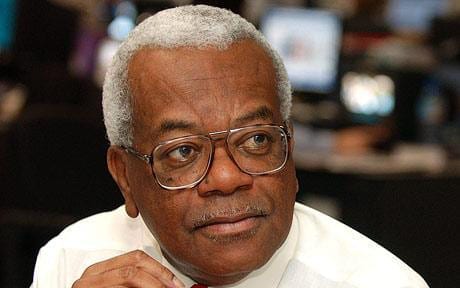
I appeared on a panel with Sir Trevor MacDonald (who needs no introduction, but got one any way), the editor of the Sheengate Titles, Richard Nye; Claire Fox, the director of the wonderfully named Institute of Ideas (which I thought sounded like something out of Hogwarts) and Matthew Syed, illustrious columnist, Times writer and former Commonwealth table tennis champion (I wanted to ask him about table tennis but felt it oddly irrelevant in context of the debate). We discussed if the media were ‘friend or foe’ (though it wasn’t specified ‘to whom’) this of course had been perfectly timed to coincide with the Leveson findings. It was pure fluke but that’s timing for you.
Sir Trevor felt Leveson would change nothing. Everything, he suggested, would be bogged down in committees and sub committees and nothing would be done. Ever. Fox and Syed felt if statute was put in place, it would potentially be very dangerous especially if you had the likes of Blair or Thatcher in charge again or some lesser megalomaniac.
As for my view, I think the politicians are playing a game. They are losers all of them, we are the biggest ones (the punter, the voter, the onlooker), but to think they could come out and out say one way or another would be a nonsense and would take a great deal of courage, which they don’t have.
When I look at politicians now I think of them as actors upon a stage, not meaning anything they are saying, not even understanding most of it, just reciting it. I don’t feel contempt because it takes courage to get up on that stage. And Sir Trevor noted that many journalists and reporters now treat politicians with barely restrained contempt when they interview them. As he noted, at least politicians enter the process to do something of good for their community (although I think some do enter it for ego), something you can never say about those who work in the city.
Sir Trevor McDonald OBE
And who will be in this ‘organisation’ that will monitor the press? Who on earth, on this earth, is so honourable, so without fault, so incorruptible to be considered for this position? A politician? No. A banker? You’re joking. A policeman. Perhaps.
I think you need a ‘common man’, or woman who has a sense, a common sense and an ability to see through the emperor with no clothes phenomenon of what is bullshit and what isn’t, what is in the public interest and what isn’t. It isn’t someone who has risen to the top. If this year has proved anything the shit rises to the top more regularly than the cream does. Although I must say I do like Eddie George. I think his contempt for the city mirrors that of my own, but then he deals with them on a daily basis so that’s understandable.
In many ways the media has been it’s own worst enemy. Editors allowing for lazy journalism – the recent article about Canada in The Telegraph being an example. I met the head of PR for Canada in the UK for lunch this week and she despaired that they usual cliché about Canadians came up without anything relevant or up to date on a country that had a government which managed to manage their bankers – something our politicians have not. As she commented: “It’s harmless but it’s pathetic.”
Then there’s the phone hacking which hacked into ‘common man’ rather than celebrity, who I am afraid I have absolutely no sympathy with. That includes the royals, both the young and old. They are sold to us as though we know them. We don’t have a clue who they are. We just think we do.
Editors encourage journalists to get stories, to hit the negative angles because they are told ‘it makes better news’ and people are more interested in bad news than good. I think it’s been proven somewhere, with stats or something, but then so have a lot of other things which also turn out to be rubbish. And all media are businesses so their bottom line is more important than anything else. Associated Papers are making money, The Times is running on a subsidy, the rest of the papers I think are losing money. The BBC may have been dented but they are respected around the world and like the NHS should not be tampered with. They should not be interested in profit and should aim in their production values at all times and at all cost. Every panelist agreed on that point.
The weave between the institutions of the police, the law, the church, the city, the media, the royals, the politicians has become so entwined. This is like a lover’s tiff that will pass over because the end game is more important. There is too much money, too much power and far far too much ego invested in these institutions for morality and integrity to get in the way of profit.
This has been a year of revelation but not revolution. And if it were it would be the wrong heads that would roll.
Sarah Tucker is an award winning travel journalist, novelist, producer and broadcaster. She has edited, produced and presented her own radio and TV series as well as presenting reports for BBC Holiday Programme and anchored I Want That House on ITV. She is the author of best selling novels The Playground Mafia (short listed for the Good Housekeeping book of the year 2007) The Battle for Big School, The Last Year of Being Single, and The Control Freak Chronicles.
Of Italian-Jewish descent, Caring is of the “supermarket-sweep” school of empire building. This billionaire started out in the rag trade but now controls the majority of the top restaurants and clubs in Central London. He survived the 2004 Indian Ocean tsunami and viewed that to be a wakeup call. Since then he’s donated millions to charity and focused on his two passions: golf and shooting. This buccaneering businessman generally passes on breakfast and lunch and lives between a converted stable block set in 500 acres near Dulverton and a mansion on The Bishops Avenue. What will he buy next?
In the first of a series, we publish a number of the most popular articles from the blog that conceived The Steeple Times. Here, in a February 2012 piece, Matthew Steeples reviews a boozy breakfast at Hawksmoor Guildhall with Anthony Brown. After seeing an image of their breakfast on Facebook this morning, we were reminded just how good it truly is, so if you haven’t tried it already – you really should.
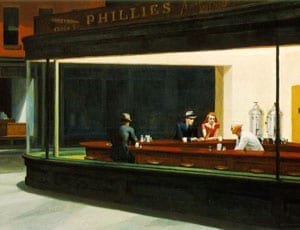
On arrival at the Hawksmoor Guildhall, in the heart of the City of London, I immediately found myself thinking about Edward Hopper’s iconic painting Nighthawks.
Nighthawks (Art Institute of Chicago, 1942) by Edward Hopper (1882 – 1967)
The main dining area at Hawksmoor Guildhall
Here, in this vast space, which can seat 160 in the restaurant and 75 in the bar, was a venue that very much combines the feel of an old banking hall with something akin to a friendlier version of the American café diner in Hopper’s Nighthawks painting. Though, to my mind, the City is indeed a lonely place, the welcoming staff and the somewhat noisy suited brokers created an atmosphere that truly reflected the stature of this fine establishment.
My companion and I wrongly assumed that this relatively new restaurant had simply taken the space of something that had been there before. In fact, this was just a clever trick. The owners, Will Beckett and Huw Gott, collaborated with the Macaulay Sinclair design studio, who were also responsible for their Seven Dials site, to create a style that combines solid mahogany panels made out of Natural History Museum specimen cabinets, a bar formed out of the counter of a Dutch bank and teak flooring taken from the University of the Arts Building near Bond Street. The result is truly impressive.
We opted to share the Hawksmoor breakfast for two priced at £35. This superb offering was served in a large pan with a smoked bacon chop, the most phenomenal sausages made from pork, beef and mutton, black pudding, short-rib bubble and squeak, trotter baked beans, fried eggs, grilled mushrooms, roast tomatoes and HP gravy. Served with unlimited toast, not that it was actually required, this bargain of a meal was a breakfast fit for a king. After this, you really won’t need to eat again for several days.
Also on offer for breakfast, on a menu designed by the Hawksmoor’s executive chef, Richard Turner, are wild mushrooms on toast with poached eggs Hollandaise (£10), a 200g fillet steak with fried eggs and hash browns (£25) and a twist on McDonalds in the form of the sausage and egg HkMufin (£8.50). Scotch pancakes come available with streaky bacon and maple syrup (£6) or with roasted plums (£5).
Urged to try the breakfast cocktails, we sampled the Hawksmoor’s Marmalade Cocktail (£8) of gin, lemon juice, homemade orange bitters and a dash of Campari and another named Shaky Pete’s Ginger Brew (£8.50) that consisted of gin, homemade ginger syrup and lemon juice topped with London Pride. The first was sharp and a perfect awakener and the second, described on the menu as “a turbo –shandy for the discerning drinker,” surprisingly worked utterly brilliant in terms of the ingredients it combined.
Open for breakfast from 7am and serving until 10.30pm at night, this is a restaurant of which the Metro’s Marina O’Loughlin rightly comments: “As Homer Simspon might say, mmmnmnhrhmm…”
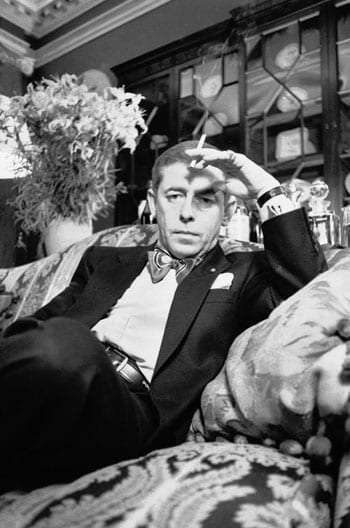
A gent who operated by routine, whisky and 40 cigarettes a day. This clubman’s knowledge of London history was phenomenal and he was dedicated to his role as parish clerk at St. Michael’s Cornhill. Gaze, a Russian icon dealer with a shop in the Piccadilly Arcade, lived a life full of dramas that included being kidnapped by a lunatic named Sacheverell de Houghton and entertaining drag queens in his set of rooms, formerly occupied by Edward Heath, in Albany, W1. Here was a bohemian character who stopped traveling after smoking was banned on aircraft and whom loved both Beethoven and The Beatles.
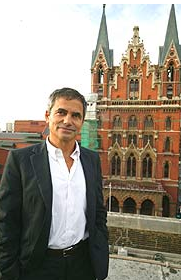
This German-born property developer is best known as the pioneer who brought “loft living” to London in the early 1990s with his Manhattan Loft Corporation. His redevelopment of the Grade I listed St Pancras railway station has resulted in accolades galore and his personal fortune has allowed him to build up a collection featuring works by Andy Warhol, Anish Kapoor, Gerald Laing, Sarah Lucas and Gerhard Richter. Handelsman’s view on money is simple: “[It’s] cynical, sometimes you have it and sometimes you don’t. You can’t take anything for granted.”