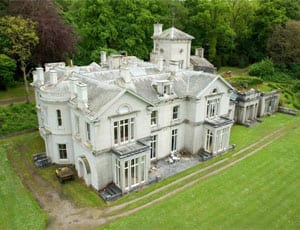
A Cumbrian mansion built by opium traders and more recently used by cannabis growers comes to the market for just £1.5 million
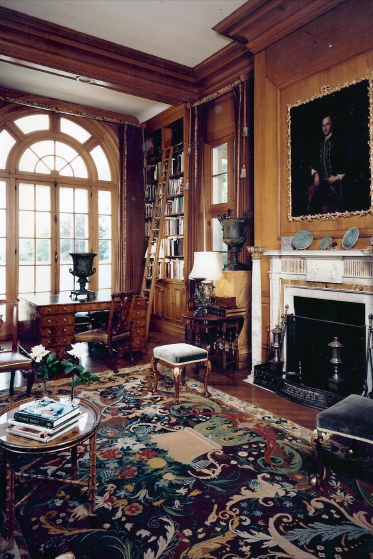
Built by the well-known Dent family, who made their fortune trading both tea and opium, Flass is a vast 23,000 square foot Palladian mansion on the outskirts of the village of Maulds Meaburn in Cumbria. Ironically it was also the setting for one of the country’s biggest drug raids in May 2012. (more…)
Former home of film director Richard Attenborough for sale for £12.75 million
The Academy Award winning actor, producer and director Lord Attenborough is best known for his roles in such hits as The Great Escape, Gandhi and 10 Rillington Place but it was at Old Friars, his home of many years in Richmond, Surrey, that he was able to enjoy watching films in privacy due to the house having its very own private cinema. (more…)
Charles Mitford Cust tells the tale of a Steiff bear with a fascinating past
I was routing around in the family safe one rainy day recently when I spotted an unusual object hidden behind a pile of ancient documents right at the back, it turned out to be a near mint condition 1908 Steiff teddy bear which following some simple arithmetic I soon realised had been hiding there for over one hundred years. (more…)
The former home of renowned Kendalian architect George Webster comes to the market
Eller How House, the home where one of the North of England’s finest architects of the 19th century, George Webster (1797 – 1864), lived and died, has recently come to the market at a price of £1,450,000. (more…)
The 2012/2013 shooting season may well be over, but one of Italy’s finest automotive design houses, Bertone, are about to showcase a shooting brake they have created to coincide with Aston Martin’s centenary and their having worked with the English brand for 60 years at the 2013 Geneva International Motor Show.
A £26 million residence with connections to rock, royalty and rectors
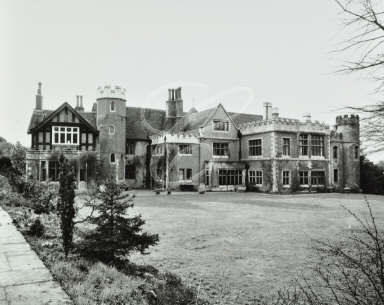
Built in the early 1500s, The Old Rectory is Wimbledon’s oldest house. Standing in grounds of 2.5 acres, this 16,200 square foot property was once described by a biographer of Sir Henry Cecil as being “not luxurious, but adequate” but now once again it finds itself in an entirely different league.
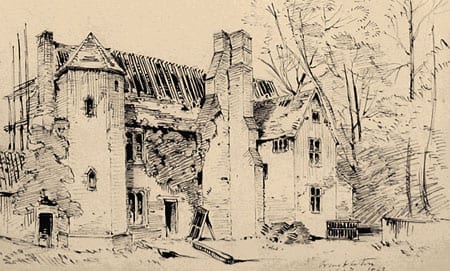
An image of The Old Rectory, 82 Church Road, Wimbledon, London, SW19 5AA in 1978. Present day imagery has been removed at the request of agents acting for the current owners.
Priced at £26,000,000, it is almost certainly one of the most expensive homes to ever come to the market in Wimbledon and whoever moves there next will undoubtedly be either an oligarch, an A-list personality or a top achieving business person.
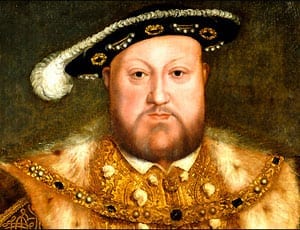
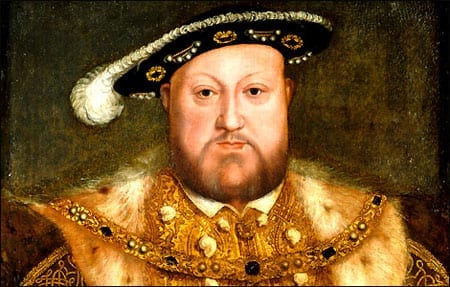
The purchaser will follow in the footsteps of a fascinating array of historically important residents, the first of whom was Henry VIII (1491 – 1547). The King took up residence in 1547 in the months prior to his death and is said, as he was so bloated, to have been unable to climb the stairs to his sleeping chambers. His bed was relocated to the great hall of the house and here he slept next to the fire. Historical research recounts that, with a brewhouse, beer and wine cellars, a coal cellar, meat room, buttery and two dairy rooms, this was a “house fit for a king.”
Henry VIII (1491 – 1547)Catherine Parr (1512 – 1548)
Henry VIII gave The Old Rectory, which was originally called The Parsonage House, to his sixth and final wife, Catherine Parr (1512 – 1548). Preferring a residence in Chelsea, Parr left and the Dean and Chapter of Worcester Cathedral took possession. A lease was sold to Sir William Cecil (1520 – 1598), later Lord Burgley, and the manor then passed to his son Thomas Cecil (1542 – 1623), the 1st Earl of Exeter.
In 1639, Charles I (1600 – 1649) bought the entire manor and gave it to Queen Henrietta Maria (1609 – 1669) but with the era of Comwell, The Old Rectory found itself occupied by General John Lambert (1619 – 1684). Shortly after, when a grander house was built next door, the property became first a laundry house and then servant accommodation and gradually fell into decline.
The Old Rectory passed next to Sir Theodore Janssen (1658 – 1748) in 1720. This French-born English financier, who was said to be worth the staggering sum of £250,000 at the time of his purchase of the house, was a founder member of the Bank of English but later disgraced for his part in the South Sea Bubble. He was expelled from the House of Commons and with his ruination, The Old Rectory saw yet another chapter of abandonment.
The garden front of The Old Rectory by Charles Henry Money Mileham (1837 – 1917)
By 1802, the house was described as an “uninhabited” ruin. A speculator credited with developing “modern Wimbledon” named John Augustus Beaumont bought it and restored and extended it but when it was sold to a Samuel Wilson in 1882 for £6,000, an era of truly comprehensive upgrades was to begin. Wilson added a pebble-dashed two-storey drawing room wing, carved oak doors and installed English, Flemish and Italian chimneypieces.
The next owner was a marine engineer named Matthias Jacobs who had been responsible for the construction of tunnels in Paris and New York. After having purchased The Old Rectory in 1909, he commissioned his brother to add a new single storey billiards room, a service wing and a study extension to mask the medieval chapel of the house. Jacobs sold up in 1923 to a Thomas Lethaby, who fitted oak paneling from Chantry House in Newark and a plaster ceiling based on the one at Knole House, Kent.
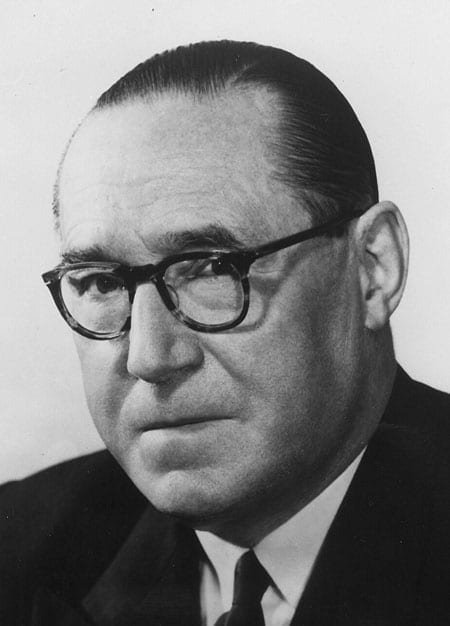
Lord Brock FRCS, FRCP (1903 – 1980)
In 1953, the eminent London surgeon and cardiologist, Lord Brock FRCS, FRCP (1903 – 1980), took possession of The Old Rectory after having paid £13,750 for it. Brock is credited as on of the pioneers of modern open heart surgery and also founded the Lord Brock Memorial Trust that to this day funds the museum he founded, The Old Operating Theatre Museum and Herb Garret in Southwark, SE1.
Following the death of his first wife Germaine Louise Ladavèze, Brock sold to an Iraqi entrepreneur and philanthropist named Basil Faidhi in 1978. Faidhi had fled Iraq for Britain and though he spent vast sums restoring the house with assistance from English Heritage, he also created a basement discotheque for his daughter, Nina, and a bar. Aside from bringing the house into the “yuppie era,” Faidhi also commissioned a historian named Richard Milward MA to write a history of the building in 1992 entitled: The Rectory – Wimbledon’s Oldest House.
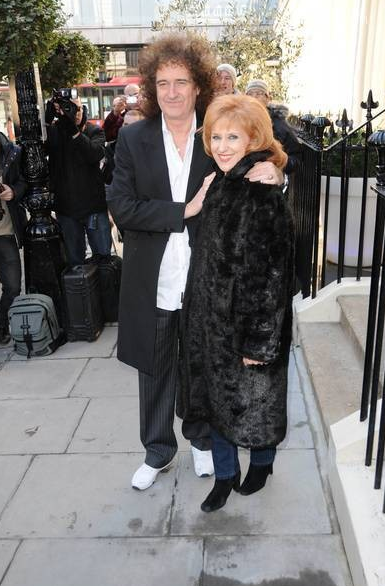
The Queen lead vocalist and anti-badger cull campaigner Brian May CBE purchased The Old Rectory in 1994 for £4,000,000 with the intention of living there with the Eastenders actress Anita Dobson.
Brian May CBE with his second wife Anita Dobson
Dobson, who didn’t marry May until 2008, had other ideas and refused to move in. It was suggested that she preferred a smaller house the pair occupied in Kensington and, at the time, a friend commented:
“[May] begged her to move into the new house so they can make a fresh start. Nobody can believe that Anita doesn’t want to be the lady of this fabulous house. But Brian says he can’t get through to her.”
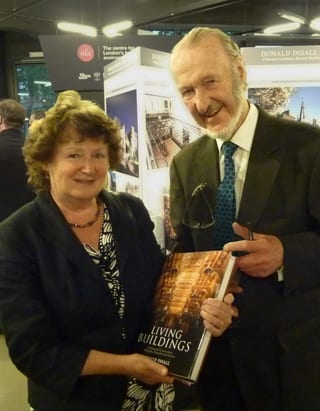
Sir Donald Insall CBE
As a result, May never properly moved into The Old Rectory and eventually decided to sell. In 2006, it achieved a record price of £16,000,000 and in the ensuing years, an Italian architect-owner named Antonella Carminati and her husband have lavished time and money on further restorations with the help of Sir Donald Insall CBE’s Insall Associates firm of architects.
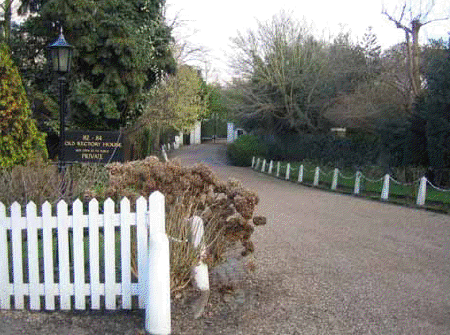
The driveway that leads to The Old Rectory from Church Road gives plenty of privacy
New fittings have been installed throughout and substantial extensions to the house have included a new kitchen and breakfast room with garaging beneath. The couple have demolished an early 20th century porch and an “unsightly” oak conservatory, remodeled the billiards room as a drawing room and removed a “bilious” blue swimming pool from the east lawn.
Now featuring 12,882 square foot of accommodation in the main house and 3,320 square foot of additional accommodation, The Old Rectory has been planned to include 8 reception rooms; a vast kitchen with La Cornue appliances and an adjoining breakfast room; master bedroom suite with two dressing rooms, his and her bathrooms and a sitting room and 7 further bedrooms.
Outside, the gardens feature an original medieval fig tree trail, shaded paths, lawns and a large pond as well as garaging for six cars. Planning permission for an indoor swimming pool complex has also been granted and ample staff accommodation is provided above one of the garages and in the gate lodge.
Given the now limited financial resources of the traditional religious houses of Britain, will it be rock, royalty or new money that next takes possession of The Old Rectory? The historians of Wimbledon will undoubtedly be watching.
The Old Rectory, 82 Church Road, Wimbledon, London, SW19 5AA is for sale through the Wimbledon office of Knight Frank. For more information call: +44 (0) 20 8946 0026.
A most curious tale of playboys, socialites, lawyers and real estate moguls
This week the mystery buyer of Clarendon Court, the former marital home of Claus and Martha “Sunny” Von Bülow (1932 – 2008), was revealed as a restaurateur and real estate mogul named Paul Roiff. Separately, the New York Post reported that Mr Von Bülow’s former lawyer, Alan Dershowitz, had purchased an apartment in Sutton Place, New York at the same time as a postal worker was on trial for killing his sister. The lives of the rich and famous are never anything other than dramatic.
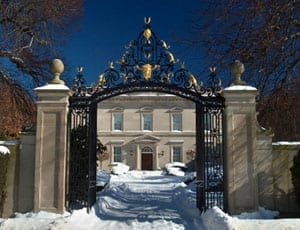
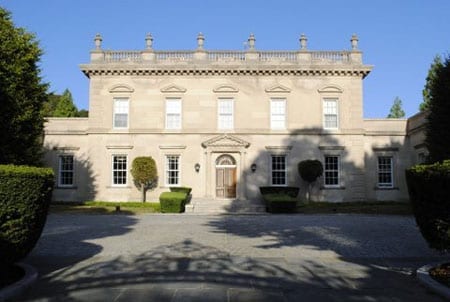
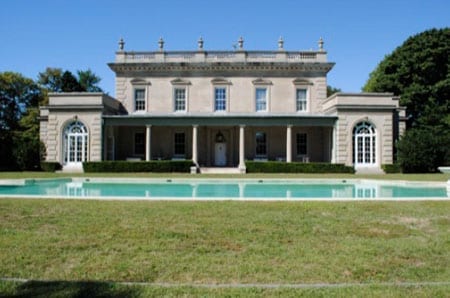
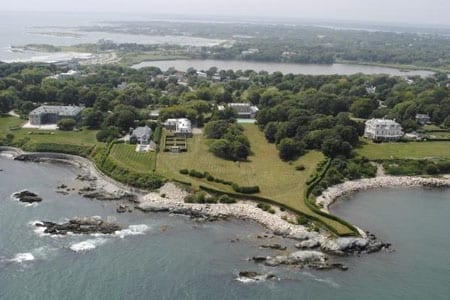
The front elevation of the former residence of Claus von Bulow: Clarendon Court, 626 Bellvue Avenue, Newport, Rhode Island, RI 02840The rear elevation of Clarendon Court, 626 Bellvue Avenue, Newport, RI 02840An aerial shot of Clarendon Court from the Atlantic Ocean
8-bedroomed Clarendon Court on Bellvue Avenue in Newport, Rhode Island is best known for the events surrounding the utilities heiress Martha Crawford Von Bülow falling into a 28-year coma there and her husband subsequently being tried, convicted and then acquitted for her attempted murder, but this fine residence has much else in its past as well.
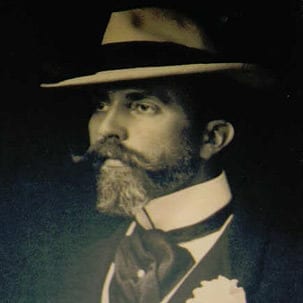
Edward Collings Knight, Jr. (1863 – 1936)
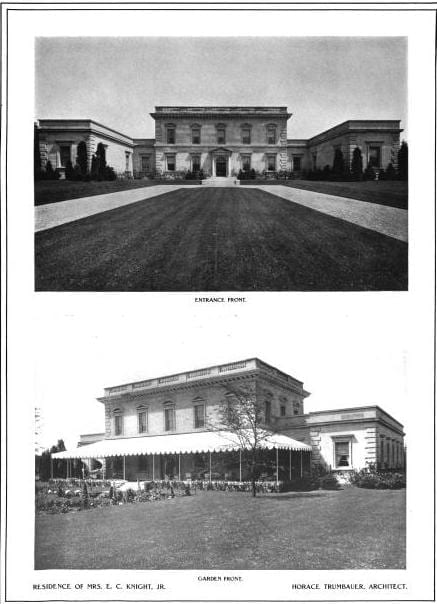
Designed by the most prominent Ameircan architect of the “Gilded Age,” Horace Trumbauer (1868 – 1938), this Palladian style villa was commissioned in 1903 by Edward Collings Knight, Jr. (1863 – 1936), a sugar-refiner and railroad executive, and his wife, Clara. It was built on an acre plot with views of the Narragansett Bay and is most curiously termed “one of Newport’s finest cottages.” The mansion that was constructed for the couple is an almost exact replica of a proposed house by Colin Campbell at Chester-le-Street in County Durham, England and features Doric columns, quoins and an urn-embellished balustrade. It provided a suitable illustration of Mr and Mrs Knight’s wealth and status.
Claradon Court in the early 1900s
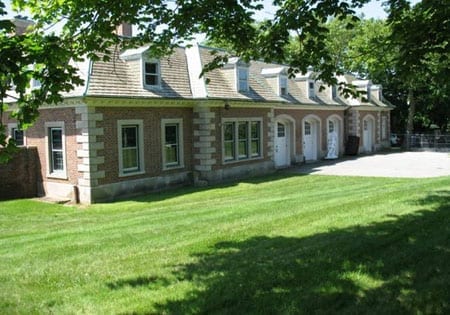
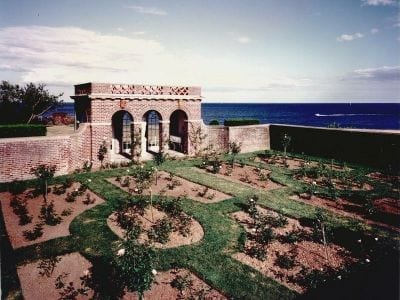
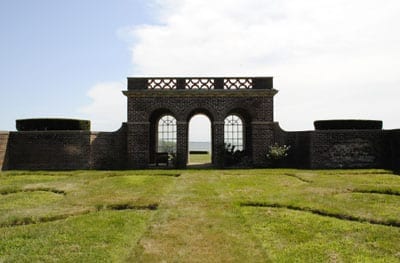
Edward Knight, who was once described as exhibiting “more talent at spending money than making it,” named the house Claradon Court in honour of his wife and shortly before it was completed in 1904, he acquired an additional six acres of land behind the plot with direct frontage to the Atlantic. Here, he had Trumbauer design a vast carriage house in an early Georgian vernacular as well as a series of high brick walls to protect the gardens from the ocean winds.
The coach house at Clarendon Court todayThe rear loggia was added by Mr & Mrs Knight at a later dateThis arch and walling was added to provide protection against the force of the AtlanticA more recent shot illustrates that the flower beds have been laid to lawn
The Knights engaged a Parisian decorator named Jules Allard to decorate Claradon Court in the English Georgian manner and after several seasons in residence added two wings onto the back of the house. Following Clara Knight’s death in 1928, her husband sold the estate, moved to a more modest Trumbauer designed house in neighbouring Middleton and remarried. His second wife, Marie Louise LeBel, is remembered as a “foul-mouthed, hard-drinking [woman], who thought nothing of killing a neighbour’s dog with a shot from her pearl-handled pistol.” Together they went on to spend the vast sum of constructing a $383,000 mansion in North Carolina as a hunting lodge. It is now the home of the Whalehead Club.
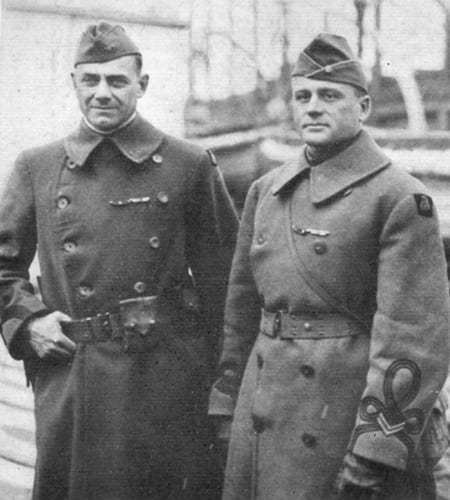
Colonel William Hayward with Major Arthur W. Little
The purchaser of Claradon Court was a First World War hero named Colonel William Hayward (1877 – 1944) and his wife, Mae (1880 – 1956). Whilst the colonel is remembered as the commander of the “Harlem Hellfighters,” a regiment that “never lost a man captured, a trench, or a foot of ground,” his wife was truly a character.
Born in Connecticut, Mae Cadwell had divorced her first husband Selden B. Manwaring of Hartford in 1914 to marry the older and richer Morton F. Plant of New York and New London, Connecticut. Morton Plant adopted her son by her first marriage, Philip “Paul” Morgan Manwaring Plant (1901 – 1941), and when he married the well-known actress Constance Bennett (1904 – 1965) in 1925 more controversy followed. The millionaire socialite Plant’s life is well documented not only as it was for him that the term “playboy” was originally created but also because of his bitter divorce from Bennett in 1929.
Following their purchase, Colonel and Mrs Hayward decided to have the name of Claradon Court changed to Clarendon Court to distance any lingering associations with Clara Knight and she is said to have filled the building with fine and decorative art. The colonel died in 1944 and his widow married for the fourth time, this time taking the president of the American Car & Foundry Company, John E. Rovensky, as her husband. After her death in 1956, Rovensky continued to use Clarendon Court until his own death in 1970 and even allowed it to be used as the set of the 1956 American musical comedy film High Society that starred Bing Crosby, Grace Kelly and Frank Sinatra.
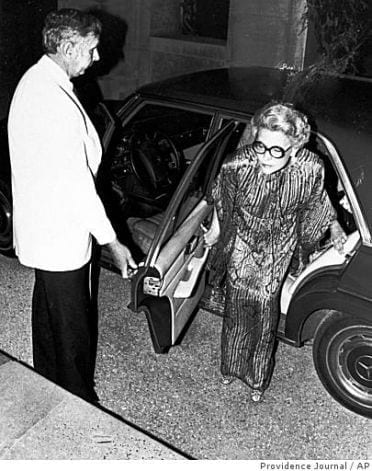
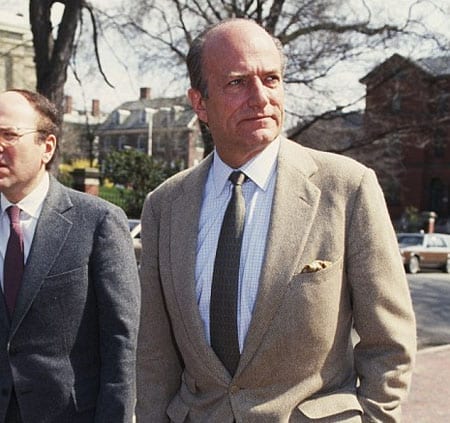
Martha “Sunny” Von Bülow (1932 – 2008)Claus Von Bülow during one of his trials
In 1970, Clarendon Court’s most notorious chapter commenced when the utilities heiress Sunny Von Bülow and her husband Claus purchased the house as it was here in December 1980 that Mrs Von Bülow fell into the irreversible coma that she was to remain in until her death in December 2008. The story of Claus Von Bülow’s trials for the attempted murder of his wife is well known and the 1990 film Reversal of Fortune, starring Jeremy Irons, Glenn Close and Ron Silver, is most definitely a true masterpiece.
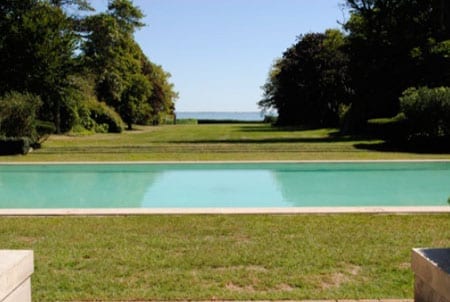
Considered a couple of “exceptional taste,” the Von Bülows were described as having filled Clarendon Court with exceptional 18th and 19th century English furniture. They also significantly improved the grounds by hiring the landscapers Innocenti & Webel to create an elegant allée to the sea by removing a hillock that had always deprived the ground floor rooms of an ocean view.
The Von Bülow landcaped the grounds to create a better view from Clarendon Court towards the Atlantic Ocean
In 1974, Claus Von Bülow wrote of Clarendon Court in an article for the Bulletin of the Newport Historical Society:
“The author of this article has lived happily at ‘Clarendon’ for the past four years. As a European he has found much to admire in Newport, with its sense of history and its preservation of a unique architectural heritage. He hopes some future writer will cover the occupancy of his family at ‘Clarendon’ with as much wistful charity as he has endeavored to extend to its previous owners.”
Von Bülow, at that time, plainly could not have imagined the tragic event that was to follow in December 1980 and for what the house would indeed become best known.
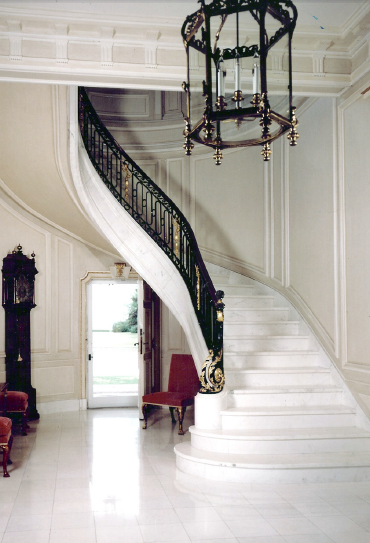
The main staircase at Clarendon CourtA study at Clarendon Court
A committee managing Sunny Von Bülow’s affairs sold Clarendon Court in 1988 to a fine art and antique dealer named Glenn C. Randall and his wife Patricia for $4,300,000. The couple converted the service wing into a gallery for their collection and lived there until Mrs Randall died after a battle with cervical cancer in May 2010. The 12,800 square foot house and it’s 10,000 square foot coach house were placed on the market for $17,800,000 in October 2010 and whilst the price was subsequently was brought down to $15,800,000, it languished until being sold in July 2012.
The new master of Clarendon Court, Paul G. Roiff, is a graduate of Boston University and Suffolk Law School. He is the president of a real estate company named Heath Properties and also co-owns a number of restaurants in Boston including Mistral, Mooo, Teatro and Sorellina as well as a 63-bedroom hotel named XV Beacon.
Paul G. Roiff
Plainly publicity shy, Roiff, who also owns homes in Florida and Michigan, used one of his employees, Keith Beardsley, to purchase Clarendon Court on his behalf. He paid $13,126,000 for the estate.
Celebrity lawyer Alan DershowitzAlan Dershowitz’s new pied-à-terre at 45 Sutton Place, New York, NY 10022, USA
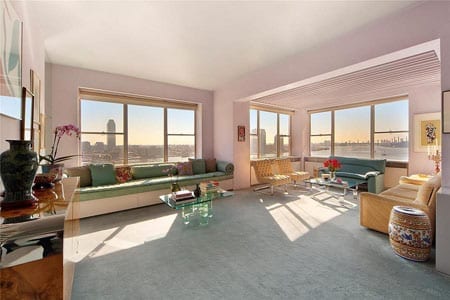
In another development, on the 25th September The New York Observer reported that the lawyer who became famous representing Claus Von Bülow, Alan M. Dershowitz, had bought a 3-bedroomed apartment in the “stronghold of old money,” 45 Sutton Place, for $1,680,000. Plainly Mr Dershowitz, who subsequently represented O. J. Simpson, has done well and is plainly now richer than his first “celebrity” client. He also owns a 6-bedroom residence in Cambridge, Massachusetts and was able to use his verbal talent to persuade the sellers of the Sutton Place co-op downwards from their original $2,290,000 asking price.
Separately, late last month, Dershowitz and his family were in court for the trial of a postal worker named Ian Clement. A 7-tonne truck driven by Clement had crushed and killed Marilyn, the 68-year old sister-in-law of Alan Dershowitz, in New York in July 2011. Dershowitz, a retired special referee for the New York court system, had been out for a bicycle ride with her husband, Nathan, a partner at Dershowitz, Eiger & Anderson.
Marilyn DershowitzThe scene of the fatal accident that killed Marilyn Dershowitz
Surprisingly and much to the distaste of the Dershowitz family, Clement, who had been charged with leaving the scene of a fatal accident, was acquitted by a jury on the 20th September. Of this, Alan Dershowitz commented:
“The facts clearly justified a guilty verdict… I think a stronger presentation might have brought about justice. Instead, we have an injustice.”
Both the Von Bülows and the Dershowitz family have endured loss and a huge amount of media attention since the events of the early 1980s. Perhaps these most recent moves will bring with them a new chapter for both Clarendon Court and Mr Dershowitz himself. Meanwhile, Claus Von Bülow, though not quite as wealthy as he was in his days at Clarendon, prospers in London and is considered one of the city’s “finest wits.” How fortunes do indeed revolve.
Contact Alan M. Dershowitz at: Hauser Hall 520, 1575 Massachusetts Avenue, Cambridge, Massachusetts, MA 02138. Telephone: +1 (617) 495-4617. View his official website at: http://www.alandershowitz.com/or follow him on Twitter at: http://www.twitter.com/alandersh
The agent for Glenn C. Randall in the sale of Clarendon Court was Paul Leys of Gustave White who can be contacted on +1 (401) 848-6706 or by email at:[email protected]
Could 100 Park Lane become the property that achieves the accolade of being Britain’s highest priced private residence?
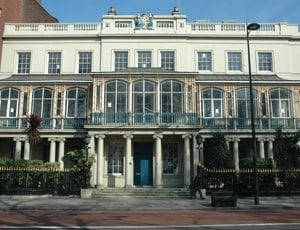
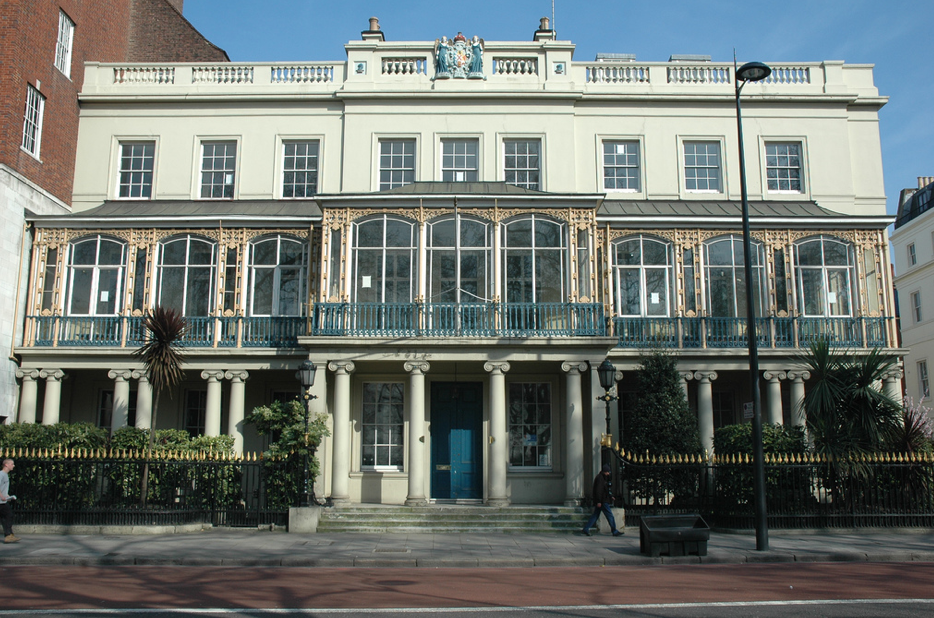
Occupied by property giants Hammerson since 1969 as their corporate headquarters, the 44,000 square foot Grade II* listed Dudley House is one of Park Lane’s finest landmark properties. It is supposedly about to come to the market as a single-family residence and a price of up to £250,000,000 could be achieved.
The Park Lane façade of Dudley House, 100 Park Lane, Mayfair, London, W1Y 4AR
Dudley House, the only remaining example of an early Park Lane mansion, is named after the Dudley Ward family and built on the site of an earlier house with stabling. The site was acquired by John, 6th Baron Ward, in 1742 but it wasn’t until 1759 that the 3rd Viscount Dudley and Ward began “judicious alterations” to the house. Having paid £6,510 at auction for his late half-brother’s interests in Dudley House, he added an entrance portico and stained glass windows whilst his successor, an ”eccentric intellectual and politician,” set about turning the building into “the most pleasing object in the vicinity.”
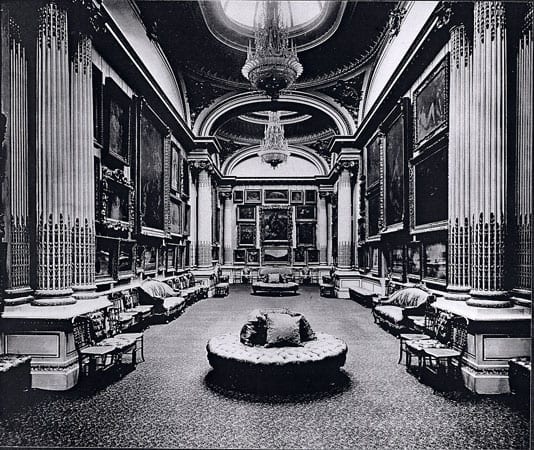
Works by the architect William Atkinson, carried out between 1827 and 1829, included a screen of Ionic columns, fine ceilings and gilded plasterwork. They remain to this day but it is the 1855 alterations of Samuel Whitfield Daukes that are truly impressive. Carried out on the instructions of the 1st Earl of Dudley, these included a magnificent 80ft picture gallery designed to showcase a collection of Italian and Flemish paintings and a vast 50ft ballroom.
The picture gallery at Dudley House
In 1895, Dudley House, which is situated at 100 Park Lane, briefly passed out of the Dudley Ward family and into the ownership of a “hard-headed South African mining magnate” named Sir Joseph Benjamin Robinson. Sir John Hubert Ward bought the building back in 1912 for £10,000 and remained there until his death in 1938.
Wartime bombing caused significant damage and this was not repaired until Hammerson took over Dudley House. Having hired Sir Robert McAlpine and Sons as contractors, designs by Sir Basil Spence and Anthony Blee were executed to restore the building. Hammerson remained there until 2006 when they jointly sold the leasehold interest on the house with freeholders Grosvenor for £37.4 million to Bristol Isles Ltd., a private investment company controlled by Sheikh Hamad bin Khalifa Al Thana, the emir of Qatar.
His Highness Sheikh Hamad bin Khalifa Al Thani (1952 – )
The ensuing renovation, directed by the designer Alberto Pinto, has been described as “tasteful” and is said to have cost some £75 million. The resulting air-conditioned home features some 17 bedrooms and 14 reception rooms.
It’ll be fascinating to see who “Doesn’t pass go!” and purchases this mammoth mansion (if indeed His Highness Sheikh Hamad bin Khalifa Al Thani decides not to move in himself).
This billionaire businessman started out in medicine but soon moved into commerce realising that enterprise would better provide for his family. He was imprisoned on falsified charges of contract murder for 11 months in 1996. Subsequently cleared, Rybolovlev then went on to make his fortune in potassium and banking. This divorced father of two has used his fortune to fund the restoration of many of Russia’s churches and also bought Donald Trump’s former residence, The Masion de L’Amitie in Palm Beach, Florida, for $95 million in 2008. This risk taker also parted with another $88 million in December 2011 to purchase New York’s most expensive apartment for his 22-year old daughter. Rybololev’s passions are surfing and 19th and 20th century art.