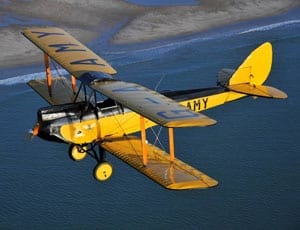
Tag: 1945

  • A Gipsy flies

    A Gipsy flies

    The story of a 1929 bi-plane with a truly fascinating pedigree


    Britain’s best-known wartime Prime Minister piloted a Gipsy Moth aeroplane that will be sold by auctioneers Bonhams in February 2013 at a guide of £120,000. The same craft was also featured in an iconic 1980s film and was also supposedly flown by a member of the Fiennes family who mysteriously disappeared in 1998.
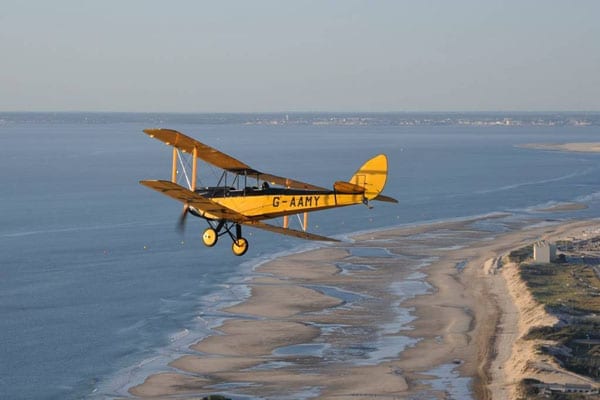
     

    The 1929 De Havilland DH 60 GMW Gipsy Moth bi-plane G-AAMY that will be sold by Bonhams at the Grand Palais in Paris in February 2013
    Sir Winston Churchill (1874 – 1965)

    Piloted several times by Sir Winston Churchill (1874 – 1965) and used in the Oscar award winning Out of Africa, this 1929 De Havilland Gipsy Moth bi-plane is 24-foot long and has a 30-foot wingspan. It is capable of a maximum speed of 105mph and “wears” a yellow and black livery. It’s registration is G-AAMY in homage to the pioneering English aviatrix Amy Johnson (1903 – 1941).


    In the film, the plane was flown by Robert Redford but though the life of the big game hunter Denys Finch Hatton he played is intriguing; the exploits of Redford’s aviator double are just as fascinating a story.
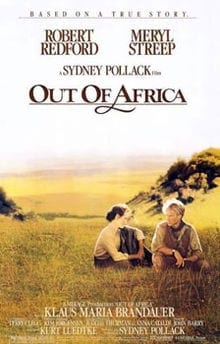

     

    Sydney Pollack’s “Out of Africa” (1985) starred Robert Redford and Meryl Streep
    Tom Danaher pictured whilst filming with Mel Gibson

    Few outside of the aviation world will have heard of Tom Danaher (1929 – ) but aside from Out of Africa, he’s pretty much done it all. After graduating from a high school in Dallas in 1941, he became a Marine Corps fighter pilot. Stationed on Okiwana in August 1945, he shot down the last Japanese bomber on the final night of the Second World War and also made history, aged 21, for downing three other Japanese “Betty” bombers in the eight nights before the ceasefire.


    Recalled to active service in 1951, Danaher flew one of the earliest jets, the F3D Skynight, with the Marines in Korea on night combat patrols and then was part of the last combat mission on a high altitude bombing strike over Pyongyang, North Korea in July 1953.


    Danaher’s passion for flying continued after the war and in 1954 he flew his own plane, a 1948 Bonanza, to England to visit friends he’d made from the RAF whilst in Korea. To make the journey, he built a 109-gallon auxiliary fuel tank so that he could fly straight across the Atlantic. On the way home he called in for an audience with Pope Pius XII in Rome.
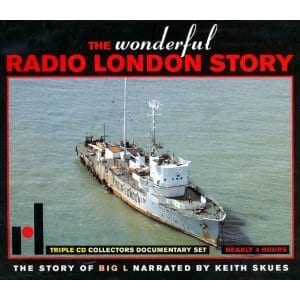
     

    The surplus Second World War minesweeper from which Wonderful Radio London operated in the 1960s

    Danaher’s visits to England led to him becoming involved in a pirate radio station in from 1944 to 1967 named Wonderful Radio London. Like many others, Danaher was not impressed by the BBC’s monopolistic attitude to radio programming and so helped build a 17,000-watt station on a surplus Second World War minesweeper. It was anchored three and a half miles off the English coast and outside of Britain’s territorial limit. Of the experience, Danaher told Airport Journals:


    “We had someone in Dallas who would record KLIF, a top 40 station, and we put it right on the air… The Englishmen over there just ate it up… The station programmed news and top 40 music and was very successful. It had the largest listening audience of any of any commercial broadcast station at the time.”


    Back in America, Danaher owned three car dealerships in Wichita Falls, Texas but sold them in 1972 to open his own airport, the Tom Danaher Airport. Lake Wichita Airport (7TXO), as it was also known, kept the aviator busy but he has also piloted in films numbering Empire of the Sun, Sky Bandits, Air America, Bad Medicine, The Pleasure of Love, White Hunter Black Heart, Cliffhanger and Goldeneye.


    In 1985, Danaher was recruited to fly Gipsy Moth G-AAMY by Sydney Pollack (1934 – 2008), the American director of Out of Africa. He recounted his six week experience on set in Masai Mara, Kenya in an interview for his local Texan newspaper, the TimesRecordNews, in 2008. Here, he highlighted the problems of trying to film with a vintage plane that “has no brakes and is difficult to steer”:


    “Robert Redford couldn’t make the thing turn. It took considerable finesse to turn it on the ground… The third time, he gave it full throttle… The left wing contacted a thick thorn bush and it tore some of the fabric off the lower left wing of the plane. We couldn’t fly it the rest of the day.”


    Other dramas arose with G-AAMY in terms of Meryl Streep’s body double refusing to fly in it and the craft struggling to reach the high altitudes necessary to film a sweeping shot of the plane flying past a waterfall. Danaher took charge stating: “If I can get a piece of string and a ruler, I can fix this.” He found just such, cleverly installed them and Pollack: “got every single shot he wanted.”
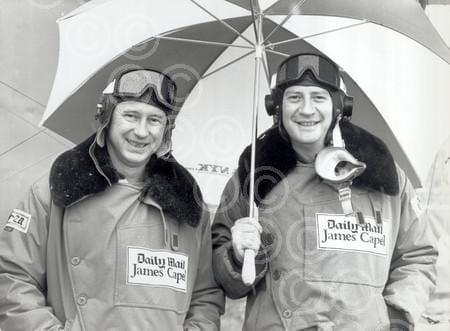
     

    Pilot Roger Fiennes (1944 – 1998) pictured with Alexy Zaitov during the 1989 Glasmoth project expedition to Moscow and back

    Another person to have piloted the Gipsy Moth G-AAMY, according to a comment left in the PPRuNe Professional Pilots Rumour Network forum, was a man named Roger Fiennes. Whether this “rumour” is true or not, the cousin of the actor Ralph Fiennes and the explorer Sir Ranulph Fiennes, is another character with a flying history as fascinating as his true family name – which turns out to be “Twisleton-Wykeham-Fiennes” when presented in full. Of why he did not use this lengthy and historic surname, Fiennes is said to have once commented:


    “You try writing that signature on a 6 foot long cheque book.”


    Fiennes flew many hours in a variety of planes and one of the best documented was an expedition supported by the Daily Mail from White Waltham Airfield in Berkshire to Sheremetyevo Airport in the Soviet Union in April 1989 and back. He flew one of three Tiger Moth bi-planes with a Russian navigator named Alexy Zaitov. The journey took three weeks to complete, involved 33 perilous stops and covered 5,000 miles.


    On 19th April 1998, Fiennes was piloting a 1941 DH82A Tiger Moth, G-BALX, from Dieppe to Headcorn Aerodrome in Kent but he failed to reach his destination. The Air Accidents Investigation Branch (AAIB) report into the disappearance concluded:


    “Although the pilot contacted Paris Information by radio, in the absence of a specific request, the flight plan was not activated. Lashenden was therefore unaware of the flight’s departure and ETA. When the aircraft was reported missing overdue action, and the subsequent Search and Rescue operation, which was activated on the morning of 21 April 1998. Since then there has been no sign of the aircraft or pilot.”


    Articles at the time and forums since are sparse in detail but several forum posters and articles suggest that Mr Fiennes had “mounting debts and a string of business collapses.” Whilst some go as far as to suggest a “Lord Lucan” style disappearance and make references to “paddling canoes” and “check[ing] the Panamanian register,” others remember a “nice guy, sadly missed.” Whatever really happened that fateful day, though, will probably never be solved.
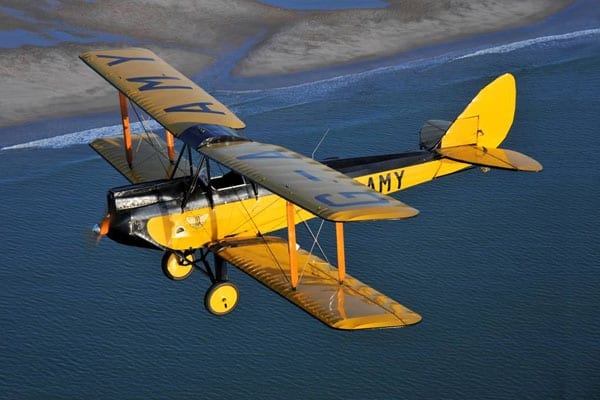
     

    Another image of Gipsy Moth G-AAMY

    G-AAMY, which was marked G-AAMT for the filming of Out of Africa, is a plane with a remarkable past. We suspect there’ll be a few more dramas for this craft yet.

    The 1929 De Havilland DH 60 GMW Gipsy Moth bi-plane G-AAMY will be sold by Bonhams at the Grand Palais in Paris, France sale during Rétromobile week (6th to 7th February 2013). For more information telephone +33 1 42 61 10 11 or go to: http://www.bonhams.com


    To learn more about Tom Danaher’s experience flying G-AAMY in Out of Africa, read the full TimesRecordNews report by Lara K. Richards at: http://www.timesrecordnews.com/news/2008/jun/08/fly/?print=1


    To read the AAIB account of the disappearance of Roger Fiennes and DH82A Tiger Moth, G-BALX, go to: http://www.aaib.gov.uk/cms_resources.cfm?file=/dft_avsafety_pdf_502449.pdf


     

  • Cows don't wear Rolexes

    Cows don't wear Rolexes

    Charles Mitford Cust asks: “Do the clocks really need to go back?”


    Yesterday, once again, the clocks went back and now we are officially in winter. As is always the case on this sad annual occasion, I am left asking myself why we have do something so apparently illogical and what are the origins of this extraordinary ritual.


    These “hairy beasties” definitely govern the clock rather than being governed by it


    I used to think it all started in World War Two but, in fact, having done some research, it transpires that we very sensibly did the exact opposite during the war years. Between 1940 and 1945 and also in 1947, we actually switched to “British Double Summer Time” (BDST). Why? We did so to save precious fuel as it was in limited supply. That should strike a chord today, don’t you think?


    You bet it should. Supporters of BDST point out that 500,000 tonnes of CO2 would be saved this year if instead of putting the clocks back yesterday, we’d left them alone and then put them forward one further hour in the spring, thereby achieving British Double Summer Time (BDST). Half a million tonnes of CO2… Wow! That is the equivalent of permanently removing 185,000 cars from the road. Hang on, aren’t we meant to be concerned about the environment these days or am I missing something?


    Where are the eco-warriors? Surely they should be screaming from the rooftops about CO2 savings like this. This makes all their bleating about wind turbines and solar panels seem stupid. Unlike these alternative energy sources, which we all know are only viable thanks to taxpayer subsidies, putting the clocks forward is free, and you can’t get anything greener than a free CO2 reduction. Yet strangely there is barely a whisper from the normally most vocal section of the green orchestra. Now, I am no conspiracy theorist, but I cannot help but feel that this is highly odd if not darn right suspicious.


    There have always been myths concerning BDST, including strong if vague references to the requirements of farming being the reason for us being plunged into darkness earlier than necessary. This is something that, as a countryman, I have always found puzzling.


    Farmers do not rely on the time indicated on their watches to go about their business. They do what their ancestors have done for thousands of years: they operate from first light to last light. The time that happens to be recorded on a watch face is all but irrelevant to them because unlike 90 per cent of the population, they do not have to catch trains or commute to work. What’s more, cows don’t wear watches, they just know when they want to be milked and they don’t care what Mr Rolex has to say about it.


    Interestingly though, even this well used excuse seems to have been run off the road. In March 2010, in a survey of their membership, the National Farmers Union found that most respondent farmers were neutral about BDST and actually the only strong representation was from members supporting longer daylight in winter.


    Another long-term excuse is that children in the north of Britain would be in more danger walking to school in the mornings if it were dark. “Walking to school?” When was the last time a kid walked to school in this country? 1951? Seriously though, with traffic density as it is today, no responsible parent would let their child walk to school even if they could do so. As Lord Archer has pointed out, this is outdated nonsense and therefore not a viable excuse for rejecting BDST.


    The Royal Society for the Prevention of Accidents (RoSPA), the RAC and the AA have campaigned for years to reintroduce BDST as they argue that police accident records clearly indicate that more accidents occur in the dark evenings during rush hour when tired commuters are returning from work than when they are fresh in the mornings. According to their research, they estimate 600 lives per year could be saved. 600 lives: that’s the equivalent of a bloody massacre. The government moved heaven and earth to ban competitive handgun target shooting when 30 people were killed but have routinely ignored 600 lives per year for decades? What are these politicians doing?


    A Conservative Member of Parliament, Rebecca Harris, put forward the Daylight Saving Bill 2010-12. It was debated in November 2011 and January 2012, but despite being supported by “Call Me Dave” himself, it was filibustered out of Parliament by largely Scottish based members who argued it would disadvantage Scotland.


    These politicians used this argument despite a 2010 survey of 3,000 Scots indicating that they were actually in favour of BDST. I guess Scots like to save money on their heating bills too: oh, there’s a surprise. Anyway, the efforts of these objectors were enough to ensure that the bill’s time was used up and it will now proceed no further.


    What? That’s it? 500,000 tonnes of CO2 and 600 lives a year swept under the carpet because a couple of whingeing Scottish MPs are out of touch with their the views of their own constituents? Does that sound right to you? Even if they didn’t vote for BDST, which with fuel prices the way they are, being canny Scots, they almost certainly would, why can’t Scotland have it’s own time zone? Many of them want independence, so here’s a good start. As an aside, evidence also shows that if Scots did adopt BDST, their suicide rate would drop dramatically as the statistics show this is clearly linked to long dark winter nights.


    Either way, we have reached a point where political correctness simply has to be outweighed by common sense. You cannot let 85 per cent of the UK population suffer for the sake of the other 15 per cent. What of the adverse affect this is having on GNP at a time when the economy is struggling so much?


    The thing about this clock moving business is that the more you search for answers, the more questions you are left asking. One is forced to conclude that it is either a deeply sinister conspiracy involving multi-billion pound energy companies who would rather we carried on paying for an extra half a million tonnes of unnecessary smog, or simply an old fashioned British farce of monstrous proportions.


    All in all, I’m left rather perplexed. What’s your view? Isn’t it time that something changed?